The Yeatman Hospital, Weldmar Hospicecare and Cruse Bereavement Support will once again join together for the Sherborne Snowdrop Remembrance and Thanksgiving Service in 2026, hosted by Sherborne Churches Together.
This year’s service will take place on Friday 6th February at 11.15am at the Church of the Sacred Heart & St Aldhelm, Westbury, Sherborne (DT9 3RA). Everyone is warmly invited to attend, to gather in remembrance and give thanks for the lives of loved ones. The snowdrop is a traditional symbol of hope – appearing at the end of winter and signalling the promise of new beginnings. The service offers a chance for quiet reflection and shared comfort, acknowledging the ongoing journey of grief. Staff from all three supporting organisations will take part in the service, and it will be followed by a chance to talk over refreshments. The Sherborne Book of Remembrance will also be available, and attendees will have an opportunity to add the name of someone they wish to remember. For further details, please contact Reverend Lesley McCreadie on [email protected] or call 01963 210548
Jane Adams is looking for a rare woodland phenomenon: something fleeting, beautiful and unexpectedly personal
The rare hair ice pehenomenon happens only in precise atmospheric conditions, and is caused by the fungus Exidiopsis effusa
My mum had the most beautiful snow-white hair. Touch it, and it felt like pure silk. I’d never heard of hair ice, but when I saw a story about it on a Devon Wildlife Trust Facebook group – with a photo of ice growing like hair from a rotting piece of wood – it reminded me of Mum’s silken locks. Ever since, I’ve dreamt of finding some. So, on a chilly winter morning, I wrap up and go in search of this ethereal phenomenon. What’s all the fuss about a bit of ice? Well, this is no common-or-garden ice. Oh no! It looks like flowing white hair growing from a fallen branch – sometimes as much as 15cm long. Hair ice only forms on decaying broadleaf wood during damp, still weather when the temperature is just below freezing. As well as depending on exactly the right atmospheric conditions and the correct type of decaying wood, it also needs the help of a particular fungus. Ordinarily, when there’s water in dead wood, it gets pushed along tiny channels to the surface, where it might form ordinary frost or ice crystals. But with hair ice, it’s thought that when the fungus Exidiopsis effusa is present, it releases substances – most likely proteins – that stop the water from forming a solid mass. Instead, each icy strand freezes individually, forming fine, silky filaments. It’s still dark when I reach my nearest deciduous woodland. As dawn lightens the sky, I scan each rotting branch, squatting down to turn some over, cold and wet to the touch, even through gloves. As I do, the disturbed ice-rimmed leaf litter releases a full-on whiff of earthy goodness, a feel-good scent if ever there was one, and a robin sharply ticks an alarm above me.
Look for it on still mornings when the temperature is just below freezing – it only occurs on moist, dead, broadleaf wood
Within half an hour, the sun breaks weakly through the skeleton branches of the trees, and all hope of finding hair ice is gone. Even a weak sun will melt it in seconds. I may not have found hair ice today, but there will be other times. Winter has a way of hiding its most magical wonders – especially ones this rare – but one wintry morning, in the right patch of shaded woodland, I’ll find it. And I will be reminded of Mum, who would have loved to have seen it.
As home technology grows more complex, Matt Renaut argues that experience, control and local accountability are what keep Dacombes of Wimborne relevant
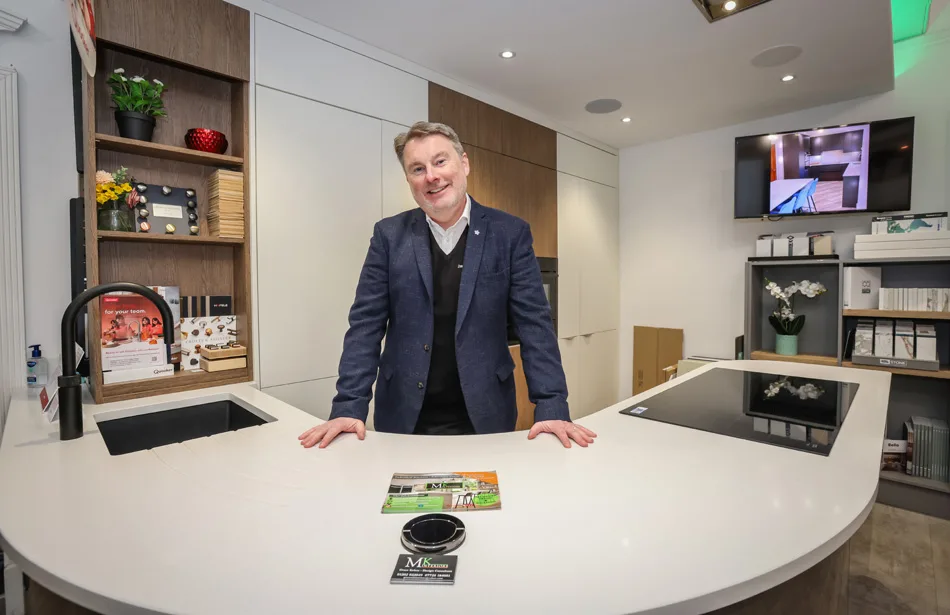
Matt Renaut in Dacombes award-winning kitchen area
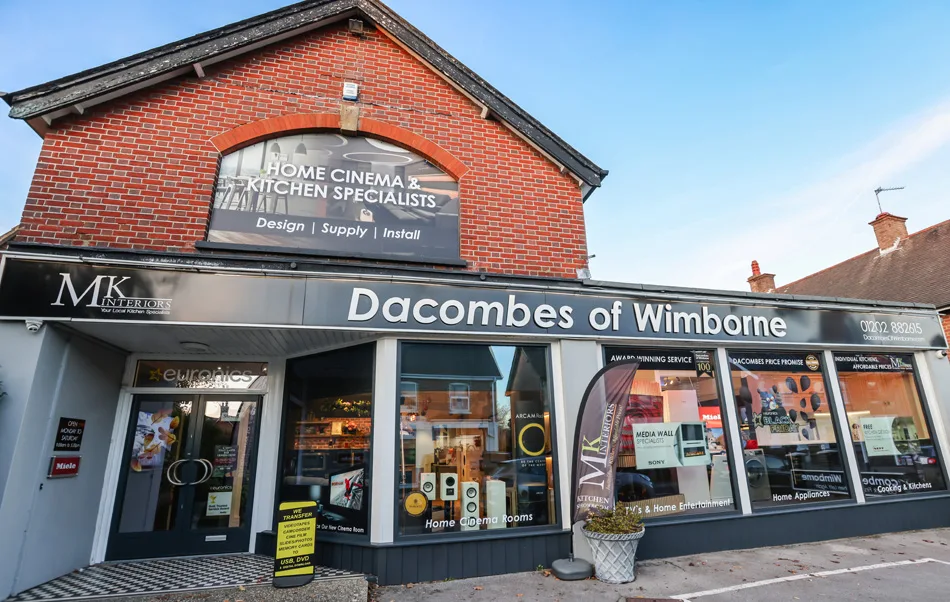
When Matt Renaut talks about what sets Dacombes of Wimborne apart, he doesn’t reach for nostalgia, despite the business being part of the town for more than a century. There’s no talk of ‘the good old days’ or doing things the way they’ve always been done. Instead, he talks about experience and what happens after the sale. ‘We like to deliver all of our products in our own vans and install them properly,’ he says. ‘That way we’ve got control. If something goes wrong, we know exactly what’s happened and we can sort it.’ It’s a practical mindset that runs through the family business Matt now manages – and the store today has evolved far beyond simply selling televisions or washing machines. The focus is now just as much on audio-visual systems, media walls, home cinema rooms and integrated home technology as it is on domestic appliances.
Post-war Dacombes selling bikes, with radios and baby carriages advertised outside Image: Museum of East Dorset
Maintaining trust The company itself has deep roots. In 1923 Mr E.T. Dacombe opened a business in Wimborne, selling prams, household goods, and later offering accumulator battery charging for early radios, as not every house had electricity. Televisions followed, and when Ralph Dacombe joined his father’s business after the war, the business became the first in the area to rent TVs – a necessary addition built on reliable, fast service at a time when sets were temperamental and technical support mattered. When Ralph retired in the 1980s, the business was taken over by the chief service engineer John Lodge. Looking to retire in the late 1990s John offered the business to John Renaut, Matt’s father. John and his wife Carole, with help from their family, set about bringing the business up to date. John saw technologies arrive, peak and disappear again, and learned early that survival depended on adapting without losing trust. ‘You either move with it or you don’t last,’ he says. ‘People don’t forgive technology that doesn’t work – or businesses that disappear once they’ve taken your money.’ That emphasis on service has been steady through every chapter of the business. Matt joined the family firm in 2000, having already had a career with national retailers and a background as a trained engineer. ‘I’ve always been on the technical side,’ he says. ‘Understanding how things work, how they should be installed, how to fix them – that’s still at the heart of what we do.’ A significant turning point came with the move away from the traditional high-street shop into a larger, purpose-built showroom just outside the town centre. It was a considered decision – and a calculated risk – to give the business something it simply couldn’t achieve before: space. ‘We wanted to be a destination store,’ Matt says. ‘Somewhere people could come, park easily, sit down, take their time and actually experience the technology we’re selling.’
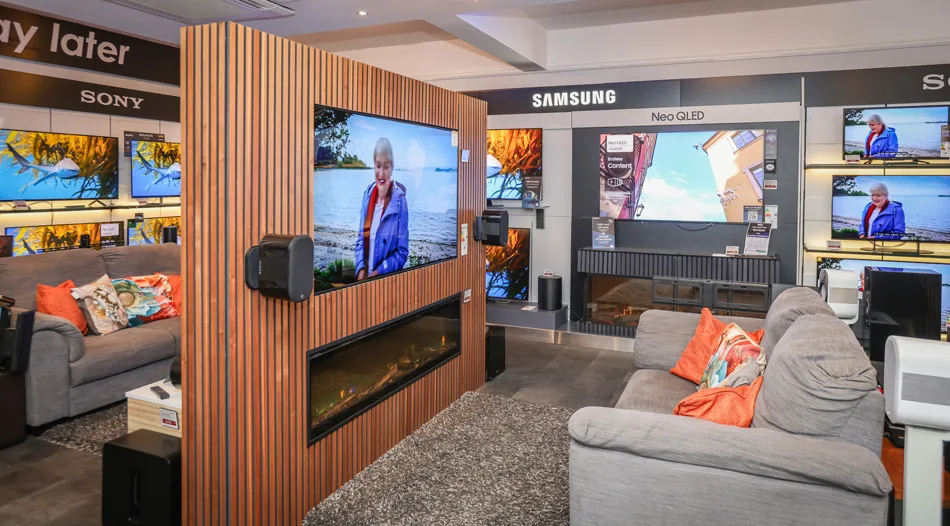
The Dacombes showroom is laid out as a series of living spacesMatt Renaut (left) with his dad, John Renaut, in the Dacombes showroom – image Courtenay Hitchcock The BV
Changing homes Instead of rows of boxed products, the showroom is laid out like a series of living spaces. Screens, sound systems, lighting and furniture are set up as they would be in a home. Customers are encouraged to sit, watch, listen and compare. ‘We don’t tell customers what things can do – we show them,’ Matt says. ‘That’s when it clicks.’ That approach has proved particularly effective as home entertainment has become central to how people live. Media walls, integrated sound systems and dedicated cinema rooms now make up a growing part of the business, often designed collaboratively with a customer around how they actually use their home. ‘People are staying in more,’ Matt says. ‘If you’re not going out every weekend, you want your home to work harder for you. That might be a media wall in the lounge, or a spare room turned into a cinema space. It doesn’t have to be extravagant – it just needs to be done properly.’ That word – properly – comes up often. For Matt, it applies equally to high-end installations and everyday appliances. ‘If someone wants a washing machine, that’s fine,’ he says. ‘We do those too! The point is, whatever someone buys, they get the same level of service, delivery and backup.’ Price, he says, is often misunderstood. As part of Euronics, one of Europe’s largest buying groups, Dacombes can compete directly with national chains and online retailers. ‘We wouldn’t still be here if we weren’t competitive,’ he says. ‘Sometimes we’re even cheaper overall, especially once you factor in the delivery, installation and support we offer.’
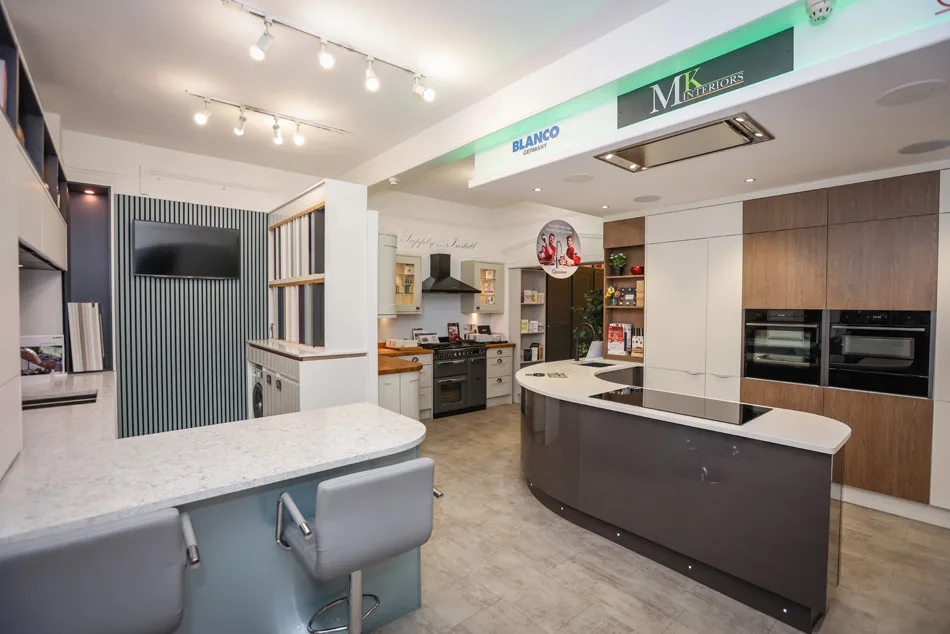
Once a month, Five Loaves Bakery, a local charity, uses the kitchen showroom to bake together
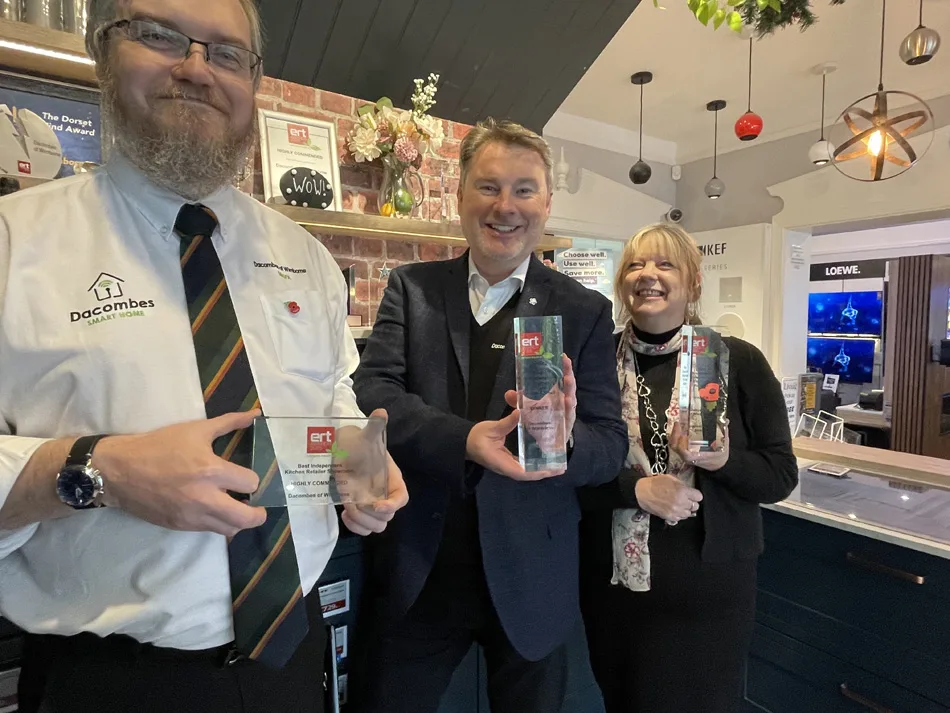
Make sure you get it right Support is where the difference becomes most obvious. Warranties are registered in-house. Serial numbers are recorded. Even years later, if a customer calls with a problem, the details are already there. ‘You’re not dealing with a call centre,’ Matt says. ‘You can probably talk to the person who sold or installed the product.’ That approach has not gone unnoticed within the industry. National recognition first came in 2016, when Dacombes won its first major industry award at an event in London. More recently, the business has picked up multiple honours at the ERT Awards – widely regarded as the UK electrical retail industry’s ‘Oscars’ – including being named Best Sustainable Independent Electrical Retailer and also Best Independent Consumer Electronics Retailer (Small Business).
A trio of awards for Dacombes of Wimborne – Mark Winton with Matt Renaut and Helen Potter. Image: Tracie Beardsley
Judges cited the company’s environmental strategy, technical expertise and consistency of service in a sector increasingly dominated by national chains. They were also particularly impressed by the fully working in-store kitchens. These were designed to showcase modern kitchen technology, but Matt offers them free of charge to local community groups for cookery classes and events, reinforcing the idea that the building is a shared asset, not just a showroom. Once a month, Five Loaves Bakery, a local charity supporting people experiencing loneliness and isolation, uses the space to bake together using locally sourced ingredients, with the baked goods sold to raise funds for the charity. ‘We’re part of the community,’ Matt says. ‘So we try to do things that make sense, long term.’ That includes supporting local events. Dacombes sponsors Wimborne Folk Festival and Wimborne Green Festival, and is a main organiser and sponsor of Wimborne Food Festival, alongside backing the town’s flower festival and many other local charities. The business’s sense of local responsibility was reinforced in 2025, when Dacombes welcomed the Holmans business into the fold. The merger brought another long-established independent Wimborne retailer and its team under one roof, ensuring continuity of service for long-standing customers. And that continuity matters to the Renauts. John is clear about the responsibility that comes with trading in the same town for more than a century: ‘You see people in the street and in the supermarket,’ he says. ‘If something’s gone wrong, you soon hear about it. So you make sure you get it right.’
Electric future Looking ahead, the direction is clear, and the building itself reflects similar thinking. The roof is fitted with 100 solar panels, backed by battery storage. From May to September, the business runs entirely on its own generated power. Two EV charging points are already installed on site, and infrastructure is in place for electric delivery vehicles in the Dacombes fleet. Appliances remain important, but the future lies in integrated home technology – kitchens designed around appliances, living rooms designed around sound and vision, and homes where systems work together seamlessly. ‘It’s been 25 years, and I’m still enthusiastic,’ Matt says. ‘There’s a lot more we can do, and a lot of people don’t yet realise what’s possible in their own homes.’ Dacombes is a business shaped by a century of change, but it is firmly focused on what comes next – modern, technically confident and deeply rooted in the place it serves.
Salary: Up to £30,000 depending on qualifications and experience
Contract type: 52 weeks a year Hours of Work: Full time, 40 hours per week Contract term: Permanent Start date: March 2026
We are seeking to appoint Early Years Practitioners to join Clayesmore Nursery. This is an exciting opportunity to join, work in and shape the setup and development of our nursery, creating a nurturing and inspiring environment for young children.
Nestled in the picturesque Dorset countryside, Clayesmore is a vibrant community where students thrive both academically and personally. Our dynamic curriculum, both inside and outside the classroom, creates a buzzing atmosphere teeming with possibilities. From outstanding academic achievements to personalised support in our renowned learning department, we ensure success at every level. Opening in early 2026, the nursery at Clayesmore will extend the excellent offering to our youngest pupils.
As an Early Years Practitioner, you will play a pivotal role in launching and growing our nursery, joining a team of dedicated staff, and embedding our vision and best practices. We are looking for passionate staff to take this journey with us. We would welcome applications from experienced Early Years Practitioners as well as those who have recently qualified.
If you are able to demonstrate the following, we would welcome your application:
• Level 2 or 3 qualified in Early Years. • Able to inspire our pupils with enthusiasm and a love of learning. • Have a sound knowledge of the requirements of the Early Years curriculum. • Able to plan and prepare engaging and stimulating activities for pupils or every ability. • Able to positively impact pupils in every aspect of their education including pastoral care. • Able to encourage learning and development, through play and teaching. • Can create a secure environment, using imagination to help children to learn. • Can work with parents and carers to support their children. • Enable children to build their literacy, language and numeracy skills. • Monitor progress to enable planning. • Put together activities which will keep the children engaged throughout the day.
This is your chance to play a key role in the launch of an exciting new nursery. With the support of the manager and the Inspired Learning Group, you will have the opportunity to grow professionally and make a positive impact in young children’s lives.
If you are an experienced or newly qualified practitioner ready to take on a rewarding new challenge, we look forward to your application. Please apply by visiting https://www.clayesmore.com/work-for-us
Interviews will take place on a rolling basis, as applications are received.
Clayesmore School is totally committed to safeguarding and promoting the welfare of children and young people and expects all staff to share this commitment. Applicants must be willing to undergo child protection screening, as all new staff will be subject to enhanced DBS clearance, identity checks, qualification checks and employment checks to include an exploration of any gaps within employment, two satisfactory references and registration with the Disclosure and Barring Service (DBS).
In its first twelve months, Sherborne’s Community Fridge has welcomed more than 1,000 visits and saved over a tonne of food from going to waste. Set up as a local initiative to tackle food waste, the fridge is backed by Sherborne Town Council and supported by local suppliers who donate surplus produce. Everything from bread and fruit to vegetables is available free to all – no questions asked.
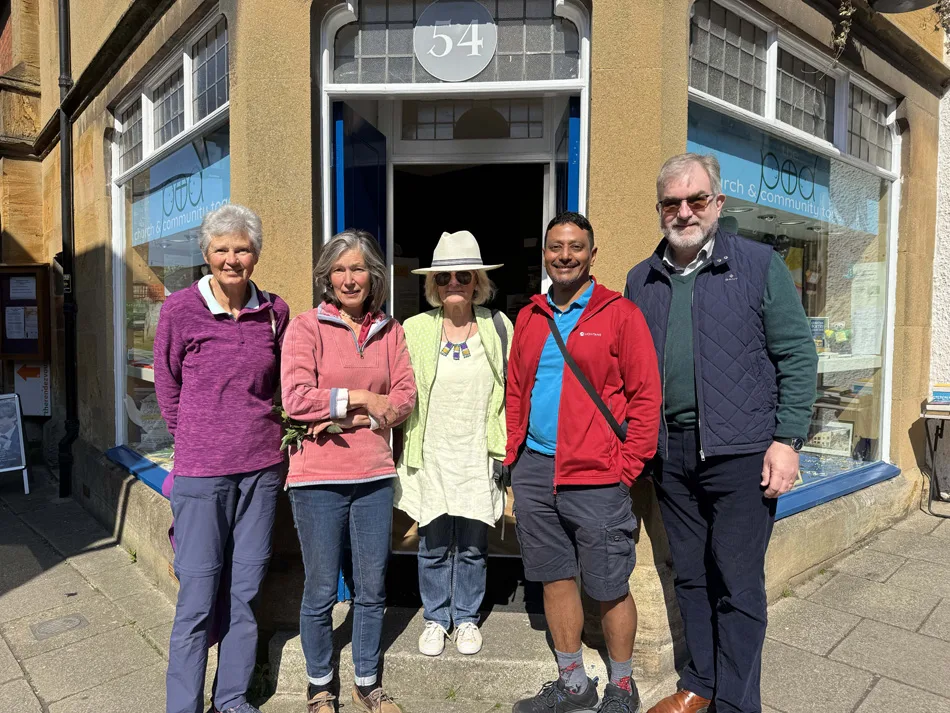
Volunteers at Sherborne’s Community Fridge, which is found inside The Pod on Cheap Street
Cllr Suresh Jeganathan, Sherborne’s Deputy Mayor and a regular fridge volunteer, said: ‘We are enormously grateful to our local suppliers including Oxfords Bakery, Sherborne Market Store and Co-op, who give us their surplus produce each week, to the volunteers at the Pod who keep the doors open and help visitors, and to our small band of fridge volunteers who collect and organise the food each week. Thank you.’ ‘The fridge is for the benefit of anyone who would like to try something from our usual selection of bread, fruit and vegetables. It just makes sense to give the produce one last chance to be enjoyed. Reducing food waste is also good for the environment, which was one of the key drivers behind the initiative.’ The Community Fridge is located at The Pod, 54 Cheap Street, Sherborne. Opening hours are Wednesday to Friday 10am to 12noon and 1 to 3pm, Saturdays 10am to 12noon
Can farmers finally move forward, asks Dorset NFU chair Tim Gelfs, or are they still being asked to carry the cost of past mistakes?
Winter sunshine across Dorset fields Image: Laura Hitchcock
Over the past few weeks, there have been some more positive announcements from the government – so is it time to grasp the nettle and move forward? Are we fully engaged with government to get the right outcomes that work for the majority? I know that the increases in the IHT levels in particular will come as welcome news to many. Some are still firmly caught with the forestalling policy, which leaves some families unfairly exposed – this has to be highlighted to our MPs at every opportunity. However, we should also focus on the announcements that affect the day-to-day running and profitability of our farming businesses: the Batters Review (see p.14) the Farming Road Map, the Welfare Bill and, of course, the long-awaited new look SFI. These will all be critical to our businesses. I know that farmers have been engaged every step of the way, particularly with the SFI debacle. It was always quite clear that, without spending caps, this scheme was always going to run out of money. I believe we can put the blame for it firmly at the door of both political parties: mistakes were bound to happen with a new scheme, but some shocking decisions compounded the already-existing problems, leading to that dreaded day last March. On a positive note, the new SFI already has a framework that the farming community supports, based on a principle of public money for environmental outcomes and paid-for work that delivers a genuine net gain for the environment. But it is critical that this aligns with Dorset Council’s vision for Landscape and Nature Recovery. Farmers will be responsible for much of this work on the ground, so we must be involved in shaping its direction locally.
Time for action My initial question is: why should we be paying for the mistakes of successive governments and their agencies? They ran out of money through bad management. The eleventh-hour lifeline for farmers coming out of schemes with no place to go was, of course, very welcome. It prevented a cliff edge. But if that funding has simply been pulled from an already-cut budget, it solves one immediate problem while storing up another. What confidence can we have in meeting future goals and aspirations if the overall pot continues to shrink? We need a transparent budget, in which we know where the money is going. This has to be an imperative first step for trust … which, let’s face it, is hanging on by its fingernails! Despite what you might think of the government of the day, in Emma Reynolds we now have a Secretary of State for Environment, Food and Rural Affairs who appears prepared to listen and to act. It seems as though she is someone who actually wants the job, rather than another candidiate looking at it as an awkward stepping stone to something better. She has said she has been in listening mode since taking up the position – but now it is time for action. It is time for accountability, time to lay out a pathway that gives farmers confidence … and it’s definitely a time for stability. There will be lots of debate and many announcements over the coming months, with plenty of talk of partnerships. Let’s hope that by the autumn we will have a scheme we can engage with, that pays for the environmental outcomes while safeguarding the country’s food security.
When you notice that a loved one is beginning to struggle at home, but is determined to retain their independence, it can feel like an impossible situation. The attachment to the familiar home environment is entirely understandable, and the fear of leaving it can cause people to hold off on asking for help for as long as possible. Thankfully, it is possible to receive individually-tailored care and support without moving out of the family home. Receiving the right care and support can equip and empower people to continue to live safely and independently at home for longer.
What support can my loved one receive at home? Home care visits from specialist carers can provide support with everything from washing, dressing and welfare checks, to household chores, grocery shopping, mealtime assistance and medication management. A bespoke package of home care can provide a unique combination of help and support which matches your loved one’s individual requirements. Choosing a regulated home care provider means that you can be confident that carers are qualified and equipped to provide the support your loved one needs to remain safe and happy in their own home.
I’m worried that my loved one feels isolated – can they enjoy a day out and still receive care? Absolutely! Day care visits to a local care home are a great way of helping your loved one to feel connected to others, whilst still receiving the care they need. On a typical day care visit, your loved one can enjoy activities, entertainment, refreshments and a nutritious meal in the company of others, within a safe and comfortable environment, supported by professional carers.
I am my loved one’s regular carer but am going into hospital – can they stay somewhere so that I know they are safe? Yes, of course. Respite breaks provide the opportunity for your loved one to stay for several days or weeks in their local care home, with all meals, activities and care included. During their stay, your loved one will have access to all of the facilities, activities and entertainment on offer to the home’s residents, enabling them to experience care home life for themselves, and allowing you to focus on your own recovery. Respite breaks are available all year round, subject to availability, and can often be arranged at short notice in emergency situations. If you know the date of your hospital stay in advance – or indeed would like to book a holiday at a later date – Somerset Care also offers a respite break pre-booking service, so that you can plan ahead to ensure that your loved one will have the care they need, when they need it.
Find out more Somerset Care’s home care, day care and respite services support you and your loved ones to live independently at home, for as long as possible. For information and advice, please visitsomersetcare.co.uk, or contact our expert enquiries team on 0800 817 4925.
For most, the season’s heavy rain has meant muddy boots and soggy fields – but at Future Roots, it’s been an opportunity for something a little more memorable.
A group of young people recently took to the water for a unique outdoor session, kayaking through a field temporarily transformed by flooding. It was a chance not just for fun and laughter, but also for reflection, says Future Roots founder and manager Julie Plumley: ‘At Future Roots we make use of every opportunity – and the rain brought some different fun, using the fields to float and reflect.’ Based on a working farm in Dorset, Future Roots is a social enterprise offering alternative provision and therapeutic support to young people who are struggling in mainstream settings. Combining land-based education with emotional support and mentoring, the charity creates a safe and inclusive space where young people can rebuild confidence, develop life skills and look ahead with hope. Whether it’s learning to care for animals, grow vegetables or – when nature allows – paddle a kayak in a flooded field, the team at Future Roots work hard to find creative ways to help young people build stronger roots for a brighter future. futureroots.net
Remarks made by North Dorset MP Simon Hoare in the House of Commons on Monday 19th January were picked up by news outlets across the world, prompting widespread international coverage referencing ‘North Dorset’ in connection with calls to confront Donald Trump more robustly.
Speaking exclusively to The BV shortly before heading in to chair a select committee, Mr Hoare warned that the former US president was posing serious risks to international stability, describing him as ‘demeaning and debasing the dignity of the office of president.’
‘The erratic nature of his behaviour, the unpredictability … if it ever was a joke, the joke has worn thin,’ he added.
Mr Hoare said Mr Trump’s actions were forcing difficult choices for the UK and its allies. ‘This is crunch time. We cannot just presume that things will go back to normal. He’s unrestrainable. He seems to be listening to nobody.’
He warned that long-established alliances were under strain. ‘I think the foundations of NATO are being shaken. Enormous comfort is being given to Putin and to anybody else who wants to see an inward-looking, infighting, destabilised Western alliance. These are dangerous times.’
Describing Mr Trump’s approach to global politics, Mr Hoare said: ‘He’s not a politician. He’s a property-dealing hustler who sees the price of everything and the value of nothing and thinks that everything can be bought, even if the owner doesn’t want to sell.’
Referencing recent remarks over Greenland, he warned of the consequences of abandoning international norms. ‘Once principles have been breached, you’re never going to restore them,’ he said. ‘If we tolerate actions against soveriegn nations which we wouldn’t tolerate from another country – just because it’s America – at best we’ll be seen as cowards, at worst as bloody hypocrites.’
He told MPs that the President was ‘thin-skinned’, driven by ego, and motivated by public embarrassment rather than negotiation. Mr Hoare questioned whether symbolic measures – including the King’s proposed state visit to the US and participation in the World Cup – should go ahead, arguing that the UK may need to ‘fight fire with fire’. The remarks came amid mounting concern in Westminster following Mr Trump’s renewed claims over Greenland and warnings of potential tariffs against NATO allies, including the UK.
Referring to the proposed state visit linked to celebrations marking the 250th anniversary of American independence, Mr Hoare told The BV: ‘I do not see how the government could advise the King that a state visit should go ahead – it would be seen as implicitly endorsing the presidential equivalent of Al Capone.’
Liberal Democrat MP Luke Taylor echoed Mr Hoare’s comments, telling the House that the UK was ‘not dealing with a rational man’ and suggesting that withdrawing from the tournament could be a way of demonstrating political resolve.
The Government has so far played down the prospect of any boycott. Foreign Secretary Yvette Cooper said continued engagement had already led to changes in US tariff proposals, while senior Labour figures urged calm and coordination with international allies rather than escalation.