It might be a damp squib of a summer, but Thorngrove’s Secret Garden might be just the treat you need, says Kelsi-Dean Buck
If you fell asleep in April and woke up last week, you might think not much time had passed. Summer is underway, but the showers have been plentiful and it certainly was a, shall we say, unsettled July?! Followers of our social media will know that we keep the summer atmosphere strong though, and the courtyard here at Thorngrove continues to burst with colour (and between you and me, we don’t mind a bit of summer rain – it’s good for the plants!). Come join us on Facebook and Instagram for regular hits of summer vibrance, along with gardening tips and inspiration. Then come and visit us in person – we love chatting plants ‘n stuff! In July we also launched our SUMMER SALE – many plants are available at a bargain price, still looking lovely, and with some TLC they’d make the perfect addition to your planters or garden space. This includes many from the hairy pot plant company, who grow a fabulous range of eco-friendly, sustainable, and ethically produced cottage garden plants and herbs grown in hairy coir pots in a peat free compost. If you’re yet to discover them, we highly recommend. Stop by Thorngrove and have a look for yourself.
Summer menu As it’s summer, we naturally now have our summer menu in the café – and we’ve had some incredible responses to it. We believe the Secret Garden Café is offering a unique range of dishes you don’t often find in similar settings, so to encourage more of you to try us out, we’ve launched our BUY ONE LUNCH, GET ONE LUNCH FREE offer! Available every Tuesday and Thursday in the café, come along and catch up with friends. Indoor climate-controlled dining, or outdoor patio seating – for when the sun does show itself! – Ben and his team in the café are ready to welcome you. Don’t just take our word for it, read some of our reviews on Google, and the comments on social media. Our ‘secret’ café is not so secret anymore!
Plant of the month Our plant of the month for August are the delightful hydrangeas. They’ve been showing off for a little while now, so we thought it’s only right to give them the spotlight for the month. These beautiful and versatile flowering shrubs can add charm and colour to your garden, and also work as impressive table centrepieces. Don’t let the rain dampen your summer spirits. All you need to do is pay us a visit and breathe in the lush seasonal plants on display … and let’s be honest, nobody wanted another drought did they? Embrace the damp – we look forward to seeing you this month!
Fleeing political violence, Zimbabwean Rozanne Bell turned her rebellious energy into a successful painting career
Rozanne at home with some of her art – image Courtenay Hitchcock BV Magazine August 2023
The adopted daughter of English parents who had relocated to Zimbabwe, Rozanne Bell grew up in a strict, almost Victorian but happy, environment. But the rebellious nature that emerged during her teenage years eventually led to expulsion from school. Recognising her daughter’s need for an outlet, Rozanne’s mother, an accomplished artist herself, encouraged her daughter to explore painting as a means of expression. It turned out to be a bit of smart parental thinking, as a natural flair swiftly emerged. Combining talent with hard work and dedication, 16-year-old Rozanne began to forge what became a successful career as an artist, resulting in exhibitions at home in South Africa and also sales in the USA. Under Robert Mugabe’s premiership, the political situation in Zimbabwe grew increasingly violent and eventually, in 2002, it compelled Rozanne to flee the country, leaving behind all the family’s possessions – a daunting challenge for anyone, let alone a mother with five children.
image Courtenay Hitchcock BV Magazine August 2023
In her studio, Rozanne Bell explains her process All images: Courtenay Hitchcock BV Magazine August 2023
Under such circumstances, a fresh start in a new country required immense strength and resilience, qualities Rozanne appears to possess in abundance. She recently described herself on social media as “storming into my studio like a supercharged Duracell battery.” – it’s an accurate depiction. Her gregarious nature, her relentless energy and her enthusiasm for art all proved necessary when she set about forging a new reputation in the UK. The bright and quirky birds and animals she had been painting in South Africa were not well received here. She had to deveop a new style and find new sales outlets. Each rejection just fired her up: ‘If you don’t fight, you don’t get anywhere. ‘You have to listen to what the people want. I just want to paint what people love.’ With limited resources, Rozanne sourced frames from local car boot sales. After a year in Dorset a local pub agreed to display her work. Shortly afterward, a Bournemouth agent took her on and Rozanne began to paint the animal characters which found her an initial niche market. She continued to work hard, reacting to customers’ wishes. ‘I had to keep pushing. I had children to feed and bills to pay.’
image Courtenay Hitchcock BV Magazine August 2023
Accessible art Rozanne’s style and subject matter are constantly evolving. She has built a reputation, with her vivid colours and expressive brush-strokes, for her flamboyant, mixed media works. She still draws inspiration from her home country’s colours, flowers and animals, but adds her own contemporary, often humorous, touches, almost always working from her imagination but using a vast array of both fresh and silk flowers for reference.
Rozanne and the drying racks – image Courtenay Hitchcock BV magazine August 2023
Recent works reveal a love of the Dorset countryside and the coastal landscapes of Cornwall. Her trademark lush curtain of flowers is nearly always present. Rozanne is not interested in producing limited editions or offering mass market prints, preferring established followers to own an original painting at an affordable price: ‘I dream of making happy paintings that people can afford,’ she says. Thoughtfully, she produces some smaller, less expensive paintings for loyal followers – of which she has many, with more than 20,000 on Facebook alone. She works on multiple paintings simultaneously, allowing her to develop complexity of layers and to incorporate a variety of media into her creations.
Rozanne incorporates her trademark lush curtain of flowers even on coastal landscapes – image Courtenay Hitchcock BV Magazine August 2023
A distinctive aspect of Rozanne’s work is her use of resin finishes. By applying resin coatings to her paintings, she adds depth and vibrancy to the final pieces. It creates a glossy and transparent layer that enhances the colours and textures, creating a gutsy visual impact. It is a messy process – she showed me the dedicated room stacked with wooden racks of paintings in the process of receiving different layers. Finishing touches might include metallic paint splashes, or highlights for a daisy petal.
Two harbour works-in-progress waiting for their resin coating – image Courtenay Hitchcock BV Maazine August 2023
A fresh perspective Rozanne is a dedicated and compulsive painter: she is in her studio near Sturminster Newton from early morning until the evening. She’s quick to point out that essential support comes from her daughter who ‘runs my life and my brain!’ As for every artist, the lockdown period in 2020 provided a different perspective and slower sales. Rozanne is beginning to re-evaluate her work and looking at taking a different direction. She wants to spend more time with her young grandson. The continuous evolution of an artist’s style and technique can lead to the refinement and enhancement of their unique artistic vision. As Rozanne explores new techniques and subject matter, she brings a fresh perspective to her work while retaining the elements that make her art so recognisable and distinctive. As she says, ‘I was so lucky to have been born with an imagination.’
image Courtenay Hitchcock BV Magazine August 2023
A new work in Rozanne’s Moonlight series dries on a studio workbench – image BV Magazine August 2023
At the end of July, Dorset Council approved the development of a 190-acre solar farm in the Blackmore Vale. Rachael Rowe reports
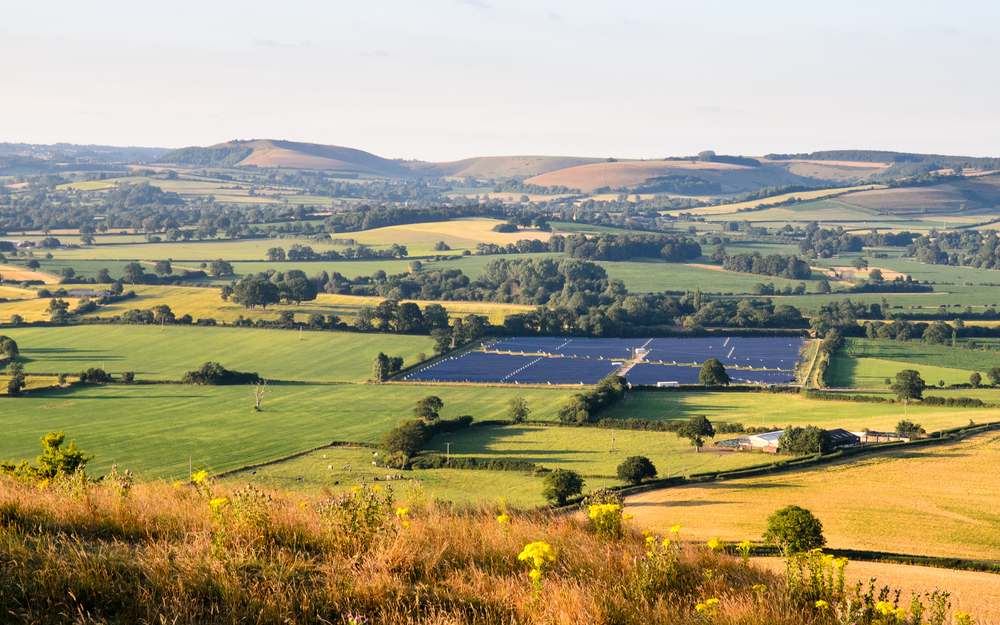
This is a 35-acre solar farm in Wales – the one approved near Hazelbury Bryan covers 190 acres
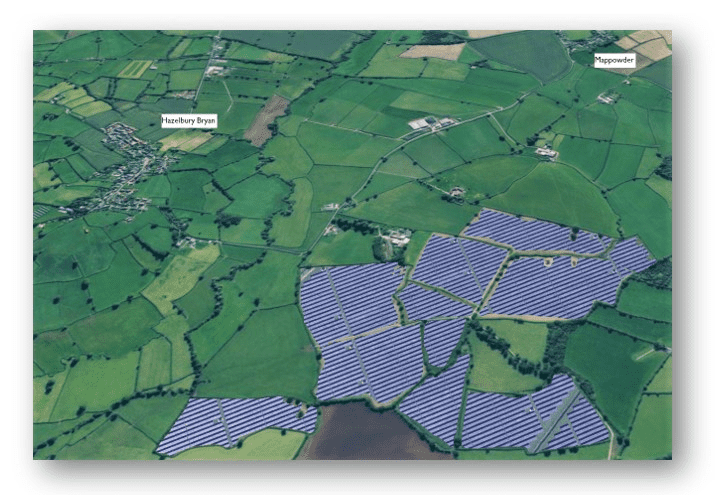
There’s no doubt that global warming is already here. From crippling heatwaves and wildfires in Europe to the alarming disappearance of insects, the signs of a crisis are clear. At the same time, there is no end in sight to the war in Ukraine, affecting supplies and security of both food and fuel. Councils and other statutory organisations are compelled to think and act differently in order to meet the challenges brought by climate change. On 26th July, Dorset Council approved the development of a 190 acre solar farm in the Blackmore Vale, close to the conservation areas of Mappowder, Pulham and Hazelbury Bryan. The panels will produce 50 megawatts of renewable energy, powering 11,725 homes annually. With the broad views from Bulbarrow Hill and Rawlsbury Camp likely to include many fields of panels, will Thomas Hardy’s Vale of the Little Dairies be changed forever?
The projected outline of the North Dairy Solar Farm at Hazelbury Bryan
How much do we need? A significant part of the UK’s strategy to reach net zero by 2050 is dependent on renewable energy. According to the National Grid, all electricity should come from renewable sources by 2035. Four main sources of renewable energy are used in the UK – wind, solar, hydroelectric and bioenergy. During 2020, 43 per cent of the UK’s electricity came from renewable sources. In May 2023, the UK’s trillionth killowat hour of renewable electricity was produced. It has taken 50 years for this amount of electricity to come from renewable sources – the next trillion is expected to be produced within five years. It’s an insight into the pace of change on renewables. Energy from the North Dairy Solar Farm (NDF) development will be used locally and also feed the National Grid. Much of the power at the Spetisbury solar farm currently powers buildings in the City of London including the Guildhall and Tower Bridge.
This 20-acre solar farm is visible from Hambledon Hill
The North Dairy solar farm Dorset Council received more than 200 letters of objection to the development of the NDF at Hazelbury Bryan. The site lies at the confluence of the River Lyddon and Wonston Brook, an area known for its tendency to flood. Not surprisingly, the concerns are mainly about flooding. Anthony Cake’s family has farmed in the area for three generations; the farm is 400 years old and close to the solar farm. Anthony said: ‘My wife and I support renewable energy programmes. We know that we all have to change the way we live. However, at no time has anyone from the developers contacted us. It’s as though we don’t exist. We were left off the map as well, and that wasn’t down to scaling. ‘We won’t see the solar farm. My concern is the risk of flooding. Between us, my family and I have 168 years of experience of flooding in this area. Where you have glass on clay, with time, channelling could occur, creating a rapid run-off. If British Solar Renewables (BSR) or Dorset Council could look me in the eye and assure me 100 per cent that my home and livelihood won’t flood … Perhaps they could underwrite the cost of my flooding insurance?’ Local people are all familiar with the flood risks. Crawford May, chairman of Lydlinch and Kings Stag Parish Council, told the planning meeting: ‘I have lived and worked in the Kings Stag area for 67 years. I know which places flood. I know how deep it gets, and how fast it can flow.’ The planning application does contain mitigation plans for landscaping, flood management and road access. However there are still concerns about the impact of such a large development in rural Dorset, especially around the use of arable land. Save Hardy’s Vale has been campaigning against the solar panel farm. Ian Bryan says: ‘It appears that the temptation of a newly re-enforced grid connection has blinded the applicants and the councillors to the very serious practical reasons why the NDF Site is so unsuitable for a solar development. Those who live downstream of the proposed development know clearly what serious flooding is like, and just how frightening – and life threatening – it can be. ‘Of course, we need to utilise solar, but as the government and Dorset Council policies say, put solar panels on brownfield sites, car parks and roofs etc. Dorset Council set out a host of good reasons in their Climate and Ecology Emergency Agenda to look after our valued, designated and food-productive landscape.’
We are where we are When developments of this nature are proposed, significant work goes on behind the scenes to investigate the plans. North Dorset MP Simon Hoare says: ‘If we are serious about combating climate change to get to net zero, we need solar, hydro and wind. There is increasing demand for electricity and we need to get the power from somewhere. It’s a good idea – but not here. ‘My main concern is the site is too big. I have concerns the number of panels will take away soakaway land when it rains excessively. It is maximising energy security to the detriment of food security. We have seen with COVID the fragility of international supply chains. ‘However, I know the council took their time on this and have not rushed to a judgement. We are where we are and the applicants must still meet the requirements of the council report. ‘While I am disappointed, I am keen we maximise renewable energy and each one of us needs to play a part.’ Driving around the Blackmore Vale, there are a lot of new housing developments – with no solar panels in sight. Is this a missed opportunity for Dorset’s housing planners to mandate developers to use sustainable energy more effectively? With global warming causing significant changes to the planet, the North Dairy Solar Farm is not the only challenging decision that Dorset planners will face in the near future.
British Solar Renewables and Dorset Council were approached for comment and had not responded at the time of going to press.
The frequently flooded road to Hazelbury Bryan, where residents are concerned that a huge solar farm can only increase flood risk
How much energy is renewable in the UK?
Electricity generated from fossil fuels contributes to greenhouse gas emission. Energy from renewable sources generates no, or very low, carbon emissions, and moving to renewable energy is a critical component in tackling climate change. In the UK, the largest single source of electricity entering the National Grid is natural gas. But in 2020, for the first time, the majority of the UK’s electricity came from renewable sources – 43%. Collectively that’s more than natural gas (34.5%) and far more than coal (1.8%). Nuclear power constitutes 16% of all energy sources in the UK. Renewable energy in the UK is generated from four main sources: Wind power 28.6% of the UK’s electricity generation Biomass 5.6% of the national renewables Solar power 4.4% of the national renewables Hydropower Making just 1.8% of the renewables. Just 13 years ago, zero carbon power made up less than 20% of the UK’s electricity supply. In 2023, more than 50% of the UK’s electricity is from renewable sources.
We’ll barely have time to celebrate the fact that The BV turns three this month (THREE YEARS! How is that possible?) – we have a packed few weeks ahead. As I write we’re just ten days away from the second Clayesmore Classic & Supercar Sunday, which is swiftly followed by the Gillingham & Shaftesbury Show. If you’re going (and obviously you should if you can!) do come and say hello if you spot us around the showground. I promise we’re friendly and we’d love it if you did! Straight afterwards we’ll be looking ahead at the Dorset County Show, and of course rolling swiftly into our September issue before we can blink, as well as the Sturminster Newton Cheese Festival and squeezing in a trip to London for another awards ceremony … and then we just might go find somewhere quiet for a very loo-o-onng nap. (and no we are NOT going to discuss the fact that I have seen two high street chains appear in my social media feed this week with Christmas trees up and decorations for sale in store). However, you’ll never find us complaining about a busy month (well, not often – I admit I’m not a total ray of sunshine when running on too little sleep and too much caffeine). Though we’ve lived here for more than 30 years, the last three spent running The BV has allowed us to see like never before the rich tapestry of Dorset. We’ve had the privilege of getting to know so many of you, and every issue reveals more of the resilience and character, the strength, the goodwill, and the sheer talent that defines our local businesses and communities. Contrary to popular perception, we locals know that Dorset is so much more than some beautiful beaches and a famous cobbled hill. It’s a beautiful hub of innovation, creativity, and determination. The awards we’ve won this year have been a welcome nod to our efforts over the last three years, of course, but the real reward lies in knowing that thousands of people appreciate what we do. We feel we’ve grown not just as a publication but as a part of the community. We’re committed to supporting local, sharing stories that matter, and being a voice for Dorset. Thanks for sticking with us.
French housing plan Now we seem to have got to the stage where houses can be built in a council’s area even when all the council and residents object.Perhaps we should take a lesson from some French towns. There, the council buy some appropriate land, put in the road and facilities and then grant individual permission to residents to build on the plots as and when the council see fit. Stops this wholesale development by big building firms just out to make a huge buck regardless of what the locals want. Roger Tatler, Gillingham
Save the planet! It is a phrase used everywhere we look. I am not an activist nor an eco-campaigner and I am not about to start superglueing myself to the M25 or London Waterloo express train. I do believe that we should all try and do our bit, relative to our means and circumstance. Maybe then we can save our grandchildren and great grandchildren from the perilous fate that looms ahead. For our ‘bit’ we have swapped our diesel cars for electric ones since 2016. We have spent the last 11 years making our home more energy efficient, as time and resources allowed. Our house has moved from an EPC rating of D in 2012 to A in 2022 – for a 1980s built detached house, this is no mean feat! We have insulated under the floors, added more loft insulation, cavity wall insulation, fitted A+ rated double glazing and doors. We had 4KW PV installed in 2012 and wherever possible replaced older inefficient appliances with A+++ rated new ones. For the last year we ran the whole house 24/7 from either solar power or off-peak electricity (pulled in overnight at a fifth of the price). This year we have had an Air Source Heat Pump (ASHP) installed, and added a second Powerwall to further support the running of the ASHP. We are adding to our solar system to try and reduce our pull on the grid some more. This should mean that we were able to export a lot more green solar-generated electricity back to the grid, helping everyone else reduce their carbon footprint too. However, our energy distribution network operator SSEN have put a stop to that – we were granted permission to install the extra panels on condition that the installers block our ability to export any electricity to the grid from them! The excess green electricity we generate from the new system will now be grounded to earth and lost, whilst somebody somewhere burns more oil, gas and coal to generate dirty electricity to keep up with demand. It is high time that pressure from the government was put on the likes of SSEN to up their game and upgrade the energy networks urgently so they are fit for the future that is fast approaching. Ian Tattersall, Gillingham
On Simon Hoare We are watching wildfires ravaging parts of Europe yet again, as well as unmanageable temperatures in the USA, China and the global south. Clearly ever-accelerating indicators show that the world is now on the cusp of a number of tipping points which will make runaway climate change inevitable. Recent research suggests the gulf stream may collapse as early as 2025 with catastrophic results. Professor Sir Robert Watson was clear on the Today Programme last week – he thinks 1.5 as a goal is becoming unreachable due to lack of political will, and states that in this country the measures to ensure we reach our commitments to the Paris agreement aren’t there in any shape or form. Lord Deben of the UKCCC (until recently) stated our government was setting ‘the worst kind of example to the rest of the world’ compared to other countries who are really moving on green solutions rather than empty pledges while actively supporting new oil and coal initiatives. This week, Rishi Sunak has clearly shown that, rather than creating opportunities for people across the UK to mitigate the seriousness of the situation we are facing, he prefers to fabricate an anti-green mantra to bolster an election campaign. I therefore find Simon Hoare’s statement (The BV, Jul 23)‘Confidence in the commitment of the government to achieve progress cannot be in serious question.’ extremely surprising. It is at complete odds with anything these eminent climate scientists are saying – and the actions of his government. Karen Wimhurst, Shaftesbury
The solar farm Dorset Council Strategic Planning Committee have approved plans for a 188 acre Solar development, stretching for 1 mile from north east to south west, on a site between Mappowder, Pulham, Kings Stag and Hazelbury Bryan. Scant consideration was given to local residents’ very real concerns that existing high levels of flooding would be exacerbated by concentrated run off from panels creating runnels which would increase water levels quickly and cause flash floods. The area is already in a flood zone and the ground saturates for about six months of the year. The applicants have failed to provide adequate infiltration tests of the site or confirm the number of panels planned so it is currently impossible to calculate the risk. The Committee appeared to be more concerned with the relocation of crested newts or whether or not sheep would be grazed under the panels. At one point debate surrounded the issue of potential fire in battery storage areas; objectors and observers were surprised that Planning and Flood Officers did not point out that there is in fact no battery storage planned in the application under consideration. Landscape Officers’ and the AONB’s concerns that significant damage would be caused to views from the Bulbarrow ridge were brushed aside with the comment that the panels would have a non reflective coating. Significantly neither the Landscape nor Heritage officers were present and the AONB was not represented. Some will respond that the climate emergency means that renewable energy must trump every other consideration but is this acceptable when giant solar plants destroy cherished views, fence wildlife out of their usual habitat, take good farmland out of production at a time of food insecurity and risk lives and livelihoods due to exacerbated flooding? National and Dorset Planning policy states clearly that environmental damage must not be disregarded during the move to low carbon energy generation but in this case, elements of policy have been ignored. My personal view is that if larger than about 60 acres, these plants should be located close to motorways or other semi industrial areas where the landscape, habitat and tranquillity is already blighted. Subsidies should be offered to industry and agriculture to cover suitable roofs with solar panels. Taking into account their enthusiasm to cover unspoiled country with industrial panels, it is also surprising that Dorset Council do not insist on solar panels and water butts to be standard with every new dwelling and encourage farms and businesses to install panels on their buildings. Catherine Langham, by email
The Pet of the Month Facebook post was once again a happy parade of good pets. Would you like your pet to be featured? Share them on Facebook or send an email to [email protected]. Please be sure to include your pet’s name, age, and a couple of fun details about them.
August is the month for monitoring – staying on top of this year’s flowers while you prep for next year, says gardener Pete Harcom
The weather we have been having lately seems to swing from one extreme to another, doesn’t it? The dry June followed by the wet July – thank goodness our gardens have escaped the heat of mainland Europe. Jobs for the garden this month:
August is perhaps the month to simply try and maintain the show of flowering plants, and to clear up the borders and flowers to help the display to continue!
Keep up the regular feeding and deadheading – especially roses, dahlias and perennials. It really does help to keep the displays going.
Cut back delphiniums, geraniums and lavender after the first flush of flowers to encourage a second flowering period. Feed them after you cut them back.
Divide clumps of bearded iris and take cuttings of your patio and container plants ready for next year.
Thin out any thickly overgrown pond plants.
Most perennial weeds are best dealt with in the summer when the weeds are in active growth. Sorry to say that digging them out is usually best if you are trying to avoid using weedkillers.
Start collecting seed from plants you want to grow next year – especially foxgloves, aquilegia, calendula, poppy and love-in-a-mist.
Sow biennials such as foxgloves, sweet William and wallflowers, honesty and forget-me-nots. They’ll be ready to plant out in the autumn and make a stunning display next spring.
If pot plants are pestered by nesting ants, try putting the pot in a large saucer with water in it – but have the pot resting on pot stands above the water level.
Watering hasn’t been an issue lately (!), but on the offchance we should get a burst of hot weather, take extra care of container-grown plants and any in the border that are not yet established. It is always best to water plants in the cooler parts of the day and at the roots only.
On hot days, water from a hosepipe can be trickled into the pond to help top up and aerate the water. Be sure to also top up bird baths.
Damping down the floor of the greenhouse regularly on hot days helps.
Plan ahead if you are going on holiday – maybe a neighbour can help if hot weather is forecast, or at least thoroughly soak plants before you go. There are a number of watering devices available such as watering mats, micro-drip watering systems with a timer, watering spikes and adjustable drip feeders.
Also, if you are going away it’s a good idea to move hanging baskets and pots to a shady area (just place the hanging baskets on a large pot).
The BV’s astrophotographer Rob Nolan is back – and counting the days to those long winter nights
M16
Well, what can we say about the British Summer holidays so far? Not a lot that’s good! I had such high aspirations for warm nights of observations, with clear sunny skies for some solar imaging, too. Alas, neither has so far come to fruition. Hopefully the weather will improve as we move through the month. As we wait for the longer nights, there’s a target that I last captured in 2021. It peeks above the horizon and is best seen during the month of July here in the UK. The Eagle Nebula in the Serpens constellation is famously home to the Pillars of Creation, that astounding image many of us recognise instantly which was taken by the Hubble space telescope back in 1995. It’s a target I’ve shared before in this column, the use of my newer mono camera and scope means that I’ve been able to capture far more detail this time around, and also represent the different gases using what’s known as the ‘Hubble palette’, showing off the amazing emission nebulas in glorious golden reds, greens and blue (representing sulphur, hydrogen and oxygen). The Eagle Nebula itself is roughly 7,000 light years away from Earth and is known as a stellar nursery, due to the amount of newborn stars being created from the abundance of gases. Stretching roughly four to five light years, the Pillars of Creation are a fascinating but relatively small feature of the entire Eagle Nebula, which itself spans approximately 70 by 55 light years. If you’re on a tablet or phone, rotate to see the image in landscape orientation – you’ll be able to easily make out the huge eagle shape of the nebula, including the head and wings. Personally though, with the detail we can now more readily reveal, I think I it looks much more like a dragon! It’s a target I’ll never get bored of imaging, and I just hope I can get some more time on it next year.
This month’s image was captured with my 1000mm Maksutov Newtonian Telescope and the ZWO ASI2600MM Pro Astro camera with Narrowband filters – it’s about 4.5 hours of data.
The night sky, August 2023 – Rob’s guide for your stargazing this month:
This month we’ll be treated to a festival of various celestial events – if the cloud will give way like stage curtains to reveal the grand show! There is so much to observe this month. Starting with the Milky Way Arch itself, which begins to reveal itself beautifully as the darker nights return. You’ll easily be able to find three bright shining stars in our glowing galaxy band –Vega, Deneb and Altair. These stars mark out the verticals of what’s known as the Summer triangle. Closer to home, we’ll be treated to two supermoons this month, the second of which is the brightest full moon of the year. Saturn also reaches opposition this month, meaning it’s the best time to observe this beautiful planet and its rings as it’s the closest it will come to Earth this year. Starting at the beginning of the month, the first supermoon was on the 1st of August – and we all missed it due to the British weather! But fear not, we get another chance on the 31st to witness a Blue Supermoon, the biggest supermoon of the year. Don’t miss it! You’ll need to set your alarm clock – the Moon will peak at 2.35am. Over the upcoming weekend of the 8th, look to the Moon to see Jupiter hanging to the right. On the 9th, The Pleiades will join the stage alongside the Moon and Jupiter to create a pleasing trio. The major event of the month is the night of the 12th/13th – we’ll witness the climax of the Perseid meteor shower. This year it’s due to be a great show for observing, so lets cross our fingers for good clear skies! These prolific shooting stars (actually dust from comet Swift-Tuttle) will be burning up high above our heads in what is usually the best annual meteor shower that we’re invited to. Finally, on the 31st, that biggest Supermoon of the year. It’ll be 30 per cent brighter than the faintest Full Moon we observe, so it wont be a blinding ball of rock in the sky, but it will still be an impressive sight. While you’re there, you’ll see Saturn hanging out close to our shining Lunar beacon. Next month , we’ve got an exciting expedition returning to Earth from space, and also the Autumn Equinox. Until then, Clear Skies!
Fancy a night of festival style footstomping, dancing and singing? It’s going to be quite an evening when Old Time Sailors visit The Exchange in Sturminster Newton for the first time on Friday 8th September! You will be sailing back to the 19th century for an immersive experience – seafaring music performed in a way you have never seen before. The motley crew and their plethora of traditional and eclectic instruments will take you back to the time of clashing tankards and drunken debauchery – and you’ll wonder why we ever left! The Old Time Sailors have recently taken Glastonbury and Bestival by storm, as well as headlining at festivals throughout the south west. Kicking off the Sturminster Newton Cheese Festival weekend, guest real ales will be on sale, as well as the full bar, and as dancing is very much encouraged, only the raked seating will be out! There’ll be plenty of space to sing and dance like a drunken sailor as the band perform centuries-old folk and shanty songs. Fancy dress is encouraged – pull out your best seafaring garments, me hearties, and come join the festivities!
Tickets from Box Office: 01258 475137 or stur-exchange.co.uk. Usual price £18: SPECIAL OFFER PRICE £14 – just quote ‘BV Magazine’.