The Blackmore Vale logo
Home Blog Page 187

It’s a clean sweep

0

Mid-life career changes have led Martin and Jenna Lee to sweeping success – he’s a Master sweep and she is Dorset’s first female Guild-qualified sweep

Legend has it that King William the Conqueror declared (not decreed() chimney sweeps to be a symbol of good luck after he was saved by a plucky sweep from a runaway carriage. Another legend says it was George III , and he was saved by a brave sweep after dogs spooked his horses.
My personal favourite is the tale of the chimney sweep who lost his footing and was left dangling precariously from a gutter. The woman in the house pulled him to safety and it was love at first sooty sight.
Since then, it’s been lucky to have a chimney sweep at weddings or to shake a sweep’s hand – Prince Philip reportedly dashed out of Kensington Palace to do just that before his wedding to the then Princess Elizabeth.
That good luck – along with a lot of hard work – seems to have followed Wimborne husband-and-wife Martin and Jenna Lee. They both made career changes, Martin six years ago and Jenna just this year, to start their own chimney sweeping businesses There are only 15 female Guild sweeps in the whole country and Jenna (43) is proud to be the first in Dorset to qualify with HETAS (Heating Equipment Testing and Approvals Scheme).

Martin Lee, master chimney sweep

It’s not all Chim Chim Cher-ee
There’s certainly a lot more to this profession than Bert from Mary Poppins would have you believe. An intense mix of classroom training, practical sessions and shadowing master sweeps is demanded for sweeping inglenooks, wood burners, open fireplaces and even pizza ovens.
Martin explains a particular challenge: ‘Everyone in the industry knows that Aga Wenlock stoves are incredibly tricky to take part. At the training centre there’s one we strip and put back together against the clock. Some sweeps have even got one in their shed so they can practice. I’ll admit I’m a bit of sweep geek but even I wouldn’t go that far!’
The classic chimney sweep’s bristle brush is still in use – but now it works alongside high-tech kit including CCTV equipment. There are the challenges of removing birds’ nests as well as occasional birds, bats and squirrels – dead and alive! Martin says rain is the bugbear of a professional sweep: ‘Fluffy dry soot is replaced by congealed soggy goo that clogs up equipment.’
Martin and Jenna are meticulous in their approach to work. ‘The secret of being a good sweep is all about the set-up,’ says Martin. ’You need to assess the property and gauge what rods and equipment you’ll need, to minimise trips in and out of the house. It’s not just about dirty boots, you might also be surrounded by valuable ornaments, so taking extreme care is very important.’

Spot the classic chimney sweep bristle brush

His expertise means he is also called on for renovation projects. ‘In one old house, the builders were opening the blocked-up fireplaces. I spent a fortnight clearing 17 chimneys. I cleared huge nests that had been there more than 50 years – in one grate I found a newspaper dated 1954. The old adverts for tobacco were wonderful!’

A matching set for the master and lady sweeps

Enter the lady sweep
The run-up to Christmas is the busiest time, with the couple each racking up 100-hour working weeks. Their customer base stretches across Dorset and into the New Forest, ranging from celebrity mansions with 14 chimneys to a small bungalow with just one.
Jenna says: ‘Martin was getting busier, so I started doing some of his paperwork. When I did the numbers I realised there was enough work for us both. I’d been working for an asphalt company for nineteen years, getting up before dawn, and it was taking its toll. As a couple, we were just passing each other in the evening. Martin would be ready to chill out and I’d be going to bed!’

Jenna Lee is the first female Guild sweep in Dorset – and one of only 15 in the UK


Jenna cut her working hours so that she could help Martin – and then she was made redundant. For six months, Jenna spent two days a week shadowing Martin and in June this year she qualified and launched her own business, Dorset Lady Sweep, complete with a distinctive, pink-flashed van and Mary Poppins-style branding. She says: ‘Some customers are surprised to see a lady sweep but by the time I’m finished, they’re impressed. A lady in Swanage told me she’d never had any issues with male workmen but felt more relaxed with another woman working in the house. ‘It’s certainly not a way to make a living if you’re worried about breaking a nail, but I love it!’
And do the couple have a watershed, when talk of rods and flues is banned? ‘Not really. We’re a good team. The only time we fall out is over radio station choice and air-con temperature in the works van if we’re on a job together!’

It’s a dirty job but someone has got to do it – more than four bags of soot came out of this chimney!
  • dorsetmastersweep.co.uk
  • Quick fire questions:
  • Dream dinner party guest?
  • Jenna: Family and friends and biker Marc Marquez – I’m a big MotoGP fan.
  • Martin: Metallica. It would be cool to have dinner and a few beers with the band.
  • Book by your bedside?
  • None. By the time we get home and have replied to emails and calls, we’re too tired to read! For us, it’s a soak in our hot tub.

BV’s Local Flavours Hamper Winner!

0

Huge congratulations to Diane Davies from Gillingham who won the BV’s Local Flavours Hamper and is now set for a very Merry Christmas with family and friends 😊

Diane Davies of Gillingham receiving the BV’s Local Flavours Hamper from Courtenay this morning. BV Magazine December 2023 – Image Laura Hitchcock

We would just like to extend our heartfelt thanks to all the wonderful local producers listed below who generously contributed to fill the hamper:

Feltham’s Farm – Cheese coffer

Meggy Moo’s Dairy – selection of milk, cream and butter

Tack Room Distillery – London dry gin

Ajar Of – selection of preserves and a Christmas Pudding

Wild & Game – Luxury pate gift set

Chococo Chocolates – Large festive chocolate collection

The Book And Bucket Cheese Company – Classic hamper

Weymouth51 – selection of sauces and preserves

Little Waddon Vineyard– a bottle of Three Summers 2018 Brut

Stony Groves – Zesty Kampot Spice Blend and Spice Mill

The Watercress Company – watercress plus vouchers

Brace of Butchers – Joint of beef

Honeybuns – selection of cakes and biscuits

Shroton Fair Gin – Zummit Dry

Virginia Hayward Hampers – one very large wicker hamper!

Rawston Farm Butchery & Shop – Christmas Cake

Christines Puddings – Christmas Pudding

Please don’t forget to support your local producers and businesses this Christmas, now more than ever they need us!

THANK YOU!

The BV’s Local Flavours Hamper full to the brim with fabulous Dorset produce – BV Magazine December 2023 – Image Courtenay Hitchcock

*Don’t forget to keep your eyes peeled for our fabulous new Local Flavours column in the January issue written by Fanny Charles*

** And… if you love a competition, we will have many more for you in 2024!

#bvmagazine #LocalFlavours #christmashamper #winner #dorset #localproduce #localproducers #supportlocalbusiness #supportlocalproducers #shoplocal

A new William Barnes oak tree for Athelhampton House

0
Members of the William Barnes society with Giles Keaton, owner of Athelhampton (front, second left)

On a rainy Sunday at the end of November, a very special Barnes Oak sapling was planted on the gardens of Athelhampton House by members of the William Barnes Society.
William Barnes was a 19th century English polymath, writer, philologist, priest, mathematician, engraving artist and inventor. He was perhaps best known, however, as a poet, writing more than 800 poems in the Dorset dialect. He was also the co-founder of Dorset Museum.
He was born and spent his childhood in the hamlet of Bagber, just outside Sturminster Newton. Along the route he would have walked into town there still stands a large oak tree, which has been locally named the The Barnes Oak – this was the tree he wrote about in his poem The Girt Woak Tree That’s In the Dell.
Mark North, Dorset Museum’s marketing officer, explained how the saplings came about: ‘During covid I visited his birthplace, and also the Barnes Oak. The floor of the path was full of acorns that had fallen from the tree, and I decided to gather as many as I could, take them home and grow trees from them. The idea of the project was to carry on the legacy of the girt woak tree and to plant them in other places that are associated with Barnes.’
The Athelhampton sapling was purchased especially for the gardens at Athelhampton at a fundraising auction earlier this year.

The Dorset surgeon who rescued the Elephant Man and saved Edward VII

0

Sir Frederick Treves, who died a century ago this month, was one of Dorset’s most famous men – Rachael Rowe reports

Sir Frederick Treves

On 15 February 1853, Frederick Treves was born at 8 Cornhill in Dorchester, the son of upholsterer William Treves. Young Frederick attended a local school run by Dorset dialect expert and poet William Barnes, who had a significant impact on Frederick’s writing in later years.
After his father died in 1867, his mother moved the family to London where Frederick attended Merchant Taylor’s School before enrolling at the London Hospital Medical College.
He became a general practitioner in Derbyshire before returning to London to continue his studies. In 1875 at the age of 22, he passed his membership exams for the Royal College of Surgeons (RCS) and five years later became a Fellow of the RCS.
In 1877, Treves married Ann Elizabeth, whose father, Alfred Samuel Mason, was a well-known Dorchester brewer. The couple had two daughters.

The Elephant Man
Frederick Treves was a lecturer in anatomy as well as a surgeon at the London Hospital.
One day in 1884, he heard a commotion in the building opposite the hospital, and went to investigate. There he met Joseph Merrick, commonly known as the Elephant Man, who was being exhibited as entertainment by Tom Norman, a London-based showman.
After birth, Merrick developed a very rare medical condition, causing deformities, lumps and thickening of skin on various parts of his body. Medical science has still not been able to identify the exact cause or nature of this condition. The only way he could earn money to survive was to appear in freak shows and fairs.
When Treves saw Joseph Merrick, he immediately had the exhibition shut down and offered to examine him at the London Hospital. He described his first encounter in his 1922 book, The Elephant Man and Other Reminiscences:
‘The whole of the front of the shop, with the exception of the door, was hidden by a hanging sheet of canvas on which was the announcement that the Elephant Man was to be seen within and that the price of admission was two pence. Painted on the canvas in primitive colours was a life-size portrait of the Elephant Man. This very crude production depicted a frightful creature that could only have been possible in a nightmare. It was the figure of a man with the characteristics of an elephant. The transfiguration was not far advanced. There was still more of the man than of the beast.’
Treves eventually provided quarters for Joseph Merrick at the London Hospital in order to oversee his long-term health problems. Merrick lived there for four years, even meeting Princess Alexandra when she visited in 1888. He died in 1890, after the weight of his head led to him suffocating overnight.

Saving the King
In 1888 Frederick Treves performed the first appendectomy in England. He was appointed surgeon to Queen Victoria in 1900 and on her death in January 1901 continued as surgeon to Edward VII, becoming Honorary Serjeant Surgeon to the King, and knighted the same year.
In August 1902, just before his coronation, the King developed appendicitis, but he was deeply unwilling to have an operation because of the very high mortality rates of operations at that time. Treves talked him into having the surgery, bluntly pointing out that if the king did not have the operation there would be a funeral instead of a coronation.
The operation was performed on the table in the Music Room at Buckingham Palace, where Treves was assisted by another famous surgeon, Sir Joseph Lister (Baron Lister of Lyme Regis). They made a small incision to drain an abscess around the appendix, preventing the development of lethal peritonitis and sepsis.
The next day, King Edward VII was sitting up in bed happily smoking a cigar. As a result of the King’s successful surgery for appendicitis, the technique was seen as being safe and was implemented across the country, saving many more lives. In 1902, Treves was granted the Freedom of the Borough of Dorchester. When Edward VII fell into a rabbit hole in 1905, Treves treated his achilles tendon.

A Dorset Writer
Sir Frederick Treves never lost his love of Dorset. In 1904 he became the first President of the Society of Dorset Men. In 1906 he wrote Highways and Byways of Dorset, a delightful description of the towns and villages in the county. Sturminster Newton is described as ‘No greate place,’ while he thought of Milton Abbas that ‘there is nothing like to it in any part of England.’
Treves travelled to all corners of Dorset on foot and bicycle in order to write his book.
To read it is like stepping back in time to the days when Thomas Hardy and Treves would have wandered the countryside, observing people, nature, and the characters living in Dorset.
On 7th December 1923, Sir Frederick Treves died of peritonitis in Lausanne, Switzerland. His funeral was held at St Peter’s Church, Dorchester, on January 2nd 1924 and the King was represented by Lord Dawson. Thomas Hardy was good friends with Frederick, and though 84 and very frail, he stood in the rain beside the open grave for the entire ceremony. He placed a poem in The Times, titled In the Evening, to mark the occasion:
‘In the evening, when the world knew he was dead,
He lay amid the dust and hoar
Of ages; and to a spirit attending said. “This chalky bed? —
I surely seem to have been here before?”

Karen’s guide to fun festive feasting

0

Expert Karen Geary has your essential guide to enjoying the party while staying healthy and happy during the holiday season

Christmas brings joy, laughter and an abundance of delectable treats that tempt even the most dedicated health enthusiast. It’s a time when staying healthy and avoiding weight gain might seem like an insurmountable challenge. But with a mindful approach and a few simple strategies, it’s entirely possible to revel in the festivities without compromising your well-being.

Embrace balance
The cornerstone of a healthy holiday season is finding balance. Enjoy the traditional holiday dishes and treats, but do so in moderation.
Allow yourself to indulge sensibly without over-indulging:
Portion control is key – three palmfuls of protein a day and one to two palmfuls of carbs. Fats are trickier. I normally say a matchbox size of cheese … but it’s Christmas! If you are a cheese addict, reduce the carbs to compensate.
Limit the snacks. I know, easier said than done with all the Quality Street hanging around, but we all know once you start, one becomes six and then all good intentions go out of the window.
Try to give your system four to five hours break between meals. I eat my Quality Street at the end of the meal with coffee – that way I can enjoy without eating too many.
Avoid the beige food at the buffet. Go for the crudités, maybe the smoked salmon, the salads and fruit … savoury over sweet!

Choose nutrient-dense foods
Christmas dinner is one of the healthiest meals we have – all that veg and lean protein! Load up your plate with colourful vegetables, lean proteins and whole grains.
These foods are not only nutritious but also keep you full, reducing the temptation to overeat less healthy options.
Mindful eating practices
Practice mindful eating: slow yourself down, savour each bite and try to listen to your body’s hunger cues.
Stop eating before you are full.
Mindfulness allows you to appreciate the food you’re consuming and helps you recognise when you’re full, preventing mindless overeating.

Stay active
Maintaining an exercise routine over Christmas might seem challenging, but you really will feel better. Find ways to incorporate some physical activity into your festive schedule. Take family walks, join holiday-themed exercise classes, or simply dance to your favourite tunes.
Exercise not only burns calories but also boosts your mood and energy levels.
Plan ahead
Before heading to a get-together, consider eating a small, nutritious meal or snack. Arriving hungry will inevitably lead to overeating. Additionally, contribute a healthy dish to the event, to ensure there’s something nutritious available.

Hydration is key
Amid the festive cheer, don’t forget to hydrate. Opt for water or herbal teas to stay hydrated and curb unnecessary snacking. Sometimes our bodies really do confuse thirst with hunger, leading to unnecessary calorie consumption.
Space out your alcoholic drinks with a glass of water in between each one.
Set realistic goals
Rather than aiming for weight loss during the holidays, focus on weight maintenance. Set realistic goals to stay on track. Celebrate small victories and remember that the holiday season is a time for enjoyment, not extreme dietary restrictions!

Seek support
Share your health goals with your family and friends. Having a support system can help you stay accountable and motivated. Consider involving loved ones in physical activities or cooking healthier versions of traditional dishes together. More people than ever are health-conscious and are likely to welcome your initiatives.

Practise self-care
Amid the hustle and bustle, prioritise some self-care. If you are the host, make sure everyone has a job to do; one tip I have picked up is to write all the tasks on small pieces of paper and let everyone draw one out of a hat – it might be ‘keep drinks topped up’, ‘washing up’ or ‘setting the table’, for example. People are always happy to help.
Try to get 15 minutes each day just for you. Adequate sleep is also crucial for overall health, so get some rest each night.
Christmas is a time for celebration, not a time for guilt or deprivation.
Enjoy it your way by making conscious choices that you know will nourish your body and mind.
I hope you have a very merry Christmas – and thank you for reading me this year!

Spice and all things nice at Stony Groves

0

From Phnom Penh to Poundbury: George Norbert-Munns is bringing the delicate gourmet flair of Kampot pepper to the UK’s foodie scene

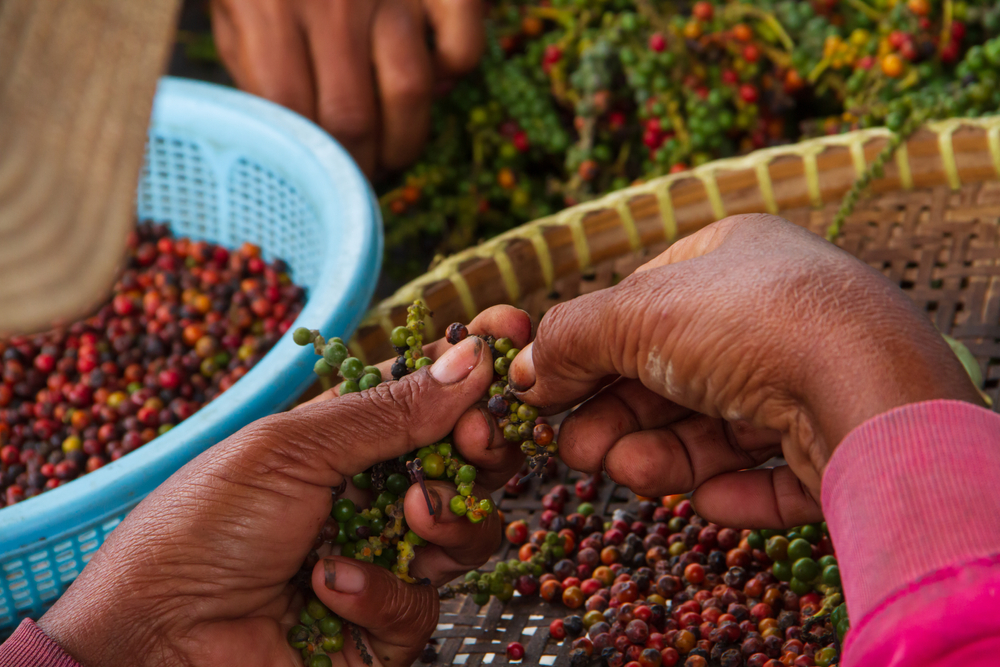
Working in a pepper field in Kampot, Cambodia

With the festive season upon us, it’s time to start cooking with some gourmet ingredients and to pop a few celebratory corks.
But what about using the champagne of pepper?
New Zealander George Norbert-Munns spent a decade living in Cambodia, where he discovered the flavours of the Kampot pepper. He now runs his spice business near Dorchester.
Kampot pepper cultivation dates back to the 14th century, and it is one of the finest ingredients in the world. Highly sought after by chefs (and therefore an ideal gift for foodies), it’s little wonder it was the inspiration for George to set up Stony Groves.
‘There is pepper … and then, galaxies away, there is Kampot pepper! It can only be produced in one small and stunningly beautiful region of steamy southern Cambodia, which is known to have produced peppercorns for centuries. ‘It is farmed using traditional techniques and produced on a relatively small scale. Worldwide pepper production is measured in hundreds of thousands of tons per annum, whereas only 100 tons of Kampot pepper is produced each year.’
Strictly controlled production ensures its quality, retaining its international reputation. Among chefs it is known as being the finest pepper in the world.

New Zealander George Norbert-Munns spent a decade living in Cambodia before moving to Dorset and launching Stony Groves


‘After almost ten years living in Cambodia, we knew that Kampot peppercorns were the finest around. In fact, Kampot pepper has been granted Protect Geographical Indicator (PGI) status, which formally recognises its quality and excellence and effectively makes it the champagne of the pepper world. So when I set up my own business, pepper seemed the right place to start. I began by offering black, red and white Kampot peppercorns alongside fragrant long pepper, which has a richer, almost Christmassy smell.
‘I launched Stony Groves at the Dorset Food and Arts Festival in Poundbury in 2021 and was immediately blown away by the positive reaction. Since then we’ve extended to food festivals right across the UK and also offer salts, smoked products, grinders and spice blends.
‘The blends were inspired by my love of cookery. As a child, I loved nothing more than being in the kitchen with my mother in Christchurch, New Zealand. In fact she loves pepper almost as much as I do! I’m still very much the cook at home and I relish experimenting with new flavours. And now I enjoy introducing them to my own children.’

Pepper fields in Kampot Province of Cambodia

Powerful pepper
Since leaving Cambodia, George has made Dorset his home – and discovered the vibrant foodie scene in the county.
‘After many years as an owner/operator of bars and restaurants in Phnom Penh (Cambodia’s bustling capital), my wife and I felt it was time to move on, start a family and enjoy a more relaxed pace of life. We chose Dorset to be near to her parents and because of the beautiful countryside. When I first moved to Cambodia in 2010, I’d originally looked into starting a pepper business, but life led me in a different direction. I revisited the idea during the long days of the Covid lockdowns – and Stony Groves was born.
‘I quickly found that south west England is a foodie paradise, with plenty of amazing markets and food festivals to explore. But I also saw that there was a lack of awareness here about the powerful pepper that we’d long enjoyed in Asia. I felt the two could be a match made in heaven, and I also hoped to share my love of quality ingredients with a wider audience – whether that was in people’s kitchens or in restaurants or cafes here in the UK.’
However, it’s not just the food. George and his family love the Dorset countryside.
‘Living in the countryside again reminds me of when I was little. My three brothers and I used to drive around Castle Hill, deep in the Southern Alps of New Zealand, in our father’s old Land Rover … sometimes doing things we probably shouldn’t. One day the gear-stick broke so we drilled in a screwdriver and, voilà, we were back on track! One of us steering, one of us changing the gears, one of us on the pedals and one of us giving directions. We were a disaster waiting to happen, but what fun.
‘Now I enjoy long Dorset walks with the dog, fishing the rivers and sea, and being located in striking distance of so many lovely towns, villages, beauty spots and food havens – there you have it, heaven!’
Most of us have probably been to food festivals and markets, bought a new ingredient, and then wondered what to do with it. There shouldn’t be that issue with Kampot pepper, there is a lot of inspiration on the Stony Groves website (including an incredible-sounding mulled wine recipe, for those looking for a seasonal winter warmer …).
George also has a top personal recommendation:
‘I’m a big fan of prawn linguine with fresh Kampot peppercorns. Start by melting some butter and gently frying an onion. Get the linguini on, then add king prawns to the onions. Once almost cooked, add the garlic, white wine and a little bit of Japanese rice wine. Plate with olive oil, grated parmesan, parsley, and our pink Himalayan rock salt. Finally, and most importantly, throw in at least a dozen of our Stony Groves Salted Fresh Kampot Peppercorns. Job done.’

Santa’s coming to Shillingstone Station!

0

Shillingstone Station will be welcoming Santa on his annual visit to the station on Sunday
17th December, between 11am and 3pm. Every year Santa stops by to catch up with his friends at the North Dorset Railway.
All children are welcome to come along and meet Santa, and receive a Christmas Gift but as Santa is so busy you will need to make a booking to see him, either by visiting the Station or by calling 01258 860696 – £4 per child.
You are also very welcome to look around the station, its rolling stock and museum, and visit the café and shop, where there are many railway-related products available to buy – perhaps that will take care of a couple of people on your present list?

  • The Station is open as usual on Wednesdays, Saturdays and Sundays, 10am to 4pm.
    All proceeds in aid of North Dorset Railway.

If you can hang it on a wall, we can frame it!

0

As Douglas McLeod Period Frames enters its fifth decade in Salisbury, Gay Pirrie-Weir finds out the essentials of the perfect picture frame

There are more than 2,000 frames in the Mcleod’s workshop – All images: Courtenay Hitchcock

You might be the keenest fan of Fake or Fortune, but have you ever thought about the frames that are carefully removed and set aside before all that “provenance” is explored? Nor had I, until we were sent to “the only place” in Salisbury to get an engraving framed – Douglas McLeod Period Frames in Trinity Street. The shop is a treasure trove of wood, metal, composite, papier maché, plaster and even plastic with which to surround your precious wall hanging, priced from something in the £1 job lot box to a huge and magnificent gilded frame, currently on offer for £8,500.
If you have ever, anywhere, seen a frame that has caught your eye for its intricate detail, its carving, its colour, its unusual texture, its age or its subtly enhancing suitability, the chances are that the specialist business in the back streets of the city has something like it – and if they haven’t they can replicate it in the hidden workshop further out of the city centre.

Douglas McLeod Period Frames on Trinity Street, Salisbury

The business was started on 5th October 1982. At that time, the UK’s only specialist historic framing services were based in the capital, where the major auction houses still organised sales exclusively for frames and “runners” scoured provincial salerooms and fairs to snap up bargains and “run them past” the specialists, en route to potential purchasers.
If you had a family heirloom portrait or landscape, the chances are it had a significant frame, and some were much more “significant” than others, dating back centuries, created by famous craftsmen and worth far more than the pictures they edged. And one of these treasures might just turn up on the parlour wall … or even in the attic.
Douglas McLeod continued with his international architectural work, but in his ‘spare time’ taught himself the historic skills of gilding and restoration, carving, moulding and all the arcane mysteries associated with the ancient craft. Some of the formulae he uses originated in the 17th century and are still closely guarded secrets.

‘You can always use a frame that is older than the picture’

After a spell in Saudi Arabia designing houses for expatriates, Douglas shifted his focus towards the framing business. He had always loved old frames – he bought them from local auctions, and customers began to arrive in the shop with battered, but sometimes beautiful, frames they found at home and were reluctant to take to the tip. People who wanted frames came in, and came back again and again, always impressed by the range of frames they could see and buy and the experienced advice they received. Douglas and his staff learned new skills, perfected those they had and acquired new tools, templates and other gizmos.
As the years went on, wife Susie and son Alexander, daughter Kate Robson and her husband Barry, and Andy Hollywood, (who, at 62, describes himself as the world’s oldest apprentice … although he is also a plumber, bus driver and multi-skilled factotum), all joined the family business. There’s also the indispensable lurcher Grace, ready to greet shop customers.
After leaving London, the McLeods set up a gallery at Dunn’s House in Salisbury, moving on to a rented shop at 10 Trinity Street and eventually to the current shop, which they bought as a home and business in 2000.

The Salisbury framers has a £1 job lot box, and gilded frames worth thousands. Whatever frame you’re looking for, it’s probably here

Some are keepers
Forty one years on, Susie is proud to say that the shop really does have something for everyone, from the granny wanting a plain black frame for a football team picture to the owner of a noted painting with a damaged frame from a grand stately home.
The Trinity Street shop is an inspiration in itself – but there are more than 2,000 frames in the workshop, where Douglas and his assistants will restore them as closely as possible to the originals. Some are so precious they will never be sold but will be cherished as examples of a particular style or process. Customers come not only from Salisbury and Wiltshire, but all over the UK and further afield.
Historically sand was used to enhance the texture of a frame – a technique Douglas thinks might have begun in ancient Egypt. A “sanded” frame was brought to the shop, three sides intact but the fourth beyond repair. A sand search was promptly instigated, and after forays to various local beaches, Douglas and Susie found that the sand at Hengistbury Head near Christchurch was the closest match. Even that wasn’t enough – Susie had to sieve the sand to isolate the correctly-sized grains.
‘That’s a labour of love,’ she says. ‘You can’t get rich doing that sort of work, but it’s worth it.’
Another favourite antique frame has little raised blobs of gilded something? – ‘Seeds,’ says Susie.

Douglas McLeod in his Salisbury workshop

Some artists, Whistler and Watts among them, were very definite about the style and material used to frame their works, and the style of frame they designed now has their names. In the shop you can see examples of these as well as original, reproduction and modern frames with the very latest conservation techniques.
Douglas has various gilding processes to match original colours and to suit the woods and materials of the frames. He has used gold leaf, but there is less call for it now that the price of gold has skyrocketed.
Susie and her staff have taken in many unusual items for framing, from the familiar oils, watercolours, etchings, engravings, drawings and photographs, to fabrics, treasured clothes, locks of hair and badges.
McLeod frames have been loaned to film and television companies and, more often, to college students as props.

In the shop, stacked frames wait for new homes


‘One student came in with a chicken’s heart in formaldehyde for us to frame. It was LONG before Damien Hirst,’ says Susie.
The company has done work for the National Trust. Large and grand development projects often bring interior designers to the shop, in search of a number of frames to lend a theme to the required decor.
One of the oldest frames in the shop is a silver oval mirror dating from the 1680s. Douglas also has a frame from the mid-18th century which he is convinced originates in a French royal residence – ‘But I can’t prove it,’ he says, regretfully.

Susie McLeod with Grace, the best shop assistant

While he and Susie nod to the passing of time, there’s absolutely no talk of retirement, and while new equipment is constantly being added in the workshop to ease the creation of more accurately matching framing materials, they know that there is no substitute for painstaking traditional skills.
‘One thing to remember is that you can always use a frame that is older than the picture. It’s often not so successful if you try to do it the other way …
But if you can hang it on a wall, we can frame it,’ says Douglas.

The workshop is the scene of constant experimentation

Recipes from Acorn House Bakery

0

Helen’s original home baking is inspired by memories of her Guyana-born mother and infused with the rich colours and flavours of the Caribbean

Be your own Bake Off star this Christmas with a choice of delicious recipes from Wincanton baker Helen Hermanstein Smith of the Acorn House Bakery. Helen, whose cakes are sold direct to customers and at Coles Yard, the Wincanton greengrocers and whole food shop, has lived in the town for many years and has built up an enviable reputation for her delicious cakes, some of which recall the Guyana heritage of her parents, who came to England in the late 1950s. Now she is sharing her baking creativity in her first book, The Acorn House Bakery Recipe Book.
A gorgeous-looking Caribbean Rum Fruit Cake is one of the recipes handed down to Helen from her mother, who made the cake every Christmas and for other celebrations.

A winding route to the kitchen
Helen was born and brought up in south London, in a large household where she remembers her mother and grandmother baking bread and cakes. Work and marriage took her away from the kitchen, and she worked for a publishing company, spending three years in Hong Kong with her husband Derek while their two children were very young.
Back in London, she completed an MBA and worked in tech for several more years before changing direction and retraining in patisserie, bread baking, cake decorating and chocolate-making at Westminster Kingsway College and Le Cordon Bleu School in London, eventually going on to become a qualified baker.

Helen and Derek lived in London but had a country get-away in Wincanton. They eventually decided to move full time to Somerset, and this was the perfect opportunity for Helen to focus on her baking, particularly in making and decorating celebration cakes, cookies, chocolate and confectionery.
A few years ago, she began to make an organised collection of her tried and tested recipes, both from her childhood and from her professional training. Her mother’s influence has continued since her death a couple of years ago: ‘It was in baking that I sought solace, not only to help deal with my grief and loss, but also to bring back many happy memories of our times baking together.’
In 2021, she set up Acorn House Bakery at her home, specialising in luxury treat boxes filled with personalised artisanal cookies, chocolates and fudge. Two years on, the range has extended to include her own-recipe artisanal jams, marmalades and chutneys, using locally grown produce and fruit from her own garden.
Now collated into her first book, Helen’s recipes range from savoury to cakes to confectionery and special treats such as a sophisticated gin and tonic lemon drizzle cake or locally inspired Somerset cider apple cake. The savoury recipes include the utterly moreish Parmesan shortbreads. One of the most inviting is the almond and apricot flan pictured on the book cover!
Baking has always been a family affair for Helen – and it still is. She says: “Derek and our children Charlotte and Adam love baking and cooking too. Sadly, it’s a bit of a competition between us – but I’m the master baker!’

  • The Acorn House Recipe Book, price £14.99, is available at Coles Yard and Paper Trees in Wincanton, at Stripy Duck bookshop in Bruton and Bailey Hill Bookshop in Castle Cary.
    Contact Helen on the Acorn House Bakery website or find her on Facebook @AcornHouseBakerybyHelen