Formerly of Hampreston for 20 years, and moved away to be closer to family.
Passed peacefully away on 10th January at home in Croxteth, surrounded by his family
The funeral has already taken place, but the family ask that if you knew Graham and wish to make a donation in his memory, please give to the British Heart Foundation.
New year, new developments at Thorngrove: January sees the unveiling of the renovated cafe and a host of garden plans and events
A sneaky peek into the building of Thorngrove’s Winter Woodland experience
2024 is in full swing and we’re not slowing down here at Thorngrove in Gillingham. The garden centre reopened on 3rd Jan, but regular followers may have noticed the café remains closed. Fear not! It’s only for a short while longer as the café undergoes some exciting refurbishments of kitchen facilities and out front of house. Ben, manager of The Secret Garden Café, had this to say about the upcoming reopening. ‘The team and I have welcomed returning customers, and seen many new faces through 2023, and during that time we always receive lots of fantastic feedback. Our vision is to increase what the café offers, while continuing to provide a relaxing, inviting, and hassle-free setting to catch-up with friends and enjoy our diverse menu. We believe we offer something unique to the area and we can’t wait to welcome people back through the doors of the café when we reopen on Monday 15th January with new changes, and of course, a new menu.’ Be sure to stop by after the 15th to sample the new menu. We look forward to showing off the hard work that’s been happening behind the scenes! Our café will also continue to function as an environment for our Employ My Ability (EMA) students to gain valuable work experience in a real-world setting. Across EMA, we’re all very excited by the updates coming to the café. If you stop by this year and enjoy your visit – please do consider dropping us a five star review on Google. In today’s world of online shop windows, it really helps, possibly more than you’d imagine!
Garden plans Have you set your garden goals for 2024? It’s that time of year when many of us make plans and set our New Year resolutions – but even while much of your garden is lying dormant, you can take this opportunity to sketch out some new ideas and goals for your garden this year. Even if it’s just ‘add a new flower’. Perhaps a fruit tree, or making sure your tools are clean … and of course don’t neglect the wildlife! We have a wonderful range of birdfeeders and bird food that will ensure the promotion of a healthy environment. Nothing beats the sight of a returning robin or the noisy tsurping of a large group of long tailed tits arriving. Make your garden a haven for the birds – across the garden centre, our beautiful selection of seasonal plants are on hand to bring some vibrancy to your home or garden this winter. With a few January sales in the shop (25% off all houseplants, and 50% off all Christmas decorations), there’s plenty of reasons to stop by and see us this month. Our events calendar continues to grow – visit our website today and check out the ‘Events’ section for news on workshops, crafts for children and more. We wish everyone a brilliant 2024 ahead, and we look forward to seeing you soon!
In the first of 2024’s BV podcast we have all the January letters and politics, and Jenny talks to Fanny Charles about the planned creation of the new Bonham Forest near Stourhead – and the furore it has created locally.
Editor Laura Hitchock is looking for reasons to be cheerful during the longest month of the year
The Reader’s Letters this month include some wonderful memories of Iwerne Minster, triggered by last month’s vintage postcard which happened to show the very house the writer had grown up in, back when the village had a whole range of shops and enjoyed hourly double-decker buses (You can see the original postcard – from the Barry Cuff Collection – including the message on the back here).
Simon Hoare MP is sharing a little spring optimism and his hopes for what this new year might bring
Ken Huggins of the North Dorset Green Party uses a very personal recent experience to look at the need to invest in the NHS
Gary Jackson of the North Dorset LibDems is looking forward with optimism, and hopes of a General Election bringing a fair change
North Dorset Labour’s Pat Osborne talks about the need for Britain to become energy-independent
And Jenny sits down with Fanny Charles to look at the pros and cons of the new Bonham Forest plan at Stourhead, which is causing major ripples in the local community.
You can read the full January 24 issue of the BV magazine here – jam-packed with incredible Dorset folks doing magnificent things. There’s also farming, wildlife, a huge Dorset food & drink section… and if you like glorious photography you’ll be a fan. Did we mention it’s FREE?
With the seasonal excess, extravagance, sugar and waste firmly in the rear view mirror, our thoughts often turn in January to how to eat more healthily, and how to lower our carbon footprint. So this month I’ve picked two splendid titles that will help us do that – and save some money in the process. Happy New Year! Wayne.
Unprocess Your Life – Rob Hobson
January’s traditionally the time to re-evaluate what we eat. Following on from a year that saw the success of the book ‘Ultra-Processed People’ by Chris van Tulleken, the nutritionist Rob Hobson looks at our intake of food from another angle and examines the way ultra-processed food items can make up at least 50 per cent of the average family’s weekly shop. The term ‘ultra processed food’ doesn’t only include the obvious candidates like sweets and ready meals – so often a ‘healthy’ cereal or fruit drink falls into the category. So many things we eat have been through a multitude of procedures and places before we see it, even if we assume from clever packaging that it’s fresh. As our relationship with food convenience and cost evolves, this can be less obvious to spot. Helpfully, this book has an excellent breakdown of the official NOVA system of categorisation from the United Nations’ Food and Agriculture Organisation. There are useful FAQs answered and then some really useful information on buying and storing various foods. The recipes are really well laid out – straightforward, with appealing photographs of what you could be making to eat this year. The roasted red pepper, pesto and hot sauces are all particularly tempting, along with the spiced aubergine stew, not to mention the sweet potato brownies and the orange, cardamom and honey polenta cake!
The Green Budget Guide: 101 Planet and Money Saving Tips, Ideas and Recipes – Nancy Birtwhistle
Saving money doesn’t have to cost the earth. How can you remove even the toughest stains? How can you make the best use of your microwave but keep meals healthy and tasty? How can you remove mould safely? Sunday Times bestselling author and Great British Bake Off winner Nancy Birtwhistle is here to answer all of these questions and more, featuring 101 thoughtful, cheap and time-saving tips and tricks on how to run a budget and home, all while protecting the environment
Dorset’s forgotten ordeal: Rupert Hardy explores the impact of Barbary pirate invasions on local seafaring and family histories
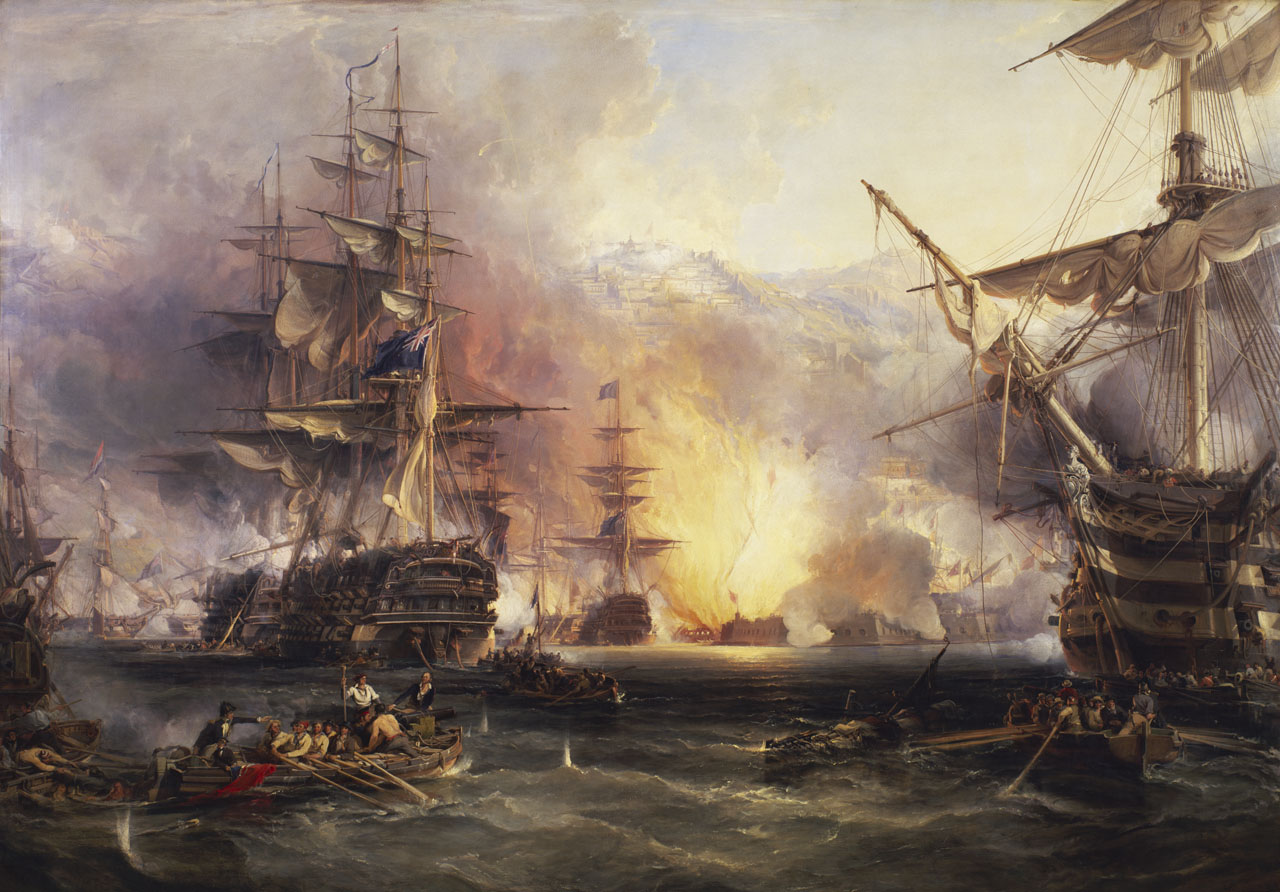
The Bombardment of Algiers, 27 August 1816 by George Chambers
In recent years, many have focused on the iniquities of the transatlantic slave trade – but it is often forgotten that for more than 300 years, Dorset, Devon and Cornwall were at the mercy of Barbary pirates from North Africa. Countries as far north as Iceland were attacked, with the west coast of England a particular target. Estimates of the slaves taken from Europe between 1530 and 1780 total well over a million men, women and children. The story is a complex one and most of these ‘pirates’ were actually privateers or corsairs, operating under the mandate of sovereign states. Their existence owed much to the rise of the Ottoman empire, which expanded rapidly in the 16th century, threatening Europe. Privateers were effectively part of the Ottoman navy, checking all shipping and enforcing trade agreements. Their aim was not just to capture valuable merchandise and slaves for the slave markets in North Africa, or to ransom their captives – they also paid tax on all the assets captured. It wasn’t just North Africans – privateers included English and Dutch nationals who had fallen foul of their home countries. One of the most infamous was John Ward, who led a mass desertion from King James I’s navy in 1604. He is said to be the inspiration behind Johnny Depp’s Captain Jack Sparrow. The Christian propagandists liked to convey a picture of dreadful deeds committed by Muslims, with no mention of the part that Christian Europe played. In the 16th century, the Knights of St John in Malta were attacking Ottoman ships and selling Muslim slaves. They were effectively privateers too.
West Country attacks The impact of the raids on England by Barbary corsairs was noted from the late 16th century – partly as a result of an ineffective naval deterrent. The situation was so terrible that an entry in the British Calendar of State Papers in May 1625 stated: ‘The Turks are upon our coasts. They take ships only to take the men to make slaves of them.’ Barbary corsairs raided coastal villages as well as ships out at sea. In August 1625, corsairs raided Mount’s Bay in Cornwall, capturing 60 men, women and children. It was feared that there were around 60 Barbary men-o-war stalking the English coast the English coast. The situation was so bad that in that same year Charles I sent a mission to North Africa to try to buy back 2,000 slaves – it was reported that there were up to 5,000 English people in captivity in Algiers alone. Charities were also set up to help ransom the captives and local fishing communities clubbed together to raise money to free their own. In 1645, another raid by corsairs on the Cornish coast saw 240 men, women and children kidnapped. The following year Parliament sent Edmund Cason to Algiers to negotiate the release of English captives. He paid around £30 per man (women were more expensive) and managed to free some 250 people before he ran out of money. By the 1650s the attacks were so frequent that they threatened England’s fishing industry, with fishermen reluctant to leave their families unprotected ashore when they put out to sea.
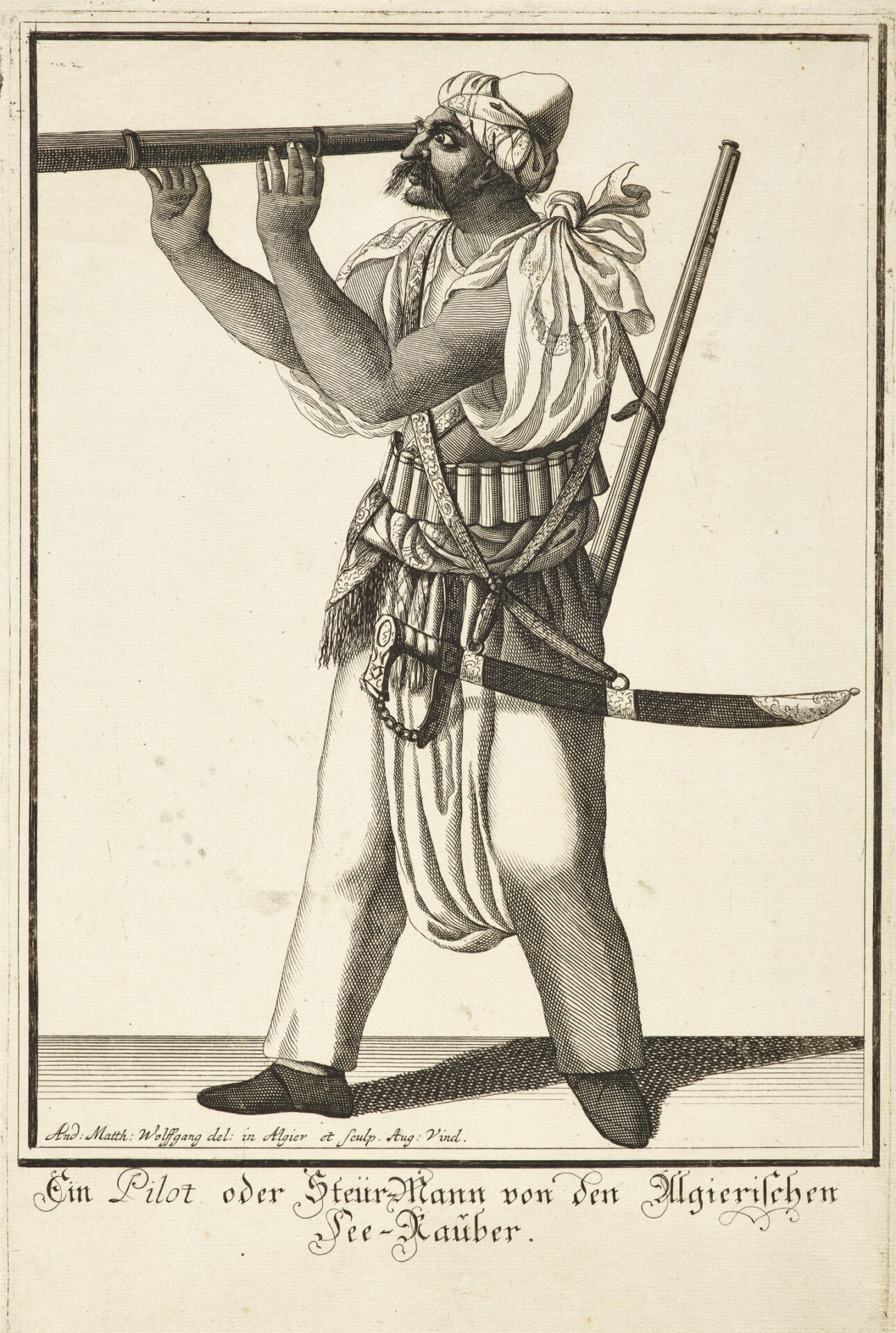
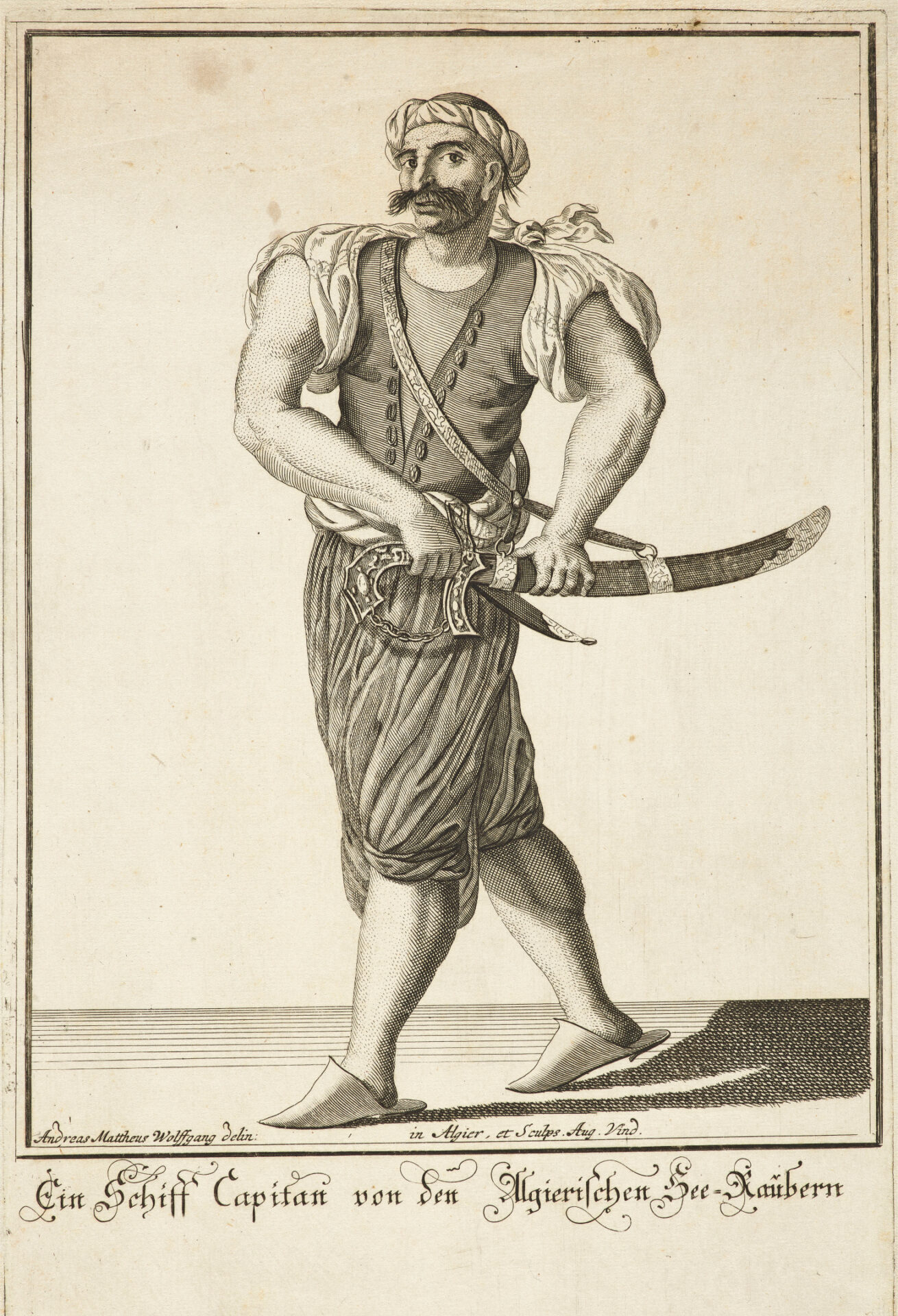
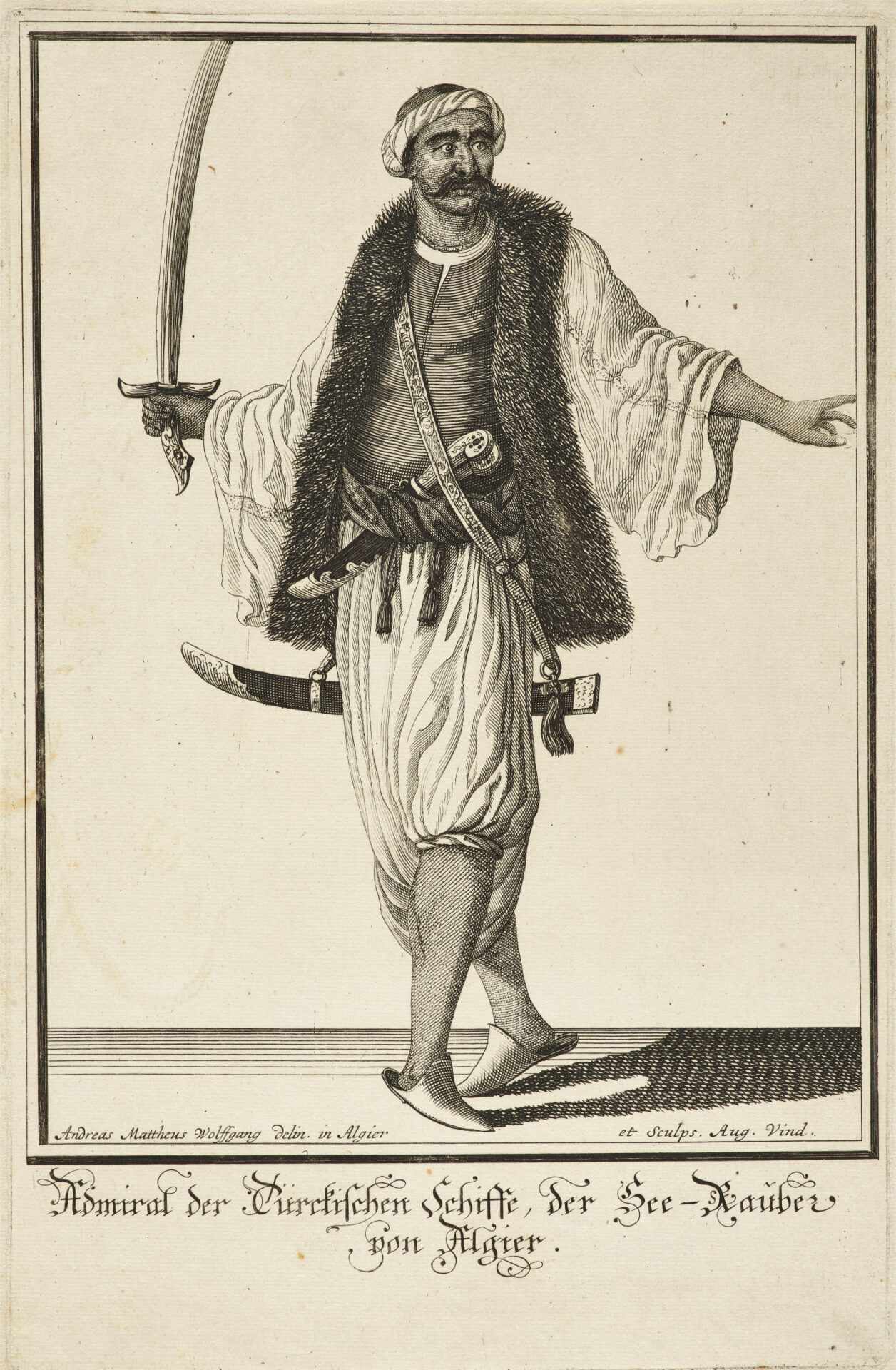
These images are from a series by engraver Andreas Matthäus Wolfgang, who trained with his father and then, with his brother Johann, in England. On their return trip in 1684, the brothers were abducted by pirates and taken to Algiers where they were sold as slaves. They were only released, around 1691, after a ransom was paid. The series can be seen in the Lichtenstein Collection here – left is a Captain of an Algerian pirate ship and right is an Algerian pirate steersman.
Dorset Although the situation was worse in Devon and Cornwall, Dorset was hit too. In the 1620s the Mayor of Poole reported that 27 ships and 200 sailors were seized off the Dorset coast in a ten day period. There are documents in Lyme Regis Museum listing a number of mariners taken captive in the 1670s, and the large ransoms paid to free them. The Dirdoe family of Gillingham were also affected – two male members of the family were captured in 1636, but one was freed the following year thanks to the Admiralty organising a small fleet to rescue them and others. Oliver Cromwell declared that any captured “pirates” should be taken to Bristol and drowned. Lundy Island, which corsairs had made their base, was attacked, but despite this, they continued to raid coastal villages. There is a vivid account of the trade in Samuel Pepys’ diary in an entry from 1661: “Went to the Fleece Tavern to drink; and there we spent till four o’clock, telling stories of Algiers, and the manner of the life of slaves there! And truly Captn. Mootham and Mr. Dawes (who have been both slaves there) did make me fully acquainted with their condition there: as, how they eat nothing but bread and water. … How they are beat upon the soles of their feet and bellies at the liberty of their padron.“
The slave’s lot The ruling pasha had the right to claim one in eight of all Christians captured. The men were mostly used to row the slave galleys, but in winter they worked on state projects, such as quarrying stone or building new galleys. They were fed on bread and water, with only one change of clothing each year. The pasha also bought most of the female captives, who were either taken into the harem or ransomed. Slaves were of any skin colour or religion, but those who converted to Islam were normally saved from rowing the galleys. The rich were usually ransomed, while the poor would end their days dying of starvation, disease or maltreatment. Some have argued that North Africa was more of an interfaith-tolerant society than Christian Europe. Ending the trade There was no formal system for ransoming slaves until after 1640, when the Catholic clergy played the biggest role in repatriating the captives (the Protestants were more disorganised). Many countries found the best response was to pay a subsidy to the Barbary States – Morocco, Algiers, Tunis and Tripoli. Eventually in 1675 Sir John Narborough, with a Royal Navy squadron, managed to negotiate a peace with Tunis. A naval bombardment by the British then brought about peace with Tripoli. Algiers was attacked not only by British warships but also by the French and Spanish. The 18th century saw reduced corsair activity, partly as the Ottoman Empire was on the retreat. But then the upheaval in Europe caused by the French Revolution triggered renewed attacks as the respective European navies were busy fighting each other instead. After Napoleon’s defeat, the focus shifted back to suppressing the corsairs. Even the United States fought two wars against the Barbary States. After a formidable final attack by the British and Dutch on Algiers in 1816, more than 4,000 Christian slaves were liberated and the power of the Barbary corsairs was mostly broken. It did not end until France’s colonial occupation of Algeria in 1830.
Andrew Livingston highlights a recent Channel 4 documentary exposing the concerning food safety and standards at a Bernard Matthews’ factory
Talking turkey in January is probably a bit of a sacrilege. Mind you, if you are actually still eating a Christmas leftover turkey, brie and cranberry sandwich as you read this, I would be seriously concerned about your oncoming bowel movements! Despite its synonymity with Christmas, turkey is, in fact, available all year round – most children grow up eating breaded frozen turkey, probably in the shape of a dinosaur (although I’m thrilled to report you can now buy turkey unicorns too!) One of the biggest producers of turkey in the country is Bernard Matthews. If you’re over 45 you’re probably already hearing a throaty Norfolk voice booming ‘Boootiful’ from your TV set. If you’re younger and denying all knowledge … where have you been? For a start, I know you know the turkey dinosaurs. The firm also employs more than 2,000 people at its farms and factories, most of which are in Norfolk. My reason for talking turkey today is simple; I feel as though the news that broke last month about Bernard Matthews just didn’t make the noisy splash it definitely should have done. On 8th December, Channel 4 aired How Safe is your Turkey? In its dispatches series. The 30-minute documentary included under-cover footage from inside Bernard Matthews’ Suffolk-based factory.
Utterly inadequate As a farmer, I hate it whenever programmes like this are shown – in almost every case the featured farmer (or farmers) is labelled as cruel or at very least uncompassionate and uncaring for the welfare of the animals. It is only ever true about a tiny, tiny minority, but naturally they grab the media’s attention. This programme, however, was different. Rather than animal welfare, the reporters investigated food hygiene and standards within the factory where the birds are butchered and processed. I have worked in the turkey industry and I have been around factories of similar size and scale. I was shocked with what the footage showed. Inadequate training, inadequate food hygiene, inadequate equipment and testing. We clearly saw food contamination from the factory equipment, with bits of blue plastic mixed in which food that it on its way to be sold on supermarket shelves. Staff were even seen falsifying records to say that meats were correctly frozen to be safe for consumption. The most shocking moment came towards the end of the 25-minute programme when a worker gets their fingers caught and crushed in an operating machine. You can see the full episode on YouTube (video above) – it is worth the watch.
Not what Santa ordered Since its release, the Bernard Matthews company has hit back. A spokesman told The Grocer that Channel 4 ‘set out to create a food scare where none exists’. The company was founded in 1950 when Bernard Matthews (the man) bought 20 turkey eggs and an incubator from a farm auction. He had a dream of making turkey affordable for the masses at Christmas, and his bussiness year on year. Mr Matthews died in 2010 and, in 2016, the company was bought by Ranjit Singh Boparan, founder and owner of 2 Sisters Food Group – the second largest poultry producer in the country, after Moy Park. To be frank, it’s not bootiful – and it’s not good enough.
Pauline Batstone shares her monthly round up of what’s happening among the town’s collection of community enterprises and events
Thank you everyone for your support with the ‘Make Stur Sparkle’ events, which SturAction helped to underwrite – we are already planning for next Christmas …
1855
The next main event in town is the Wedding Festival starting with a display of wedding dresses in St. Mary’s Church on Friday 2nd and Saturday 3rd February. The Wedding Fair itself is in The Exchange on Saturday 3rd February from 10am til 3pm, and is free to attend. For more information on the fair please email [email protected]
The FREE school uniform exchange inside the old Barclays Bank
The Car and Bike Enthusiasts will also be in town on the 3rd and there will be free parking on that first Saturday of the month, paid for by SturAction from funds raised by your support to our community shops.
There’s a sale on at The Furniture Store
The Boutique is restocking after its pre-Christmas sale of posh frocks; come and treat yourself to a new look! The Emporium, Art Gallery and Dapper Chaps continue to be bursting with a range of fascinating things at knock down prices, and The Furniture Store is holding a sale. Time for a fresh new look for your home as well, perhaps? There are some amazing bargains so do come and look – yes you can afford it … Upstairs in the Furniture Store is the free school uniform exchange. We have enough school uniforms for a host of children, all sizes and pretty much all local schools.
The new season is in at the pre-loved Boutique!
1855 is proving a great attraction to the town, as we always hoped it would be. More than 80 traders means a constant turnover and something new every day. SturAction is your local charity, working to make Stur a good place to live, work and play – our only aim is to raise funds to invest in the town. We are always looking to welcome more volunteers to work as part of our family, whatever your skills. Can you spare even an hour a week? Please get in touch with Cheryl, our shops manager for a chat. She’s usually found in 1855 or via [email protected]