William Barnes, the beloved Dorset dialect poet, left a rich legacy that now resides at the Dorset History Centre. The William Barnes Society has launched a fundraising campaign to ensure that his extensive archive remains accessible to all. When he died William Barnes bequeathed his writings, poems, letters, sermons, woodcuts and engravings to the County Museum that he co-founded in the mid-19th century. Today, the collection requires the expertise of a professional archivist to be properly catalogued, and the Society aims to raise £35,000 to fund this critical work, making Barnes’ contributions available to a global audience. As part of the campaign, a series of events will be held, including the revival of The Year Clock, a play about Barnes’ life, written by Society Vice President, Tim Laycock. Claire Dixon, Executive Director of the Dorset Museum & Art Gallery, supports the project: ‘William Barnes is an important part of our story. Cataloguing this collection will connect more people with his work and life. We’re excited to collaborate with the Dorset History Centre and the William Barnes Society on this essential project.’ The campaign also has the backing of Sir Andrew Motion, former UK Poet Laureate and President of the William Barnes Society. Sir Andrew noted that his own published selection of poems by William Barnes (Penguin, 1984) would not have been possible without access to the Barnes collection. Details about ways of donating can be found on the Society’s website williambarnessociety.org.uk
Back when Sturminster Newton held its first Cheese Festival in 1999, there can’t have been many who envisaged its popularity being so long-lasting that it would celebrate a 25th anniversary. “It’s a perfect day,” said volunteer Steve Lewis, busy running the popular wine bar. “It’s absolutely rammed but last year it was too hot, the year before too wet, and then in 2021 we were coming out of COVID. Today is perfect!”
Crowds enjoying the sunshine at Sturminster Cheese Festival. Image: Rachael Rowe
Outside, crowds gathered around the band stage, a glass of beer or cider in hand, relishing the warmth of the September sun. There were lines for the popular food stands – this year, the longest queue was probably for the Greek Souvlaki and Gyros stand where two cooks worked frenetically … yet somehow appeared completely chilled out as they kept up with relentless orders. It was a similar scene at the Westcombe Cheddar toasted sandwich stall and Purbeck Ice Cream. Considering there were at least two other foodie festivals within a short drive, people had clearly chosen Sturminster Newton: and for good reason.
Greek Gyros stand at Sturminster Cheese Festival. Image: Rachael Rowe
Inside the enormous food marquees business was brisk, with producers highlighting classic ranges and new items. People had clearly come for the cheese … and particularly the samples. Dense crowds gathered around all the stalls, sampling and chatting to the producer. And so others didn’t miss out on a cheesy sample, some visitors devised a system, passing pieces back to friends in the crowd. Feltham’s Farm, Lyburn Farmhouse Cheese and Book and Bucket Cheese were among the most popular with visitors. The Real Cure was another very popular stall with its tasty salamis and cured meats – and requisite generous samples. Apart from tasting the cheese, there were interesting questions being asked about the produce as visitors took ful advantage of being able to speak to the producers about their work and food provenance. Why is Leicester cheese such a deep yellow? It’s due to a natural dye, Annatto, which comes from a South American plant. It’s been included in Red Leicester cheese since the 18th century.
Enjoying the samples at Sturminster Cheese Festival. Image: Rachael Rowe
Other questions included asking how long Cheddar cheese matured for – and then tasting the difference between the eight weeks and a year-matured versions. Despite the crowds, the producers managed to keep up with both sample demand and all the questions being fired at them by interested, curious customers. Some of the more seasoned visitors had clearly come with a shopping list of favourite cheeses and foods to buy, having savoured the high quality from previous years. The venison produce at Taste of the Wild sold out within two hours of the show opening. One lady at the Bath Cheese stand made a beeline for their delicious soft cheese, exclaiming “I love this one. I always go for it.” Outside the queue at the Greek Gyros stand appeared to be getting longer.
New produce There’s always something new at Sturminster Newton Cheese Festival. On the Weymouth 51 stall – renowned for its chilli sauces and fermented food – the new golden coloured Dorset Fire was eye-catching. Owner Mikka Tamlyn explained: “It’s a probiotic health tonic, best taken before a meal” Made with Dorset Naga, Dorset Wasabi and apple cider vinegar, the taste was surprisingly mild – and apparently is just as good in a gin and tonic as its stated health benefits! While many of the stalls are regulars at the Cheese Festival, this year’s first timers included the Lyme Regis based Black Ven Distillery, which attracted a crowd interested in its British rum. When owner John Tucker found that there were only a handful of true British rums in the UK (with most others being spiced blends), he started distilling, using almost all of his ingredients sourced from the South West. As a first timer iat the Sturminster Newton Cheese Festival, John was clearly impressed: “Its been amazing. A wonderful experience. It’s been the best show of the year for us.”
Crackerdash cheese board game at Sturminster Cheese Festival. Image: Rachael Rowe
The Sturminster Newton Cheese Festival is always about more than food, however. The craft section seems to get bigger each year and 2024 was no exception. Autumnal coloured decorative wreaths, glass decorations, hand crafted leather mules, woodwork, weaving and more filled the tents and space outside. Hampshire-based Crackerdash had an innovative cheese-themed board game where you eat the cheeses as part of the experience (what’s not to like): “We came last year and although it was hot we had a good time. So we’re back again this year but chose an outside pitch where it’s cooler!” As visitors enjoyed discovering new foods and stocking up on old favourites, they gathered with friends over lunch from one of the many food stands. There was even vocal appreciation of the odd wasp: “It’s good to see them. There haven’t been many bees and wasps around this year.” As the Sturminster Newton Cheese Festival celebrates 25 years, it’s wonderful to experience a perfect day sampling some of the finest food produced in the West Country, and see the crowds enjoying a day in the sunshine. The queue at the Greek gyros stall got ever longer… if you didn’t brave it, hopefully they will return next year. Here’s to the next 25 years of cheese festivals in Sturminster Newton.
L-R: Captain Mario Carretta, SP-CC Lauren Dyson, Co-pilot Tom Gee and Dr Tony Doyle
Dorset and Somerset Air Ambulance is thrilled to announce the return of its 100 Miles in October Challenge! Back for a second year, this exciting event invites everyone to support the life-saving service by ‘moving’ 100 miles throughout October. Whether you prefer to walk, run, cycle, swim or hop your way through October, the 100 Miles Challenge is for everyone! You can complete your miles at your own pace, anytime and anywhere. It’s free to sign up and you will receive a complimentary t-shirt to wear once you have activated your fundraising page, so you can look great while clocking up those miles. Plus, there are exciting rewards and a special medal for those who complete the challenge and meet their fundraising goals! Tracy Bartram, DSAA Communications Manager said: ‘Last year, we had hundreds of people join our 100 Miles in October Facebook Challenge Group and it became a brilliant hub of engagement between everyone that was taking part. There were messages of support for each other and photos uploaded daily of people walking, running, stepping, or cycling their miles throughout the month. In total, the event raised an incredible £21,829.03 and we are hoping that this year we can build on that success. With that in mind, we’ve made some enhancements for 2024, including other ways that people can fundraise while taking part and rewards to thank those that do. We can’t wait to see and engage with our supporters as they smile their way through the month and we will be there every step of the way.’ Ready to take on the challenge and support Dorset and Somerset Air Ambulance? Visit: dsairambulance.org.uk to sign up for your 100 miles.
On the weekend of 28th and 29th September, Shillingstone Station will host the Flight Refuelling Amateur Radio Society of Wimborne (FRARS) for the Railways on the Air (ROTA) event. Marking the anniversary of the first steam-powered passenger railway – on 27th September 1825, from Darlington to Stockton – FRARS will be on hand in the signal box, tuning into the airwaves to contact other heritage railways, including Somerset & Dorset lines. There’s also the exciting possibility of reaching out to railways across the UK and even further afield! Visitors to the station can explore many of North Dorset Railway’s projects, including a steam engine undergoing restoration by Project 62, while enjoying the café and shop. Volunteers have been hard at work extending the railway line north toward Sturminster Newton, with significant progress made on restoring the track bed. Once complete, nearly 800 metres of track will be ready for future passenger rides. However, with material costs rising, North Dorset Railway has launched an appeal for funds to support the purchase of the ballast, sleepers and track chairs needed to complete the project. The entirely volunteer-run railway is seeking donations to help bring these plans to life. Donations can be made in person at the station via cheque, card or through their website northdorsetrailway.co.uk. Every contribution helps support this vital heritage site and its role in serving the local community.
Shillingstone Station is open Wednesday, Saturday and Sunday from 10am to 4pm, and entrance is free. Visitors are invited to enjoy the charm and history of this North Dorset gem.
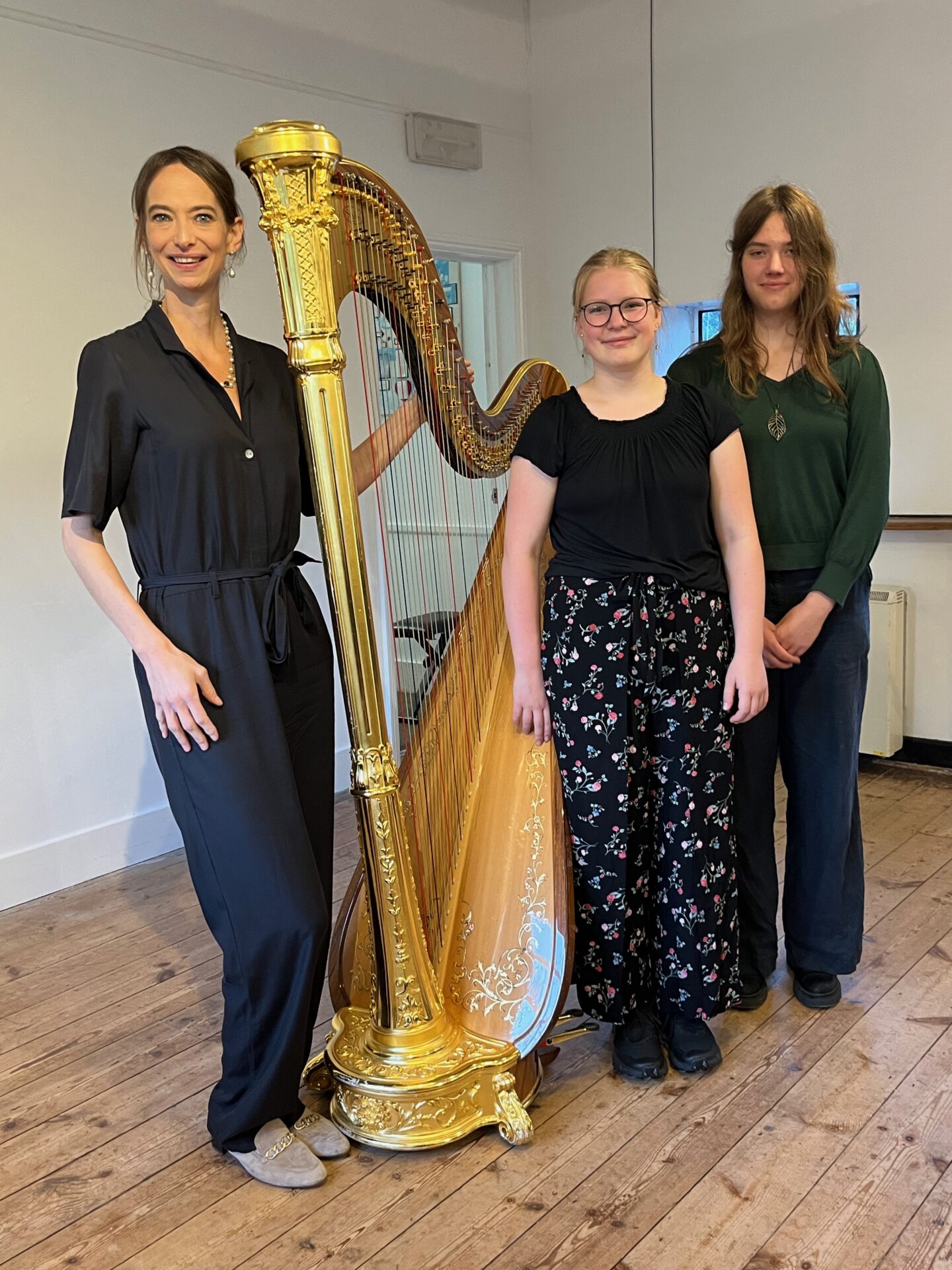
Gwyneth Wentink (left) with students Charlotte Bommas and Nora Dijk
If you are scared of spiders (and I am), the names Black Widow, Red Backed, Dancing White Lady or Tarantula are sure to send you into a near-catatonic state. But when they are the inspiration for an exciting piece of music, composed for the harp and played by an exceptionally talented young harpist, they lose their terrors and become an exciting and enjoyable experience. Charlotta Bommas, a 14-year-old music student, was one of two young harpists who came to North Dorset for a three-day masterclass with the international Dutch-born star of the instrument, Gwyneth Wentink. At the end of the course, Charlotte and Nora Dijk, a 16 year old from the Netherlands, joined Gwyneth for a recital in the Mill Room at Springhead, the environmental arts and education centre based in an ancient mill, set in glorious gardens at Fontmell Magna. It was a concert of delights and surprises, with a programme that ranged from music from the film Willow, arranged for harp and played by Nora, to Charlotte’s interpretation of Spiders and Gwyneth playing an extract from Canto Ostinato, a compelling work by Dutch minimalist composer Simeon ten Holt, arranged for solo harp. Charlotte began playing the harp at the age of five – as did Gwyneth – and showed a mastery of this demanding instrument that was mature beyond her years. Spiders, composed by Paul Patterson, was first performed by Sioned Williams at the Wigmore Hall in 1985. The composer says: ‘The very sight of the harp strings always reminds me of a spider’s web and perhaps the harpist’s hands and fingers could be likened to that of the spider weaving a complicated web. The idea to write a work called Spiders came to me after a visit to Australia where a great variety of spiders are to be found in abundance, and where I was almost bitten by a Red Backed, whose favourite spot is to wait under the toilet seat!’
The four spiders The movements are named after four of the most deadly spiders, says Patterson: ‘The Dancing White Lady is a fast 7/8 movement with lots of crossed rhythms where the sight of legs flying in all directions could be visualised. Sharp irregular motives represent the Red Backed Spider who sits patiently for its prey before it strikes with great speed. In the Black Widow movement, we enter the mysterious world of timelessness as the spider relentlessly weaves its web. The last movement, a tarantella, is a wild Neapolitan dance in triple time. It is believed to take its name from the Tarantula, whose poisonous bite is said to cause a “hysterical impulse to dance”.’ Canto Ostinato, composed between 1974 and 1979 for the piano, is a massive work (lasting up to four hours) which has almost cult status in the Netherlands. It is an intricate piece in which ‘time bends, spirals, loops back, implodes and explodes,’ says Gwyneth, who has made a recording of part of the work*, running to a bit under one hour, which will hopefully introduce a wider British audience to this haunting, complex, beautiful work. In between the music, the three musicians answered questions and Gwyneth gave a brief description of the harp – in this case, a magnificent gilded Italian-made instrument. The ability of the harp to be mesmeric, meditative and calming is well-known, but in these pieces we also heard it as exciting, loud, dramatic, passionate, persuasive or even funny. It was a real eye-opener for many, as well as a welcome illustration of the acoustic qualities of the Mill Room. I am, however, still utterly terrified of spiders. Just not Paul Patterson’s version!
I think a homemade jam makes any cake or scone taste incredible – I will often go that extra mile when making a cake for a friend or loved one. This is my own go-to recipe and one that I repeat often. It’s so simple but does inevitably include Very Hot Sugary Liquid so I’ve included lots of tips to make the process as easy as possible! I often use frozen raspberries from the supermarket (especially off-season) and they work just as well as fresh – you don’t even need to defrost them first – Heather.
Notes before you start: If you are giving this jam away or you expect to keep it for a while, then put your jars through a hot dishwasher to disinfect them before you start. My jam never stays around that long so I just use a big glass bowl! This recipe requires you to stand at the stove for 15 to 20 minutes and stir constantly, so I would get everything ready before you start. Also – boiling jam mixture is VERY hot, so please be careful!
Method
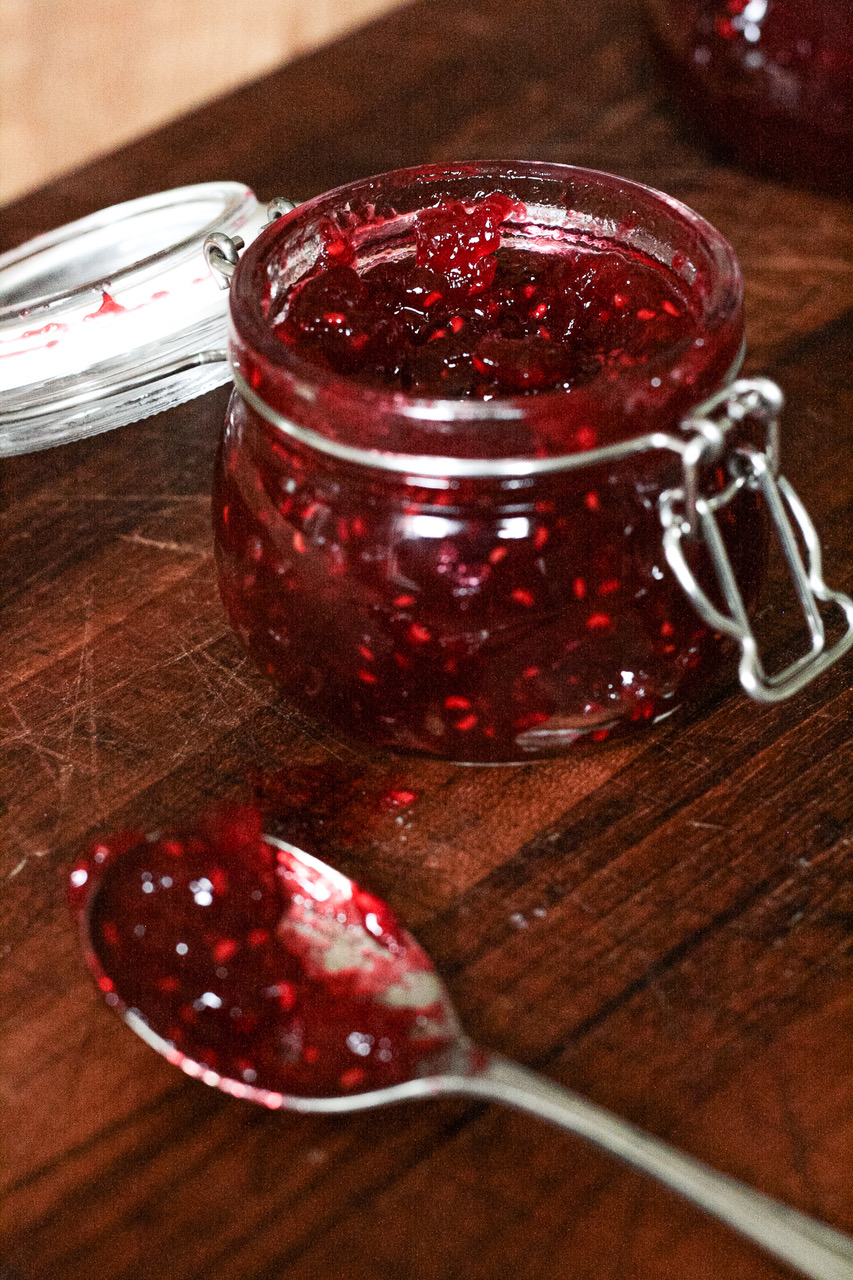
Put your raspberries and sugar into the large saucepan and mix thoroughly. Turn the heat up to high and keep gently stirring as the raspberry mixture heats up. You’ll notice as the jam comes to boiling, that a foamy texture forms on the surface – this is normal.
Keep gently stirring as the mixture starts rapidly boiling (this could take ten minutes if you are using frozen raspberries). Once the mixture begins rapidly boiling and bubbling, it may spit little bits of boiling hot jam from the saucepan – at this point I begin to use oven gloves to hold the spoon so that I don’t burn my hand!
If you stop stirring, the bottom of the mixture is likely to burn … so just keep stirring!
Once the mixture reaches rapid boiling, it will take about five minutes until the jam is done – as you are stirring, keep a close eye on the foamy texture on the top of the jam: you will notice this begin to disappear. Once the foam has gone and the bubbling sound becomes louder, dribble a little of the jam mixture onto the small plate and let it cool for 30 seconds. Then, using your finger or a spoon, move the jam on the plate and see if it is set. If it is still runny, keep boiling for one more minute. If it has set, take the jam off the heat.
I tend to use jam for cakes so I like to sieve some of the seeds out. To do this, carefully tip half the mixture through the sieve into a bowl and, using the wooden spoon, push the jam through the sieve. Then stir the remaining “seeded” jam into the seed-free portion and mix together. Ignore this step if you want all the seeds in the jam!
If you’re using jam jars, pour the warm jam into the jars (beware pouring very hot jam into cold glass jars) and seal.
My background, prior to entering politics, is in small-scale commercial rooftop solar. Not the 50MW utility-scale type project being proposed for near Bradford Abbas. However many of the same fundamentals apply. If we are to avoid the worst ravages of the impending climate crisis, we need to rapidly decarbonise energy generation. That inevitably means more renewable energy – in all its forms. For the UK to meet its solar targets we will need to convert approximately 0.3 per cent of the UK’s total land to solar. That’s roughly half the amount of land currently being used as golf courses. However, we must ensure that the drive to generate clean energy does not come at the cost of food production. At the Wyke Solar Farm the land is predominately grades 3B and 4, theoretically less productive land. But the 430-acre site also contains parcels of the highest Grade 1 land. Taking any productive land away from food production is bad for UK food security. The reality is that making a living from food production is increasingly difficult. Farmers who agree to lease their land to renewable energy developers nearly always do so because the income represents a better future than traditional farming. An alarming state of affairs. We must address how our farmers are paid for the food they produce in order to secure both their future and that of the next generation. If we make farming viable, I’m certain we will stop seeing land given over to solar. The Wyke Solar farm is in its “pre-app” stage. That means no application has been made yet, but that developers, RWE, have begun a consultation process with local residents ahead of making the formal planning submission. People can email RWE or attend the in-person consultation in Bradford Abbas Village Hall at 4pm on 16th September. I will also be meeting personally with the developers to express my concerns. The Council will have their opportunity to scrutinise the plans once an application has been made. Edward Morello MP West Dorset
Steve Masters, Dorset Wildlife Trust’s ecologist, shines a light on the often-forgotten miniature realm of the important bryophyte
Moss has been used by humans throughout history for a variety of purposes, thanks to its absorption and antiseptic properties Image: Steve Masters
Have you ever perched on an old log in the wood, only to find yourself enveloped within a sumptuous rug of moss? Or, paddling in a river, wondered at the creeping green sheets adorning the exposed rocks? Around 1,000 species of bryophytes are found in the UK – representing 58 per cent of the total European species. As such, they contribute significantly to our biodiversity: they are in fact the second most diverse of the world’s plant groups (angiosperms – flowering plants – are the most diverse group). Bryophytes include mosses, liverworts and hornworts. They are the ancient organisms likely to have first arisen from green algae around 450 million years ago in the Ordovician period, a time of expansion for multi-cellular organisms. To identify and understand bryophytes, we need to get up close and personal with them, in some cases microscopically. The leaf structures of mosses and liverworts are often only one cell thick, with a whole host of structures which aid them in photosynthesis and water conservation. Some liverworts take the form of sheets of green fingers creeping across rocks, or miniature necklaces hung about trees.
Sphagnum moss. Image: Vaughn Matthews
Mossy romance The life-cycle of bryophytes sets them apart from other plants. It is two-staged: the leafy part (gametophyte) produces male and female structures which then combine to make a sporophyte. The sporophyte produces spores in a distinctive capsule, which are then dispersed and develop into a new leafy part. Another amazing ability is that of reproducing asexually, which many species do either by simply shedding part of their leaf structure or via specific structures which are shed. Both these and the capsules are beautiful structures, rivalling those of any flowering plant. Bryophytes play a key role in ecosystems across the UK, in many different habitats from grasslands to wetlands to woodlands. In each of these habitats, they often create favourable micro-habitats for other species – for example, conserving water for young seedlings in arid environments, thereby helping vegetation to establish. They help shelter invertebrates, the recyclers of our ecosystems, and create the perfect terrestrial habitats for amphibians. Mosses also provide the ideal cosy nest material for birds and small mammals to hunker down. They are integral components of some of our most precious habitats, such as peat bogs, in our fight to combat climate change. Among the main components of peat bogs are sphagnum mosses, and they perform three essential functions. Firstly, along with other plants, they form the storage vessel in which the carbon is locked. Secondly, they help to hold water within the bog, and thirdly, due to their chemical interactions with the nutrients around them, they create an acidic environment which reduces the decomposition of the plant material, ensuring the locked-in carbon is not released. Without the sphagnum moss component of these communities, the function of peat bogs to store the 500 billion tonnes of carbon they do worldwide would be severely impacted.
Moss hunting Dorset Wildlife Trust nature reserves offer the opportunity to discover an amazing array of bryophytes: whether during an autumnal woodland walk, a bright winter wander across a grassland or a damp dabble in a heathland mire. Why not try finding big shaggy-moss at Bracketts Coppice, cow-horn bog-moss at Winfrith Heath or swan’s-neck thyme-moss at Kingcombe Meadows, and wonder at the mysterious world of bryophytes. If you’re lucky, maybe you’ll find the moss cushion at the bottom of The Faraway Tree’s slippery slip!
Did you know?
Sphagnum mosses have been used by humans for centuries. Native Americans used them to line their children’s cots and carriers, where it acted as a natural nappy due to its absorption abilities – twice that of cotton wool. The moss also played a key role in medicine, particularly during the First World War. Its chemistry creates a mild acidity with antiseptic properties which, combined with its abilities to absorb, made it useful as a wound dressing.
Step back in time with our ‘Then and Now’ feature, where vintage postcards from the Barry Cuff Collection meet modern-day reality. Explore the past and present on the same page, and see the evolution of familiar local places. ‘Now’ images by Courtenay Hitchcock
The sign over the White Horse door, above, declares the landlord as Sidney Guy. A large family from Marnhull, Sidney Guy is listed as a carpenter and joiner, aged 44, in the 1901 census (he’s 15 in the 1871 census, the oldest of seven children all living at 11 Salisbury Street). He died in 1928, before this photograph was taken. Sidney named one of his sons William Sydney, born in 1881 – we don’t know the exact date of the postcard, but it’s probably early 20th century, making Sydney junior in his 50s or 60s: too old to be the man pictured. William Sydney doesn’t appear in the 1921 census. Above, the B3092 dwellings are also remarkably recognisable, despite the loss of a chimney stack and the vanishing of the two gabled semi-detached cottages behind the first swoopingly-thatched cottage.
The White Horse Inn has barely changed , though the large barn between it and No.40 Stearts Lane, behind, has long since vanishedThe biggest change here is not in the buildings but in the B3092 itself