A local expert from Citizen’s Advice provides advice
Q: “I recently applied for a job which offered National Minimum Wage. I went for an interview and at the end the manager asked me for some documents and also asked how old I was. I told her I was 25 and she said she would be in touch, but it would be unlikely I’d get the job because they wouldn’t be able to afford to pay me the required wage. She said she would prefer to hire someone younger. Is this legal?
A: Nobody should be asking you how old you are in a job interview. At 25, you’re entitled to the National Living Wage. On the Citizens Advice website there are full details of the wages people are entitled to by law. but these rules shouldn’t mean employers avoid hiring people because of how old they are. That’s known as ‘direct age discrimination’ in the Equality Act 2010. You’re also protected by the National Minimum Wage Act 1998, which says employers can’t not hire you (and they can’t fire you) simply because your age means you’re entitled to a higher rate. If you’ve been discriminated against, there are steps you can take. Make a note of what happened as soon as you can – noting down exactly what you were asked and any other remarks the interviewer made. This will be useful as evidence later. Next, you should write a letter of complaint to the employer. Keep a copy of this letter for your own records. There’s advice on the Citizens Advice website on what this letter should include and you can also speak to an adviser at your local Citizens Advice to get help writing it. If the letter doesn’t get an outcome you’re happy with, you could take the employer to an employment tribunal. You’ll need as much evidence of discrimination as possible. Evidence should include the job advert, the job description, your notes about what was said at the interview and any contact you’ve had with the employer since – like your complaint letter.
There’s a deadline Remember that you only have three months minus one day from the date that the ‘discriminatory act’ (in this case, the comments in your interview) happened to start tribunal proceedings. You do this by contacting the government organisation Acas and telling them that you intend to bring a claim. Nobody should have to worry about being discriminated against when job hunting.
For more advice on your rights when searching for work, visit citizensadvice.org.uk/work or call Citizens Advice on 0800 144 88 48.”
Cleaners – 15 to 20 hours PW term time inc. inset days with an additional 2 weeks at the end of the summer holidays; usually worked over a one week period at the end of August school holidays in agreement with the site manager. This is a permanent post.
Closing date: 10th July, interviews TBC – Dorset Grade 1 (£9.50 per hour) – please contact the school for an application form [email protected]
The successful candidate will be required to have an Enhanced DBS check in line with the Government’s safer recruitment guidelines. Sturminster Newton High school values the diversity of our workforce and welcomes applications from all sectors of the community.This role is UK based and your ‘Right to Work’ will need to be established as part of the appointment process.
For further information please email Joanne Bruton [email protected]
Please note that we cannot accept CV applications for any of the above positions
have experience of working with children with complex needs
have experience of supporting pupils with intimate care plans
have experience of supporting pupils on the Autistic Spectrum
have a knowledge of how to support a pupil’s emotional needs as well as their academic development
are able to demonstrate a good use of initiative and responsibility to support pupils’ learning
are able to take on others ideas
Our curriculum is set up to explore learning through a hands-on approach that requires skilled professionals to have the ability to promote what is being seen as well as knowing the curriculum well enough to make connections with other areas of the curriculum at the same time; i.e. development of grammar through an investigation or the use of speech. Candidates need to also recognise the small steps that a child needs to take and how this is recorded as part of their Individual Learning Plan. This skilled role will enable a child to unlock their learning and become confident learners – a privileged position indeed.
The school is committed to safeguarding and promoting the welfare of children and young people and expects staff and volunteers to share this commitment. This post is subject to enhanced DBS disclosure and pre-employment checks will be undertaken before any post is confirmed.
Interested candidates are invited to call our Headteacher, Mr Graeme Wilson, to discuss the position and find out more about the school. Please contact the school by email or call the school office on 01963 32132. Application packs and further information are available from our school website: www.wincantonprimaryschool.co.uk/vacancies
Application forms should be returned to the Headteacher Mr. G. Wilson
by 9am on Thursday 30th June. Interviews will be held on Monday 4th and Tuesday 5th July 2022.
Massage isn’t necessarily about scented candles, gentle pan pipe music and trying not to fall asleep, explains expert Mel Mitchell
Rest and recovery are just as important as your fitness and staying active. I know, I can hear you – rest? And recovery? Yes! Adding in a bit of ‘R and R’ and self care is an important part of any fitness routine, staying active or indeed as part of everyday living. As a sports massage therapist as well as a personal trainer I see first hand how important looking after yourself from both ends of the spectrum is.
What is sports massage? I occasionally get clients that have never had a sports massage before, and they are always a little unsure as to what the difference is between that and a normal massage. The massage that you would get as part of a spa treatment is nearly always aimed solely at relaxation and stress relief. Instead, sports massage is a physical therapy, designed to help correct specific problems – imbalances in soft tissue that have either led to injury, or that could potentially end up as one. Its aim is to target specifically tight or sore muscles in order to prevent injury and to improve performance and functionality (but don’t get me wrong, sports massage therapy can also be beneficial in terms of stress relief!).
Not just for the sporty There is also a misconception that sports massage is only for… people who do sports. I mean, I know, it is in the name. But without a shadow of a doubt, it can benefit anyone and everyone. Everyone is built to move, and our muscles get used on a daily basis, so of course muscles are going to potentially become tired, tight or dysfunctional. Think of your body as a car, filled with moving parts that become worn and that require regular maintenance in order to run efficiently. We all get everyday aches and pains, so why would it not benefit everyone? Another question I get asked regularly is how often? It very much depends on the individual, how active you are and how much the finances will allow. Once a month is generally the rule of thumb I like to follow. The most important thing to remember is prevention is better than cure!
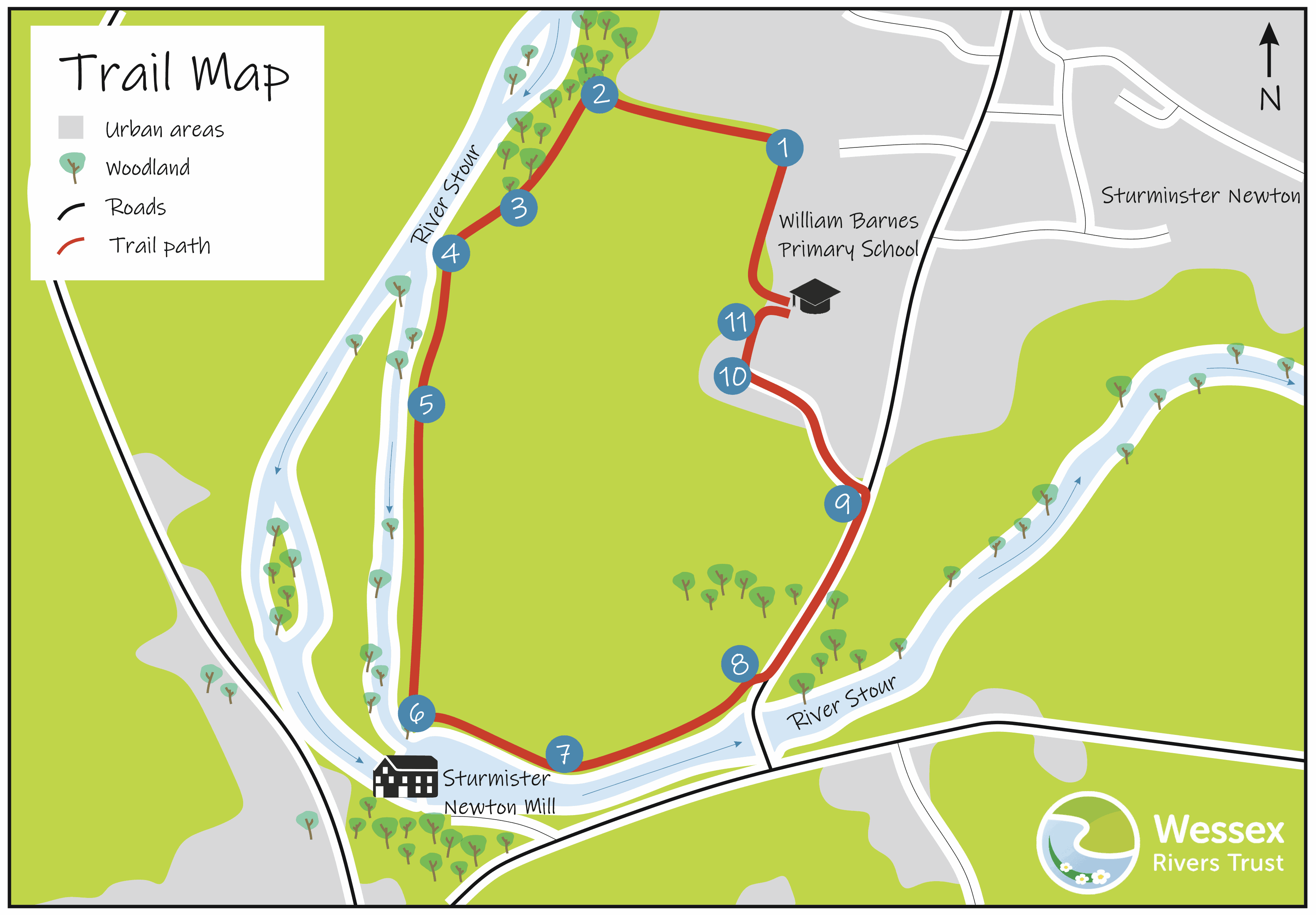
Amy Ellis, the education officer for Wessex Rivers Trust, contacted William Barnes primary back in September 2020 with an exciting idea of creating a River Stour Trail with the children.
Amy Ellis, the education officer for Wessex Rivers Trust, creating a large interactive 3d model of a river from its source as a natural spring to its mouth as an estuary at the sea
The plan was for Year 5 to create the art work for a nature trail looping from the school, into the recreation ground and then along the banks of the river to Sturminster Newton Mill and back along the river to the school. Rather than using information boards, Amy envisaged posts with QR codes, linking to Wessex River’s website. The children would provide the artwork for the website and Wessex Rivers would provide the scientific and historical information for the trail. “Covid restrictions meant the project kept getting delayed, until we had just three days before the end of Summer term last year,” explained deputy head Richard Hull. The trail-making day itself was a great success. Amy began in the school hall, creating a large interactive 3d model of a river from its source as a natural spring to its mouth as an estuary at the sea. Afterwards, the children headed out to the banks of the Stour for some pond dipping and then returned to school to produce some breathtaking artwork using acrylics, oil pastels and charcoal. Full of ideas, Amy also had the children in hysterics playing various games as they learned about how animals adapt to their environments.
The trail is open After considerable hard work from Amy and the education team at Wessex Rivers, the project is now completed. Posts with QR codes are in place along the river, the artwork has been uploaded and a downloadable trail leaflet has been designed and shared with the local community. The children were delighted to see their paintings and drawings online as part of the trail, and were excited to see that the project has come to completion. Amy said: “It was a pleasure to work with William Barnes Primary. There is nothing like the sound of excited school children discovering what wildlife is hidden beneath the surface of their local river! The children produced some incredible art work to support the Wildlife and Heritage Trail which you can see by clicking here.”
The Wessex Rivers Trust offers subsidised education sessions to schools, uniformed groups and home education groups. If you are interested in getting involved in a similar project with your school or group then please contact Amy via – https://www.wessexrt.org.uk/
“These used to be one of my most requested bakes, loved by many of my clients. I made so many of these that I trialled them with all sorts of cuts of bacon and pastry types. This recipe is made using what is, in my opinion, the best combination; homemade rough puff pastry and thick cut streaky bacon from a butcher. I also highly recommend the use of lard if you are going to make the pastry – it adds a wonderful crispness to the pastry that you might not get just using butter. “If you decide you don’t have the time or the inclination to make your own pastry, then I recommend ready-rolled puff pastry, and swap for dry-cured, unsmoked streaky bacon from a supermarket – you may find that the thickness of butcher’s bacon overwhelms the pre-made pastry otherwise.” Heather x
Cheesy bacon twists – delicious warm from the oven with a cup of tea. Or frankly cold at any time of day… Image: Heather Brown
Ingredients
thick cut streaky bacon
parmesan cheese
225g strong white bread flour
115g butter
115g lard
pinch of salt
some cold water
1 egg
Directions
To make the pastry: Mix the salt into the flour and cut the butter and lard into chunks (approx. 1cm cubes) and add them to the mix. Toss the butter and lard pieces in the flour until they are coated.
Add the water a little at a time and, using a knife or a spatula, mix into the flour/butter mix until the dough just comes together. The aim is to create a ‘dough’ with the flour, but to still have lots of large lumps of butter and lard.
As soon as the dough has come together, tip out onto a floured work surface and shape into a large ‘brick’ shape. With your rolling pin, roll out the dough into a long rectangle of pastry. Take one of the ends and fold it into the middle and repeat with the other end – folding the dough into thirds. Press together with your hands to seal the ends. Cover with a sheet of cling film and leave to rest for 5-10 minutes.
Rotate the dough 90 degrees. Repeat the above by rolling out into a long strip, folding into 3 and sealing in. Cover and rest for 5-10 minutes.
Repeat this three more times.
Wrap the dough completely with clingfilm and pop in the fridge for at least an hour but overnight is also fine.
Once the pastry has had a good time to chill and for the butter to get nice and hard, preheat your oven to 200º fan (gas 6) and grease/line two baking trays.
On a lightly floured surface, roll out your pastry to a large rectangle about 0.5cm thick.
Grate over one half of the pastry a generous amount of parmesan and gently press in with your finger tips. Then fold the pastry over and press down. Rotate the pastry and roll out again to a large rectangle 0.5 cm thick.
Lay your bacon strips onto the pastry, covering the whole area with bacon. Cut around the pieces of bacon.
Take a strip of bacon and pastry together and twist it in your fingers and lay the twisted strips onto the baking tray.
Beat the egg lightly and then brush over the pastry that isn’t covered by bacon. Sprinkle over more parmesan cheese.
Bake in the oven for 20-35 minutes until golden brown and the pastry is cooked through. You’ll need less time for pre-made pastry and thinner bacon and more time for thick pastry and chunky bacon. Enjoy!
Cheesy bacon twists Image: Heather Brown
Heather Brown is on the committee of the Guild of Food Writers; a home economist with a passion for Dorset’s brilliant foodie scene. Heather runs Dorset Foodie Feed, championing Dorset’s food and drink businesses, as well as working with her food industry clients.
Clayesmore is a wonderful school in which to work, with excellent facilities and a warm, supportive and happy atmosphere.
We are seeking a new team member to join our External Relations department. The ideal applicant will have several years’ experience in content creation, journalism and/or PR and can demonstrate strong writing skills. Although not essential to have experience of the independent education sector, this would be helpful.
Reporting to the Head of External Relations, this position is embedded within the functions of marketing, admissions and development, and will be responsible for the creation of social media and digital content, newsletters, press releases, magazine articles and school literature.
This role could be part-time or full-time depending on experience but will require a minimum of 25 hours per week.
A competitive salary and attractive benefits are provided for the successful candidate.
For further information and an application form please go to:
Clayesmore is committed to the safeguarding and promotion of children’s and young people’s welfare and expects all staff and volunteers to share in this commitment.
As one of the area’s biggest employers you’ll join local people working in a range of teaching and other jobs. It’s our busiest time for recruitment, so we have roles available in areas including:
Director of Land-Based Studies
Teachers of: Science | Psychology | Modern Foreign Languages ( French & Spanish) | English as an additional language (iPGCE training available for all teaching roles)
Boarding House Roles as: Deputy Housemaster/Housemistress | Boarding House Assistant (residential) | Day Matron (non residential)
Summer can be tough with allergies – but with 70 per cent of the immune system in the gut, there are foods that can help, says nutritional therapist Karen Geary
Pineapple is one of the foods that help with allergies. It’s full of healthy vitamin C, but the fruit’s true allergy powerhouse is an enzyme called bromelain which fights inflammation to help reduce the swelling and irritation brought on by pollen and other seasonal allergens.
Seasonal allergies are now in full swing and, with many people suffering, it is worth considering various support options – especially if you don’t like the side effects of medications. There are many different types of hayfever (allergic rhinitis), which is an immune response to allergens such as different types of pollen, as well as mould, damp, feathers, animal dander and dust mites. Histamine is an inflammatory agent found in the body in a white blood cell called a mast cell, an important part of our immune system. When they open, they release histamine into the body and generate those familiar responses – sneezing, wheezing, sore eyes, inflamed nasal passages and sinuses … all those symptoms of allergy.
Several of the phytochemicals in watercress actually block histamine release, keeping the immune system from going into overdrive.
Fight it with food
There are a number of familiar foods that naturally fight inflammation and help to stabilise mast cells: Pineapple contains an enzyme called bromelain, known to fight the inflammation caused by pollen. It also contains vitamin C, which is anti-histamine. Apples, broccoli, onions, coriander leaves, basil (including holy basil tea) all contain good amounts of quercetin, a type of bioflavonoid which has anti-inflammatory properties. However apples are a no-go if you are allergic to birch pollen. In these cases, the human immune system confuses the apple and the birch pollen allergen, causing the same reactions to the nose, mouth and throat – known as the oral allergy syndrome (an itchy mouth and a swollen tongue). Watercress is a cruciferous vegetable with a peppery, tangy taste like rocket. It is considered one of the most nutrient-dense plants commonly available. A study showed that watercress inhibits 60 per cent of all histamines released from mast cells. Pomegranates (including the juice) have a sweet but tart taste and are used in both savoury and sweet foods. They contain polyphenols, such as tannins and anthocyanins, and are higher in anti-oxidants than green tea. A study showed that they act as mast cell stabilisers. Vitamin C is a natural anti-histamine, and is found in oranges, kiwi, cherries, blackcurrants, peppers, melon, kale, spinach, broccoli, parsley. Teas, camomile or nettle. Camomile can help inhibit histamine release and nettle is anti-histamine. Peppermint tea can help clear nasal passages. Camomile is also great as an eye compress to cool swollen, red eyes. Turmeric helps prevent mast cell activation, as well as being a great anti-oxidant. Peaches are a potential mast cell inhibitor Black cumin seed is an anti-histamine and a powerful anti-oxidant. The oil is great in salad dressing, or taken straight from the spoon.
Camomile tea acts as an antihistamine and has anti-inflammatory properties. You could also use used and cooled camomile tea bags as an eye compress for relieving itchy, swollen eyes.
Supplements
As well as adding useful foods to your diet, there are natural anti-histamine supplements that may support you in your quest for calm eyes and a clear nose. Quercetin can be purchased in supplement form. It can inhibit the production and release of histamine by stabilising mast cells. Some of the better quercetin supplements also add vitamin C and nettle – both natural anti-histamines. Zinc may help prevent histamine being released from the mast cells. Zinc is key in immune health. Vitamin D is needed for mast cell stability. There is increasing evidence that gut health may be implicated in hayfever and other allergies – yet another reason for taking care of our gut. This makes sense, given over 70 per cent of the immune system resides in the gut. The research is patchy but growing that the probiotic strain LP299V (L-Plantarum) may well help.
Histamine-generator foods
Food sensitivities are often an indicator of poor gut health, producing reactions that can manifest themselves as an allergy (or simply make your hayfever symptoms worse). Common foods include gluten, dairy, coffee, yeast, eggs and nuts. However, just as there are anti-histamine foods, there are also foods that can generate more histamines than your body can handle, or that contain a chemical that has the ability to release histamines within the body. If you suspect this is the case, then start a food diary and keep a note of your symptoms before you see a health practitioner. You can download a tracker here. Some perfumes and chemicals in bath and beauty products may also make things worse. Pare things back and choose natural products, like coconut oil for a body moisturiser.