Home Blog Page 375

Would you consider a Prefabricated home?ļæ¼

0
We’ve come a long way since the temporary post-war emergency housing gave prefabricated a bad name, says Rupert Hardy, chair of North Dorset Council for the Protection of Rural England (CPRE)

Proposal for Boklok UK Housing Estate CGI

Some of us still remember the stigma surrounding ā€˜prefab’ housing. In the post-war years, prefabricated homes were seen as a temporary solution to the housing crisis.
Many weren’t intended to last more than a decade, were poorly made and insulated … but surprisingly are still standing. Their lack of appeal was also related to British housebuilding’s traditional use of brick and stone, rather than northern Europe’s use of wood, which lends itself to prefabrication.
Building standards have moved on considerably since the 1940s when an indoor bathroom was considered
a luxury. Modular homes on sale today are energy- efficient, built to last and quick to assemble. CPRE often
complains about excessive housing targets, but there is clearly a need for more genuinely affordable and social housing.
Modular homes should be 10-20% cheaper than traditionally built homes, once scale economies have been
achieved. Although there are few on sale in North Dorset now, this is likely to change.

The eco credentials
We are of course also faced with a climate emergency and modular homes can boast eco-friendly credentials, using sustainable materials and construction methods, incorporating features such
as enhanced insulation, solar panels and heat pumps.
Many are made of wood, the most sustainable building material with the lowest carbon footprint. They are
therefore more environmentally friendly and cheaper to run. Off-site construction also requires fewer builders, thus addressing one of the housing industry’s major challenges.
Modular building offers a lower carbon footprint as there are fewer lorry deliveries to the site, which has a
pleasant knock-on effect of people living nearby being less affected.
In other European countries such as Germany, factory- made modular homes are common. In Sweden more
than 80% of detached houses use prefabricated timber elements.

Urban Splash are building 406 modular homes at Inholme, in the Midlands, with 60% being affordable housing, including 60 homes for older persons. The development won the prestigious National Housing Design Awards 2020. Buyers can configure the internal layouts to create their own space before being precision-built inthe company’s factory, fitted with bathrooms and kitchens and delivered and assembled in just a few days.

Flat pack housing?
Things are changing here in the UK too, and political support is also growing. Of the 200,000 homes built in the UK each year, only 15,000 are modular but it is anticipated that this will now start to rise rapidly.
Insurance giant Legal & General have opened a factory in Leeds, with the intention of producing 4,000 units a year; housing associations are expected to be major customers.
Worthing Council in Sussex have signed up with BoKlok, a company jointly owned by IKEA, to build 162 flats
on its own land – 70% of the properties are being sold using its innovative affordability model, which analyses how much residents can afford after tax and monthly living costs have been deducted. Standard features will include heat pumps and enhanced insulation.
In the East Midlands at Inholm, Urban Splash are building 400 modular homes with heat pumps that use 67% less energy to build compared to a traditionally built unit.
Sleepy Dorset may be slow to emulate other authorities, but even here change is expected soon. Many peoples’ sons and daughters trying to get a foot on the housing ladder deserve no less. For many, the future
will be prefrabricated.

RURAL MATTERS – monthly column from the CPRE
Meet Bo Peep – 2022 edition

0
With hundreds of sheep about to lamb and a major new countryside show to organise, Dorset shepherdess Bonnie Cradock is in for a busy spring! Tracie Beardsley reports in this month’s A Country Living.
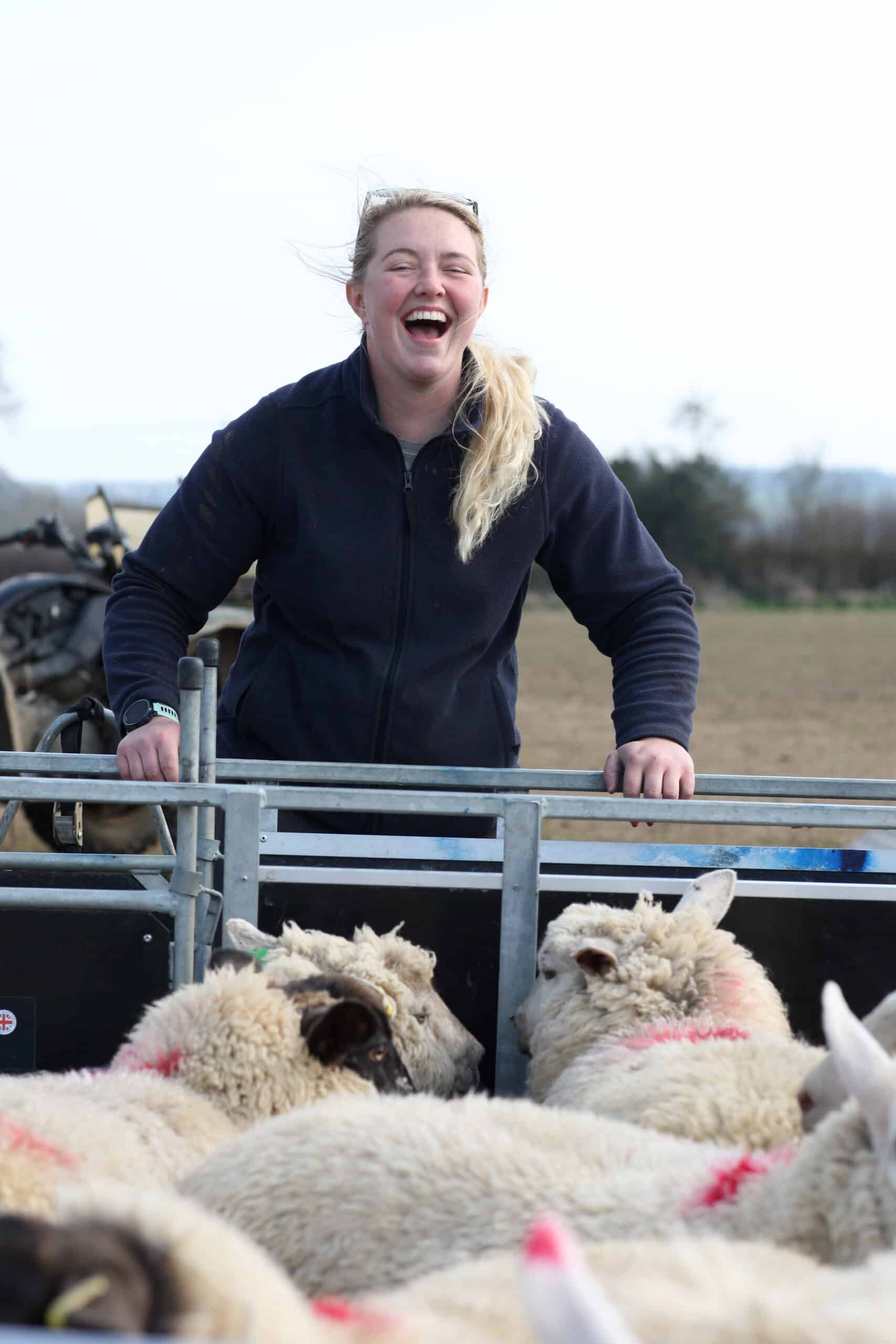
Bonnie Cradock (26) from Ludwell never wanted to work in agriculture, and fast- tracked a promising military career before being invalided out. – image Courtenay Hitchcock

Bonnie Cradock has been up since silly o’clock. The 26-year old shepherdess from Ludwell near Shaftesbury has nearly a thousand sheep to look after. Add to that her second job of helping to organise two of Dorset’s major country shows. And even though she grew up on a dairy farm, she never even wanted to work in agriculture!

A soldier, but for a sheep
When her elder sister, Laura, came home from a careers fair with an army keyring, Bonnie decided to find out more. At 16, she passed the officer selection process with flying colours, and at 17 gained an army bursary to do A-levels at Welbeck Sixth Form Defence College. Bonnie went on to Southampton University to study geography through the Defence Technical Undergraduate Scheme (DTUS), with a view to joining the Logistics Core. A keen sportswoman, she also played rugby and polo for the army. Ironically, it was the animals she now tends that put paid to her military career.
ā€œI broke my collar-bone when I was five, helping to move sheep with my brother Matt. The old injury played havoc with my shoulder and resulted in me being discharged.ā€
For three years now, Bonnie has been learning the skills of sheep farming, guided by her knowledgeable big brother. Her parents are also involved in the administrative side of the business.
She says: ā€œMatt and I were never that close growing up. Being the youngest of three, I was always either picked on or left out. We get on so well now – working together has brought us much closer. We’ve got different strengths and weaknesses, so we pick up where the other one falls down.ā€

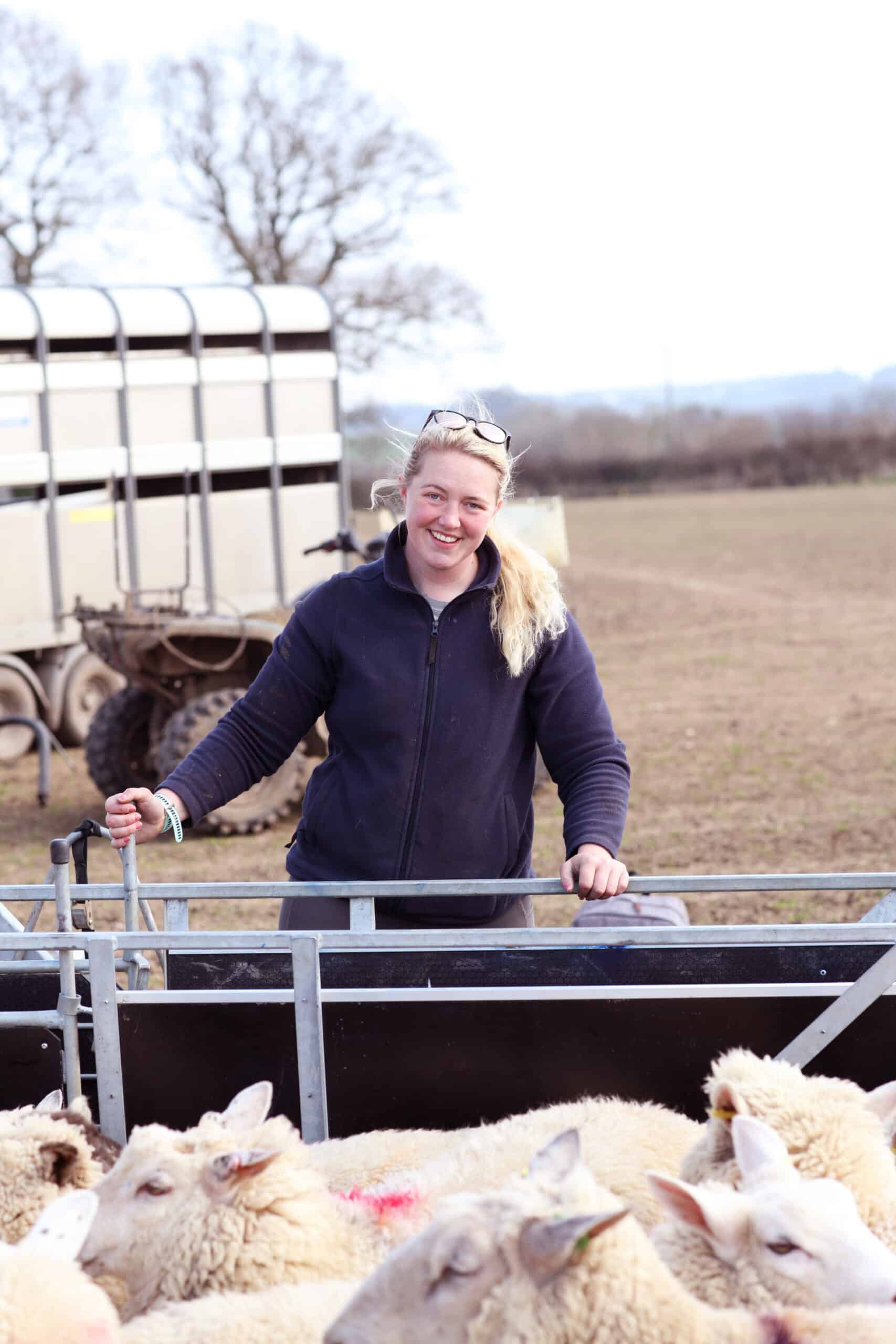
Bonnie now runs a flock of almost a thousand sheep with her brother Matt across three plots of rented land in Lydlynch, Motcombe and Farrington. – image Courtenay Hitchcoc

The glam life of a shepherdess
Lambing season kicks in this month, the ā€œhardest part of this job, but the most rewarding,ā€ explains Bonnie. ā€œMy days will start at 4.30am and I arm myself with a Thermos of coffee. We rent our land so our flocks are spread around – ewe lambs at Lydlynch, a breeding group at Motcombe and more ewe lambs on turnips at Farrington. It can take four hours to check on them all.

In addition to her flock, Bonnie is also Assistant Organiser and Event Secretary for the Gillingham and Shaftesbury Show
image Courtenay Hitchcock

ā€˜ā€™Our sheep will lamb outside, usually and most inconveniently in the muddiest parts of the field. So we have to set up pens for the mums and their newborns. There we can monitor them more easily and make sure they’re suckling and getting enough milk. Just like newborn babies, that first hit of colostrum is essential.ā€
Every year it’s all hands on deck to cope with the surge of births. In traditional style, there’s a four-year old collie sheepdog, Brock, working alongside a more modern herder – a quad bike that Bonnie refers to as their ā€˜gamechanger’. Her mum gets roped in as well, bottle-feeding any lambs who are struggling to feed naturally. She adds: ā€œDad gets involved too – fixing everything my brother breaks!ā€

Bonnie’s lambing season begins the day after the Spring Countryside Show at the Turnpike Showground in Motcombe – and will be immediately followed by an intensive sheep-shearing course
image Courtenay Hitchcock

The lambing season starts at the end of April, just one day after Bonnie finishes helping to run the first ever Spring Countryside Show at Turnpike Showground in Motcombe.
ā€œI’ve been working a few days a week for the past couple of years for the Gillingham and Shaftesbury Show as assistant event organiser and assistant event secretary. I could never work in an office full time – I would miss the outdoors.
But I love this job; I can work it around tending to the sheep and my boss actually believes me when I turn up late for work because of a ā€˜sheep situation!’
The spring show means April is going to be a crazy month for me – working flat out on the show then straight into 10-hour lambing days, followed by an intensive sheep-shearing course. And I thought a career in the army would be hard work!ā€

ā€œMatt and I were never that close growing up. Being the youngest of three, I was always either picked on or left out.
We get on so well now – working together has brought us much closer.ā€ (pictured with 4yr old Brock the sheepdog)
image Courtenay Hitchcock
Quick-fire questions with Bonnie:

A-list dinner party guests?
Winston Churchill and Jeremy Clarkson. I want to know what Jeremy Clarkson is really like and if he is as clueless a farmer as he seems on TV. I’ve always been fascinated by history and meeting the man who called the shots in WWII would be incredible.

Books on your bedside?
Eclectic choices. My mum themes my Christmas presents and last year it was sheep! Sheep tote bag, sheep headband, mittens and a book – ā€˜A Short History of the World According to Sheep.’ That’s next to read after I finish my chick-lit and a history book about Nazi Germany.

by Tracie Beardsley

Do you know where your nearest defibrillators are?

0

This month’s news from the unofficial capital of the Blackmore Vale Sturminster Newton …

If a defibrillator is ever needed, it must be used fast, says Pauline Batstone – so we should all know where our nearest one is kept.
Local photographer Adie Ray has been creating beautiful still lifes with the products found in the Emporium

It has been a very good month for the Sturminster Newton Community Benefit Society (CBS) both in terms of income but also in achieving more of the Societies initial aims. The two CBS shops are attracting an ever-increasing number of happy customers which helps to make Sturminster a real ā€˜destination’ for those who want good value from their purchases. Whether it be collectables, essential buys, or just a bit of retail therapy shoppers report great satisfaction, and donors too are pleased as they find it a very gratifying way of recycling their unwanted goods.

• Please make yourselves aware of the locations of the town’s various defibrillators. The one in the Market Place, which was bought and is maintained by the CBS, has recently had its first use. Unfortunately, there was a significant delay in accessing the defibrillator – if we all take the responsibility of knowing where the defibrillators are, we stand the best chance of saving a life. They are not all registered on one database, but
ones I am currently aware of in the town are located at Harts, Sturfit, The Market Place, and the old phone box by the high school.

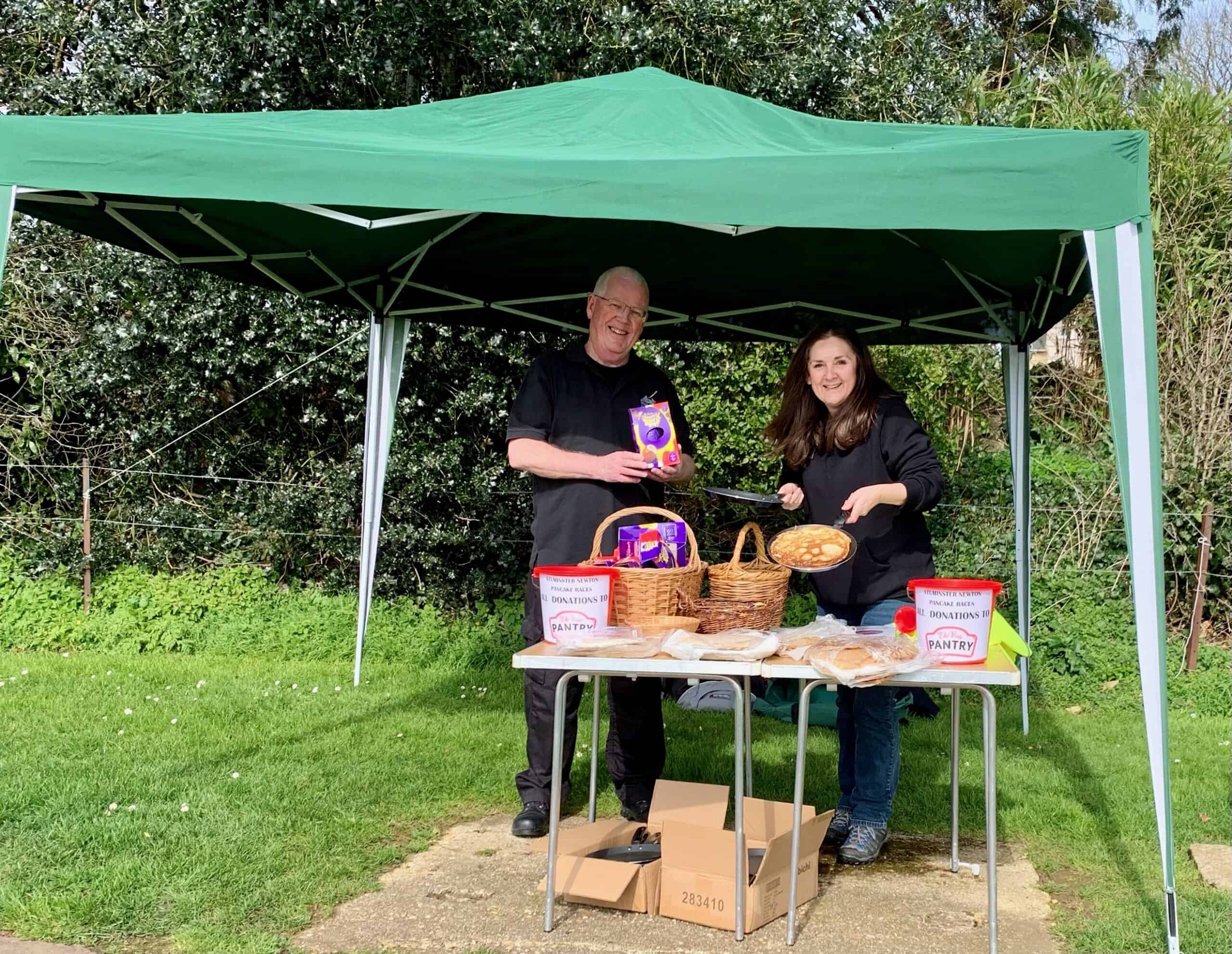
• Working with several local businesses and Sturminster’s schools the CBS and SturBiz finally had a sunny day to put on the delayed pancake races on the Rec. There were teams from William Barnes and Yewstock Schools, Harts of Stur, plus a few brave parents, all fighting for the glory of crossing the line with a pancake in their pan.

Jacqui Wragg (right) organised the pancake races which finally went ahead on the Rec!

Huge thanks to: the schools, Harts of Stur, those mad parents for taking part, the council groundstaff, Farnfields Solicitors, the Co-op, the Market Place Cleaners for supplying prizes and the White Hart for the pancakes themselves. And finally, the helpers from the CBS – in particular our very own organiser Jacqui Wragg.

Another still life with a collection of paperweights, pottery and an old dictionary image: Adie Ray

• I am also pleased to report that along with various local companies and the Sturminster Schools, the CBS and SturBiz were able to put on a second Careers Fair. This time the fair took place at the High School, along with able assistance from Yewstock school. The overall aim was to give our young people an idea of
the range of professions which they may be able to follow locally.

Spring activities

Easter is coming and there are some great spring events planned; put them in your diary:

9th to 24th April
Children’s Spring Quiz around the various shops in the town.

11th to 22nd April
Crafts at the library with many thanks to the library staff and volunteers.

Good Friday, 15th April at 12.00 noon
A short Service at the Cross erected by the churches in the Market Place, followed by Hot Cross Buns (from Oxfords of course).

Easter Saturday 16th April
• Children’s Easter Bonnet Making workshop 10.30 a.m. at The Exchange, with thanks to the WI.
• This is followed by an Easter Bonnet Parade at noon – leaving from the Exchange, heading round the town and back to the Railway Gardens for some prize giving.
• The town shops will be open as usual on the Saturday including The Emporium and The Boutique which will be open until 4.00 p.m.
• Milling at The Mill

Easter Sunday 17th April
• Easter Egg Hunt around the town centre, starting at 12.00 noon – look for egg tokens to bring to the Market Place to exchange for real Easter Eggs.
• Milling at The Mill

Check the website sturminster-newton.org.uk for up-to-date details.

Can we stop the waste, change what we eat and how we grow?

0

While the fuel bills are taking the headlines, the 20 year high in food bills and food poverty requires immediate action, argues the Green Party’s Ken Huggins.

Energy prices have risen dramatically recently, but food prices have also been rising and are now at a 20-year high. As with energy costs, this disproportionately affects the households whose income falls below their needs.
For us here in the sixth richest nation in the world it is a national disgrace that food poverty means there are over 2,600 food banks operating across the UK, with almost six million adults and two million children struggling to get enough to eat.
This is why the Green Party is calling for a Universal Basic Income, so that citizens have a guaranteed income to support their essential needs. The relentless rise in the use of food banks in the UK began long
before the Covid pandemic. It is 22 years since the Russell Trust opened its first food bank in their home town of Salisbury, and it now supports over 1200 food banks across the UK. In North Dorset we have food banks in Sherborne and Blandford and the Vale Pantry community food store in Sturminster Newton. No
doubt there are others.
While energy is essential for our society, food is essential for our survival. For good health we need good food, and we need to grow more of it ourselves. Here in the UK we rely on imports for a staggering 45% of
our food overall, including 84% of our fruit. This means we are extremely vulnerable to external events such as climate change and conflict. Food produced sustainably and consumed locally helps protect us from global shocks.
So we have to change what we eat, what we grow, how we grow it … and reduce the appalling wastage. One-third of food production is never eaten! Farmers are THE key workers, and we must support them to
transition to more sustainable agriculture.

We know they must do better

0

Many in business could learn from the ā€˜can do’ attitude of the British public and do better, argues Lib Dems’ Mike Chapman.

Against a backdrop of some glorious Dorset spring weather, the gold of daffodils along verges, the beginnings of blossom and the return of the dawn chorus, we have had some grim stories with which to come to terms. The line on Ukraine that struck me most forcefully came in a conversation with a
now very elderly soldier. Echoing Kennedy, he said ā€œIch bin ein Kyiverā€. It is so much to be hoped that the active diplomatic, financial, humanitarian and material support being given to which those words allude will
help enable democratic values to prevail.
Some of that high ground was lost, though, with the shocking announcement of the mass redundancy at P&O. Thoughts are with those who have lost a livelihood – but also with the agency staff who will do a tough
and responsible job on much poorer terms. The phalanx of security men escorting employees from the ships was a sorry sight. They might as well have had a Z on their uniforms for all the moral authority they conveyed. There hasn’t been such instant damage to a well- known brand since the infamous comments of Gerald Ratner!
Since we are comparing and contrasting … as a people we seem to embrace the need for a ā€˜Can Do’ attitude. We are seeing it in the heart-warming stories of the support being mustered for the Ukranian refugees across the nation. We saw it in the Covid vaccination programme and annually in the response to
Children In Need. The contrast is with the inertia of government (and its centralisation and secrecy), with the stories coming out of the DVLA about a culture that seems to be at odds with the ethos of public service, and with the light now being thrown on the prosecution, nay, persecution of so many postmasters and postmistresses. A dishonourable mention must also go to high-rise cladding businesses, profiteering
energy companies and sewage- discharging water companies.
We need to seize the day, hang on to the ā€˜Can Do’ and turn it into ā€˜Can Do Better’.

P&O join the householdbrand ā€˜race to the bottom’

0

It is the power imbalance which allows giant brands to mistreat their staff, says Labour’s Pat Osborne.

P&O Ferries sacked 800 staff without notice by video this month, replacing them with agency workers on worse pay and conditions.
As a subsidiary of Dubai-based DP World, a firm owned by the Dubai royal family, P&O aren’t exactly
short of a bob or two.
In fact, over the last two years DP World has paid out more than $376 million in dividends to their
royal shareholders, at the same time as reportedly receiving more than £30 million in emergency
funding from the UK government (including benefitting from the taxpayer funded furlough scheme) while sitting on the kind of bank balance that has Scrooge McDuck reaching for his swimming trunks.
P&O aren’t alone in engineering a deliberate race to the bottom for pay and conditions. Household
names like British Gas, BA, Weetabix, TESCO, ASDA and Clarks have all used ā€˜fire and rehire’ tactics to bully and intimidate their staff into accepting cuts to pay and conditions in recent times. It seems that the Tories
have created an environment where bad bosses think they have license to tear up staff contracts, leaving many working people leaning into the cost-of-living crisis feeling more insecure about their jobs and income than at any time since WWII.
We need to reverse this race to the bottom for pay and conditions by ending the power imbalance that allows bad employers to treat their staff in this way. That’s why Labour’s ā€˜New Deal for Working People’ and Keir Starmer’s promise that a Labour government will write it into law within 100 days of taking office
are so important. Under Labour, work will be more secure and better-paid because unions and individuals will be given stronger rights to redress power imbalances in the workplace.

Amid the images of disaster, we see the rise of human spirit | Simon Hoare MP

0

As we watch the atrocities being committed in Ukraine, Simon Hoare MP praises the communities who have risen up in swift action to provide help – and urges us all to continue to ā€˜do our bit’ where we can.

While Spring creeps into life the situation in and around Ukraine resembles deepest winter. Our Ukrainian brothers and sisters are living through the hell of war, amid scenes and images which we had all hoped were
consigned to the European history books.

The best of us
While Russia is showing us the worst of mankind, and of man’s inhumanity to man, across North Dorset we are seeing the best.
Our DNA-embedded spirit of wanting to do all we can to help has risen to the fore. I cannot tell you how genuinely moved and inspired I was by the veritable army of volunteers I was privileged to go and help (albeit for a few hours) at The Exchange at Sturminster, and to see similar hives of activity at Shaftesbury’s Guildhall and Blandford’s Ginger Viking.
A continuous stream of members of the public, motivated not by instruction but by a spontaneous desire to ā€˜do something’, bringing literally tonnes of food, clothing, blankets, toiletries and toys. Some came with a
car full, others a carrier bag; it was clear that all were doing everything they could to help. Then there were the rooms of people sorting, packing and boxing up.
Still others in a human crocodile loading vans for dispatch to Southampton and the port. Each and every one is a hero. They were and are the best of us.

A magnificent spirit
Local businesses too have been marvellous. I don’t know all of those who helped but a shout out to Dikes of Stalbridge, Johnsons of Gillingham, Virginia Heywood at Shaftesbury and Gillingham’s South West Packing for either donating goods or that elusive and much-needed commodity, the cardboard box.
Thank you too to Dorset Council for allowing the use of the chapel at St Mary’s School for storage purposes, and of course thank you to Ginger Viking and the Exchange for allowing their premises to be used as donation hubs. You’ve all been magnificent.

So – what can be done now?
As your MP I continue to press Ministers to be swift and flexible with the refugee resettlement process, and
for the Home Office to be far more fleet of foot than it has demonstrated hitherto. We are dealing with a wartime situation and our processes and policies, designed for peacetime, need to reflect that dynamic shift. Whatever can be afforded – be it Ā£1 or Ā£100 – I would urge you to make a donation to the DEC
fund www.dec.org.uk.

Can you offer housing?
Also, please consider registering on this website for the housing scheme www.homesforukraine.campaign. gov.uk.
You might have a spare room, granny flat or a holiday-let. Please do register your interest on this site. If we can do our bit then we should. If we all try to ask ourselves the question ā€˜if we were in their position, what would we want others to do for us?’ I don’t think we will go far wrong.

by Simon Hoare MP

Deliciously light lemon friands

0

Easter has come around again and our social media feeds are full of all kinds of creme egg infusions… the latest trend seems to be rolling a whole creme egg in pre-made croissant pastry and baking in the oven! I can’t decide if that is amazing or an abomination?
If you are looking for a chocolatey delight this Easter then our recipe in February’s BV Magazine of decadent chocolate brownies also includes a cheeky twist to bake creme eggs into the top. We also had a delicious recipe for leftover hot cross buns last Easter, turning them into a bread and butter pudding, should you happen to panic buy hot cross buns this Easter.
This month’s recipe is a lighter and zestier alternative to all that chocolate. These Lemon Friands are essentially the French version of a cupcake. Made with egg whites and icing sugar, they are deliciously light and the addition of some fresh raspberries and blueberries really work alongside the ground almonds. They are a lovely bake to make to serve with coffee, or as a light little dessert after your full Easter Sunday Roast with loved ones. Perhaps with some clotted cream … Heather x

Delicious lemon friands are the French cupcake – image: Heather Brown
Ingredients

• 200g butter (melted)
• 250g icing sugar
• 50g plain flour
• 190g ground almonds
• 6 egg whites
• zest of 2 lemons
• fresh raspberries or blueberries.

Directions

• Pre-heat the oven to gas 5/fan 180Āŗ. If you have a friand tin, then by all means use that, but I simply use a standard muffin tin. Grease the base and edges of each cup (mould?) of your muffin tin. Then cut strips of greaseproof paper long enough to go down one side, across the bottom and up the other side of each cup and pop them inside each one. This helps to release the friands from their tins once cooked – they can be super-tricky to get out otherwise.
• Mix together in a large bowl the icing sugar, plain flour and ground almonds. Then grate in your lemon zest and stir to combine.
• Whip the egg whites until they form stiff peaks.
• Add the melted butter to the dry ingredients and mix, then add the egg whites and gently fold to combine.
• Divide the batter mixture into the muffin tins, and sprinkle a couple of blueberries or raspberries into the top of each cake.
• Bake in the oven for 15-20 minutes until the top is firm to the touch and golden brown.
• Leave to cool.
• Once cool, remove from the tins and sprinkle with a little extra icing sugar.

By Heather Brown

Heather Brown is on the committee of the Guild of Food Writers; a home economist with a passion for Dorset’s brilliant foodie scene. Heather runs Dorset Foodie Feed, championing Dorset’s food and drink
businesses, as well as working with her food industry clients.

One man, his horse, his birds -and the spirit of freedom

5
Moving crowds to tears is all in a day’s work for Jonathan Marshall, the horseback falconer starring at the new Spring Countryside Show.

Talking to Jonathan Marshall is unexpected. From a look at his website, my impression was of the ultimate showman persona; shinily clichƩd, with a confidence bordering just on this side of arrogance.
I did not expect a quiet, unassuming northerner on the phone – with an irrepressible sense of humour, the deepest love for his horses and falcons threading through every word, and entirely dismissive of his own importance:
ā€œthe fella in the middle of the arena telling the story is irrelevantā€

An accidental career
Jonathan Marshall’s love affair with horses began in early childhood – at 78, his mother still has horses, one of whom is 38 years old. At the age of eight, Jonathan discovered falconry and the birds soon took over his attention. Eventually he realised that he could combine his two passions – falconry was traditionally a horseback method of hunting.
ā€œI never set out to be a horseback falconer – I mean, who does? – but in ’86 I made it my professional career. Though I quickly realised if I was going to make it a show, I needed the right horses. It’s not quite so spectacular if I’m on a donkey!ā€
So Jonathan chose to work with the most beautiful – Andalusian, Lusitano, Friesian and Arabs.
ā€œWe work on dressage lines – high school moves such as Piaffe, Passage, Passo Espanol, Reverencia and Levade. But I’m well aware I’m not a dressage rider, I’m a showman.
ā€œWe carefully rehearse every second of the shows – the falcons are trained to the lure, flying through the horses legs. It’s all timed to music, and the horses and the birds know exactly what they’re doing. It’s taken a long time to get the show to where it is now – our first season was a steep learning curve, and it was … well, let’s say it wasn’t the most polished performance at first!
ā€œAnd it’s evolved over time – it’s such a natural pairing between the horses and the birds, and it always
resonates at an instinctive level with the audience. I’ve noticed it especially since we came back from the lockdowns – last year’s shows were far more emotive.
“I think it has to do with our collective lived experience over the pandemic. At the end of each performance I allow the horses and birds to run and fly, entirely uncontrolled and unrestrained, and I simply run with them – it’s the ultimate expression of freedom, and for the first time I found audiences were crying, reacting on a deeply emotional level. It’s spontaneous, the only part of the show that’s not carefully scripted; it’s not a stunt… and I think there’s a part of everyone who longs to be as free as those animals in that moment.ā€

Jonathan breeds peregrine lanners – or ā€˜perilanner’ , a hybrid between a peregrine falcon and a lanner falcon. It is larger and faster than a lanner, but does not fly as far as a peregrine.

Books too
During lockdown Jonathan began writing ā€œI’m in my 50s now. I’ve got to think forwards – I’m not so young anymore, and it hurts when I fall off!ā€.
His first book ā€˜Spirit, the fastest bird in the world’ is a story about acceptance, and that no one is more
important than anyone else. His second book, ā€˜A Falcon’s Love’ which he has illustrated himself, is out shortly.

Jonathan will be appearing at the Spring Countryside Show with his 2022 ā€˜A’ team:

Amadeus
In 2018 Jonathan got a call about an unbroken 10-year old Friesian stallion. Kept purely for breeding, when his owner died no one knew what to do with him; his sheer size was intimidating.
Within a week of bringing him home, however, Jonathan was riding Amadeus on Bude beach.
ā€œHe was a bit of a bully, and was used to simply getting his own way. The first time I approached him in the stable, he started to push himself forwards at me, but instead of retreating I kicked the stable door loudly,
and he backed off. He came at me again, so I kicked the door again, and in a gesture I’ve come to know and love, he lifted one hoof gently – it was like a sorry, an ā€˜OK, I’ll be a good lad’. He is honestly the kindest, gentlest, most beautiful horse I’ve ever worked with. Everyone loves him. And he still lifts his hoof to ask permission or apologise, even now.ā€

The Falcons
Jonathan will be bringing Duchess, Sonnet and Aria, his peregrine lanners, to the Spring Countryside Show – the trio are full sisters, though hatched in different years, and bred by Jonathan himself.
ā€œI’ve had falcons since I was eight, and these birds are the best I’ve ever had. Anyone who breeds any animal knows that sometimes you get a pairing that just produces magic. The parents are good birds, but
their offspring are something else. They have the speed and agility you’d expect, of course, but they’ll spin as they dive, just for fun, they twist like nothing else … they’re amazing birds, spectacular to watch.ā€

interview by Laura Hitchcock