Gardener Pete Harcom has your list of jobs (and not-jobs!) for December
Leave the dead hydrangea heads on the bush to protect new growth
Though the garden is quiet in the middle of winter, getting on with some jobs now will get you well ahead for the spring and will ensure your garden is ready as the seasons turn towards the warmer, brighter months.
Prepare your borders Winter digging can continue, weather permitting – just don’t dig when the soil is too wet or frozen. To feed the soil and improve the structure, use garden compost, well-rotted manure and leaf mould.
Cut it back Pruning all the climbing roses and any tall ones will help reduce wind rock during the worst of the winter weather. Prune old flowered rose shoots to a third of their length, and check all climbers to ensure they are adequately supported. Now is also the right time to prune your Japanese Maple (Acer palmatum) if required
Protect your pots Bring your potted plants into the greenhouse, or failing that at least move them into groups – this will help protect them from harsh winds and frosts.
Sowing time Sow your sweet peas and micro greens seeds in the greenhouse. Also sow some alpine plants now – these can be very easy to grow in a cool greenhouse, and don’t worry about the exposure to low temperatures before germination some alpines need, an average UK winter should provide the right temperatures. If you already have alpines in the flower borders, it’s also a good idea to put some gravel around them now to prevent them getting waterlogged.
A little protection work Fungal spores and many pest-pupae overwinter in the soil at the base of plants, ready for action once spring arrives and growth begins again. Remove (and compost) all old mulches in all areas of the garden, and lightly dig around the base of plants to expose any resident pests to predators (birds love grubs!) and winter weather.
Pond life If you have a pond, ensure plenty of light is getting in through the winter months by removing any overhanging shrubs and trees. This will help your pond plants to replenish oxygen levels in the water. Always ensure there is a ball or similar to help prevent the surface entirely freezing over during any cold snaps.
Christmas decorations Harvest the winter berries on plants like Holly if you intend to use them for wreaths or garlands for Christmas displays, before the birds and the weather get them all. They should be fine if you put them in buckets of water until you are ready to use them.
And what NOT to do: Avoid disturbing large piles of leaves now. Leaf piles are amazing for wildlife, providing shelter and a great nesting spot for hibernating animals, such as hedgehogs, small mammals, frogs and countless insects. Lastly, just leave your Hydrangeas’ spent flower heads on the plants! They help protect the new flower buds that are forming lower down the stems.
Roger Guttridge explores the history of a Sherborne landmark
Looking up Cheap Street c 1900 All ‘Then’ images from the Barry Cuff Collection
These days its main raison d’être is ornamental, although it can also serve as a temporary shelter during a storm or shower. But in its 500-year history, Sherborne’s grade-one listed Conduit has had several other uses, mostly in the 19th century. It was built by Abbot Mere in the early 1500s as a washroom for his monks and originally stood in the northern alley of the Abbey cloister. Some sources say it was built by ‘Albert’ Mere but I suspect this is an error that began with someone mishearing or misreading ‘Abbot’. It pays not to believe everything you see in print… In 1560, a couple of decades after Henry VIII’s Dissolution of the Monasteries, the Conduit was moved to its present site in the Parade towards the bottom of Cheap Street. The hexagonal building originally had a short cross on its roof but that is long gone. The addition of windows and a door in 1834 made the Conduit a lot less draughty and enabled its next use as a reading room. Later it became an early Victorian police station and in 1861 a penny bank. One thing that is not welcome there today is the bicycle – a sign tells us that the parking of cycles is prohibited. The nearby village of Bradford Abbas once had a smaller version of the Conduit but it was ‘taken down by the overseer’ about 1800, ‘to the great regret of many of his neighbours’.
Looking up Cheap Street today. The milk cart of yesteryear has been replaced by a trailer carrying Christmas trees for this year’s public decorations
The Conduit three ways My ‘then’ pictures from Barry Cuff’s collection show the Sherborne Conduit from three still-recognisable angles. The one looking up Cheap Street in about 1900 (opposite, top) shows a horse-drawn milk cart in the foreground, albeit possibly super-imposed in the darkroom.
The Conduit from Long Street c 1900
At the junction with Long Street (far right) is Durrant’s grocer’s shop, whose tall delivery vans were a familiar sight in the Sherborne area. According to David Burnett’s book Lost Dorset: The Towns, Henry Durrant was a champion of Dorset Blue Vinny cheese when it was going out of fashion. I’ve heard that the original Blue Vinny needed prolonged exposure to the bacteria of a manure heap to reach maturity, but for some reason this is now against public health regulations! Henry Durrant was also a councillor and a magistrate but a 1931 Directory of Dorset lists him as an antique dealer in Long Street.
From Long Street today
The second picture (above) looking along Long Street towards the Conduit and Conduit House, with the Abbey literally towering majestically above all, also dates from about 1900. Far right is Edwin Childs’ Cycle Works. Like many people in that business, he moved with the times and later opened a garage for motor vehicles further along Long Street on a site later replaced by the Cloisters housing development.
Looking towards South Street, probably 1950s
J H Short, pictured outside the shop next door, was a family grocer. Opposite are the Castle Hotel, a favourite haunt of carriers, and the National Provincial Bank. A rainy post-war Sherborne The coats worn by the couple in the final picture looking towards South Street (above) suggest it is post-war, possibly 1950s.
Looking towards South Street today
Frisby’s, the shoe shop chain, occupied the tallest of the buildings on the left side of South Street.
The BV’s Andrew Livingston remembers his mentor, BAFTA-winning writer, chef and, most of all, fisherman Nick Fisher, who passed away this month
Since I heard of Nick Fisher’s tragic passing last month I have been taking the time to delve deep into his archives of film and television. I went straight to YouTube and there, hosting ITV’s agony uncle show Dear Nick, was the man I knew. Fewer wrinkles and odd grey hairs, but still the charming, engaging man who moved into our village of Hooke when I was a child. ‘Welcome to Dear Nick, the show with more problems than you can shake a stick at, but at least we can talk about them.’ His 1996 words resonate loudly with me today as I stare at the screen and remember my 63-year old friend, whose body was found in a hotel in Dorchester early in November.
Entertaining mundanity Nick became well-known when celebrity TV chef Hugh Fearnley-Whittingstall reeled him as fishing expert on Channel 4’s Dorset-based River Cottage. But, as a child, I just knew him as the funny man down the road with the oddly apt surname-profession combination. Beginning his writing career in the 80s as an agony uncle for Just Seventeen magazine, Nick moved on to screenwriting for television in the 90s. In 1993 he moved in front of the camera to present his first television show – Screaming Reels on Channel 4, a light-hearted look into the world of fishing. Just like Dear Nick, I had never seen Screaming Reels before, but thanks to YouTube there he was again, the fishing-obsessed man I would end up knowing. Much like his writing in the Marshwood Vale Magazine that came later in his life, in Screaming Reels Nick found the hilarity in the mundane. But this time he got to talk about fishing. From the age of four he had been obsessed with fish, and watching him on screen you can see his passion. Nick fished all over the world, holding a commercial fishing licence, a charter skipper’s licence and being a certified yachtsman. But I saw him most frequently bobbing on his mooring in West Bay Harbour.
Writing for TV Nick developed an incredible way with words and it was through this that I got to know him much better – in later life he would mentor me as I tried my hand at journalism. Living with a Willy: The Inside Story is a hilarious book of Nick’s that I read during puberty. The blurb probably says it best: “This book isn’t going to teach you a lot of long Latin words ending in m, but it might just help you understand what it really means to own a daft tuft of flesh shaped like a chipolata.” However, I mostly consumed Nick’s writing via the television. Growing up in a time before Netflix, as the credits rolled on so many BBC programmes we’d say, ‘Oh, Nick wrote that!’ Eastenders, Casualty, Holby City, Hustle and New Tricks to name a few. He also created his own show, The Giblet Boys, and won a BAFTA for Best Children’s Drama in 2006. He dedicated the award to his three sons, who inspired the writing. He said there was nothing on TV for them to watch. In 2016, Nick once again proved his versatility as he tried his hand at writing fiction. Pot Luck is a brilliant story of crime, drugs, greed and, of course, fishing – specifically commercial crab fishing. It is set in Weymouth and has been so popular that it has recently been commissioned for television.
The last chat The last time I saw Nick we stood and chatted on his drive for half an hour about chickens. The fox had just been through his backyard flock, so I donated a couple of our 16,000 hens. Those few birds were nothing compared with the time he had given me, just to help a young writer develop. Knowing now that it was our last conversation, and having now looked deeper into his life, I wish we could have talked about anything but chickens! But I wasn’t to know what was going on inside his head. Nick’s death has been a stark reminder that we don’t know what people are going through. In the lead-up to this Christmas I’m going to make a conscious effort to check in more with the people around me. And wherever we go when we die … I just hope Nick has got his rod and tackle with him.
Shaftesbury Rotary Club are a well known local name – but how much do you know about what the organisation actually does? Laura Hitchcock reports
Shaftesbury Rotary Club was established on 8th March 1963, and will be celebrating a happy 60th birthday in 2023. The club makes donations of between £20,000 to 30,000 each year from the money they raise, with three main events leading their year-long fundraising campaign.
North Dorset Cycle Ride The North Dorset Cycle Ride was started a few years ago to raise awareness of prostate cancer; the popular ride that takes in the amazing natural beauty of the towns and villages around the Blackmore Vale, is Shaftesbury Rotary Club’s biggest fundraising event of the year; few people are aware that Shaftesbury Rotary Club is one of the biggest donators to Prostate Cancer UK. The next North Dorset Cycle Ride is on 14th May 2023, and will once again include three routes: the six mile family fun ride, plus the more strenuous 25 and 50 mile routes (registration is now open here). No matter which route you choose, all rides end one way – up Gold Hill to the finish line at the top!
Gold Hill Festival The Gold Hill Festival (previously Gold Hill Fair) has now been running for more than 30 years – the popular one day festival enjoys an eclectic line-up of local music acts as well as local producer stalls, food and drink.
Wide Donations The third big event in Shaftesbury Rotary Club’s calendar is the annual charity golf day at Rushmore Golf Club – last year a record number of 27 teams entered. From the funds raised throughout the year, the club has given donations to local causes such as Westminster Memorial Hospital, Somerset & Dorset Air Ambulance and Mosaic; as well as national charities CLIC Sargent, ShelterBox (Disaster Relief Charity), Sight Savers and the Ukraine Crisis Appeal. Shaftesbury Rotary Club also makes an annual donation to the Rotary International project PolioPlus, which aims to eradicate polio on a worldwide basis. In addition, the club supports KidsOut, an organisation working with women’s refuges across the UK to provide toys and games to children who have witnessed or experienced domestic violence. It also organises the local support for the Shoebox Appeal, which gives support to less fortunate people at Christmas, as well as many other projects.
Youth projects The club has also launched a couple of projects with local young people. Youth Speaks is a new debating competition for secondary school students, and in 2023 the second area competition will be hosted in partnership with Shaftesbury School. Shaftesbury School will also be the venue for the Young Chef competition in 2023. A local RotaKids club was launched this year at Abbey Primary School; with the club members’ support, a number of activities and projects aimed at supporting the local community are being planned.
If you are interested in meeting new people, forging new friendships and making a real contribution to the local and wider community, then the Rotarians would love to hear from you! In addition to supporting community events they meet fortnightly, and are keen to welcome new members.
A Chicago attorney called Paul P. Harris formed the Rotary Club of Chicago (one of the world’s first service organizations) on 23rd February 1905. In 2022 The Rotary Foundation has 1.4 million members in 35,000 Rotary clubs across 200 countries. It spends $1,000,000 a day on community projects and charitable causes throughout the world.
Guaranteeing a fresh turkey for your Christmas table may be a tricky call this year, says Andrew Livingston
Sadly, this year will be the first time in years that we as a farm aren’t growing our own turkeys. With Avian Influenza (AI) continuing throughout the year we couldn’t risk having 30 or so turkeys potentially contracting the disease and infecting our shed of free-range layer hens. I miss the sight and sound of the gobbling giants down our drive, but I am definitely going to enjoy a plucking-free Christmas this year!
Turkey roulette It hasn’t been a good year for the turkey industry. Last year, Norfolk, the traditional home of turkeys, survived AI; this autumn the county has been decimated with cases. The Animal Plant Health Agency’s map of cases is horrific viewing. Turkeys and geese are more affected by AI than other poultry, which means that when one farm goes down it’s just a matter of time before neighbouring farms fall to the disease. If you can’t do without a turkey on the table this Christmas, my personal suggestion is that you buy early and have a frozen one on standby; waiting for fresh-farmed turkey is a game of Russian roulette this year.
Vaccines and superchilling One point of good news for the industry is that the government this year reintroduced the process of superchilling. Reserved for seasonal birds such as turkeys, geese and ducks for Christmas, super-chilled birds are frozen rapidly and then defrosted in December to be sold on the supermarket shelves. Superchilling storage has no effect on the meat taste or texture. Of course, just because your turkey is in the fridge doesn’t mean it’s actually fresh. The Food Standards Agency (FSA) is advising consumers buying turkey, duck, capon or goose products in the run-up to Christmas that they may have been previously frozen and defrosted before being placed on sale as chilled. The products should be clearly labelled as ‘defrosted’ and are suitable for home freezing if the label says so. So if you are picky, choose carefully and read the smallest print on the label. Ultimately, it’s a bit late for this Christmas, but this means that next year birds can be slaughtered in the summer, frozen and then defrosted for Christmas to avoid the risks of bird flu. Further ahead, there is brightening news that Norway has begun using AI vaccines on their birds. The government will have to make a sharp U-turn on the vaccine policy, but something needs to change as compensating farmers is costing the country millions of pounds. Currently poultry is not vaccinated due to the risk of bird flu going into the food chain and infecting the public. Like the Covid vaccine, the AI counterpart doesn’t stop birds from catching the disease but just prevents death. The risk is then what effect the disease has on humans if they eat infected meat. You could say turkeys voting for the vaccine is the same as them voting for Christmas, but I have heard first-hand accounts of the effect of the disease on a flock of birds and it is harrowing. It’s not just the financial implication for farmers … it’s the mental strain of having thousands of birds culled by the APHA – if they haven’t all died before they get there. If you’re lucky it may be turkey for Christmas this year. But if something doesn’t change soon, prepare to be carving Christmas trout on the big day!
We’re fortunate to have some amazing contributors to The BV. Carl Bovis often allows us the use of his amazing photography, and I’m always proud that writers Gay Pirrie-Weir and Fanny Charles are part of the BV team.
Deepest Somerset £25 The perfect Christmas gift for past and present residents of Somerset – and for all those who love the county. Deepest Somerset celebrates the food and history, the wildlife and the landscape, the iconic places, and the fascinating people who live and work in the county. The beautifully illustrated hardback, with an introduction by King Charles III (then Prince of Wales), is a gorgeous addition to any bookshelf. And all proceeds go to three Somerset charities. Fanny Charles spent a day with one of the world’s great cheese-makers, George Keen, at Wincanton, to learn how his family has been making traditional, clothbound, unpasteurised Cheddar for more than 100 years. Gay Pirrie-Weir talked to Glastonbury Festival founder Michael Eavis about his lifelong Methodism. Julian Temperley talks about his historic victory over the EU to be allowed to use the word brandy for his distilled Somerset Cider. Their first book, Deepest Dorset, is now sold out, but Deepest Wiltshire is still available. Both books make wonderful gifts for anyone with a connection to the counties, and are available from independent stockists, or direct from the Deepest Books website: deepestbooks.co.uk
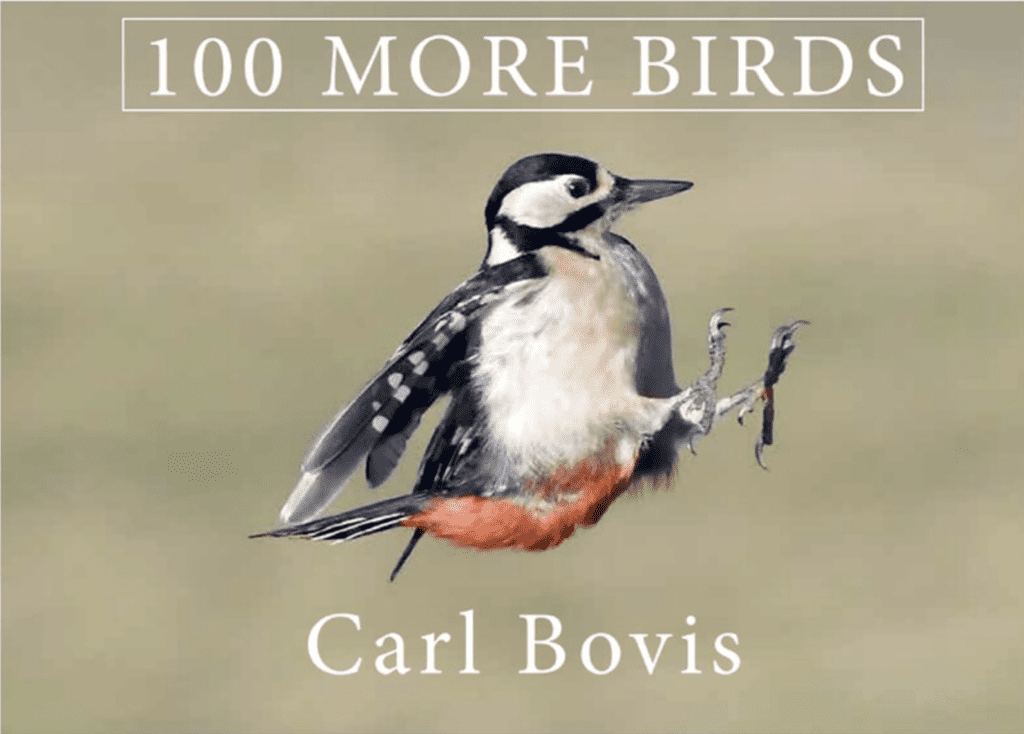
100 More Birds by Carl Bovis £19 This is the follow-up to Carl’s wonderful 100 Birds. It features another 100 of his best, or most interesting, bird photos, coupled with fascinating information from Carl about how, when and where he got the shots, some information about the birds, plus personal stories and experiences relating to the birds. The book is a simple format across 200 pages; one side of each is a full page bird photo with its own page of personal reflection from Carl opposite. Buy direct from Carl’s website carlbovis.com and don’t forget to have a browse of his site for other gifts while you’re there. His jigsaws and calendars always sell out at Christmas. His pack of blank greeting cards, in packs of ten, are perfect notecards to keep in your drawer.
My first visit to a racecourse – on a windblown and wet November day in Wincanton – wasn’t at all what I expected, says Laura Hitchcock
Never mind the weather – everyone wears a hat and ignores the rain. All images: Courtenay Hitchcock
A trip to the races always looked like it might be fun. But … to be honest, it isn’t really for the likes of me, is it? My dad was a milkman and we lived in a big Essex town – horses were as much a part of my home life as art, ballet and opera. Not. And yet I grew up horse-mad, absorbing everything I could from books – Ruby Ferguson’s Jill series? The Pullein-Thompson sisters’ entire back catalogue? Misty of Chincoteague (though I still have no clue where that actually is) – I had them all). I paid attention, I studied riding theory just in case. I finally got on a horse for real in my 20s – turns out that you can learn a surprising amount from books, but a real horse definitely helps. Children’s books about gymkhanas and showjumping abounded, of course, but horseracing? Not at all. If you’re not introduced to it or grow up with it, then it’s frankly a closed, mysterious and mildly intimidating world, even to a grown up. So when we were invited to Wincanton Racecourse for Badger Beers Chase Day, of course I was keen but swiftly went looking for help – we’re incredibly lucky to have a pair of the UK’s top Thoroughbred breeders, Lucy and Doug Procter, writing for us.
Frodon to victory in the 61st Badger Beer Handicap Chase
The biggest question The first worry, obviously, was what do you wear to go racing? Well, apparently, on your average weekday race meet, it’s pretty much anything goes ‘You’ll see a lot of tweed,’ said Doug ‘but mostly because it’s what most farmers wear most days! Go with anything practical for the weather – a racecourse is an exposed place in November’. But we were attending on one of the biggest racedays in Wincanton’s racing calendar, which is slightly more dressy. Lucy offered some helpful hints on the ladieswear front: ‘Go for long boots with dark trousers or a skirt and woolly tights. I always opt for a thick polo neck sweater (or three!), and then add a scarf. There’s nothing more miserable than being inappropriately dressed for the weather, so a weatherproof coat is a must: most people will be in a tweed or plain coloured long wool coat, or a Barbour-type/beige waterproof overcoat. And if you’ve got a cap or some kind of hat it’s much easier than juggling an umbrella when it’s raining.’
Frodon in the winner’s enclosure
First impressions Feeling confident from our pro what-to-wear tips, we headed to the main gates on race day. It was busy and as we watched the queue we were fascinated by who was there. Because it actually seemed to be everyone. Tweed-clad country types hunkered against the rain in their battered wax jackets and flat caps. Sharply-suited men, clearly there for a ‘lads day out’ queued noisily behind retired couples happily chatting. We saw wellies and trainers lined up alongside Dolce et Gabbana and Dubarry boots. Doug was right – there really isn’t a type of person who goes racing. It was rapidly obvious that everyone goes. We’d clearly been missing something.
The packed stand at Wincanton on Badger Beer Chase Day
Working out the system Once inside the gate, we bought a racecard (£3.50, and DO get one, even if you’re not planning on betting; the whole day makes sense once you have one), and soon worked out the system for what to see. Obviously the day revolves around the races, but we quickly understood that it actually starts in the parade ring (sometimes called the paddock). Head there first and see the horses circling as they wait for the jockeys. I was surprised at just how close we were able to stand, and swiftly became aware that racehorses are… stunning. Powerful, elegant and very very different from the horses grazing in a field on your Sunday walk. Now’s the point you want to look at your racecard and decide who you’re rooting for. The card’s a bit overwhelming at first – if you’re a statistician you’ll feel right at home – but there’s a key to what all the numbers mean, from the weights the horses are carrying to the names of the owner, trainer and jockey, how far they’ve travelled and a rough guide to current form. But if you’re a racing ‘pro’ like me, you’ll obviously eye up the horses as they walk past and … pick the prettiest one. Once the jockeys arrive and mount up, the tide of the crowd flows back towards the track. Usually the viewing areas are separated according to your ticket entry (the closer to the finishing post, the more expensive the entry price), but Badger Beers Chase Day was a Single Enclosure Day, meaning anyone could stand anywhere. The stand was packed as most people chose to shelter from the weather, but, working on Doug’s advice, we headed for a gap at the side of the track, ignoring the shivering-sideways rain. I’ve obviously watched the odd horserace on the television – who hasn’t had a bet on the Grand National? – but the experience of standing right there on the track was very new and entirely unexpected.
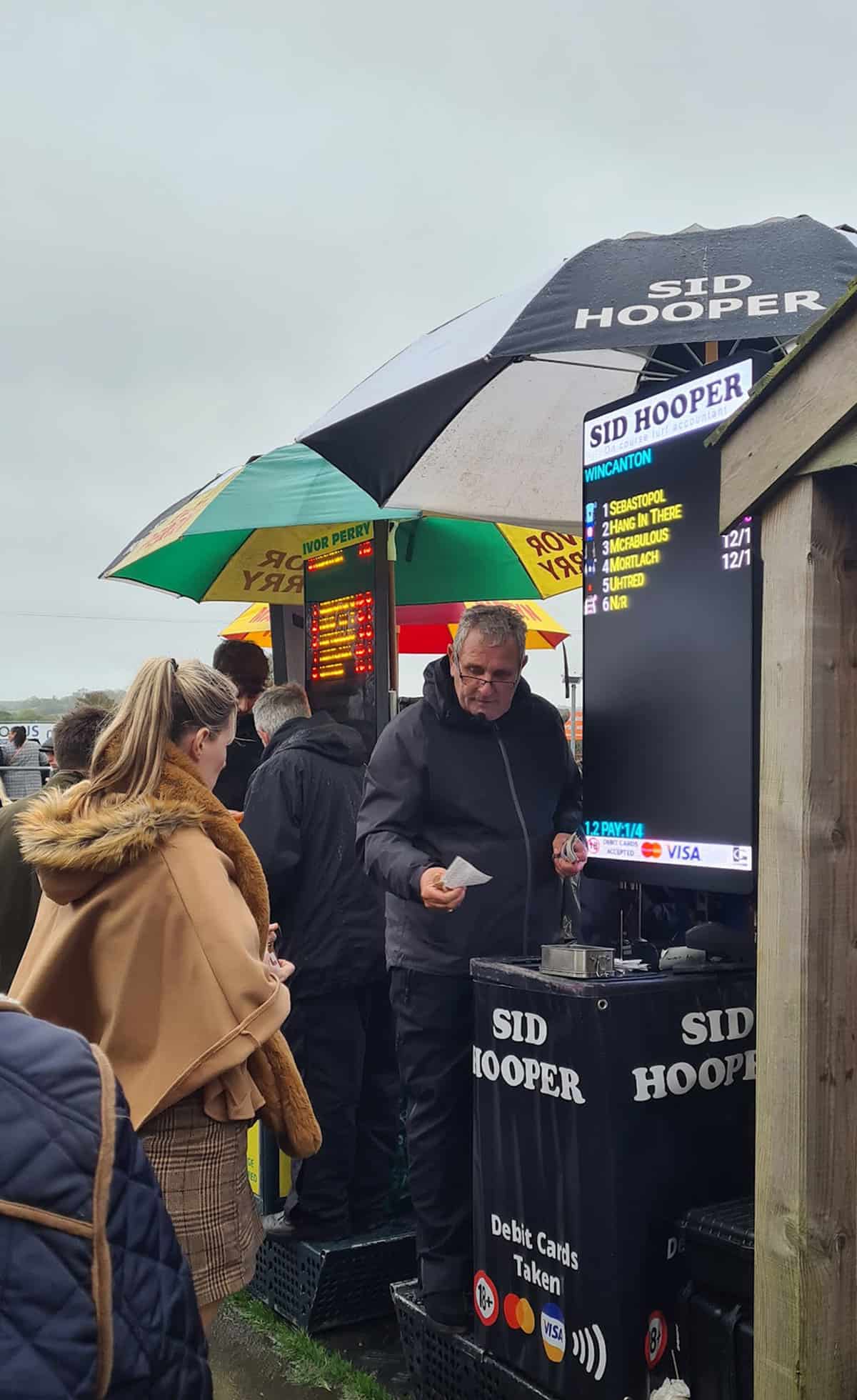
Contactless is taken by some of the course bookies
Suddenly feeling it The crowd, the weather – suddenly horseracing was tangible, something very physical. And then the horses pounded past on the first circuit – mere feet away from where we stood. The noise from the stand began to build, the weather was forgotten, and we found ourselves cheering with the crowd as the pace picked up for the second circuit, eyes glued to the big screen until they rounded for the final straight and came into view. We could actually feel the horses approaching. It’s a cliché to talk about the thunder of hooves, but what other word is there? The noise was visceral, sandwiched as we were between the horses galloping past and the wall of sound from the crowd hollering them home. As they passed the finishing post I was beaming – and keen to head straight back to the parade ring and do it all again. This time I tried an actual bet – again, don’t be afraid. The bookies make it easy, and the solid advice was ‘if you’re not sure, just go for the favourite. They’re tipped to win because they’re judged to be the best horse on the course, so it’s never a bad idea’. Nearly all the course bookies had banners declaring their minimum bet as £1 or £2, so don’t be ashamed to put on even a tiny amount, it really doesn’t matter (and some are contactless if you, like us, forgot to bring some cash. Just look for the sign on their board). We actually spent more on coffee than we did on betting, but it was a lot of fun choosing a horse, cheering them on and then going to collect our winnings (which we promptly bet on the next race, of course).
Watching on the screen doesn’t compare to standing within feet of the horses as they hurtle past
We were part of the crowd jumping and cheering local horse Frodon to victory in the 61st Badger Beer Handicap Chase. We picked a couple of winners, we grabbed a (really good) burger from a stand, a warming coffee from another, avoided the busy bars and forgot to worry about the weather. We bumped into some old friends and saw many others doing the same. It turns out that horseracing isn’t about having a slightly seedy day of gambling, nor is it just for the poshest of hat-wearers politely chatting over a whisky. It’s just a really fun, relaxed, sociable day – and the attitude to us as blatantly-obvious absolute race virgins, was friendly and welcoming. There’s always someone who knows the answer to a question – just ask the nearest person who looks like they might know what they’re doing. On top of which you get to be up close to some of the most beautiful animals on earth. So – the big question. Would we go for another day at the races? The answer to that is that we’re already marking the calendar, and booking up friends to come with us next time …
Castle Hill Closure I’m writing on behalf of the Trustees of Cedars Castle Hill to confirm that we’ve reluctantly concluded we have to close Castle Hill House (CHH) and combine our residential and nursing activities under a single roof at our other care home, the Cedars. This move is a pre-emptive response to the financial, staff and funding-related challenges that are threatening to overwhelm the care sector. Essentially we will offer the 11 current residents of CHH a transfer to a ground floor room at the Cedars where they will be surrounded by those they know well and cared for by staff familiar to them. All this is to be smoothly achieved by Christmas. In the meantime CHH will be ‘mothballed’ (but continue to provide office facilities and accommodation for staff) while we search for a longer term solution for the building. We recognise that closing CHH may well cause some uncertainty and personal upset. Naturally, we’re sorry about this – but we’re a small charity, facing significant challenges, and feel we have to take action before we’re overwhelmed by events. However, we firmly believe that this move will strengthen our position – to the benefit of residents, staff, families and the local community. Mike Hall For and on behalf of Trustees of Cedars Castle Hill
On Sonnaz and Roger I was delighted to read the article about Sonnaz, the upholsterer, in your latest edition (The BV, Nov 22). I attended an upholstery course with Sonnaz in Wimborne four or five years ago, where she gave me the very best advice on recovering two wing chairs, which have been greatly admired, she is a lovely person. Then I turned over a few pages where I read the article by Roger Guttridge about the workhouse in Shaftesbury. We recently went on a Great Rail Journey holiday to Italy and a gentleman, who was on the tour with us, overheard us saying we came from near Shaftesbury. We couldn’t believe it when he told us his parents were the last people to run the workhouse in Shaftesbury and he had gone to school in Motcombe! We didn’t even know there had been a workhouse in Shaftesbury let alone where it was, and that a workhouse was still in operation until relatively recent times. Thank you for a good read. Sandy Milne by email
I do love your ‘Random 19’ column – it’s always fun and never fails to teach me something I didn’t know about the interviewee. I have always been a fan of BBC’s The Repair Shop, but I had no idea that Sonnaz was from Dorset! You rather skimmed over it in your introduction, but the fact that she moved to Dorset as a presumably very young person with no connection here beyond her work, and then took on a position as the only female apprentice at Sunseeker – what strength of character that shows. I attended the opening of 1855 in Sturminster Newton this week, just to meet her in person (the shop was excellent too, and I’ll definitely be back!) – and she was just as lovely as she has appeared in your column. Thank you Janet Moone Wimborne
Further to Roger Guttridge’s excellent article on the family emigrating from Sturminster Newton to Australia (some of our members had never see the house they lived in while in Dorset) on 16th January 2023 it will be 230 years since the arrival of Thomas and Jane Rose and their four children as the first family of free settlers. Our Society is holding a series of events culminating in a re-enactment of their arrival aboard the Bellona, taking place aboard a Tall Ship coming into Sydney Cove on the morning of the 16th January. Thomas and Jane Rose Family Society Australia
Help for the Foodbank I am the secretary of Kilmington and Stourton WI and we recently held our Christmas celebration meeting where we had a buffet for members, carols and readings. This year we asked our members to bring an item or two to donate to the Gillingham Foodbank and they more than responded! (see image above) We were delighted to deliver all the food to the Foodbank and the money we raised for our raffle ticket sales on the night – £110 – will also be going to them. We always make a charitable donation at Christmas as a WI but this year with the cost of living crisis ever more apparent, our members were delighted to be able to help such a worthy cause. Here are the committee members, all volunteers, who organised the evening in a photo with all the donations from our members. Bernie Isted Secretary, Kilmington and Stourton WI
Wincanton U18s need you! Could you be a sponsor for our Under 18s football team for the 2023/24 season? We desperately need donations towards – and sponsors for – Home/Away kit, training kit and tracksuits, training and match balls and equipment, registration and insurance costs. For more information, please contact Sean Corney on 07763 708125 or email me on [email protected]
Calling all non-Dorset readers: we want you to email us! We know that we have readers in more than 100 different countries – we’re fascinated, and would love to know where you are, and why you read The BV every month! Did you used to live here? Do you have relatives here still? Are you just a fan of Dorset? Please email [email protected] and we’ll share some of the stories!