The BV first featured Barry Cuff’s collection in The Gardener with 10,000 postcards in April 2022. In the first of a new series, the local postcard collector – and The BV’s allotment columnist – shares a selection of images from his archive. This month Barry has picked the French photography and publishing firm Levy & Sons LL.
Wimborne High streetPortland Harbour
French company Levy and Sons first produced postcards for the Paris Exhibition of 1900, and by 1901 they were selling postcard views of Paris, Boulogne and other French channel ports. In 1904 the company sent photographers to England, where they photographed views of the South Coast and London. In Dorset they covered Swanage, Corfe Castle, Wareham, Wimborne, Weymouth and Portland. All the cards were numbered, and the postcards were ready for sale in 1905.
New organiser James Cox tells editor Laura about his plans for the county’s great agricultural country show in 2023
James Cox
James Cox will be a familiar name to many in North Dorset, having run the Gillingham & Shaftesbury Show for the past four years. He has now taken on a new role as show secretary of the annual two-day Dorset County Show. ‘It’s an exciting opportunity,’ says James, ‘but in a way it feels like coming home. My family farms near Dorchester, it was our local show and I have been involved with it as a volunteer for as long as I can remember. ‘It feels appropriate to be starting the new year with a fresh look at the show – quite simply, we’re going to make it a brilliant showcase for Dorset rural life, both agriculture and countryside.’ The show may have a long history, but James is determined not to let it rest on its reputation; he is already deep in plans for 2023 and has been listening to feedback from last year’s visitors.
‘The big news this year is that we have the world’s biggest monster trucks coming to the main arena on both days of the show. We’re really proud to have secured them. But just as important as the big attractions are the basics of the show. We’re looking at toilets, car parking, layout. We have introduced a new food and drink area which will be a large (some might say ’gurt big’) comfortable area to get something to eat, where the catering will focus on Dorset food and drink – we want people to be buying burgers from Bridport, not Bookers.
SONY DSC
‘We’re introducing a Woodland Area for the first time, where the Dorset Axemen will be demonstrating their forestry skills, along with various carvers and woodworkers showing traditional rural crafts. ‘We’ve also increased the trading area to allow more variety – the artisan crafts will extend outside the marquee this year. ‘Of course, we’re not losing the educational farming demos in the Fabulous Food and Farming Area, and the show wouldn’t even exist without the competitions in livestock, horticulture, equestrian and homecraft. The team never forgets that at its heart it is an agricultural country show – traders and visitors alike come together for a brilliant celebration of Dorset.’ Gate prices will remain the same this year at £23, but the team has introduced new ticketing options which mean greater savings. If you purchase before the of January, the cost is just £15. Watch the show’s social media for updates!
Following our success in gaining Lottery Funding we are happy to invite applications for the following two roles based at our Farm Site in Holnest just south of Sherborne Dorset.
1: Project Lead – Rural Remedies: Planting Seeds to Strengthen your Future
You will be leading on the planning and delivery of therapeutic mentoring sessions to individual young people primarily aged 8 to 13 years. There will be some group work and social activities to help build friendships and positive peer to peer communication.
Full time 3-year Fixed Term Contract, Up to £15 per hour (depending upon experience) for 35 hours per week. There will be a need to work flexibly.
2: Youth Ambassador Co-ordinator
The purpose of the position is to offer young people who attend or who have attended Future Roots in any capacity to have the opportunity to have their voices heard. To disseminate their thoughts and feelings to stake holders in order to make changes to the systems that impact on young people’s lives including Future Roots.
Part Time 3-year Fixed Term Contract, Up to £15 per hour (depending upon experience) for 7 hours per week. There will be a need to work flexibly
For an informal discussion about either role please contact Julie Plumley (Director) on 01963 210703 or [email protected]
To Apply please supply a CV and a completed Application Form by 6 p.m. on 26th January 2023.
Friday Lunchtime Recitals 1.45pm Cheap Street Church (unless otherwise stated) FREE ADMISSION ALL WELCOME!
13 January – Woodwind I 20 January – Instrumental Soloists 27 January – Strings 3 February – Pianists 10 February – Instrumental & Vocal Soloists 24 February – Brass 3 March – Wind Band (BSR, Sherborne School) 10 March – Instrumental & Vocal Soloists 17 March – Woodwind Il
January issue out now – and it’s crammed with brilliant local people talking about really brilliant local people, plus some of the most amazing photography from our readers. Grab a coffee and have a flick through…
Some quick highlights:
Rupert Hardy, chairman of the North Dorset CPRE, takes a look at the case for large Dorset solar farms in our fields vs. solar panels on roofs – P.6
Could there actually be an economic case for ploughing a motorway through Dorset? Andrew Livingston ponders the question – P.72
There’s six pages of local history, including the inside story of Britain’s ‘most haunted manor’ at Sandford Orcas, and in a new column we gain an exclusive look into the world’s largest collection of Dorset postcards, with some rarely seen before images – starts on P.42
Prices may be falling and mortage lenders nervous – but house hunters are still looking to move. A round table of local experts takes a look at the Dorset housing market in 2023 – P.14
Take a deep breath of calm as you move slowly through the six pages of reader’s photography this month – the standard is astonishing and there was a genuine battle for the front cover. Did we get it right? – P.72
New organiser James Cox talks exclusively to editor Laura about his plans for the Dorset County Show in 2023 – P.11
Take a look at the life of Dorset farrier Sam Wilkes and you will believe horseshoes really are lucky – P.20
Plus there’s the all the Dorset food and drink, the oddly soothing gardening (I do not grow vegetables. But I would never miss Barry Cuff’s allotment column), fascinating Dorset wildlife, the farming section will really make you think… why wouldn’t you have a flick through?
(Quick reminder – we’re NEVER PRINTED. The only way to read the BV’s jam-packed goodness is right here online)
Gardener Pete Harcom says that January is the perfect time for a little thoughtful planning on how to make the most of your garden this year
Shutterstock
The benefits of gardening are well documented nowadays. Stress relief and increased self-esteem are gained from regular gardening sessions, while immunity, heart health and brain health are improved. The risks of stroke or Alzheimer’s are reduced and mental health is significantly boosted. Gardening really is a labour of love that reaps benefits in all areas. But it can also have an astonishingly positive impact on the environment. A thoughtful gardener can make simple changes which hugely benefit the natural ecosystem. With that in mind, here are a few ideas for your garden plans in the coming year, along with some general January garden jobs.
Native plants for native wildlife Consider the wildlife support that native plantings can bring – plants such as pulmonaria, grape hyacinth, Aubretia, primrose, sweet Violet and English bluebell are just some that attract our bees and butterflies. Consider allowing an area of garden to ‘go native’ to attract wildlife – simply let the grass grow, and put up some bird boxes, a hedgehog home or maybe a butterfly house. Do ensure that bird feeders are clean and replenished and water is available, especially in very cold weather.
Don’t bin it! All decaying leaves should be either cleared up and put on the compost heap or left in a pile somewhere sheltered to provide shelter for hedgehogs and beneficial insects. While tidying, remember to check that the crowns of herbaceous perennials and alpines are not waterlogged under piles of fallen decaying leaves.
A little housekeeping Winter pruning can still be done on climbing roses, apple and pear trees. Magnolias, Cotinus, Berberis and flowering currants can also be pruned now. Tall shrub roses will benefit from being reduced in height to reduce wind rock, which can allow water to lie in against the roots. Clear up the greenhouse, wash all pots and the greenhouse glass (carefully!). Perhaps consider installing automatic vent openers, installing guttering and a water butt to conserve water. Also be sure to cover outside taps with insulation.
Seed time Now’s the time to order the coveted seeds from the catalogues, but do take a moment to review what worked well in your garden last year (and what didn’t go so well!) and make a new plan of action. If you order plug plants, ensure they will be hardy, if your greenhouse is not heated or at least insulated. You can go ahead and sow antirrhinum, Sweet Peas, lobelia, Begonia Semperflorens and geraniums (pelargoniums) now, in gentle heat in the greenhouse or on a windowsill – in a propagator if possible.
New borders Plan and replant herbaceous borders. Take hardwood cuttings from deciduous shrubs, such as forsythia, willow and viburnum. Peat-free and loam-based composts are readily available and advice can be obtained from garden centre staff. Consider the soil in your garden – soil testing can help, particularly if you have moved to a new garden or taken on an allotment. Doing a simple test can avoid years of disappointing results! I find the Mooncity 3-in-1 soil tester is very easy to use. Again, speak to your local garden centre staff for advice.
Could there actually be an economic case for ploughing a motorway through Dorset, asks Andrew Livingston
shutterstock
Here’s a horrific notion to get you started for 2023 – should Dorset have a motorway? Now just hear me out before you smash your phones, tablets and laptops in utter disgust. Growing up in one of the five counties without any stretch of motorway has always been a source of pride for me. But I have been starting to brood on it. And I won’t lie – I am starting to see a few benefits. What if, let’s say, the M3 continued all the way to somewhere like Dorchester? This all started when I saw a few statistics as I rummaged through some government reports. Around 75 per cent of Dorset is used for agriculture, around the national average. However, food production in the county employs fewer than 6,000 people. In 2021 that was less than 10 per cent of the total employed in that sector in the South West. It made me think. We’ve got some amazing food here in Dorset. Could we be doing better at exporting it? Think about our neighbours in Devon, Cornwall and Somerset. Their counties are renowned for some amazing agricultural and food products that are sold all over the country – the cheeses, creams, beers and cider that are grown and made there.
Only five English counties are entirely without a motorway: Rutland, Suffolk, Norfolk, Dorset and Cornwall
Made in Dorset There are so many amazing foods made in this county, but you don’t really see them further afield. Granted, Clipper Tea is found globally, but the tea isn’t grown in Dorset. Ford Farm’s Coastal Cheddar, Moore’s Biscuits, Capreolus charcuterie and BV Dairy’s creams are a few local products that I can think of that you can find in stores nationally (but of course no one actually knows when they’re buying BV Dairy product from Dorset!). Admittedly, Cornwall also doesn’t have a motorway and still manages to ship its food and beverages nationally just fine; but they do have the A30 and A38, which both lead straight into the M5. And I don’t mean to break the hearts of big fans of the A35 and the A37 but frankly, they are awful. Especially in the summer. The Romans invaded Maiden Castle and Dorset in 43 AD and occupied the county for more than 300 years. When they left and headed back to Italy all we had to do was tarmac their roads occasionally (and maybe replace the signposts once a century) and we would have been fine! I will admit – before I get chased out of the county by the readership wielding flaming pitchforks – that the A38 from Bridport to Dorchester is stunning on a clear day. But you daren’t overtake anyone on the one stretch of dual carriageway in case a wandering car drifts lanes as the driver looks across Eggardon Hill to the north and the Jurassic coastline to the south. In my head I obviously hate the very idea of a motorway. But I also believe that the rest of the country deserves some of our amazing Dorset produce. If extending the M3 means that Londoners get the experience of the silky smooth taste of Purbeck ice cream then so be it. I’ll even accept some decent dual carriageways if it means that the north could finally know that a Dorset Knob isn’t just sitting between the legs of the Cerne Giant.
A trip to Gillingham for this month’s Then And Now, where Roger Guttridge discovers an Olympic champion’s unlikely connection with North Dorset hostelries
The Royal Hotel in Newbury c. 1920. The garden to the left is now part of Bracher Brothers, the funeral directors. Picture from Around Gillingham by David Lloyd
Sports fans in their late 60s or older will remember Mary Rand as one of Britain’s greatest female athletes. But how many know of her connection to a couple of North Dorset hotels? Mary (née Bignal) was born and brought up at Wells, Somerset, won an athletics scholarship to Millfield School and at the 1964 Tokyo Olympics became the first British woman to win Olympic gold in a track and field event. She actually won three medals – gold with a world record in the long jump, silver in the pentathlon and bronze in the 4x100m relay.
The Royal Hotel in about 1900. Note the two lions on the portico. Picture from the Barry Cuff Collection
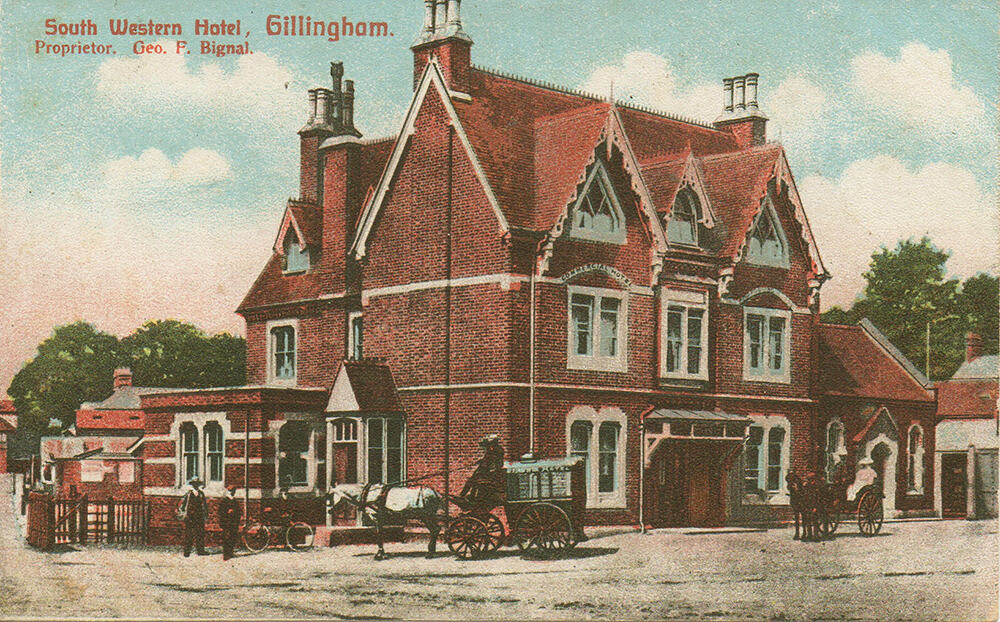
Her (admittedly tenuous!) connection with the Blackmore Vale is that her grandfather George Bignal owned two of Gillingham’s leading hotels – the Royal and the South Western. Both hotels were spawned by the coming of the railway, which arrived in 1859.
Flats now stand on the site of the old Royal Hotel. Picture by Roger Guttridge
In fact, the Royal was originally called the Railway Hotel, despite being in the area of Newbury, a tidy stroll from the station. In 1889, it was owned by Frank Ford, who made a point of stressing that it was ‘within three minutes’ walk of the London & South Western Railway’ (L&SWR). It was also a posting house and offered billiards and pool. By 1895, it had become the Royal Hotel and George Bignal was the owner. It did not close until 2005 but was subsequently demolished and the site redeveloped as flats. The developers and local planners deserve credit for making an effort to build the flats in a similar style. It is a shame they couldn’t find a spot for the two lions that once graced the portico.
The South Western Hotel c. 1900. Picture from the Barry Cuff Collection
Locals will already be familiar with Bignal’s other hotel which was, ironically, barely a stone’s throw from the station, built on land bought from the L&SWR. The South Western’s prime site made it eminently accessible to train passengers, especially commercial travellers. They were able to hire carriages and traps from the hotel to take them to neighbouring towns and villages. The South Western also cashed in on its proximity to Gillingham’s market yards. On market days it would be crowded with farmers and livestock dealers, who could rely on the hotel staff to look after their horses.
The South Western survives today as flats. Picture by Roger Guttridge
The building to the right in the c. 1900 picture above was the Market Hall, which was also used for public meetings and was the town’s first cinema, the Electric Palace. George Bignal owned the hotel around this time and issued his own public house tokens, a form of in-house currency. Unlike the Royal, the South Western is still standing by the station, but has long since been converted to flats.
This month’s news from the unofficial capital of the Blackmore Vale..
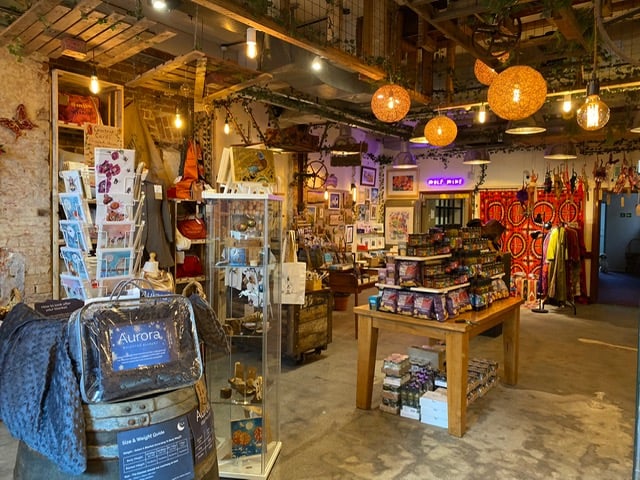
1855 is Stur’s new shopping experience with more than 40 different local artisans selling their wares. The first of our new monthly ‘wine tasting and meet the traders’ event is on 27th January, from late afternoon until 8.00 p.m. Do come and try the delicious hand-picked range of wines from small vineyards with resident experts from Wolf Wines. Don’t be put off by Tim Burr lounging beside the door outside – he’s a local lad and very friendly.
The new ‘wine tasting and meet the traders’ event in 1855 is on 27th January, from late afternoon until 8.00p.m
Do the shopping rounds Nest time you are in Stur, come and see what household treasures you can find at The Emporium – including our fascinating art gallery upstairs, Dapper Chaps men’s clothes and the furniture showroom in the former Barclays Bank. Maybe you still need that new spring outfit at a fraction of the usual cost – come and indulge in the PreLoved Boutique.
Thank you The team would like to thank all those who supported the two day Christmas event (so long ago in November!). The the sale of all your pre-loved goods in the SturAction shops, plus sponsorship from local businesses, paid for the town’s lovely Christmas tree, for the installation of all the little trees and helped towards the cost of the ice rink. Thank you also to everyone who came to enjoy themselves and especially to Father Christmas and his Elves. Hopefully we will do it all again next year – even better!
Dates for the diary: Wedding Fair 4th February 10am to 2pm Sturminster Newton invites couples & families to a unique town event, where they can discover enticing offers for all occasions. Visit wedding and special occasions exhibitors in The Exchange – everything you need to make your event wonderful. Then follow the trail through Sturminster Newton and visit the wedding exhibitions in some of our independent shops on your way to St. Mary’s to view the wedding dress display.
North Dorset Schools Career Day 9th March, 10am to 6pm Calling all Dorset employers! Exhibit for free and showcase your key roles, apprenticeships, and career progression. Meet and engage with young people from five schools in years 8 to 11. The twilight session is open to other schools, year groups and parents. The event will be at The Exchange in Sturminster Newton, and you can register as an exhibitor here.