Showcasing a range of exhibitors offering a spectacular array of plants and garden must haves, as well as the opportunity to talk to experts and gain helpful advice. With plenty to explore, from small independent nurseries selling unusual hardy perennials, herbs, alpines, cottage garden favourites and native wildflowers. Discover other unique items for your garden including the Simon Gudgeon range, from hanging seats and benches to birdfeeders. The perfect day out for any garden lover.
Entrance to The Plant Fair is free of charge within the Makers Yard. Should you wish to extend your day and explore the Sculpture Park, book tickets at sculpturebythelakes.co.uk
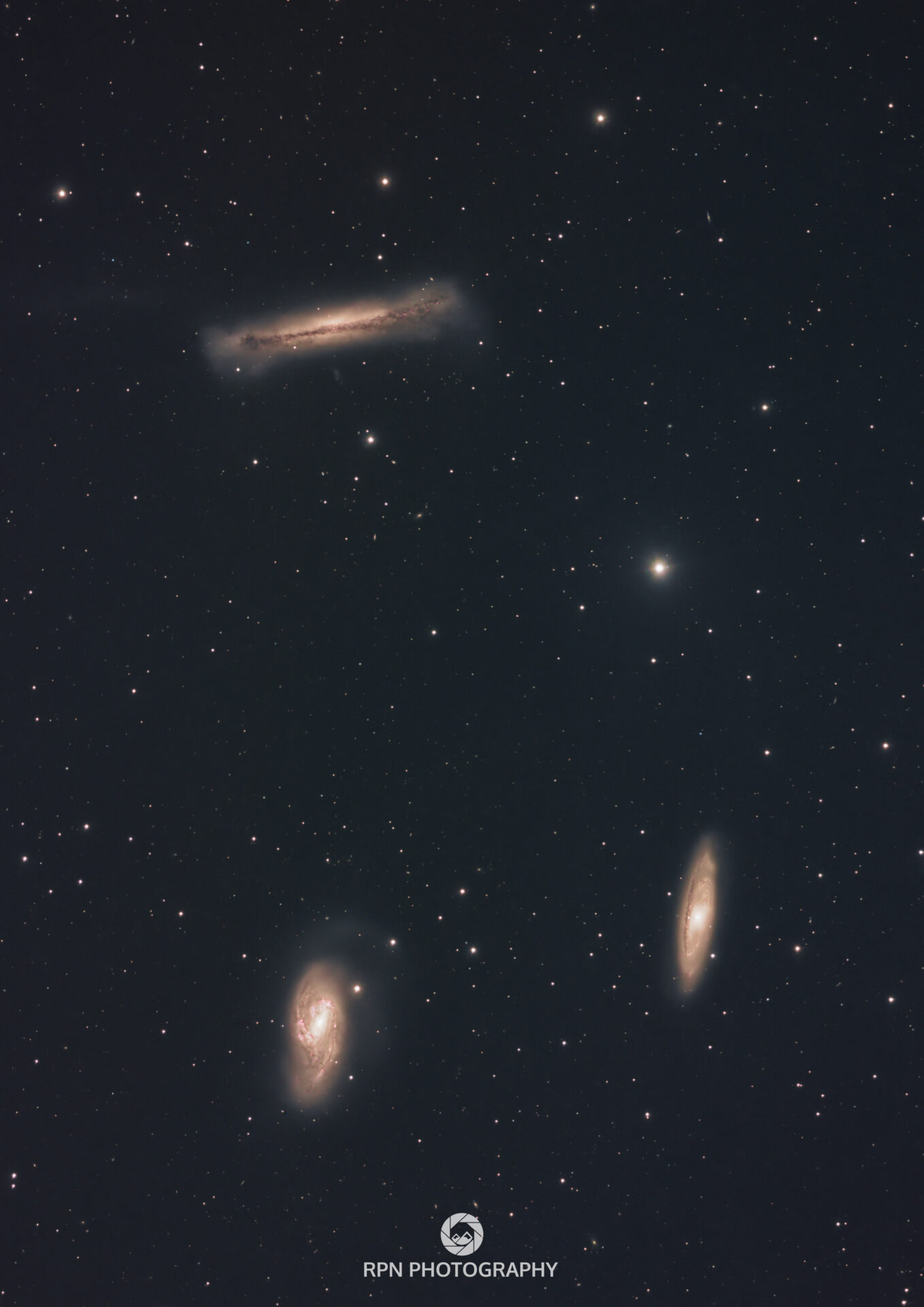
The skies have cleared, and The BV’s astrophotographer Rob Nolan is celebrating the start of galaxy season with a special trio
Leo Triplet
Slightly more favourable conditions throughout April meant at least a few clear nights to see the galaxies far far away – especially now that we have officially entered ‘galaxy season’. With a greater number of galaxies visible in the night sky than at any other time of year, many amateur astronomers take advantage of the opportunity to observe and photograph these amazing objects. I’m a bit late into galaxy season, which starts in March, but as we all know, the weather was not great. So to kick things off, I thought I’d go for a three in one! The Leo Triplet, also known as the M66 Group, consists of a small group of galaxies a mere 35 million light years away, in the constellation Leo. In this photograph, clearly visible are M65 (bottom right), M66 (bottom left) and NGC 3628 (top). M65 and M66 are spiral galaxies, while M65 appears to not have much gas and dust; its high ratio of old stars to young suggests that there is little new star formation going on. M66 appears rather more interesting, with bright star clusters along its sweeping spiral arms. NGC 3628, also known as the Hamburger Galaxy, appears as though it may be a barred spiral galaxy with the bar seen end-on edge from Earth, making it a most conspicuous galaxy to observe. Since there’ll no doubt be more galaxies coming, it seems the perfect time for a quick explainer on the three basic types. Spiral galaxies, such as our Milky Way, are rich in gas and dust, great for star creation. Irregular galaxies have similar ingredients and potential, but are usually smaller and don’t form a discernible shape. Finally, we have elliptical galaxies – these vary in size dramatically from very small to mind-bogglingly huge! Not as pretty as spiral galaxies, they take on a rather uninspiring oval shape. Most stars in these galaxies appear red, due to being older, with very few new stars being created due to the lack of gas and dust. This image of the Leo Triplet was captured with my 1000mm Maksutov Newtonian Telescope and the ZWO ASI2600MM Pro Astro camera with Broadband filters and is about four hours of data.
The night sky, May 2023 – Rob’s guide for your stargazing this month:
Our local neighbours – that’s Venus and Mars for anyone wondering – grace our western skies this month. The southern skies are currently dominated by the immense, stunning orange star Arcturus. Look to the lower right of Arcturus this month and you’ll find a couple of bright blue stars, Spica and Regulus. Near to Arcturus in the region to its left, you might also make out the faint stars making up the two giant constellations Ophiuchus and Hercules. But this month’s constellation has to be Ursa Major, the Great Bear, which is an international favourite. You’ll no doubt know its seven brightest stars as the Plough here in the UK. This constellation is always on show in the northern hemisphere, so it tends to be the first star formation stargazers become familiar with. An interesting fact about this constellation is that the majority of the stars lie at the same distance away from Earth and appear to have been born around the same time. The constellation is also home to some binary stars that you can ‘split’ with the unaided eye.
Star dates for the diary Particular events of interest this month include the annual Eta Aquarid Meteor shower on the 7th May in the very early hours, caused by small pieces of Halley’s Comet burning up in Earth’s atmosphere. Unfortunately though, due to the bright moon during the night, the unusually intense display will likely be washed out. It may still be worth trying to catch a glimpse though! The rest of the notable events this month involve our Moon and its regular dance in and around the views of the inner planets. On the night of the 13th and 14th May, just before dawn, observe the enchanting crescent Moon passing below Saturn. On the 22nd May, Venus, the Evening Star, will appear above and to the left of the thin crescent Moon. In the twilight sky of the 23rd May, the crescent Moon and Venus appear to get very close, with the familiar stars Castor and Pollux just above. Mars also makes an appearance on set, looking left in the sky. On the 24th May, Mars again makes an appearance below the crescent Moon, with stars Castor and Pollux and the planet Venus off to the right lower in the sky. Until next time, clear skies!
Banned in Dorset on council land, disposable barbecues still pose an ever-increasing fire and environmental risk. Rachael Rowe reports
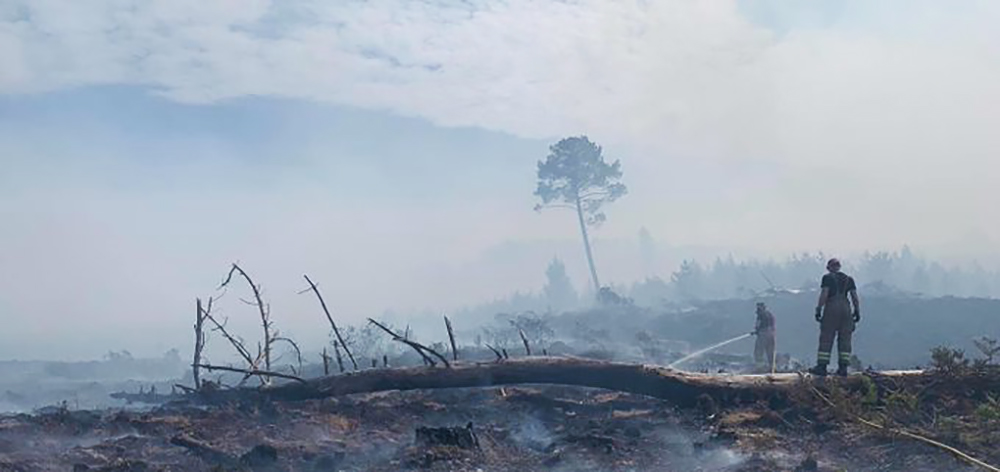
Wareham Forest in the aftermath of the 2020 fire caused by a disposable barbecue. All images: Dorset & Wiltshire FRS
The fires that tore through Wareham Forest in 2020 and Studland in 2022 were among the worst wildfires ever seen in Dorset. Sadly, both were entirely preventable, the causes attributed to disposable barbecues. The fires caused significant damage to wildlife and the local area. So why do people continue to buy and use them? Dorset Council has recently taken a stand on disposable barbecues, putting a Public Spaces Protection Order in place.
Wareham Forest on fire
Why are disposable barbecues a hazard? Disposable barbecues are a significant fire and environmental hazard. They might be convenient for a day at the beach or an alfresco lunch. But if they are not correctly disposed of, they can lead to significant burning and fire hazards as well as wild fires. When disposable barbecues have been buried in the sand, which naturally retains and intensifies heat, people have suffered serious burns. If they end up in the sea, disposable barbecues pose a risk to marine life. Those left on dry land can quickly catch light and cause untold damage, as the ravaged Wareham Heath photographs show. Dorset has significant areas of heathland, home to rare species such as smooth snakes and sand lizards, all at risk from wildfires. According to figures from Dorset Fire and Rescue, there was a significant increase in fires involving barbecues in the five years to 2020 – in 2016 there were four incidents, rising dramatically to 74 in 2020 in Dorset. Aside from the intrinsic fire risks, there is another issue with disposable barbecues. Designed for single use, they are not in any way environmentally sustainable. Coals and other substances from them can leach into the soil, which is also a major hazard to wildlife. With this in mind, Dorset Council and Litter Free Dorset have been working with Southern Co-op to ban sales.
Southern Co op, Dorset Council, Litter Free Dorset and a team of 60 volunteers worked to break down 8,000 disposable barbecues
Co-operative action In April, Dorset Council and Litter Free Dorset were able to take a significant step forward, raising awareness of the hazards and environmental impact of disposable barbecues. When Southern Co-op decided to take disposable barbecues off their shelves, they found they had 8,000 to get rid of – responsibly. The company contacted Litter Free Dorset and worked with several other organisations across the county to dispose of the offending items appropriately. The dismantling operation (pictured above) took place at the massive W&S Waste Management warehouse at Canford Heath. ‘Sadly, we have witnessed the devastating impact that disposable barbecues can have to both people and wildlife if they are not disposed of responsibly,’ says Mark Smith, chief executive of Southern Co-op. ’Removing them from sale was an important move to protect our local wildlife and ecosystems, and was part of our commitment to reducing our environmental impact. ‘However, we also needed to be able to dispose of them responsibly. Thanks to Litter Free Dorset and a host of dedicated volunteers, this was made possible.’ Several large supermarket chains, including Waitrose and Aldi, have also pledged to remove disposable barbecues from sale.
The metal grill sheets and foil trays, compacted ready for recycling
A tricky separation Litter Free Dorset co-ordinator Emma Teasdale says: ‘Of course we want people to enjoy their summer and make the most of our beautiful county, but this should not be at the cost of the environment. We are asking people to make the change by avoiding single-use items – including disposable barbecues – and to look for reusable alternatives. The dismantled barbecues weighed in at seven tonnes – that’s a lot of aluminium and coal,’ she says. ‘It took a team of 60 volunteers all day to unravel and sort the barbecues into their constituent parts, and everyone went home looking filthy. The entire exercise also demonstrated just how hard it is to dispose of these items appropriately – even when there is no rush and the barbecues are totally cold. It is so much harder when they are still hot!’ The coal was donated to Swanage Railway and other parts were separated for recycling. The metal grill sheets and foil trays were destined for the W&S scrap metal site and the paper and plastics were recycled locally. Litter Free Dorset project officer Eimear Coyle said the feedback had been positive. ‘We’ve had a few shops approach us about stopping selling the disposable barbecues, and we are continuing to promote the messages about them. Dorset Council has already prohibited the use of disposable barbecues on its land.’
The coal was donated to Swanage Railway, and the metal, paper and plastics were separated for recycling
What can you do? The obviously solution is to stop using disposable barbecues – do not buy them in the first place. If you are a retailer, just stop selling disposable barbecues.
The smoking remains of Wareham Forest in 2020
What about sky lanterns? Another perennial problem, usually from weddings and festivals. More than 200,000 are released in England each year, and yes, they do look pretty. But there’s no knowing how far they will travel or where they will land. If they land in a field they are not only an obvious fire hazard but also traumatic to livestock Dorset and Wiltshire Fire and Rescue Service is firm in the opinion that they should never be used under any circumstances.
I write this at 3:44am Friday morning. I sat down here at my desk 22 hours ago, well prepared for the monthly ‘pre-publication day marathon ahead. Two hours ago I was standing in my kitchen eating a hot buttery toasted bagel with peanut butter, thinking ‘just a couple more hours’. But we’re not done yet. Beside me, Courtenay is slowly clicking through page after page of this oh-so-nearly done May issue (just this letter and the Index to go. Whose idea was the clever clicky index anyway?) I know I mentioned it last month, but in a couple of weeks we head to London for a national awards ceremony. We don’t care if we win. The very fact that we made that list is beyond astonishing. Because it’s just.. us. I’m not sure if most people truly grasp that. Obviously we’re here, now, putting the magazine together, and we of course have a big team of writers and columnists who fill it with us. But apart from that… Website design? Us. Website content? Us. Ad design? Us. Networking? Us. Event coverage? Us. SEO work? Still us. Accounts? Us (C’s money in, I’m money out. Would appear I’m better at spending it). Social media? Us. Stats analysis? Also us. We often tell people this, and they nod, and say ‘OK, but can I talk to the person who does the…’. Yes. Yes, you can. How can I help? When we booked our awards dinner seats, we were asked how many places we wanted. I think he thought I was joking when I said ‘well, as there’s actually only two of us…’ Yes of course it’s exhausting, and we have no idea when we’ll next get a holiday. But every business owner knows there’s a tipping point before you expand; we’re teetering on the brink. And there are benefits. It means we know every single last detail about this gorgeous magazine of ours. It’s innately ours in the way only something that grows under your fingertips can be. We know everyone in it. We remember every article. We read every Facebook comment, see every email, write every tweet (and worry over whether tweet should be capitalised). So for a panel of judges to think The BV is up there with two of the best regional newspapers in the country? We’re already winners. (what I actually meant to talk about this month was mugs. I got a bit sidetracked. In the space of the last month, every single one of my favourite mugs – the sturdy afternoon coffee looks-like-an-enamel-mug mug, the thin small evening one, the round comfy hug-in-your-hands one, the I-run-like-peanut-butter funny one… has developed a chip, a crack, been dropped or come out the dishwasher in two pieces. How does that happen? Have a wonderful May – and think of us on the 18th.
On planning applications I am concerned about the number of recent planning applications submitted by developers in our area – as discussed in Rachael Rowe’s excellent article of the March issue (Is North Dorset overwhelmed with housing developments?).It has recently come to my personal attention that developers may not always disclose all details within their applications, leaving room for potential harm to our neighbourhoods. I would like to urge all local residents to take the time to thoroughly examine the documents submitted by developers. If you wish to object to a proposal, it is imperative to review all submitted materials with a critical eye. It may seem overwhelming at first, given the volume of paperwork, but I believe this is precisely what the developers intend. They may use excessive documentation to obfuscate important details or hide major gaps in their proposals. As communities, we must not let ourselves be overwhelmed by the daunting task of reviewing these applications. Rather, we should work together, dividing the paperwork and sharing our findings with one another. By doing so, we can ensure that all developments adhere to the needs and requirements of it’s neighbours. I encourage all residents to take an active role in reviewing local planning applications and voicing their concerns when necessary. As a united community, we can welcome much-needed excellent housing expansions, but also prevent undesirable developments, ensuring that our area remains a great place to live for years to come. J Nailsea, Sherborne
On climate protesters Criticism of climate protesters is a sad indictment of how seriously many view the looming crisis. The criticism most widely hurled at these various forms of direct action is that they are counterproductive, that they antagonise ordinary people and make them stop listening. There is an obvious reply. No one was listening in the first place, before the activists took to the streets. Even endless scientific warnings have made little impact on public or government behaviour. The establishment media have paid only lip service to the dangers, even as the effects on the climate have become harder to overlook. And governments have made placatory noises while doing nothing meaningful to reverse the collision course humanity is on. There have been repeated promises to stay under 1.5ºC of global warming while already emitting enough greenhouse gases to cause an increase that means we have little chance of avoiding staying under 2ºC with what we are doing. We need change on a scale that no one is grasping, apart from the protesters, and I appreciate how drastically they are trying to get that message across. The future looks pretty dire. If we lose the biodiversity we lose everything, there’s no going back. It scares me a lot. Its not a rebellion we need. Its a revolution. M Holderness, Charlton
On complaining businesses As a newly-retired woman who has successfully run my own business for most of my life, I have recently been surprised at the number of local business owners that dismiss, belittle or simply moan about social media. The internet is no longer new, and businesses have had many, many years to adapt to the ever-evolving digital landscape. It is crucial for businesses to embrace change and adapt to survive in today’s competitive market. Publicly complaining about the ways of the modern world is, in my opinion, the fastest way to make your brand appear old, dated, and irrelevant to a new audience. The most successful businesses are those that attract and retain new customers by staying current, utilising the tools and technologies available to them; and in 2023 that has to include social media. I am astonished at the many older, established local businesses who not only struggle to adapt to a newer business model, but publicly bemoan the need to! Social media platforms offer businesses an incredible opportunity to engage with their audience, build brand awareness and promote their products or services. By dismissing or belittling these platforms, local businesses will simply miss out on valuable opportunities to connect with potential customers and grow their brand. They can ensure their business remains relevant, attracts new customers, and continues to thrive in an increasingly digital world. Susan N, Blandford
On young people It is crucial that we begin to address the needs of the younger generation in Dorset. In recent years, I have noticed a growing number of young people in our community who seem to be struggling to find meaningful activities, support, and opportunities for personal growth. This then leads to feelings of isolation, boredom, and disconnection from the community. In some cases, these feelings might even contribute to risky or antisocial behaviour. It is our responsibility to ensure that our young people have access to the resources and support they need to thrive. Outside of the uniformed youth groups, where are the safe spaces for them to socialize, learn, and develop new skills? Where are the programs and activities that help them develop a sense of belonging? I am tired of seeing our young people drift moodily through their teen years, awaiting the day they can escape elsewhere in order for their lives to begin. What a waste of our home-grown talent and skills. Ronnie B, Child Okeford
The field solar debate (In response to the March Rural Matters column from the CPRE – Say YES to solar, but NO to greenfield solar power stations) Interesting, but not balanced. I have solar panels and battery storage but feel Rupert Hardy’s pro-roof PV, anti-field scale PV stance only tells part of the story. I am no expert but the cost and use of resources to produce 1kW in a field must be less, cleaning, maintenance and repairs must be easier, and linking up with the grid must be better. I recognise that the UK’s effort to eliminate hydrocarbon use is of little point unless the rest of the world does the same. That said, if I had the choice between having a south facing field in an AONB covered in PV and less global warming … and no field covered in PV and more global warming ….my choice is easy. One is a reversible inconvenience, the other is a disaster. Keith Beeson, via the website
On being shortlisted! I am an avid reader of the BV, and wanted to extend my congratulations to the entire BV team for being shortlisted for the national award this month (Regional Publication of the Year in the News and Magazine Awards 2023). It is well-deserved recognition for creating such a high-quality publication. Over the last couple of years, I have been consistently impressed by the breadth and depth of the magazine. From local news – covered properly – to showing us the beauty of Dorset’s wildlife, to a fascinating insight into farming, allotments and equestrian (I don’t ride, nor do I drive a tractor or grow my own veg. And yet I can’t resist them!), the BV magazine has become my go-to source for staying connected with my county. The digital format makes it easy for me to read and share the magazine with friends and family, even those who live outside Dorset. Your magazine has a warm voice that makes it feel like catching up with an old friend. And of course the stunning photography keeps me coming back for more every month. I am sure many others feel the same way. I congratulate the whole BV team just for making the shortlist, an achievement in itself alongside two big regional newspapers, and I wish you the best of luck in winning the award. You deserve the recognition for the outstanding work you do. Marie L, nr. Wincanton Thank you Marie! The swish Mayfair awards night dinner is on the 18th of May; we’ll be sure to keep everyone posted! – Ed
Gorgeous donkeys are apparently a new thing for the letter’s page – this beautiful nose was sent in by Laura McCormick.
Diverse Abilities, Dorset’s leading disability charity, is excited to partner with the Dorset Mud Run, taking place on May 20th, 2023, at Stock Gaylard near Sturminster Newton. The Dorset Mud Run challenges participants to complete a 6km course filled with fun and challenging obstacles such as swinging over ditches, scrambling up mud hills, crawling under cargo nets, and wading through ponds. The course, set amid stunning scenery, concludes with the best obstacle course in the UK. After the race, there’s a bar and plenty of food stands for runners to enjoy a well-deserved feast. Participants who take part in the event to support Diverse Abilities will receive a discount for entry and the charity’s assistance with fundraising. All funds raised will support the charity’s Splash Appeal, aimed at building a desperately needed hydrotherapy pool for people with profound, lifelong disabilities at The Beehive, the charity’s activity and therapy center. Diverse Abilities supports hundreds of families affected by disability in Dorset every year. Helen Mortimer, of Diverse Abilities, expressed gratitude to the Dorset Mud Run organizers for their support and for providing entry discounts to those fundraising for the charity. Entry is just £20, with discounted entry for fundraising for Diverse Abilities. To register for a Diverse Abilities discount code, CLICK HERE. For more information, email Helen at [email protected] or call 01202 718266
Banned in Dorset on council land, disposable barbecues still pose an ever-increasing fire and environmental risk.
Dorset’s ancient hill forts may offer stunning views to their thousands of visitors, but they bring a challenge for farmers.
A new monthly Shaftesbury Market begins this month – and withentertainment and a 100 artisan goods and food stalls, the event is expected to be great for tourists and the town alike
Jim Bettle – Dorset charcoal maker and countryman, makes a living from his ancient craft, fuelling his passion for a more sustainable country.
You can’t interview the Tivoli Theatre’s manager Charlie North-Lewis without hearing a steady stream of name-dropping – his long and winding career is a musical tour through 40 years of popular culture. He picks his Dorset Island Discs with Tracie.
Bestselling author Libby Page answers the Random 19 questions. A Sunday Times bestselling author, known for her feelgood novels exploring themes of community, love and connection, Libby was born and raised in Dorset.
In local history, Roger Guttridge tells the story of Bradford Abbas’s Rose and Crown pub and its ‘famous five’ customers from the 1930s. We tracked down the actual footage of them, and it’s definitely worth a watch.
Charlotte Tombs not only has the most glorious page this month, but she also has a pretty blunt explanation of the difference between your supermarket tulip, and the artisan version.
The Gillingham & Shaftesbury Agricultural society urgently require an assistant show secretary. This is a part time role, hours to be discussed.
You must have a good understanding of accounts and excellent computer skills.
Remuneration to be discussed but will be based upon the hours negotiated and the experience that the applicant brings.
If you think you have the personality and the required skills to manage this challenging but exciting role then please in the first instance send your CV along with a covering letter to:
Part time (Mainly term-time with some work in the school holidays)
Working with the Bursar, the successful candidate will play a pivotal role in the day-to-day financial operation of Hanford School, Child Okeford.
Candidates must have well-developed financial skills, and be able to work both independently and as part of a team, providing a friendly and efficient service. Experience of working in an educational setting would be advantageous, although not essential.
In return we can offer flexible working (currently 2.5 days per week for 40 weeks per year), lunch on workdays during term time and a kind and supportive environment, all in a beautiful rural setting.
We’re really excited to celebrate the launch of the National Trust’s latest title – Wild Escapes by Sian Anna Lewis!
Wild Escapes: Incredible Places to Unwind and Explore is a captivating book that invites readers to embark on a journey through some of the most amazing wild escapes in the UK. Sian is the award-winning travel writer and creator of ‘The Girl Outdoors’ blog, and she offers a comprehensive guide to beautiful destinations where you can simply switch off for a while, including tips on local walks and watering holes on the doorstep. Through its pages you can journey to 40 unforgettable getaways in Britain’s wildest corners, from floating cabins to miniature castles, tree pods to moored boats. Lose yourself in cosy reading nooks after a day hillwalking in the Peak District, go foraging in Yorkshire’s woodlands, or warm up by the campfire after taking a dip in coastal Cornish waters. Stay in the heart of Wales’ myths and legends.. and yes there’s a Dorset option too (hint: you can pitch up at the birthplace of scouting). With spectacular photography on every page, just reading Wild Escapes is an escape in itself.
To celebrate the release of Wild Escapes on May 11th, we’re giving away bundles of all the National Trust’s brand new spring titles! Wild Escapes is top of the bundle, of course, but winners will also receive:
Nature’s Wonders by Jane Adams Yes, the BV’s very own wildlife writer (see what we thought of Nature’s Wonders here). With a mix of evocative writing, beautiful photographs and facts that are too good to keep to yourself, this book explores 50 magical moments that define our seasons. It’s an inspiring guide to connecting with the nature around you and seeing how it changes through the year. There’s butterflies, blossom and bluebells. There’s foxgloves, flying ants and fungi. There’s snow, seedheads and shadows. You’ll discover how many miles an hour spring moves, how spiders can heal us and how woodpeckers help to protect sensitive technology.
Grow by Robyn Booth This beautifully illustrated book is a modern, fresh take on gardening that shows how anyone can grow their own vegetables, create a mini wildflower meadow or learn how to make the most of their houseplants. And you don’t need your own garden to get started. Creating a thriving window box, choosing suitable plant pots for a desktop oasis or joining a local community garden are perfect ways to experience the joys of gardening.
Gardens of the National Trust by Stephen Lacey The definitive guide to hundreds of Britain’s most outstanding gardens, in the care of the National Trust. The text and pictures have been fully updated, several gardens have undergone major redevelopment since the previous edition, while others have expanded the acreage open to visitors. Extensive tree planting, including reinstating a lost eighteenth-century avenue at Dyrham Park and recreating the pear tree arch at Rudyard Kipling’s home, Bateman’s, are just a few of the new and exciting additions to this classic guide to Britain’s most outstanding gardens.
A Good Appetite by Jenny Chandler. Packed with brilliant bite-sized guides to everything from eating with the seasons, batch cooking and the best ways to use your freezer to foraging and growing some of your own food, this book is all the practical information and recipes you need for making the way you shop and cook more planet-friendly.
Nature Poems by Deborah Alma A carefully selected anthology about britain’s nature, there are celebrated poems by the greats – Keats, Yeats, Tennyson, Robert Browning, Christina Rossetti, Philip Larkin, Sylvia Plath, John Masefield, Robert Burns, Dylan Thomas – as well as contemporary poets whose work you will want to seek out and explore further, including Carol Anne Duffy, Simon Armitage and Jean Sprackland.
Positively Green by Sarah LaBrecque An informative and captivating guide to sustainable living, Positively Green provides advice on how to reduce your environmental impact, while easing climate anxiety and boosting mental wellbeing. From changing how you clean your home to putting food impacts into perspective, this book is the perfect resource for those wanting to limit their effect on the environment and reduce climate-based worries.
Together the book bundles are worth £100 – and we have THREE to give away! To be in with a chance to win one of the National Trust book bundles, just answer the first three questions in the widget box below. There are more chances to win by completing the other entry options if you so wish – they’re entirely up to you! The closing date for this competition is 1st June 2023 and only entries received on or before that date can be included. The prize will go to the first three randomly chosen entries. Good luck!