Pauline Batstone shares her monthly round up of what’s happening among the town’s collection of community enterprises and events
You never know what kind of glamour you can pull together in The Boutique
Introducing the Artists… 1855, Stur’s artisans bank continues to flourish: there are now more than 70 traders taking a space to show their craft or produce. Why not come and enjoy a food tasting on the first Saturday of the month, between 10am and 12 noon? For the time being 1855 will not be open on Sundays, and the monthly late night shopping Friday has been paused.
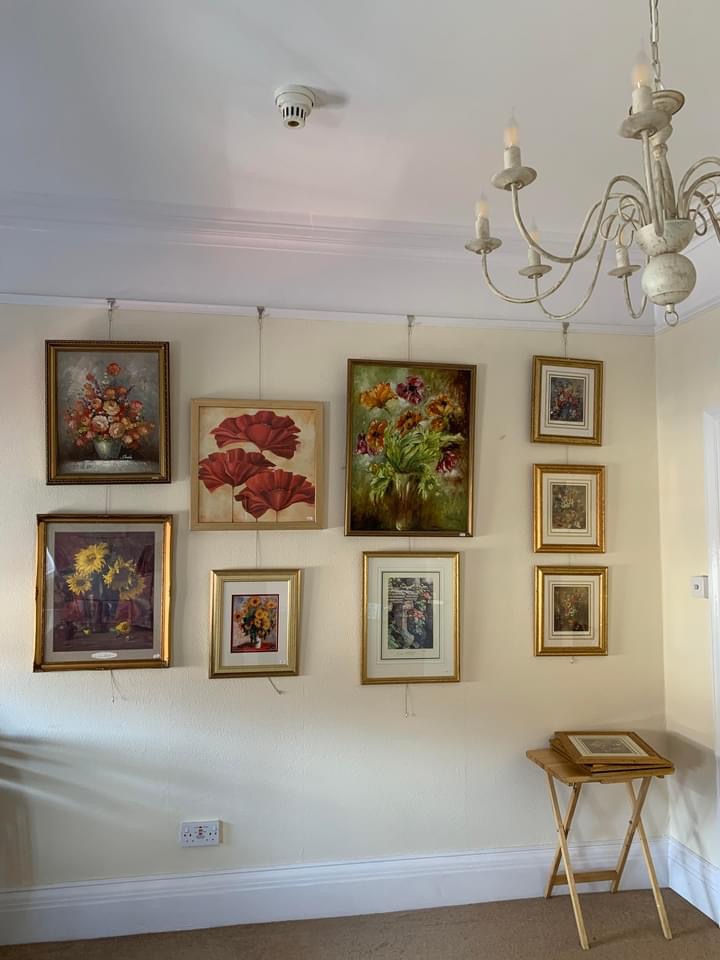
The art gallery above The Emporium
FREE school uniform Both The Emporium and The Vale Pantry are working together to provide a free school uniform hub in the former Barclays Building to help children get ready to go back to school. Do you have any items that have been grown out of and are now lurking in a drawer? All donations gratefully received. And do come and see if there is anything which fits your children. Why buy new when you can recycle? The Boutique always has free school uniforms alongside some great quality children’s clothes, most of which are just £2. It’s a great place for mums and grandmums to find a new outfit too: a constantly-changing range of lovely garments for the new season at knockdown prices!
Inside 1855 in Sturminster Newton, the town’s artisan bank with more than 70 traders
Sofa art While you’re strolling through town, don’t forget to pop in and explore the Art Gallery in The Emporium – it’s an actual Tardis above the shop, and every room is filled with art. Down the road at the old Barclays bank the Furniture Store is similarly bulging with fascinating items to transform your home, whether your sofa is actually on its last legs or you’re looking for an upcycling project. We are always ready to receive donations – and always ready to welcome new volunteers into our team.
Family festival SturAction, Sturminster Newton’s own Community Benefit Society, is one of the supporters of the Riverside Family Festival which is back this year on Saturday 19th August on the Riverside Meadows down by the bridge. The Festival aims to give families a cheap, fun day out during the summer holidays while raising funds for local charities – this year The Vale Pantry, The Yellow Bus Community Project and Children’s Cancer UK wil all be benificiaries. The group of parents running the festival would welcome some extra help on the day (and tidying up the day after!) – if you have a couple of hours to spare you would be very welcome. Please contact [email protected]
Free parking on the first Saturday There is always free parking – all day, both car parks – on the first Saturday of every month thanks to SturAction. By random chance cough it also happens to be the same day that the 200 or so car and bike enthusiasts have a friendly morning meet in the Rec.
The excitement has been building, the engines are purring in anticipation, and we can finally announce that the 2023 official Clayesmore Classic & Supercar Sunday Show magazine is here!
Just a year ago, the inaugural Clayesmore Classic & Supercar Sunday made an impressive debut, drawing a crowd of over 1,500 guests who marvelled at a stunning collection of 180 beautiful classic and supercars gleaming under the blazing sunshine at Clayesmore School. The event, expertly organised by Clayesmore’s own then-18-year-old Zander Miller, exceeded all expectations, with iconic vehicles such as a Ferrari F40 and Alfa Romeo GTAM wowing the crowd, and a range of classic cars spanning nearly 80 years of automotive history on display.
Following the tremendous success of the previous event, we’re thrilled to present this year’s official show magazine, designed to enhance your experience at what’s set to be an even bigger and better Classic & Supercar Sunday.
What’s Inside?
The show magazine is a treasure trove of information. Within its pages, you’ll find an exclusive feature on cars not to miss – all hand-picked by our team of car enthusiasts. Get ready to see, amongst others, a dazzling Ferrari F40 and an F12 N-Largo, a Ford GT, a Lamborghini Gintani SV and a Twin Turbo Huracan, the Aston Martin Vanquish Zagato Shooting brake … and also a brand new DB12 from sponsors Harwoods!
No event would be complete without a schedule of activities. We’ve made sure to include a timetable in the magazine to keep you informed of all the exciting activities we have planned for the day. You wouldn’t want to miss the ‘REV OFFs’ and the awarding of prizes such as the Best Club Stand and the People’s Choice Award.
Finally, our sponsors have been a vital part of making this event possible, and we’re pleased to include notes from them, sharing their passion for cars and their support for our event.
The Clayesmore Classic & Supercar Sunday is more than a car show – it’s a celebration of automotive artistry, a gathering of enthusiasts, and a family-friendly day full of fun. Grab your official show magazine, get involved, and be part of this spectacular event.
We look forward to seeing you there. Get ready to rev your engines!
Interested in exhibiting? Classic and supercar owners and clubs are invited to register here.
The stoat has a mesmerising effect on those who spot it and Dorset may be a perfect habitat. But they remain a mystery, says wildlife writer Jane Adams
I saw a stoat the other day. The heavens had just opened, and it appeared on the road just as I was sheltering under some trees at the side of a small wood. I couldn’t take my eyes off it. Its sinewy body and short little legs seemed to flow up the road like a furry brown wave breaking again and again over the tarmac. Then it was gone.
Vital exuberance Stoats are part of the mustelid family, a group of meat-eating mammals that include the weasel, polecat, pine marten, otter and badger. Weasels look very similar to stoats, but at roughly 20 rather than 30 centimetres long, weasels are much smaller, and their shorter tail also lacks the stoat’s distinctive black tip. It would be interesting to know how many stoats live in Dorset; with its rich mosaic of woodlands, heaths and farmland, it seems the perfect place for them to thrive. It’s also home to their favourite prey of voles, shrews and rabbits – despite the latter often being twice their size! Yet, the precise number – just like the mammal itself – remains a mystery. Culturally, the snow-white winter pelts of stoats with black-tipped tails, known as ermine, were not only favoured embellishments for royal ceremonial garments but also carried significant symbolism in ancient heraldry. Our local stoats stay brown-furred and white-bellied year round, as Dorset lacks the cold winter climate needed to trigger a colour change. Nevertheless, the UK permits gamekeepers and poultry farmers to trap and kill them under licence, and in some countries stoats are still farmed for their valuable fur. A few years ago, a friend phoned me, bubbling over with excitement about a family of stoats that had taken up residence in his garden log pile. They played, he told me, with such utter exuberance and vitality – bouncing, twisting and slithering between the logs. He swore it was the most joyful thing he had ever witnessed. So, please raise a glass to the remarkable stoat. Long may it remain a wild enigma … and stoatally different.
‘the stoat is bigger than the weasel, and can also be identified by the black tip to its tail’
Stoat facts
Stoats hunt along hedgerows, walls and ditches, avoiding wide open spaces.
Females can delay embryo implantation (called embryonic diapause) for nine to ten months in order to give birth to up to 12 young (kits) during the most favourable environmental conditions.
In August, kits born in the spring are starting to become more independent and hunt for themselves, so may be seen more often.
Male stoats are called dogs, hobs or jacks. Females are known as jills. Their collective name is a gang or pack.
As well as voles, shrews and rabbits, they will also eat amphibians, reptiles, birds, eggs, fruit and earthworms.
They use the nests of their prey as dens, and are known to line them with rodent fur during cold weather.
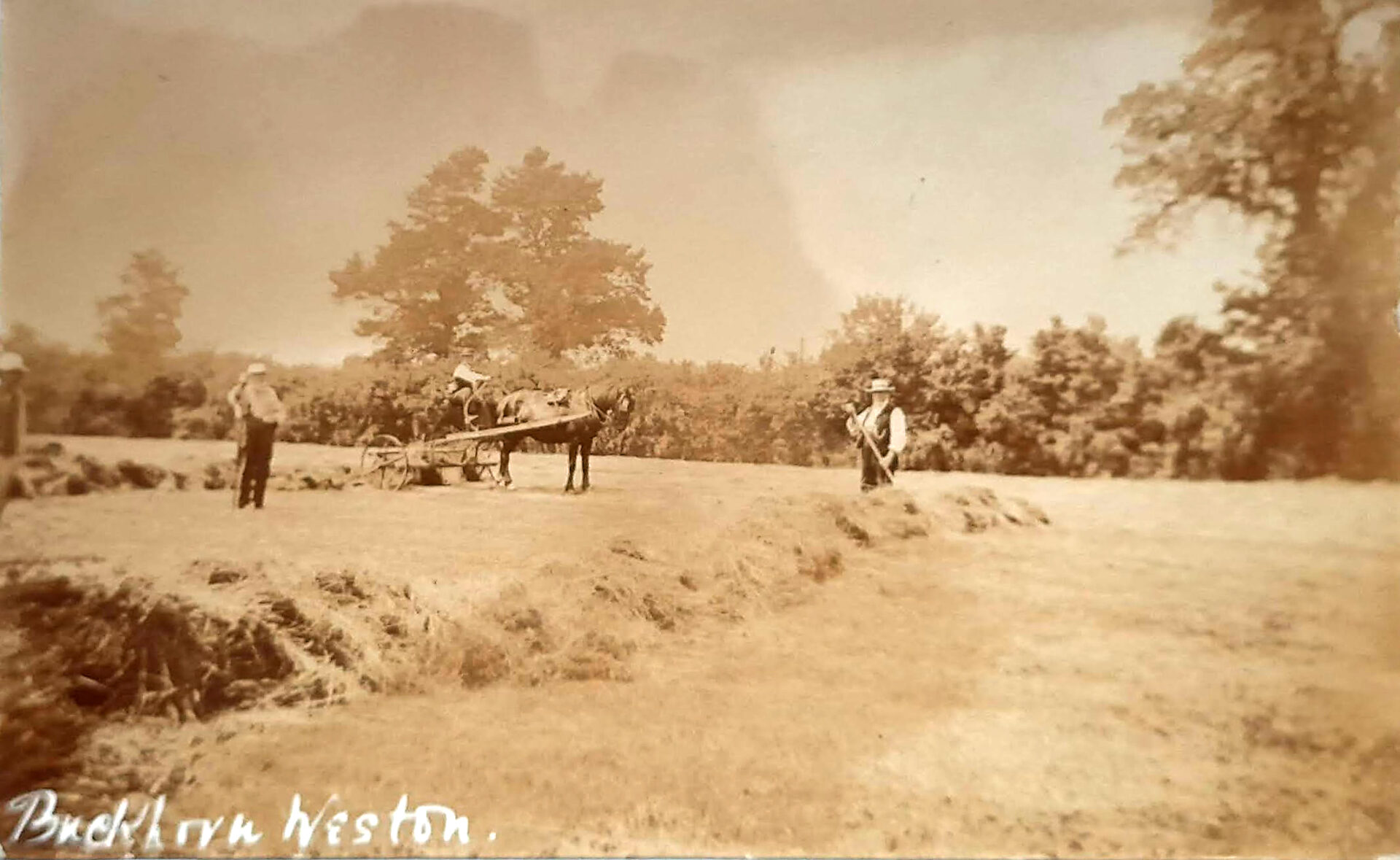
This month Barry Cuff has selected a few postcards with a suitably agricultural theme for the August harvest and the Gillingham & Shaftesbury Show.
This postcard of threshing at Chetnole was posted on the 14th October 1920 to Chiswick, LondonThis postcard of sheep being watered at Ashmore pond was sent to Chester in February 1907This scene of hay making at Buckhorn Weston was sent to Southampton in 1906This postcard of Lord Portman’s prize cattle at Bryanston was sent in 1911 to Birchington-on Sea in Kent
After 40 years in the TV industry, Simon and Karen Priestman bought a boutique vineyard – and promptly created an award-winning wine
All images: Courtenay Hitchcock BV Magazine August 2023
After four decades behind the cameras on some of the UK’s biggest TV drama and film productions – including Paddington, Dr Who, Call the Midwife, Poldark and Grand Designs – Simon Priestman and his wife Karen decided it was time for a change in lifestyle. ‘The kids left home and we were looking for a project,’ says Simon. ‘We loved growing things, so decided it had to be related to that. It was initially going to be a lavender farm, then we changed our minds and it became a vineyard. We looked at lots, including a vineyard in Italy,. Then one day, this place just happened to come up online. We said: “we’ll go down and have a look at it, but it’d be mad to get involved.” So we did … and look what happened!’ ‘We walked around the corner as you go down into the vineyard and just … wow. The view opened up and we said: “Well, this is lovely!” – and that was it,’ says Karen. ’There’s so much potential in this place for other things as well. So yes, that was it. We were hooked!’
Karen and Simon Priestman, owners of Little Waddon Vineyard – image Courtenay Hitchcock BV Magazine August 2023
Bold beginnings As professional camera crew, how much experience or knowledge did the couple have in vineyards and vines? ‘None.’ In winemaking? ‘None!’ Simon is remarkably cheerful as he acknowledges this. ‘I applied to Plumpton College in June 2018 to see if I could do their week-long vineyard course. They were fully booked and didn’t have anything available – because of course you’re meant to book these things two years in advance. We were still working full time shooting at that point, and so by the time we made it through the inevitable delays, the lawyers had done their thing and all the paperwork was complete, we literally wrapped on a film in Liverpool and drove straight down.
The vineyard is filled with beds of pollinator-friendly wild flowers – image Courtenay Hitchcock BV Magazine August 2023
‘We got here at some ghastly time in the morning, exhausted, to find the entire vineyard completely overgrown. The whole thing was just … oh my god, what have we done?’ ‘We knew the vineyard was planted in 2004 with three varieties of grape – Phoenix, Seyval Blanc and Regent,’ says Karen. ‘They’re all cold climate grape varieties, so they’ll thrive in the UK, and they’re disease-resistant, so we were confident we had a good base. But it’s not your usual three varieties – English sparkling is traditionally made from the classics, Chardonnay, Pinot Noir and Pinot Meunier. Combine that with our lack of knowledge and we could have met a bit of resistance in the industry before we even started!’ ‘We parachuted into this,’ Simon continues. ‘It’s been a very steep learning curve, but a fantastic one. We don’t actually make the wine here – that’s a stage further, we’ve not taken that on yet. Daniel Ham is our winemaker – he was Langham’s head winemaker when we met and has now left to set up on a bio-dynamic vineyard near Salisbury.’
The Terrace at the vineyard is a delighful spot for the Tour & Tasting experiences. Image: Simon Priestman
Little Waddon was certified as Organic, but due to a recent hike in the cost of the certification process, it is no longer officially classed as organic bio-dynamic. However they stay true to those principles, and continue to produce their wine in a regenerative, environmentally-friendly manner in the low intervention style. ‘We’re pesticide free,’ says Simon. ‘We don’t put any harmful chemicals on our land or on our vines. We don’t use commercial yeast for making the wine – it’s wild yeast ferments and no chemical or mechanical filtering, food colourants or added tannins and we don’t use sulphur at the start of the winemaking process or at bottling. We’re proud that it’s simply grape to glass. ‘In five years we’ve built a portfolio of seven wines. When we first spoke, Daniel asked what style of wine we would like, and Karen immediately said “definitely a sparkling wine!”. He asked if we realised that it’s a three-year process to make a Traditional Method sparkling wine (we didn’t) … So Karen said “Can’t you make us a Prosecco, or similar? That’s quite quick isn’t it? Just for the first couple of years while we wait for our English Sparkling wine?” He sort of gave us a look, and said “well, for a start Prosecco is DOC, so you can’t make it in this country. Also, you have to have pressurised tanks, which you know I don’t have!”
The Little Waddon col fondo range, including a rosa and a rosso. image Courtenay Hitchcock BV Magazine August 2023
Cold Fondo ‘But then he said, “you know, there is this method that I know about – but I’ve never made before. It’s an ancestral method that goes back to the ninth century, called Col Fondo.” ‘I thought he said cold fondo, so I excitedly told Karen: “we can make cold fondo!” and went back to Dan with a “Yes, we’ll have the cold fondo, please!” ‘There was another sigh, and Dan said patiently ‘Noo-o-o, it’s from the Italian, Con il Fondo – it translates as with the lees, or with the bottom.” You make the base wine by letting that go through fermentation and then malo-lactic fermentation, then let it cold clear over winter.
The Fizz at the vineyard Tour & Taste experience includes fresh scones with jam and cream
In February of the following year you add 10 grams of organic sugar per litre and stir it up with the lees in the tank. Then you bottle it and simply beer cap it. Around about May, as it starts to warm up, it re-ferments a second time in the bottle. It’s two and a half bar pressure, as opposed to the five bar pressure of a Traditional Sparkling wine method. It does contain the lees, hence ‘with the bottom’ but it makes an extraordinary semi-sparkling wine. ‘The 2018 vintage was put forward for a competition and we won a bronze medal!’ ‘Interestingly enough,’ adds Karen, ‘that year, we were only the second vineyard in the country to make it. But since we started, we’ve set a trend – everyone now is making Col Fondo! We went on to make a Col Fondo Rosa (rosé). Then last year we also made a Col Fondo Rosso (red) sparkling – very on trend, it looks completely crazy because the mousse is red. ‘The Blanca, the white, is still our most popular, but the Red Col Fondo is great fun. It’s a great barbecue drink, perfect for surprising your friends! ‘We also do a Still White and a Still Red. And of course we now have our Traditional Method Sparkling too! ‘We do like to experiment and try different things – hence the Red Col Fondo. ‘We’re known for our Col Fondos, but if we do say so ourselves, our Traditional Method Sparkling is a little beauty.’
The newly-refurbished Tasting Room – image Courtenay Hitchcock BV Magazine August 2023
The Tasting Room
‘We sell our wine at some local shows and events’ say’s Simon. ‘But people really love our Tour & Tasting experiences. ‘I take everyone for a stroll around the vines and tell the story, then we arrive back at the Tasting Room. We sit on the terrace if the sun is being kind enough to allow us to enjoy the spectacular view, and Karen does an amazing plate of food while we all taste the wines.’ Little Waddon Vineyard produces small batches of low intervention crafted wine. Most people buy direct from the Vineyard via the online shop. Some of their Ruby Moon red goes to the Groucho club in Soho, and some Col Fondo can be found at ‘Terroir Tapas’ and also ‘Parlourmentary Deli’ in Bournemouth. It’s a busy sort of choice for “retirement”, but Simon and Karen show no signs of slowing down any time soon. They also have The Hide, a shepherd’s hut, with a cabin and wood-fired hot-tub, in a quiet corner of the vineyard, which earns its keep as a luxury Airbnb rental. With its lush interior, stunning views to the coast and of course that wood-fired outdoor hot tub, it’s no surprise that it’s already booked up for most of the year. With the ever-present pressure of rising energy costs, they are also moving the vineyard towards 100 per cent renewable energy already powering most of their needs.
image Courtenay Hitchcock BV Magazine August 2023
See the Little Waddon Vineyard website for Tour & Taste event details, to purchase wine direct or to find more details of The Hide.
The red kite has become an emblem of conservation success in the United Kingdom. Once on the brink of extinction, these beautiful raptors and their impressive aerial displays have captivated the hearts of both conservationists and the public. The red kite (Milvus milvus) is a medium-sized bird of prey known for its striking reddish-brown plumage, distinctive forked tail … and its impressive aerial acrobatics. In fact, it is that forked tail, combined with a wingspan of up to 195cm or more than six feet, which enables them to manoeuvre gracefully through the air, appearing to glide with exceptional agility. Red kites are found in a variety of habitats – farmland, woodland, grassland and even urban areas. Although considered opportunistic hunters, occasionally hunting small mammals such as rabbits, red kites are primarily scavengers, feeding on carrion. During April, females will lay a clutch of one to three eggs in a nest built by both parents. The nest appears untidy – sometimes built on top of old crows’ nests, and lined with sheep’s wool and random scraps of paper, plastic and cloth. Shakespeare referred to red kite nests in ‘The Winter’s Tale’: ‘When the kite builds, look to lesser linen.’ Though now considered a rural bird, red kites frequented the streets of Elizabethan London, feeding on scraps and stealing hung out washing for their nests. During the incubation period and in the first few weeks after hatching, the male provides food for the nest. Chicks usually fledge after 50 to 60 days, and the parents typically care for them for another two to three weeks once they have left the nest. Previously widespread throughout the UK, their population declined dramatically in the early 20th century due to both habitat loss and persecution from landowners. Thanks to successful conservation efforts and re-introduction programs, red kite numbers have made a remarkable recovery – there are now an estimated 4,400 breeding pairs throughout the UK. However, this now-protected species still faces many challenges.
Still a problem Relying heavily on scavenging, red kites are particularly vulnerable to illegal poisoning – as reported previously in the BV. Birds also often fall victim to poison baits intended for foxes or crows, as well as rodenticide poisoning due to feeding on the dead rats they scavenge. Simple actions by landowners, such as refraining from using harmful pesticides, disposing of waste responsibly and avoiding disturbance near nesting sites, are all essential for the survival of this species in the UK. A good place to spot soaring red kites in North Dorset is on the hills of Fontmell Down nature reserve (also worth a visit just for the stunning views over the Blackmore Vale). Listen for the red kites‘ mewing calls and marvel at the aerobatic theatrics of this marvellous bird..
To find out more about the wonderful wildlife found on our nature reserves in Dorset, visit dorsetwildlifetrust.org.uk.
An anonymous Dorset Mind writer describes how navigating life with a depressed parent has shaped her – and how she’s working to heal herself
TRIGGER WARNING: THIS ARTICLE CONTAINS THEMES THAT COULD BE DISTRESSING, INCLUDING THOUGHTS OF SUICIDE. PLEASE SEEK SUPPORT VIA SIGNPOSTING AT THE END.
I don’t claim to have a ‘bad dad’, nor even a bad relationship with him. It’s just … complicated … And always has been. My dad suffers with a long-term health condition and also depression. He has done for the best part of my life, and I grew up accustomed to having a depressed parent, though not understanding the effect that had on my own personality. I witnessed a lot of short fuses. I can still feel the fear that cemented me to the spot after I’d done something wrong. My dad never screamed at us – it was what he wouldn’t say that gripped me. From a young age I tried to accommodate this uneasy presence in the house. I learned to tiptoe around, to stay far from trouble, keeping myself quiet and unnoticeable – a habit which has followed me into my adult life. I also had terrible anxiety as a teenager which will likely always haunt me.
Disquieting memories I hold no resentment for the way I’ve turned out, but as an adult I’ve started to shake off some of the lasting effects of my dad’s temper. I realised I cared far too much about pleasing other people, and that I was struggling to stand up for myself. When I look back on certain memories, I immediately have a sense of complete discomfort – which is how I’d describe a lot of my childhood. Obviously, it wasn’t all bad memories, but that’s the problem with having a depressed parent: it affects everything. I’ve struggled with depression myself and I know it is extremely hard to see things clearly when you’re that low – my deeply depressed dad is excellent at pretending he isn’t. Now, with the benefit of maturity and distance, I can see as clear as day which parts of me are a direct result of my dad’s mood swings. A lot of my teenage anxiety was caused by the lack of stability – as an already very nervous 12-year-old, I overheard him quietly threaten suicide to my mum.
At least he’s not … It’s become so important for me to recognise that compared with a lot of my peers, I did have a difficult upbringing. Everyone has different relationships with their parents, but I can’t help feeling sad when I see my friends casually video call and chat with their dads – as though they are friends. But I am so grateful to my mum who has been the most incredible presence and wonderful force in my life. Somehow, there’s always the “at least he’s not …” conversation. And I agree – it could have been so much worse. However, I owe it to both my child and adult self (who remains an adamant people pleaser) to see my family life for what it was. I never wanted to be a product of my dad’s mental illness and the first step to moving away from this learned behaviour was simply recognising it – when it happens, what sets it off and how it makes me feel. Recognising my own reaction to my dad’s actions helped me to determine what I should do with the emotions I was absorbing from him. I found I took in a lot of his anger, often then passing it on to someone else. I have also learned how to stop being so complacent and agreeable in order to avoid confrontation, which was a huge part of growing up for me. I was once told by a teacher in Year 7 that I “seemed to fade into the background.” I think about that comment every time I feel out of place in a conversation, or when I feel myself slipping back into the timid girl I was growing up. It’s sometimes exhausting, attempting to reverse an entire part of my life. But for the most part, I’ve finally grown into my authentic self. I just wish I could go back in time and give myself a hug.
Support for you:
Visit Dorset Mind for local mental health support and to discover ways to keep mentally healthy Young Minds have support for young people and parents. Call Samaritans for free 24/7 emotional support on 116 123 Dorset’s mental health Connection is a 24/7 helpline open to all ages. Dorset residents or people visiting Dorset can call 0800 652 0190 or NHS 111 Please call 999 if someone is in immediate danger.
Harts of Stur, the family-owned department store based in Sturminster Newton, has added four more awards to its trophy cabinet at the Housewares Awards 2023.
Happy Harts. Some of the Harts team celebrating their recent awards success
Organised in partnership with Housewares magazine, the awards celebrate the outstanding achievements of the housewares industry, applauding innovation, dedication, and excellence among manufacturers and retailers. Harts impressed the judges with its robust online presence and also its excellent and diverse in-store offerings, such as the garden department and Harts Coffee Loft. The department store retained its title as Best Online Independent of the Year for the second year, receiving specific praise for its seamless e-commerce, fast page loading, the user-friendly navigation, mobile optimisation, and also for the clean website design.
Sam Belcher with his award for Salesperson of the Year.
It’s always a team award It was Harts’ first time winning Independent Retailer of the Year, awarded for their expertise across the retail spectrum, including aspects like store design, product range, customer service, marketing, promotion, and innovation. Additionally, Harts’ recent store redevelopment and display creativity earned them the joint Best Retail Display of the Year award (alongside Woodbridge Kitchen Company). Sam Belcher completed the award quartet by winning Best Salesperson of the Year – recognising his adaptability, product knowledge and sales skills. Upon the announcement, David Conduit, purchasing director, said, ‘We are over the moon to receive these prestigious awards. Harts is and always has been a team effort, and these awards recognise the contribution all colleagues make to ensure we stay ahead. We never like to stand still – we’re already working on enhancements, both online and in-store, that will hopefully see us as award challengers again next year!’ Harts’ success doesn’t stop here – they are also finalists in the eCommerce awards, the results of which will be revealed in September.
In an extraordinary display of determination and solidarity, 12 adventurous cyclists took to the roads in June, covering 215 miles across France, Belgium, and Holland as they cycled from Dunkirk to Amsterdam. Their three-day journey was raising funds for Teddy20, the Blandford-based children’s cancer charity. The feat was not only about physical endurance but also a shared commitment to an important cause. The team of cyclists – Owen Newton, Alice Jewer, Matt Wilkey, Kevin Strafford, James Blackham, Lewis Fish, Robert Smith, Jonny Pyke, Simon Stranger, Gary Johnson, William Fyfe, and Andrew Rodden – include many with personal stories of the way in which Teddy20 has supported themselves or a loved one. They pedalled their way through picturesque landscapes and historic towns, and the team’s fundraising total currently stands at more than £11,000! Making a difference Teddy20 is committed to supporting young cancer patients and their families, ensuring they never face the battle alone. The funds raised by the cycling team will make a huge difference, providing essential support, financial help, and emotional care to those affected by childhood cancer. Along the journey, the cyclists not only pushed their physical limits but forged unbreakable bonds, supporting each other through every challenge. Their camaraderie transformed a gruelling task into an unforgettable shared triumph. They were backed up by a supportive crew, including Brian Wareham, Jill Budd, Adam Gonthier, and Sophie Ferry, and sponsored by various local businesses. Teddy20 has expressed profound gratitude to the cycle team, back-up crew, and sponsors. The team’s fundraising page remains open until the end of August.
If you’re interested in signing up for the next Teddy20 Charity Cycle Challenge contact [email protected] to get your name on the list.