Hazelbury Bryan primary school’s call to ‘make a noise’ against bullying was answered by a cathedral bellringer’s visit
Tim Joiner (left) setting the bells with Robert Newton and Jane Pridmore
Tim Joiner is a previous Lord Mayor of Westminster and a bell ringer at Brecon Cathedral. When Hazelbury Bryan primary school settled on ‘make a noise’ as the theme for the school’s anti-bullying week, parent-governor Romana Phillips knew just who to call – she couldn’t think of anything more appropriate for ‘making a noise’ than bellringing. Tim was happy to travel from Brecon, and he also contacted the Dorset County Association of Church Bellringers to see if they might put on something special just for the school. St Mary and St James church doesn’t have its own band (the collective noun for group of bellringers), so a group of Dorset bellringers from different churches volunteered to join Tim to perform a quarter peal. ‘That’s ringing 1,250 times around the bells,’ explains Tim. ‘It takes 45 minutes to ring a quarter peal – every time we go round, it has to be a different permutation or combination, a different order of the bells. And you have to memorise it.’
Robert Newton (far left) and Tim Joiner give some of the pupils a quick lesson in bell ringing All images: Laura Hitchcock
Tim holds up a small book with pages filled with rows of numbers – looking remarkably similar to the old logarithm books readers of a certain age will remember from school. ‘Methods for various numbers of bells are laid out across the columns of numbers. That’s bell ringing music. But you’re not allowed to use it, you have to learn it – you’re not allowed to use it during the ringing at all. ‘You end up with something called rope-sight, where you can see where all the bells are. And you instinctively know “I need to be second place …. third place … fourth …” and you don’t even worry about what the other bells are doing. You just need to know which one you’re going to follow. And you do that by listening, and by looking … and to an extent by how quickly your arms are going up and down!’
The quarter peal under way in St Mary and St James church
The band’s all here Tim was joined in Hazelbury by Robert Newton from Hilton, John Close from Winterborne Whitchurch, Angie Jasper from Hampreston, and Jane and Nigel Pridmore. Nigel rings at Puddletown and Jane is the Dorset County Association Training Officer: ‘So I ring everywhere!’ All of the ringers gave up their afternoon to ring the quarter peal – John and Robert came direct from a morning spent ringing near Bridport.
The children were excited to pull the Sally (the colourful padded rope end) and ring a bell
‘On the first day, I talked to the children on school about size and pitch of bells, and showed them how chord changes work, so they got a basic idea,’ explains Tim. ‘It’s actually quite difficult, but they did it! Then on the second day, we played some simple tunes with the handbells. It was a lot of fun, and they did so well.’ Lucy Odhams, Kestrels class teacher, was in charge of the anti-bullying work in school. ‘Making a noise doesn’t mean a physical noise,’ she explains. ‘The children know it means they shouldn’t ignore bullying, and we’ve represented that through the bell ringing. All the children have been ringing bells themselves, and then we were really lucky to have the opportunity to make a really BIG noise in the bell tower. ‘It’s been a great activity, and really kept them focused on making that noise, being able to tell someone if they ever saw bullying happen.’
Tim Joiner with some of the Hazelbury Bryan Primary School pupils in the bell tower
‘We talked a lot about how people might not always be poorly on the outside,‘ continues headteacher Mrs Waring. ‘We’ve got to consider people’s hearts and minds on the inside, too. ‘It’s also been lovely to see that some of our challenging children, those with special educational needs, have absolutely shone this week,. They’ve thoroughly enjoyed the bellringing. It’s been wonderful.’
Simon Hoare is the new Minister for Local Government: officially the Parliamentary Under Secretary of State in the Department for Levelling Up, Housing and Communities
‘I’d not long arrived at my flat in London, and was just warming up some soup when the phone rang,’ he says. ‘I saw it was the Chief Whip, and obviously my first thought was “what have I done now?” ‘But he simply said “The PM would like to know if you want to join the front benches.” Obviously the correct second thought is then “Doing what?!” ‘He then offered me the position of Minister for Local Government, and I had a quick yes-or-no decision to make. Obviously I said yes – but then had to ask “so what happens now?” It’s a massive honour – of course it is – but it’s also new to me. I had no clue what the protocol is. No one prepares you for it! ‘I had two calls in fairly rapid succession – the first was from the Propriety and Ethics team who asked all manner of interesting questions about whether I had been a terrorist, or had ever been convicted of money laundering and the like. Having passed that one with flying colours – I’ve had a rather dull existence, apparently – I was called by the Permanent Secretary to confirm the appointment, and to let me know my Private Secretary would be waiting for me at the Houses of Parliament at 9.15 the following morning. ‘And sure enough, there he was, waiting in the foyer with my badge. He took me to my office which already had my name on the door, the computer was already set up for me, as was a diary already full of appointments. People talk about hitting the ground running, but I’m not sure I’d really done it at such speed before! ‘In theory I know that as soon as the King approves the appointment, you’re it, effectively. But when it actually happens, the sheer speed of it is astonishing. It wasn’t until two hours after the first phone call that I realised I probably ought to call my wife! ‘The whole thing takes some getting used to. I was in a meeting this week and was presented with three possible options for a course of action. I suggested that one was the right way to go, and a few notes were taken. I then asked how we might progress that, who it needed to be passed through or get approval from, and I was met with a slightly surprised face. Turns out my decision had just allocated £190m. That’s how it works. ‘I do have to say a word about the efficiency of the civil servants, who have met me with overwhelming warmth, help and kindness at every step. And I have been touched by the number of colleagues from right across the House who have congratulated me – it’s such an encouragement when even the opposition say ‘it’s about time’ instead of ‘why on earth?’… I must be doing something right!’ Simon started his political career as a parish councillor, before becoming an elected local councillor for 12 years. He’s confident that with his experience of working in local government he has an excellent understanding of his brief. ‘It’s hugely, hugely exciting, and I’m keen for the challenge – I think we all as human beings enjoy being stretched. To be honest I still get a thrill just parking my buttocks on the back benches. Now I’ve a front row seat. And I have to admit, the House looks completely different from down there. Instead of looking down on it from up at the back, I’m inside it. It’s much smaller and far more intimate.’
North Dorset first ‘But I cannot forget that I am only here to do this job because I was first elected by the people of North Dorset and my first duty of care always has been and always will be to them. In France, a civil servant is placed into a constituency when an MP is promoted, to look after matters previously in his care. But we don’t do that in England, and rightly so. I think it is so important to stay anchored and connected with your base, it’s enormously important in everything we do.’ But what exactly is the Minister for Local Government actually responsible for? What will the new job entail? ‘It’s a vast remit – I’m now responsible to Parliament for local funding, special educational needs – in partnership with the DoE of course – adult social care, planning, alongside the planning minister, election law (ensuring systems are in place to guarantee public confidence in a democratic vote, preventing any “we was robbed/it was rigged” shenanigans in the UK!). I’m also the minister for the Covid inquiry and the Commons minister for faith, which means I’ll be taking through the Holocaust Memorial Bill. Today I’m in a Westminster Hall debate on heritage pubs, and later have a meeting about local government funding on the Isle of Wight. ‘But I like to be busy! The devil makes work for idle hands and all that. I think we all like to be busy, don’t we? Just as long as we get tangible results.’
THE characters in Shaftesbury Arts Centre youth theatre’s December double bill are all on journeys. In Magic Fairy in a Microwave by Dara Murphy, Sarah is on a chaotic journey into her own overactive imagination. In The Clearing (by Jennifer Reif) a group of teenagers find themselves on strange, moving paths into a mysterious wood. The two one-act plays, Delightful Dramatic Diversions, are being staged at the arts centre on Saturday 9th December at 2.30pm and 6.30pm. Magic Fairy in a Microwave won the Overall Best In Fringe award this year’s Shaftesbury Fringe 2023, and the same cast will be playing again. It’s the story of Sarah Williams and her overactive imagination – after a series of events, she eventually becomes trapped deep in her own mind … or has she been trapped by the narrators? It is a fast-paced physical extravaganza with guns, knives and blood. Kittens will be harmed, and we discover what happens should a fairy ever become locked in a microwave. The second play, The Clearing, is a collection of ten vignettes. In early autumn a group of teenagers find themselves in a clearing in the woods. Some are searching, some are hiding, some are lost and others found. Each vignette is witty, sweet and poignant – woven together they make for a magical and refreshingly good-natured play.
Poisoned apples, dashing princes, magic lamps or talking cats – which pantomime should YOU choose this Christmas?
ALL the major theatres in the area have their pantomimes ready for your cheering, booing and it’s-behind-you-ing, and now the choice is between distance, cost and which stars you most want to see. In the ten shows in (relatively easy) distance, audiences have a choice of three Snow Whites and 21 dwarfs, two Cinderellas, one Aladdin, one Dick Whittington, one Goldilocks, one Peter Pan and one Sleeping Beauty, so most of the big panto stories are covered! The cost of living crisis has really hit most of us in recent months, and travel may feel even more difficult this year. But it’s still important to take your children to see live performances of these traditional stories in an atmosphere that can’t be captured on film. It’s the only theatre where audience noise is actively encouraged, with lots of chances to hiss, boo, cheer and generally join in – and it’s also an opportunity to dress up in your finery. Kids at pantomimes often look as colourful and glittery as the fairy princesses on stage. Most of us get our first experience of live theatre at the pantomime, and if it weaves its colourful magic effectively, it can set a path for the rest of your theatre-going life.
The best loved pantomime of all is Cinderella, the story of a kind child whose mother has died and whose father has remarried, saddling her with a selfish stepmother and two ghastly and ugly sisters. When she is invited to Prince Charming’s ball, the sisters tear up her invitation. Of course, being panto, it all comes out right in the end. This year the ever-popular duo of Gordon Cooper and Jack Glanville lead the Evolution show’s move from the traditional Octagon setting to Westlands, while the town centre venue awaits its refit. The panto opens on 8th December and runs to 31st, with several matinees and morning shows as well as evening performances. The other Cinders is at Wimborne Tivoli, where the show is on from 15th December to 1st January and the stars are Luke Atwood and Brandon Nicholson as the sisters, Lucia-Jade Barker as Cinderella, Courtney Jackson as the Fairy Godmother and Lee Redwood as Buttons.
Dick Whittington This is the earliest show – it started on 25th November and is running to 7th January at Salisbury Playhouse – and Will Carey takes the title role. While pantomime is often the first experience of live theatre for a child, sometimes it is the professional debut for young actors, too; that is the case for Olivia Hewitt-Jones who is playing the feisty heroine, Alice Fitzwarren. But while Dick Whittington will be her first pro panto, Olivia is no stranger to the traditional Christmas show – her father Brian was a pantomime producer for years and her mother, actress Amanda Bairstow, acted in them. Alongside Will and Olivia are Lindo Shinda as Cosmo the Cat, Will Jennings as King Percy Rat and David Rumelle as Sarah the Cook.
Snow White Another orphaned child pursued by a wicked stepmother, Snow White is saved by the efforts of seven dwarfs. It will be on stage at Bournemouth Pavilion (2nd to 31st December) and Weymouth Pavilion (13th to 31st December) and also at Southampton Mayflower, probably the biggest and grandest theatre in the region, from 9th to 31st December, where the stars are Salisbury-born Christopher Biggins and Ashley Banjo and Diversity. Bournemouth’s show has Su Pollard, Noel Brodie and Jamie Steen in the leading roles, and at Weymouth you can see George Sampson and Jamie Riding.
Aladdin Poole’s pantomime is Aladdin, starring the popular Chris Jarvis as Widow Twankey, with the eagerly-awaited return of Andrew Pollard and Alim Javardi, (who were named as the UK’s best pantomime duo for last year’s Nadine and Doris) and also Melinda Messenger as the Spirit of the Ring.
Bath and Bristol Neil McDermott joins the experienced duo of Jon Monie and Nick Wilton in Sleeping Beauty at Bath’s beautiful Theatre Royal from 7th December to 7th January. At another grand old Victorian theatre, Bristol Hippodrome, see David Suchet as Captain Hook in Peter Pan from 2nd to 31st December – it also stars Andy Ford and Faye Tozer. Book your tickets and get your glad rags on and prepare to shout IT’S BEHIND YOU at the tops of your voices.
‘I was deeply anti-hunting,’ says Jeremy Whaley – not the conversation opener expected from a lifelong huntsman and hunt master. ‘But as a child I loved my pony, and I really loved dogs. At the yard where I kept my pony there were children who hunted, and I’d see them come back muddy and tired – but they always had that look in their eye that said they’d had the best day.
Jeremy Whaley of the South Downs Bloodhounds
‘Eventually they persuaded me to give it a try – and I was just fortunate that I was out with the huntsman Jim Bennett and the Old Berkeley pack. It was a spectacle! The horses, the chaps in their mustard coats … but most of all, I instantly recognised that one of these men had a magical – and I mean that literally – bond with all these dogs. They were all looking at the huntsman and listening to him, it was spellbinding. Then we moved off and I watched that man working all those dogs, off leads, running around barking … and yet, they were still under full control. I was hooked. ‘I was an academic and sporting failure – horses and hunting became my mental life saver. ‘Jim was a professional huntsman, and I was lucky enough to hunt regularly with him throughout the rest of my childhood and my early adult years. He taught me and showed me that it was hound work, and the relationship with his hounds, that was important to him, not killing foxes.
Megan James with Halo of the South Downs Bloodhounds
‘Just as, for a farmer, raising animals is a passion and the killing of those animals is merely a necessity for feeding humans. It was only ever about his love of hounds, never a passion to kill a fox. That was what set me on the path to 23 years hunting with foxhounds – like Jim, I loved the hounds, but I never enjoyed killing the fox. I was Master and Huntsman of The New Forest, then The Chiddingfold Leconfield and Cowdray, and then The Berwickshire Foxhounds in Scotland. Then the law changed and the Protection of Wild Mammals (Scotland) Act 2002 came into force which, due to loopholes in the legislation, allowed an unlimited number of dogs to ‘flush foxes to guns’. I’d not seen anything like it before, I couldn’t stomach it. ‘So I looked for alternatives. Drag, or trail, hunting is too artificial for me. There’s no challenge in what is effectively following a railway line of scent. Then I saw Nic Wheeler from Coakham Bloodhounds, one of the oldest bloodhound packs in the UK. I went out with them, loved it, and realised it was my answer.’ The hounds come too Hunting humans with bloodhounds is referred to as hunting the clean boot. ‘It’s not fox hunting by another name. They’re completely different sports. Just as someone who’s good at squash may not enjoy tennis, clean boot hunting with bloodhounds is a sport in its own right, with its own skills and challenges,’ says Jeremy.
The South Downs Bloodhounds out
‘The point is, the hunting of most wild animals with hounds is illegal. It doesn’t matter if it was bad law – it is what it is, it is not going to change and, if we want hound sports to survive, we need to not only move on and hunt within the law, but do so in a way that seeks to impress and educate the average, tolerant, man, woman or any other of the myriad genders that currently exist on the Clapham omnibus. ‘I started the Borders Bloodhounds Hunt in 2002 – and the more I learned, the more I loved it. Due to a change in circumstances I had to move back south, so I found a kennels to rent and brought the hounds with me. I started the South Downs Bloodhounds (SDB) in 2004, on an absolute shoestring budget! ‘One day we had 126 riders turn up we realised we really needed to set up a booking system! We usually average about 30 riders a hunt now, and most simply pay a cap to attend for the day.
Tub hunting We start in August with tub hunting (because the quarries are a bit tubby that early in the season …), and we do four or five hunts of around a mile each in a day to get the quarry, the hounds and the horses fit. We have the formal opening meet in the middle of October, and by then we will have three or four longer hunts of two to three miles; up to five miles if I can manage it. ‘The routes are mapped in advance, and I try to always vary them, even if we’ve been to the same place before. The hounds learn a route very quickly, so we always try and make each one different. ‘We’ll go anywhere – Hampshire, Wiltshire, Dorset, Somerset … we’ve just been up to Fife in Scotland! In fact, the Fife and the Lauderdale Hunts are both now converted to a bloodhound hunt. ‘Hunting human quarry with bloodhounds has all the vagaries of the proper chase – you can see them working the trail out. It’s not just a case of the quarry running as fast as they can along the route that’s given to them, it’s far more complex.
The South Downs Bloodhounds Quarries l-r: Liz Wheeler, Tom Hawthorne, Richard Taylor and Quarry Captain Nick Hudson
‘Last week we had six quarry out as a group, and really that’s too many. The hounds just flew without checking. Obviously there were some who enjoyed a fast ride, but for me it’s far better to make life difficult for the hounds. Just two quarries, and let the hounds struggle a little. ‘We used to hunt a policeman, he was really good. One time we came up into a really big stubble field and I knew the quarry should have gone half way down before turning right. But the hounds flew along confidently, shooting past where the quarry should have turned. We made it to the end of the field, and the hounds checked. I watched them casting about, and started to wonder if the quarry had got lost somehow. Then, just one individual hound, Subtle, started to move her way back up the line. I called the rest of the pack, and they followed her – half way back across the field they roared off in the right direction. ‘I spoke to the policeman afterwards, and he said he’d decided to cause us some problems – he ran all the way to the end of the field, doubled back to re-trace his own steps up the line, and then cut left across the field as planned. Brilliant!’
Jeremy Whaley, senior Master of the South Downs Bloodhounds, leading the way.
A hound is a hound How big is the South Downs Bloodhounds pack? ‘I normally have 18 couple in kennels,’ says Jeremy. ‘And I take 12 to 13 couple to hunt.’ A pack of hounds is always counted in couples. Two hounds are a couple and one hound is one hound – unless he is with others, when he is, naturally, half a couple. It is traditional for a huntsman to take an odd number of hounds out for a day’s hunting, so he might take 20½ couple – or 41 hounds.
The South Downs Bloodhounds in full voice, ‘roaring off in the right direction’.
‘Everyone is welcome to join the South Downs Bloodhounds. Riders must book ahead via the website, but anyone is welcome to attend the meets on foot and follow, or to become quarry. The SDB hunt is renowned for being welcoming to newcomers and isn’t overly concerned about the ‘right’ hunting dress, or people understanding hunting terms. There are always hunt members to buddy up with, whether you’re riding for the first time, or watching on foot. You do not need references to join the SDB. Details are all published on the website, and Jeremy encourages anyone to come and experience it for themselves. ‘To be honest, we take the piss out of each other a lot. And that’s not accidental. We really want people who will come along, muck in and have fun. We’re not frightfully grand, and we’re not there to impress anyone. We’re just ordinary people who love our animals, enjoying our sport.’
southdownsbloodhounds.com Jeremy is always looking for new places to hunt; if you would like to see these hounds hunting humans across your land, he’d be delighted to hear from you – [email protected]
Last Christmas I saw a Tweet by someone hunting for some specific items – and for whatever reason, it stayed with me. She wanted suggestions on where to find the perfect crumble dish, a soft blanket large enough for a 6’ man asleep on a sofa, and a specific set of pink vintage tumblers to match a jug. The list has lived on in my head ever since – it’s such a perfect, thoughtful, careful list of gifts. Did her sister know that the list writer thought her crumble was the best, and worthy of a very special dish of its own? Did the man who nods off on the sofa appreciate the big-enough blanket? Did she ever find and replace the broken glassware? I’ll never know. But I do know I try and create my own version of this list every time I buy a gift. What does my person truly love, want or need? Gifts are an offer of your love and respect. A ‘that’ll do’ present, bought in haste, is neither lovely to give or thrilling to receive. The very best thing about giving a gift is seeing the other person’s face light up, letting you know you got it just right. As we all face another winter of climbing bills and narrowing bank accounts, it’s not a bad thing to focus on the small, thoughtful things that somehow always end up meaning the most. Think back – I’m willing to bet that your most treasured gifts weren’t the expensive ones. They were the thoughtful ones. As you’d expect, there’s a lot about Christmas gift buying in this issue – and we’ve covered as many local producers, crafters, makers, growers and servers as we possibly could. Do please click their links, visit their shops, have a browse. If we all do just a little, if each of us buys just one or two thoughtful items from local businesses, or even simply like and share their social media posts, together we really can make a lot of difference. Lastly, it’s good to remember at this time of year that Christmas is a terrific amplifier – love gets lovelier, hurt gets hurtier, loss gets lossier, lonely gets lonelier and family gets crazier. Thank you for a wonderful, frantic, ridiculous year – we’re off to light the fire, warm some wine, eat a mince pie or three, and enjoy having a full nest for the first time in a year as our biggest ones come home from America. Have a wonderful, wonderful month.
Laura and Courtenay x
PS don’t forget we’ll be out later in January – were taking Christmas off. We rather think we’ve earned it.
On the Blandford/Pimperne planning decision Dorset Council should be thoroughly ashamed of themselves. So much brownfield land available and housing stock unused. Given the state of the housing market I rather suspect however that it might be mothballed by the developer, as homes are struggling to get sold! Bridgette Browne, Facebook
Great news for all the local people who just can’t get on the housing ladder in Blandford as house prices are so over inflated in the area due to people living longer. It’s £50-£70k cheaper to live in Shaftesbury/Gillingham areas than it is in Blandford forcing those who have family and family links to Blandford outside of their town as they can’t afford or find somewhere to buy. All this nonsense about destroying the AONB is just pure nimbyism by the very people who want to protect their over valued houses price. While there is a lack of infrastructure within Blandford this isn’t a local issue, it’s a national issue that central government isn’t addressing. However the lack of housing and affordable housing is critical in this area and these houses will go towards easing that pressure John Hart, Facebook
I think there is a clear case for the application to be called in for review by the secretary of state. It is clearly a breach of an adopted local plan, and even if the Dorset Council has not agreed their structure plan the previous plan is the agreed guidance. The perceived benefits are just smoke and mirrors. I can only praise the Pimperne parish chairman for standing up for his Parish the AONB and against a clumsy planning decision. Kevin Maitland-Gleed, Facebook
Insulted of Gillingham For 80 years I’ve lived on this Earth Most of them filled with mirth, I’ve had a good life, a jolly good time And like to mark occasions with a rhyme. And now I’m told I’ll be rewarded for living so long With an increase in pension – this must be wrong? 25p a week is the amount I will receive Surely my eyes do deceive?!! This sum hasn’t been significant since it was 5 bob Back in the 60’s when I first had a job. For 45 years I’ve worked – often 12 hours a day Only to be insulted in such a way!! Barb Dimmack, Gillingham
Appalled in Blandford I’m just catching up on the October issue, and I wanted to send a note of horrified solidarity to editor Laura on the subject of The Cheese Incident (Letter From The Editor, Oct 23). Firstly – butter has no place on a cheese plate. What were they thinking? Of course you didn’t expect it, it had no right to be there! Secondly – I suspect we’ve all done it … Mary White, Blandford (Thank you for your support at this difficult time, Mary. Needless to say it’s more than I received from C – Ed)
The night sky I had no request to send Rob Nolan for his Christmas picture – I don’t know enough about space objects to ask for one by name. His images are always worth stopping to appreciate, but I wanted to thank him for his stargazing notes. I have developed a new bedtime routine of checking the clouds before I lock the back door, and if its clear I’ll pop out into the garden for a few minutes and look up. I make note of the special dates, confidently point out various planets and look for meteor showers with my grandchildren – they think I’m a wise old woman who understands the stars, but I’m just repeating what Rob says. Thank you Rob! Pauline White, Sherborne
On the willow ships I’m just sending a thank you for your continued BV magazine and the BV podcasts. I found the recent article about willow coffins very interesting (mentioned in November’s BV, and then there was a fascinating follow-up interview with Cath on the Podcast here – Ed) , particularly the part about ashes departing on a Viking ship and being set alight at sea! My sister lives in Ipswich and has told me many times over the years about the Sutton Hoo treasures and the Viking ship discovered inside a burial mound there. The idea of using a Willow shopping trolley amused me though – I’m old enough to remember little old ladies using them. It always used to make us laugh; I’d love to see a Uni student wheeling their books to lectures using one! Sheila Lockyer, by email
Gillingham Walking Festival needs you Once again, this event was very successful, with approximately 150 walkers taking part in September’s Gillingham Walking Festival. This year we had 15 walks, of varying lengths and difficulty, to various locations around Gillingham. Some involved public/minibus transport, some included a stop for refreshments, and some followed a route included in the new pack of eight circular walks from Gillingham Station, which was launched on the first day of the festival (free printed copies can be obtained from the Station, Gillingham Library, and other venues around the town., and a digital version is on the website here. The festival was begun in 2014 as part of the Gillingham Walkers Are Welcome initiative. For the last few years, it has been run by a committee of helpers, each with their own role, and co- ordinated by Sheila Messer. Enormous thanks are due to Sheila for her enthusiasm in facilitating walking in Gillingham. Now, however, Sheila has decided it is time for her to step down and to hand the reins to a new coordinator – provided one can be found. The current committee are happy to continue their work but are unable to take on the co-ordinator role. Could you, or someone you know, step into this role to ensure the future of the festival? If you would like to find out more, please contact Sheila on 01747 821269 or email her on [email protected]. Penny Peat, Festival committee member
This week, I learned about Dutch supermarkets introducing ‘chat checkout’ lanes, allowing for leisurely conversations between customers and cashiers. This popular initiative, now in 200 stores, is similar to the French Carrefour’s ‘Blablabla Caisses’. While self-checkout is convenient for quick visits, I’ve noticed many, particularly older people, struggle with it. They seem to miss human interaction, a necessity often overlooked in our fast-paced society. Introducing these conversation-friendly checkouts is a compassionate response to the human need for connection, particularly for the elderly. I hope UK supermarkets adopt this approach, a small but impactful change for improving life quality, especially for our older community members. Daniel Forth, Wimborne
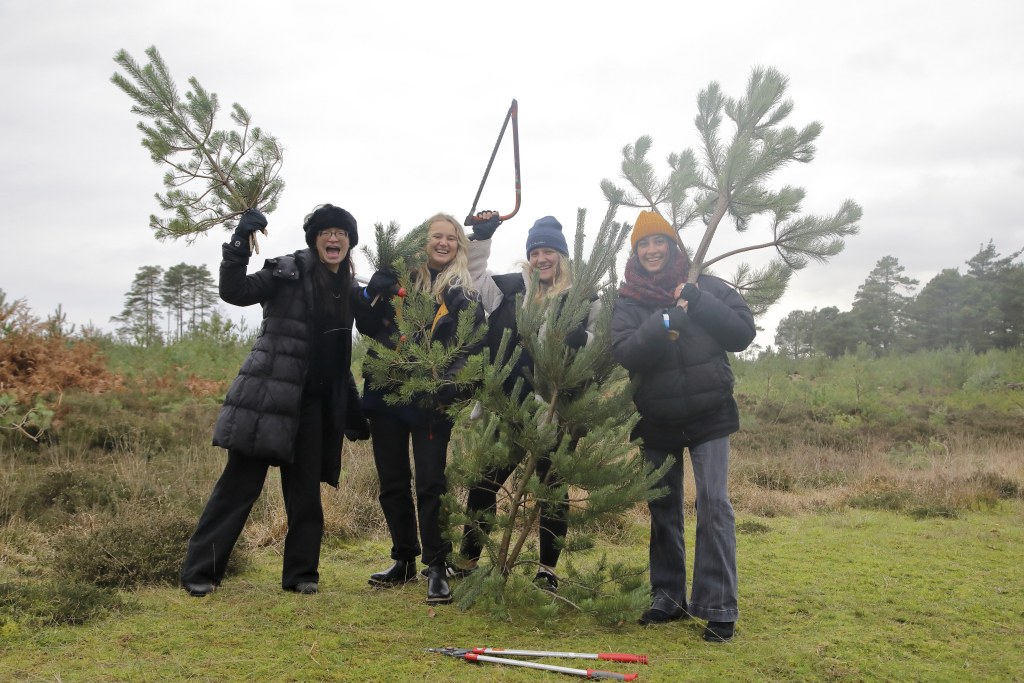
Pull a Pine event, RSPB Arne Nature Reserve, Dorset, December 2022
This year’s Pull a Pine event will be held over two days on RSPB Arne; Saturday 2nd and Sunday 3rd December, 10am to 3pm (last entry 2pm). The family friendly event is one of the biggest conservation events in the country. Visitors have the opportunity to get their wellies on, dig out their hats and scarves and join in a wonderful festive day in nature to pick their own sustainable, home-grown Christmas tree – and to help save one of Dorset’s rarest habitats at the same time. The Pull a Pine event features an entire suite of entertainment, including live music from Quinns Quinney on Saturday 2nd and Sixteen String Jack on Sunday 3rd. There will be refreshments, hot tasty food, and mulled cider. There will also be Christmas crafting activities and in the Arne Café Garden a Christmas Fayre, featuring stalls for locally-made artisans and festive gifts, plus carol singing. Most important is the opportunity to do your bit for nature. Pine trees from commercial forestry plantations, which now dominate areas of Dorset’s heathland, spread quickly onto rare lowland heath. If left unchecked, they will out-compete important native heathland plants. Lesley Gorman, Visitor Lesley Gorman, operations manager at RSPB Arne, said: ‘Our visitors have a great day out and get to choose a lovely wonky Christmas tree with character. And in return, it would take staff and volunteers weeks, if not months, to achieve what’s done in a single weekend at Pull-a-Pine. ‘Last year’s event saw more than 15,000 small pine trees removed over a weekend – a huge effort which allows this special place to maintain a healthy mix of landscapes and wildlife.’
University Music Chamber Choir will be coming to Dorchester to lead the Advent Carol Service at St Peter’s Church on Saturday 2nd December at 4.30pm. The choir is formed of students from Bournemouth University and Arts University Bournemouth, all of whom continue to develop their musical skills to an incredibly high level while also completing their varied degree courses. The service incorporates beautiful choral settings from composers including Judith Weir, James MacMillan, John Tavener, Philip Stopford and Benjamin Britten alongside much-loved advent hymns. It begins in candlelight as the readings, liturgy and music move from darkness to light. This is the choir’s first visit to Dorchester and provides the local community with a wonderful opportunity to listen to and support this talented next generation of singers. The Advent Carol Service is a free event, and everyone is very welcome to come along.