What’s on at the Exchange Sturminster Newton Septemeber/October 2021
Box Office: 01258 475137
Book online: www.stur-exchange.co.uk


What’s on at the Exchange Sturminster Newton Septemeber/October 2021
Box Office: 01258 475137
Book online: www.stur-exchange.co.uk
Save the Date: 10th – 18th September
Unmissable factory sale at Neal’s Yard Remedies ec-factory in Peacemarsh
Up to 75% off

Messy Mice Toddler Group
Run by Okeford Fitzpaine CE Primary School & Sunbeams Daycare.
St Mary’s Church Okeford Fitzpaine.
Thursdays in term time – starting Thurs 16th September
9.30am – 11am
FREE of charge and refreshments will be provided.

Open days – No need to book. Please do come and see what our lovely village school can offer your child!
Dates:
Saturday 18th September 10am – 12pm
Tuesday 21st September 10am – 11.30am
Thursday 23rd September 10am – 11.30am

Dorset Museum
Chair of the Board and Trustees
Voluntary Roles
Dorset Museum is owned and managed by the Dorset Natural History and Archaeological Society. This Charity was one of Dorset’s first conservation organisations, established to collect, preserve, research and exhibit objects relating to the archaeology, natural history, art, literature, and culture of Dorset.

Led by the Executive Director, Commercial Director and Director of Collections and Public Engagement, a full complement of paid staff and a team of over 150 volunteers support the Charitable Objects of the Society.
The Society has recently completed a multi-million-pound redevelopment of Dorset Museum. The Tomorrow’s Museum for Dorset project has transformed the Museum into a cultural destination at the heart of Dorset’s community. As a result, Dorset Museum has become a leading, contemporary cultural and heritage centre which includes new galleries, a learning centre, collections storage, a library and visitor facilities.
The Society is looking to recruit an individual to join its Board of Trustees as its new Chair, succeeding the existing Chair, who is standing down after serving a full permissible term of six years.

The Society is seeking someone with Board level experience ideally with Chair or Deputy Chair experience. The Board is also looking to appoint someone who can demonstrate the very highest levels of good governance. The Chair will need to lead on the development of a new strategic plan. The Chair will exhibit high standards of organisational and financial management. The Chair will lead the Board in making informed, ambitious and strategic decisions and will need to establish a constructive and supportive but challenging working relationship with the Executive Director.
The role of Chair is not remunerated. The likely overall time commitment for the role is 26 days a year.
The Charity also seeks to appoint two new Trustees to join the Board. The Board of Trustees has ultimate responsibility for the running of the DNHAS and the Dorset Museum. The Board deals with all major policy decisions, strategic and constitutional matters and is responsible for the approval of the annual budget and accounts and business plan, ensuring the solvency of the DNHAS and the safety of its assets. The overall governance of the organisation lies with the Board. As a Trustee you will provide knowledge, support and guidance to the leadership team to ensure excellent governance.

As a Trustee you will:
Whilst a wide range of attributes are useful to the Board the Charity is particularly looking for potential Trustees who have a background in one or more of financial/ accountancy, fundraising, Museum skills and/or sustainability.
Trustees should expect to commit at least eight days a year to the Museum. Involvement on special projects and committees increase the commitment.
Interested applicants should Click here for an Application Pack or contact Anna Butler on 01305 262735 or by e-mailing: [email protected]
Any applicant should make clear whether they wish to be considered for the role of Chair or ordinary Trustee.
Closing date for applications: 12noon on Thursday 30th September 2021
Interview date: Early October 2021
We welcome and encourage applications from people of all backgrounds. We do not discriminate on the basis of disability, race, colour, ethnicity, gender, religion, sexual orientation, age, veteran status or other category protected by law.
25th September 2021
Meet the head and the head of prep – Tour our wonderful grounds and facilities
Register by clicking here
Emails: [email protected]

Friendship Month Events
Tuesday 14th September 2.30pm
The Gugg, Station Road, stalbridge DT10 2RQ
Enjoy a teo or coffe with some lovely cake and chat with local members of the oldest friendly society in the UK.
Give us a go!
Call Judy Penfold on 01963 363119
email [email protected]

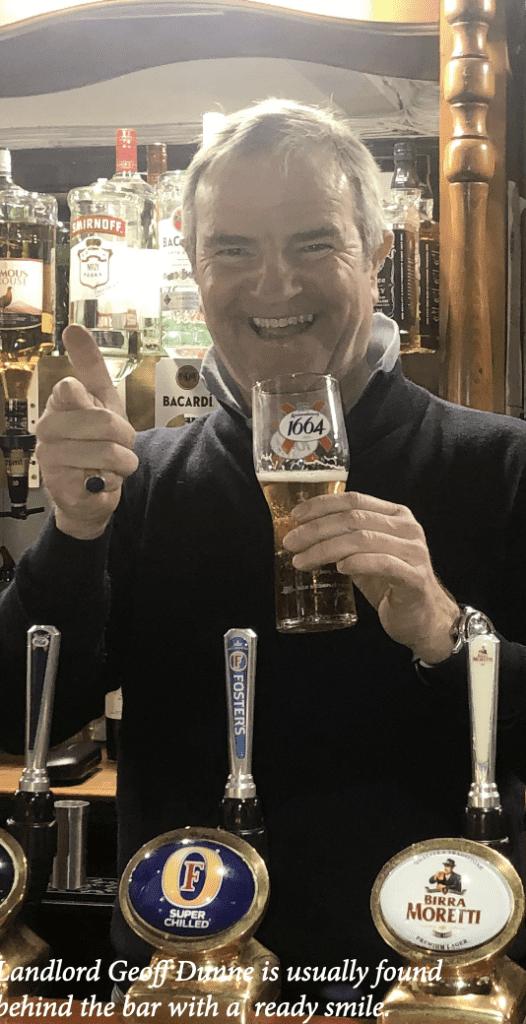
This month we’ve been chatting to Geoff and Emma Dunne who run the Swan Inn, Sturminster Newton.

How did you end up at The Swan Inn?
Emma and I originally applied to take on the Upton Inn at Upton Cheyney in the Cotswolds, but coincidentally that is where our predecessors have moved to and it was already a done deal; which in turn made The Swan Inn available. So here we are!
What’s your favourite local place to visit on an afternoon off?
Our favourite has got to be the delightful Bank House Brasserie here in Stur, and then maybe walk off all those calories up at Bullbarrow Hill or Okeford Hill with our Westie called Monty. We are so spoilt for choice with walks here, from just walking out of the pub and along the river bank to Fiddleford Mill, Hambledon Hill or Emma’s all-time favourite (and Monty’s) Piddles wood.

Tell us about your pandemic?
Well – what an introduction to the world of publicans! We took over on July 1st; took three weeks to get ourselves
together and we re- opened the pub on July 27th 2020. In August the Eat Out to Help Out’ campaign really got our restaurant off to a flying start – we had diners from all over Dorset enjoying our fine dining a la carte menu. Restrictions were quickly imposed – table service only, masks and social distancing all put a lot of people off and
it went very quiet very quickly until the second lockdown in November. Then of course the third one in late December so Christmas Parties didn’t happen, and likewise New Year.
The whole winter season impact of COVID19 hurt pubs and restaurants in particular, and we were no exception.
Government grants and the Furlough scheme helped but we still had considerable costs and cashflow was a major concern.
We were lucky though – unlike many we had considerable support from Hall & Woodhouse, the family-owned Dorset brewer, but even so it was a long and hard enforced closure.
What’s been your biggest challenge since taking over? What are you proud of?
Our biggest challenge (after Covid of course) has been recruitment. Covid and (allegedly) Brexit have wreaked havoc on the hospitality sector and nowhere more so than with kitchen staff. It is proving very very difficult to recruit quality Chefs and support staff – where are you all?!
I think there are two things I’m deeply proud of; one is the work Emma carried out in our now- amazing garden, and second is quite simply surviving the lockdowns and still being here at the end (we hope this is the end…).
What part of the pub is your absolute favourite?

Obviously I love the whole building – it has such a rich history and you can feel that wherever you are. But… for me
this has to be out in the garden. Even though it’s late summer now (did we have summer? I might have blinked and missed it…) and most of the flowers and shrubs have had their better days, it’s still brims with some very pretty flowers, and there’s nowhere better in my view to sit and enjoy a glass of wine in a quiet moment.
Which dish is your most popular?
Without a doubt our Sunday roasts. It is the most booked up meal time of the week and hugely popular, a very substantial meal and enjoyed universally both for price and quality.

So what’s next – do you have big plans on the horizon?
We did have big plans for our restaurant but these have been shelved whilst we consolidate following the financial hit of the various lockdowns and trading restrictions. Right now it’s really a matter of building our business; the food, the beers and our very well appointed accommodation, recruiting another chef and aking our food offer to 7 days and perhaps expanding the menu. Quiz night has returned and is now every Monday night (we were amazed at how many Quizzlers there in and around Stur!). We have Jason and the Alco-Noughts performing live on Saturday 18th at 8:00pm. We’ve four teams planned for the local Dart league (recommencing in October) as well as our own Darts Knockout Competition due to take place in September.
Finally, we hope, an amazing Christmas and New Year to make up for last year’s washout!
In the August Letters, P Bone of Shaftesbury took me to task for saying I prefer Plain Salted crisps to any other flavour (see the Random 19 July issue), declaring that Smoky Bacon and Prawn Cocktail were the only correct answers to that question. Even just reading of those flavours made me turn pale, but for the sake of the scientific method, I sampled both. The Smoky Bacon reminded me – and not in a pleasant way – of the Bac-os Bacon-Flavored Bits that used to be served at salad bars across my native USA. As for the Prawn Cocktail – I draw a veil over my reaction.
However, PB has perhaps sensed that I was not entirely truthful in my original reply. The only thing that could cleanse my palate of those crisp flavors was tortilla chips (plain, lightly salted, of course). I far prefer them to crisps. Maybe that’s the American coming out in me again.
Or, maybe they just do things differently up in North Dorset.
Tracy Chevalier
Piddle Valley
(NB – If you missed Andy Palmer’s August column, you may wish to click & read it here before continuing. A hornet’s nest was stirred)
As ever I enjoyed reading Andy Palmer’s article in the August BVM, not least about the delights of Mappowder Village Hall events (cannot remember why I missed the curry night – and there are loads of proper china plates in the corner cupboard in the kitchen if you had looked Andy, rather than use paper ones).
Yes I agree Thomas Hardy is not the author whose works should be the first books you grab if you are feeing a bit depressed. I dont agree with him being a mysoginist though – his works do spell out a few home truths to his Victorian middle-class readers about the subordinate position of women at that time, and the double standards operating even more then than now. Hardy the feminist?
And thanks for the plug for The Emporium Andy, just one of our four excellent “charity” shops in Stur busily recycling once loved goods.
Cllr Pauline Batstone
Sturminster Newton
Despite being a Thomas Hardy fan of old, there are times when the author’s relentless pursuit of misery does rather crush one’s spirits.
For Andy Palmer to single out the story of Tess as an award winner in the category of Wretchedness is fair, and one could go as far as to say that despite using every means at his disposal to lay bare the hypocrisies of Victorian society, Hardy could just be the Morrissey of the mid to late 1800s, without the blunt rudeness.
Matthew Coldicutt
Hardy Country resident
This is the first time I have felt compelled to write in about an article in a magazine.
I thought Andy Palmer’s article decrying Hardy for being a ‘little bit miserable’ was refreshingly honest but perhaps reckless living as he does in Hardy’s Vale.
My main concern, being Mr Palmer’s neighbour, is that offended Hardy fans don’t target our house by mistake.
Maybe I’ll put a sign up, ‘Mr Palmer resides next door’?
Derryl Darling
(Location withheld for Ms Darling’s own safety…)
Rather than write in the royal ‘we’ as if I represent the entire Thomas Hardy Society (though as the Secretary and general dogsbody perhaps I might get away with it!), I am writing in the capacity of a sometime Hardy academic and an all-the-time lover of Hardy’s works.
Your article asking why Hardy is so popular produced more than a couple of smiles across my visage, but I do wonder exactly how much of Hardy’s oeuvre Mr Palmer may have perused?
I grant that Tess of the d’Urbervilles is not one of Mr Hardy’s chirpiest novels, and Jude the Obscure is indeed a tad bleak – one critic summed it up as follows: one cousin marries a bimbo while the other marries a rather misguided teacher. Bimbo does a runner, teacher grants a divorce so that the cousins may marry, cousins don’t marry but have offspring, one of whom turns up on the doorstep claiming to be from cousin #1’s marriage #1. Being a rather miserable little chap he proceeds to kill his half-siblings and then himself. Cousin remarries returned bimbo, other cousin remarries deluded teacher after a still-birth, cousin #1 coughs up blood and dies, cousin #2 spends rest of life self-flagellating.
Divorces 3, Deaths 5.
I ask you, what is not laugh-a-minute about this plot?
Alas it seems to be these rather tragic stories that are most loved by Hardy readers, instead of those containing his dry wit and genuinely lough-out-loud moments, such as the novels The Trumpet-Major (the character of Festus Derriman is a creation of comic genius) and The Hand of Ethelberta. Or the short stories such as ‘The Thief Who Couldn’t Stop Sneezing’.
The subject of Hardy’s poems include drinking cider, dancing and flirting. Indeed his poem ‘The Ruined Maid’ is utterly hilarious; so much so that the Dorchester Town Crier Alistair Chisholm adapted it to a male perspective, calling his version ‘The Roué’, which is, if anything, even funnier than Hardy’s original!
Mr Palmer, I only hope that your good self and your plethora of devoted readers do not conflate Hardy’s supposed miserableness with those of us from the Society who are his mortal representatives on Earth! We’re actually an ok bunch who quaff vast amounts of cider, partake in barndances and other general silliness, and engage in lively debates on social media, where we ask such pressing questions as: ‘if you could sit on a bench with any Hardy character, who would it be and what would you say?’
(My own answer – I would ask Marty South from The Woodlanders why she didn’t give Grace Melbury the enormous slap she deserved)
I encourage you and your readers to come and join our convivial community and attend one of our events. I can’t guarantee that you will drink cider, dance or flirt, but at last one of the three will inevitably be engaged in!
Dr Tracy Hayes
Just to say I very much enjoyed the latest issue of the BV – but I don’t THINK (I may be wrong) that the first of the ‘Readers’ Photographs’, though lovely, is Compton Abbas church?
C Owen
I spoke to Benn Churchill the photographer of the image in question, and he confirmed the picture features St Mary the Virgin’s church, Compton Abbas. Ed.
I was surprised that you gave so much space in your magazine to the vandals who created that crop circle near Okeford – you mention that it cost the farmer
£600 in lost wheat. Do you not think you’re glorifying willful destruction which will only encourage more lost crops?
Name withheld
It was a story of public interest and our stats show that a huge amount of readers spent a lot of time on those pages – probably due to the high quality photography.
We took great care to dicuss the issue regarding the agricultural and financial damage, and the illegal access and trampling issues; hardly glorifying it. In the same issue we also reported on an incident of alleged illegal hare coursing – balanced discussion is not glorifying. Ed.