This was a new route for us circling the back of the Gussages and enjoying an empty path around the ancient tumuli and barrows of the Cranborne Chase. We enjoyed almost every step (read on to discover the bit we didn’t), and we fully intend to repeat this one before long. (NB – when this route was published in the June issue of the BV magazine there was a problem with the app, and only five images were showing. That has now been fixed, and you can see the full glory of this stunner of a walk)
We didn’t meet another person, the paths were easy to follow, and though the inclines look alarming on the app they are very gentle on the ground. We had a fabulous few hours taking this one at a very gentle pace, stopping to enjoy the views at every turn.
The route winds around a number of ancient barrows and tumuli
There’s nothing nicer than walking through waist high grasses – this is a section of Ackling Dyke, the Roman road, and it was thick with the sound of insects as we shushed through the grasses.
I never can resist a perfect hedgerow ‘window with a view’
Beware the small bit of super-busy road walking … This is the small road stretch outsode Gussage All Saints. Do look to your right when you reach here, there’s a lovely view across to famous Knowlton Church.
The paths are often straight for long stretches, allowing you to be free of map reading
There is a small car park at the start, but is is NOT where it is shown on the OS map; the farmer has moved it from the side of the field into the natural layby within the strip of woods. It makes total sense, and is conveniently placed – just look out for it. Our route starts where the car park is, so do trust it!
The one issue we had on the whole route was less than a mile into the walk, as we left the tumuli on Wyke Down and approached the A354. The path runs between two fields , but it was entirely overgrown and completely impassable in June (see above – the image left is the entrance, and the image right is the exit once we’d circumnavigated to the far end)- instead we hopped the fence and walked the parallel edge of the neighbouring field. Not correct, we know, but what else can you do when the bramble and nettles are shoulder high?
Apart from that, the route is clear, easy to follow and just gorgeous walking, taking in part of the ancient route along Ackling Dyke.
All the Dorset Walks we feature have been created and walked recently by ourselves, so you know you can trust them – we aim for unpopulated routes with as little road and as many views as possible! You can always see the route and follow it yourself via the free Outdoor Active app – see all our routes here.
It’s July – no more worrying about frosts! It’s a busy time for growing and Pete Harcom has your summer garden to-do list for the month
Sowing and planting Many summer bedding plants can go straight in the ground now. We can also sow biennials (such as foxgloves, sweet William and wallflowers, honesty and forget-me-nots), ready to plant out in autumn for next spring. Simply sow them all into large seed trays in the greenhouse or a dedicated seed bed. Polyanthus and primulas can also be sown now in a cold frame or greenhouse to ensure warmth for germination (candelabra primulas are particularly spectacular in a shaded position) If you have already sown annuals then these can be thinned out, when large enough to handle, to ensure they are not overcrowded. Baskets should also be finalised with planting and can now be put up.
Hungry hour Continue with the feeding of plants, especially ones that are in containers and baskets – use a high potash liquid tomato feed.
Outdoor housekeeping Deadhead flower borders regularly to prolong flowering. This can apply to many plants – although do try to leave roses that produce attractive hips. Be sure to cut back delphiniums and geraniums after the first flush of flowers to encourage a second flowering period. Feed them after cutting them back. Divide clumps of bearded iris. Tender perennials such as fuchsia are best propagated from cuttings, and July is a great time for this as young plants root more easily. Dianthus can also be increased this way by taking cuttings from the tender new growth – try to avoid flowering shoots. Most perennial weeds are best dealt with in the summer, when the weeds are in active growth. Digging out is best – it’s good to avoid using chemical weedkillers. Mulch on borders can help retain moisture and keep down the weeds – this will save a lot of work. A really thick layer of mulch (2-3in all over) works best. Watch out for aphids (greenfly and blackfly) and capsid bug damage on stems and leaves of young shoots.
Leave your hedge alone Finally, as I said last month, avoid pruning your hedges until the end of August at the earliest. The main breeding time for garden birds is between March (and yes, some start even earlier!) and August, so leaving the hedges can give them time to rear their young. Our garden birds need all the help they can get!
In the quiet hills of West Dorset, a modern round barrow has been constructed with the most ancient of purposes – Rachael Rowe reports
The entrance to the Round Barrow
The panoramic view across the Dorset countryside catches me unaware, stretching to the horizon. There is only the sound of the wind rushing through the trees and birds singing. High Ground Meadow, just outside Corscombe, is a special place for many people, with its natural burial ground and, more recently, a round barrow. Nowadays there are more cremations and more options available to commemorate loved ones, in addition to the traditional grave. One of the newest is the round barrow – yet it is also one of the oldest.
What is a barrow? You are correct if you thought barrows were earth mounds where ancient peoples buried their dead. LNeolithic communities built long barrows from 4,000 to 2,000 BC, while round barrows date from the Bronze Age, around 2,000 BC. They were also used by Anglo Saxons and Romans, many aligned to sunrise at the solstice. Today, barrows are once again being built, with niches to house urns following cremation. There was a huge demand for the first modern round barrow, created in Wiltshire in 2014. TThe round barrow at High Ground Meadow was developed in 2018, two years before the first set of ashes found its Corscombe resting place.
The passage within the Round Barrow All images: Rachael Rowe
Like a clock The entrance to the West Dorset barrow is carpeted with wildflowers and blends naturally into the landscape. Undertaker Tom Vassie takes me into the open doorway, pausing at the time circle just inside the entrance. It’s a circular structure with a floral wreath. “This area is always open, so people can be close to the ashes,” says Tom. “it can also be used for small services as the ashes are interred, or for people to sit and reflect.” We continue through to the domed central area, and Tom explains the structure. “The barrow is shaped like a clock. At each ‘hour’, a passageway leads off from the central chamber. Other chambers are at three, six and nine o’clock. So we have a theme of time here, and the standing stones outside represent the seven days of the week. Although the barrow is not aligned for a solstice, it is directly aligned with Glastonbury Tor.”
An extraordinary place As I walk around the circular structure, there is a profound feeling of peace and calm. Tiny candles flicker among the urns and stone niches. It feels mystical – spiritual, in a way – and somewhere contemplative but quite extraordinary to be. On a ledge is Tim’s Stone: when Tom went to the first barrow in Wiltshire, the owner (Tim) donated one of his stones to this new barrow in Dorset. The barrow is a tranquil and serene setting for someone’s final resting place. The urns are made locally. The blue pots come from Mosterton and the earth-coloured ones from Owermoigne. They are designed to blend into the setting without being garish or out of place. It is an alternative to ashes being scattered in a garden of remembrance – or perhaps somewhere they should not be placed. People still scatter ashes in inappropriate areas, apparently.
Niches – with display urns – in the round barrow
Undertakers not directors Niches can hold a surprising number of urns. For example, most niches can take a pair of urns, but some of the larger ones hold up to nine, so a family can be together. You can also choose your niche within the barrow. There’s a cost, of course, but compared with a graveyard plot, they are less expensive, especially if there are several urns in one niche. I ask about the choices funeral directors give to people when a loved one dies and am instantly corrected by Tom’s mother, Jo. “We’re undertakers, not funeral directors. The family directs the funeral. We are there to help and support them.” Tom continues: “Some families carry the coffin and lower it in the burial ground. They often say they didn’t know they could do that. We enjoy helping the families shape the service with favourite music and other personal touches.” For example, people can choose to have a ceremonial walk to the barrow to place the urn, or they can simply take the urn into the chamber.
The time circle inside the Round Barrow
A place to remember Today, 70 per cent of people who die in England are cremated. However, since the pandemic, more people have been thinking about how they want to be remembered when they die. A round barrow is an option for people who wish to be cremated but would also prefer a final resting place. With views of rural Dorset in such a tranquil setting, the round barrow feels spiritually connected to the past, and yet is very much in the present as a final resting place.
Pigeons are presenting a real problem to the Brassicas – Barry Cuff shares his challenges, along with his monthly harvest and growing notes
Barry’s thriving pea rows in front of the covered blackcurrants –threatened not by pigeons but by thieving blackbirds
We have a major problem with pigeons on our plots – this year has been the worst since we took on our allotment in 1989. Their main target food is brassicas. Spare plants in plug trays were destroyed overnight. These had been destined to fill gaps and to give to other plotholders. We’ve tried the usual deterrents of black cotton, CDs and glitter strips, but the pigeons soon become used to them. So the only protection is a physical barrier and initially we use net cloches that cover one row. When our Brussels sprout plants were uncovered, having grown too big for the cloches, they were attacked after a few days in the open. A barrier using fleece and posts was then erected to protect them. But when fully planted up with brassicas the area will be about 400 square feet, and this large area will need to be protected in some way. As we are surrounded by houses and industrial units we are not allowed to shoot the birds. Another problem that has never occurred before is honeydew, a sticky liquid secreted by aphids, on some of our gooseberries. A few of the bushes lie underneath a line of cob nuts which are infested with Hazel Aphid. These are specific to Corylus (hazel) and produce the honeydew. It means that we have to wash the gooseberries before use. Whether the aphids will lower the production of nuts in the autumn remains to be seen.
Still sowing During the month we sowed more carrots, beetroot, snap peas and mangetout, and made our first sowings of Witloof chicory and coriander. A further 20 Swift sweetcorn plants were added to the block, making a total of about 50 plants. Brassicas planted out from plug trays included Fargo, Cheesy and Cendis caulis.
Starting to harvest June was a very busy month on the plot, with weeding both by hoe and hand. We had enough rainfall to ensure good growth of vegetables, fruit … and weeds. We picked our first broad beans (Witkiem Manita) on the 2nd and the last (Masterpiece Green Longpod) on the 26th. Our first lettuce was cut on the 1st – we sow lettuce every month from March to August in plug trays for transplanting when large enough. We only use one variety, Little Gem, as this is a quick-maturing variety with crisp, sweet hearts. The first carrots (Early Nantes) and beetroot (Crimson King) were pulled on the 22nd, which is a little later than usual. Both varieties of garlic were harvested on the 16th, and once again a few plants were lost to white rot, a disease we have to live with despite a six year rotation. We have picked quite a few punnets of blackcurrants from mid month, and our strawberries did well despite being old plants. As the bed now has a bindweed problem a new bed will be created next year with new plants.
Free skulkers We normally dig one or two early potatoes in June, but this year we had a good crop of skulkers. This is a Dorset word for volunteers – potatoes left in the ground when harvesting the previous year’s crop. The smallest tubers are easy to miss when digging the crop. Normally they are removed before they have produced anything worthwhile, but as we do not dig in the winter, these were allowed to grow until we needed the plot for brassica plants in June. Basically freebie potatoes! Half way through the year and the plot has done well despite a few problems.
After a three year pause, Sherborne’s Open Art Exhibition is happening again this July. Founded by Sherborne Art Club in 1931, this highly-regarded annual show for fine art was last run in 2018. The exhibition is open to all to submit entries, and is known as one of the best quality, most prestigious open exhibitions in the region, exhibiting the work of many top artists as well as entries from accomplished amateurs, and attracting visitors from far afield. Up to 400 pictures and sculptures will be exhibited, and there will be unframed folio browsers for sale. Selection for the exhibition is by an independent judging panel who are looking not only for excellence but also for diversity of style, medium and subject to create a balanced and attractive exhibition. Visitors will certainly find something to like and, with prices over a large range and hidden bargains in the browsers, there will certainly be something for all those looking to buy.
A team effort The organisers are very grateful to local solicitors Mogers Drewett who have sponsored the exhibition (including a £200 prize for the Judges’ Choice Award) and to those other businesses providing prizes and additional sponsorship. Castle Gardens and Old Barn Framing Gallery, previously linked to the show, have donated prizes for oils and watercolours respectively, with other prizes from Charterhouse Auctioneers (dry media), The Eastbury Hotel (second and third in Judges’ Choice), estate agents Knight Frank (acrylic and mixed media) and Sherborne Arts (for the work voted favourite by show visitors). The organisers also thank those many people who volunteered to help with hanging, stewarding and other tasks to make this popular event happen again.
Sherborne Open Art Exhibition 23rd to 31st July 10am-5pm The Digby Hall, Sherborne If you’d like to submit, full details can be found here Hand in days: Friday 15th July 1pm-6pm Saturday 16th July 10am-1pm
Expect to see floods of super bright supercars and classic beauties driving through glorious Dorset this August, as Clayesmore, in association with South Coast Supercar Club, present a Classic & Supercar Sunday Event on Sunday 14 August.
Set in 70 acres of glorious grounds, with a sweeping driveway to the main house, Clayesmore couldn’t be more of a stunning backdrop to display exotic and heritage cars. The event is a collaboration with a student, Zander Miller, who started the supercar club as a hobby during lockdown. It has swiftly snowballed into a who’s who of supercar owners in the South West. “The response to us hosting this event has been phenomenal” says Rhiannon Harris, Head of Commercial, Clayesmore. “We are excited to announce that Hendy Group, the South Coast’s premier automotive retailer, will be partnering with the event and will wow the crowds with a stunning display of their prestige cars on the day. “Hendy really loved Zander’s entrepreneurial spirit and the idea of bringing this event to Clayesmore. We are delighted to have them on board.”
Like to exhibit? Clayesmore are keen to exhibit the best of the best of local owner’s cars, so if you would like to register to exhibit, please do register here https://bit.ly/classicandsupercarsunday
Book your tickets now! Clayesmore are excited for this to be a real community event for all the family, with gourmet street food, fizz and entertainment. Tickets for the event are on sale now; book yours today classicandsupercarsunday.eventbrite.com
Don’t miss one of the finest shows of summer 2022 as Artsreach brings the Rude Mechanicals to North Dorset
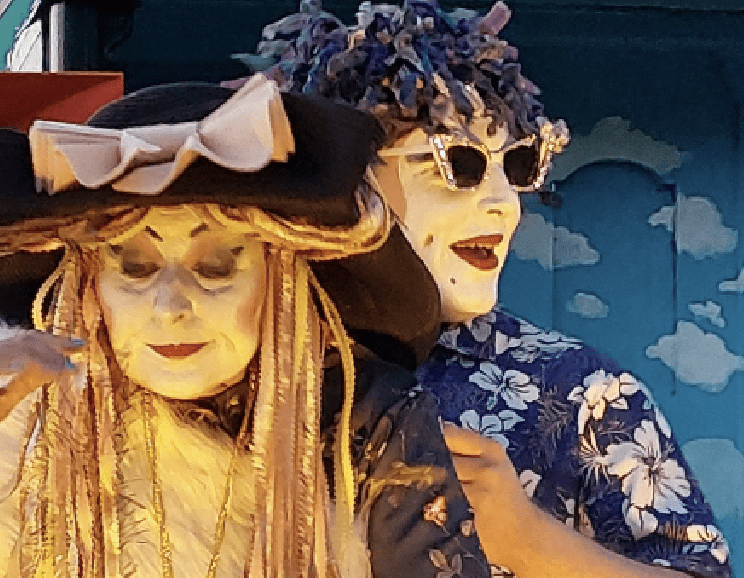
ONE of the most inventive, imaginative and colourful of the summer open-air touring companies, the Rude Mechanicals are coming to North Dorset with a thoroughly entertaining and wildly original take on how we live, social media, reality television and the meaning of love. Gods and Dogs, by the Rudes’ director and founder Pete Talbot, is a brilliantly witty new satire, set in 2084 on the island of Abatina. It’s a century on from Orwell’s classic dystopian fantasy, and our heroine and fellow residents are under the all-seeing eye of the president, Big Al – all fake tan and a floppy quiff, he’s a cross between The Great Oz and Big Brother (and you-know-who across the pond). The celebrity-obsessed residents, policed by the fawning dogs of the state, live for a word of praise from their president, who is beamed into their homes and workplaces by sophisticated technological gizmos. Their dismal lives are brightened by a weekly fix of Marriage Maker, a reality show in which one lucky girl is chosen (out of three) to marry a superstar and have three days of hedonistic luxury and sex, before a divorce. Each eight-episode series mean the star gets to marry eight people over two months. Gods and Dogs follows what happens when one of the hopefuls falls for the footballer she “wins”, while her friend, who is already sceptical about the whole set-up, is properly courted by a charming young man with a flash car, who is at war with his own background.
Mocking insight As always with the versatile Rudes, the style is commedia dell’arte, the faces painted in white-mask, the singing, dancing, musicianship and talent enormous. The Eastbourne-based company has built up an eager following around the areas they have regularly toured since 1999. always bringing an original show to their “open air’ audiences. This year’s company includes regulars, returners and newcomers, as Tom Blake, Georgina Field, Max Gallagher, Evie James, Rowan Talbot, Ed Thorpe and Lia Todd bring 22 characters (and the voice of Big Al) to vivid life. You won’t see a more inventive look at modern society on stage this year. It never takes itself too seriously, but drives its revelations home with a sparkling little hammer.
The tour has four Artsreach-promoted Dorset dates, at East Farm, Tarrant Monkton, on Wednesday 20th July, Stourpaine on 21st, Mill Farm at Bradford Abbas on 22nd and Child Okeford on Saturday 23rd July.
Residents on a new housing development in Okeford Fitzpaine are working together to create a welcome for their African guests, reports Rachael Rowe
Housemartin Shutterstock
If you walk into the Old Dairy estate in Okeford Fitzpaine, you’ll need to watch what is above your head. Thanks to a sterling effort by local residents, this new-build estate has become a magnet for increasingly rare house martins. At the last count, there were at least 36 nests full of healthy chicks among the 35 houses on the estate. It’s clearly a home-from-home for the birds – but how did the human residents help?
Tina and Mike Crimes started encouraging house martins in 2017
Why house martin conservation is important House martins nest in colonies and can raise up to three broods of chicks in one season, often through to September. Raising more than one brood each year increases their chances of survival. From late August onwards, the birds will begin their winter migration, returning the following spring to breed. However, house martins were placed on the Red List of Birds of Conservation Concern (BOCC) in December 2021 after a 72 per cent decline in population over the last 50 years. The reasons behind this are uncertain but thought to be a consequence of climate change. It is clear they need a little help.
House martins nesting in Okeford Fitzpaine All images: Rachael Rowe
Holiday homes in Dorset Resident Tina Crimes moved into her home in 2017 and noticed a pair of house martins. She set up nest cups and soon had a pair nesting on her roof. The birds may have been in the area before, but as it was previously a chicken production factory, it was probably not an attractive place for any bird to settle. What did attract the birds’ attention was the mud and clay soil left by the builders – the house martins found plenty of material to build their homes. When Tina discovered that house martins were a protected species on the endangered list, she stepped up efforts to attract them. “I placed a dish of mud outside the house. They love clay-based mud, so I kept it topped up. I also used a call signal downloaded from the UK and Ireland House Martin Conservation site. The charity was formed to protect housemartins and they sent me some leaflets which I posted through my neighbours’ doors.” The leaflets helped inform the neighbours on the estate about the birds so they wouldn’t knock down nests and would understand they are a protected species. Tina says: “Most of us love them, though one or two struggle with them, especially if the nest is above a door. But no one has removed a nest. One house has six nests!” The birds are high up in the apex of roofs on brick houses but are not as attracted to render or thatch. Although some residents placed nesting cups on roof areas, some birds nested on top of them instead of inside. However, that’s expected; the birds breed more than once in a season and move the bigger chicks “downstairs” so they can accommodate new babies upstairs.
The Old Dairy estate in Okeford Fitzpaine is welcoming its new African visitors
Watch your head! Naturally, with a plethora of nests and cute chicks, there’s a different hazard around the houses, with bird mess inevitably landing on paths, cars – or people. The birds also clean out muck from nests and are generally very untidy house guests. But, as Tina points out, it is easily cleaned away with a hose or brush. Residents have also taken to placing plant pots underneath the nests to catch droppings, and some houses have mats on window ledges. Vigilance is required when leaving the house – you never quite know what might land! Tina is proud of the way the community has come together. “We have come from all over the country to live here, many from urban environments and unused to anything like this – and yet we have all accepted these wonderful birds into our homes.” Watching the house martins swoop around their homes is mesmerising and has been uplifting for the residents. It is an excellent example of how humans and nature can live side by side in harmony and how new housing developments can be adapted to attract wildlife.
The case of the sea eagle The decision to close the investigation into the poisoned sea eagle by Dorset police, despite finding high levels of rat poison brodifacoum in the eagle, was described as ‘completely baffling‘ by the RSPB, who had been helping with the investigation. The decision also coincided with the Force’s award-winning wildlife crime officer Claire Dinsdale going on long-term sick leave with stress, a re-branding of the Force’s wildlife crime team to remove the word ‘wildlife’, and that astonishing outburst on Twitter by Chris Loder MP, who seemed to criticise Dorset Police for spending time and resources on the investigation and who argued that eagles ‘weren’t welcome’ in Dorset (as per my letter in the May issue of the BV). Now, after large criticism and a FOI request revealed correspondence between Mr Loder, and Police and Crime Commissioner David Sidwick. A specialist investigator has been brought in by police. But this investigator is from the same police force – is this not a case of marking their own homework? Perhaps Dorset Police can explain why the poisoned eagle investigation was dropped in the first place. And also share the status of the ongoing investigation into alleged raptor poisoning in 2021 on the very same estate where the poisoned white-tailed eagle was found. Obviously these investigations are not easy – but the public should be able to rely on the police to conduct a thorough and complete investigation. Dr Charles Mathews, nr Sherborne
On Simon Hoare I thought Mr Hoare’s answers in the Q&A (The BV, June issue) were surprising – I am not a Conservative voter, and yet I found myself agreeing with many of his points. In a party of liars, cheats, crooks and tricksters I appreciate that our own MP appears to be standing up for the right things, no matter who voted him in. Ian Downton Blandford
I appreciated Simon Hoare’s honesty in the Q&A this month. However I felt an absence of his usual forthright and honest tone when discussing the state of NHS dentistry. Sorry Simon, but this isn’t just a simple lack of trained dentists – every practice is turning away from the NHS because it’s not viable to run their business with the funding they receive. I myself received very poor NHS treatment – basically because I needed a three-tooth bridge, and the NHS pays a flat fee (barely enough) for a bridge. The actual cost of having a three-tooth bridge made is double that of a two-tooth, but dentists are unable to recoup that cost back. So I received an unsuitable treatment which then required me to go private to get fixed correctly. Not the dentist’s fault – a simple lack of funding prevented them from providing the best care. This is NOT how the NHS is supposed to work. By all means recruit more dentists, but take a long hard look at the very model under which they work too – and have a dentist do the review, not a civil servant!
Marion Colly Sturminster Newton
It was refreshing to read an MP being open and honest, and saying in a public forum that he ‘cannot defend the indefensible’ with reference to Johnson and ‘partygate’. Thank you Mr Hoare – you hold in your hands the last remaining shred of trust I have in the Conservative Party. It’s not much, but I suspect without decent MPs like you, our country would be in a far worse state. Jenny Baines Shaftesbury
I particularly appreciated Wendy Darvitt’s question for Simon Hoare on the Nolan Principles. Almost thirty years since the Seven Principles of Public Life were drawn up and it seems like people no longer talk about them, and yet we’re in need of them more than ever. Just this week we hear that Mr Johnson attempted to use his position to get his then-mistress a job (Integrity? Objectivity?), had sex with her in a Ministerial office during normal office hours (Leadership? Plus it seems looking at sex in the House of Commons means you lose your job, but actually having it is fine … ), and then used his influence to pull the independent journalism which had uncovered the fact. The shock is that we’re no longer shocked … Roger Dorn Sherborne
Ukraine benefit Just to let you know that the Ukraine Benefit Concert we held at GMC last Friday evening was very successful. With your kind help we raised more than £2,600. This will be matched by Utility Warehouse to give a fantastic total of £5,200. For those that weren’t able to attend (or were there and want to see it again!), a video of the first half of the concert is now available on YouTube (see above right – Ed), with the second half to follow soon. Even if you have no wish to donate, I would urge you to follow the link and watch the video(s). The combination of Briggs, Hearnshaw, Honeybourne, Hope, Steele-Perkins & Trotter playing organs, a piano and several trumpets is unprecedented for a concert in the UK – indeed anywhere in the world. The atmosphere was electric and putting the videos together has made me realise how very special it was! Gordon Amery Organist & Concert Organiser Gillingham
On your typography Thank you once again for the latest issue, full of interesting articles obviously not vetted by a Commercial Director. A magazine with an EDITOR and how it shows! Sadly as an ex-designer of magazines, local and national, your typography drives me to distraction. No para indents, wayward and irrational text alignment…I could go on and on….and on. I doubt that many of your readers even notice or care. Why [am I writing]? Because overall it is a great local asset. Around 70 to 80 ex-employees of mine have over the years realised that I am a fully qualified pedant…but only over typography. Good typography is I believe a lost art. Paul Killinger by email I did reply to Paul to defend the BV’s style guide: “The lack of indents is fully intentional – every paragraph break is preceded by a subhead, so the indent is superfluous. Text alignment should in all cases (unless I’ve missed one, which is error, not design!) be left, footer notes are italicised and right-align.” Typography, like all things, changes with the years; I’ll stand by mine. Thanks for the compliment on the content though Paul – that means FAR more! Ed
By snail mail The letter below was received by email, courtesy of a kind Stalbridge resident who lives in the original BVM offices: