How do you spot a good egg? Rachael Rowe has been speaking to judge Paul Tory to find out what makes some eggs hard to beat
Paul Tory is chairman of the Dorset and Wiltshire Poultry Society and he organises the judging at Gillingham and Shaftesbury Show. So he seemed the right person to ask what the judges are actually looking for in an egg? ‘The basic principle of egg judging; you are looking at a single egg, three eggs together or their contents. With duck eggs, we always judge three, which all need to be egg-shaped (hold that thought – Ed) and identical in size. There should be no blemishes, and the eggs should be blue. ‘You look at the size, the weight (they should all be the same weight), and you sniff for freshness. ‘When it comes to contents, there are three aspects. First, the yolk should be yellow. The inner white part should be clearly separate and jelly-like. Finally, the outer white is watery. None should be runny – the runnier it is, the worse the egg. The more orange a yolk, the healthier it is. It should also be round and protruding – like a rising sun.’
Pointy, oblong and squat There are some similarities with chicken eggs but also differences from the duck eggs. Paul says: ‘Chicken’s eggs are either white, blue, or brown. The white ones need to be as white as possible – it’s a hard class to win because white eggs show minor defects. There is also a class for one egg of each colour from three different chickens. ‘In all cases, eggs should be egg-shaped with no blemishes.’ I’m left wondering what other shape an egg could be (and the effect on the chicken) when Paul explains that some eggs are oblong. There is also an odd-shaped egg class where you could find pointy eggs, squat-shaped ones and double yolks – and maybe a few oblong ones. And finally, there are individual egg classes: “The winner is a stand-out egg and catches your eye. It glistens without a shine and is not dull.” After talking to Paul, I’m sure I’ll never look at an egg the same way again.
Understanding biennials has led to a nostalgic flower patch full of scent and colour, says flower farmer Charlotte Tombs
Sweet rocket
Biennials were always a bit of a mystery to me before I started to sell my flowers. But they really aren’t that mysterious and once I got my head around the fact that you sow the seed in one year and they flower the next, it’s easy. If you were to plant an annual now, it would flower in late summer – and would be a very disappointing plant rushing to complete their life cycle before the days get shorter and the threat of frost looms. The definition of a biennial is a flowering plant that takes two years to complete its life cycle. Since growing flowers for sale, I have learned that if you sow your biennial seeds now, they are big enough to plant out in the autumn, when they will have the chance to develop and grow a healthy root system to survive the winter, all being well. Then when it warms up again in the spring and the daylight hours increase, they are ahead of the game, ready to start the growing season. They tend to flower when the spring bulbs have finished and before your autumn-sown annuals, filling that lull after the bulbs are over.
Ones to look out for The biennial family of flowers seems to be quite a nostalgic group of plants – think wallflowers, for example. And no, don’t think of those horrid orange, yellow and brown tones like a 1970s swirly carpet. There are some beautifully coloured varieties that really are worth growing. Look for the sunset series, in particular the apricot, although it does seem rather hard to find the seed (which I see as a good indication that it is tip-top!). The sugar rush series is another good variety; they have the added bonus of smelling glorious as you brush past them on a warm spring day. Another biennial to look out for and sow is hesperis (sweet rocket – pictured above); white or mauve and also scented, but a member of the cabbage family so watch out for hungry pigeons (I’m writing from experience – I had to put a net over the bed one year, it took me forever to work out what was eating them).
Some of this summer’s Sweet Williams All images: Charlotte Tombs
Old-fashioned pretty Honesty is another pretty white flower, but resist the urge to pick it and instead wait for its prized seed heads. Peel the papery case off to reveal a lovely silvery disk like a coin – no wonder this plant is often called the money plant. It is very popular for Christmas wreaths and dried flower arrangements as well. Foxgloves are also a nostalgic and popular biennial. The last biennials that I grow myself are in the dianthus family. Sweet Williams – they are a cottage garden favourite for good reason. Easy to grow, they smell amazing and they make great cut flowers too. Look out for a variety called Sooty which makes a nice contrast with the ones that have an eye.As a bonus, they are all great for pollinating insects, too. Another seed to sow and try is wild carrot – you can get a beautiful purple variety. The more common white variety has, in the centre of each flower, a dot of blood red which legend says is a stain from when Queen Anne pricked her finger while making lace. So why not try planting some biennial seeds this month and being a patient gardener? I promise you won’t regret it.
Charlotte offers workshops throughout the year – please see northcombe.co.uk for further details.
One of the most competitive places on the Turnpike Showground is the cattle showing ring – Andrew Livingston explains why
Amy with her Champion Dairy Shorthorn at the 2021 G&S Show
It may seem strange to those outside the world of agriculture; why take a lot of trouble to walk a near one-tonne animal around a field? The answer is that farmers are passionate about their work, whether that is the crops they grow or the animals they raise. One person who knows more than most the rigmarole and the joy of showing cattle is Amy Wonnacott from New Park Farm, Lytchett Matravers. “Some people enter to showcase their breeding and their herd – it can raise the value if and when they sell them. Others just do it for the joy of demonstrating their herd’s potential.” She added: “I treat it as a hobby – it’s time with my cows and very enjoyable days out.” Once again, Amy will be entering the Gillingham and Shaftesbury Show. Last year she won first place for her 36-months-and-under heifer in the dairy section, while also picking up three other rosettes on the day. “I am currently in my 13th year of showing. I have won many rosettes, many different championships and have had some amazing achievements. I usually try to attend four or five shows a year. “Gillingham and Shaftesbury is one of my favourites – it’s local for me and I see so many people I know. It has the proper country feel to it.”
The night before the show the cows are put to bed to keep them clean overnight
Trust the process It takes three or four months to get your cattle reading for showing, but, says the 24 year old Puddletown Young Farmer, the hardest part is getting the right animal. “One of the most challenging parts of showing is picking your show team. It’s not an easy job to select who you want to halter train and take showing. “I usually take a walk around different-aged cattle and just look at them. I’m looking at how their body is structured, how well they walk on their feet, how straight their back is and if they look big for their age. Preparation for a show starts early – it is a long process.” Once you have assembled your team, the majority of your time is spent making the animals comfortable being handled and walked with a halter (effectively a dog collar for cattle). The cattle you see at the G&S Show will have been walked every day for the last few months by their human companion. Some handlers play loud music to the cows to get them ready for the noise of the show.
“Some breeds of cows are harder to train than others. I find that Holsteins are the easiest and quickest to train, for example, but the Jerseys and Ayrshires are harder – it’s just in their nature to be a bit stubborn!” Says Amy. In the run-up to the show the cattle are pampered to perfection for the big day. “The lead-up to the show is very busy. We clip them so they have nice short hair. Once they arrive at the show they will get washed again so they are sparkling clean, and put them in their beds to keep them clean overnight. “They will also get their topline clipped to help make their back look even straighter. Finally, they get a last brush and are taken into the ring. They are paraded around the ring at a steady pace with their heads held high. The judge will assess the animals and select first, second or third.”
Amy doing some last-minute clipping ahead of a Jersey class
Pampered cows Champion cow or not, the animals who are shown have a special place in their handler’s hearts. Amy explains: “Once they have become a show cow, especially if they have done well over the show season, they do become one of your favourites from the herd. You have been pampering them for the last couple of months and you can’t help have a soft spot for them.”
The weather’s taken a turn, so settle in with a mug of something warm and have a listen to the second of August’s podcasts: just click play below, and turn up the volume!
In this week’s episode:
Laura Beddow is a Dorset councillor, a parrot rescuer, and dreams of an itinerant life playing her viola around a campfire with a cider in her hand. She shares the tracks of her years in Dorset Island Discs.
‘Don’t sell the sausage. Sell the sizzle.’ Sophie Baker is managing to do both – brilliantly – with her award-winning sausage business, reports Tracie Beardsley in this month’s A Country Living
This month Rachael Rowe met Jen Daly and Ken Peet – London expats who are the proud owners of the thriving Cerne Abbas Stores – in Meet Your Local
In the local politics round up, all four voices have something different to say. Simon Hoare MP considers the change in the way we consume our news has lead inexorably to a political fatigue. Ken Huggins of the Green Party considers the relevance of a recent Hollywood film, Mike Chapman ranges his thoughts from lurching politics to the cost of living crisis, and Labour’s pat osborne considers Blandford’s own drop in the ocean.
In this month’s Then and Now, Roger Guttridge visits Halstock to share the macabre story of how a pious Dorset girl came to lose her head
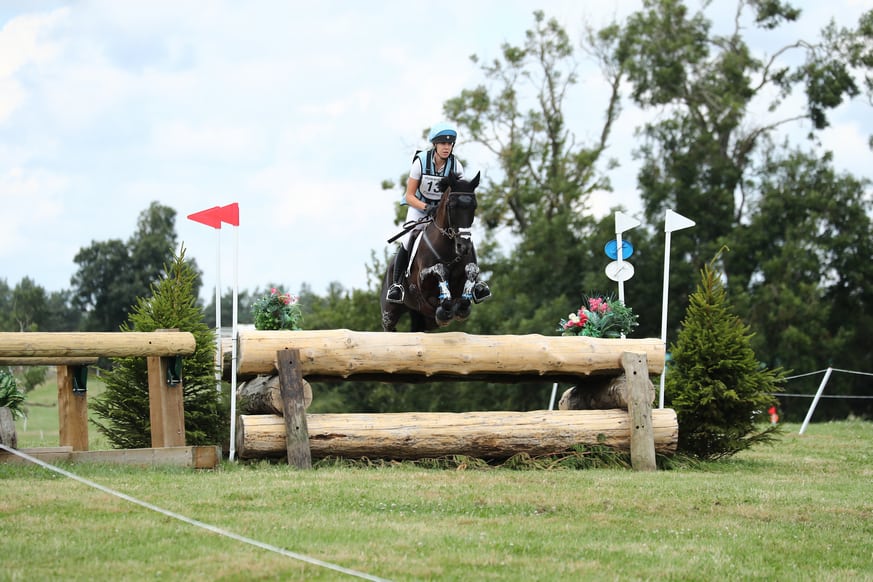
The weather forced a change in the yard schedule, says Toots Bartlett, but it was an opportunity to discover how the horses might cope outside the UK
Freestyle R enjoying his off duty time
Wooza! What a heatwave! July consisted of many (many…) early starts and late finishes in order to work around the heat. With temperatures rising as high as 38º on the yard, my team and I began our days at 5am in order to be on the first horse by 5.30am. This meant we were usually able to have the whole yard ridden by 11am and out of the sun before the days reached peak temperatures. With very limited shade in our fields we felt it kinder for the horses to remain in the cooler barn, and we attached fans to all of their stables to help. Electrolytes were added to all the horses feeds to help maintain hydration, even if they were on a light exercise day. Whilst making sure we were safe and sensible, we did utilise the heatwave whilst maintaining the horses’ fitness plan, to see how they coped and performed in extreme heat. This was a really good gauge for us to know how they would react when competing abroad. Top tip – for any horses that might not be keen to drink a lot in the heat, cutting up apples and carrot and placing them in the water is a great way to encourage hydration. We also monitored each horses temperature throughout the week.
Equador MW jumped double clear round the 3* showjumping course at Burgham International horse trials
July’s results Only a few events for team TB during July. A trip to Cheshire to the beautiful Somerford Park resulted in Freestyle R producing another double clear at 3* with a fabulous dressage of 26, giving him another chance of an International win. However, the ground was still extremely hard and he is such an exciting prospect now that he is producing such consistent top quality results, I chose to save him for another day and not run to time cross country. Our New Zealand horse Equador MW had his first event in the 2* and gave me a brilliant clear cross country. He then followed it up by jumping double clear round our first Intermediate together, to finish eighth at Upton House. Lastly, Six year old Cor Y Taran has made the step up to Novice level and in style!
Lippy the clever giant We have a fabulous four year old in for schooling livery; already standing at 18hh, Lippy is a big friendly giant. He has an exceptional brain and loves to learn. I find it incredibly rewarding riding the younger horses. Small things like doing a whole schooling session without them picking up the wrong canter leads feels like such a big accomplishment, it leaves me with a big smile on my face for the rest of the day!
Toots Bartlett is happy with six year old Taran’s progress in the novice class
In other news … We had a lovely girl from the high school join our team for two days work experience, which is a great way to gain an insight into how each yard is run and just how much work goes on behind the scenes. In very exciting news (to me!) team TB welcomed a rather special new addition. With the growing number of horses it was time to upgrade the lorry to a 26 ton beast – something I never thought we would have! It is slightly intimidating at the moment, and it will definitely make the narrow lanes of Dorset look even smaller. But I am so excited and so grateful. I am sure I will eventually adapt to sitting so high up! As I write this we are on our way up north to Northumberland to Burgham International horse trials, where we have two horses in the 3* and one in the Novice. Fingers crossed they might have had some more rain then the south!
(Update from Toots on the Burgham results: ‘It wasn’t the best weekend – Equador MW jumped double clear round the 3* showjumping, but I had a fall on Freestyle R early on the cross country course which cost us a third place in the 3*. It was another great run for Taran in the Novice, but no placing!’)
Do you enjoy working outdoors and being part of a team? If so, we have a great opportunity for you as a Repair and Maintenance (R&M) Supply Operator!
What can I expect?
We describe ourselves as ‘community within a community’ here at Wessex Water, and the Networks team is no exception. We provide a vital service that helps to ensure we supply water to 1.3 million customers, and we have a fantastic opportunity for you to join the team.
As one of our Repair and Maintenance Supply Operators, working in the Network Utilities team, you’ll carry out a variety of repairs and maintenance to the water supply distribution network, making sure that it meets quality and customer service standards. This might mean excavating and repairing burst water mains and leaks or making new connections, as well as landscaping and general building works.
You’ll be working within a great team, outdoors, dealing with different challenges every day and providing a vital service to our customers. These jobs involve operating as part of a two- person team.
What are we looking for?
This role will be based at our Sturminster Newton depot, so it is best suited to candidates living in the surrounding area, but consideration will be given to those living further away.
We’re looking for someone with a positive and can-do attitude who is well-organised, customer focused and a great team player.
You will need:
a valid driving licence
experience installing new services and meters, pipe-laying and/or general building
a current Streetworks ticket and a Health and Safety certificate would be preferred although full training can be given.
It is important to understand that you will be required to participate in an out-of-hours standby rota.
Benefits for you
Pension – up to 20% combined contribution
25 days’ holiday rising to 28 with length of service
Opportunity to buy and sell up to five days’ holiday
Health benefits package
Life assurance (up to four times your salary)
Electric vehicle salary exchange
Flexible working
Cashback and discounts from over 1,200 retailers
Paid volunteering day
Enhanced family leave
Interactive health and wellbeing platform
Support from mental health first aiders
£1000 referral fee if you recommend someone to work for us
What will you get from us?
Our people tell us Wessex Water is a great place to work, and they stay with us! We are proud of how we support development and career progression. We have a wealth of both financial and non-financial benefits to offer our people and are committed to ensuring we provide an environment that supports health and wellbeing and flexible working.
We continue to promote diversity and inclusion. With that in mind, we welcome all applicants.
We are delighted to have signed the Armed Forces covenant and are a Disability Confident Employer. Applicants who declare they have a disability or have previously served with the Armed Forces, and meet the minimum requirements for the job, will automatically be invited for an interview.
Please let us know if you require any additional support or adjustments to assist you in starting your journey with Wessex Water.
If you have what it takes to join this award-winning business and want to be part of our exciting journey and share in that success, then please get in contact with us to find out more.
Following his successful supercar breakfast meet-up in June, this month local teenager Zander Miller staged his first all day Classic & Supercar Sunday event at Clayesmore School, and estimates that the 160 classic and supercars on display had a combined value of more than forty million pounds.
‘It is tricky to estimate’ said Zander. ‘The Ferrari F40 that came is worth over £1,000,000 due to its rarity, age and condition. Many of the supercars are worth between £250,000-£500,000. And then the classic cars ranged from 1920 to 1997; we had an Aston Martin DB2 and an Aston Martin DB11. They’re 70 years apart! I’d imagine we had a value of around £40 (ish) million.’
Regular readers will remember the BV feature on eighteen year old Zander in the June issue – the teenager’s hobby of photographing supercars and posting them on Instagram lead to Zander organising his first supercar owners meet-up and the formation of the South Coast Supercar Club. In his final year of sixth form at Clayesmore, the budding entrepreneur was noticed by the school team who were keen to encourage him – they subsequently invited Zander to put on a full day event at the school over the summer. Zander grabbed the opportunity and, despite being in the middle of his A Levels year, threw himself into organising the one day event.
I spoke with Zander afterwards to find out how his first big show had worked out. Firstly I wondered just how many cars had shown up on the day? ‘The Clayesmore Classic and Supercar Sunday had 160 classic and supercars on display to the public. We had expected around 150; there were some inevitable no-shows as people unfortunately had to change their plans, but we received many more drive-ins on the day.’
Can you tell us about some of the cars that were there? ‘Our headline sponsors of the event The Hendy Group brought a lovely example of an RS Cosworth. We also had a Ferrari F40 on display from one of our most exclusive members, offering the rare opportunity to view such an iconic car – we were really happy that the owner even allowed the public to sit inside!
‘One of our other sponsors, First Choice Detailing, had arranged a tri-colour of cars on their stand to represent the Italian flag, covering the most track-focused and exclusive cars manufacturers can offer. There was a member’s Alfa Romeo GTAM (one of only 500 examples in the world), and a Ferrari SF90 Stradale, Ferraris latest and greatest hybrid technology which reaches over 200mph!
‘We were very fortunate that Meridian Modena (our local Ferrari dealership) were able to bring their brand new Ferrari 296 GTB demonstrator car. We were delighted to have had this on display next to the F40 as not many customers have taken delivery of this elegant machine.’
Putting on your first major event of this kind is a huge amount of work. Was it a steep learning curve? ‘If you’d asked me eight months ago if I would be working with Clayesmore and arranging a proper car event, I never would have believed you! Every single step has been a huge learning curve and has taught me so much about arranging a professional event which customers are willing to pay tickets for and then be satisfied on the day.
‘From my previous events, I’ve known the difficulties with logistics and communications with the South Cost Supercar Club members; however we tried to make the event as seamless as possible for our exhibitors and members. Even this was a learning curve – but now I know what works and what doesn’t for our future events.
‘I had a lot of positive feedback both during and after the event which is so nice to hear after all the hours of hard work and planning! All the praise really does make it worth while, and keeps me motivated. However I of course had a few comments and tips on what I can still improve upon. Hendy’s told me: “if you come out of the blocks and everything’s perfect, you’re either naive or lucky”. There are some positive lessons learned that will make sure my business continues to grow and be successful.’
Will there be a 2023 Classic & Supercar Sunday event?
‘Ha, I’m not sure yet! But there will definitely be something. I look forward to what is in store for the future of the club, and I’m excited to see where these next events take me. I think a big charitable event is what I’d like to do next.’
On the day we spoke, Zander had just learned his A Level results: ‘Somehow I’ve managed to arrange Clayesmore Classic and Supercar Sunday while juggling all of my subjects at Clayesmore. With the successful event last Sunday, I’m glad I can say that my place at Bournemouth University was approved, and I achieved a Distinction* in my Enterprise and Entrepreneurship BTec, A* in Photography, A* in Design and Technology and B in Business Studies. ‘The last few months have been busy and tough. But I have come out the other side with amazing grades and a growing and profitable business in an industry that I look forward to continuing in after my degree. ‘I’d also like to mention how grateful I am to Clayesmore for giving me the opportunity to work alongside them, starting an event which has the opportunity to become even more successful in the future. And a further thanks goes to Rhiannon Harris from Clayesmore School who I worked closely on the event with. It simply would not have been as successful without her.’
The best quality milk comes from local, healthy and happy cows, believes the third generation dairy in Shaftesbury
BV Dairy was established in 1958 and is now run by the third generation of the Highnam family. Both the business and the range of specialty products has grown and developed to form one of the most respected and successful independent dairies in the South West. BV Dairy started in the family home at Kington Magna, selling liquid cream. The business moved to its current site in Shaftesbury in the mid-1980s, and with the extra space the product range was extended to cultured milk products like yoghurts, sour cream and crème fraîche – anything from nought per cent fat soft cheese (quark) up to a 45% fat soft cheese (cream cheese). Our UF Plant, a world-class facility for manufacturing, was commissioned in May 2004. It uses Ultra Filtration (UF) Technology that, at the time, was a recent manufacturing process and uncommon in the UK. The plant offers total flexibility in the manufacturing of a range of different products, and has enhanced our position as an innovative manufacturer of specialist dairy product for our customers. Our active New Product Development department works constantly on new concepts and also with customers (and potential customers) whenever possible. October 2016 saw the commissioning of a new chill store facility; housing 1,000 pallet spaces and incorporating new office space and storage. The design ethos is based on lean principles, efficient running and full IT integration. We utilise VNA (Very Narrow Aisle) Fork Trucks running on guidance systems; and solar panels which generate 3,500kWh of electricity each day.
Back to the farm Hailing from a farming background originally, BV Dairy understands all aspects of the dairy industry and is proud of its strong relationship with the local farming community. We understand the importance of restricting food miles; our milk is sourced directly from within the local community, from dairy farms within a 30-mile radius of the production facility in Shaftesbury. These farms are regularly inspected as part of the Red Tractor Farm Assured Scheme and are required to comply with this standard. In addition, BV Dairy’s own Farm Liaison Team work closely with our farmers in applying modern best-practice principles and helping them maintain herds of healthy, happy cows that supply high quality, rich, tasty and nutritious milk. When collected from the farm all milk joins a schedule of testing – not only to maintain quality but also to form the basis of an agreed payment scheme for the farmer. In addition, BV Dairy host regular forums attended by their farmers and other invited dairy professionals where issues can be discussed and ideas exchanged to help ensure a continuing good working partnership.
The BV Dairy cows Our typical dairy farm supplier has a long heritage of dairy farming, and a long relationship with the Dairy. They vary in size from smaller, family farms with around 80 cows up to larger concerns with 400 cows. The systems used are dependent on the individual farm but ALL cows will go out on grass for a period of the year, and spend their winter in a cubicle house or barn. The breed of cow is also varied, with some farms having pedigree Holstein Friesians and others having crossbred stock – such as Jersey crossed with Friesian. There are also Guernsey’s, Brown Swiss and Montbeliarde. A nutritious diet is essential and in summer months this is mainly grass. In the winter when grass does not grow well cattle are fed mainly silage (preserved grass or maize) with a mixture of cereals and protein feeds to ensure that they maintain their health. BV Dairy support varied calving patterns as this helps achieve a consistent volume of milk arriving at the Dairy. Calving timetables are tailored by the farmer to suit his farm, workforce and the space and land available – there could also be other farming enterprises such as arable, beef cattle or sheep to consider. Some farms have the facilities to calve year-round whilst others calve in blocks; spring or autumn, or sometimes both!! BV Dairy is committed to its farmers whatever size their farm and our aim is to help them support healthy, happy cows