This year’s Sturminster Newton Half Marathon –organised by the Dorset Doddlers – takes place on Sunday 6th August. The race starts at 10.30am in Station Road, just outside the Railway Gardens, and the route goes out through Manston, Margaret Marsh, Stour Row and Todber, returning back via Moorside and Hinton to finish on the High School playing field. The lead runners are expected to finish at around 11.40am.
The 5K option If distance running is not your thing, there is also a multi-terrain 5K, which starts just after the half marathon. You will line up on the same start line before making your way along Sturminster’s roads, tracks and footpaths towards Hinton St Mary. After a lap around Hinton, the route will head back through the beautiful avenue of trees before crossing the finish line at the High School. Race Admin will be stationed at the High School. You can enter online in advance for the Half Marathon, and all 5K entries will be taken on the day at Race HQ. All finishers will receive a race memento and a delicious Honeybun Cake! There will also be refreshments and children’s races on the School playing field. Come along and run, or get out and support the runners along the routes. If you live on the route and it is a hot day feel free to come out with your hosepipe and cool them down!
For more information on both races and the whole event, please visit sturhalf.co.uk or call race director Christine on 01258 472010.
Boundary changes and the impact of new fossil fuel regulations on rural areas – a busy month for MP Chris Loder
Chris Loder MP
The Parliamentary Boundary Commission has just announced its final recommendations for changes*. Initially, there was huge disquiet from the Cerne and Piddle Valleys (who did not want to be moved from West into North Dorset). To think that the Cerne Giant was going to be in North Dorset was incomprehensible! But equally, scores of people from Upwey and Broadwey did not want to move from South Dorset! And I know that the thought of Minterne Magna and Sydling St Nicholas being in the same constituency as Verwood – but not Dorchester – was nonsensical. However, the beautiful parishes of Glanvilles Wootton, Ansty and Hilton will all now be welcomed into West Dorset from the next General Election, while it is farewell to Puddletown in the north and Chickerell to the south. It took quite a lot to make the case successfully to the Boundary Commission – both Richard Drax and I constantly made representations on behalf of constituents to change the original recommendations. I was sorry to read the official response of the Liberal Democrats who supported the Cerne and Piddle valleys being moved out of West Dorset; it is duplicitous of their parliamentary candidate to claim on Twitter last week that he was really pleased that Cerne Abbas was staying in West Dorset, when he supported the original proposal tenaciously.
A busy month Since my last column, I’ve met with the Rail Minister, Huw Merriman, to discuss the ongoing poor performance of the West of England line. Traversing the Blackmore Vale itself, the line frankly deserves greater attention. In particular, I raised with the Minister the performance of the line’s operators – South Western Railway and Great Western Railway – and the need for better services to and from West Dorset. I’ve also met with the Education Minister, Nick Gibb, to discuss the provision of local education here in West Dorset. I was particularly pleased to raise my specific concerns around the provision of agricultural education, which more often than not does not receive the funding or attention it deserves. Opportunities for land-based education are vitally important, especially in rural agricultural areas, and I am so glad that we have Kingston Maurward College here in West Dorset (one of the main providers for the region). My concern is that land-based education, typically the more vocational and hands-on courses, are not receiving the same attention as more mainstream institutions.
Opinions needed In other news, it may surprise you to know that 51 per cent of properties in West Dorset don’t have access to the gas grid – the highest proportion in the county. The unique infrastructure of the constituency and the sparsity of settlements means that many households have no choice but to use alternative fuels such as heating oil, LPG or kiln-dried logs. In some of the more rural areas like the Chalk valleys and the Marshwood Vale, more than 95 per cent of properties do not have access to mains gas, which puts us in a unique position of rural need. Pending consultation, the Government’s current proposal is to phase out the installation of high carbon fossil fuel heating systems from 2026. I have some reservations about this approach – it needs to better reflect rural needs. The rural voice and lifestyle risk being disproportionately affected. For me to better represent your views, I would welcome your feedback on rural energy and the Government’s current proposals – and what you’d like to see. Please do send your thoughts and comments via my website here: chrisloder.co.uk
‘Tis the season of exams. I was cheered recently when an invigilator described the efforts that go into providing a level playing field for all those sitting exams, whatever their disadvantages or disability – from different colours of paper to C-Pen readers, scribes and interpreters. Nothing, though, to suggest that a student should do anything other than bring their A game and give the thing their best shot. With that questioning spirit in mind, here is a short quiz with some suggested answers: Q: What do the Conservative Government and the recent Glastonbury festival have in common? A: A rather tired line-up giving us a few last hurrahs (and a few notable early departures) … Q: What do government, local and national and English cricket both need to do? A: Embrace a broader, more inclusive and representative approach. Stop ministering to a like-minded, narrow-minded and class-conscious minority. Throw the doors open to talent, energy, commitment and fair-mindedness. Q: (many and various): Where is the credible plan for… … net zero? For a UK response to huge US and EU investment in the technologies of the future? For an effective, balanced strategy for NHS and public sector manpower, pay and conditions, for training and deploying the thousands of GPs we so sorely need? For beating down core inflation? For preventing profiteering by retailers, banks and energy providers? For protecting our environment from self-serving utility companies? For building the houses and communities we need? For enhancing our food security? For providing reliable, affordable public transport? For resolving the mess that is our economic relationship with Europe? I could go on …
Multiple choice section: Is our Army: a) the strongest it has ever been b) getting stronger by the year or c) the smallest and weakest for 200 years? Is the NHS: a) going from strength-to-strength b) brilliant by international comparison or c) worryingly fragile and open to fragmentation and sell-off? Is Brexit: a) a success b) still the right thing to have done, or c) both feet well and truly shot to pieces? The by-elections on 20th July give people across the country the opportunity to put this government on notice. A stronger message MUST follow: not simply ‘must do better’, but that there is no confidence and even less trust in the Conservative ethos of personal freedom (aka ‘look after Number One’ and ‘let the devil take the hindmost’). Theirs has been an historic failure that now needs fixing by the grown-ups on behalf of all of us – and our kids and grandkids. This government is now visibly hunkering down, eking out its last months in power and focusing on the few dog-whistle topics that make the headlines in their safe papers. That isn’t government. It is having us on. Mike Chapman, North Dorset LibDems
With 400 years of history within its walls,Hardy’s Pure Drop Inn – The Crown at Marnhull – would have a few tales to tell. Rachael Rowe reports
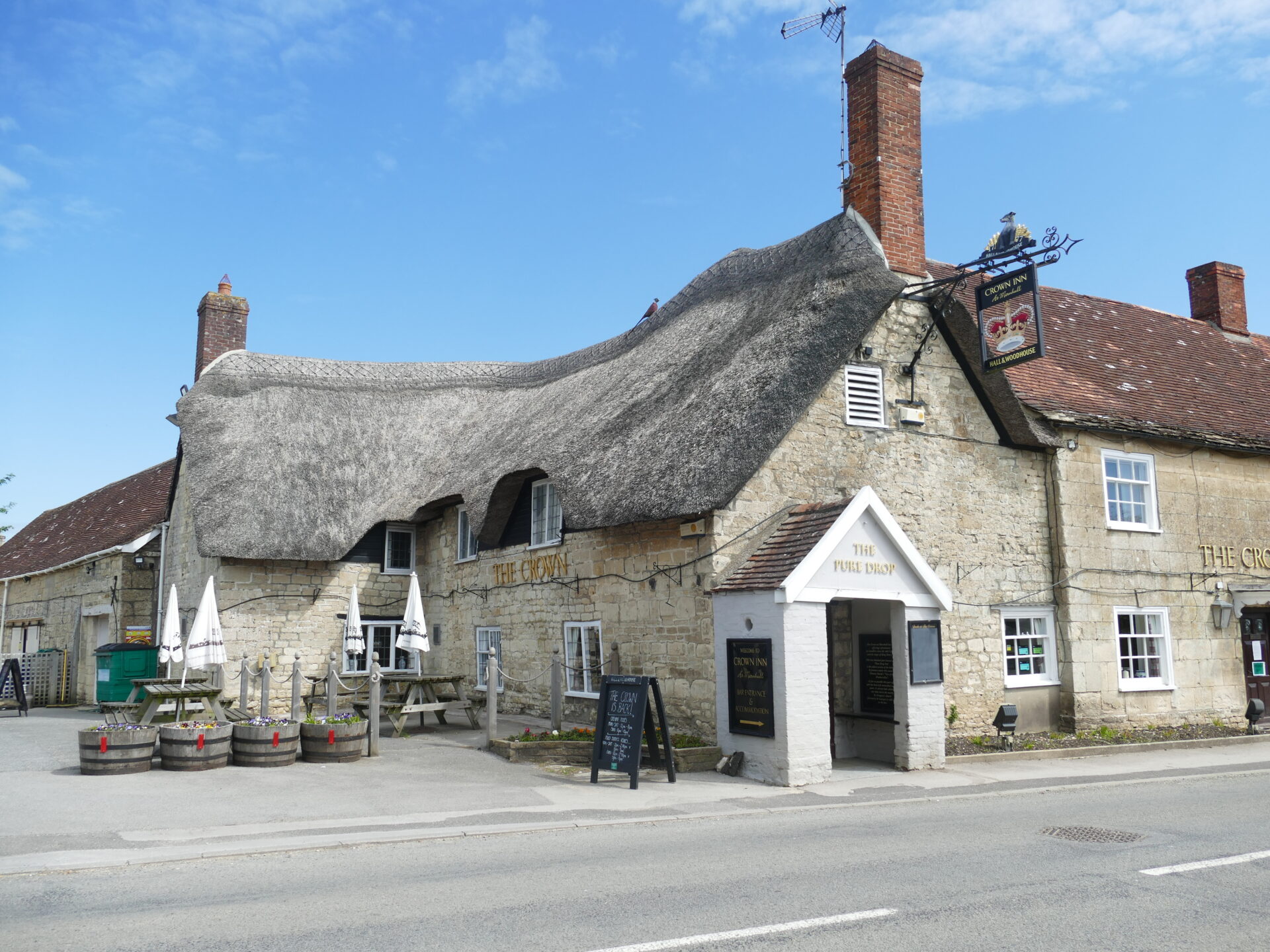
The Crown Inn marnhull – All images: Rachael Rowe
If walls could talk, the Crown Inn at Marnhull would reveal more than 400 years of history. Walking into the bar, which dates from the 16th century, feels like a step back in time. And yet this business is very much focused on the future. In the Hardy Room, I met operations manager Ryan Proudley and directors Gemma Proudley and Eric Montgomery (known as Monty). Ryan and Gemma recently got married – the Crown was shut for three days so the entire team could celebrate. ‘I left the Royal Marines after several years.’ says Monty. ‘I was working in bars in Bristol but wanted to set something else up.’ ‘I used to work with Monty in Bristol,’ adds Gemma. ‘I started out at 17.’ ‘We decided to do something together.’ says Monty. ‘We looked at a lot of pubs but they weren’t quite right. Then, in 2015 we found The Crown through Hall & Woodhouse.’ ‘As a bit of context, when we found this pub it had been through 12 landlords in 10 years. It had not been looked after,’ says Gemma. ‘But we saw the potential. We walked in and thought about all the things we could do with the place. And it was a nice village – everyone was really welcoming. We’ve been here eight years now.’ Monty is clearly a history buff, and is fascinated by the inn’s past. ‘The parts of the building under thatch date from the 1500s. It was once part of the estate of Henry VIII. Catherine Parr lived up the road at Nash Court Manor. Nearby St Gregory’s Church is older, 800 years, and was formerly Roman Catholic. There’s a priest hole in the bar area and it’s said there’s a tunnel leading to the church. ‘When we were renovating one area, we found a bill of sale for a tea clipper that ran aground in Poole – the beams throughout the building are from that ship. ‘We also found a stone engraved with the date 1725 in the more ‘modern’ part of the building! And then Thomas Hardy set Tess of the D’Urbervilles here – this is the Pure Drop Inn. So now we have a Hardy Room, with a replica desk and his books – we have really embraced that theme.’
Crown Inn carved stone dating to 1725
Tell us about the team? We have 32 staff. Some are front of house, some in the kitchen, and some are part time or seasonal. We think of them as Team Crown. We make sure everyone has the corporate and front of house training and knows how to greet people. All these little things are very important. Everyone talks about Team Crown.
In charge of Team Crown – (L-R) Ryan Proudley, Gemma Proudley and Monty
What flies off the menu? ‘Our cod and chips!’ Ryan answers immediately. ‘And also our pies. And the chalk stream trout, which comes from Hampshire.’ The team has just added a ‘Dorset shelf’ in the bar where local spirits are displayed. Monty agreed that he had learned a few things about their bar menu items too. ‘When we started out we were told people wouldn’t want cocktails because “it’s rural Dorset”. But we sell loads of cocktails! We’re also very pet friendly and sell doggie ice cream. When the rep talked to us about it, we all thought he was mad. But in fact our second most popular ice cream flavour is Marshwood’s Doggie Vanilla –just behind human vanilla!’
Seared Tuna Niçoise Salad, with pickled fennel, green beans, tomatoes, new potatoes, rosemary and garlic olives, mixed leaves, lemon and dill dressing and boiled egg
Getting involved Team Crown is right at the heart of the community in Marnhull. ‘We provide the catering for Marnhull and Child Okeford lunch clubs once a month and we also look after the cricket teams,’ says Ryan. ‘On Fridays, Saturdays and Sundays there’s usually a load of cricketers in the garden with a burger and pint. We do well on the cheesy chips, too! ‘During COVID, we just worked hard – we did loads of takeaways which were really popular. And volunteers in the village helped us with deliveries. ‘We also have bed and breakfast rooms which are used by local businesses – the rooms run at 90 per cent occupancy.’
And your biggest challenge? ‘The energy bills,’ Monty is swift to answer. ‘Rising prices are an issue, but energy costs are the worst. Our energy bill was £19k a year – it’s now £100k. ‘So we have looked at where we can cut back – we should have been doing a lot of that anyway. But we also have to look at how costs can be absorbed. We simply can’t pass everything on to the customer. ‘Another challenge is finding skilled staff.’ adds Ryan. ‘It isn’t really anything to do with Brexit – finding specialist skilled staff who want to come here to a rural village is hard. We’ve been lucky in that the staff we recruited have stayed.’ One of the ways that the Crown has attracted staff is to buy a house in the village so workers can live locally but still have their personal space.
What are you most proud of? ‘The journey we have been on and Team Crown. They are not just employees but friends.’
crowninn-marnhull.co.uk 01258 820224 Fri and Sat – 12 to 11pm Sun to Thu – 12 to 10pm Food Service: Mon to Sat 12-2:30pm and 5-9pm Sundays 12-2:30pm and 5-8pm FULL takeaway menu also available seven days a week during food service hours
George Hosford is still taking time to test, adapt and learn as he moves the farm away from fertilisers to a more sustainable solution
Maisie the ewe is a curious and gentle superstar of school trips to Traveller’s Rest Farm. All images: George Hosford
Professional sheep farmers find it rather fluffy nonsense when I refer to my sheep by name. But sheep only remain on this farm for the purpose of entertainment and education. Commercial sheep farming is a mug’s game that we gave up last year, after a dose of scab forced us to dip all of our sheep in a very unpleasant chemical (actually, a contractor did the dipping …), which is the only reliable way to get rid of this pernicious affliction. It was the excuse we needed to disperse the flock, after finding they weren’t really helping with management of oilseed rape by grazing it in the winter, nor were they encouraging wild flowers in our grass swards. The regenerative approach lends itself more to cattle grazing than sheep – cattle browse where sheep nibble, right down to the ground given a chance. When dipping, you have to submerge the animal completely. If you don’t, you won’t kill the scab mites in the ears of the sheep, and control will not be complete. The rubbing, itching and wool shedding will return, and the job will have to be done again. Back in the 60s, 70s and early 80s, it was compulsory to dip all sheep for scab annually – a policeman would usually attend at dipping-time to ensure it was done properly. Dipping is needed for welfare reasons. The mites drive the sheep nuts when they dig in, and it is worst in cold weather. Compulsory dipping was aimed at eradicating the problem nationally, but once the disease was nearly gone from the country, the rules were relaxed. Unfortunately a few pockets of scab remained, and now we are back to a situation where it is endemic. The risk of contracting it in one’s flock is huge when you buy in replacements, particularly from far off sales, using an agent to buy for you (as we did). Our replacement policy for many years had been to buy in retired hill ewes, usually from Wales, and expect to get another two or three crops of lambs from them. We got away with it for a long time, but got caught out in the winter of 2021 and that was enough to say ‘no more sheep’. Our tiny 11-ewe flock is scab free, and apart from the purchase of Reggie the ram last year, we will remain closed, to minimise risk of re-infection.
Wheat tests The top image opposite is one of our wheat fields, showing the colour contrast between varieties. The smaller area of the pale one on the right – Champion – was the last of the seed we had sown in a different field. It’s our first year trying Champion. It has pretty good book values for disease resistance, standing power and yield – we will see what the combine thinks in a few weeks. The darker crop on the left of that picture is Theodore, in its second year for us. It had league-topping ratings for yellow and brown rust, and septoria. However, where we have been really stingy with the fungicide we have seen a brown rust explosion, needing fire engine treatment with fungicide. Apparently we are not alone. Similarly, variety Extase, which we and every other farmer in the country is growing, has very good book values for disease, but has broken down to yellow rust in the absence of fungicide. Proper farmers will now be yelling ‘Why no fungicide?’, but having shifted our emphasis away from intensive fertiliser and chemical inputs, we are trying to stretch the genetic ability of the best varieties to resist disease. Reducing fertiliser rates also reduces vulnerability to disease, so a good case must be made before we head for fungicide. Older (dirtier) varieties received a prophylactic application at T1 and T2 timings, but the supposedly cleaner ones did not, and this is where we have stress-tested the policy.
The darker wheat crop on the left is Theodore, and the pale one on the right is Champion.
It’s all in the mix So having seen Theodore and Extase grown on their own with no fungicide both showing their true weaknesses, it has been fascinating to watch how a blend of the two has fared. Where the yellow rust appeared in Extase in mid-May, and brown rust in Theodore a couple of weeks later, the same varieties sown in a blend have remained clean until a small amount of rust appeared on the Theodore last week. Our agronomist says it is now too late in the season to worry about treatment. So what is going on? High on my list of reasons is that the plants of the same variety being separated by plants of the other variety means that cross-infection from plant to plant is reduced. We will definitely be trying more blends next year, and three and four-way mixes, too. In the image on the left we have a field with phacelia on the left, buckwheat on the right (growing our own seeds for cover crops) and we have linseed, vetch, turnips and camelina all in the same field.
Phacelia left, Buckwheat right (growing seeds for 2024 cover crops) with linseed, vetch, turnips and camelina all in the same field
Trying new tricks We are deliberately reducing fertiliser levels as part of our desire to create healthier soils; building organic matter and biological activity in the soil improves water and nutrient-holding capacity, leading to similar – if not better – crop performance, at lower input cost, than in depleted soils which have been degraded by decades of intense cultivation and fertiliser use. Nitrogen fertilisers and cultivations oxidise carbon and organic matter in the soil, sending carbon dioxide (CO2) and even more damaging nitrous oxide (N2O) into the atmosphere, as well as releasing water-soluble nitrates downwards towards the water table. The climatic and environmental consequences are huge, and it is essential that we learn how to grow food more efficiently, without these dire consequences. Consumers can do their bit by demanding food produced by more sustainable methods, and farmers can do their bit by trying some new tricks.
See George’s full June round up, including a terrific write up of the agriculture festival Groundswell, on his blog View From The Hill
Good news has seemed hard to come by recently, but there has been some light to lift the spirits. The unwelcome news included our MP Simon Hoare when he was found to have claimed four driving offence fines against his MP’s expenses. Boris Johnson hogged the limelight, again, with extraordinarily petulant outbursts over being found to have deliberately misled Parliament. Poor man was too upset to think about reimbursing the £245,000 of taxpayers’ money used to fund his legal costs during the investigation. Or to forego the (up to) £115,000 annual allowance he’s now entitled to receive as an ex-PM. Rishi Sunak has railed against concerned protesters, calling them ‘eco-zealots’. And he accused Labour of allowing donors to dictate the party’s energy policy of blocking new oil and gas projects – notwithstanding that large donations have been made to the Conservative Party and some of its MPs (including Sunak) by individuals and companies linked to fossil fuel interests. Labour disappointed us by refusing to support a Green Party motion in the House of Lords that would have prevented the government from using an unconstitutional manoeuvre to overturn a House of Commons vote on public protests. Instead, Labour tabled a motion of ‘regret’ – which no doubt troubled the government greatly. No wonder there are times when it’s best to switch off the news and take a break. Otherwise the many problems we face can feel insurmountable, which they are not – but we are running perilously short of time to deal with them.
In other news Some recent good news came via an unlikely source – the Daily Mail. I know, you didn’t see that coming, did you? The paper blasted Labour for having accepted donations from Dale Vince, founder of green energy company Ecotricity and a supporter of various environmental protest organisations. In response, Vince offered to match all public donations to Just Stop Oil made over a 48-hour period, which promptly raised £340,000. Well done Daily Mail! When the bad news seems relentless, it’s good to stay grounded – for example by enjoying positive community news in magazines such as this one. And reminding ourselves that we humans have the capacity to be so much better. And not only can we do better, we must. Ken Huggins, North Dorset Green Party
Climate change is all around us and it is being acted on. While vaping could be the next public health crisis, says MP Simon Hoare
Simon Hoare MP
I want to try to cover two issues this month: the first is around the environment and the second on a public health matter. We have gone through an incredibly dry weather period here in North Dorset, punctuated by just two heavy episodes of rain. From looking parched and somewhat ‘Augusty’, after the latest deluge the verges, gardens and fields are now looking a little fresher. Whichever way you look at it, our climate, and therefore the environment, is changing. It is no longer something anyone can ignore, or tuck away in the ‘too difficult’ drawer. I take the issue of climate change seriously and am proud of the record of the government since 2010 in driving forward the green, renewables agenda. We saw strong leadership provided at COP in Glasgow, have overseen a massive expansion of offshore wind and solar power generation, a focus on electric vehicles and the greening of the wider economy. There has been a significant tilt in the daily percentage of power generated in the UK from renewable sources, and a realisation that maximising domestic, renewable energy security is as important as defence or food security. The ground breaking Environment Act points the way to a more nature-rich, biodiverse and secure natural environment. We often forget that it was this government, the first among developed economy nations, that legislated for Net Zero by 2050. We are of course in a period of transition right now. Climate change sceptics point to the increase in costs to support renewable investments – and they are correct. But how much higher the cost of a degraded and destroyed world, rendered unfit by man’s own hand, for man’s habitation? I did not come into politics to witness a cultish global suicide pact. Those who are fully committed to addressing climate change worry that progress is not being made quickly enough. That all use of non-renewable power sources should stop now. Of course, the goal is desirable and attainable but we do have to keep the lights on, manufacturers manufacturing etc while we progress to that destination. Where things can be speeded up I will continue to press, but confidence in the commitment of the government to achieve progress cannot be in serious question.
On vapes and teens The second issue I want to touch on is teenage health. ‘Safe sex, don’t smoke, healthy diets, exercise, sensible alcohol consumption, no drugs’ – they are all part of the parent and carer’s mantra. It is only in recent weeks that media coverage and political narrative has turned to vaping. Somehow, plumes of dubiously sweet flavoured smoke can be inhaled and exhaled with impunity. It’s a flammable fruit juice isn’t? Perfectly safe isn’t it? Entirely harmless? Well, I would urge parents – and in fact all those who are using vapes as the ‘well it’s not a cigarette’ option – to take a look online, see some of the chemicals that go into vapes. Then ask a very simple question: if that was in food would I buy it? Let my child eat it? Government is alert to the issue and the Prime Minister is taking a lead. Locally I am particularly concerned (I declare an interest here – from September, my three children will be attending school in the town) to see two vape shops in Gillingham, one adjacent to a sweet and party shop! Two vape shops within striking distance of a very large high school – a coincidence or a deliberate marketing decision? You can probably guess what I think. I do not want, and neither does the government, to see vaping – and its potentially addictive and adverse health effects – become the next public health challenge.
For the first time in its 183-year history, the Dorset County Show is making a significant addition to its line-up by hosting qualifier classes for the prestigious London International Horse Show. This collaboration between the Dorset County Show and renowned equestrian organisations such as the British Show Pony Society (BSPS), the British Show Horse Association (BSHA), and the Association of Show and Agricultural Organisations (ASAO) aims to breathe new life into equestrian showing and attract a wider audience. The series of qualifiers consists of 20 different classes that encompass a range of categories, including Hacks, Riding Horses, Coloured Ponies, and Cobs. The classes will provide opportunities for rising equestrian stars to showcase their skills and vie for a place in the finals at the esteemed London International Horse Show in December. With only 45 county and agricultural shows across the UK chosen to host these qualifying rounds, the Dorset County Show joins an exclusive group of events contributing to this new series.
Reaching a new audience The collaboration with the BSPS, BSHA, and ASAO signifies a joint effort to revitalise equestrian Showing and increase the number of agricultural and county shows featuring equestrian classes. Over the past few years, these rural events have seen a decline in participation, making it crucial to introduce Showing to new audiences. By partnering with these organisations – that have a collective audience of over half a million – the series aims to really showcase equestrian Showing as a spectator sport to a far wider audience. James Cox, the Show Organiser for the Dorset County Show, expressed his enthusiasm for hosting the qualifiers; ‘We’re thrilled to have been awarded the chance to host qualifiers for the London International Horse Show for rising equestrian stars. It’s wonderful to be able to bring this new element of one of Europe’s oldest and most prestigious equine events to our historic show. Equestrian showing of this calibre promises to be exciting viewing for audiences of all ages.’ Nigel Hollings of the BSHA highlighted the importance of making the classes fun and accessible for everyone, whether or not they’re competing: ‘We’re determined to make them an enjoyable experience for competitors and the watching public alike. We’re requiring the commentators explain to the audience what the judges are looking for and why one horse or pony may win points over others. This will present Showing in a new light and make it much more accessible and entertaining.’
If you’re interested in participating, equine entries into the Dorset County Show are open until August 17th 2023. The show itself is on September 2nd and 3rd. Adult tickets are currently available for £19, and children attend for free. For more information and to book tickets, visit dorsetcountyshow.co.uk.
With 84 per cent of UK women feeling unheard by healthcare professionals, Dorset Mind is now offering local women a menopause pathway
Last year, the government surveyed 100,000 women for its Let’s Talk About It women’s health report. The results revealed that 84 per cent of the women surveyed felt they were not heard by healthcare professionals. And only 64 per cent said they felt comfortable discussing menopause-related issues. At Dorset Mind we are committed to challenging the stigma surrounding mental health – promoting open conversations about mental wellbeing. These discussions are beneficial in helping individuals realise they are not alone and we know it reduces the risk of suicide.
Menopause pathway As some staff and volunteers at Dorset Mind experience their own menopause journeys, we understand the impact of menopause on so many aspects of women’s lives, including mental health, empathising with the numerous challenges associated with menopause. Symptoms such as anger, irritability, anxiety, forgetfulness and low mood can affect women throughout this stage of their lives. In partnership with the NHS, Dorset Mind now offers a menopause pathway through its Active Monitoring service. This consists of six weekly sessions for patients with mild to moderate mental health issues. The menopause pathway – along with other available pathways addressing anxiety, depression, stress, grief and more – guides patients throughout their sessions. Referrals can be made by healthcare professionals. There is often no waiting list. Mery Zanutto, Dorset Mind’s Active Monitoring team leader, played a crucial role in the development of the new menopause pathway: ‘I am a former Advanced Surgical Practitioner as well as having experienced the menopause journey both naturally and finally surgically induced, so National Mind felt I was a good asset in providing both clinical and personal experience into the materials. Due to the increased awareness and demand for support services among patients in the past couple of years, we needed to be able to address and respond to the increasing number of enquiries. ‘Our new pathway focuses on perimenopause, menopause and post-menopause which, together with the two additional resources of The Role of Hormones and How to Best Manage the Menopause Treatment, will provide people with basic knowledge.’ Ensuring that women not only feel heard but also have their concerns taken seriously is essential. Throughout their healthcare journey, this includes discussions of symptoms, subsequent appointments, treatment options and follow-up care. Dorset Mind is proud to offer Active Monitoring support in GP surgeries across Dorset for individuals aged 11 and above. Currently available in 12 Primary Care Networks, the service can be accessed without a waiting list. More information about the specific GP surgeries offering this support is available on the organisation’s website
While Dorset Mind provides valuable support, it’s important to note that GPs remain the primary resource for clinical guidance.