Ten teenage drummers from across the country took to the stage at Lighthouse, Poole on Sunday for the final of the Zildjian Young Drummer of the Year competition. Now in its 24th year, the contest brings together some of the most talented young percussionists aged 16 and under. The finalists each faced three challenges on the day: performing a two-minute solo, playing along to a pre-recorded track, and joining a live band to perform a piece they heard for the first time that day. The judging panel featured some of the UK’s leading session and touring drummers, including Ash Soan (Taylor Swift, Rod Stewart and Snow Patrol), Ben Thomas (Rag ‘N’ Bone Man), Rob Rolfe (Enter Shikari) and former winner JJ Wallace, who has since played with Jorja Smith and Celeste.
The title was won by 16-year-old Ellis Gates from London, who returned to the competition after narrowly missing out last year. ‘The competition was an amazing experience, just as it was last year,’ he said. ‘This year I felt more prepared, and when I performed my solo I felt calm and focused.’ Ellis, who began playing drums as a toddler after receiving a toy drum kit from his grandmother, now studies at the Julian Joseph Jazz Academy and hopes to continue his music education in New York. Founder Mike Dolbear praised the standard of this year’s finalists. ‘Huge congratulations to all of them – they were incredible,’ he said. The competition has been hosted at Lighthouse since 2023 and continues to grow internationally, with finals now being staged in the United States and across parts of Europe.
The BV community news section is sponsored by Wessex Internet
When the Chancellor delivered her Spring Forecast, few in the business community expected major policy changes. What many had hoped for, however, was a clearer recognition of the pressures employers are currently navigating.
Ian Girling, CEO of Dorset Chamber
Across Dorset, businesses are preparing for new obligations under the Employment Rights Act, alongside increases to the national living and minimum wages. These changes come at a time when operating costs remain high and confidence, while improving in some sectors, is still fragile. Recent research from the British Chambers of Commerce shows that one in four businesses are struggling to pay their energy bills. Dorset firms are not immune from those pressures. While inflation has eased, many costs have not returned to pre-crisis levels, and for smaller employers in particular, margins remain tight. It is right for government to speak positively about economic progress and the importance of stability. Businesses value certainty. But confidence cannot be declared into existence. It is built through consistent policy, manageable regulation and realistic support for growth. The coming months will test that confidence. The potential for renewed volatility in global energy markets, coupled with geopolitical tensions, adds further uncertainty. Dorset businesses are resilient, but resilience should not be mistaken for limitless capacity to absorb additional cost. If growth is the objective, then employers need the conditions to invest – in people, in innovation and in expansion. Skills remain a crucial part of that picture, and apprenticeships continue to offer a practical route for businesses to develop talent locally while creating meaningful opportunities. That is why the Dorset Apprenticeship Awards matter. Now in their fifth year, they highlight not only the contribution apprentices make to organisations across the county, but also the personal transformation that comes with the structured training and support. We regularly hear apprentices say the programme has changed their lives. That is growth in its most tangible form. While national economic debates continue, there is important work happening here in Dorset. Business will play its part in driving growth – but it needs the right environment to do so.
The not-for-profit Somerset Care Group is kickstarting its 35th year with a UK care award based on customer reviews. Established in 1991, Somerset Care has been recognised as a Top 20 Mid-Size Large Care Home Group in the Carehome.co.uk awards. They celebrate excellence in care by recognising the Top 20 highest-rated Care Home Groups, honouring care homes that have received outstanding reviews from residents, service users and their families and friends.
Eve Mitchell, Somerset Care’s Chief Operating Officer, explains what the accolade means to colleagues across the Somerset Care Group: ‘To receive an award for the care we provide is wonderful, but to know that this stems from independently-verified reviews from our customers and their families means so much more! ‘We are incredibly proud of the high-quality, specialist care which our care home teams provide, and the difference this makes to our residents and their loved ones. This award recognises their dedication to supporting people to live the life they choose. ‘I would like to say thank you to every single customer, resident and family member who has shared their valued feedback on carehome.co.uk. This award means so much because it reflects your experiences of the care we provide.’
Recent praise for Somerset Care on carehome.co.uk: ‘Came to Cooksons Court after being discharged from hospital. Booked originally a 2-week stay but have added an extra week. Medical staff, carers etc fantastic. Caring service. No one can do enough for me. Food delicious. Very impressed. Admin staff also so helpful.’ – Respite resident (Cooksons Court residential and nursing care home, Yeovil)
‘I am exceptionally pleased with the care and compassion all the staff at Calway House have shown in helping my Mum settle in. The staff are friendly, caring & patient. As my Mum has dementia it is such a relief to know she is safe, well fed and cared for. The activities provided every day are a real bonus and have played a massive part in settling my Mum in. Calway House is spotlessly clean every time I visit. All the staff are most welcoming and available to chat to no matter what time of day you arrive. I have no hesitation in recommending Calway House.’ – Daughter of resident (Calway House residential, dementia and nursing care home, Taunton)
‘A lovely welcoming home with the most amazing staff. There’s always something going on for the residents. Every one’s happy there. Mum is receiving the best care and we know she is being well looked after. As she told us, ‘you can’t look after me as well as they do!’ The food is excellent and a good choice. Visitors are made so welcome – home from home.’ – Daughter of resident (Wyndham House day care, respite and residential care home, Minehead) To find out more about the specialist day care, respite breaks, residential care, dementia support, and nursing care offered across Somerset Care’s 22 care homes, please visit somersetcare.co.uk or call 0800 8174 925.
Dorset Community Energy has welcomed the Government’s new £1 billion Local Power Plan, describing it as a major opportunity to expand community-owned renewable energy across the county. The plan – described by ministers as the largest public investment in community energy in UK history – aims to give communities the resources and support to develop their own local energy projects. The programme will include grants, loans, expert advice and targeted investment, alongside efforts to remove regulatory barriers that have historically made it difficult for community schemes to enter the energy market.
Dorset Community Energy team in front of the solar installation at Greenford C of E Primary School, Maiden Newton
There will also be a new Partnership Fund encouraging closer collaboration between local authorities and community energy groups. Dorset Community Energy says it looks forward to continuing its work with Dorset Council and BCP Council, as well as exploring future opportunities with the national energy body Great British Energy. The organisation has been developing community-owned renewable projects in Dorset since it was founded in 2013. Over the past decade it has installed 30 solar PV systems on schools, hospitals and community buildings across the county, funded through community share investment. Together, those projects have generated more than 8,000 MWh of clean electricity – enough to power around 2,400 homes. They have also saved local organisations almost £1 million in energy costs while preventing an estimated 2,000 tonnes of CO2 emissions. Any surplus income from the schemes is reinvested locally through the organisation’s Community Fund, supporting further projects and initiatives across Dorset. Supporters say the new Local Power Plan could allow projects like these to grow significantly in the coming years, keeping more of the financial benefits of renewable energy within local communities while helping tackle fuel poverty and strengthen energy resilience. dorsetcommunityenergy.org.uk
The BV community news section is sponsored by Wessex Internet
James ‘Jim’ Wren, one of the last surviving veterans of the sinking of HMS Repulse, has died aged 105. A Royal Marine, Jim survived the worst naval disaster of the Second World War, endured three and a half years as a prisoner of war under the Japanese, and later became patron of the Force Z, HMS Prince of Wales and HMS Repulse Survivors’ Association. Born in 1920, Jim joined the Royal Marines in 1939 at the age of 19. After training at Stonehouse in Plymouth, he was posted in 1940 to the battlecruiser HMS Repulse. Launched in 1916, the ship was fast, heavily armed and one of Britain’s key capital ships.
Jim and Margaret Wren on their wedding day in 1946
During Arctic convoy duties, Repulse took part in operations against German battleships like Gneisenau and Bismarck. Jim later recalled the gruelling conditions, but also the camaraderie among the crew. ‘The ship was very well organised, and we had a great Captain,’ he said. ‘It was gruelling work, especially in the Arctic. The camaraderie was marvellous. I met some really super men in those days. I can never forget them.’ In December 1941, HMS Repulse sailed from Singapore as part of Force Z alongside the new battleship HMS Prince of Wales. On 10th December Japanese aircraft attacked, and within hours both ships were sunk. Repulse went down at 12.32pm. Of her crew, 513 were lost, including 30 of the 55 Royal Marines aboard. Jim was blown into the sea, covered in oil, and survived by clinging to a Carley float before being rescued. ‘I lost many good friends,’ he said on his 100th birthday. ‘I was with them every day. I can still see their faces.’ After evacuation attempts in Singapore, Jim was captured and taken to Sumatra, where he spent three and a half years in brutal captivity. Prisoners of war endured starvation rations, disease and forced labour clearing jungle and building airstrips and railways, with mortality rates devastatingly high. Jim believed he survived because of the bond between the marines, who shared food, protected one another and tried to preserve dignity in impossible circumstances. He secretly hid rice sacks to use as shrouds for men who died, later gathering jungle leaves when the sacks were taken away. At the end of the war, Jim endured a ten-week journey home. He returned severely underweight, weighing just six stone. He had met Margaret shortly before deployment, and she waited for him throughout the war. They married a year later and remained together for 74 years, until her death in 2020. Jim continued serving after the war, including time aboard HMS Vanguard, before moving to Salisbury, where they settled. On his 100th birthday, the then Prince of Wales commissioned his portrait for Buckingham Palace. In later life he campaigned for respect and protection of the wrecks of HMS Prince of Wales and HMS Repulse after illegal salvaging desecrated the sites. At his memorial, the Exhortation and Last Post will sound in memory of the 842 Royal Navy personnel lost when the two ships sank – and for Jim Wren, who carried their memory for more than eighty years.
With frost easing and wildlife stirring, March offers gardeners a final window for planting, dividing and preparing for a busy spring
March is the time to divide your hellebores, once they have finished flowering
If weather allows and the soil isn’t frozen, March is a good time to prepare your flower beds or create new ones. Once the soil is workable, dig in a 5cm (or more) layer of compost or well-rotted manure, add a general-purpose fertiliser, and apply some mulch on top. Annual flowers can be sown from March onwards: rake soil to a fine tilth on a dry day and protect the seedlings from frost with cloches or horticultural fleece. It’s always best to wait until late March before buying the year’s tender plants such as fuchsias and pelargoniums, unless you have good frost protection. Clear the winter’s moss and algae from paths and driveways using a pressure washer or patio cleaner. Baking soda can help dry moss out, making it easier to brush away after a few days. March is the last chance to plant bare-root trees and shrubs, and also the final time to prune bush and climbing roses. Take them back to strong stems, cutting no more than 5mm above a bud. Deadhead the daffodils as the flowers fade, but allow the foliage to die back naturally. You can also finally deadhead last year’s hydrangea flowers before any new growth begins: cut stems back by about a third. Slugs can’t be eradicated, but populations can be controlled. Please avoid slug pellets as they harm wildlife. Alternatives include traps (such as beer traps), barriers like sharp grit, eggshells or wool pellets, or removing slugs by hand at night. Nematodes are another effective option, available from garden centres. They target slugs in the soil without harming other animals and provide around six weeks of protection. Keep soil moist after application for best results. Plant summer flowering bulbs such as lilies and gladioli this month. Anemone coronaria tubers need particularly well-drained soil, so add grit to the soil when planting to ensure that drainage is sufficient and to avoid waterlogging. Divide your hostas this month too, before they come into leaf, and also hellebores and polyanthus-type primulas after flowering.
The garden centres will tempt you, but it’s always best to wait until late March (when the risk of frosts is past) before buying the year’s tender plants such as fuchsias and pelargoniums
In the pond March is the key month for breeding amphibians – always fun to watch for if you have even a small pond. Frogs start breeding first, laying clumps of jelly-like spawn at the pond edge, joined by toads a couple of weeks later. Finally, newts return.Shine a light into the water at night to see males performing a courtship dance to woo females. Female newts will then wrap eggs individually in leaves of marginal plants such as water forget-me-not and Veronica beccabunga (a great name that!).
Barry Cuff takes a look back through his notes on what happened on his Sturminster Newton plot last month
Potatoes chitting Images: Barry Cuff
After weeks of rain, the weather turned a little drier around the third week of February, finally allowing some work on the plot, although the soil was still too wet to dig. There were only two slight air frosts which meant that weeds continued to grow, as did the grass paths. Daytime temperature reached 16º on the 16th, and we’ve had red dead nettle, dandelion, speedwell and hairy bittercress all in flower. We spotted a brimstone butterfly on the 25th, and many ladybirds among the weeds and vegetables, as well as three slow worms found in the compost heap. Plot work: Mulching with manure and compost as land became vacant, and straightened the plot edges (we have more than 400ft of edges!). Hedges: We have a fairly thick hedge on our northern boundary consisting of hazel, blackthorn, hawthorn, elder, ivy, snowberry and bramble. We have cut it back and burnt the trimmings. Sowings: In the greenhouse – red cabbage (two varieties), little gem lettuce. In large containers – radish, mixed salad leaves and agricultural peas for seed sprouts. Planting: On the 23rd, we planted an 18ft double row of broad beans – Witkiem Manita and Masterpiece Green Longpod (these were sown in trays in the greenhouse on 19th January). We have spare plants to fill any gaps. The leftover seedlings will go to a neighbouring plot-holder. Mice: We have caught 17 mice in our two greenhouses since the beginning of the year. We do not like killing them, but they can cause so much damage. Was the rain driving them inside? Seeds: We bought the majority back in November 2025 but we still look out for any bargains or new varieties not stocked by our main supplier (Kings Seeds). We have tested the parsnip already: germination can be poor for parsnip seed, and as they will take up to 50 days to emerge on the plot, we need to test early (result 68 per cent).
Barry and Val are still eating purple sprouting broccoli harvested fresh from the allotment
Potatoes: All chitting well in trays in the garage. We hope to plant the first earlies during the first week of March. For an early meal of new potatoes, we planted two ‘Jazzy’ in a large pot in the greenhouse on the 6th. Harvesting: From the plot as required – parsnips, carrots, leeks, Brussels sprouts, spring cabbage, sprouting broccoli and salad leaves and roots. Still using 2025 harvest: From the store we’re still eating our own potatoes, onions, garlic and squash. And we also have sweetcorn, peas and French beans in the freezer. Fresh February salads: We are still enjoying freshly harvested ingredients from the plot – spring onion, winter radish, carrot, rocket, spinach beet, sorrel, land cress, radicchio, mizuna, red and golden mustards, plus chicons from store. The mild winter has meant all these have kept producing. Rent: We have just received our invoice for 2026/27, and it comes to £53.92 + £7 insurance for Val and myself. This works out at 16p/m2 and includes free water and a 40 per cent discount on our Kings Seeds order. May we have lots of fine days and plenty of sunshine in March!
heat are being encouraged to start sowing now, as the Great Dorset Chilli Festival launches its annual chilli-growing competition. This year’s variety is Rooster Spur, a small but famously fiery chilli known for its prolific harvest. Dorset seed company Sea Spring Seeds once counted 3,238 chillies from a single Rooster Spur plant (see image). To achieve ripe fruit in time for summer, organisers say seeds should be sown now, giving plants enough time to grow and produce chillies before judging at the festival in August.
The competition is open to amateur growers, and focuses on the overall quality and appearance of the plant rather than simply the number of chillies produced. Entries will be judged by commercial seed grower Matt Simpson of Simpson’s Seeds, with winners in each class receiving a £50 voucher from Harts of Stur, the Sturminster Newton-based cookware and gardening retailer. A limited number of free Rooster Spur seeds are available to anyone keen to take part in the hotly-contested (sorry) compeititon. Growers can request a pack and competition rules by emailing [email protected] The Great Dorset Chilli Festivalreturns to Stock Gaylard Estate on 1st and 2nd August 2026.
The BV community news section is sponsored by Wessex Internet
Dorset already ranks among England’s highest council tax area – as bills rise again, sharp variations in parish precepts prompt fresh scrutiny
As council tax bills begin landing on doormats across Dorset, many households will notice another increase. Dorset Council has agreed a 4.99% rise – the maximum it can charge without triggering a local referendum. While council tax is calculated according to property value, the total bill also includes separate charges for adult social care, the police and fire services, and the parish or town council precept. Nationally, Dorset is already among the most expensive areas in England for council tax. For 2025/26, Dorset Council’s Band D charge stands at £2,630.30, placing it third highest nationally behind Rutland and the City of Nottingham. But within Dorset itself, it is the parish and town council precept that varies most dramatically.
Sturminster Newton – where the Band D parish precept is £303.52 for 2026/27.
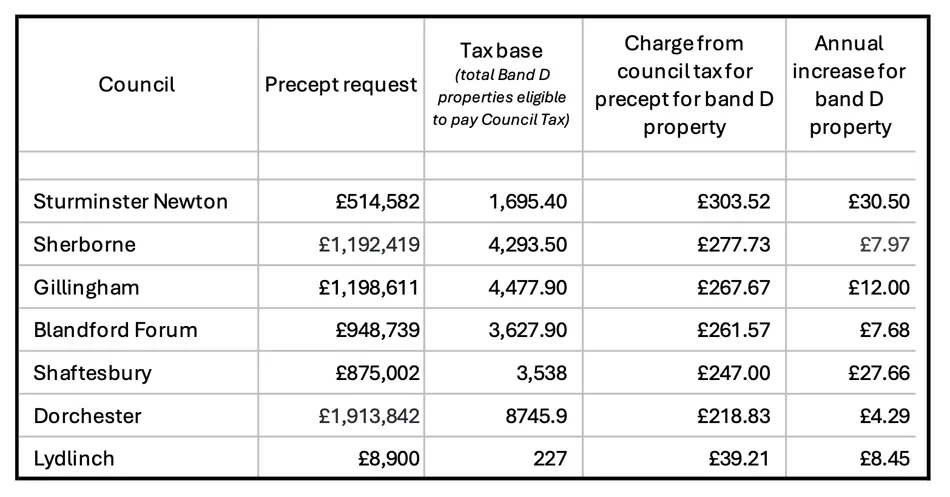
What is a precept? A precept is the amount requested by a parish or town council to fund local services. These range from grass cutting, public toilets and play areas to CCTV systems, street lighting, allotments, recreation grounds and community facilities. Unlike principal authorities, parish councils often have limited income streams and rely heavily on the precept. This year, towns and parishes across Dorset have reviewed their budgets against rising costs in wages, fuel, utilities and maintenance. Some have also chosen to fund new projects or expand services. The table opposite shows how precepts vary across several Dorset towns.
A wide variation The difference is striking. A Band D household in Lydlinch will pay £39.21 towards its parish council this year. In Dorchester the figure is £218.83. In Sherborne it is £277.73. In Shaftesbury it is £247. But in Sturminster Newton, the Band D precept charge is £303.52 – the highest among the towns listed – with an annual increase of £30.50: also the highest increase in the county. So why is Sturminster Newton’s figure higher than larger towns such as Dorchester or Sherborne? One key factor is the ‘tax base’ – the total number of Band D equivalent properties contributing. Dorchester’s tax base stands at 8,745.9. Sherborne’s is 4,293.5. Sturminster Newton’s is just 1,695.4. When costs are spread across fewer households, the charge per property rises accordingly. Another factor is income generation. Some councils operate car parks or own significant buildings that generate rental income, helping offset expenditure. Others have fewer assets from which to raise funds. Sturminster Newton Town Clerk Kate Squire explained the context behind this year’s decision: ‘Sturminster Newton Town Council considered a range of budget options for 2026/27, setting out the impact of different service and project scenarios on the precept. Following that, the council approved a precept request of £514,582.00 for the 2026/27 financial year. For a Band D property, this represents an annual increase of £30.61. ‘The approved budget includes £10,000 to fund one day per week of Citizens Advice provision at The Exchange, supporting local residents with access to independent advice services within the town. ‘Unlike many town councils, Sturminster Newton Town Council does not have significant chargeable assets from which to raise income. The council receives only a modest level of income from sources such as room hire and cemetery fees, and does not operate car parks or other facilities with regular paying customers. As a result, a greater proportion of the cost of delivering local services must be met through the precept rather than being offset by income. Wherever possible, the council actively seeks to secure external grant funding for projects, in order to reduce the burden on local taxpayers and ensure that improvements and community initiatives are delivered in a cost-effective way.’
Screenshot
Some potential service changes and higher-cost options were considered during the budget-setting process, but councillors concluded that more detailed work and consultation would be needed before pursuing them: ‘Members agreed that proposals of this nature would require community consultation and, if necessary, a review to ensure transparency, fairness and long-term sustainability. The information required to undertake that work could not be gathered and properly considered within the timescales required to meet the statutory precept deadline. ‘The town council’s precept funds a wide range of services and facilities that directly benefit residents and contribute to the day-to-day running, safety and appearance of the town. These include the operation and maintenance of Station Road public toilets, the town’s CCTV system, two equipped recreation grounds and four smaller play areas, two nature reserves, the cemetery, the Mill, and the Youth Club. The Council is also responsible for maintaining over 60 litter bins, more than 30 benches, street cleaning within the town centre, several miles of public footpaths, two allotment sites, formal gardens and other open spaces, as well as street lighting, a community newsletter, and the provision of small community grants. ‘In addition to these visible services, the precept covers the staffing and administrative costs required to deliver them lawfully and to an appropriate standard.’
Different choices Looking across Dorset, it becomes clear that precepts reflect a combination of:
The size of the tax base
The range of services provided
The number and type of assets owned
The level of income generated
Local priorities and projects
Dorchester, for example, has the largest overall precept request in cash terms, reflecting its larger size and wider responsibilities. Sherborne and Gillingham sit close together in Band D charges, despite different tax bases. Smaller parishes such as the village of Lydlinch have far lower absolute costs and therefore lower charges. With Dorset already among the highest council tax areas nationally, understanding how parish and town precepts are calculated – and why they vary so widely – is likely to become an increasingly important part of local discussion. For many residents, the parish element of the bill is the most visible reminder that local services, however small, come at a cost.