Home Blog

Are we wasting our time?

0

What do you call a gathering of parish councillors? A tribe? A murmuration?
(A wrangle? A mutter? A grievance? – Ed)
Whatever we are called, I always welcome the opportunity to meet up with fellow councillors – it’s a great way to share ideas and to swap experiences (usually of dealing with the scourge of developers and a multitude of potholes). It was at one of these recent gatherings that Dorset Council shared its latest thoughts on planning.
The big news was, of course. that the Planning and Infrastructure Act received Royal Assent in December. This is the wildly ambitious plan to Get Britain Building – to create 1.5 million new homes. As a consequence, most towns and villages are now being bombarded with planning applications – and the character of some places is being changed forever.

The Dorset Insider


While it’s important that the housing crisis is addressed, I have to wonder whether the homes we need – as opposed to the luxury homes beloved by developers that no local person can afford – are actually being built.
Naturally, with Dorset currently unable to meet the five-year housing supply target, planning application numbers have increased. Now, and each year, 3,246 homes must be built in the county. That does not include the Bournemouth, Poole and Christchurch area, where there are additional targets.
In practical terms, that means many existing Neighbourhood Plans – drawn up by town and parish councils to shape where and how development happens in their areas – will now be out of date. The mood in the room was interesting at this stage, almost like a mad pass-the-hot-potato game with no one wanting a large development on their own patch. Some council chairmen are clearly under siege from major developers. The usually smug ones from the AONB villages were not looking so smug as they swiftly realised that nothing in Dorset is sacred any longer. Will we see houses on Hambledon Hill or Bulbarrow? I think not … but it increasingly feels as though no meadow is safe. And as for North Dorchester and its abundance of water, the recent flooding should have sent a very clear message to planners – but it won’t have.
And if it’s not housing on that meadow everyone loves, it may yet become a field of solar panels.

You will be overridden
Many parishes and towns have spent hours drawing up their Neighbourhood Plans. Designed to allow a certain amount of development and have a settlement boundary, they have always taken hours of unpaid work and, in many cases, high consultancy fees. It’s always good to have a strategic way forward and some of these plans have been agreed by local referendum. However, as the good people of Pimperne know, a Neighbourhood Plan is not worth much when it comes to the council’s decision-making process. I’m currently wondering if we should even bother to spend money on our own parish Neighbourhood Plan if it is simply going to be overridden when housing targets loom.
The answer to this dilemma came with the decision-making processes for agreeing developments. As the Neighbourhood Plans are out of date, the policies in the Dorset Local Plan will take precedence.
This also means that if a local Neighbourhood Plan says something that does not accord with the Dorset Local Plan, the latter takes precedence. In other words, all that local knowledge will be disregarded – you need to say the right things, speak the mantra and align with the planners, or risk being overridden.
Hopefully some Neighbourhood Plan thinking can be included in the Dorset Local Plan (LP). While another iteration of the Dorset LP is expected in August, at this stage it feels less like a consultation and more like a done deal at this stage. Developers are actively submitting plans regardless of any public consultation.

Why bother?
All of this is very difficult.
As a parish councillor, I’m left having to explain to people why our opinions count for nothing.
And why productive fields are being lost when national food security is a live concern.
People are asking why some new homes that are said to be ‘desperately needed’ remain unsold locally. Why build more?
They are asking why promised social housing has not been prioritised by developers, when that is the exact housing needed to stem the accommodation crisis.
And local people are demanding answers about drainage and flood protection – none of which is solved by developers as if they were a silver bullet.
However, what frustrates people the most is that so many have contributed productive ideas to these Neighbourhood Plans: plans which do include more housing as there is a recognition that additional homes are needed.
To see these careful plans overridden, hours of unpaid work brushed aside and hard-won local knowledge dismissed is not only deeply disappointing, it sends a clear message to volunteers: why bother?
This is not a NIMBY moan. It is a serious question. Does any parish or town council truly have a voice any more? Or are we expected to sit down, shut up and allow developers to concrete over whichever part of the countryside is next? The voters deserve better.

***The Dorset Insider is a no-holds-barred column pulling back the curtain on local affairs with insight, honesty and the occasional raised eyebrow. Written by a seasoned parish councillor who prefers to remain anonymous (for obvious reasons), it cuts through the noise to expose the frustrations of grassroots politics, and say what others won’t. Rest assured, their identity is known – and trusted – by the editorial team. Expect opinion, candour … and a healthy dose of exasperation:***


When you don’t know

0

In a county awash with acronyms and restructures, Help and Kindness offers calm clarity and connection, writes Jon Sloper

When you don’t know – shutterstock

When my wife and I first had the idea for Help and Kindness ten years ago, it was in response to conversations with people working in the midst of the local government reorganisation that created Dorset’s two unitary authorities. Council colleagues were restructuring and redefining roles. Staff changed jobs, some were made redundant, and almost everyone’s responsibilities shifted. Community organisations who had worked closely with councils pre-unification were anxious – they didn’t know how contracts would work, how they would be paid, or how what they did would link into the new structures.
Many people found themselves building new connections with colleagues, and often didn’t know who to approach within the wider voluntary and community sector (VCS).
The changes were hugely challenging.
Within this turmoil, we soon identified ways in which we felt we could strengthen the VCS, and make it easier for people to stay connected during times of change. Through extensive relationship building and research, our Help and Kindness directory was created. We designed it to showcase the breadth and scale of support across Dorset and to provide a clear point of connection for people looking for help.
It went on to support the community response to COVID. Today it is helping navigate the major changes under way in the NHS and local authorities. Public sector services are continually adapting to meet both community needs and new national directives – this cycle of planned and urgent change is part of life, and reducing the frequency of an “I don’t know” during these transitions is a huge help.
Not knowing who to talk to, or how things work, doesn’t just impact services – it affects us all. Sometimes there is too much choice and it becomes overwhelming, making it hard to know where to start. Other times it feels like being in a vacuum without any signs or guides. We often don’t know what we don’t know.
Unknown great things
The challenge of finding answers is further complicated by the continual redevelopment of services. Even when the changes are for good reasons, they can simply add to the confusion if they come with a new name, a rebrand, a new set of acronyms or a largely different team.
Great things are happening right across Dorset that people simply don’t know about. Resource shortages limit promotion and advertising that could help to increase their visibility. Services can be narrow, or siloed, and don’t always have a connection to related services, within organisations as well as between different ones.
The ‘work together’ element of our strapline reflects our response to this. Every week we link people who share common interests but don’t realise it, perhaps planning a new service that they didn’t realise was already in place. We connect new services with existing ones. We help people share challenges with others who truly understand the situation.
Residents feel these uncertainties too. People contact us because they don’t know how to describe their difficulties in ways that align with available help. They don’t know whether to speak to health, social care, children’s services, housing or trading standards or the police. Not knowing can paralyse us. It creates further worry and frustration, and can quickly turn to anger, fear or despair.
Across Dorset there are skilled and compassionate people and organisations who can release that sticking point. When people call or email us, we can help point them in the right direction.
There is so much good happening in Dorset – we now have almost 14,000 listings in our directory – and real commitment behind the changes sweeping the county. But change inevitably brings new ‘I don’t knows’. We continue to strengthen connection and shared knowledge, offering a compassionate introduction to support when people feel all at sea and simply don’t know where to turn.
helpandkindness.co.uk

The BV community news section is sponsored by Wessex Internet

Let itbee spring

0

As spring gathers pace, Dorset’s gardens begin to fill with tawny mining bees, hairy footed flower bees and colourful nomads emerging from winter

The common carder bee, one of the commonest of our native bumblees

Bees are a welcome sign that spring has arrived – or, at least, is just around the corner. Most people are familiar with bumblebees and honeybees, but these are only a small fraction of the 270 or so species of bee that can be found in Britain. Some bees live in social colonies, while others lead solitary lives. A surprising number of bees are parasitic – laying their eggs in the nests of other bees.
Spring is a good time to study bees and there are several excellent online resources available. The Field Guide to the Bees of Great Britain and Ireland (Falk and Lewington) is an indispensable book for anyone wanting to extend their knowledge of these fascinating insects. Find out more online at the Bumblebee Conservation Trust website: Bumblebeeconservation.org
Dorset Wildlife Trust Conservation Officer,
Hamish Murray, is sharing his guide on which bees will be buzzing around between March and May …

Tawny mining bee

Tawny mining bee
One of our most distinctive bees, the female is particularly striking, with dense reddish-brown hair covering most of her body while the head and legs are black. Like all mining bees, these are solitary insects with each female digging its own nesting burrow, typically in light soils. The distinctive burrow entrances (looking a bit like worm casts) are a good clue that mining bees are present in an area. Tawny mining bees are found over much of England, and are frequently seen in gardens, even in urban areas.

Ashy mining bee
With 68 species recorded in Britain, Andrena (mining bees) is our largest genus of
bees. Many species are difficult to identify but from mid-March, the grey and black ashy
mining bee is easy to spot as it collects pollen from a variety of wildflowers. As with many
spring bees, dandelions are a favourite foodplant: if you want to encourage bees (and other insects), it’s certainly worth leaving some of the showy yellow flowers to grow in your garden.

Grey-patched mining bee
Another large and attractive mining bee, this one has foxy-brown hair on the thorax and a shiny black abdomen. Closer inspection might reveal the small patch of grey hairs on the side of the body which give this bee its English name. This is a late spring species, found in Dorset gardens during April and May. A carefully cultivated patch of lesser celandine in my front garden attracts many spring insects, including this mining bee.

Garden bumblebee


Garden bumblebee
In a recent poll to find Britain’s favourite insect, bumblebees came top. Early spring is a
good time to see bumblebees as this is when the queens emerge from hibernation to look for a suitable site to build a nest and lay their eggs. Of the seven widespread and abundant species of bumblebee found in Dorset, the garden bumblebee can be distinguished by the yellow lines at the front and back of its black thorax. This species also has a noticeably long tongue which it uses to feed on primroses and other early spring flowers.

Gooden’s nomad bee

Gooden’s nomad bee
There are around 30 different species of nomad bees in Britain. As their name suggests, they do not build their own nests, but lay their eggs in the well-stocked burrows of various mining bees. The wasp-like Gooden’s nomad bee is one of the most colourful and widespread of this genus, often occurring in large numbers around the nests of their unwitting hosts. Look out for the bold yellow-and-black striped body, orange legs and yellow spots at the base of the wings.

Red mason bee

Red mason bee
Unlike their mining relatives, mason bees build their nests wherever they can find a suitable ready-made hole, whether it’s in the mortar of an old wall or in a specially made ‘bee hotel’. Having found a suitable hole, mason bees collect wet mud from which they construct their nest cells. Once completed, the nest entrance is capped with a mud plug, allowing their young to develop in safety over the winter.

Common carder bee
One of the commonest of our 20 or so native bumblebees, the common carder can be found in a wide range of Dorset habitats from suburban gardens to sea cliffs. Unlike the familiar striped bumblebees, carder bees are a uniform gingery colour. Although common, carder bees are one of the earliest bees to emerge in the spring, they can be seen right through the summer and well into the autumn.

Hairy-footed flower bee

Hairy-footed flower bee
The name of this distinctive bee arises from the long, feathery hairs on the legs of the male. The dark females look quite different to the buff-coloured males, but both sexes are very active fliers and have a characteristic high-pitched buzz.
In my garden, hairy-footed flower bees are particularly attracted to comfrey and lungwort.

Visit dorsetwildlifetrust.org.uk

Take on the Jurassic Coast Ultra Challenge

0

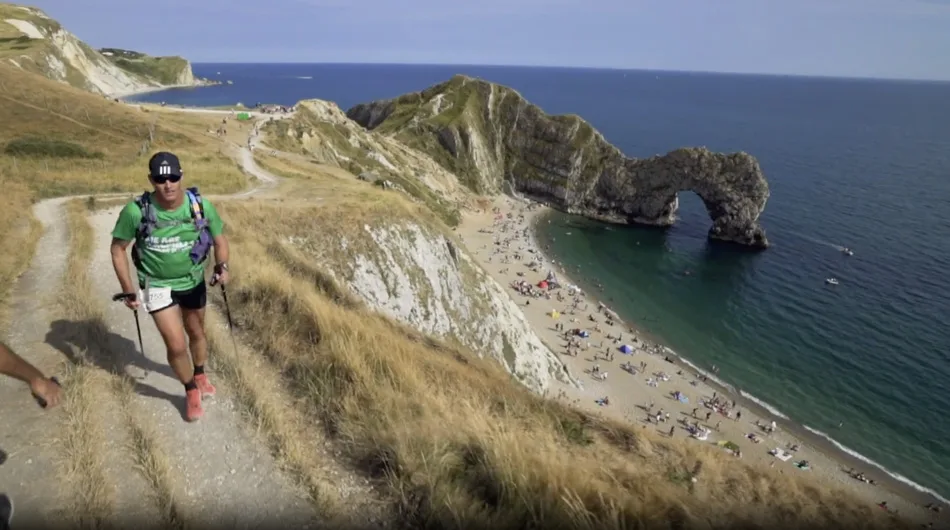
Walkers, joggers and runners are being invited to take on one of the South West’s biggest endurance events when the Jurassic Coast Ultra Challenge returns on 16th–17th May 2026.
The event follows a spectacular route along Dorset’s World Heritage coastline, beginning at Corfe Castle and passing through Swanage, Lulworth Cove and Durdle Door before reaching Weymouth. Those tackling the full distance continue past Portland Bill and Chesil Beach before finishing in Bridport.


Participants can choose from several distances depending on experience and ambition, including the full 100km challenge, as well as 76km, 58km, marathon, 25km and 10km options.
The route includes major rest stops every 10–15km with food, drink, medical support and marshals along the way. While some participants take part for personal achievement, many use the event to raise money for charity. Up to 700 charities are supported through the challenge each year, ranging from national organisations with local branches – such as Mind and Cats Protection – to Dorset-based charities including Weldmar Hospicecare and Diverse Abilities.
With its dramatic scenery, demanding climbs and celebratory finish line in Bridport, the Jurassic Coast Ultra Challenge has become one of the UK’s most popular endurance events – and a major fundraiser for charities of all sizes.
More information and entry details are available at ultrachallenge.com.

The BV community news section is sponsored by Wessex Internet

Steele Raymond expands with new brand

0

South Coast law firm Steele Raymond has unveiled a new brand and website as it continues a period of expansion across the region, alongside the growth of its partnership and specialist legal teams. The firm says it has nearly doubled the size of its partner group in recent years, strengthening expertise across key practice areas as demand has grown from businesses, developers and private clients across the central south.

Managing Partner Jennifer Rogerson


A new office in Poundbury brings the firm closer to clients across Dorset, alongside its long-established base in Bournemouth, while maintaining what it describes as a single-firm approach across its locations. The expansion reflects wider demand for legal advice as the region continues to see growth in housing development, business investment and commercial property. For regional firms like Steele Raymond, that means handling everything from land deals and planning agreements to business sales, restructures and employment disputes.Managing Partner Jennifer Rogerson said the growth reflected the role regional firms play in supporting local economic activity:
‘When a regional firm grows in this way, it creates more capacity for projects that shape our communities. You can see it in real outcomes resulting in growth that is intentional and grounded in the relationships we have built over many years.’
Alongside the expansion, Steele Raymond has maintained its long-standing position in The Legal 500 guide, where it has held Top Tier status for more than 20 years.
The latest rankings recognise eight practice areas, including Top Tier positions for Commercial Litigation, Commercial Property, Residential Development and Corporate & Commercial. Other specialist teams, including Contentious Trusts & Probate, Employment and Family, are also strongly recommended.
Chairman and Head of Corporate Tim Stone said the firm’s focus remained on providing clear commercial advice to clients: ‘Whether it is a sale, funding round or group restructure, clients choose us because of our extensive market experience and ability to bring clear commercial direction at the right time.’

British Under 18 Taekwon-Do champion returns to teach

0

‘I loved it, and it was my life. It was absolute life.’
As a teenager in the late 1990s and early 2000s, Taekwon-Do wasn’t a hobby for Chris Ryu – it was everything. Training daily, competing nationally and internationally, he became British Under 18 Taekwon-Do Champion in 2005. By 17 he was already a qualified instructor.
Then he walked away.

Chris Ryu


An injury, a new relationship and a fallout with a club meant the sport that had shaped his youth slipped into the background. He kept a connection to it, but it was more than two decades before he returned fully to the mat.‘I had a long break,’ he says. ‘But I always missed it.’
Today, he is back. At the end of 2025 Chris launched Unity Taekwon-Do, a new North Dorset-based club that has attracted 62 students already.
Unity now runs classes in Sturminster Newton, Shaftesbury and Gillingham, as well as sessions within Sandroyd School.
‘Our youngest student is three and our oldest is 64,’ says Chris. ‘We’ve built a bit of a family unit at the club – there’s lots of actual families that train together, too.’ He has even finally managed to convince his wife to try Taekwon-Do herself. ‘Just a few weeks ago I got the pleasure of presenting her with her first belt, after 23 years of being together,’ says Chris. ‘There was a moment in the grading where I gave an order and she replied, “Yes, sir.” That was a little bit strange. I don’t get that at home!’
The intergenerational mix is deliberate. While martial arts are often seen as something primarily for children, Chris is keen to challenge that assumption. ‘A few weeks ago during class I saw someone who was 12 years old teaching someone who was 64. It felt like a really special moment.’
The benefits for older bodies go beyond strength, he says: ‘Keeping fit, keeping active, keeping joint mobility – that’s the obvious bit. But there’s also the social aspect. Belonging to something. Being welcomed into a club. It’s nice. And we try to encourage that.’
He is currently training to deliver Choi Kwang-Do, a version of Taekwon-Do adapted for older bodies, removing harsher movements and focusing more on circular motion, balance and mobility. An over-50s class is planned.
The club’s early growth has surprised him.
‘We’re five months in and we have 62 students. I’m blown away, actually.’
Chris is well known locally for his IT and web development work, and he previously opened a STEM education centre. That background is evident in the running of Unity, down to the digital lesson planning tool he has built. ‘We have a formal lesson plan for every single lesson. Everything’s structured. Students can even see that in advance if they want to prepare their minds for what they might have to do later on,’ he says, explaining that this can be particularly helpful for those with autism spectrum disorder.

Chris in sparring gear

Everyone’s different
Chris holds multiple safeguarding and autism-related qualifications, and says lessons are adapted around individual needs.
‘We’ve got boisterous confident kids, but also shy students, those who struggle with attention, we have students who don’t speak,’ he says. ‘Our lessons look different to different students, but we work with them on that individual level. Sometimes that might mean a one-to-one with a senior student, or simply getting them to hold a pad for someone – it’s a very easy way of building some social contact.’
That individualisation extends to physical ability. Standards are fixed, but execution is judged technically rather than athletically.
‘Everyone’s different shapes and sizes,’ he says. ‘We have a set criteria they need to pass at grading and there are no exceptions. But one person’s side kick might be waist height, someone else might be head height. It doesn’t matter. Did they side kick correctly? Did they chamber? Did they pivot? That’s the important bit.’

One of Unity’s junior Taekwon-Do classes at Sturfit in Sturminster Newton

A modern club with big plans
Although Unity is not formally tied to a single governing body, Chris has trained across multiple major Taekwon-Do styles. He holds black belts in two systems and is working towards a third: ‘I wanted not only to get a black belt in all three, but also unify them into one syllabus.’
His aim has been to combine those different schools and approaches under one roof – though for most students that complexity sits quietly in the background. What they experience is a traditional martial arts club that competes regularly and invests heavily in equipment. The group is entering several competitions over the coming months, and a minibus has already replaced the original van as numbers have grown.
Unity uses reaction-testing equipment and kick paddles that measure striking power and feed data into an app. Chris has also published a children’s book, and is currently developing a mobile game aimed at reinforcing the life skills taught in class. Perhaps it’s no surprise that he reflects his software and systems background with an unusually digital approach for a local martial arts school. Affordability has also been a priority. Membership starts from £25 per month, with no sign-up fee, and licence and personal accident insurance included. Even the dobok – the formal Taekwon-Do uniform – is embroidered in-house to keep costs down.
Looking ahead, Chris is determined to secure a permanent, fully matted martial arts centre in Sturminster Newton. The aim is not a single-club Unity headquarters, but rather a shared space hosting multiple martial arts disciplines, alongside daytime sessions for older adults and other exercise classes. ‘I think we might then start to see the creativity,’ he says, recalling the more dynamic, acrobatic elements of Korean training he experienced in his youth.
For now, though, his message is simpler.
‘Just give it a try,’ he says. ‘Even if you tried it before and didn’t like it, just try it again. Maybe you just didn’t enjoy that club, or you didn’t enjoy that teaching style, or that style of Taekwon-Do. We’ve had lots of students return after a long break – and they’re really loving it.’
And after more than 20 years away from the mat, he understands that feeling.

For more information or to contact Chris direct, please see Unity’s website unityma.co.uk

Open Day at The Exchange

0

What do you know about The Exchange? Could it be Fake News? Last month we asked the question ‘What happens at The Exchange?’ – and the answer was ‘more than most people think!’.
But there are lots more questions about The Exchange – some as simple as ‘What is it?’. The Exchange calls itself a ‘community and arts centre’. What is that? Can one building be both? Who built The Exchange? Who pays for it? What does it do for Sturminster Newton? And North Dorset? Is there anything there for me?
Why should I bother about it anyway?


There are lots of answers to these questions – but how many of them are the right answers?
The best answer of all is to come and find out for yourself! You may be new to the area and know nothing about The Exchange. You may have been inside, but not seen much. You may even have been told things about The Exchange that are just not correct. Or you may simply want to find out more. Whichever it is, there will be answers on Saturday April 11th.
Between 10am and 2pm, The Exchange will be having an Open Day. There is no charge to come in – there never is! – and there will be plenty going on. Find out what goes on inside every week: from music and exercise to dance, you can watch and even join in with. Pick up information on all the regular classes and activities.
Hot drinks at the café will be half price, with home-made cakes on sale. The café is also the art gallery, and Kirsty Baird – whose work will be hanging on the walls – will be there to talk about what she does. There will be guided tours of the building so that visitors can hear what goes on, see where it happens, walk the stage, see the lights, and learn some local history. Trustees, staff and volunteers will be on hand to answer questions and make you welcome. And there will be free parking across Sturminster Newton all day.
There will be NO fundraising on the Open Day – but we will happily sell tickets for coming events! And there is plenty going on in March – please do look at the website or get hold of a brochure.

The BV community news section is sponsored by Wessex Internet

Assistant Clerk of Works | Charborough Estate

0

Contract

  • Full Time
  • Permanent
  • Salary according to experience

Qualifications

The successful candidate is likely to have a qualification in building construction and/or project management and/or experience in the sector. 
Key requirements include a strong knowledge of health and safety, technical skills, and experience in construction.
Training can be provided where required.

Team Information

We have a maintenance team of four, comprising a clerk of works, foreman, experienced plumber/maintenance person and a junior.

The estate is a traditional rural estate including:

  • Extensive heritage property
  • Portfolio of residential properties
  • In-hand and let farms
  • An expanding number of commercial lets
  • Farm buildings and farm infrastructure
  • Private water supplies

The maintenance team undertakes much of the routine maintenance across the estate, supported by contractors as required – particularly for larger projects.

Primary roles for the clerk of works include:

  • Project Oversight
    • Supervise refurbishment and building works.
    • Ensure compliance with standards and regulations.
    • Maintain risk assessments and safety documentation.
    • Manage contractor performance and tender processes.
    • Act as estate representative on-site.
  • Maintenance Management
    • Plan and deliver annual maintenance schedules.
    • Manage reactive repairs and keep records.
  • Budgeting & Financial Control
    • Prepare and monitor project budgets.
    • Source quotes and manage contractor costs.
  • Reporting & Communication
    • Provide progress updates to estate management team.
    • Advise on technical issues and timelines.
  • Estate Infrastructure
    • Oversee roads, drainage, and utilities.
    • Coordinate emergency response for essential services.
  • Quality Assurance
    • Inspect works and manage snagging.
    • Ensure high standards before handover.

The Role

The estate Clerk of Works is transitioning to working part time.  We are seeking to recruit an enthusiastic and energetic individual, with experience in the sector, who can work unsupervised to support the Clerk of Works and undertake all day-to-day management of the team’s responsibilities.  For the right candidate there is likely to be an opportunity to secure promotion to the Clerk of Works role within a few years.  

The successful candidate will demonstrate:

  • Practical, hands-on experience of all aspects of property maintenance.
  • An ongoing willingness to support and mentor the team.
  • A willingness to work with and assist other departments including the in-hand farm, forestry team and gamekeeper.
  • The ability to work with and manage third party contractors.
  • The flexibility to assist with and/or manage a range of estate projects such fencing, landscaping, etc.
  • Attention to detail to deliver projects to a high standard.
  • The diligence to complete appropriate administrative tasks and record keeping.

A team player with a love of the countryside and appreciation of the function of rural estates is essential.

A detailed understanding of the health and safety implications of their work and an ability to recognise and manage all areas of risk is imperative.

The successful candidate

Please direct all applications and enquiries to the agent:

Christopher Jowett
The Estate Office
Charborough Park
Wareham
Dorset
BH20 7EN
[email protected]
07973 840381

Apprenticeship funding opens to Dorset firms

0

Dorset businesses will be able to access new apprenticeship funding from 1st April as the council opens applications for its Apprenticeship Levy transfer scheme.
The programme allows the council to pass on unspent levy funds to local employers to help cover the cost of apprenticeship training.

apprenticeship Dorset


A wide range of sectors across the county have already benefited from the scheme. Previous levy transfers have supported roles including teaching assistants in Bridport schools, stonemasonry apprentices in Weymouth, health and social care workers, police constables, accountants and leadership and management trainees.
Employers are now being encouraged to review their training plans and speak to apprenticeship providers ahead of the new funding opening.
Mia Pearson, Dorset Council’s Apprenticeship and Work-Based Learning Consultant, said apprenticeships play a key role in building skills within local businesses: ‘Apprenticeships are more than training – they’re an investment in the future of our local economy, helping employers grow, innovate and retain talent.’
Levy transfers allow larger organisations to share unused apprenticeship funds with smaller employers, helping more businesses invest in workforce development while addressing skills shortages across the local economy.
Businesses interested in applying can contact Dorset Council on [email protected] to discuss eligibility and the application process ahead of the April launch.