Last week I was in Greenland with the Foreign Affairs Committee. We met the Prime Minister and the Minister for Civil Preparedness to discuss the threats made by President Trump, as well as the malign influence of Russia. While there, we also met climate scientists funded by the UK and took a trip to view retreating glaciers.
Edward Morello MP for West Dorset
The existential threat posed by climate change is not just visible in the Arctic – it is also here in West Dorset. The increased frequency of extreme weather conditions was made clear by the flooding we experienced earlier this year. This is why on Thursday I convened a meeting with Dorset Council, the Environment Agency and Wessex Water to discuss what steps we are taking, and can take, to increase resilience locally. We cannot prevent all flooding, but we must do more to be prepared and to avoid catastrophic cost to homes and the local economy. The council has allocated significant additional funding and is currently consulting on where that money can best be spent to help residents.
Rural policing Parliament is currently in recess for Easter, which provides me with an opportunity to be in the constituency, uninterrupted by the need to be in London for half the week. I’ve been taking the chance to meet some of our neighbourhood policing teams to discuss combating shoplifting and anti-social behaviour. As with so many of our public services, Dorset Police gets a bad deal when it comes to central government funding: this is because the Treasury funding model does not recognise ‘rurality’. Our constabulary has to police more than 1,000 square miles of countryside with about the same amount of money as a small city receives. It makes visible policing very hard to deliver, but neighbourhood policing is incredibly important. People want ‘Bobbies on the beat’, and we know that where the police have a visible presence on our high streets, shoplifting is reduced. Where police regularly patrol hotspots, anti-social behaviour is less likely to occur. I will continue to lobby Government for fairer funding for Dorset Police, and also the constabulary to prioritise neighbourhood teams. Edward Morello LibDem MP for West Dorset
A pair of ospreys central to Dorset’s reintroduction project have returned to the county for the fifth consecutive year.
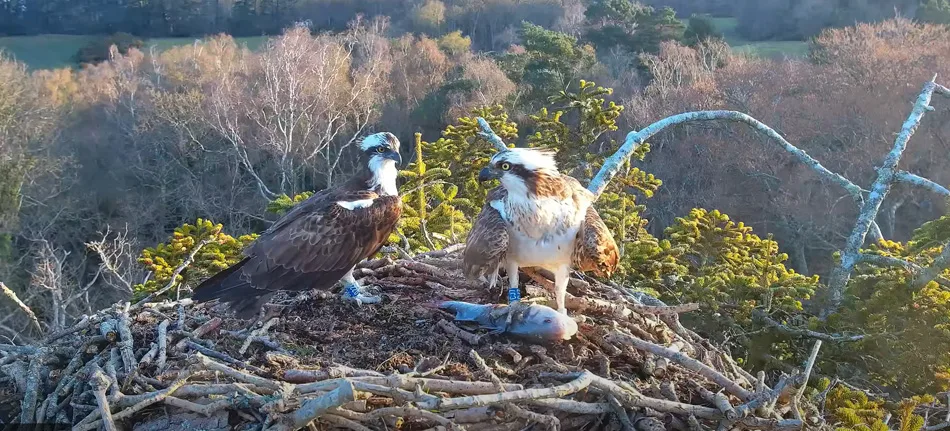
022 (left) and CJ7 (right) on first reuniting and handing over a large bass
Female CJ7 and male 022 – the first breeding pair on the south coast of England in around 180 years – have completed their migration from West Africa and are now back at their nesting site at Careys Secret Garden, near Wareham. The birds are part of a long-running programme led by Birds of Poole Harbour and the Roy Dennis Wildlife Foundation. Since first pairing up, CJ7 and 022 have successfully raised chicks in each of the past two seasons, helping to establish a small but growing population in southern England. Their return is closely watched each year, with both birds tracked via webcams and public engagement events. CJ7 arrived on the evening of 25th March, with 022 following early the next morning. Ospreys were once widespread across the UK but were driven to extinction in England by the mid-19th century due to persecution. Their gradual return has been the result of decades of conservation work, including targeted reintroduction projects. Sam Ryde, Deputy Manager at Birds of Poole Harbour, said the pair’s return is an important step in rebuilding the south coast population, with hopes that numbers will continue to grow and link with other breeding groups. The birds are expected to begin rebuilding their nest in the coming weeks, with the potential for another breeding season ahead: watch the story unfold live from the Birds of Poole Harbour webcams.
The BV community news section is sponsored by Wessex Internet
From a wild hilltop to a suburban garden, Jane Adams watches the quiet lives of Dorset’s snow leopards: the ashy mining bee
The ashy mining bee is a similar size to a honey bee, with striking black and ash-grey or whitish hairs. Females (shown here) have a glossy black abdomen, with a broad band of grey hairs at each end of the thorax and a patch of light grey on the front of the face. Males are smaller, with similar though less distinct markings.
From Pentridge Hill, the view is just about as natural as any landscape in Dorset can be nowadays. Brown hares coddle themselves into forms on the edge of the hill, their eyes on red kites drifting silently only 20 feet above. Below them is a patchwork of green hankies stitched together with hawthorn blossom. Buttons of ancient tumuli sit beside long barrows. It is sunny. Early April. Still coat weather, but there’s enough warmth that you tip your head back and close your eyes to feel it. I wasn’t expecting bees. I’d climbed up to join the Jubilee Trail that runs along the top of the hill. With Blandford in the distance on my left and Martin Down to my right, it’s a show-stopper of a view. But as the sandy, well-trodden footpath dipped in front of me, I looked down and saw the path was alive with ashy mining bees.
Each female digs a nesting burrow 10-20cm deep in a patch of bare or almost bare earth, such as on a well-trodden footpath, a patchy lawn, or a heavily-grazed field
Flying only a few centimetres above the ground, some looked to be in pursuit of mates, others disappearing into holes in the path, each with a small volcano of excavated earth beside it. With so many holes so close together, it would be easy to think you’d found a communal nest. But these bees are solitary. Each female digs her own burrow about 10-20 cm deep, stocking it with pollen before laying an egg that will develop underground and emerge as an adult next spring. These aggregations of burrows simply form because it’s a perfect place to nest – a bee utopia, you might say. A friend of mine once described the ashy mining bee as the ‘snow leopard of the bee world’, and it’s definitely a looker. Of the 250 or so solitary bee species in Britain, this is one of the most common and easiest to recognise. Both males and females have black and white bands across the thorax. The female has a glossy black abdomen, while the male’s is dusted with grey hairs.
They only live for a few weeks, but are fantastic pollinators, often emerging just as fruit trees, such as apples and pears, begin to flower. As with most wild bees, they aren’t aggressive – I sat watching their comings and goings from only a few feet away. In that moment, my world shrank from the landscape of Cranborne Chase to a five-foot square patch of soil and some black and white bees. A week later I visited my mum, excited to tell her about the bees at Pentridge. As I sat drinking tea on a bench in her garden, I could feel eyes on us. Sure enough, in the close-cut lawn and neat flowerbeds of her suburban garden, ashy mining bees sat at the entrances to their newly dug nests, their little heads poking out as my mum weeded carefully around them. ‘Oh, them,’ she said when I excitedly pointed them out. ‘They’re here every year.’
Dorset author Harry Bucknall has published a new book charting a 6,500-mile journey across Britain. A Road for All Seasons, released on 19th March, follows four journeys – made across spring, summer, autumn and winter – taking in locations from Mull to Sunderland and Aberystwyth to Aldeburgh.
The project grew out of a desire to better understand modern Britain during a period of political uncertainty. The book combines travel writing with social and cultural observation, focusing not just on landscape but on the people and communities encountered along the way. Each section is accompanied by illustrated maps tracing the routes taken, alongside sketches inspired by places visited. Bucknall, who lives in North Dorset, previously served in the Coldstream Guards before working internationally in industry and consulting. His earlier books include In the Dolphin’s Wake, based on a journey through the Greek Archipelago, and Like a Tramp, Like a Pilgrim, which followed a walk from London to Rome. ‘A remarkable story from a remarkable man.’ Alan Titchmarsh and ‘A boisterous, jubilant adventure.’ – The Times The new book continues that pattern of long-distance travel writing, but turns its focus closer to home, offering a contemporary portrait of Britain through its geography, history and everyday encounters. A Road for All Seasons is published by Constable and is available in hardback and digital formats.
The BV community news section is sponsored by Wessex Internet
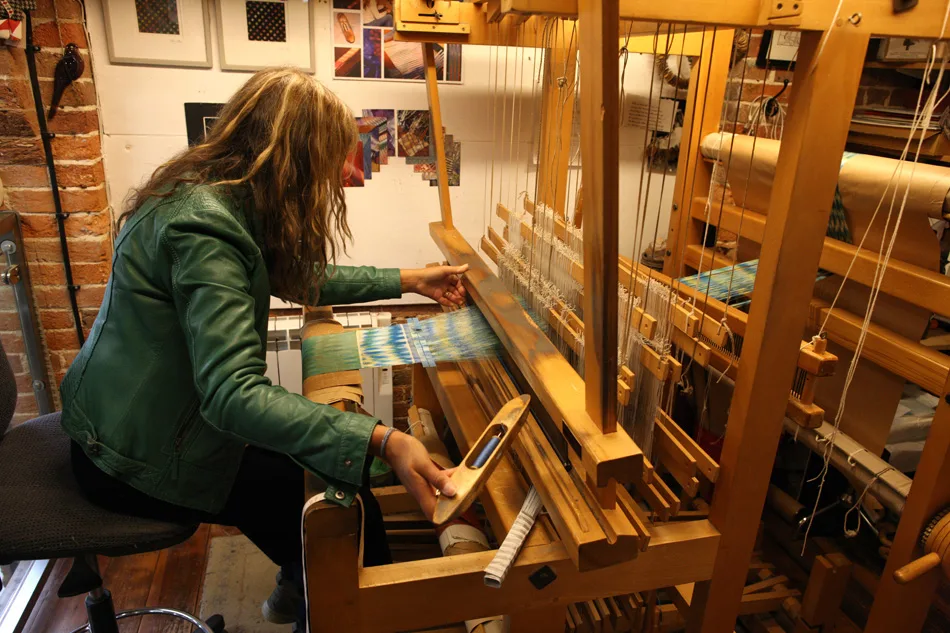
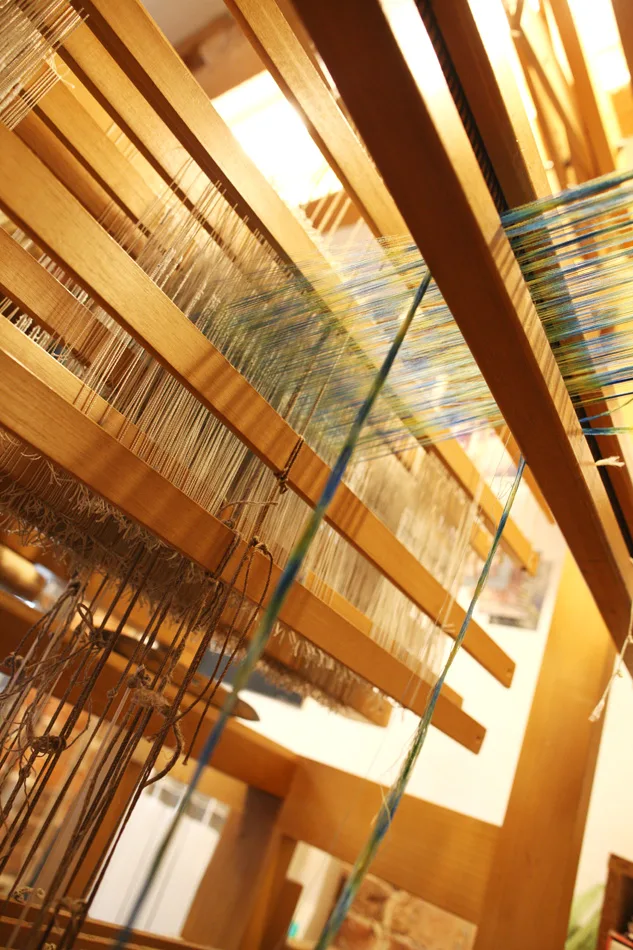
You can hear Debby Kirby hard at work long before you see her. The rhythmic clack and sigh of her loom travels across the ancient stone floors of Walford Mill Crafts Centre in Wimborne, a hypnotic beat that rises and falls like steady breathing. Step closer and you see woman and machine working in unison. Nimble hands slide – ‘battening’ – the shuttle across the weave; fingers passing – ‘picking’ – the weft thread through the loom shed, feet driving the pedals below – ‘shedding’ – the yarn with effortless dexterity. It’s mesmerising to watch. ‘It’s like patting your head and rubbing your stomach at the same time,’ Debby says. ‘It’s physically a tough workout. You must sit properly, engage your core. Even though it’s hard work, you do get into a zone. Your breathing slows down and it’s very meditative. If I’m tired or out of sorts, I always feel better after weaving. It’s quite Zen-like.’
Debby Kirby
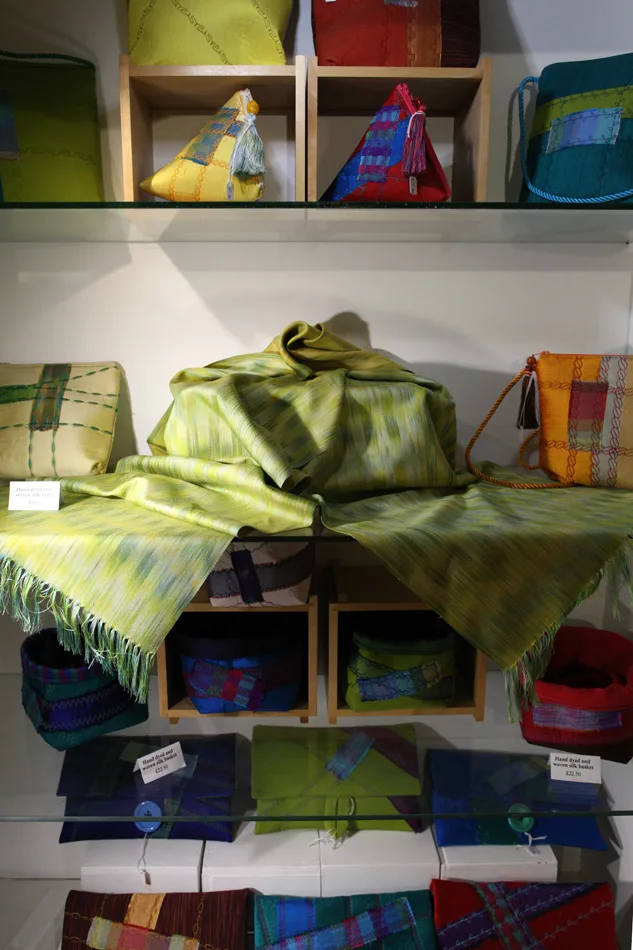
Debby has been performing this intricate mind-and-body choreography for more than 40 years. Since the mid-1980s she has worked in her corner of the mill, a building dating back to the 1760s and now run by Walford Mill Education Trust as a centre of excellence for contemporary British craft and design. Nestled on the mezzanine, her loom sits in full view of the mill visitors, who often pause to watch silk transform, thread by thread, into something luminous, tactile and beautiful. At just 24, Debby was one of the original artists to take up residence when the mill became a creative hub. Today, her output ranges from beautifully designed silk accessories including colourful spectacle cases, make-up bags and her signature flowing scarves to, more recently, large, dramatic wall-hangings. At the heart of it all is her Harris loom, faithful companion for more than four decades. ‘In all this time it’s only needed one day of maintenance,’ she says with pride. Made from beech it cost £500 (loaned by her father Mac, and taking two years to repay).
The loom is the type still used by Scottish Harris Tweed weavers today. ‘It’s very friendly to use,’ she says. ‘Everything works evenly and there’s very little that can wear out or break.’ Does such a trusted co-worker have a name? ‘I guess it’s me. I guess it’s Debs. It’s such an extension of me that when I come into work, I don’t even see the loom – only the work on it. I know all its noises and its foibles. I talk to it. If a thread breaks, my language can be sharp, but when I reach the end of a length and I’m excited, I’ll pat it and say, “well done”.’ She also admits to being lovingly territorial. ‘I occasionally let work placement students use it, but there’s nothing weirder than coming back into the room and seeing someone else on my loom. It just doesn’t look right.’ As for her weaving on another person’s loom? ‘Sacrilege,’ she says firmly. ‘It would be like playing someone else’s musical instrument. It just feels wrong.’
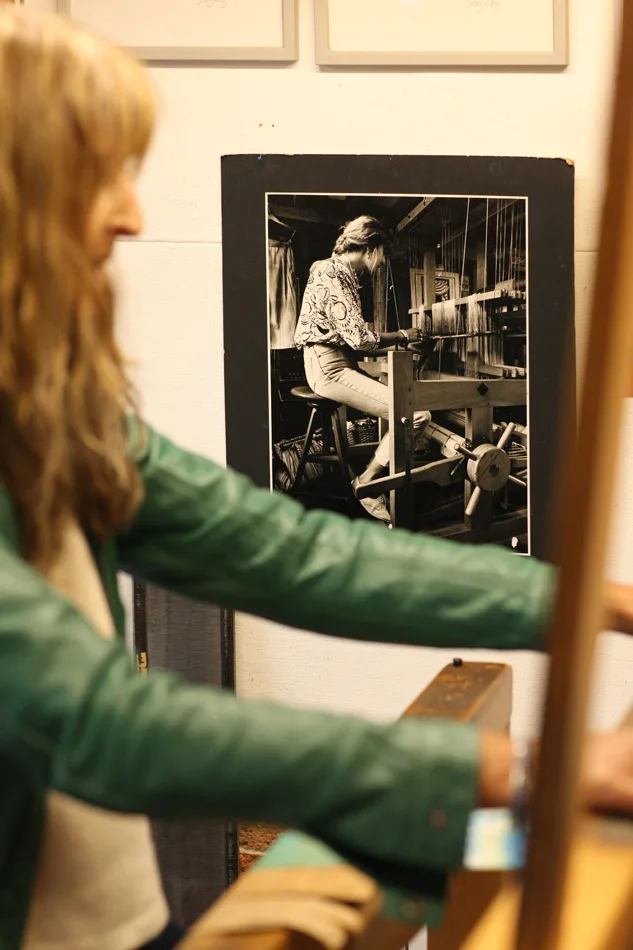
Debby works next to an image of herself at the same loom in the 1980s
Liberty’s and Fortnums Debby’s creativity goes back to childhood. Growing up in Poole, she was always drawing and painting, and as she grew she became fascinated by landscapes, architecture, proportions and the way spaces divide. ‘Weaving is very much like graphic design,’ she says. ‘It’s all about proportion.’
Debby started selling her scarves through a number of London’s leading retailers including Liberty’s and Fortnum & Mason
University beckoned, but not quite as expected. After an inspiring foundation course at Bournemouth University, Debby applied for graphic design, only to be nudged, wisely, towards textiles. Accepted by West Surrey College of Art, she arrived knowing ‘absolutely nothing’ about the discipline. The early weeks were discouraging – lino cutting, lace making, spinning sheep’s wool collected from barbed wire: ‘I remember thinking this really wasn’t for me,’ she says. Then came weaving. Working with finer cottons, everything clicked. A tutor and master weaver, Mary Restieaux, introduced her to the delights of fine silk, and Debby knew instantly she had found her material. ‘That was the catalyst,’ she says.
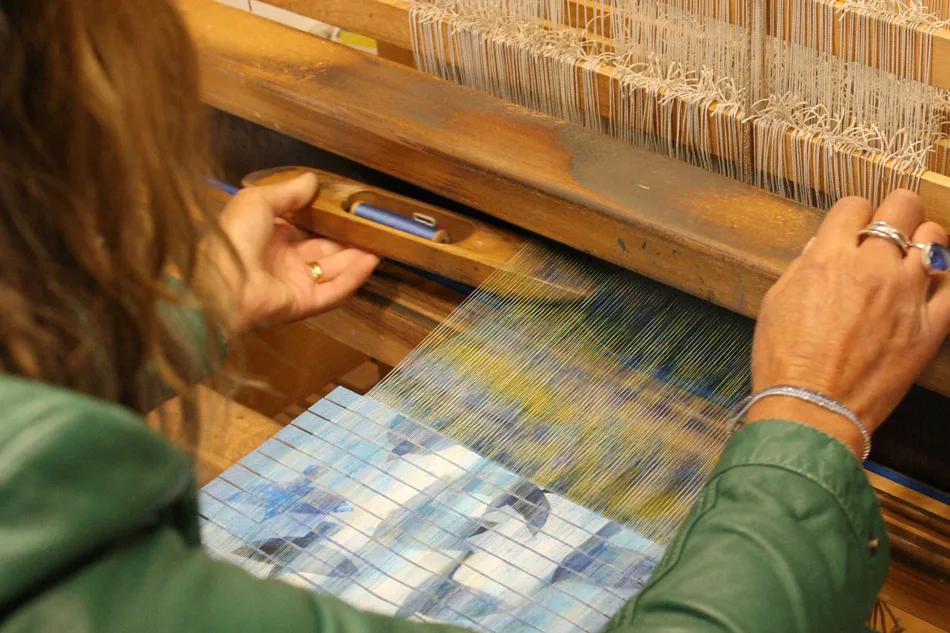
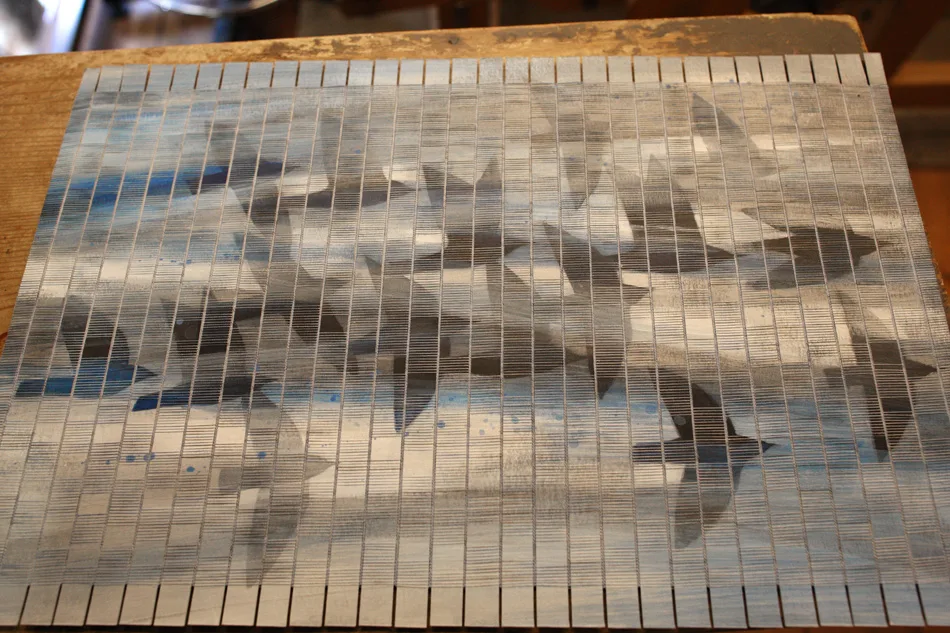
Debby’s latest work involves cutting a painting into strips and then weaving it into colour matched silks
After graduating, for 18 months Debby worked in an office by day, waving by night, while building her speed and confidence. A local craft fair and a Bournemouth Echo interview which generated a call from Vogue Patterns magazine helped launch her professional career. Buyers at Liberty & Co and Fortnum & Mason followed. Joining the Dorset Craft Guild led to her invitation to Walford Mill in 1985. Silk remains her enduring passion. Entirely natural, it drinks in colour and reflects it back with extraordinary lustre. Debby dyes all her own threads by hand at home in Stourpaine, taking over the kitchen on dedicated dyeing days. Using non-toxic, colourfast dyes, she can dye up to 60 colours in one day. A run of scarves may need up to 250 feet of silk and it’s a long day standing over boiling pans. ‘My husband is banned from the kitchen and we get a takeaway! For me, dyeing brings an element of chaos,’ she explains. ‘Weaving is very ordered and mathematical, counting in cycles, feet pressing different pedals to create pattern. With dyeing, silk just sucks up the colour. You never fully control it. I love that balance between randomness and structure.’
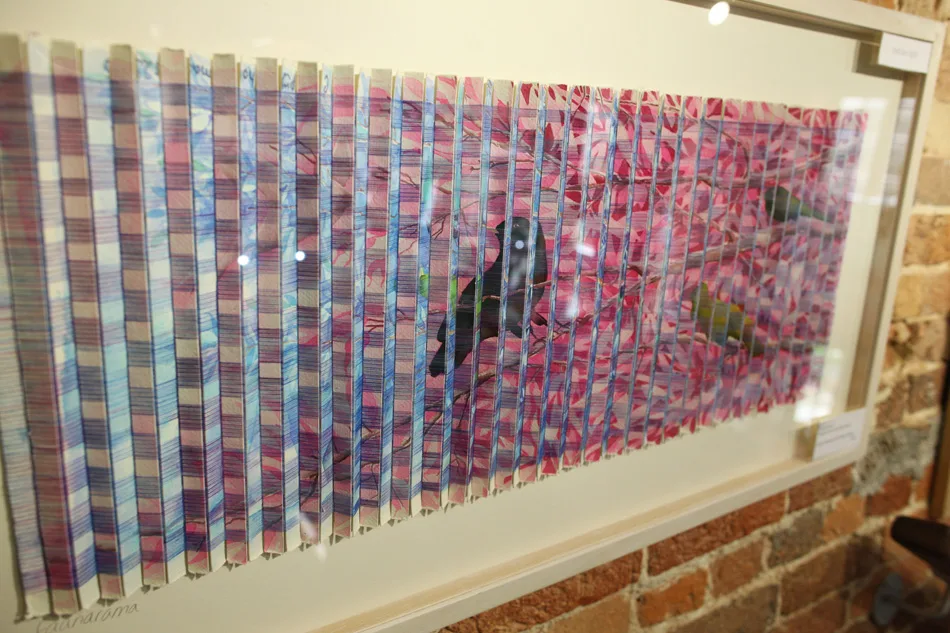
Debby also creates 3D concertina-ed wall hangings with two images woven together with her silks
A steady rhythm Debby’s visual inspiration is constant and instinctive. A recent visit to Egypt left a lasting impression – not so much the history, she admits, but the proportions of the pyramids. ‘I’ll have my camera out or use coloured crayons on graph paper. My designs stem very much from my gut reaction to what I see.’
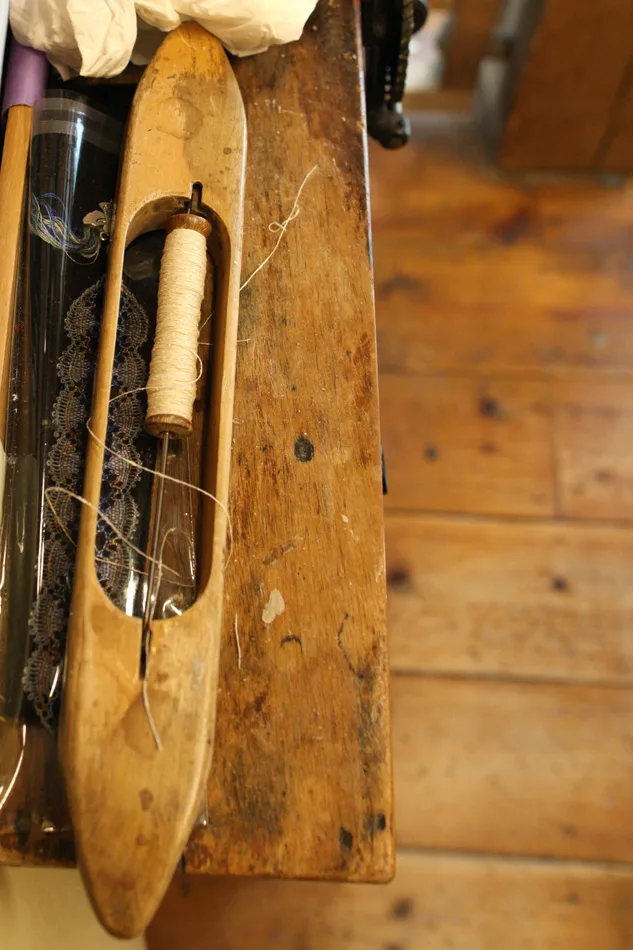
One of the shuttles for the Harris loom
Spread across several floors, the mill hums with the quiet creative energy from jewellers, painters, potters and other makers, all working alongside one another. ‘It’s always been such a lovely place, even with the challenge of recurring flooding!’ Debby says. ‘You bounce ideas off other artists. There’s lots of collaboration.’ One of her most distinctive projects emerged this way: weaving silk with paper. Developed over more than twenty years with a calligrapher friend, this unique technique has evolved into three-dimensional hanging works and collaborations with painters and photographers, with pieces displayed in hotels, surgeries and private homes.
An exhibition is planned this summer to celebrate both the craft centre’s and Debby’s 40th anniversary. For her, it’s a swansong of sorts, but also a beginning. Her trusty loom will be moving to her garden studio at home. ‘I’m retiring from Walford Mill – but I’m still weaving. It’s just a change of pace. I’m excited about having more time to experiment.’ And as the loom continues its steady rhythm, there’s no sense of finality. It’s clear that Debby Kirby’s life, like her work, will always be woven with creativity. debbykirby.co.uk
After months of campaigning, countless meetings in Westminster and close collaboration with Dorset Council, I am thrilled that this Labour Government is backing MEMO Portland (sometimes known as Eden Portland) with £20 million of investment.
MP Lloyd Hatton South Dorset
For those who may not have heard, the exciting MEMO Portland proposals are inspired by the hugely successful Eden Project down in Cornwall. When built, MEMO Portland will be a world-class visitor attraction located underground on the island – celebrating our Jurassic Coast and creating a hub for environmental research and biodiversity awareness. After all, where better to learn about biodiversity than deep underground where fossil records tell the story? When up and running, I know that MEMO Portland, when up and running, will create well-paid jobs for local people, attract fresh investment to our part of the world, and boost hospitality businesses across the county. Crucially, MEMO Portland will attract new visitors to Dorset – helping create an all-year-round tourism economy. This means higher footfall for our pubs, restaurants, hotels, cafes and shops – all building on our incredible existing tourism offering across Dorset. Taking a step back, I firmly believe that a vibrant arts and culture scene is key to rejuvenating our local economy – and MEMO Portland can be right at the heart of this rejuvenation. Now that we have secured record funding for MEMO Portland, I will continue to do everything I can to strengthen our arts and culture offer here in South Dorset. And I cannot wait to see a new stonemasonry training centre established as part of MEMO Portland. The apprenticeships on offer will provide a unique opportunity for young people growing up locally. This fresh funding is fantastic news for our part of the world. Now, the real work begins to deliver MEMO Portland at pace. I will continue supporting this landmark project every step of the way. Lloyd Hatton Labour MP for South Dorset
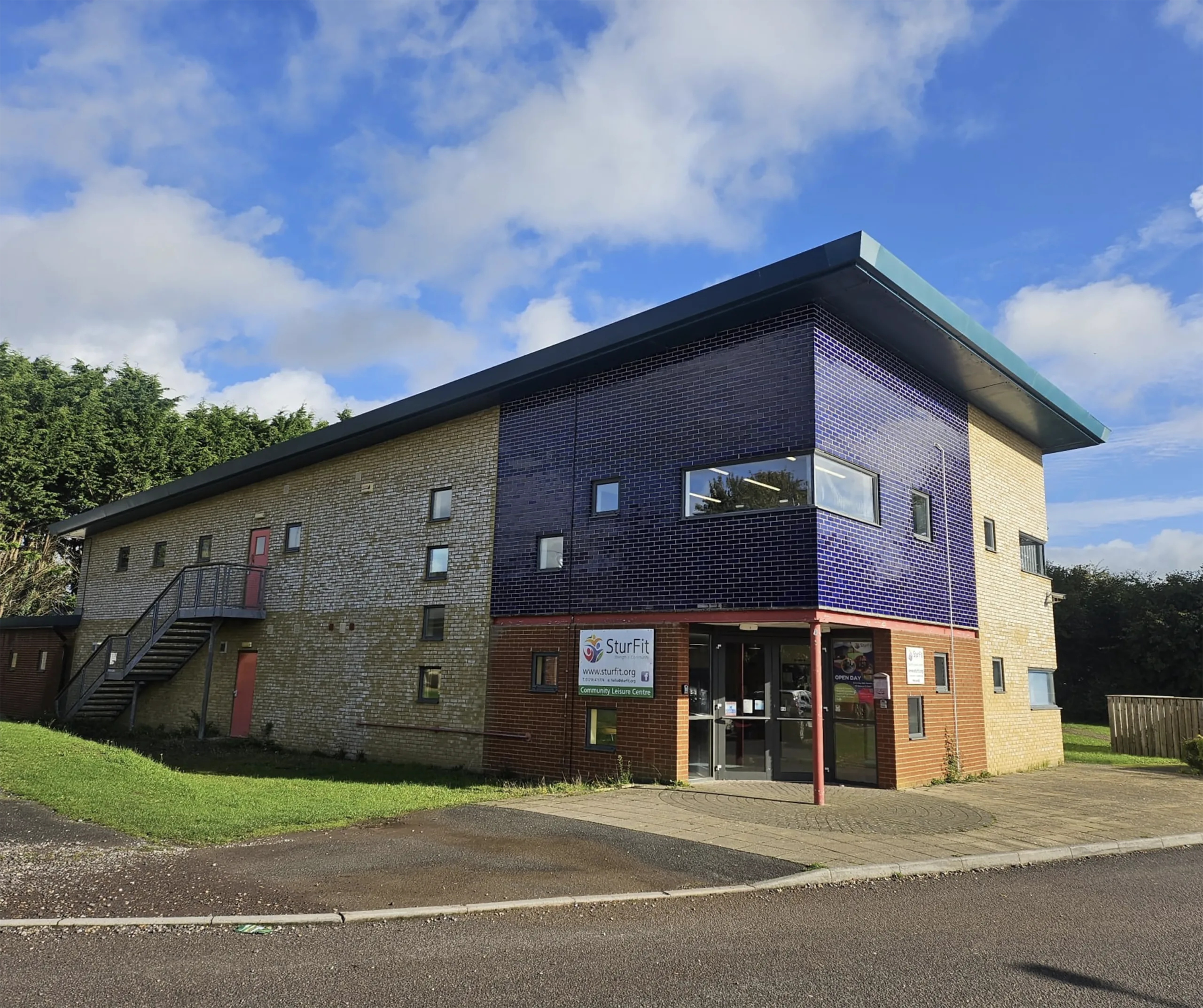
Sturminster Newton’s leisure centre is run by the community – and it needs a couple more people to help protect and guide its future
Sturminster Newton leisure centre
For more than 15 years, Sturfit has kept the Sturminster Newton community leisure centre open, maintained and evolving: not as a business, but as a not-for-profit charity run by local people. It’s a place used every day by families, clubs and individuals – and is much-needed by the local high school. Several thousand people a week walk through the doors, and for many, it’s not a luxury, it’s something they rely on. And now, we need a few more people to help make sure it stays that way.
A role that genuinely matters Being a trustee isn’t about helping out at the edges: you’ll help shape decisions that affect thousands of local people every year. Being a trustee is about helping to guide how this centre is run, how it’s sustained and how it continues to serve the community well. It’s a few hours a month, but the responsibility – and the impact – is very real. Decisions made by the trustees affect how the whole town uses this place. Who we’re looking for We’re looking for a small number of thoughtful people who care about the community and are willing to play a part in keeping this facility strong and sustainable. We would particularly welcome: Someone with experience of leadership or management – perhaps you’ve led a team, department or organisation Someone with a good understanding of finance or business planning Alongside this, we are always open to people who can bring a fresh perspective, sound judgement and a willingness to contribute. You don’t need to be sporty. Many of us aren’t! What matters is that you can think clearly, ask sensible questions and commit a few hours each month.
Why it matters Keeping a facility like this open, accessible and financially sustainable doesn’t happen by accident. It depends on local people being willing to step forward and take a share of responsibility for it. Most assume someone else will do that: this time, it could be you! If you’ve ever thought you might like to contribute to something local – not just support it, but really help protect and shape it – this is a straightforward way to do it. It’s a small commitment in time, but it helps ensure something important remains here for everyone. Interested? In the first instance, email [email protected] and tell us a little about yourself. Sturfit is a registered charity that has operated Sturminster Newton’s leisure centre for over 15 years, providing accessible sport, fitness and wellbeing facilities for the local community.
The BV community news section is sponsored by Wessex Internet
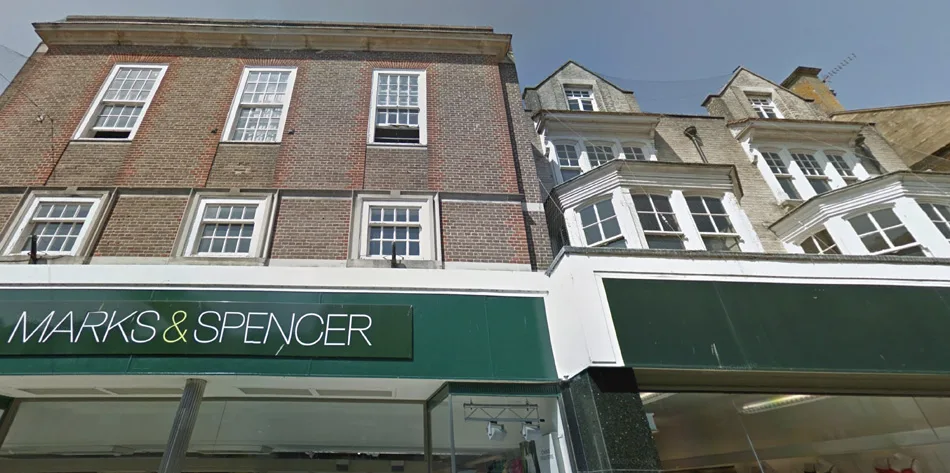
Plans to redevelop Dorchester’s former Marks & Spencer site into a 102-room Premier Inn have been abandoned, with rising construction costs and increased business rates cited as the key factors. Whitbread, which owns the Premier Inn brand, purchased the South Street site in 2023, with proposals to demolish the existing buildings – a mix of 1930s and Victorian architecture – and replace them with a modern hotel. The scheme had been expected to bring an estimated £3m boost to the local economy. However, the company has now confirmed it will not proceed.
M&S south street Dorchester
In a statement, Whitbread said the project was ‘no longer viable’ following a review of costs, adding that the site will be put up for sale in the coming weeks. The decision leaves a prominent town centre site, vacant since M&S closed in 2020, once again without a clear future. Whitbread already operates a Premier Inn at Brewery Square, and had positioned the second hotel as a way to meet growing demand for overnight stays in the town. The withdrawal suggests that, even in well-located market towns, development viability is becoming more finely balanced. Steve Bulley, president of Dorchester Chamber for Business, described the news as ‘a shock’ and said it had come ‘out of the blue’. He indicated the site could now be reconsidered for a mixed-use scheme, potentially combining retail at ground level with residential above. The South Street site has long been seen as a key regeneration opportunity. Its extended vacancy has become increasingly visible in the town centre, and there is likely to be pressure for a quicker, more flexible redevelopment approach once a new buyer is found. ‘The site also carries historical significance. During construction work in 1936, builders uncovered the Dorchester Hoard – more than 22,000 Roman coins – adding another layer of interest to any future plans. For now, attention turns to what comes next, and whether a different model – potentially less capital-intensive than a hotel development – proves more viable in the current climate.
The Cerne Giant Festival returns from 18th April to 9th May, bringing three weeks of walks, talks and workshops centred on the Cerne Valley’s landscape, history and culture.
Built around the festival’s theme, ‘Celebrating humanity in the landscape’, this year’s programme places a particular focus on Cerne Abbas’ Anglo-Saxon roots. Ongoing archaeological work at the Abbey site is beginning to uncover earlier layers of its history, with recent finds offering new insight into the area’s early settlement and religious life. The festival itself takes its inspiration from the Cerne Giant and the long-standing May Day traditions on Giant Hill, where Morris dancers and villagers gather at dawn each year. That connection between place, history and community runs throughout the programme. Events range widely, from guided walks and heritage talks to hands-on workshops and performances. Highlights include nature photography sessions for families, river-dipping and fly-casting workshops, and a farm walk exploring conservation and land management. Literary and cultural events include poetry and storytelling from the Bards of Dorset, alongside talks on subjects such as Shakespeare’s relationship with the natural world and Dorset’s historic holy wells. Anglo-Saxon themes feature strongly, with a riddle-based quiz inspired by early monastic life, and Kith and Kin, a performance exploring the life of a 9th-century Saxon woman. The programme is designed to appeal to a broad audience, with a number of family-friendly events alongside more specialist talks and discussions. Tickets are available via cernegiantfestival.org and Cerne Abbas Village Stores.
The BV community news section is sponsored by Wessex Internet