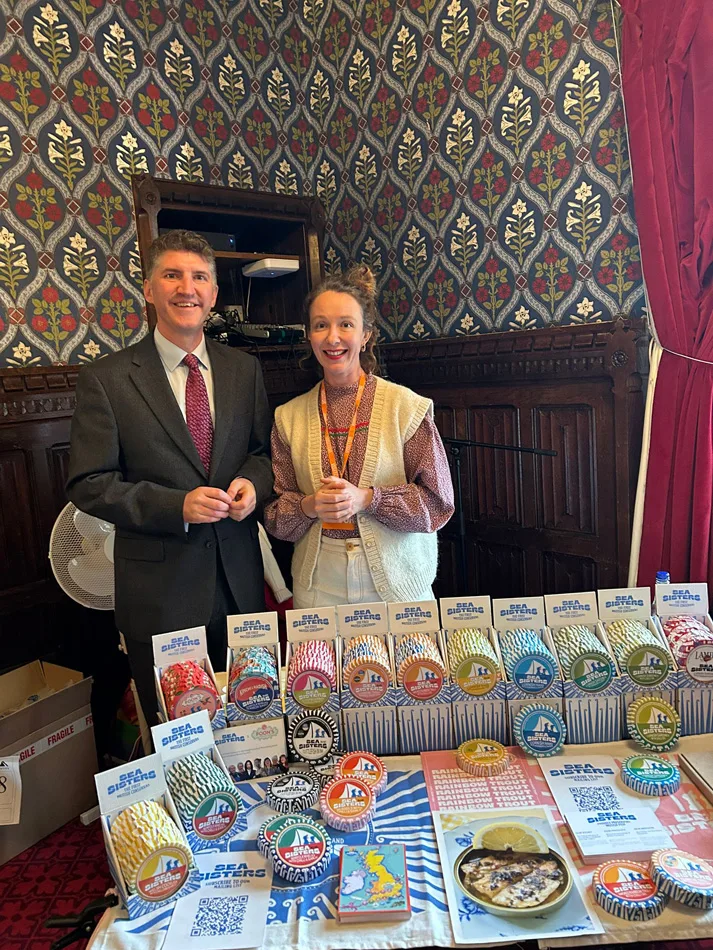
In its first twelve months, Sherborne’s Community Fridge has welcomed more than 1,000 visits and saved over a tonne of food from going to waste. Set up as a local initiative to tackle food waste, the fridge is backed by Sherborne Town Council and supported by local suppliers who donate surplus produce. Everything from bread and fruit to vegetables is available free to all – no questions asked.
Volunteers at Sherborne’s Community Fridge, which is found inside The Pod on Cheap Street
Cllr Suresh Jeganathan, Sherborne’s Deputy Mayor and a regular fridge volunteer, said: ‘We are enormously grateful to our local suppliers including Oxfords Bakery, Sherborne Market Store and Co-op, who give us their surplus produce each week, to the volunteers at the Pod who keep the doors open and help visitors, and to our small band of fridge volunteers who collect and organise the food each week. Thank you.’ ‘The fridge is for the benefit of anyone who would like to try something from our usual selection of bread, fruit and vegetables. It just makes sense to give the produce one last chance to be enjoyed. Reducing food waste is also good for the environment, which was one of the key drivers behind the initiative.’ The Community Fridge is located at The Pod, 54 Cheap Street, Sherborne. Opening hours are Wednesday to Friday 10am to 12noon and 1 to 3pm, Saturdays 10am to 12noon
Can farmers finally move forward, asks Dorset NFU chair Tim Gelfs, or are they still being asked to carry the cost of past mistakes?
Winter sunshine across Dorset fields Image: Laura Hitchcock
Over the past few weeks, there have been some more positive announcements from the government – so is it time to grasp the nettle and move forward? Are we fully engaged with government to get the right outcomes that work for the majority? I know that the increases in the IHT levels in particular will come as welcome news to many. Some are still firmly caught with the forestalling policy, which leaves some families unfairly exposed – this has to be highlighted to our MPs at every opportunity. However, we should also focus on the announcements that affect the day-to-day running and profitability of our farming businesses: the Batters Review (see p.14) the Farming Road Map, the Welfare Bill and, of course, the long-awaited new look SFI. These will all be critical to our businesses. I know that farmers have been engaged every step of the way, particularly with the SFI debacle. It was always quite clear that, without spending caps, this scheme was always going to run out of money. I believe we can put the blame for it firmly at the door of both political parties: mistakes were bound to happen with a new scheme, but some shocking decisions compounded the already-existing problems, leading to that dreaded day last March. On a positive note, the new SFI already has a framework that the farming community supports, based on a principle of public money for environmental outcomes and paid-for work that delivers a genuine net gain for the environment. But it is critical that this aligns with Dorset Council’s vision for Landscape and Nature Recovery. Farmers will be responsible for much of this work on the ground, so we must be involved in shaping its direction locally.
Time for action My initial question is: why should we be paying for the mistakes of successive governments and their agencies? They ran out of money through bad management. The eleventh-hour lifeline for farmers coming out of schemes with no place to go was, of course, very welcome. It prevented a cliff edge. But if that funding has simply been pulled from an already-cut budget, it solves one immediate problem while storing up another. What confidence can we have in meeting future goals and aspirations if the overall pot continues to shrink? We need a transparent budget, in which we know where the money is going. This has to be an imperative first step for trust … which, let’s face it, is hanging on by its fingernails! Despite what you might think of the government of the day, in Emma Reynolds we now have a Secretary of State for Environment, Food and Rural Affairs who appears prepared to listen and to act. It seems as though she is someone who actually wants the job, rather than another candidiate looking at it as an awkward stepping stone to something better. She has said she has been in listening mode since taking up the position – but now it is time for action. It is time for accountability, time to lay out a pathway that gives farmers confidence … and it’s definitely a time for stability. There will be lots of debate and many announcements over the coming months, with plenty of talk of partnerships. Let’s hope that by the autumn we will have a scheme we can engage with, that pays for the environmental outcomes while safeguarding the country’s food security.
When you notice that a loved one is beginning to struggle at home, but is determined to retain their independence, it can feel like an impossible situation. The attachment to the familiar home environment is entirely understandable, and the fear of leaving it can cause people to hold off on asking for help for as long as possible. Thankfully, it is possible to receive individually-tailored care and support without moving out of the family home. Receiving the right care and support can equip and empower people to continue to live safely and independently at home for longer.
What support can my loved one receive at home? Home care visits from specialist carers can provide support with everything from washing, dressing and welfare checks, to household chores, grocery shopping, mealtime assistance and medication management. A bespoke package of home care can provide a unique combination of help and support which matches your loved one’s individual requirements. Choosing a regulated home care provider means that you can be confident that carers are qualified and equipped to provide the support your loved one needs to remain safe and happy in their own home.
I’m worried that my loved one feels isolated – can they enjoy a day out and still receive care? Absolutely! Day care visits to a local care home are a great way of helping your loved one to feel connected to others, whilst still receiving the care they need. On a typical day care visit, your loved one can enjoy activities, entertainment, refreshments and a nutritious meal in the company of others, within a safe and comfortable environment, supported by professional carers.
I am my loved one’s regular carer but am going into hospital – can they stay somewhere so that I know they are safe? Yes, of course. Respite breaks provide the opportunity for your loved one to stay for several days or weeks in their local care home, with all meals, activities and care included. During their stay, your loved one will have access to all of the facilities, activities and entertainment on offer to the home’s residents, enabling them to experience care home life for themselves, and allowing you to focus on your own recovery. Respite breaks are available all year round, subject to availability, and can often be arranged at short notice in emergency situations. If you know the date of your hospital stay in advance – or indeed would like to book a holiday at a later date – Somerset Care also offers a respite break pre-booking service, so that you can plan ahead to ensure that your loved one will have the care they need, when they need it.
Find out more Somerset Care’s home care, day care and respite services support you and your loved ones to live independently at home, for as long as possible. For information and advice, please visitsomersetcare.co.uk, or contact our expert enquiries team on 0800 817 4925.
For most, the season’s heavy rain has meant muddy boots and soggy fields – but at Future Roots, it’s been an opportunity for something a little more memorable.
A group of young people recently took to the water for a unique outdoor session, kayaking through a field temporarily transformed by flooding. It was a chance not just for fun and laughter, but also for reflection, says Future Roots founder and manager Julie Plumley: ‘At Future Roots we make use of every opportunity – and the rain brought some different fun, using the fields to float and reflect.’ Based on a working farm in Dorset, Future Roots is a social enterprise offering alternative provision and therapeutic support to young people who are struggling in mainstream settings. Combining land-based education with emotional support and mentoring, the charity creates a safe and inclusive space where young people can rebuild confidence, develop life skills and look ahead with hope. Whether it’s learning to care for animals, grow vegetables or – when nature allows – paddle a kayak in a flooded field, the team at Future Roots work hard to find creative ways to help young people build stronger roots for a brighter future. futureroots.net
Remarks made by North Dorset MP Simon Hoare in the House of Commons on Monday 19th January were picked up by news outlets across the world, prompting widespread international coverage referencing ‘North Dorset’ in connection with calls to confront Donald Trump more robustly.
Speaking exclusively to The BV shortly before heading in to chair a select committee, Mr Hoare warned that the former US president was posing serious risks to international stability, describing him as ‘demeaning and debasing the dignity of the office of president.’
‘The erratic nature of his behaviour, the unpredictability … if it ever was a joke, the joke has worn thin,’ he added.
Mr Hoare said Mr Trump’s actions were forcing difficult choices for the UK and its allies. ‘This is crunch time. We cannot just presume that things will go back to normal. He’s unrestrainable. He seems to be listening to nobody.’
He warned that long-established alliances were under strain. ‘I think the foundations of NATO are being shaken. Enormous comfort is being given to Putin and to anybody else who wants to see an inward-looking, infighting, destabilised Western alliance. These are dangerous times.’
Describing Mr Trump’s approach to global politics, Mr Hoare said: ‘He’s not a politician. He’s a property-dealing hustler who sees the price of everything and the value of nothing and thinks that everything can be bought, even if the owner doesn’t want to sell.’
Referencing recent remarks over Greenland, he warned of the consequences of abandoning international norms. ‘Once principles have been breached, you’re never going to restore them,’ he said. ‘If we tolerate actions against soveriegn nations which we wouldn’t tolerate from another country – just because it’s America – at best we’ll be seen as cowards, at worst as bloody hypocrites.’
He told MPs that the President was ‘thin-skinned’, driven by ego, and motivated by public embarrassment rather than negotiation. Mr Hoare questioned whether symbolic measures – including the King’s proposed state visit to the US and participation in the World Cup – should go ahead, arguing that the UK may need to ‘fight fire with fire’. The remarks came amid mounting concern in Westminster following Mr Trump’s renewed claims over Greenland and warnings of potential tariffs against NATO allies, including the UK.
Referring to the proposed state visit linked to celebrations marking the 250th anniversary of American independence, Mr Hoare told The BV: ‘I do not see how the government could advise the King that a state visit should go ahead – it would be seen as implicitly endorsing the presidential equivalent of Al Capone.’
Liberal Democrat MP Luke Taylor echoed Mr Hoare’s comments, telling the House that the UK was ‘not dealing with a rational man’ and suggesting that withdrawing from the tournament could be a way of demonstrating political resolve.
The Government has so far played down the prospect of any boycott. Foreign Secretary Yvette Cooper said continued engagement had already led to changes in US tariff proposals, while senior Labour figures urged calm and coordination with international allies rather than escalation.
From the opening of our state-of-the-art wildlife observatory on Brownsea Island to a boom in dormouse numbers, here are some of the wild highlights and successes of 2025:
Species Survival Fund Success 2025 marked the final full year of our Species Survival Fund project, which concludes in February 2026. Launched in March 2024, the project is supported by the Government’s Species Survival Fund to restore and create over 500 hectares of habitat across 18 sites in Dorset. Thanks to the dedication of our staff, volunteers and partner landowners, we have so far:
rewilded 356ha of degraded grassland and arable land
restored 96ha of meadows, downland and heathland
enhanced 37ha of wetland habitat
restored 1.6km of river and 12 ponds
created or maintained 2,100m of hedgerow.
More than 3,600 volunteer hours helped make this possible. This work has already benefited species such as hazel dormice, dingy mocha moths, great crested newts, Sandwich terns and heath tiger beetles.
Record spoonbill numbers Brownsea Lagoon is a vital feeding and roosting site for birds throughout the year, but autumn 2025 delivered something extraordinary: record-breaking spoonbill numbers. While it was once exciting to see 10 to 20 spoonbills, on 30th September we counted an incredible 115 – the highest ever recorded for Brownsea, Poole Harbour and Dorset.
The opening of The Lookout In March we unveiled The Fine Foundation Lookout, a new wildlife observatory offering panoramic views across Brownsea Lagoon. Reached by boardwalks to minimise disturbance, The Lookout forms part of our Wild Brownsea project with the National Trust, supported by the National Lottery Heritage Fund and our members. Since opening, The Lookout has helped visitors discover Brownsea’s wildlife in new ways and deepened public understanding of the lagoon’s importance for wetland birds. Brownsea Island is closed over winter for habitat management, but the observatory will reopen in spring 2026.
Water for Wildlife target reached Our Water for Wildlife appeal, launched in September, has surpassed its £30,000 target thanks to our members and supporters. These generous donations will help us create and restore wetland habitats, strengthen ecosystems and support species such as lapwing, water voles and great crested newts – a powerful demonstration of what supporters can achieve together.
Dormice thriving at Powerstock Common One of the year’s most uplifting findings came from Powerstock Common, where our ecology team recorded nearly 50 dormice in monitoring boxes. They included late season breeding females, suggesting a strong breeding year locally, likely due to the warm summer. Nationally dormice have declined by 70 per cent since 2000, highlighting the importance of continued habitat management and monitoring. Visit dorsetwildlifetrust.org.uk to learn more about these projects and campaigns, and to see what Dorset Wildlife Trust has planned for the coming year.
A local expert from Citizen’s Advice provides timely tips on consumer issues.
Q: I really overspent my budget in December and now I owe lots of money. I am losing sleep over it and I don’t know what to do first.
A : If your spending ran out of control at Christmas, get advice as soon as you can from Citizens Advice or from another free confidential debt advisory service such as Stepchange or National Debtline.
Here are our top tips for dealing with a Christmas debt hangover:
Collect the information about your debts – make a list of who you owe money to, and how much you owe
Check if you do have to pay a debt – you’re responsible for a debt if it’s in your name and it’s something that the law says you have to pay, like council tax or water charges. You’ll also have to pay a debt if you’ve signed a contract to give money to someone.
Work out which debts to deal with first. Priority debts are debts that can cause you serious problems such as mortgage, rent and council tax arrears, unpaid tax bills, court fines, gas and electricity bills. You need to work out which of your debts are priority debts, and deal with them first.
Once you’ve got your priority debts under control, you should look at all your other debts. They’re ‘non-priority debts’ because the problems they cause are less serious and include credit cards and mobile phone debts.
Check if you can increase your income. Are you being paid correctly? Are you eligible for any benefits?
Reduce your regular outgoings. You might be able to save money by:
getting a discount on your council tax
getting a water meter fitted
switching to a cheaper broadband, TV, or phone deal
paying for your prescriptions in advance
Check your options for getting out of debt. You might be able to talk to your creditors and arrange a way to pay them, or make a formal agreement called a ‘debt solution’. You’ll need to decide what the best solution is for your own situation – a debt adviser will be able to help you choose. It’ll depend on things like:
the type of debts you have
the total amount of debt you have
how much money you can pay towards your debt
Finally, now’s the time to learn from your mistakes and start planning how you will do things differently this time next year.
The Liberal Democrats have reselected local veteran and engineer Gary Jackson as their candidate for North Dorset at the next general election.
Gary Jackson North Dorset Lib Dems
Jackson, a former Royal Engineer now working in critical infrastructure, came within 1,589 votes of winning the seat in 2024. With national polling currently predicting a sharp fall in Conservative seats, North Dorset is seen as one of the Lib Dems’ top targets in the South West. He was chosen in a competitive selection process, winning strong support from local members. In 2024, Jackson secured 16,619 votes to the Conservatives’ 18,208. Reform UK followed on 7,894, with Labour and the Greens far behind – setting the stage for a two-horse race in 2026. Gary says his campaign will focus on fixing NHS access, especially dental care – by the end of 2024, no NHS dentists in Dorset were accepting new adult patients – and cost of living support for families and pensioners. Rural policing and safety is another priority, including restoring PCSOs and front desk counters. Investment in villages and market towns, from broadband and transport to farming and flood protection is the last of his four aims. Gary says: ‘I’ve served my country in the Army: now my mission is to serve my community. Rural crime is rising, services are stretched, and the cost of living is biting hard. People in North Dorset feel forgotten. ‘I’m launching a petition to push for better neighbourhood health services, and I’ll be listening to residents across the constituency. Together, we can deliver a better future – but only if we act now.’
A not-for-profit nursing home in Taunton is now able to generate around half of its annual electricity usage from renewable sources, following a major rooftop solar panel installation.
Lavender Court on Roman Road, which provides specialist nursing care, residential care and dementia support for up to 85 people, is already seeing the benefits of 315 solar panels installed across more than 600m² of roof space.
The installation forms part of Somerset Care Group’s wider commitment to reducing its environmental impact through energy reduction, innovation and education.
Chris Keates, Somerset Care’s Head of Property, explains: “As a not-for-profit care organisation, it is important that our approach to the care we deliver – and the resource used to do so – is as sustainable as possible. The solar installation at Lavender Court is part of our ongoing commitment to improving environmental sustainability, and it is estimated that this will generate around half of the nursing home’s total annual electricity usage.”
For those living and working at Lavender Court, the impact is already being felt.
Duewanittar Munemo, Registered Manager of Lavender Court, adds: “Even in the darkest weeks of winter, it is really encouraging to see the energy quietly being generated from the roof the home! We have a display screen in the foyer at Lavender Court, which shows the energy currently being generated by the solar panels, and this has become a real talking point with residents, staff and visitors alike.
“We are proud to have taken this important step towards reducing our environmental impact at Lavender Court, and are looking forward to brighter and longer days, when we can really see the solar panels working to their full potential!”
Part of the not-for-profit Somerset Care Group, Lavender Court in Taunton offers day care, respite breaks, residential care, dementia support and specialist nursing care, all within a homely, purpose-built environment.
To find out more about Lavender Court, visit www.somersetcare.co.uk/lavender, or contact Somerset Care’s friendly and knowledgeable enquiries team on 0800 8174 990.