Colour and creativity filled the Pamela Hambro Hall in Winterborne Stickland on 16th August, for the Valley Gardening Club’s annual Summer Show. Independent judges praised the quality of entries, with more than 190 exhibits from 23 competitors across horticulture, cookery, handicraft, photography and children’s classes.
Several names shone through the prize list. Hazel Steele took home both the Gladioli Cup and the Dahlia Cup, while Sophia Steele (unrelated) won the children’s award for most points. Richard Osborne was another multiple prizewinner, lifting the Hans Hennicker Trophy for best vegetables alongside the RHS Banksian Medal. Philippa Smith showed her versatility by carrying off three trophies in handicraft and cookery, while Amanda Gotham impressed in the photography section, winning both the cup and the W.I. Plate. Other winners included Karen Marchant with the Sweet Pea Shield, Lynne Rainford for the Murray Simpson Trophy, Caroline Cooper with the Sid Smith Trophy for dahlias, Rose Hennicker claimed the President’s Vase, Hazel Harlock the General Cup, and Chris Fielding who collected the Jubilee Bowl for vegetables. As the club rounds off its 91st anniversary season, members are already looking ahead: the next Spring Show will be held on Saturday 21st March, followed by the Summer Show on Saturday 15th August 2026. More details and photographs are available on the club’s website: sites.google.com/view/valleygardeningclub
Barry Cuff takes a look back at what happened on his Sturminster Newton plot last month
Images: Barry Cuff
There was only one topic of conversation down on the plots thoughout August: the lack of rain. When will it rain? How much water is in the well? Will we need to switch to mains water if we run dry? Is it worth making new sowings? How are your runner beans, are they setting seed? Plot-holders checked the forecast daily for any hint of rain. After such a long dry spell, our allotment plots were an oasis of green amid the parched lawns, pastures and bleached stubble of North Dorset – the local cereal harvest was one of the earliest on record. Luckily our well did not dry up and continued to supply much-needed water for our vegetables and fruit, though an estimated 500 gallons was pumped daily to the holding tanks and troughs.
August notes: Watering Most of our vegetables were watered daily, especially runner and French beans, the cucurbits, celeriac, newly-planted leeks and brassicas, newly-sown carrots and beetroot. Needing slightly less water were our sweetcorn, parsnips, older brassicas and the fruit bushes and strawberries.
Badgers For the first time in years badgers have attacked our neighbour’s sweetcorn, knocking over the plants and eating the cobs. Our block of 60 plants was not far away … to protect them, we erected a fence of chicken wire and stakes, plus a sprinkling of natural repellent (male pee). The combination of both worked.
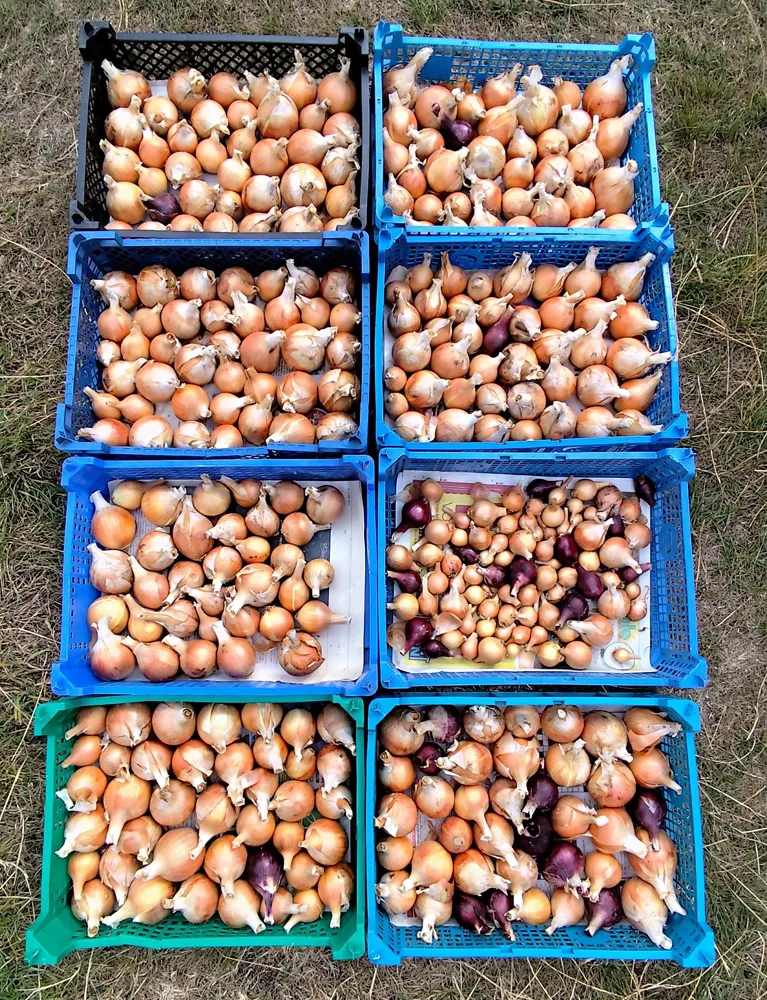
Last croppings We completed harvesting our onions on the 1st. All are now dried off and stored. The last of the potatoes were dug on the 4th. They were the Desiree, and we had plenty of spuds per plant but they were generally small due to the drought. The peas and mangetout gave up the ghost around the middle of the month as they succumbed to powdery mildew caused by drought stress.
homemade coleslaw from allotment in Dorset
First harvests Sweetcorn – we had three cobs on the 14th, and four on the 18th. Red Cabbage – One head on the 15th for coleslaw. Celeriac – We had a decent-sized root on the 21st, used for salads and stir fries.
Harvesting as needed We are harvesting the following daily (or as required): Carrot, beetroot, gherkin, cucumber, courgette, French beans, runner beans, tomatoes, sweet peppers and lettuce.
Planted From plug trays we have planted out lettuce, radicchio and Chinese cabbage. We’ve made direct sowings of carrot, beetroot and the first of the autumn salad leaves and radish, and sown lettuce, Chinese cabbage and Spring onion (winter hardy) into plugs.
RAIN! As I write this it is raining (29th)! We have had more than one inch since the first downpour on the 26th. Many of our autumn and winter vegetables will benefit, together with the fruit bushes.
As Dorset councillor Carole Jones warns that Sturminster has lost ‘a wealth of experience’, Rachael Rowe tries to understand what is happening at Sturminster Newton Town Council
Pauline Batstone
What looks like a culture of silence within Sturminster Newton Town Council and apathy in the community has meant that one of Dorset’s most experienced councillors has stepped down as Mayor – and no-one is asking the questions that beg to be asked. Pauline Batstone, a long-standing county councillor and former chairman of Dorset Council (2019-2020), with more than 30 years of service to the community, has resigned after just four months as the Town Mayor of Sturminster. How – and why – did this happen? At first glance there was nothing out of the ordinary on the agenda for the town council meeting on Wednesday 3rd September … but significantly, just four months after electing a mayor, there was an election for a new one. In due course, Cllr Joe Rose was unanimously chosen. But the question remains – why has the town council lost a mayor so quickly, especially an experienced person who knows how the systems work? There were few members of the public at the council meeting to try and understand – most people in Sturminster Newton are probably oblivious to the situation. The meeting continued with discussions on the new youth club and repairs to Sturminster’s famous mill – and how the council could afford the bill for this heritage building.
Locked out Anything that might have provided a clue to the mayor’s departure had presumably been shifted to the confidential section of the meeting agenda. There were brief thanks to Cllr Batstone for her service to the town council, but no indication of why she had stood down. Sometimes it is what is not said, rather than what is actually voiced at a meeting or an organisation – a look across a table, raised eyebrows or confrontational body language can indicate that there is more going on below the surface. The culture of an organisation may dictate how things work and get done (or not) – and understanding the culture can be critical to changing processes or embedded procedures. As a new mayor, Cllr Batstone was keen to work alongside the council’s staff, particularly after council meetings, to ensure that decisions taken were actioned. However, she and the deputy mayor, Cllr Debbie Mantock, found it hard to meet with staff to discuss operational matters. ‘We found the office was locked, and were told they were too busy,’ says Cllr Batstone. ‘Last year I was deputy mayor and Helen Lacey was mayor. Then I was elected mayor in May and Debbie Mantock became deputy.’ Debbie is a relatively new councillor – ‘The first thing that was said to Debbie was “I suppose you think you’ll have power but you won’t. You won’t have any power.” Then somehow the question of Debbie sitting alongside me in meetings came up. We asked the councillors whether there was an issue with three people sitting at the top of the table and they didn’t have a problem. However, we were told there was no room as the clerk had to work. The next meeting, the chairs had shifted and there were just two places. Other councillors told me the staff didn’t like the way I wanted to work.’ There are additional issues in this case which cannot be reported for legal reasons. However, there is now a vacancy on Sturminster Newton Town Council which will lead to an election. Local residents who want to make a difference in their community can stand, and the people of Sturminster Newton can decide who represents them.
Sturminster Newton Town Council offices are located on Old Market Hill at the rear of The Exchange
A massive loss Carole Jones, the Sturminster ward councillor on Dorset Council, is concerned about the mayor’s resignation: ‘I am extremely sad that Pauline felt she had no choice but to step back at this time,’ she says. ‘With well over 30 years representing her community, she had a wealth of experience and a real ‘can-do’ attitude. Frankly, she has done more for Sturminster Newton than all of the other town councillors put together. ‘Without Pauline, we would have three empty bank buildings ** – and that’s just for a start. The town council should be a leading light in our community – it should be taking projects forward, garnering support, with all councillors taking the lead in different areas. In reality, this simply doesn’t happen. ‘Getting good people to stand for election is near-on impossible … getting people who get stuck in is rare. It is so frustrating to lose the best we had – and why? Well, I can only guess at the frustrations. It must have been like pushing water uphill.’ Surely Sturminster people should be asking more questions – not one member of the public or councillor asked why a new mayor was being elected at this September meeting. This should be a wake-up call for residents to take a proactive interest in their community and call the council to account for its actions.
**Statement of clarification from Cheryl Basten Manager, The Boutique/Founder of The Emporium, Marketplace, 1855: ‘Without Pauline, we would have three empty bank buildings’
This statement is factually incorrect and misrepresents the history of how these shops were established. For accuracy, the facts are as follows:
• As Manager of The Boutique, I approached John Romans regarding the use of Lloyds Bank as additional storage when we had outgrown our original shop. During the viewing, I asked whether we could open it as a shop, and John agreed. We opened The Emporium in July 2020, two weeks later. At this point, Pauline was not on the Committee, Mike Woods, the original founder, was still in charge and the organisation was called SNEDLS.
• Pauline only became secretary after Mike Woods resigned. She had no involvement in acquiring Lloyds or establishing The Emporium.
• Later, when we again needed more space, John allowed us to use Barclays, which became ‘The Marketplace’ after we began selling pre-loved furniture there.
• Through managing these shops, I met many artists, makers and creators who wanted a space to sell without the full responsibility of running a shop. This led to the creation of ‘1855’, originally NatWest, another John Romans building, which myself and volunteers redesigned. 1855 now holds approximately 115 ‘Traders’.
Cheryl Basten
Further comment from Pauline Batstone:
“I am honoured to have Carole and Cheryl fighting over my reputation. To clarify, so that I am not credited with anything I am not due – I was one of the four original signatories back in 2018 to set up the Community Benefit Society nicknamed “SturAction”. We aimed to raise funds to be spent on the town through a charity shop, our first all inclusive shop being what has now become The Boutique. Two of us invested our own money when we needed matched funding. I was a Board Member, Secretary and general dogsbody from the start, stepping back from the Board in 2023 to allow a change of blood in the form of the redoubtable Sue R to take my place. I subsequently handed the Secretary role to Sue but continued as Minutes Secretary until last year. Apart from occasionally helping out as a shop assistant, when I was Secretary I have been a “behind the scenes” person in conversations with our landlords, the local authority and media, whilst Cheryl, as Shop Manger, worked on acquiring and making the former bank buildings into the splendid shops they are today, and all credit to her.”
Six locomotives spanning half a century of steam power will take centre stage at the Swanage Railway’s Autumn Steam Gala from 12th to 14th September. Star of the line-up is Southern Railway ‘Schools’ class express engine No. 926 Repton, visiting Dorset for the first time since it was based in Bournemouth during the Second World War. Joining it is S15 class freight engine No. 30506 – the first of its type to appear in Purbeck in more than 20 years.
Swanage Railway volunteer commercial director Alexander Atkins said: ‘With steam locomotives from the 1890s to the 1940s hauling passenger and demonstration freight trains, as well as bracing brake van rides, the Autumn Steam Gala will be an exciting spectacular not to be missed. Some of the passenger trains will be running over our four mile line beyond Norden to Furzebrook and the River Frome – within sight of Wareham.’ The railway’s company chairman – and volunteer signalman – Gavin Johns praised the chance to see two fine examples of Southern Railway design working again in Dorset’s landscape. The visiting engines will of course be joined by Swanage Railway’s own fleet, including Victorian London and South Western Railway T3 No. 563 and two Battle of Britain class Bulleid Pacifics, Manston and 257 Squadron. Advanced adult tickets start at £29, and full details and ticket sales available at swanagerailway.co.uk
Wimborne Food Festival returns on Saturday 20th September, bringing a full day of flavour, community and food-focused celebration to the town centre. Running from 11am to 4pm, the event is organised by Wimborne BID and Dacombes of Wimborne, with cookery demonstrations, producer stalls, talks and pop-up experiences taking place across Willow Walk, Wimborne Square, Minster Green, Church Street and East Street – the latter two of which will be closed to traffic for the day to make space for café seating and live music.
Wimborne Food Festival
One of this year’s highlights is a live cookery demo from George Williams – a full-time doctor from Sturminster Marshall who recently impressed viewers as a contestant on MasterChef. George will be creating three quick, Dorset-inspired recipes using ingredients sourced from Wimborne’s independent shops. His demo will showcase dishes from the frying pan, oven and air fryer, each built around late-summer produce. ‘It’s been a joy to connect with so many wonderful independent food and drink retailers around Wimborne to create these Dorset dishes,’ George said. The event’s focus is firmly on local – celebrating the ingredients, producers and retailers that give the town its distinct flavour. George will also share behind-the-scenes stories from the MasterChef kitchen and reflect on the surprising differences between medicine and cooking under pressure.
More details and the complete festival programme is available on the website wimbornefoodfestival.com
Dorset and Somerset Air Ambulance (DSAA) will launch its 2ndHeli Appeal on Monday 8th September, calling on public support to raise the final £1 million needed to purchase and fit out a second air ambulance helicopter for the region.
The charity, which has served Dorset and Somerset for 25 years, is taking this ambitious step to meet rising demand. If successful, the appeal will allow the air ambulance crew to reach more patients, strengthen operational resilience and ultimately save more lives.
As the busiest air ambulance in the South West, DSAA responds to almost 3,000 missions every year. Its current AW169 helicopter – affectionately named Peggy – is flown more intensively than almost any other air ambulance in the UK. With patient need increasing and inevitable downtime for essential maintenance, one aircraft is no longer enough.
2ndHeli Appeal logo
A second helicopter will:
Strengthen resilience and operational availability
Maintain air operations when one aircraft is offline
Feature a state-of-the-art medical interior, enabling advanced care day and night
Provide the basis for extended operating hours in future
Enable hundreds of additional life-saving missions each year
Thanks to careful financial planning and extraordinary generosity from supporters, the charity has already secured the majority of the funds required. The 2ndHeli Appeal represents the final push to bring a second AW169 home.
Charles Hackett, CEO of Dorset and Somerset Air Ambulance, said: “We are proud of how far we have come over the years, but we have reached the limit of what is possible with just one aircraft. With daily maintenance requirements, we cannot get more than 19 hours a day of flying, and the demands on ‘Peggy’ mean that faults and issue come around all too soon.
People support our charity, because they believe in our ability to achieve extraordinary outcomes that wouldn’t otherwise happen. This care, this service, this gift to the people of Dorset and Somerset is lifesaving and very special, as every mission is funded by you. Without that wonderful support, our service would not exist.
Dorset and Somerset Air Ambulance Helicopter and crew
We now have an incredible opportunity to transform emergency care even further across the region, and hope the public, businesses and local communities will support us on our quest.
With your continued support and others alike, we will bring a second helicopter into service next summer. Together, and only together, we can make this happen.”
Dorset and Somerset Air Ambulance is a local life-saving charity which receives no direct Government funding and relies entirely on donations and fundraising. Its operational costs exceed £10 million a year, with each mission costing around £3,500.
On the 23rd August 2025 aged 76 Stephen Cox formerly of Shillingstone much Loved brother and uncle. Cremation Saturday September 20th at Camborne crematorium at 1200
Don’t hang up the trowel just yet – this month’s full of quiet garden jobs that pay off in spring, from bulbs to buds to blooms
Keep deadheading flowers like dahlias to enjoy the blooms for as long into autumn as possible
September can be a busy time in the garden – some jobs extend flowering while others will begin setting you up for next year:
Regular feeding and deadheading really help to keep the displays going, especially the roses, dahlias, fuchsias and perennials.
Divide herbaceous perennials, this helps invigorate them.
Start collecting seed from any plants you want to grow next year – especially good for this are foxgloves, aquilegia, calendula, poppy and love-in-a-mist. Aquilegia seeds are an easy job, the seed pods rattle when they are ready to harvest. They can be scattered immediately after gathering too – simply sow them in a shady spot if you need some colour there, or collect them for sowing in the spring. To store them, put them in a dry spot in the shed until required for sowing.
September is an ideal time to order next year’s spring bulbs – as well as daffodils, try some colchicum and Madonna Lilies.
Trim lavender plants to keep them compact.
Divide clumps of bearded iris now to ensure they get established again before the winter weather arrives.
Most perennial weeds are best dealt with now, while the weeds are in active growth. Digging out is often the best method if you are trying to avoid using weed killers.
Pruning wisteria Prune your wisteria three times a year to keep it in check – this will help ensure you get lots of magnificent flowers each spring. The first pruning is carried out in the middle of summer after flowering, usually in July or August. The middle September prune is the lightest: try to reduce the new, long green, whippy shoots back to just five or six leaves. This is an important prune to keep your wisteria at a manageable size, and to encourage a better display of flowers. It’s also an opportunity to tie in any new growth that can be used to replace old branches. The main third pruning is done over winter, generally in January or February. Pruning while the plant is dormant and leafless makes it easier to see where to cut. Working around the plant, reduce the shoots that were shortened in summer to just two buds. This encourages the production of flower buds and ensures that the flowers won’t be obscured by leaves.
When Okeford Fitzpaine Parish Council was quoted £10,000 to clear a blocked waterway, councillors feared it would sink their budget. After several sharp intakes of breath, it was clear the councillors needed to find a Plan B – and quickly – to prevent icy roads this winter.
Mortar shell – image Colin Keyser
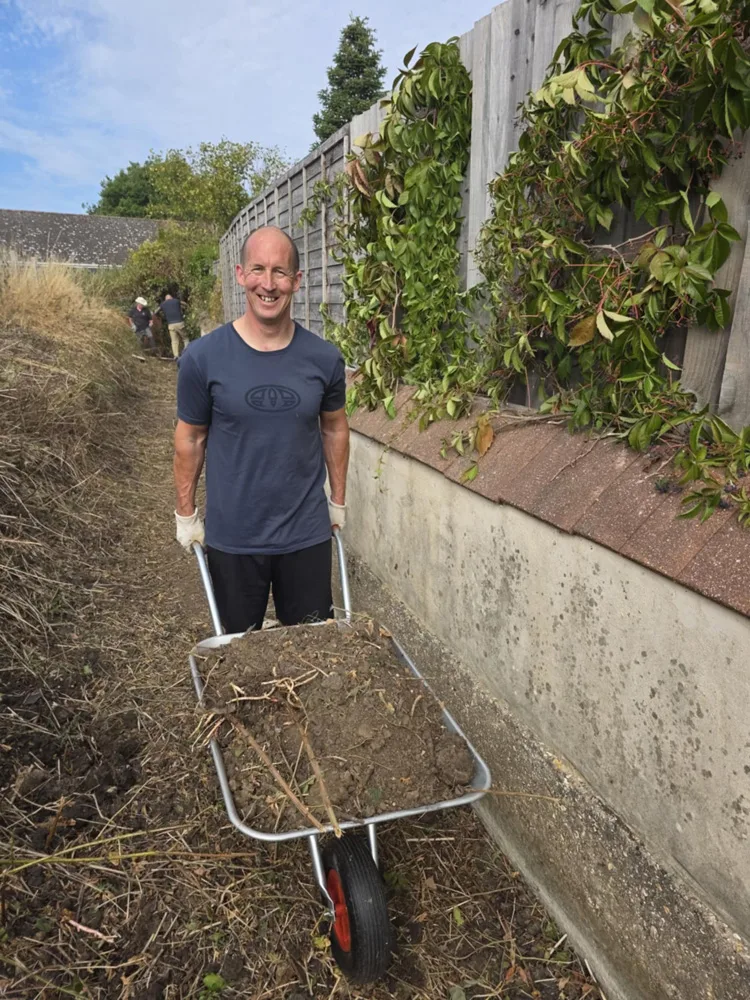
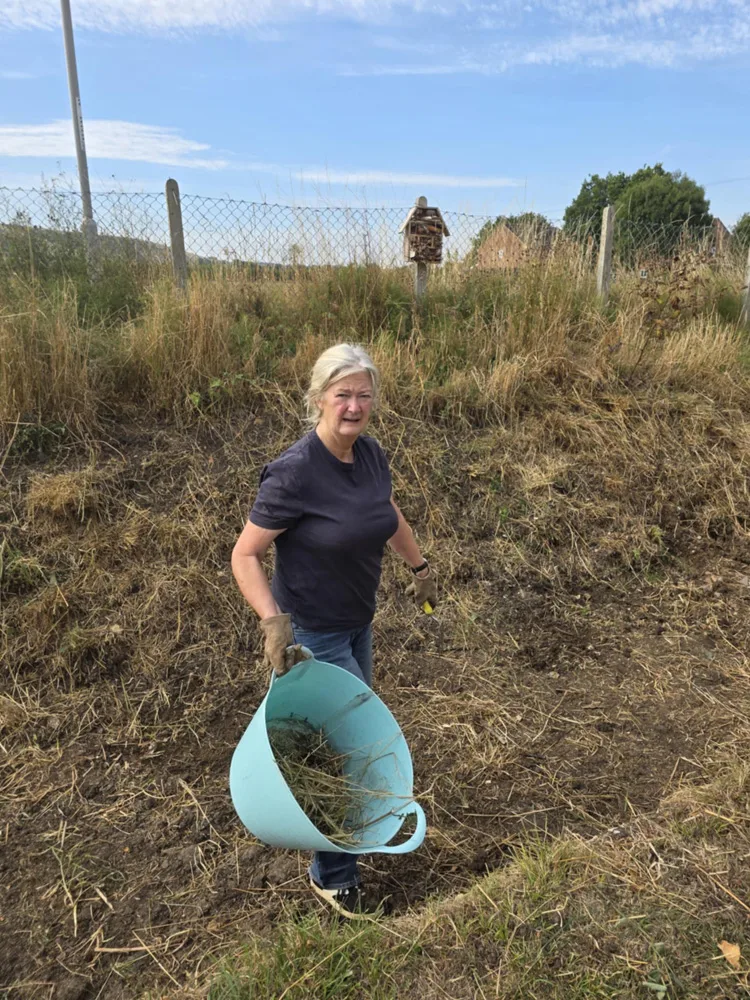
Councillor Sophie Harvey, a farmer’s daughter full of practical solutions, said, ‘I’m not afraid to get my hands dirty’ – and came up with an alternative option. She asked for volunteers to come and help clear the vegetation. Village resident, and retired civil engineer Roy Parsons gave expert advice on the task needed and two working sessions were organised around the August Bank Holiday weekend. Local farmer Chris Norton, loaned a trailer to dispose of the excess soil. Would anyone turn up? It was a big ask on a bank holiday weekend, but the parish council was clear that even an hour’s help was welcomed. On both days, volunteers of all ages turned up to dig and clear the muck and old vegetation from the waterway – everyone from retirees to family pitched in. Some were regular volunteers, others had recently moved in and were eager to meet new people and get involved. By the end of the first morning, significant progress had been made: some people enjoyed the experience so much they came back the following day, joined by new volunteers.
Clearing the ditch. Photo credit Sue Finklaire
Interesting debris Soon the team began to find an assortment of rubbish – Lego bricks, old T-shirts, fence posts and even a discarded jumper. But the find of the day went to local resident Colin Keyser, who managed to dig out what appeared to be a rusty old mortar shell from the Second World War. He took it home and called the police: ‘They visited my house,’ he said. ‘They inspected and measured it, declared it safe and I was given the OK to pass it on to the local history group. ‘I began cleaning it up: about 45 minutes later I was busy banging off the rust, wire brushing it and cleaning all the mud out from the inside when the phone rang. It was the police again: “Did I still have the mortar shell?”. When I said I did, they asked me to put it up the far end of the garden … they’d had second thoughts and it may still be live! ‘Two policemen turned up to sit in my garden awaiting an EOD (Explosive Ordnance Disposal) team from the army. The EOD arrived and said they thought it was a training grenade launcher from the Second World War, and had no explosives in now – but they would take it away just to be on the safe side.’ And with that, two police officers, two army bomb disposal officers, and the grenade launcher headed off into the sunset. Local people are hoping that the grenade launcher can be returned at some stage as an exhibit in the village museum.
Councillor Sophie Harvey Photo credit Sue Fiklaire
Borrowed bullets The volunteers would like to find out more about the item – they are not convinced it is a grenade launcher due to its shape. There’s also the question as to how it got there in the first place. During the Second World War there were ordnance dumps in the area, and the Americans were stationed nearby, so it could have come from any of these places. There are also local stories about young boys who used to “borrow” bullets to play with, so it may have originated from a mischievous prank. As for the waterway, it has been successfully cleared to the point that minor repairs can be done, and a contractor can review the area to see what additional remedial work may be required. Councillor Sue Finklaire, who also helped on the day, said: ‘It felt deeply heartening to be surrounded by such generous support from the community, especially from those who had only recently made the village their home.’