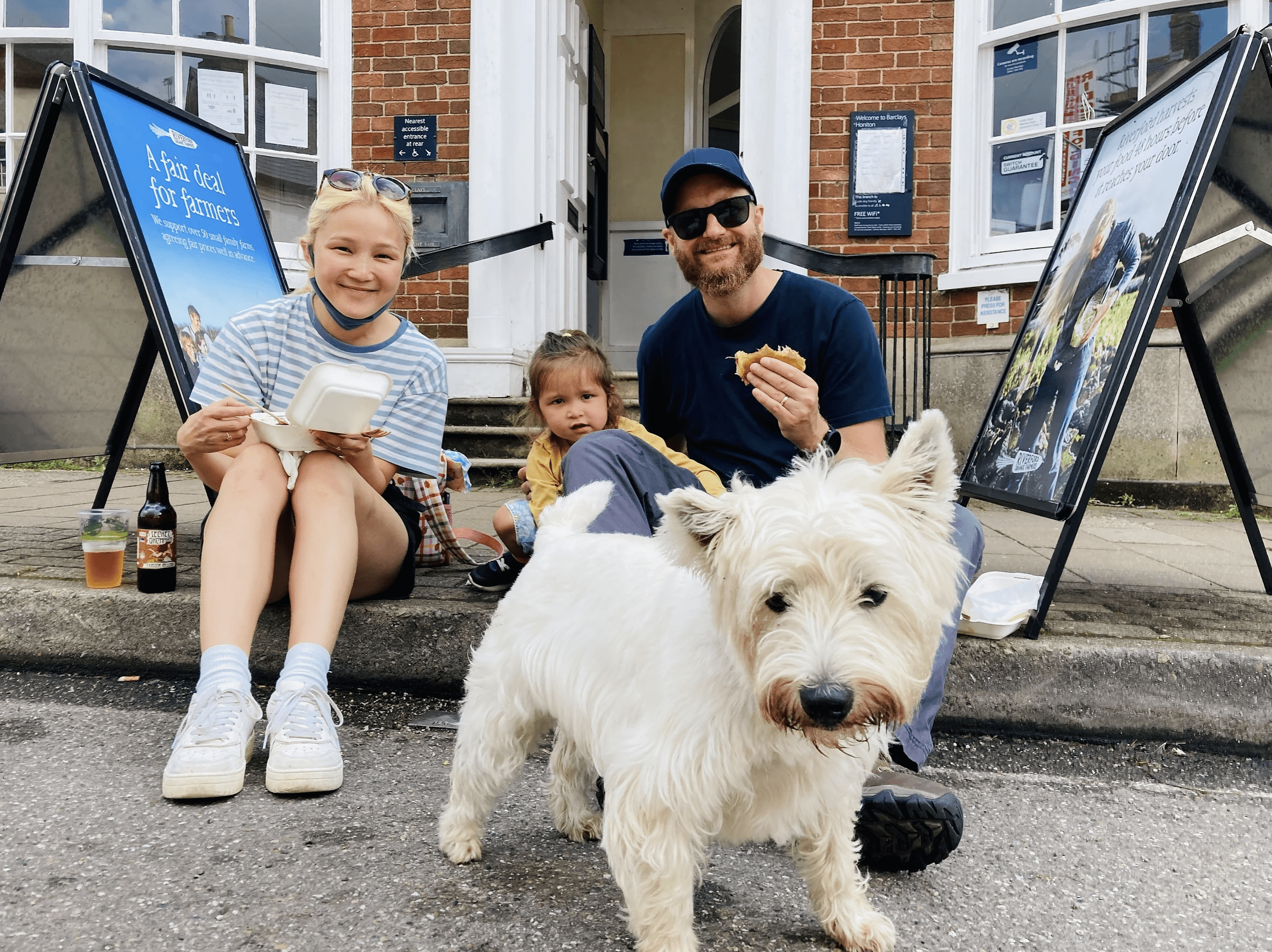
Local food and drink festival organisers eat:Festivals are Finalists in the Dog Friendly Business of the Year category at the Bristol, Bath & Somerset Tourism Awards.
Organiser Sarah Milner Simonds said “We think this is a ‘paw-fect’ start to the new year and really wag-ficient news. We work really hard to make our one-day food and drink festivals welcoming for the whole family and that includes four-legged members too.” Co-organiser Bev Milner Simonds continued “We have always made sure we are dog friendly but this year we enhanced experience by having a Dog Concierge on hand to welcome pets, publishing local dog walks, working in partnership with local dog businesses to increase our number of water bowl spots and having Pooch Paws-Points dotted throughout the festival with seating for owners to take a breather.” eat:Festivals find out if they have won Gold, Silver or Bronze on 17 February and until then they are working hard on the plans for the 2022 season of events – including enhancements for everyone and their dog!
There is a political battle raging over giant solar farms which blight the countryside and reduce food production, and smaller less impactful initiatives. Dorset so far has not shone but may now be catching up, says Rupert Hardy, Chair of North Dorset CPRE.
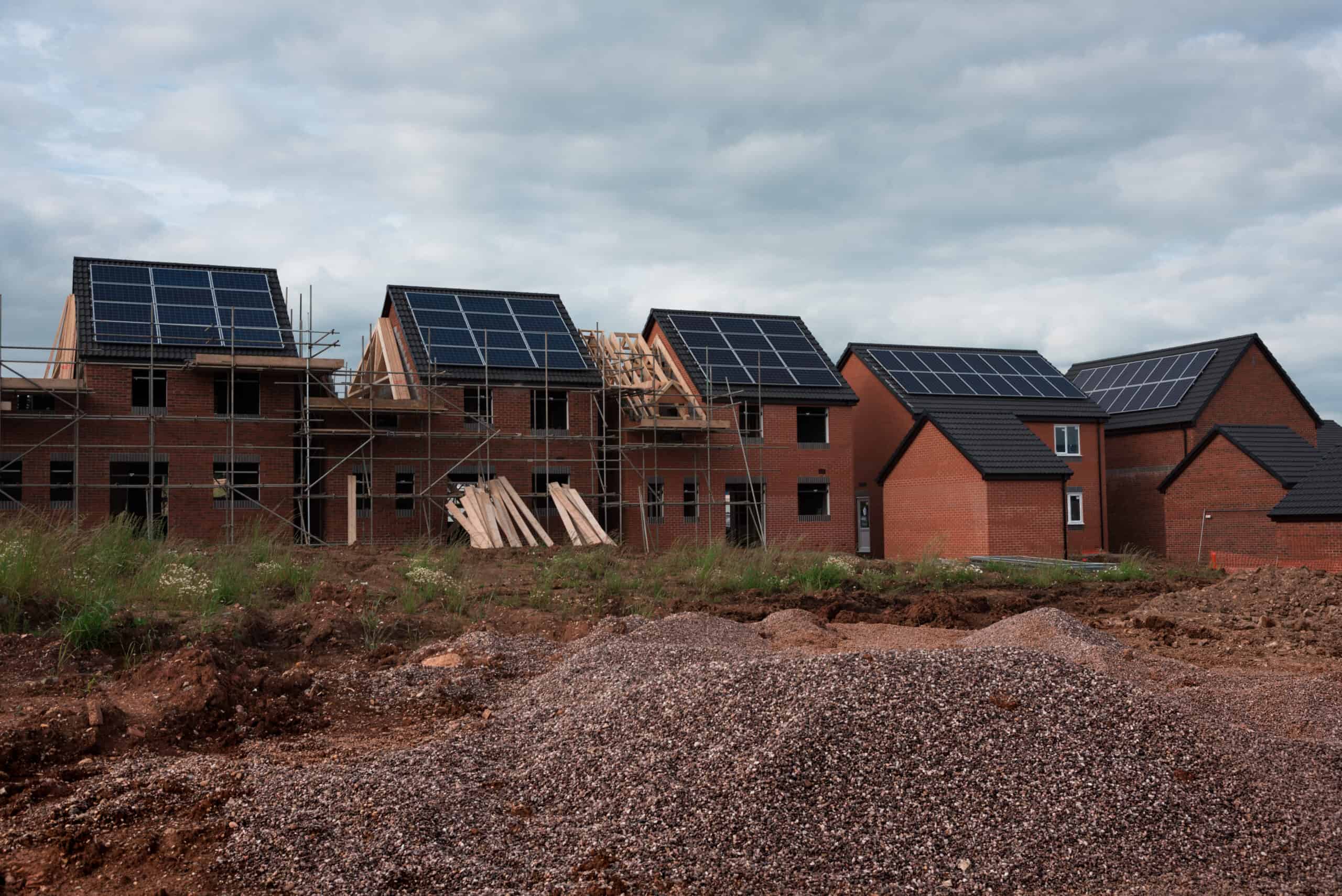
Some UK councils now stipulate solar PV provision as part of their planning conditions, but Dorset have not yet; Rupert Hardy questions this lack of initiative
North Dorset CPRE has always been supportive of renewable energy, especially at a time of Climate Emergency, and we support small (less than 5MW) community-funded solar farms as do the Low Carbon Dorset team at Dorset Council (DC). However we have opposed a number of huge solar industrial power plant planning applications that can desecrate our beautiful countryside, especially if it is good agricultural land that should be growing food for Dorset. We have also consistently argued for solar panels to be put on public buildings and industrial roofs, as well as more on household roofs. The record though is lamentable. As of September 2021, 95.4% of households and 98.4% of businesses within the DC area did not have solar panels on their roofs. Why?
Local ownership of panels
The phasing out of domestic solar panel subsidies in recent years meant that individuals became reluctant installers, despite the drop in prices of panels. While cash-strapped local authorities have been unable to help, community energy groups have sprung up with the goal of offering panels at very competitive rates. It is a growing movement in which energy generation is owned not by large industrial companies but by local communities, with the profits invested back into the community. However last month Community Energy England, in advance of the second reading of the Local Electricity Bill, said that ministers were failing to respond to growing support for community renewable energy, or properly plan for growth in line with net-zero commitments. As many as 280 MPs (out of 650) have now committed their support to this Bill, which is designed to ensure that Ofgem creates a ‘Right to Local Supply’ framework. There was no mention of funding for community energy in the Prime Minister’s Ten-Point Plan in 2020, nor in recent Budgets, while most of the decarbonisation funding is going to local authorities and not community groups. Many also ask why the government did not make the fitting of solar panels on all new buildings mandatory in its low carbon strategy announced before COP26, rather than subsidising heat pumps, which are not feasible or too expensive for many homes. Some councils also now stipulate solar PV provision as part of their planning conditions, but DC have not yet. Despite this, last March Sustainable Swanage and community energy group, Purbeck Energy, launched a project to offer Swanage residents the chance to get solar panels for their properties at competitive rates. They are using a company, IDDEA, which has already installed 1,000 panels across southern England. The Swanage Mayor, Mike Bonfield, is fully supportive and praised it as a “brilliant scheme”. How about some of our North Dorset towns encouraging the same?
The Church of England has begun a programme of solar panel installations – even on buildings such as the Grade I listed medieval church St Mary of the Annunciation, Beaminster – as they will be barely visible from the ground
Non impact initiatives
One of the reasons for slow progress on industrial buildings has been issues of building ownership and leasehold arrangements, as well as roof weight and warranties. However progress is now being made to improve the energy efficiency on public buildings in Dorset, where ownership is clearer. The first major push came from DC’s Low Carbon Dorset team, who gave grants of £5m to fund 4.1MW of projects, both public sector and business, thanks initially to the European Regional Development Fund.
In the last year DC was given £19m by the government for more renewable projects, which include solar PV, heat pumps and LED lighting. This was one of the biggest grant packages given by the government, so well done DC. It is paying for panels to go on the roof of Durlston Castle and the art gallery, County Hall in Dorchester, and various schools. In North Dorset, Blandford School is adding more panels to its existing ones, while Gillingham School has installed some too. Bridport-based Dorset Community Energy, which facilitates community ownership of renewable energy production, has financed the installation of panels on twelve schools, including Blandford School, and four community buildings throughout Dorset, such as Blandford Community Hospital. Thanks initially to the Lottery, and now 98 local shareholders, it has funded 1.5MW of panels. We hope to see more of these community-led projects.
The church enters the battle!
The Church of England may not be a pioneering custodian of the nation’s most historic fabric, but it is now installing panels on many of Dorset’s churches, even Grade I listed medieval ones such as St Mary of the Annunciation, Beaminster, as they will be barely visible from the ground. Farmers are slowly fitting panels to their buildings, but it is estimated that only a small proportion of farmers so far in Dorset have done so. Weight problems are often quoted as to why less retro-fitting is done. Mole Energy, part of Mole Valley Farmers, the co- operative group, have certainly been busy promoting the fitting of panels to farm buildings here, but have pointed out that renewed demand is now facing capacity issues. They say the rapid phasing out of domestic subsidies in 2016 meant many solar PV installers had to diversify and the associated tradesmen left the industry, so there may be too few installers now.
We have openly criticised DC’s Draft Local Plan for its total lack of ambition in pushing developers to adopt more sustainable and energy efficient building standards, compatible with its declared Climate Emergency strategy.
However the recent publication of DC’s Climate and Ecological Emergency Strategy promises positive changes, so we urge DC to include initiatives to promote roof-mounted panels in the Local Plan’s next iteration this spring. Please do ask your MP to put pressure though on government for a more credible low carbon strategy, as this is so critical.
Rupert Hardy Chairman, North Dorset, Campaign to Protect Rural England
The charming tradition of sending Valentine’s Day cards and flowers to loved ones has a racier origin than you’d imaging, says (a blushing) Charlotte Tomb!
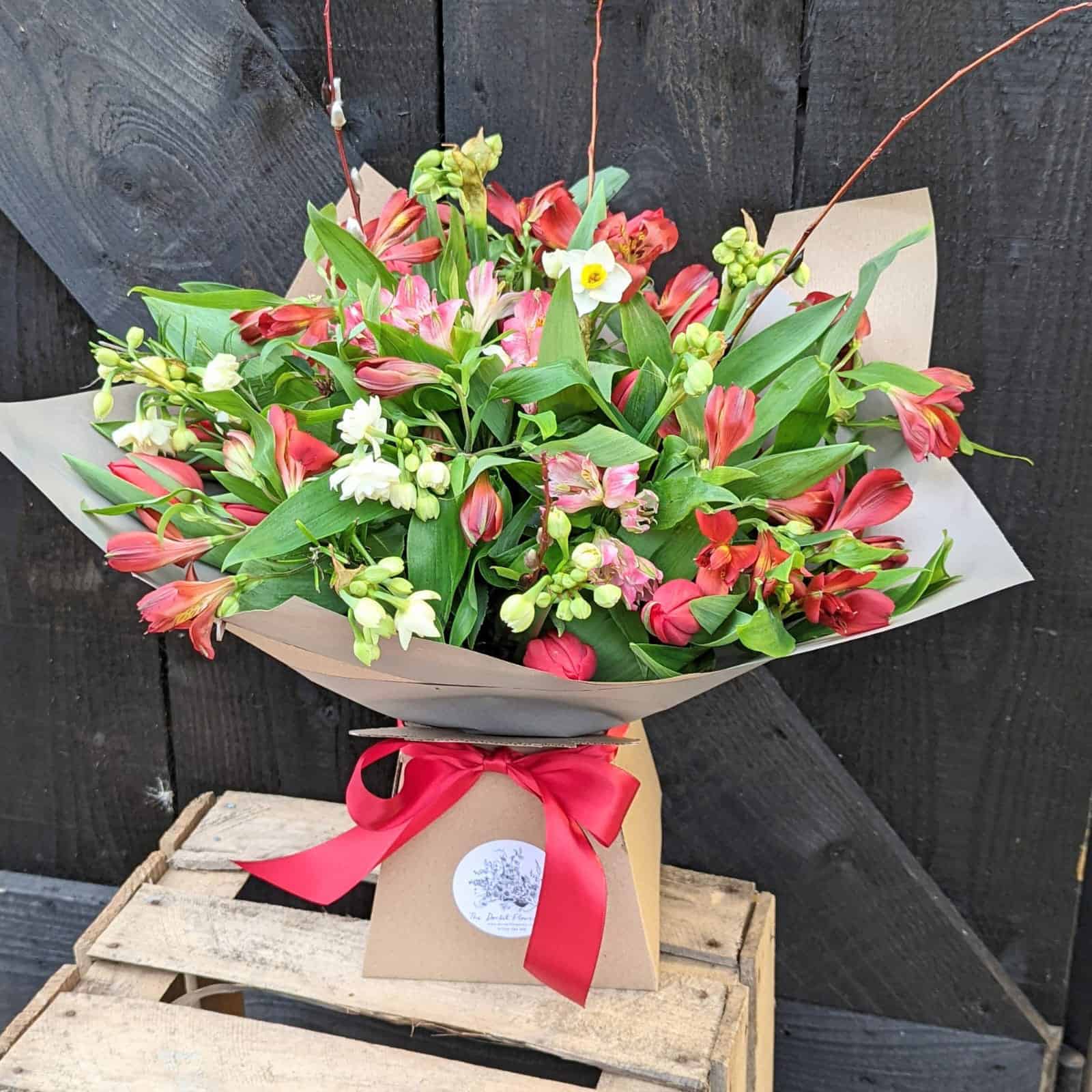
A Valentine’s bouquet from Dorset Flower Co, full of British flowers – a gorgeous mix of doubles and singles tulips, alstromeria and narcissus with Dorset-grown foliage
It’s still far too early for my flowers to make an appearance, though it won’t be too long and there are a few brave souls showing their faces already: the early daffodils, snowdrops and hellebores. So I thought I’d do some research and find out a little more about St Valentines Day and how it came about. Many holidays and traditions that we celebrate today seem to have their roots planted in Pagan history. St Valentine’s Day seemingly (as there appears to be conflicting views) has its beginnings in a Pagan fertility festival called Lupercalia (‘the god of fertility and flocks’) which was celebrated in Ancient Rome between the 13th and 15th February. It is said that the festival involved people running naked through the streets and spanking young maidens on the bottom with leather whips – apparently this was to aid fertility (really? Not in Dorset and definitely not in February!). As with many of the old Pagan festivals, the early Christian church adopted/absorbed/ smothered (take your pick) the celebrations and made them their own (not to the extent that the Romans did, and readers may well have mixed views on this).
In the centuries that followed, two early Christian martyrs met their grisly ends on the 14th February and it is thought that both their names were Valentinus, the Latin for Valentine.
In 496AD Pope Gelasius declared the 14th February as ‘St Valentines Day’ and it became a Christian feast day.
’My sweet Valentine’
In 1382 Chaucer celebrated the engagement of the young King Richard II to Anne of Bohemia on St Valentine’s Day. And another reference is from an inmate of the Tower of London, where a Duke referred in a letter to his wife ‘as my very sweet Valentine’.
By 1601 William Shakespeare mentions Valentine in Ophelia’s lament in Hamlet, and by 1797 it was common practice for sweethearts to pass love notes to each other. With the introduction of the Penny Post in 1840 by the Royal Mail it became not only affordable but possible to send cards anonymously with pre-printed verses and pretty pictures not too dissimilar to the cards of today. Then racier cards began to appear which shocked the prudish Victorians.
That’s more than enough history. – back to flowers where I am on safer ground.
Don’t spend the earth for your Valentine There are British flowers available to buy for your Valentine – and they won’t cost the earth (literally), unlike the rather pitiful foreign red roses flown thousands of miles around the world.
They are a little harder to find, but a good local place to start is The Dorset Flower Company near Dorchester who offer amazing bunches of flowers (see image), plus total transparency as to where your flowers come from: all bouquets come with a card giving the provenance of every stem. The best way to find a reliable local British flower seller is to use the Flowers from the Farm website, which shows growers and florists who (like myself and The Dorset Flower Co) only use British grown flowers.
Amateur jockey Freddie Gingell, from Mere, celebrated his first ever winner under Rules just a month after turning 16 at his local track, Wincanton. He declared it was “amazing”, before paying tribute to his mum who died of cancer in May 2020. He achieved his dream of riding a winner after riding West Approach in last week’s Colin Lewis Memorial Open Hunters’ Chase. Freddie lost his mum Kim to cancer in May 2020, and family and friends created an emotional reception on his return to the winner’s enclosure.
West Approach was trained by Freddie’s grandfather, Cheltenham Gold Cup-winning trainer Colin Tizzard. He bounded clear in the home straight to score by 21 lengths over the odds-on favourite Alcala in the two-horse race.
Freddie Gingell and West Approach on their way to victory
Freddie, who is still studying for his GCSE’s at Sexey’s School in Bruton, said: “It was amazing. This horse jumps for fun. He is amazing and I knew I had a good horse underneath me.
“My confidence did start growing turning in but I still had three tough fences to get over. I couldn’t believe it really (when I saw the winning post looming). It is only my fourth ride and I’m still a novice rider. It is amazing to have a winner under Rules.
“It does mean more to ride that first winner here – I never miss a meeting at Wincanton. If it’s a school day, I’m always here for the last race.”
Freddie said he believes he had an extra pair of eyes watching his every move. “Mum is probably up there crying now. She wanted me to do my best. I want to stay amateur this season and see where that takes me. I leave school in May and hopefully concentrate more on my racing then. It would be nice to get my conditional licence next season but I’m only 16 and in no rush.”
Colin Tizzard, based in Milborne Port, described the race as “beautiful” to watch.
He said: “My heart is still beating now for the last circuit. The horse was absolutely loving it and Fred was loving it and that goes through the reins. I’ve never seen this horse jump like that. It was lovely for Fred. If Kim is watching now she will have loved every second of it. It was absolutely fantastic.”
Not only was Gingell’s famous grandfather on hand to witness his first success under Rules but so was his uncle and assistant trainer, Joe Tizzard.
In the winner’s enclosure
He said: “I was chuffed to bits with him. It is a big thing for Fred to come to his local track with half the family here. It is lovely for him to get his first winner here but there is more pressure instead of sneaking off somewhere quiet where you don’t know anybody.
He added: “He does ride well for a little squirt and he is good over a fence. If he wants it he has got a good opportunity to be a jockey and I think he is good enough. He has got a big future I think and that is not me being biased.”
One in 34 houses are second homes, that’s threetimes the national average, says the Green Party’s Ken Huggins who proposes radical solutions.
When the new Local Plan for Dorset was put out for consultation last year, many people were dismayed by the number of new houses proposed to be built. At 4,458 a year it represented a 47% increase on the existing Local Plan. Surprised by the unprecedented number of responses to the consultation, Dorset Council is now rethinking the matter. Yes, we need new housing, but not so many. And most crucially we need genuinely affordable housing for low-income households and young families. Private developers are focused on building for open market sale, because prices are so high in Dorset. The general requirement for larger housing sites to provide 35% affordable housing does little good for those in need, because affordable is defined as no more than 80% of open market prices or rents.
That still means prices out of reach for people on an average local income. The same applies to rental properties if they’re set at 80% of market rents.
Also, time and again we see developers agreeing to an ‘affordable’ housing quota when obtaining planning permission, but once construction begins they claim the development is no longer financially viable and so they apply to reduce the number of affordable houses to boost their profits.
A final shocking statistic is that here in Dorset one in 34 homes are second homes, empty for much or all of the time. That’s nearly three times the national average. It is unacceptable. The Green Party approach is as radical as the circumstances demand. Suitable sites should be compulsorily purchased by Dorset Council and made available to housing associations and Community Land Trusts to build social rented housing. This would be the equivalent of council housing that this country once excelled at before the disaster of right-to-buy with local authorities being unable to build replacement homes.
When Prime Minister Harold Macmillan was asked what was the greatest challenge for a statesman, he replied: ‘Events, dear boy, events’. North Dorset chair of the Liberal Democrats Mike Chapman reflects on the impact of leadership styles.
My school cricket team contained two future England caps. Did we lose? No, not ever. Did we feel good about that? Yes. Did the rest of the team improve with such talented teammates? No, we fell by the wayside.
Years roll by, and a new leader joins my business team. He has one strong message: double the output, double the profit or say goodbye. He lasted just long enough to sow the seeds of destruction for the whole enterprise, his youth and boldness clashing against the wall of the older and more experienced. There are other leader types, too: “There go the people, I must follow them, for I am their leader” is the classic stance of the politician.
There are four people presenting themselves in England today as our leaders: he who seems to self-serve; he who has served well in another career; he who pushes for fairness and opportunity. Then there is Nigel.
What sort of leader do we need, then? Boris, the chaotic in charge of the chaos? Keir the not-quite- charismatic, always looking back over his left shoulder? Ed, someone tapped into the thinking, practical heart of our nation? And no, not Nigel under any circumstances. That phrase from a bygone age will help nudge us along the path to a decision: “Events, dear boy, Events.” How apt that a party should be an Event.
Our current ‘unwritten constitution’ is unfit for purpose and ripe for abuse, argues Labour’s Pat Osborne.
“Partygate” continues to dominate the news, while the Tory’s plan to address the cost of living crisis is still nowhere to be seen. In fact, Sunak and Johnson seem content to announce confirmation of National Insurance increases from April. This will undoubtedly make a bad situation worse for people in North Dorset who are already paying more at the pump, paying more in the shops, and feeling less in their back pockets after a week at work. With Sunak’s previous £20 a week cut to Universal Credit having already pushed some 200,000 of the most vulnerable people into poverty, and energy bills set to climb 70% in just over a year, we’re all going to find it increasingly difficult to get by without the Government stepping in. Whilst Sunak sharpens his dagger for an inevitable leadership bid, the business of running the country for the benefit of the people takes a back seat. So, it’s important that we don’t lose sight of why this is happening. Partygate is happening because we are among a tiny minority of countries in the World that don’t have a written constitution. Until we do, checks and balances like the Ministerial Code will always be open to abuse by those in power. While the national press focuses on Colin the Caterpillar’s trip to Downing Street, the power of the Government is increasing with every Bill, the authority of the Courts and our human rights are being eroded, our rights to citizenship, to protest and to vote are all being swept away. The most recent example being so called ‘Brexit Freedom Bills’ which seek to give ministers the power to make law without Parliamentary scrutiny.
With the exception of a few notable changes made by the last Labour Government, our current ‘unwritten Constitution’ is largely a relic of the 19th Century. It’s ripe for abuse and no longer fit for purpose. It’s high time that we renewed our expectations of those who seek to serve us and hardwired them into a written constitution that genuinely holds the public as sovereign.
Cllr Pat Osborne Labour’s former Parliamentary Candidate for North Dorset
The cleaning of farm and commercial grain stores across Southern England. Removing the dust and debris of the previous stored crops.
Full training and independent certification is given – Working at Heights; Confined space safe working; Powered access platforms; Alloy Tower erection; Manual Handling and First-aid. Qualifications for you to keep that can be used across a wide range of industries.