Home Blog Page 379

Self-made self- sufficiency

0

“It’s all linked and never finished”. And Carl Mintern wouldn’t have it any other way now he’s discovered the joys of self-sufficiency, Tracie Beardsley reports in this month’s A Country Living.

Carl Mintern with a haul of wild oyster mushrooms from near his home

After restoring an old farmhouse in Lovington, local builder Carl found himself moving into it. His client had decided to rent the property rather than live there, and gave Carl first refusal and a significantly reduced rent. The house came with eight acres of land.

Four years on, Carl and his wife Jackie, along with their three teenage children, have created a self- sufficient lifestyle, living off the land as much as possible.

Carl explains: “Until that point, we had no intention of growing our own food. I’d grown a few carrots, and we’d kept a few hens for eggs but the idea of self-sufficiency and doing things to the level I do now just wasn’t in my zeitgeist.” That level includes producing as much of their own food as possible.
Their smallholding is home to a menagerie of hens, ducks, pigs, goats and sheep.
Feeding stock with the by-products of bakeries and fruit and veg shops that would otherwise
go to landfill reduces waste and their own carbon footprint.
“Every animal pays for itself,” Carl explains.
He makes his own cheese and ice-cream – enjoying 20 pints of milk a day from two goats. He even slaughters and butchers his pigs himself, having learnt how to do this from books and YouTube. His first pig took him three days to slaughter and butcher. Three years on, it’s gun- to-freezer in three hours.
“What became clear to me from the moment we moved in was that we shouldn’t waste this opportunity. I’d never had land before. I didn’t want our time here just being the same as what we usually did –
working, watching Netflix, going to bed. This desire was coupled with an immense sense
of custodianship of the land.”

A proud Carl showing off a success from his first time growing a vegetable garden

Hitting the ground running

The boxes were barely unpacked when Carl set to work. Within the first year, he’d created a vegetable garden, erected a polytunnel, bought in pigs and goats to rear, started digging a pond and learnt about bee- keeping.
He’d already taught himself how to forage and is now an expert, leading foraging courses across Dorset and Somerset and most recently writing a regular column on the topic here in the BV (see this month’s on page 56).
“I’d had a rural childhood – poaching trout and dabbling in foraging,” he explains “but I really got into it when I was diagnosed with testicular cancer. I couldn’t work for six weeks while I underwent chemotherapy so I immersed myself in mushroom foraging and went from becoming an enthusiast to an expert.

“Wild, edible plants are a ridiculously neglected amazing source of free food – absolute gems,” he explains as he shows me a kitchen shelf groaning under pots of dried foraged mushrooms and walnuts. “We’re not talking food miles, we’re talking food metres when you walk and forage.”
Carl shares his passion for self-sufficiency in a series of brilliantly informative podcasts – just look for the ‘self sufficient hub’ podcast to listen in.
“Wherever you live, whatever your lifestyle, you can grow some of your own food and be more self-sufficient than you are. I want to share my ideas and passion with anyone prepared to listen. Growing your own food is the Swiss army knife of sustainability. It improves soil health, it sequesters CO2 from the atmosphere and it tastes incredible! And when you sit down to a meal and literally everything on the plate is something you have helped produce – that’s a phenomenal feeling.”
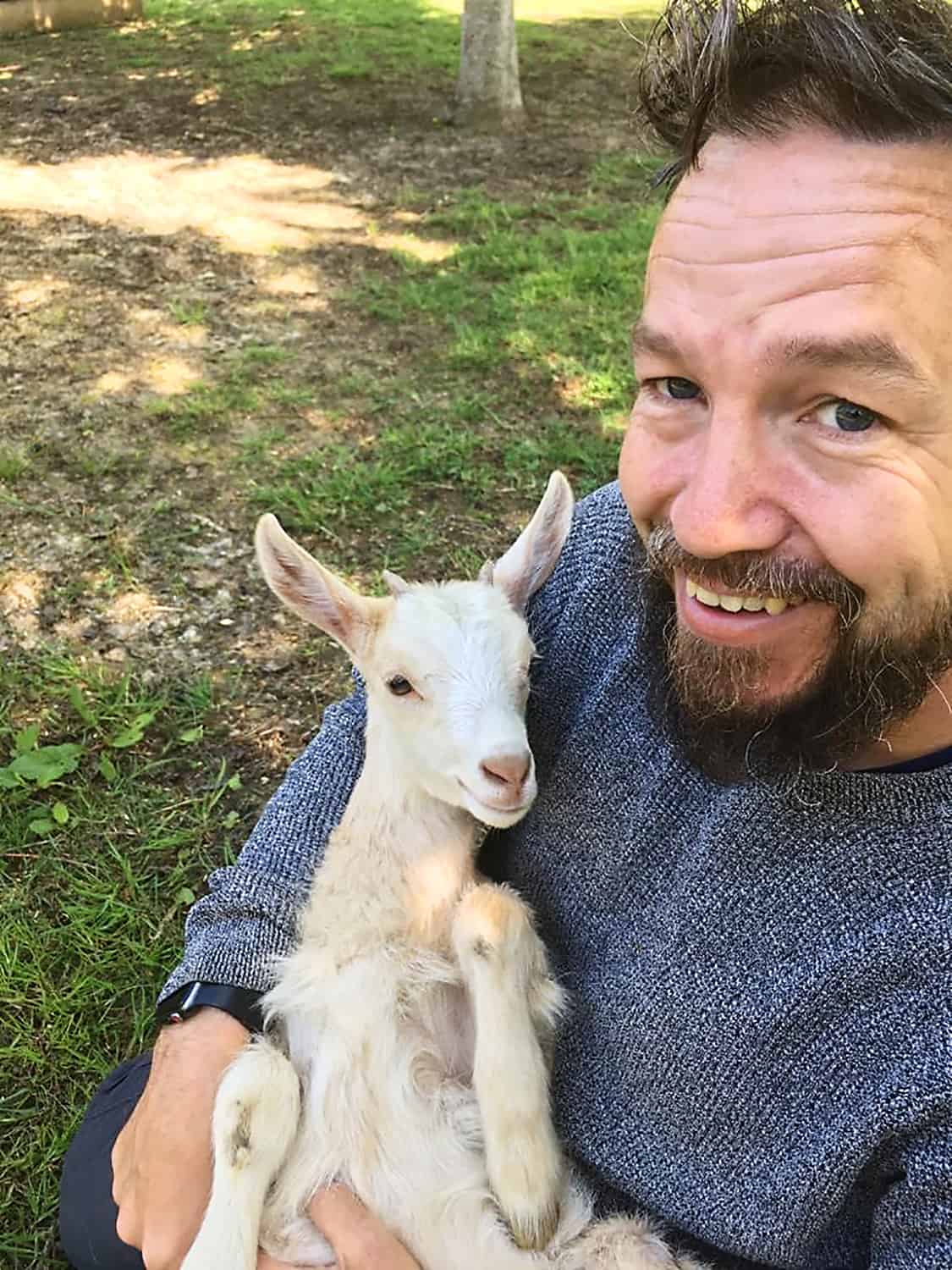
Carl spending a moment with a one-day-old baby goat, born in his garden from his milking herd

Big plans and new adventures

Sadly, the ‘Good Life’ is drawing to an end in Lovington as the owner of the farmhouse is reclaiming her property. But Carl is determined to continue his self-sufficiency adventure. “I’m planning to buy a field where I can create a learning centre and set up the smallholding again.

‘’My vision is that I can teach people the skills I’ve gained – the principles of permaculture, how to grow your own food, to preserve, to forage, to compost, to make cheese, bake sourdough, master the art of fermenting. I want to pass on to others all the things I’ve spent the last four years immersing myself in – things I didn’t realise I loved until we lived off the land.”

Find out more about Carl at Self Sufficient Hub. Carl’s Foraging Courses in Dorset and Somerset are now available – full details are on Carl’s website here.
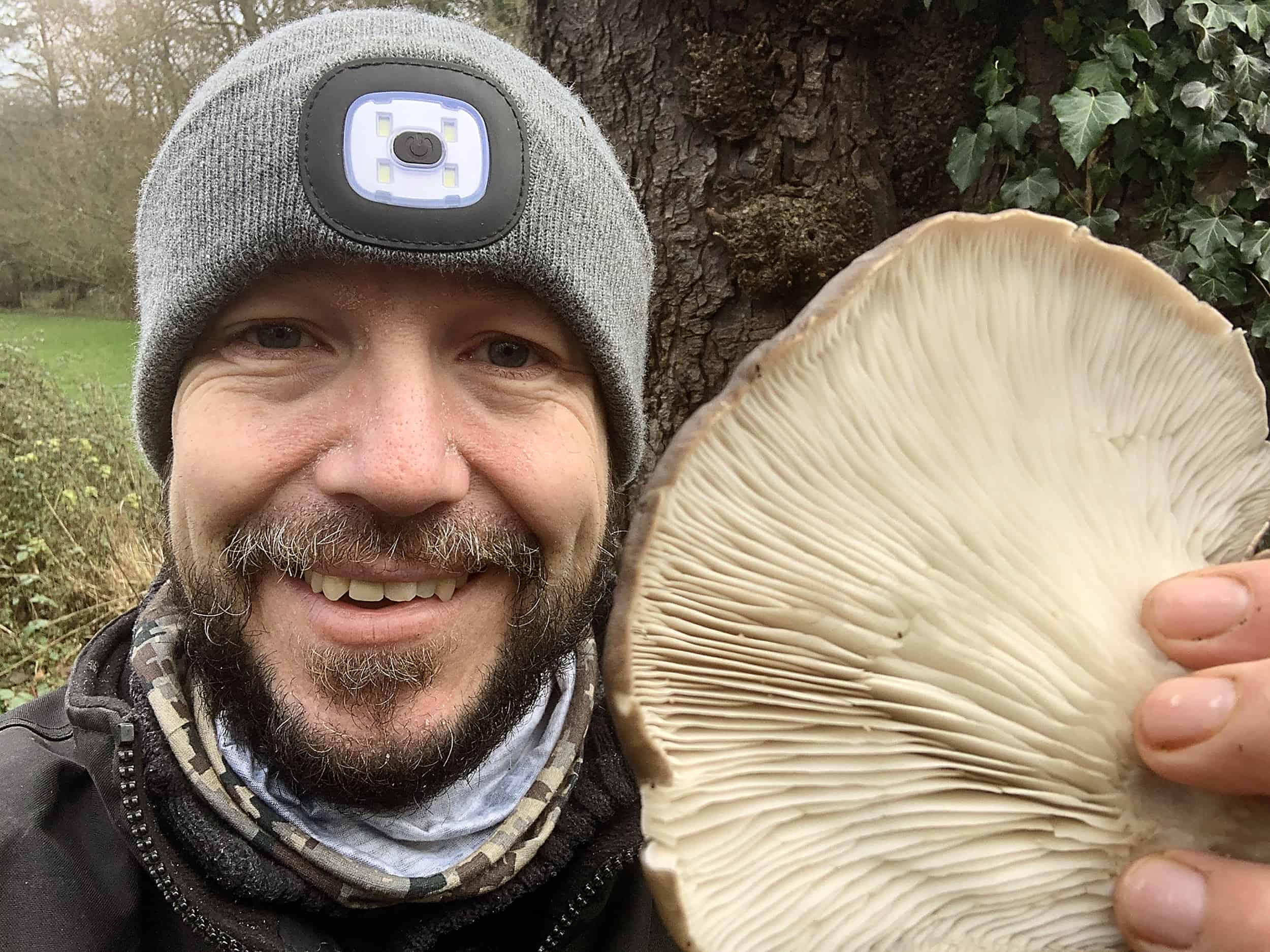
Carl harvesting wild oyster mushrooms which will feed his family (excess will be dried and preserved for use later in the year).

Quick-fire questions with Carl:

Favourite book?

The Encyclopedia of Country Living by Carla Emery; self- sufficiency learnt on the great plains of America, covering everything from milking a goat to midwifery.

Dinner party guest?

Sam Harris – neuroscientist and moral philosopher, master meditator – I’m a big fan of his.

What would be on the menu?

Something in season of course!

by Tracie Beardsley
Relief Milker Opportunity | Hemsworth Farm nr Blandford

0

Opportunity for a relief milker on an organic farm near Blandford Forum.

This is a permanent position, but a part time job, mornings only.

Extra hours are available for assistance with calf rearing.

Immediate start.

For more information, please contact Sophie on 07866 915305 or Email: [email protected]

He brings the gift of a Rose

0

The equinox on March 20th is a sad day for star gazers as that’s when days become longer than the nights, says expert Rob Nolan. But there’s still lots of astral excitement to observe.

NGC2244

Well, we’ve certainly had some changeable weather this past month, ending with storm Eunice tearing through the south west on Friday the 18th Feb. Certainly not conducive weather for star gazing by any means! High winds have been a theme recently. Given that we’ve just celebrated Valentine’s Day, it seemed only fitting to give you all the gift of a Rose this month! Like many, though, mine is a bit late for the 14th February…
The Rosette (or Rosetta) Nebula’s appearance in optical light resembles a rose flower, or the rosette, the stylized flower design used in sculptural objects since ancient times, and the nebula was named after the design.

The nebula has earned the nickname the Skull because it also closely resembles the human skull. I much prefer to see it as a rose though.

A beautiful nebula

The Rosette Nebula (NGC 2237) is one of my favourite objects in the winter sky to photograph. It’s an unbelievably beautiful nebula in constellation Monoceros, the Unicorn. It has an apparent magnitude of 9.0 and is approximately 5,200 light years away from Earth.
The nebula is a large cloud of gas and dust that lies near a large molecular cloud and is closely associated with the open cluster NGC 2244, whose stars were formed from the nebula’s matter in the last five million years.

The surrounding gas that forms a ring around the dark centre is glowing because it is being blasted by radiation from nearby stars (I know, I’m destroying the rose romanticism now), making the Rosette Nebula an emission nebula made up of hydrogen gas, giving it a red colour when imaged.

This image is also my first mosaic composition, which was created by stitching four separate images together to make the overall image, providing higher overall detail. Each Panel of the mosaic contains two and a half hours of data. This was shot in January this year using a Skywatcher 200 PDS Newtonian Reflector Telescope and Cooled Astro Camera.

The Night Sky, March 2022 – Rob’s tips for your stargazing this month:

Winter officially ends in less than a month on the 20th March. At which point we will pass equinox, and the days become longer than the night.
The most exciting changes may happen in the southern skies at the moment, but now is a great time to have a look at some of the northern constellations that are visible every night of the year. Cassiopeia, Cepheus, Draco and Ursa Major and Minor are all visible and should be explored. Gemini in the Southern Skies plays host to the bright stars Castor and Pollox.

Castor is actually a family made up of six stars, with three pairs of stars all gravitationally bound to each other, which can be seen when observing them through a small telescope.

Pollux is cooler, and appears more orange, but it’s also not alone. A planet larger than Jupiter orbits Pollux, called Thestias.
Gemini is also home to a beautiful star cluster, M35, which can be seen with the unaided eye despite being nearly 2,800 light years away from Earth.

Praesepe – also known as The Beehive – is a swarm of more than 1,000 stars, visible as a faint misty patch in Cancer to the unaided eye, between Gemini and Leo. It was first distinguished as a group of stars by Galileo – grab a pair of binoculars or a small telescope to take a closer look.

Other events to enjoy this month start on the 8th of March, when the Moon is near the Pleiades.
As mentioned, on the 20th March, the Spring Equinox occurs, a saddening time for astronomers as it marks the beginning of the end of the few long nights we’ve enjoyed during the autumn and winter months.

On the 28th March, just before dawn, look low towards the south-east to observer Venus with the narrow crescent Moon below. If you have a pair of binoculars to hand, you can also see Saturn and Mars in the vicinity.

Most of the planets in our Solar System are only visible just before dawn during March, with the exception of Uranus, which is observable by binoculars or a telescope all night long.

by Rob NolanFind RPN Photography on Facebook here

Wanted: live-in qualified carer | Ashmore

0

Live-in qualified carer required for 76-year-old disabled gentleman.

Shared rota including evenings, weekends, using hoists.

Some housekeeping duties.

Separate flat on-site, near Ashmore/Wilts.

Seeking DBS-checked non-smoker/driving licence.

Apply to: [email protected]

Dianne Mary Alice ‘s artful journey of self discovery

0

From garden design, journalism and fashion and textiles, to a new career as an artist, Dianne Mary Alice explains to Edwina Baines how she goes about her unique creative life.


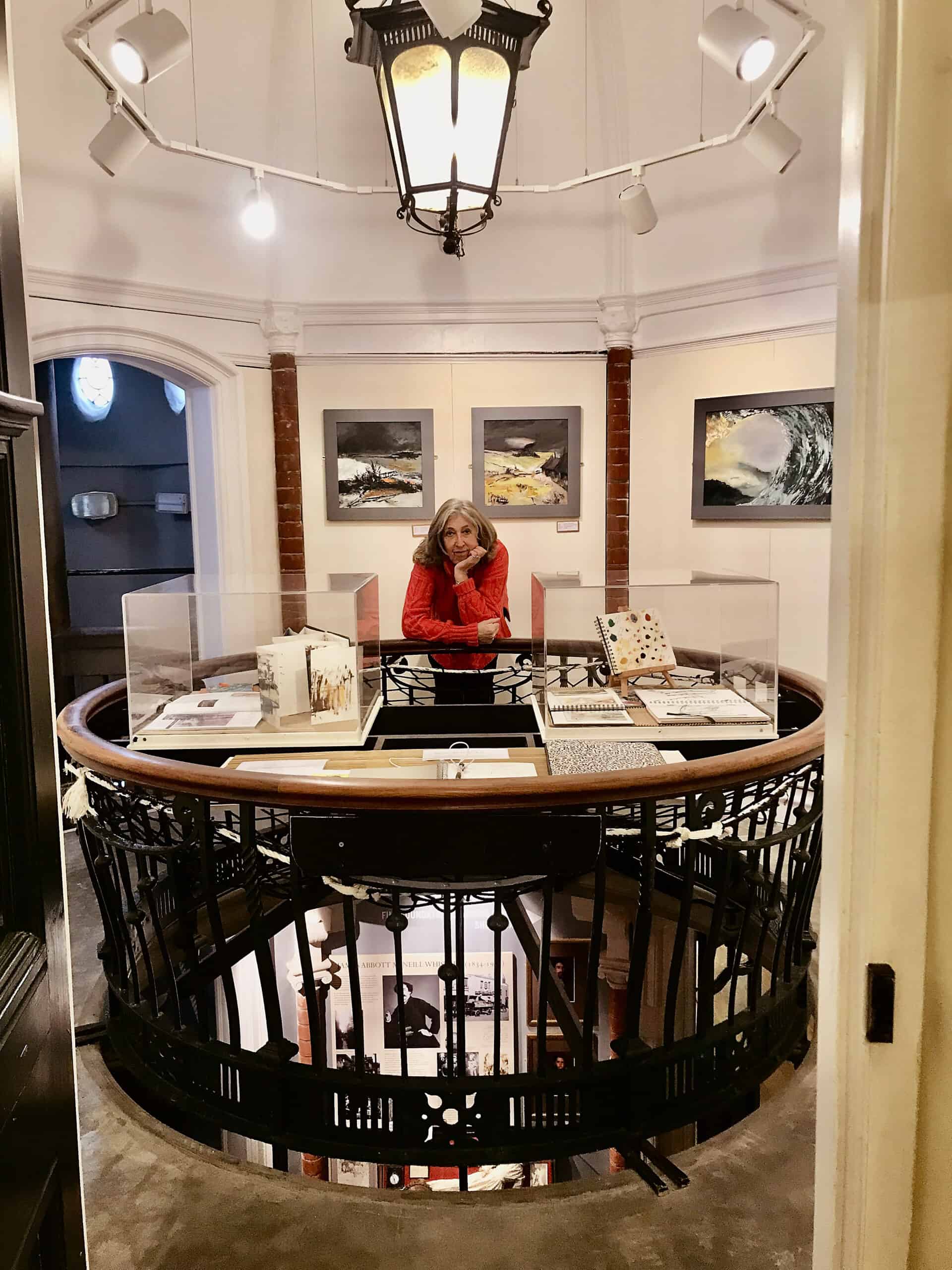
Dianne in the Rotunda Gallery, at the Philpot Museum, Lyme Regis with some of her paintings and sketch books image: Edwina Baines

The artist’s journey is a process of self-discovery, filled with doubts, dreams and challenges. From the issues of making a living and dealing with rejection to finding and expressing themselves in their true voice, the creative artist lives in a world of profound questions and subtle choices.

Charting her progress over recent years, Dianne’s first solo exhibition, entitled An Artist’s Journey, runs until March 6th in the Rotunda Gallery, at the Philpot Museum, Lyme Regis.
In one of the older parts of Lyme Regis, this museum stands on the site of famous fossil collector

Mary Anning’s home; and the Rotunda Gallery is situated at the top of its quirky tower – the glass dome providing a wonderfully lit space for display purposes.

A winding path

Every journey has a starting point: for Dianne it was a Fashion and Textiles course, followed
by theatre costume design and training for a knitting-machine designer and inventor.
For several years she worked in publishing, on Prima, the woman’s journal – before deciding on a change of course. After retraining, for the remainder of her career she worked as a garden designer: and as a lover of flowers, plants, landscapes, the sea and dogs, these motifs are now reflected in her artwork.
Locations have changed from Newcastle upon Tyne, Leicester and London but with a new home in Dorset came the move to full- time painting. During our drive from her home in Weymouth
via Symondsbury to Lyme Regis, Dianne chatted to me:
“I like to try new things and find out about different artists. I’m always yearning to learn more and experiment with different media. Colour and texture are important to me and perhaps that is why I like to use thick paint and a palette knife.”


A Dianne Mary Alice watercolour titled ‘Little Black Dog’, featuring her ‘chien de lapin’ Oliver, who she rescued whilst on holiday in France image: Edwina Baines

A Show Of Love

Lyme Bay Arts runs Sou’-Sou’- West Contemporary Art Gallery on the Symondsbury estate, where local artists exhibit throughout the year. The current one, ‘A Show of Love’, features one of Dianne’s mixed media collages entitled ‘Lovely Things’ and includes a picture of her dear little dog, Oliver (see above).

She explained, “When boating on the Canal du Midi in France we found him on the tow path in a very poor state (or perhaps he found us!); he couldn’t even stand.

A marvellous French vet said he might have a chance and a few days later he began to perk up, so we decided to keep him. The vet called him ‘un chien de lapin’ as similar looking dogs were used for rabbit hunting. He remains a bit of a hunter!”

From her home in Weymouth, Dianne can walk out with Oliver across the fields to Bowleaze Cove for local inspiration.

Here on the often-isolated sand and pebble beach, the big skies, reflective light and ever changing sea provides inspiration – and explains the colourful, exuberant vigour in Dianne’s work.

“Initial sketches and line drawings are done ‘plein air’ whenever possible, often moving on to underpainting in acrylic and ending with oil,” she explained.
There are several more Exhibitions in the offing. A new group show is being run by Casterbridge Arts Society in Poundbury, Dorchester, over the Queen’s Platinum Jubilee weekend in June. Focusing on conservation and preservation, it will be entitled “It’s Up to Us.” Dianne is hoping to work on a large canvas which will feature the theme of fish – a North Devon fisherman friend has provided lovely images for inspiration.

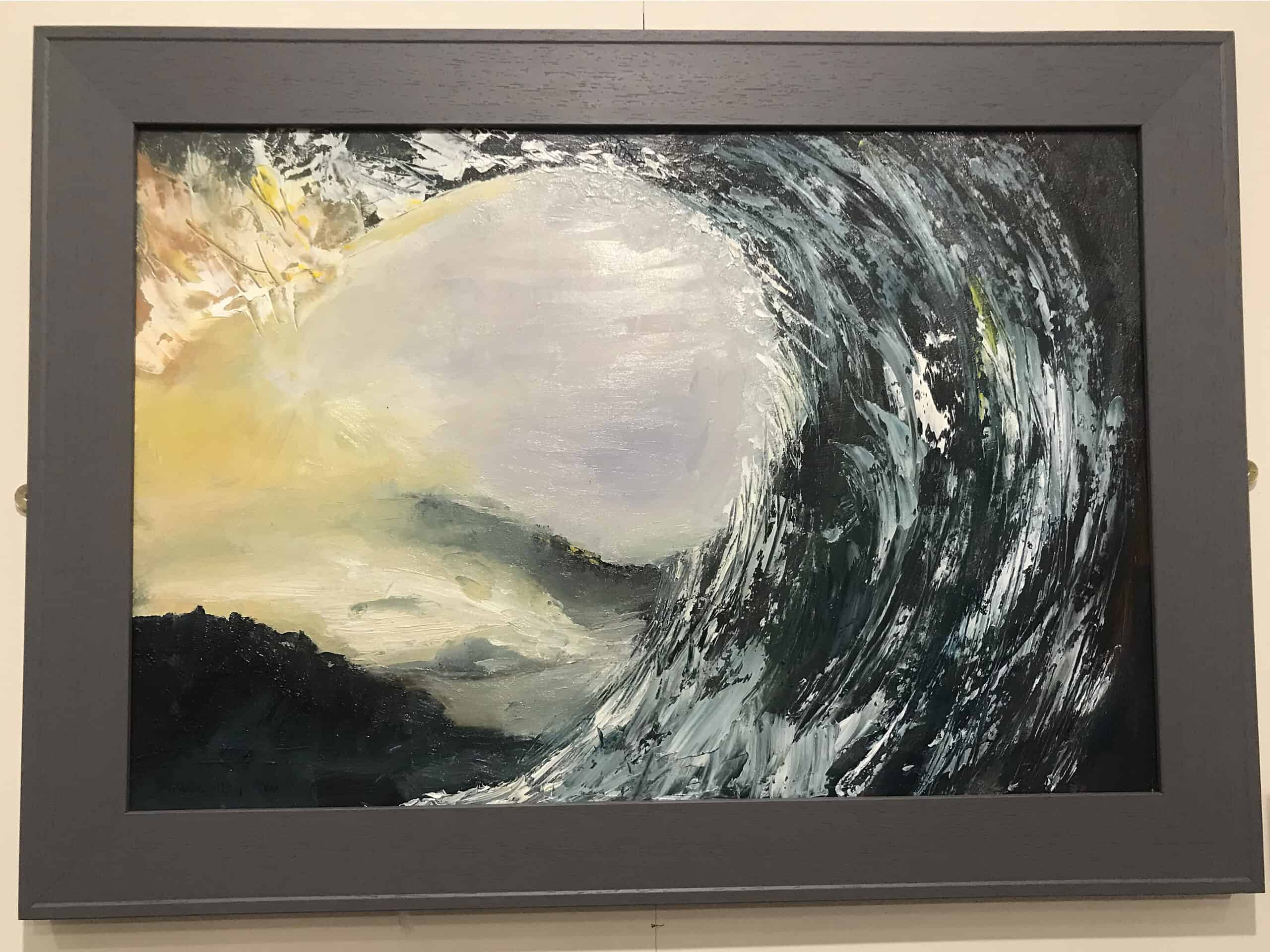
The wave – Oil : pictture by Edwina Baines

Take Three Artists

Over Mothering Sunday weekend, March 25th/26th, the ‘Take Three Artists’ exhibition will include Elaine Harris, Debbie Leech and Dianne Mary Alice showing their work in Upwey Village Hall. All three artists are members and volunteers of Artwey, a Community Interest Company of around 60 artists based in Weymouth, Portland and Dorchester. Their mission is to promote the visual arts through their website, exhibitions, open studios, art trails and workshops.
Members work in a variety of media from paint to print, sculpture to textiles, ceramics to photography and much more.

Elaine Harris is fascinated by the ebb and flow of a wave, a big sky, a foggy day, a wild bouquet, sunlight through leaves, the quietness of a still moment. She says of her work: “I photograph, I draw, I paint. I try out different and new techniques. I am on a constant quest to learn, to improve, to refine and to visually describe the image which I have in my head.”

Debbie Leech is keen to indulge her love of all things creative. She enjoys painting and printmaking and attends regular life classes and workshops. What she says could apply to all three of these artists: “My journey is on-going and I am still learning every time I pull a print, experiencing equal amounts of excitement and frustration. Seeking creativity in the many avenues of art helps to keep me sane and happy. It is such an uplifting feeling bringing something to life that is personal and original.”

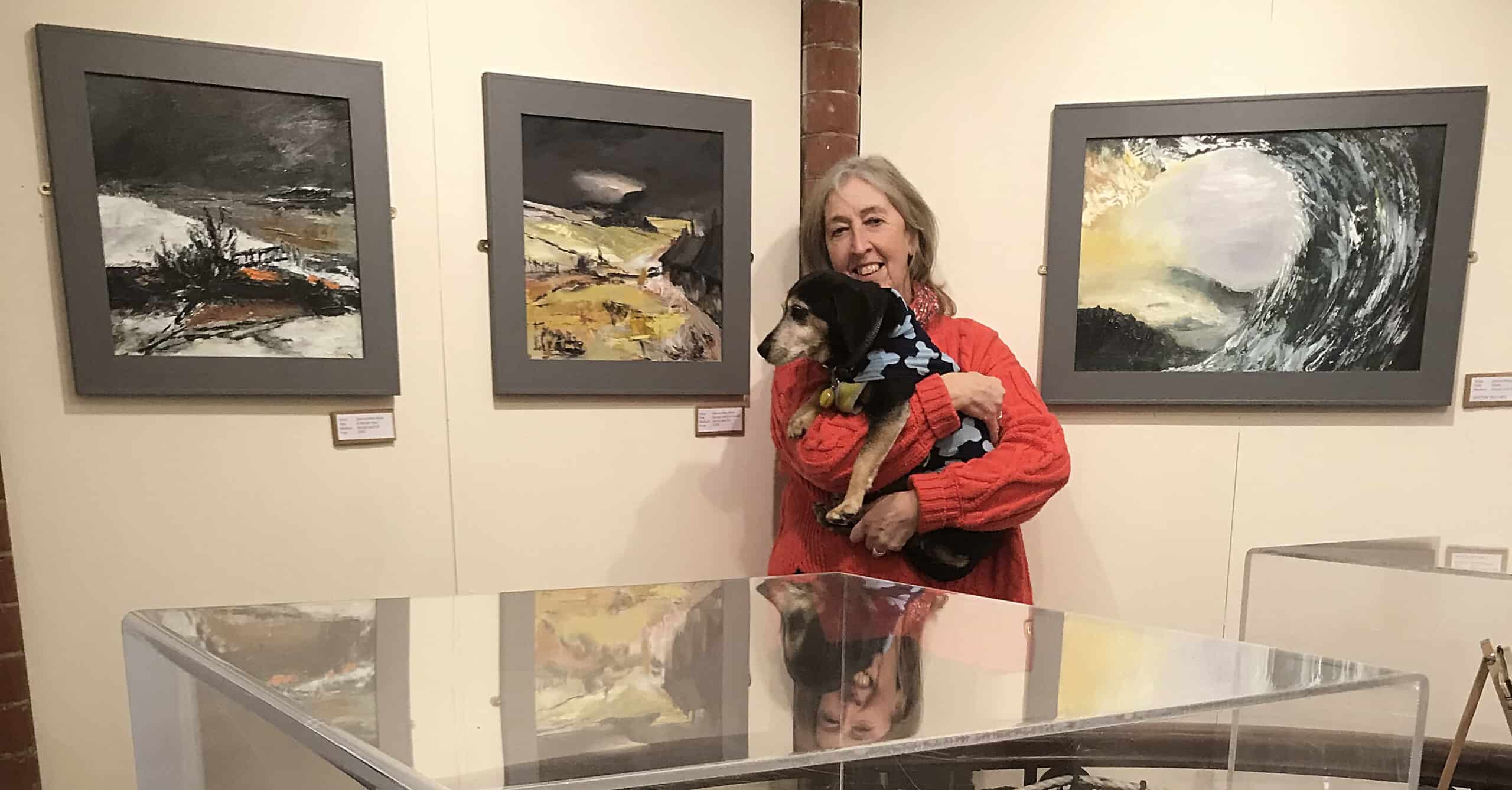
Dianne and Oliver in Lyme Regis’ Philpot Museum. On the right is the oil – The Wave

Looking forward to Dorset Art Weeks on 14 – 29 May, Artwey members will be exhibiting at the historic Nothe Fort at the entrance to Weymouth harbour for Dorset Art Weeks. Some dates to get in our diaries!

by Edwina Baines [email protected]

Do I need to use a solicitor when buying a house?

0

Expert help on common domestic legal issues from the team at Porter Dodson LLP.

There’s no legal requirement to do so, but using a solicitor for your house move reduces your risk, says Jenny Cottrell from Porter Dodson.

shutterstock

There is no requirement that you use a solicitor, or licensed conveyancer, when buying a house; you could choose to represent yourself. However, when making this decision, ask yourself: why should I consider using a solicitor when buying a house?

Protecting your investment

Using a solicitor will give you peace of mind that you have been advised of any hidden legal issues you might otherwise be unaware of. You will be reassured that you will be able to sell your property when the time comes without issue.

Less hassle

Buying a house involves dealing with lots of different people; estate agents, mortgage companies, the land registry, search providers, HMRC and the seller. Your solicitor will communicate with all these people for you, taking the strain of coordinating the process off you and making sure that all payments are made on your behalf.

Mortgage lenders may require that you do

If you need to take out a mortgage to finance your purchase, your mortgage lender may insist that you use a solicitor to ensure that their interest in the property is properly protected.

Your solicitor’s role

• Guide you through the process
• Carry out property searches to reveal any issues • Report to you on the legal aspects of the property and raise any questions with the seller that need to be answered
• Complete a stamp duty land tax return and pay any stamp duty land tax triggered by your purchase
• Report to your lender and deal with the transfer of mortgage funds
• Coordinate the exchange and completion of the purchase
• Register you as the new legal owner with the Land Registry.

So, whilst you do not need a solicitor to sell your house in England and Wales, the risks of doing your own conveyancing if you don’t have any experience are very high. Buying or selling a house can be
a complex process. Using a legal professional gives you peace of mind that the process will be completed correctly. It also allows you more time to focus on the other, more exciting, aspects of your house move.

We’re here for you

If you’re buying or selling a house, we can help you. To find out more, contact Jenny Cottrell:

[email protected] or 01258 444682.

Returning to fitness post-covid.

0

You might find something you’ll love. I did, says Mel Mitchell, who was dubious about enjoying an ‘aerial hoop’ fitness class.

Having worked my way through my own journey back to fitness, I thought I would talk about ways to get back to exercise post-covid. It’s safe to say the road to recovery will be different for everyone, and is dependant on a number of factors including the severity of the symptoms.

Covid as we all know affects the respiratory system – I was lucky enough to suffer only mild symptoms but even I was surprised how much it affected my breathing and chest during exercise.

Too much, too soon.
My advice would be to wait until you feel better and are free of symptoms before you begin exercising again. The tendency is to go straight back to the old routine, especially once you
are out of isolation and have your new found freedom. In hindsight, I probably returned to exercise too quickly. My chest definitely wasn’t prepared for my first CrossFit competition back that’s for sure! It’s important to listen to your body – at the end of the day, you are the best judge of how much you feel is enough. But even if you feel like you are fully recovered, adopting a slow return to fitness is definitely the best approach.
I made the mistake of assuming I was recovered enough to go straight back to the high intensity workouts that I was doing prior to getting covid. How wrong was I!

I ended up coughing and wheezing and feeling a lot more fatigued than normal for a full week after I thought I was fully recovered.
Getting back to exercise too soon and too hard may ultimately lengthen your recovery. Start
off slowly and work upwards, gradually building the intensity and length of your workouts over
a number of weeks. Listen to your body, and if symptoms return ensure you take a step back and rest.
There is still a lot we don’t know about the affects of covid and it will inevitably affect individuals in different ways. The key is to be patient, which I know can be difficult especially if you are anything like me and are used to being so active!

Huge growth in community-led projects…

0

…but we need more volunteers and more progressive action from town councils copying successful schemes elsewhere, insists Rupert Hardy, chair of North Dorset Council for the Protection of Rural England (CPRE)

Community-owned Thorncombe Village Shop

Over the last decade or two there has been huge growth in community-led ventures in Dorset, as well as the rest of the UK.

The drivers for this have been the reduction in services offered by local authorities, particularly during the austerity years following the 2008 financial crisis, when government cut back massively on its financial support to local government, with, for example, subsidies for local bus services being cut.
More onerous drink-drive laws affecting pubs, the growth of supermarkets undercutting traditional village stores, successive governments reducing the provision of social housing and a need
to provide roof-mounted renewable energy that will not desecrate Dorset’s beautiful countryside, have all been factors.

An increase in ‘belonging’

At the same time growing life expectancy has meant that more retirees have the time and energy to support volunteering and community- led activities, usually on a voluntary, unpaid, basis. Innovation
in ownership structures and arguably greater altruism have all helped too. Across the UK more people feel they are part of their local community, with around a third acknowledging that Covid has increased their sense of belonging.

There has been a growing realisation that communities need to act to reduce loneliness and isolation as the government has been slow to address longstanding issues, such as mental health.

The list of community-led or owned activities is long: community-owned pubs and shops; community transport; community land trusts; community energy groups; community kitchens and myriad other groups.

Dorset CPRE has been active in promoting many of these too, as we believe in community engagement and localism, opposing a government that remains too focused on centralisation and control of power.

Genuinely affordable homes…
Community-led housing covers a range of models, but community land trusts (CLT) may be the most significant, involving local people creating genuinely affordable homes on a non-profit basis. The concept was borrowed from the USA, where it was developed strongly during the civil rights movement era. The first community land trust in Dorset was set up more than a decade ago in Buckland Newton, but there are now over 20 here, with seven actually housing people. Oliver Letwin, the MP, was a great supporter of the concept. There are examples in Gillingham, Sturminster Newton and Fontmell Magna, while our Sherborne CPRE group is supporting a new one which hopes to take advantage of Sherborne Castle Estate’s wish to provide sites. Hastoe Housing Association manage many of the properties in Dorset.

Dorset CPRE support pubs and village shops, which are the beating hearts of our village communities, but they have been threatened by many factors, with COVID lockdowns affecting pubs brutally.
There are several community- owned pubs in Dorset and I am happy to eat at one in Shapwick, The Anchor, which produces delicious food. The designation of pubs threatened with closure as ‘Assets of Common Value’ has helped in their growth. Dorset CPRE run and judge the Best Village Shop competition in Dorset, and a number of community-led shops, such as Thorncombe Village Shop have won prizes. The Plunkett Foundation has been instrumental in getting such ventures off the ground, and there are now over 350 in the UK. They succeed as they engage the community, who are more likely to shop there, and they stimulate social activity. There are also community kitchens, such as Sherborne Community Kitchen created in Sherborne during Covid to help the vulnerable, staffed by volunteers. Most towns have community food banks too, such as Blandford and Gillingham, but without volunteers they would not exist.

Dorset Community Transport Minibus at Blandford

…and affordable solar panels
The phasing-out of domestic solar panel subsidies in recent years meant that individuals became reluctant installers, despite falling panel prices, while cash-strapped local authorities were unable to help.
However, community energy groups have sprung up with the goal of offering panels at very competitive rates. It is a growing movement in which energy generation is owned not by large industrial companies but by local communities, with the profits invested back into the community.
Last March Sustainable Swanage and community energy group, Purbeck Energy, launched a project, Solar Streets, to offer Swanage residents, as well as surrounding villages, the chance to get solar panels for their properties at discounted rates. They are using a company, IDDEA, which has already installed 1,000 panels across southern England.
The Swanage Mayor, Mike Bonfield, is fully supportive and praised it as a ‘brilliant scheme’. Swanage Town Council funds the Sustainable Swanage Projects Officer. How about some of our North Dorset towns doing the same?

Friends Supporting the Community- Owned Anchor Pub at Shapwick

Local transport schemes?

In the last decade a number of community transport schemes have got off the ground in Dorset towns and villages. This is in response to less public transport and the need to reduce rural isolation.

It would be great if government were to fund better public transport, but the chance of this happening appears remote.
Dorset Community Transport, based in Blandford, runs 50 minibuses across the county helping schools and groups. They are largely funded by Town and Parish Councils, and stepped in take over some of the bus routes which commercial operators pulled out of in 2017 after more subsidy cuts.
Bere Regis NeighbourCar offers a service run by volunteers using their own cars, for ‘anyone with transport difficulties’, while Milton Abbas runs a similar scheme. They both pay volunteers expenses.

DC now run a website to promote all community transport schemes, as well as offering £5,000 to fund new schemes.
Overall, it would be fantastic if more people came forward as volunteers so we can sustain the community spirit developed during Covid. Communities need you more than ever!

RURAL MATTERS – monthly column from the CPRE

Housekeepers & Cleaners Required | The Newt

0

Housekeepers and Cleaners needed.

£10 per hour plus guaranteed tips, free lunches, daytime hours, friendly team, rolling rotas, and fantastic benefits!

Interested?

Email your CV to [email protected]