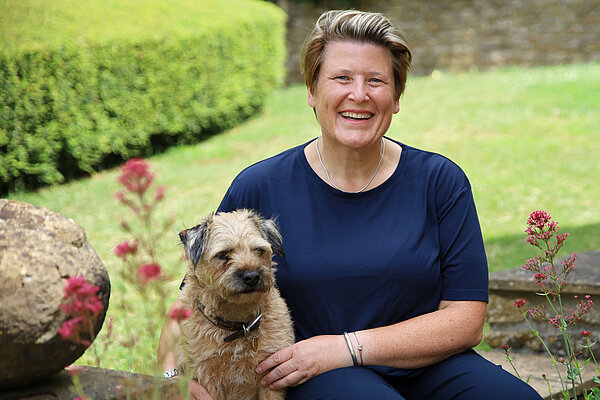
This month’s recipe is nice and easy and lovely and cosy. I am 100 per cent about the cosy right now. It may bring back early lockdown memories – remember when everyone seemed to be making banana bread? But this banana and chocolate cake is so simple to make and so delicious. As autumn draws in it’s perfect to enjoy in your snuggliest jumper with a hot cup of tea. I personally tend to leave my chocolate in big chunks – I think it works beautifully with the slightly squidgy texture of all the banana. This cake is also a great one to make with children, the recipe is quite forgiving and they can get stuck in helping break up the banana and chocolate! Heather
Ingredients
115g / 4oz butter
115g / 4oz soft brown sugar
1tsp vanilla extract
1 egg
3 bananas
200g / 7oz of chocolate
170g / 6oz self raising flour
60ml milk
Method
Preheat the oven to gas 5/160º fan and line a 20cm x 20cm (8” x 8”) tin.
Beat together the butter and sugar well. Add the egg and vanilla and beat again.
Add in the banana by breaking it into smallish pieces using your fingers and stir in.
Add the flour and milk and mix gently.
Finally, add the chocolate once you have broken it into pieces – the chunkier the better!
Spoon the mix into the prepared tin and bake for about 25-30 mins (check after 20 mins) until it’s golden on top and it springs back to the touch in the middle.
Leave to cool in the tin.
Heather Brown is a special officer for the Guild of Food Writers, and has worked in the food industry for 20 years. She is a food writer and photographer, offering one to one help to local businesses for content and websites.
Notes:
The large pieces of banana and chocolate will mean that a skewer probably won’t come out clean when it is fully cooked. It will be quite a dense bake but you are looking for the cake not to ‘wobble’ if you gently shake the tin.
You can finish this cake with a drizzle of melted chocolate on top if you wish.
You can also make this cake in a 2lb loaf tin. I would recommend lowering the oven temperature to gas 4/140º fan and baking for 45+ minutes to make sure its cooked properly all the way through.
In England more than 120,000 people died last year while on an NHS waiting list for treatment – double the number recorded in 2018. It’s a stark reminder of the impacts of long waits for care. While the additional pressure of Covid and the resulting backlogs will clearly have had an impact on these figures, there’s no dodging the fact that more than 13 years of Tory underinvestment in staff, beds, equipment and the NHS’s crumbling infrastructure has played a huge role in the crisis. Sceptics will quite rightly claim that the 120,000 figure does not accurately account for variation between NHS trusts. Nor does it link deaths to cause of death, or provide any further details on the person’s age and medical conditions. It doesn’t account for the nuance of each individual case. Indeed, it does very little in itself to illustrate the pain and agony that individuals and their families are experiencing in their final months while waiting for treatment that never comes. As such, the 120,000 figure merely emphasises the potential scale of avoidable human tragedy when waiting lists balloon to 7.6 million – a figure that indicates that almost one in seven of us is waiting for treatment. As waiting lists are set to increase further in the coming winter months – potentially reaching the nine million predicted by the Tories’ own ex-health secretary, Sajid Javid – Rishi Sunak’s key election pledge to cut NHS waiting lists lies in shreds. This is a tragedy of the Prime Minister and his Chancellor’s own making, born of their failure to get to grips with the key issues affecting the NHS, and their disgraceful ideologically-driven refusal to enter into meaningful discussions with the British Medical Association over pay and conditions of those that give us care.
been since a Newcomers’ Event has been held in Child Okeford but, on Saturday 9th September, it returned! There were 20 stands filling the village hall advertising village activities ranging from gardening to Subbuteo, and badminton to amateur dramatics – an impressive range of options, terrific for anyone looking to try something new this autumn.
Child Okeford residents were excited to welcome village newcomers
The event was to welcome new residents to the village, to show off what Child Okeford has to offer and to encourage new membership for the clubs. Despite the name, everyone was welcome at the event – old and new residents alike – and though the event clashed with the Cheese Festival in Sturminster Newton on the same day, plenty of people came along. The organisers say they won’t leave it so long next time!
We certainly live in ‘interesting’ times, and September was no exception. Thankfully there were some positive events in Dorset, of which more in a moment. On the down side, we saw yet more record-breaking weather. Remember that heatwave at the beginning of the month? As I write we see another weekend of unseasonally warm temperatures on the forecast. In spite of all the warning signs of our changing climate, the government chose this month to begin rowing back on its previous net zero pledges. It even claimed to be fighting against a completely bogus ‘war on motorists’, which looks like a desperate effort to drag itself back up the polls by appealing to the minority of the population who still think global warming is someone else’s problem to deal with.
Dorset goodness Putting such madness to one side for the moment, happily there were two really positive environmental events here in Dorset. On 9th September a Conference of the Parties (COP) was held in Dorchester’s historic Corn Exchange, making Dorset the first county to hold such an event. Something to be proud of – and let’s hope others will follow us. Three of Dorset’s leading climate and environmental action groups joined forces to organise the event – Zero Carbon Dorset, Dorset Climate Action Network (Dorset CAN) and Sustainable Dorset. The conference echoed the annual international COPs, where representatives of world governments seek to address the critical issues of climate change and the environment. The objective was to inform, engage and galvanise Dorset residents into greater action to tackle the issues around climate change and the environment. The day was packed with excellent sessions and the crowded venue buzzed with enthusiastic attendees all day. If you’re sad to have missed it, you can catch up via YouTube here as the live sessions were recorded. The other inspiring event this month was the ten-day Planet Purbeck Festival from 15th to 24th September. There was a huge range of activities, too many to list here, so see for yourself on the Planet Purbeck website. Again, the enthusiasm of presenters and attendees was heartwarming. Everyone was committed to learning from one another and eager to work together to find the solutions we so urgently need. If only our government was so inclined, instead of focusing on division and delay.
In 1811 Dr John Fisher introduced his nephew, John Fisher, to Constable. The younger Fisher became the artist’s closest friend, providing moral and financial support whenever they were needed and often purchasing works from Constable which he could ill afford.
Gillingham mayor Barry Von Clemens and artist and sculptor Sasha Constable, descendent of John Constable, unveil the new board
In 1819 Fisher became Vicar of Gillingham in Dorset and Constable was invited to stay there in 1820 and again in 1823. During these visits, he made sketches around the town and completed two known works in oils. The Bridge at Gillingham, of the bridge with the village church beyond, was painted during his second visit and is now housed in the Tate Gallery, London. Parham’s Mill, the second painting, is housed at the Fitzwilliam Museum, Cambridge. Fisher’s son Osmond later recalled seeing Constable ‘sitting with his easel in the meadow at the right hand corner’. Gillingham Town Council has commemorated the bicentenary of its connection with John Constable by unveiling a new information board at Gillingham Town Meadow, close to the river and the bridge, which tells the story of the two famous paintings and Constable’s connection with Fisher and the town.
North Dorset is home to ancient broadleaved woodlands which are a testament to the enduring power of nature. Standing tall and proud among the towering canopies of trees are, of course, the impressive English oaks which can be found at many of Dorset Wildlife Trust’s woodland nature reserves including Bracketts Coppice and Hibbitt Woods near Yeovil. They are often the oldest trees in the wood, hundreds of years old and supporting thousands of species. Ancient woodlands are also home to many of Dorset’s rare species. Their diverse mix of trees, shrubs and other plants support all manner of wildlife. Woodland butterflies like the white admiral and silver-washed fritillary can be seen basking in sheltered sunny areas. Birdsong often fills the air with resident birds like song thrushes, marsh tits and great spotted woodpeckers joined by summer visitors like chiffchaffs, blackcaps and spotted flycatchers. Roe deer can often be seen as they cross the grassy rides and during the night, hazel dormice climb among the trees and brambles in search of food and nesting material. Ancient skills Looking after our woodlands and ensuring wildlife continues to thrive there requires a lot of work from Dorset Wildlife Trust’s wardens. One of the most important ways in which we manage many of our woodland reserves is through coppicing, where a tree is cut down to a stump, encouraging new shoots to grow and ultimately regrowing the tree. It’s an old method of managing a woodland, and something people have been doing for thousands of years. Traditionally, coppicing provided a continuous and sustainable supply of timber and materials, used in a huge range of things from thatched roofs to charcoal making. It takes advantage of the fact that almost every broadleaved tree native to the UK will regrow from the base if cut down when young, with several stems growing from the original stump. It’s the method by which it is hoped the tree recently felled at Sycamore Gap in Northumberland may yet be preserved. As the warden responsible for both Ashley Wood near Blandford and Girdlers Coppice at Sturminster Newton, I spend many a winter’s day in these woods coppicing, often with the help of our antastic team of volunteers. Each winter, when the trees are dormant and the birds have finished nesting, we coppice one or two small areas – known as coupes – in each woodland. It is always a popular task with our volunteers. Working in the woods, using age-old techniques to give the woodland a helping hand to provide an ideal place for wildlife … what’s not to like?
A carpet of wildflowers will usually follow when coppicing lets new light and space into an ancient woodland
Breathing life into old wood Coppicing can have huge benefits for wildlife, with many species responding to the newly-created open areas within a previously-dense and dark wood. It is no coincidence that the decline of many woodland species over the last century has coincided with the decline in coppicing in the UK. The increase in light and warmth in a newly-coppiced area stimulates new growth. Come spring, there will be an eruption of bluebells, wood anemones, violets and many other woodland flowers. These valuable nectar sources, along with the warm sheltered conditions, attract insects – which in turn attract birds, reptiles, bats and other small mammals. So, I urge you to get out there and visit an ancient woodland. Take a moment to listen to the birdsong, take in the earthy scent of damp moss and fallen leaves – and contemplate the centuries that have passed within that wood. May there be many more to come.
It’s a mixed package for the first of the October podcasts. After the usual start with the letters, we delve straight into the politics columns. Then Jenny has a fascinating conversation with Dorchester Literary Festival’s co-organiser Janet Gleeson, and Terry talks to Pauline Batstone who’s currently in Bridport … the one 11,000 miles away in Tasmania!
Letters. As usual we start the month with the letter from the editor, in which Laura looks for the goodness of humans – and shares an only-Laura tale of four cheeses – as well as all the BV’s reader’s letters.
In politics this month, newly-elected MP for Somerton and Frome, whose consituency encompasses the western end of the Blackmroe Vale, sets out her plan of activity for the coming months. Ken Huggins from the Green party looks at Dorsets first COP – and the inspiring positivity surrounding the event. Labour’s Pat Osborne is raising an eyebrow at the rising NHS waiting list – and looking at the far-reraching consequences of them. West Dorset MP Chris Loder has launched a campaign to make the stretch of A30 between Sherborne and Yeovil (a stretch he calls an ‘unofficial racetrack’) safer.
Jenny sat down withDorchester LitFestorganiser Janet Gleeson to look at some of the highlights of this year’s much-anticipated festival, with a round up of authors from Victoria Hilsop returning for a third visit to first-timer Lemn Sissay, one of Janet’s personal favourite poets. Together they discuss the appeal of non-fiction authors at literary festivals, how unpredictable the success of any talk can be … and also to hear about the nuts and bolts of running such a large, popular literary event.
Lastly, Terry chatted to Cllr Pauline Batstone who is currently 11,000 miles away – just outside Bridport, near Weymouth. I’ll leave her to explain how…
On the edge of Milton Abbas is a haven of local, fresh and sustainable produce – Rachael Rowe meets the man who grows it
Steeptonbill Farm Shop in Milton Abbas – All images: Rachael Rowe
There’s something about the award-winning Steeptonbill Farm Shop that makes you want to start cooking. Whether it’s the freshly dug artichokes and beets or the vibrant display of squashes, I’m resisting the urge to reach for my cookery books and make the most of the seasonal produce. Owner Steve Gould says: ’I’ve been here for 15 years. Previously I was in the public sector for 28 years. What I aim to do is support the small local growers so they can carry on growing high quality food. We only do seasonal here – you won’t find green beans from Kenya. Look at these artichokes and chard! I dug them up this morning. You can’t get fresher than that.’ Or can you? He hands me a couple of fresh eggs, still warm, just collected from the farmyard next to the shop. Hens run loose in the yard – free range at its finest. The squashes outside the small shop are eye-catching with their autumnal flashes of orange and golden yellow. Naturally, Steve has grown them. ‘I don’t use any pesticides or chemicals. I just use the ducks, they love the slugs and snails! ‘I wish in my lifetime I could get everyone to enjoy good food.’ The shop in Milton Abbas is open seven days a week, and Steve works at the shop when it’s open. Andrea, who lives in the village, helps with their busy social media channels. Steve delivers the fresh produce to restaurants and pubs across Dorset. ‘I go to Dorchester, Cattistock, Portesham, Weymouth and Abbotsbury. Some chefs like to come here and dig their own parsnips, artichokes and leeks to show how fresh and local they are. When I’m not out delivering or needed in the shop, I’m working on the farm. ‘It’s so important to know where your food comes from. We are what we eat. Take this beet – I planted the seed. I watched it grow. I looked after it. I know the life it has had in the soil. I know its history and where this food has come from. Can you say that about what you get in supermarkets? The supermarkets are killing us growers. When we’re gone, we’re gone.’ Steve is irate about the cost of potatoes. ‘Last year British spuds were £5 to £7 a bag. This year they are £26 to £28! It’s because potatoes need to be stored cold to stop them chitting. The growers told the supermarkets that they need to put the price up by £1 a bag to meet the costs of the energy for cold stores. The supermarkets refused to increase the price so the spuds were used as animal feed – and the price increased.’
Raw local honey is always a best-seller
Pork and marmalade sausages Steeptonbill Farm Shop is packed with local produce. There’s bread from Oxford’s Bakery, un-homogenised milk from Meggy Moo’s, Purbeck ice cream and cheeses from Yeovil. What are his most popular lines? ‘This local raw honey. And more local honey from near Blandford. I sell loads of it, it’s so good. Of course, all these producers are local people. I spend most of my money in Dorset and so do they. It all helps the local economy.’ The colourful stand full of Haribo and marshmallows stands out like a sore thumb from the ethos of local food but there’s a simple reason for its presence. ‘That’s the tuck shop for Milton Abbey School just down the road. They’ll come up here and clear that out!’ There are also chillers full of tempting meat and meat products – Steve raises his own livestock on the farm. ‘I used to have 280 pigs! I have my own breed. I take a Saddleback sow and cross that with a large white pig. Then I cross with a Landrace so they get a long back. Then I use a Danish Duroc breed that gives lovely marbling to the meat. ‘My pork and marmalade sausages are really popular,’ he says. In his spare time, Steve is a judge of rare breed sheep at local shows. He is also an active member of the community in Milton Abbas. ‘I’m a parish councillor and my portfolio includes flood awareness and footpaths. I’ve also been involved with the local play-park, where a group of us fundraised for new facilities. We all need to be community players.’
Steve Gould with some of the vegetables he grows
A vocal campaigner Even with such an apparently successful business model, Steve still struggles with one big factor. ‘A lack of customers. During Covid we had 600 people a day here, as everyone got out and about and enjoyed shopping locally. But that has really gone down as people have gone back to the supermarkets. It’s also the pressure that farmers are under with the price of feed and fuel. ‘I’ve known several local farming colleagues who are really affected psychologically by the stress. ‘I am most proud of my knowledge of what I grow and my expertise in helping people to eat healthily. I love helping people to enjoy food. A lady asked me recently how to cook a leg of pork – she wanted to stop eating ready meals. But all she had ever used was a microwave. I talked her through what she needed to do and she really enjoyed it.’ ‘During Covid Steve really stepped up beyond all expectations to help people,’ Social media expert Andrea says: ‘What he has achieved is truly inspirational. He is a voice for farming and high quality produce.’
Find it: Steeptonbill Farm, Milton Abbas, DT11 0AT Mon to Sat 9am to 5pm Sundays 9am to 4pm Facebook: steeptonbillfarm
Two months into the job, the LibDems’ Sarah Dyke takes a moment in her first column to look back – and to outline her plans for the future
Sarah Dyke
It has been just over two months since I was elected as the new MP for Somerton and Frome – a whirlwind experience but also the honour of a lifetime. I would like to use my first BV column as an opportunity to reflect on my first few weeks in office, and to set out my aims. I am determined to stand up for our area and to fight to ensure my constituents get a fair deal. Since being elected I have been active throughout the constituency. I held a village tour earlier in the summer where I met with as many people as I could and listened to their concerns, both local and national. I will be holding regular surgeries and you can also get in touch by writing to [email protected].
Hit the ground running On my first day in Parliament, I pressed the Secretary of State for Education on the RAAC crisis and I also raised the deep local concerns over the lack of NHS dentists and GP appointments by writing to the Secretary of State for Health and Social Care. I have asked for a meeting with the Secretary of State to discuss these issues and to hear about the steps his department is taking to resolve the shortage. Everyone should be able to access an NHS dentist if they need one – and no one should be forced to pay hundreds of pounds for private care. The Liberal Democrats have called for proper workforce planning for health and social care – including provisions for dentists and dental staff – to be written into law. I believe this is crucial in order to provide the level of overall care people in Somerset (and everywhere else) deserve.
Healthy water I also want to use my position to campaign on the state of our natural environment. I am seriously concerned about the health and welfare of our rivers, which have been massively polluted over recent years. Our natural environment has to be something that we can all take pride in, and I will fight for this to be the case. I have written to the Secretary of State for Levelling Up, Housing and Communities to urge him to support Somerset Council’s bid to introduce modular water treatment units at wastewater treatment works. This project will help to unlock vital housing in Somerset while ensuring that our natural environment is protected. Finally, can I take this opportunity to say thank you to everyone who supported me at the recent by-election? I will continue to work hard for our local community and to be your voice in Parliament.
The Somerton and Frome constituency may be a Somerset one, but it naturally overlaps with the Blackmore Vale area, stretching as it does north of Sherborne to Milborne Port and Henstridge up to the A303 and Wincanton.