

Come and visit us.
13th May 2023
Register with us today by scanning the QR code in the advert.

Come and visit us.
13th May 2023
Register with us today by scanning the QR code in the advert.
Nestled amidst the idyllic landscape of Dorset, the enchanting market town of Wimborne Minster beckons travelers with its rich history and stunning architecture. A constant winner in regional and national awards, this picturesque town sits gracefully on the banks of the rivers Stour and Allen, boasting a past that stretches back to pre-Roman times it’s a town of kings, smugglers and ancient legends. As you stroll through the charming streets, you’ll be captivated by the town’s captivating blend of old-world charm and modern comforts.

Steeped in history and surrounded by stunning scenery, Wimborne Minster is crowned by its namesake – the grand and gracious Minster itself. The church, a testament to the town’s rich past, is an architectural marvel and a centerpiece of Wimborne’s charm. As you stroll through the town, you’ll find a harmonious blend of ancient and contemporary, with traditional cottages sitting alongside modern buildings, creating an atmosphere that is both nostalgic and vibrant.
One of Wimborne Minster’s most celebrated attractions is its lively independent shopping scene; it’s a shopaholic’s must-do destination with chic boutiques and stylish independents alongside familiar nationwide brands. Wimborne is easily walkable along its charming streets and traffic free areas, and it has a popular farmers market full of local produce and artisans.

Win a Mini Break in Wimborne Minster!
BV magazine is delighted to offer our readers the chance to win a fabulous mini break in Wimborne Minster! The lucky winner will receive a two-night stay for two at the charming 1777 at The Albion Inn, with bed and breakfast included. Renowned for its sumptuous rooms and outstanding breakfasts, it’s the perfect base from which to explore the wonders of Wimborne Minster. Don’t miss out on this fantastic opportunity to experience the delights of this picturesque town – enter below for your chance to win.

To be in with a chance to win two nights B&B stay in Wimborne, just answer the first three questions in the widget box below. There are more chances to win by completing the other entry options if you so wish – they’re entirely up to you! The closing date for this competition is 31st May 2023 and only entries received on or before that date can be included. The prize will go to the first randomly chosen entry. Good luck, and happy travels!
Win a short break in Wimborne Minster
On the doorstep I repeatedly hear support for more pay for doctors, nurses, teachers and public sector worker … for more investment in clean water, in our decaying roads, for social care and in new hospitals. This is almost always swiftly followed by an equally passionate demand for less tax, both local and national.
They say a camel is a horse designed by a committee. Is the answer to the balance between taxation and spending one of strong leadership, backing one particular approach to avoid the compromises that create camels?
It is a sad truth that economic theories are only ever right in retrospect and even then only in their explanation of errors and omissions. It feels a bit like football referees and VAR – and how unpopular is the killjoy that disallows the goal at the height of its passionate acclaim. How often would we prefer the exciting dream over the prosaic truth?
The trouble is, that is how charismatic scoundrels can rise to the top – ‘never mind the truth, never mind your best interests and follow me for the ride of a lifetime.’ The inevitable outcome? Disappointment, disillusion and a hefty hangover.
As we head into the election season that will be with us for the next 12 to 18 months, both here and across the Atlantic, we should look deeply into what is said and the people saying it. We need to think long and hard about our experience of the last 13 years.
Political VAR
It has been said of those who run large organisations that once at the top, they need to lose the mindset and behaviours that got them there. Looking around the world at dictators and monomaniacs, they all seem to build on the ruthlessness that elevated them, believing they can have their position in perpetuity and ride roughshod over humanity, decency, fairness and truth in the pursuit of their personal visions and vanities.
Fortunately, we do have checks and balances. For every power-mad political ref, we have VAR in the shape of a regulator or quality commission. The only “buts”, perhaps, are that sometimes it appears a regulator has too little power (I give you sewage spills, internet, energy bills) while others can seem to have too much, or use their powers in too simplistic a way.
Our ultimate recourse is to the independence of the judiciary and the humanity, knowledge and understanding of our elected policymakers, both local and national. However, if we give one faction too much credence for too long, then we start to undermine the inherent strengths of the system. They start believing they – and only they – are right.
What matters most, then, is the quality and capability of our chosen representatives.
Let’s pick the best.
Mike Chapman, North Dorset Liberal Democrats
The Clayesmore Lecture – Friday 12 May 2023, 7.00pm

Get ready for an enlightening and entertaining evening with Rory Bremner, the multi-talented impressionist, comedian, presenter, ballroom dancer, and actor, as he takes to the stage for the Clayesmore Lecture 2023.
Rory Bremner is not just a famous performer; he is also an advocate for neurodiversity and ADHD awareness. With a personal experience of living with ADHD, Rory shares his thoughts and insights on how to embrace the positives of “thinking differently” and the impact of neurodiversity on his life. He describes ADHD as his “best friend and worst enemy” and passionately champions the positive discussion surrounding the condition.
Rory Bremner was educated at Wellington College and King’s College London. He is best known for his political satire show, Bremner, Bird, and Fortune, where he wrote and starred. His talent and hard work earned him back-to-back BAFTA awards for Top Comedy Performance in 1995 and 1996, along with three Royal Television Society awards and two British Comedy Awards.
Join us for an evening of laughter and learning as Rory Bremner shares his experiences and insights. Don’t miss out on the opportunity to see one of the UK’s most beloved performers and advocates for neurodiversity on stage. Book your tickets now for the Clayesmore Lecture 2023.
The Clayesmore Lecture – Friday 12 May 2023, 7.00pm
Tickets are £25 each book here – Rory Bremner
A local expert from Citizen’s Advice provides timely tips on consumer issues.

Q: “ I ordered a watch online with personalised engraving for my partner’s upcoming birthday. The company has since gone out of business. I keep phoning and emailing them but can’t get through to anyone. I’m assuming they can’t fulfil my order, but I’d paid for the watch upfront and can’t afford to buy another gift until I get my money back, please help?”
A: This is a very frustrating situation, especially as you’ve already parted with your money and spent time searching for a suitable gift for your partner’s birthday. If the company’s gone into administration, it may still be able to fulfil outstanding orders. But if the company is already in liquidation, you’ll need to try to get your money back. If you’re unsure about what state the company is in, the Citizens Advice website has information on how to find out.
As the company hasn’t responded to your calls or emails, is there a shop or office you can visit or write to, to get an update on your order, or request a refund? If that isn’t possible, the next steps depend on whether it’s a limited company (it will have ltd or plc after its title) or if it’s a sole trader (someone who runs their own business) or partnership. If it’s a limited company, you’ll need to get details of the administrator or receiver – the person dealing with settling the trader’s debts. The names of those administrators will usually be on the website of the company that’s gone bust.
You should register your claim as a creditor on the GOV.UK website. Fill out the form with details of what you’re owed and send it to the administrator dealing with the trader’s debts. Unfortunately, there’s only a small chance you’ll receive any money back because you’ll be last in a long list of creditors who need to be paid.
As the order was online (and you therefore presumably paid by debit or credit card) you could also try getting your money back with a Section 75 claim or a chargeback claim to your card provider or bank. Full details about both these types of claims can be found on the Citizens Advice website. If the seller was a sole trader or partnership and not a limited company, pursuing a Section 75 or chargeback claim is your best option.
Every case is different when traders go under, but you can call the Citizens Advice consumer helpline to find out exactly what your rights are: 0808 223 1133 or visit the Citizens Advice website here for more details.
Sponsored by Wessex Internet
Rupert Hardy, Chairman of North Dorset CPRE, takes a look at Mapperton, the Dorset country estate creating its own version of Knepp’s rewilding in Surrey

Luke and Julie Montagu took on the challenge of running the family estate at Mapperton, near Beaminster, in 2016 from Luke’s parents, the Earl and Countess of Sandwich. They quickly began introducing many positive changes, but the biggest has been the decision to rewild part of the 1,900 acres they own.
Inspired by the success of the Knepp Estate in Sussex, the Montagus are now using rewilding, traditional conservation and also regenerative farming to deliver major ecological benefits – as well as offsetting the huge expenses of maintaining the historic house, the Italianate gardens and their four farms.
Rewilding began in 2021, using the 200 acre farm at Coltleigh; another 257 acres will be added this year and further 500 or so later. The aim is to restore the degraded landscape which features beautiful but marginal agricultural land. For the rewilding sceptics, this really is not good agricultural land. Extensive ecological surveys were conducted to help identify key habitats and the benefits of rewilding. The estate is introducing large grazing herbivores which will replicate the low-intensity grazing comparable to the Mesolithic Period.
White Park horned cattle, Exmoor ponies and beavers have all been brought in, and the cattle will be managed using virtual fence technology and electronic collars in order for internal fencing and gates to be removed in the rewilded area. It is hoped that after ten years or so, virtual fencing can be dispensed with too. These herbivores help create habitats by dispersing seeds and nutrients through grazing, browsing, trampling and rootling. Broadleaf tree species are being planted and new ponds created to support a wetland ecology.
Beavers should be able to help with flood alleviation as they are master ‘ecosystem engineers’. Hunted to extinction in the UK in the 1600s due to the value of their pelts, they are being reintroduced selectively.
New to Mapperton this year will be the introduction of Iron Age pigs, which look like wild boar. Pine martens are also being considered. Driven game shooting is now stopping but the estate will still have a sustainable rough shoot. There are wild deer on the estate and these still need to be culled to manage the health of the herds.
Luke wants to carry out research into the rewilding process, and plans to work with both Reading and Bournemouth Universities on various projects.

Mapperton vs. Knepp
Comparing Mapperton with Knepp, there are some clear differences in approach. All of Knepp has been rewilded, while half of Mapperton – where there is better land – will still be farmed, with a focus on regenerative agriculture, placing soil health at the core of the farming practice. Crops are sown using direct drilling with no ploughing and minimal use of fertilisers and pesticides. All these will improve biodiversity and lead to better recycling of farm waste, carbon sequestration and more nutritious food.
Luke is well aware that Mapperton is more remote than Knepp, so the estate is relying far more on virtual visitors. He and Julie have previous career experience in film and reality TV, which has helped in developing a strong social media presence for Mapperton abroad, especially in the USA. They already have 130,000 subscribers to their YouTube channel. They also have a Patreon community, who pay extra to get exclusive video of what is happening at Mapperton. Potentially these virtual visitors can become real visitors this year, as the couple will be organising Grand Historic Tours in Dorset, commercially aimed at wealthy Americans.
If you look at the physical visitor stats, half come from Dorset. However, only 0.5 per cent of Dorset residents have ever visited Mapperton. There is clear potential here for the estate, especially with the plans to make the estate a more family-friendly attraction, with play areas being built in the gardens.
Clearly more holiday accommodation will be needed and old farmsteads are being converted. Glamping started last year and Luke hopes that it will be possible to offer real camping soon. They also intend holding more events and talks in the expanded visitor centre. The Dorset economy can only benefit from more attractions like Mapperton, inland from the crowded coast.
Benefits of social prescribing
One new interesting approach is social prescribing. Local healthcare professionals will be able to refer patients to nature-based programmes at the estate, which would include outdoor activities, such as coppicing and foraging, to support their health and well-being. One of Luke’s admirable visions is that of connecting people with nature, the landscape and the heritage of the area.
To complement the activities at Mapperton, West Dorset Wilding has been set up with two other estates to raise understanding of rewilding and regenerative agriculture and to establish wildlife corridors, as well as targeting certain species such as beavers, focusing on the River Brit catchment. Close by are a number of gardens open to the public which have introduced rewilding, such as Hooke Farm, which has glorious wild flower meadows in the spring.
Do go and visit Mapperton this year (www.mapperton.com). You will find more than delicious sandwiches in their smart café!
The highly anticipated Hatch House Ballet event is back this summer and promises a captivating four-night extravaganza from July 27th to 30th in the enchanting 17th Century walled Dutch garden of Hatch House on the Wiltshire/Dorset border. With a star-studded lineup featuring stars from the Paris Opera Ballet joined by principal dancers from the Royal Ballet, and Staatsballett Berlin, this year’s event is set to be an unforgettable experience for ballet enthusiasts and socialites alike.
The return of Hatch House Ballet felt wonderful, with its glamorous setting in the walled garden … a triumph for artistic director Matt Brady and his team, and a glorious evening
Fanny Charles, BV magazine August 2023
Matt Brady, director of the Covent Garden Dance Company and founder of Ballet at Hatch House, has grown this unique summer event. What began as a single night with 160 guests in 2009 has become a stunning production, entertaining nearly 2,000 guests from around the globe each summer. For the first time in its 14-year history, Hatch House 2023 will span four nights this July, as it once again immerses guests in the dazzling world of ballet.
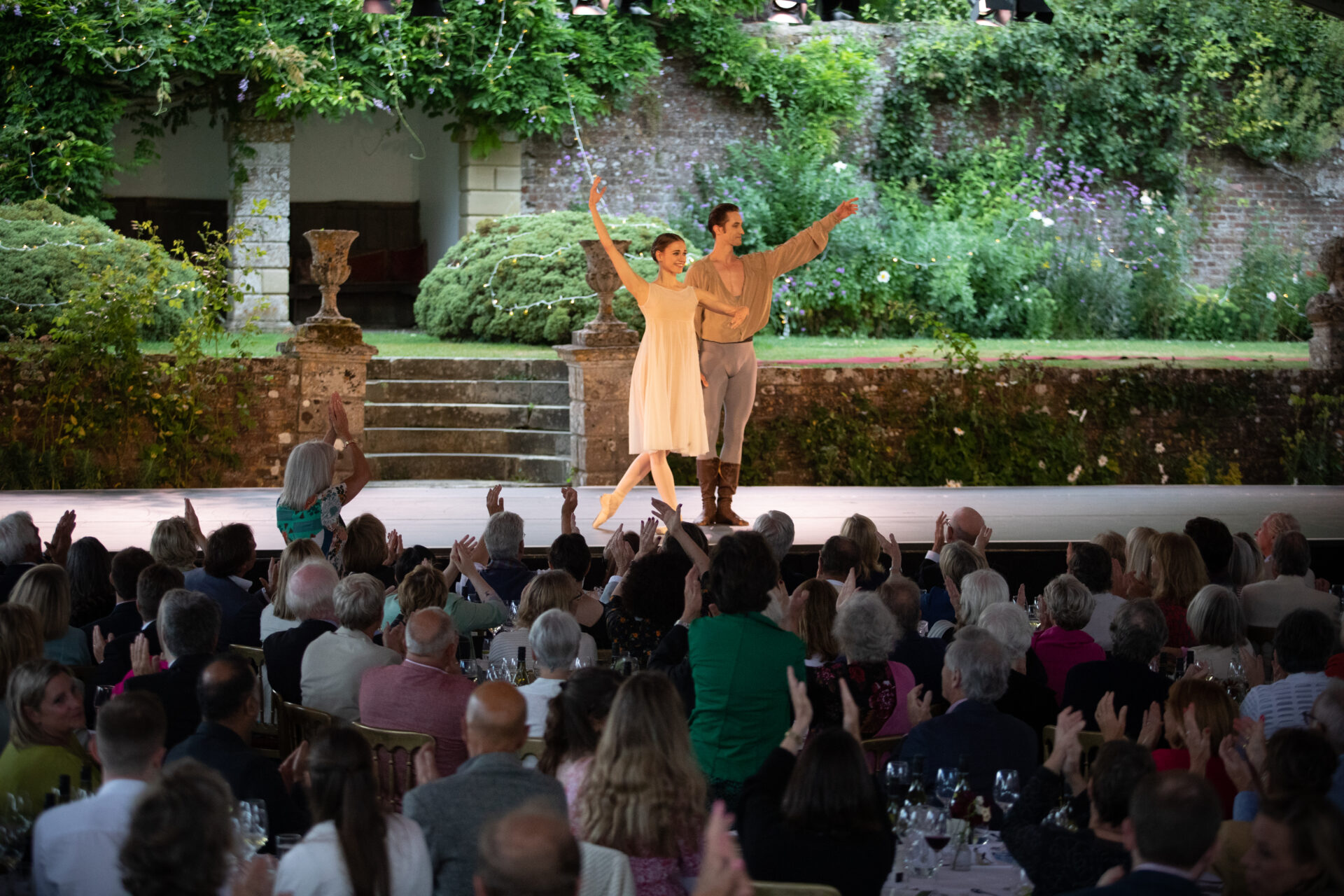
This year’s production will showcase the exceptional talent of present and future stars of the Paris Opera Ballet, including Valentine Colasante, Myriam Ould-Braham, Pablo Legasa, Guillaume Diop, Luna Peigné, and Michaël Lafon. They will be joined by Royal Ballet Principals Francesca Hayward and Cesar Corrales, Staatsballett Berlin Principal Ksenia Ovsyanick, and former Royal Ballet Principal Mara Galeazzi, among other notable international artists.

The walled garden will transport attendees to 1920s Paris, complete with a Café Folle serving Parisian cocktails, illuminated ‘twilight trees,’ and light art installations by special guest artist Hugo Dalton. As guests savour a gourmet supper hamper accompanied by exquisite fine wines, they will be treated to a mesmerizing mix of classical, neo-classical, and contemporary balletic and dance works, all infused with a French touch.
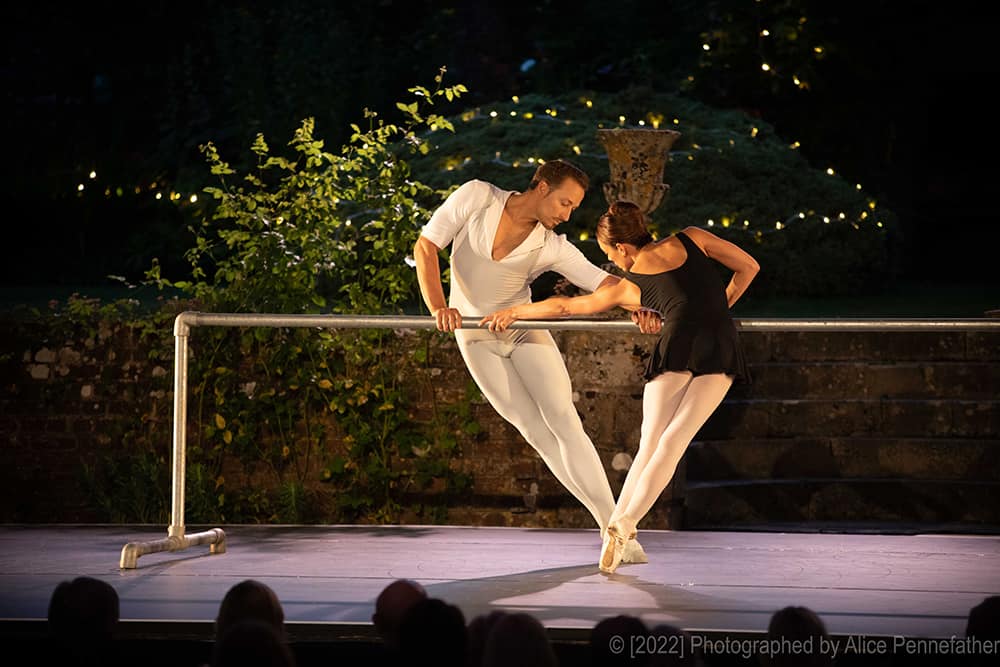
The magical evening concludes with the transformation of Café Folle into a Parisian speakeasy, featuring live performances from singer Faiith Lynch and encouraging guests to embrace the freedom of expression so iconic of the era.
Tickets for this unmissable event are priced from £185 per person. The Saturday night is already sold out and Friday night (28th) has just a few remaining seats. Thursday 27th July and Sunday 30th July both currently have some availability. Tickets can be booked by emailing [email protected], calling 01749 813313 or visiting www.coventgardendance.com. To learn more about the event, you can see our full review of Hatch House Ballet in 2022 here.
Don’t miss the chance to experience Hatch House Ballet this summer – book your tickets now and be part of this unforgettable event.
This month wildlife writer Jane Adams introduces us to the shiny little beetle whose hitchhiking larvae have a mean bee streak

The wonders of nature never cease to amaze. From ants nurturing the caterpillars of butterflies to tiny wild bees nesting in bramble stems, it’s mindblowing how much is going on right under our noses.
I recently stumbled across an oil beetle. Beetles make up 40 per cent of all insects and 25 per cent of all animal species, yet we see them so rarely – and this is especially true of oil beetles. But to protect this declining insect, conservationists urgently need to know how many there are and where they live.
It’s thought three species of oil beetle have already become extinct in the UK, and of the five that are left only two – the violet and the black oil beetle – are widespread and out and about in April. There’s also the short-necked oil beetle; though very rare, this species still survives in the south west in a couple of isolated locations. Could there be more that we don’t know about?
Stowaway Triungulins
Oil beetles are large, from 2.5 to 3cm long. With luck, if you’re in the right place at the right time, you’ll spot an adult oil beetle’s glossy blue-black body as it trundles about during the day. In fact, adult females often use compacted human footpaths as a place to excavate their egg burrows, so one might literally cross your path! But don’t pick one up – they extrude an oily substance from their joints when alarmed – hence their name!
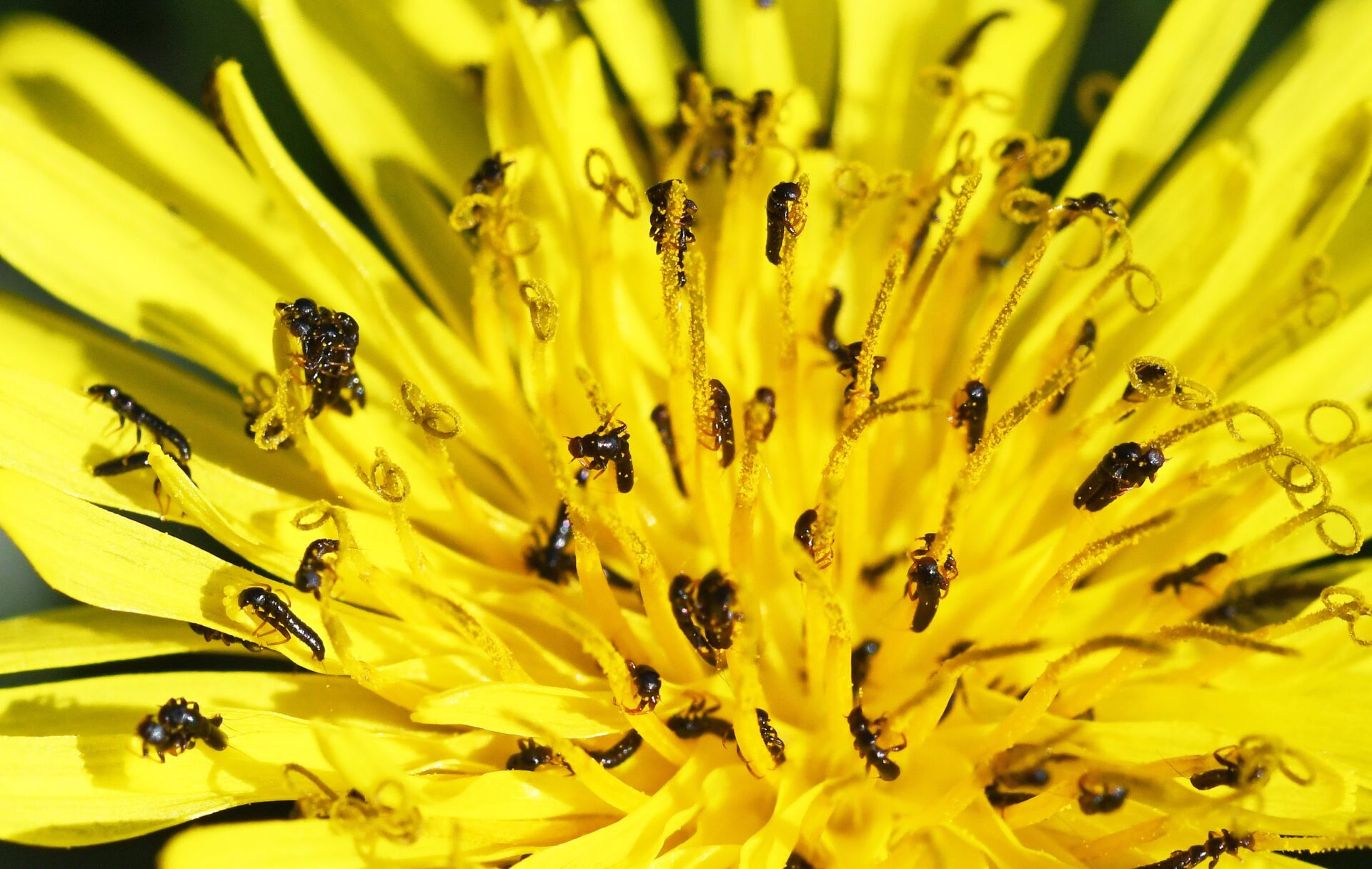
Another life stage of the oil beetle you might happen to see is their larvae, or triungulins – so-called for the three hooks on their feet.
Once the eggs hatch, these 1.5 to 2mm larvae make a dash for the nearest flower and then wait for unsuspecting insects to pass so that they can jump on board.
To survive, triungulins need to be transported to the nest of a female solitary bee. Here they will eat the bees’ eggs and pollen supplies before emerging as an adult oil beetle the following spring. It’s an unreliable plan. Thousands of oil beetle larvae don’t make it to their desired destination – and don’t worry, bee populations are never at risk. This is just one of nature’s wonders and has been going on – right under our noses – for millions of years.
When to look: Mild days from February to June (they are especially active in April!).
Where to look: Woodland edges, flower-rich meadows, coastal grasslands, dunes, and heathland on mild days from February to June. Look for adult females excavating burrows and triungulins on the petals of dandelions and other wild flowers (see image above).
What to record: Take as many close-up photographs as possible from different angles of any adult oil beetles you find (phone cameras are especially good for this). Photographs of the head and thorax are especially helpful for identification. Also make a note of the location and date.
Where to record findings: Record your findings and submit photos on the Oil Beetle Recording Scheme website. For more info see their twitter account @OilBeetlesUK. And here’s a helpful Buglife ID sheet you can print.
There has been a change in the rubbish on our beaches, says DWT’s marine awareness officer Julie Hatcher – but there’s still more to do

Have you noticed a big change on our Dorset beaches in the last few years? The piles of plastic drink bottles, heaps of fishing litter and tangles of advertising balloons that used to accumulate in coves and corners of beaches have mostly vanished. Following the introduction of innovative and inspiring movements such as 2minutebeachclean plus widespread coverage of the marine litter issue, there has been an avalanche of action.
All along the coast, community beach clean groups have formed and individuals are inspired to pick up the litter they see when they are out and about. Litter is removed from beaches almost as soon as it touches land.
Unfortunately, that’s not the end of the story for marine litter. In the relative absence of large litter items, it is shocking to notice the profusion of microplastics that remain.
A man-made death trap
These tiny pieces of plastic, each measuring no more than 5mm in diameter, wash ashore in their billions during storms. They often blanket the strandline, rockpools and seaweed in their myriad of colours and shapes. Too tiny to pick up by hand, they make their way into the beach habitat, mixing with the organic debris that provides vital food and shelter for the wildlife that lives there. To remove them mechanically is to remove that rare and specialised wildlife ecosystem.
The term microplastics encompasses tiny particles, chunks, threads and beads from a wide range of sources. They include nurdles, the form in which raw plastic is transported around the world; irregular broken pieces from larger objects; bio-beads used in sewage treatment; bits of monofilament and nylon threads from fishing line and nets; polystyrene beads … the list is endless.
But that’s just the stuff you can see. In addition are the microscopic microplastics. These miniscule plastics include fibres from our clothing and the microbeads used in some industrial applications. Even the cosmetics industry continues to use non-banned microplastics. They are ingested by plankton, right at the bottom of the marine food chain.
Nothing can be more depressing than walking on an exposed beach in the aftermath of a storm and seeing an endless swathe of microplastics stretching into the distance, coating all surfaces and smothering pools. But it’s when you look closely by your feet that the true horror hits you; the sheer number of individual items making up this man-made deathtrap.
This stuff can’t just be picked up like bottles and fishing nets. People have tried sweeping it up en masse and filtering out the sand and organic matter but it can’t be done without destroying that extraordinary wildlife habitat.
The answer lies with preventing it entering the environment; with consumer demand and political campaigns; with changing our habits and behaviour. We can all start by reducing our consumption of single use plastic, by re-using and refilling containers for example. Selecting items with minimal plastic packaging, supporting businesses that make the effort to reduce plastic waste and checking cosmetics ingredients to avoid microplastics are all steps we can take to minimise the effect they have on the environment. Change can happen quickly – and we can all have an impact.

© Bluebean Publishing Ltd