Help us to celebrate this moment in history with our community and volunteers. Enjoy delicious treats, take part in a tombola, browse patient crafts, play bingo & learn about our volunteering opportunities.
The Vale Pantry in Sturminster Newton is a new breed of community service, offering food and practical help to those who are struggling
Tucked away in a back street of Stur is the Vale Pantry. The vibrant little community supermarket currently supports 360 families and opens its doors six days a week to all those who find themselves struggling to manage. Forty willing volunteers work cheerfully, offering not just an affordable full shopping basket but a listening ear, empathy and practical support too. Some ask how hard can it really be – it’s just a shop, after all. Deliveries in, stack the shelves and send people on their way with the means to make some meals. Local councillor Carole Jones has been involved with the Pantry since its inception, and she’s keen to explain why ‘just a shop’ couldn’t be further from the truth. Says Carole:
As I try and bring you along for a pretty standard week at the Pantry, perhaps think about how many individual items we need* – excluding fruit and veg – to do what we do on a weekly basis. Our van is off the road this week. We rather suspect it didn’t know what it had signed up for – and is formally protesting. But we had committed to collecting much-needed supplies (donated by a foodbank, if you can believe it), so the first job of the week is to persuade a merry band of cars to collect a haul of staples: beans, tomatoes and anything else that is offered. These are then distributed around the various businesses that kindly allow us storage space!
Inside the Vale Pantry
Strawberry love While chatting to one customer who is in desperate need of a Citizen’s Advice appointment, a call comes in from the shop – we haven’t any carrots left. We can’t be without, of course, so carrots are promptly purchased. As we finish storing the last of the foodbank donation, the phone goes again – this time it’s an elderly customer struggling to find (and afford) a much-needed chiropodist. We can help with that. While on the phone, we’re also asked to contact the church to try cutting the trees. I will admit we are many things, but oddly, tree surgeon is not on the list. The evening team of collectors from the local supermarkets is out in force across the area throughout the week. I get a call at 9pm: ‘I’m at Tesco – they have offered us 400 punnets of in-date Strawberries. Do we want them?’ A big fat yes please, obviously – who knew you could be so excited about strawberries? However, the volunteer there to collect them drives a tiny Smart car; possibly the least likely vehicle on the road to transport 400 punnets of strawberries. The next morning The Pantry looks like Spitalfields fruit market. I wonder how on earth we are going to get rid of this many strawberries. We have the busiest morning of the week, the sun is shining, we are rocking the strawberries … but the stack doesn’t appear to be diminishing. We decide to head to Nazareth Lodge to share the strawberry love. The car is already loaded with food to deliver to those without transport, but we can’t simply drive past those who we know would appreciate a few strawberries – the bin man, the local lollipop lady and the little lady walking her dog all get a punnet. Next stop is Sherborne, to the couple who collect from Waitrose for us. We talk about a homeless man – he gets well looked after by the locals with food, he has a phone, £500 in his pocket from selling The Big Issue (this is what modern day homelessness looks like) and he has a pleasant disposition. But no one will give him a roof over his head. Our volunteers put the call in to me, and within 48hrs we help change this chap’s life. Next there’s a Pantry member who is expected to find a way to get to his mental health appointment some 15 miles away. He has no transport – how does he do this without help? We go back and pick him up – and on the way we pick up five trays of bread from Sainsburys and 40 dozen eggs from the farm that supplies us. We pass through Henstridge, and know that visitors to the Honesty Jar would love some of the strawberries and bread, so we drop some in on the way through. Then it’s time to get the evening orders in for the shop tomorrow – and while we’re doing it, a local grandmother puts a shout out for some premature-sized nappies that she can’t find. We can do that too. Suddenly it’s 7pm – but Tom at the Marnhull Spar is always good for coffee …
Cllr Carole Jones outside the Vale Pantry
Posh turkeys Next day, a local school trip had perfect timing – more strawberries gone! It’s also the day our visitors with disabilities come and load our shelves. One of the young men with autism loves to bag the bread rolls outside, come rain or shine. He also loves the pizza he takes home for tea! We mentor a young girl in the shop. She has been challenged by the care system, and she is a bag-full of mischief, but she had a wonderful breakthrough this week. For the first time in her life she cooked an entire meal! The week doesn’t end there – in fact it’s a bit of a turkey. The Dorset Meat Company has a donation for us (we’ll not discuss the sat nav taking us to a coffin maker instead!). We had presumed a car would be fine to collect 20 turkeys; but no. These are posh turkeys, all in boxes with thermometers. Jamie Oliver, no less. Thankfully the van is now back on the road, so we can at least transport them. A call goes in to one of our volunteers (who thought she was safe starting to unwind for the weekend) – we have 20 turkeys with no homes! We can do this. The almost 5kg turkeys are a family affair, so the calls begin. A few can collect, but for most, money for fuel is tight. How many meals can they get out of a turkey? And what a treat … So we go again, but instead of strawberries it’s Turkeys on Tour. Thankfully we leave the birds with some very happy families who are planning their first weekend roast in a while. Of course, on top of the constant treadmill of food in and out, there is the invisible, out-of-hours work. Bids and grants need applying for, a seemingly never-ending job (it’s expensive to run the Pantry). But thanks to the team this week, two families are now getting some much-needed wrap-around care, eight members have had face to face appointments with a fabulous Citizen’s Advisor and a new freezer was purchased with the help of the Rotary Club. We simply couldn’t do this without the help of the whole community.
Two volunteers with the Pantry Van
Run entirely by volunteers, the Vale Pantry offers memberships to any family that is struggling financially. Members may visit once a week and pay £6 on each visit before choosing the food they would like for the week ahead. The foods available include fresh fruit and veg, chilled and frozen produce and store cupboard essentials. A typical weekly shop taken home is worth between £25 and £50. For more details, email [email protected] or call 07968 348481
*The answer is 3,264. That’s the number of items we need weekly, not including fruit and veg.
The last of the crops are only just harvested, but Barry Cuff is already eating fresh salad as he watches the new crop begin
Fresh salads: spicy leaf mixes and tender pea shoots from the greenhouse, lettuce and radish from under cloches. Image: Barry Cuff
We had very varied weather all through April with a blackthorn winter* setting in mid month to coincide with the flowering of the bushes. But it was not as cold as some years, despite winds from the North and East, and there were fewer frosts than usual. The coldest occurred on the 4th April, and this one killed our skulkers.** We rely on these for a few early meals of new potatoes; they are left in the ground to dig as required unless they are in the way of any new crop sowing and planting. However, within 20 days of the frost, new growth had appeared and as the ground is not required till early June we hope to have new spuds ahead of the 2023 planted crop! Apart from a few wet days we were able to work on the plot with no damage to the soil. By the third week of April we had harvested the last of our 2022 vegetables, the leeks, parsnips and purple sprouting broccoli. We now have to rely on stored produce; beans and peas from the freezer and squash, onions and potatoes from the garage. We still have small amounts of six potato varieties – Picasso, Elfe, Sagitta, Charlotte, Royal and Rooster – and all are still in good condition. Our onions should last to around the middle of May, but we cut into our last Crown Prince squash. Still in perfect condition, it was excellent roasted.
A new season For salads we have spicy leaf mixes and tender pea shoots from the greenhouse and are cropping lettuce (Little Gem) and radish (French Breakfast) which are growing under cloches. We have potted up about 60 tomatoes in the greenhouses. These were sown on the 14th and we pricked them out on the 25th March. We have now sown celery, celeriac, chervil, parsley, leeks and Brussels sprouts in the greenhouse. The onions sown in March are ready for planting out – just as soon as the weather warms up! On the plot, the broad beans are in flower and we have sown two lines of peas plus some carrot and beetroot. All of our potatoes apart from the earlies were planted during the month. Hopefully May will bring warmer weather – it is one of the main months for establishing this year’s crop.
*an old English name for a spell of cold weather in spring or early summer, when the blackthorn is flowering ** skulkers are ‘volunteer’ potatoes accidentally left in the ground from the previous year.
Dorset’s ancient hill forts may offer stunning views to their thousands of visitors, but they bring a challenge for farmers. By Andrew Livingston
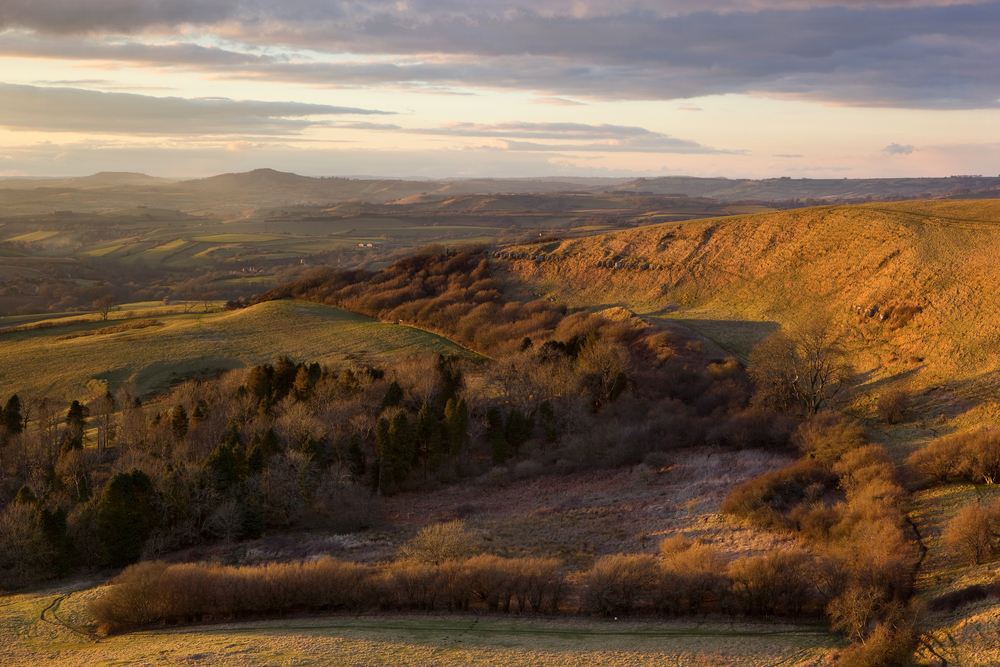
Eggardon Hill at sunset
With the King’s Coronation, the month of May this year has three Bank Holiday Mondays. Many will spend these days in the pub, some will head to the beaches … and a lot will flock to visit some of Dorset’s most famous landmarks – the hill forts. Dorset’s hill ranges were once home to Iron Age settlers who built on the high ground to defend against invaders. These landmarks are popular with visitors –usually offering easy access, stunning views and an opportunity to connect with Dorset’s ancient history. The hills are farmed as they have been for thousands of years. As the weather improves, more and more locals and tourists will visit the hill forts – but, like those earlier invaders, they can be unwanted guests for the farmers. ‘It’s a hard piece of land to farm,’ says Cameron Farquharson, the tenant farmer of Eggardon Hill. ‘When we had that Beast from the East, we had about a metre of snow because of the drifting. You just couldn’t get to animals, and for us, it was a nine-mile round trip. Eggardon is a complete nightmare.’ Eggardon Hill, just off the A35 between Bridport and Dorchester, could lay claim to the best hill fort views in the county. However, the combination of its 252-metre elevation above sea level and the steep land decline toward the coast might create staggering vistas – but also means that it’s entirely open to the elements. ‘You’ve always got a wind. Even on the hottest day, ‘ says Cameron. ‘Last year we were having temperatures of 40º but there was always that breeze – it was like roasting in a fan oven!’
Gladis’s Law Archaeological work in the 1960s on the National Trust site revealed burial mounds (also known as bowl barrows) that date back as far as the Bronze Age. For visitors, the attraction at the top of Eggardon Hill is the Iron Age earth ramparts that are still visible. ‘‘Obviously no machinery is allowed to work on that particular piece of ground and animals have to graze it in a certain way. The cows are on it spring and summer and then we have the sheep up there from October through to 1st March.’ For 16 years Cameron has run his sheep and Highland Cattle over Eggardon Hill, and during that time he acknowledges his single biggest issue has been with the general public. ‘We’ve always lost sheep to dog-worrying – we used to lose maybe three or four sheep a year to it. But the winter just gone, I’ve lost 23 sheep and ewes that were in lamb. The year before that we lost 17 and the year before that we lost 19. My losses have suddenly grown since lockdown.’ Cameron has been vocal in the media since one of his Highland cows died due to dog worrying in 2021. ‘Gladis hit the national headlines. She was chased by dogs – two Labradors, so witnesses said – and she went over the top of the embankment. Of course, she went down, heavy in calf, and broke her neck. ‘That’s the next step above the sheep; there’s always problems but there has never been an issue with the cattle before.’ Since then, Cameron has been campaigning for the laws to be changed to ensure dogs are kept on a lead when in fields with livestock. The Bill is currently being discussed in Parliament and Cameron hopes it will shortly pass into law.
Cameron Farquharson with Gladis, who was heavy in calf when chased off an embankment on Eggardon Hill by two uncontrolled dogs – both Gladis and her calf died
A human problem Unfortunately, dogs aren’t the only problems on Eggardon Hill. Cameron and his family have also had issues with members of the public – predominantly, in his experience, with older people, who, he says, are often ‘disrespectful towards the ground and the livestock. ‘We’ve had walking sticks smacked over our quad bike, smashing the light. We’ve been spat at. We’ve been sworn at … not just me, it’s also aimed at my children. ‘I love Eggardon Hill. It’s very similar to where I grew up in Scotland, a rugged, rough piece of ground. But at the end of the day, I can’t afford to farm it when it causes these losses and this much trouble. ‘If I could find another piece of land in Dorset, I’d be gone,’ he says.
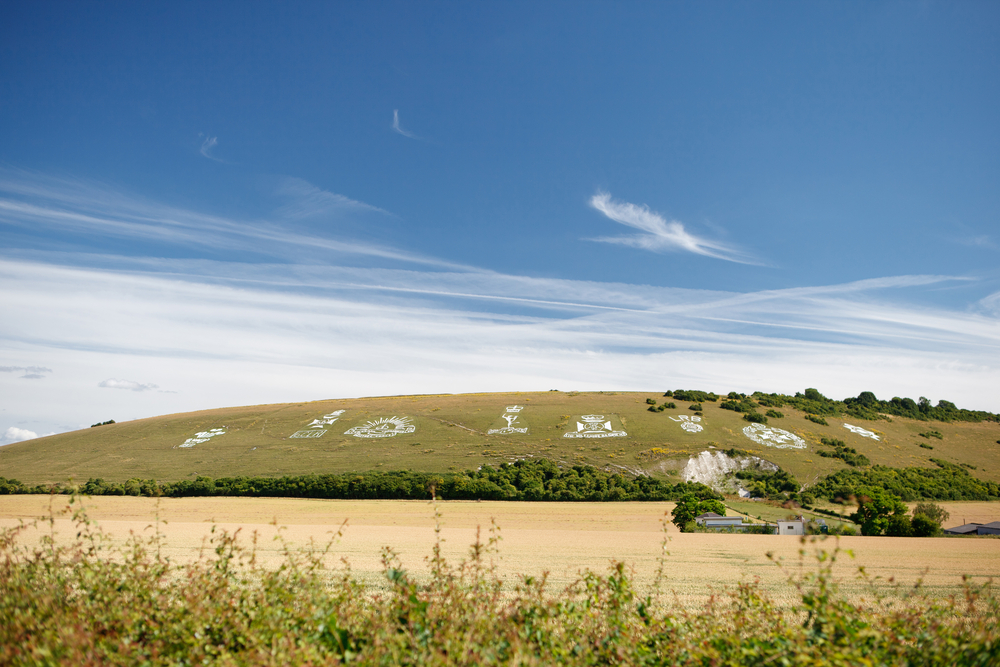
The badges North-east of Shaftesbury, in the small village of Fovant just over the border in South Wiltshire, there is an iron-age fort, like Eggardon, that would once have been home to a settlement. Chiselbury Camp hill fort is more than 10 acres in size, 200 meters above sea level. Chiselbury, however, is not the landmark that visitors come to see on this hill. As you drive on the A30 between Shaftesbury and Salisbury you will see the peculiar sight of large regimental badges carved into the hill chalk. The badges were initially created during WWI. Soldiers were garrisoned in the fields outside the village in 1916, and they carved their own regimental insignias into the hillside as they waited to go to France to fight. Twenty badges originally stood on the hillside, and nine remain today. Every year, a Drumhead Service is held there on the closest Sunday to the 1st July – the first day of the Battle of the Somme in 1916. Edward William’s family have owned East Farm, whose land includes Chiselbury Camp hill fort and the badges, since 1961. He explained that the badges were recently classified as ancient monuments. ‘They’re looked after and maintained by the Fovant Badges Society. But as they are now classed as ancient monuments they are ultimately in the hands of English Heritage. No one is allowed to touch them, even for maintenance, without detailed permission from English Heritage.
Fovant badges
‘Fovant Badges [Society] have a rolling contract for their upkeep. They’ll submit their plan for which badges are to be cleaned or re-chalked, and English Heritage has to approve it before any work starts. ‘We just run cattle along the side of the downs – it’s too steep to do anything else with it. If you walk on the footpath through the badges they look like nothing at all. Each one is about half to three-quarters of an acre. When they re-chalk one – every three or four years –they need to transport 30 tonnes of chalk for each one.’ The badges are maintained each year in June, in preparation for the Drumhead Service, at a cost of £30,000 a year to the Society.
Finally the garden is warming up and ready for some tending – but also for some leaving alone, says gardener Pete Harcom
Try to leave a patch of un-mown long grass in your garden.
Well, once again last month was a cold one, wasn’t it? May should be a lot warmer, but do still keep an eye on the weather forecast and protect any early outdoor sowings and plantings with fleece. Your new bedding plants may need to wait to be planted out until towards the end of May.
Jobs for this month:
Continue to keep on top of weed growth – my best tip is to simply hoe them off regularly while they are easy to handle.
Aerate the lawn with a garden fork to avoid compaction and moss growth. After the aeration, apply a slow-release granular fertiliser (small granules will reduce the scorch potential).
Birds will be nesting now – please check hedges before trimming them back. In fact, it’s probably best to leave the hedges until late summer if at all possible.
Prune back your spring flowering shrubs such as deutzia, choisya, weigela and philadelphus – these can all be pruned after flowering to maintain shape. Also, trim back aubretia and alyssum after flowering to increase fresh growth before they get too leggy.
Daffodils and spring flowering bulbs can be lifted now; divide them to increase plants for next year. Continue to deadhead tulips and daffs as the flowers fade.
Planning ahead for your own spring bedding for next year, between now and July is a good time to sow wallflowers, pansies and daisies in a spare piece of ground. They are biennials (they take two years to flower) so you need to plant them now to enjoy them next year.
Why not create a wildflower meadow this year? Even in a small garden this will attract so many of our native insects and animals. Native wildflowers are a food source which will attract bees, butterflies and birds to your garden. The Wildlife Trusts have some great advice on how to grow a wild patch. Even the smallest wildflower meadow will provide homes and food for wildlife and benefit biodiversity. Native wildflowers provide pollen and nectar to help sustain the insects that pollinate our food crops.
It’s #NoMowMay … Try to leave a patch of un-mown long grass in your garden. Butterflies, for instance, like to lay eggs in flowering grasses. Some types of butterfly and moth only ever lay their eggs on specific native plants.
This may be a time to re-evaluate the positioning of plants – think about any plant failures or poor growth which may be due to siting and their location in your garden.
Showcasing a range of exhibitors offering a spectacular array of plants and garden must haves, as well as the opportunity to talk to experts and gain helpful advice. With plenty to explore, from small independent nurseries selling unusual hardy perennials, herbs, alpines, cottage garden favourites and native wildflowers. Discover other unique items for your garden including the Simon Gudgeon range, from hanging seats and benches to birdfeeders. The perfect day out for any garden lover.
Entrance to The Plant Fair is free of charge within the Makers Yard. Should you wish to extend your day and explore the Sculpture Park, book tickets at sculpturebythelakes.co.uk
The skies have cleared, and The BV’s astrophotographer Rob Nolan is celebrating the start of galaxy season with a special trio
Leo Triplet
Slightly more favourable conditions throughout April meant at least a few clear nights to see the galaxies far far away – especially now that we have officially entered ‘galaxy season’. With a greater number of galaxies visible in the night sky than at any other time of year, many amateur astronomers take advantage of the opportunity to observe and photograph these amazing objects. I’m a bit late into galaxy season, which starts in March, but as we all know, the weather was not great. So to kick things off, I thought I’d go for a three in one! The Leo Triplet, also known as the M66 Group, consists of a small group of galaxies a mere 35 million light years away, in the constellation Leo. In this photograph, clearly visible are M65 (bottom right), M66 (bottom left) and NGC 3628 (top). M65 and M66 are spiral galaxies, while M65 appears to not have much gas and dust; its high ratio of old stars to young suggests that there is little new star formation going on. M66 appears rather more interesting, with bright star clusters along its sweeping spiral arms. NGC 3628, also known as the Hamburger Galaxy, appears as though it may be a barred spiral galaxy with the bar seen end-on edge from Earth, making it a most conspicuous galaxy to observe. Since there’ll no doubt be more galaxies coming, it seems the perfect time for a quick explainer on the three basic types. Spiral galaxies, such as our Milky Way, are rich in gas and dust, great for star creation. Irregular galaxies have similar ingredients and potential, but are usually smaller and don’t form a discernible shape. Finally, we have elliptical galaxies – these vary in size dramatically from very small to mind-bogglingly huge! Not as pretty as spiral galaxies, they take on a rather uninspiring oval shape. Most stars in these galaxies appear red, due to being older, with very few new stars being created due to the lack of gas and dust. This image of the Leo Triplet was captured with my 1000mm Maksutov Newtonian Telescope and the ZWO ASI2600MM Pro Astro camera with Broadband filters and is about four hours of data.
The night sky, May 2023 – Rob’s guide for your stargazing this month:
Our local neighbours – that’s Venus and Mars for anyone wondering – grace our western skies this month. The southern skies are currently dominated by the immense, stunning orange star Arcturus. Look to the lower right of Arcturus this month and you’ll find a couple of bright blue stars, Spica and Regulus. Near to Arcturus in the region to its left, you might also make out the faint stars making up the two giant constellations Ophiuchus and Hercules. But this month’s constellation has to be Ursa Major, the Great Bear, which is an international favourite. You’ll no doubt know its seven brightest stars as the Plough here in the UK. This constellation is always on show in the northern hemisphere, so it tends to be the first star formation stargazers become familiar with. An interesting fact about this constellation is that the majority of the stars lie at the same distance away from Earth and appear to have been born around the same time. The constellation is also home to some binary stars that you can ‘split’ with the unaided eye.
Star dates for the diary Particular events of interest this month include the annual Eta Aquarid Meteor shower on the 7th May in the very early hours, caused by small pieces of Halley’s Comet burning up in Earth’s atmosphere. Unfortunately though, due to the bright moon during the night, the unusually intense display will likely be washed out. It may still be worth trying to catch a glimpse though! The rest of the notable events this month involve our Moon and its regular dance in and around the views of the inner planets. On the night of the 13th and 14th May, just before dawn, observe the enchanting crescent Moon passing below Saturn. On the 22nd May, Venus, the Evening Star, will appear above and to the left of the thin crescent Moon. In the twilight sky of the 23rd May, the crescent Moon and Venus appear to get very close, with the familiar stars Castor and Pollux just above. Mars also makes an appearance on set, looking left in the sky. On the 24th May, Mars again makes an appearance below the crescent Moon, with stars Castor and Pollux and the planet Venus off to the right lower in the sky. Until next time, clear skies!
Banned in Dorset on council land, disposable barbecues still pose an ever-increasing fire and environmental risk. Rachael Rowe reports
Wareham Forest in the aftermath of the 2020 fire caused by a disposable barbecue. All images: Dorset & Wiltshire FRS
The fires that tore through Wareham Forest in 2020 and Studland in 2022 were among the worst wildfires ever seen in Dorset. Sadly, both were entirely preventable, the causes attributed to disposable barbecues. The fires caused significant damage to wildlife and the local area. So why do people continue to buy and use them? Dorset Council has recently taken a stand on disposable barbecues, putting a Public Spaces Protection Order in place.
Wareham Forest on fire
Why are disposable barbecues a hazard? Disposable barbecues are a significant fire and environmental hazard. They might be convenient for a day at the beach or an alfresco lunch. But if they are not correctly disposed of, they can lead to significant burning and fire hazards as well as wild fires. When disposable barbecues have been buried in the sand, which naturally retains and intensifies heat, people have suffered serious burns. If they end up in the sea, disposable barbecues pose a risk to marine life. Those left on dry land can quickly catch light and cause untold damage, as the ravaged Wareham Heath photographs show. Dorset has significant areas of heathland, home to rare species such as smooth snakes and sand lizards, all at risk from wildfires. According to figures from Dorset Fire and Rescue, there was a significant increase in fires involving barbecues in the five years to 2020 – in 2016 there were four incidents, rising dramatically to 74 in 2020 in Dorset. Aside from the intrinsic fire risks, there is another issue with disposable barbecues. Designed for single use, they are not in any way environmentally sustainable. Coals and other substances from them can leach into the soil, which is also a major hazard to wildlife. With this in mind, Dorset Council and Litter Free Dorset have been working with Southern Co-op to ban sales.
Southern Co op, Dorset Council, Litter Free Dorset and a team of 60 volunteers worked to break down 8,000 disposable barbecues
Co-operative action In April, Dorset Council and Litter Free Dorset were able to take a significant step forward, raising awareness of the hazards and environmental impact of disposable barbecues. When Southern Co-op decided to take disposable barbecues off their shelves, they found they had 8,000 to get rid of – responsibly. The company contacted Litter Free Dorset and worked with several other organisations across the county to dispose of the offending items appropriately. The dismantling operation (pictured above) took place at the massive W&S Waste Management warehouse at Canford Heath. ‘Sadly, we have witnessed the devastating impact that disposable barbecues can have to both people and wildlife if they are not disposed of responsibly,’ says Mark Smith, chief executive of Southern Co-op. ’Removing them from sale was an important move to protect our local wildlife and ecosystems, and was part of our commitment to reducing our environmental impact. ‘However, we also needed to be able to dispose of them responsibly. Thanks to Litter Free Dorset and a host of dedicated volunteers, this was made possible.’ Several large supermarket chains, including Waitrose and Aldi, have also pledged to remove disposable barbecues from sale.
The metal grill sheets and foil trays, compacted ready for recycling
A tricky separation Litter Free Dorset co-ordinator Emma Teasdale says: ‘Of course we want people to enjoy their summer and make the most of our beautiful county, but this should not be at the cost of the environment. We are asking people to make the change by avoiding single-use items – including disposable barbecues – and to look for reusable alternatives. The dismantled barbecues weighed in at seven tonnes – that’s a lot of aluminium and coal,’ she says. ‘It took a team of 60 volunteers all day to unravel and sort the barbecues into their constituent parts, and everyone went home looking filthy. The entire exercise also demonstrated just how hard it is to dispose of these items appropriately – even when there is no rush and the barbecues are totally cold. It is so much harder when they are still hot!’ The coal was donated to Swanage Railway and other parts were separated for recycling. The metal grill sheets and foil trays were destined for the W&S scrap metal site and the paper and plastics were recycled locally. Litter Free Dorset project officer Eimear Coyle said the feedback had been positive. ‘We’ve had a few shops approach us about stopping selling the disposable barbecues, and we are continuing to promote the messages about them. Dorset Council has already prohibited the use of disposable barbecues on its land.’
The coal was donated to Swanage Railway, and the metal, paper and plastics were separated for recycling
What can you do? The obviously solution is to stop using disposable barbecues – do not buy them in the first place. If you are a retailer, just stop selling disposable barbecues.
The smoking remains of Wareham Forest in 2020
What about sky lanterns? Another perennial problem, usually from weddings and festivals. More than 200,000 are released in England each year, and yes, they do look pretty. But there’s no knowing how far they will travel or where they will land. If they land in a field they are not only an obvious fire hazard but also traumatic to livestock Dorset and Wiltshire Fire and Rescue Service is firm in the opinion that they should never be used under any circumstances.