We are looking for new full or part time members of our team to join us as our youngstock yard develops. Join our friendly team as we raise sport horse and thoroughbred youngstock, handling and preparing them for exciting futures ahead. All general yard duties including mucking out, grooming, handling and feeding are vital to this role. Previous experience with young horses required, along with a proactive approach to all aspects of yard life. We are part of The Chedington Court Estate, and offer excellent working conditions for our employees. Based just outside of Holwell/Glanvilles Wootton, approximately 5 miles from Sherborne. Due to our location, you will ideally need to drive. For more information, please contact Vicki on 07817 960454.
YARD AND COMPETITION GROOM, BEAMINSTER, DT8
We are seeking an enthusiastic person to join the team at Chedington Equestrian. The yard is a purpose built, high-end training and rehabilitation yard. We have a great team of people and this will be a great role with plenty of support and variety. The position will include all daily yard and horse care jobs as well as supporting one of our resident eventing riders at competitions and training days. The role will also involve assisting in the rehabilitation and therapy yard with the rehabilitation liveries and horses coming in to use the aqua treadmill. Sorry this role does not allow horses or dogs. On site accommodation with all bills included.
For more information, please contact Bek Burton on 07879 761396
During Britain’s Industrial Revolution, 4,000 miles of canal were developed in an astonishingly short time – but in the end, Dorset didn’t get any! Roger Guttridge details the local planning catastrophe.
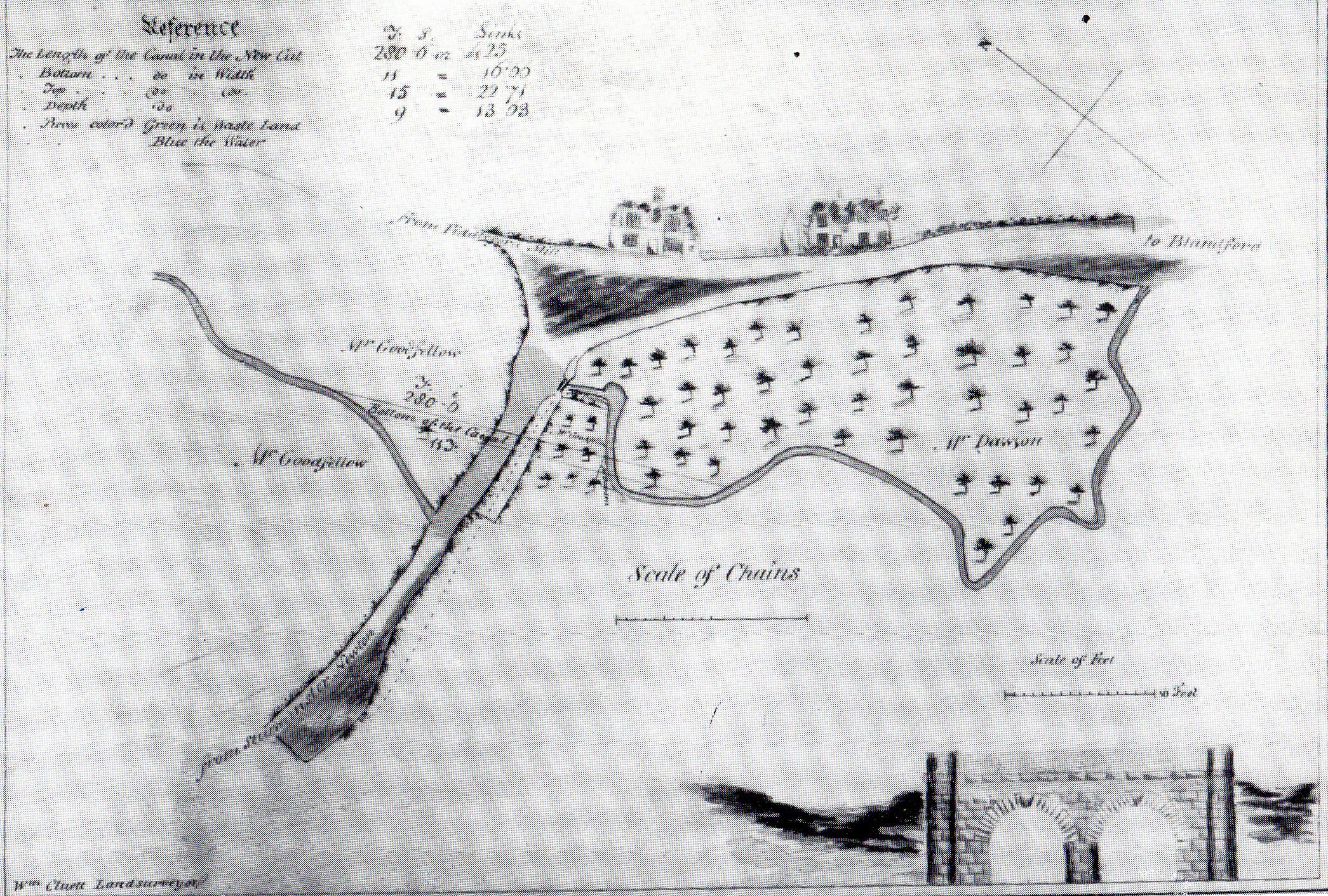
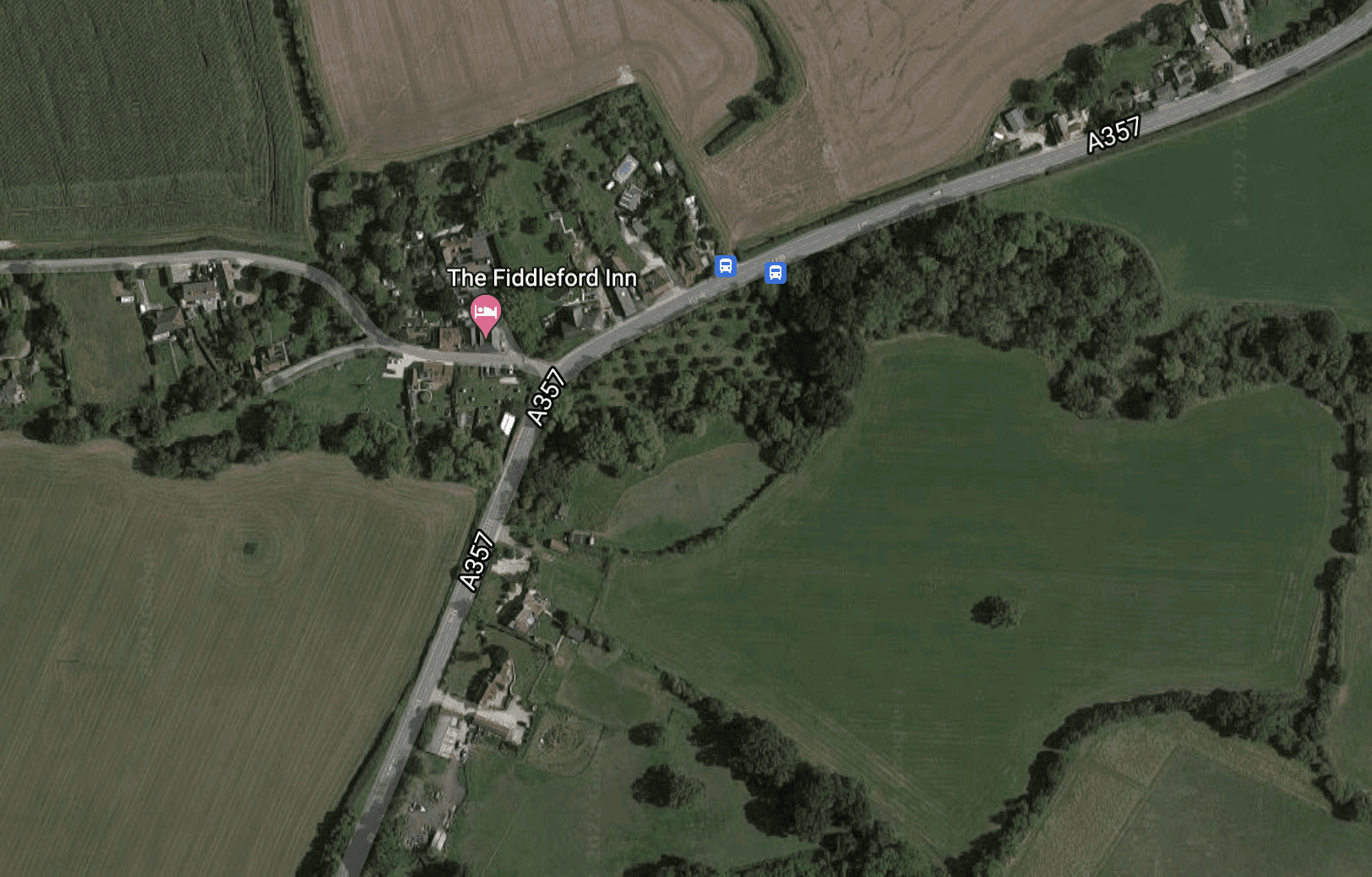
The sketch of Fiddleford showing plans for an aqueduct across the present-day A357 (modern map for comparison below)
As a veteran of canal holidays in the ’70s and ’80s, I’ve often wondered what Dorset would have been like had these arteries of the Industrial Revolution reached our county. They almost did: between 1796 and 1803, eight miles of the Dorset and Somerset Canal were constructed at the Somerset end. Had the ambitious project continued, parts of North Dorset would have been transformed, especially Fiddleford, where there were plans for an aqueduct fed by the Darknell Brook (see images, above). Had they come to pass, the Fiddleford Inn or the former Traveller’s Rest, two doors away, might now be called the Narrowboat or the Boatman’s Rest.
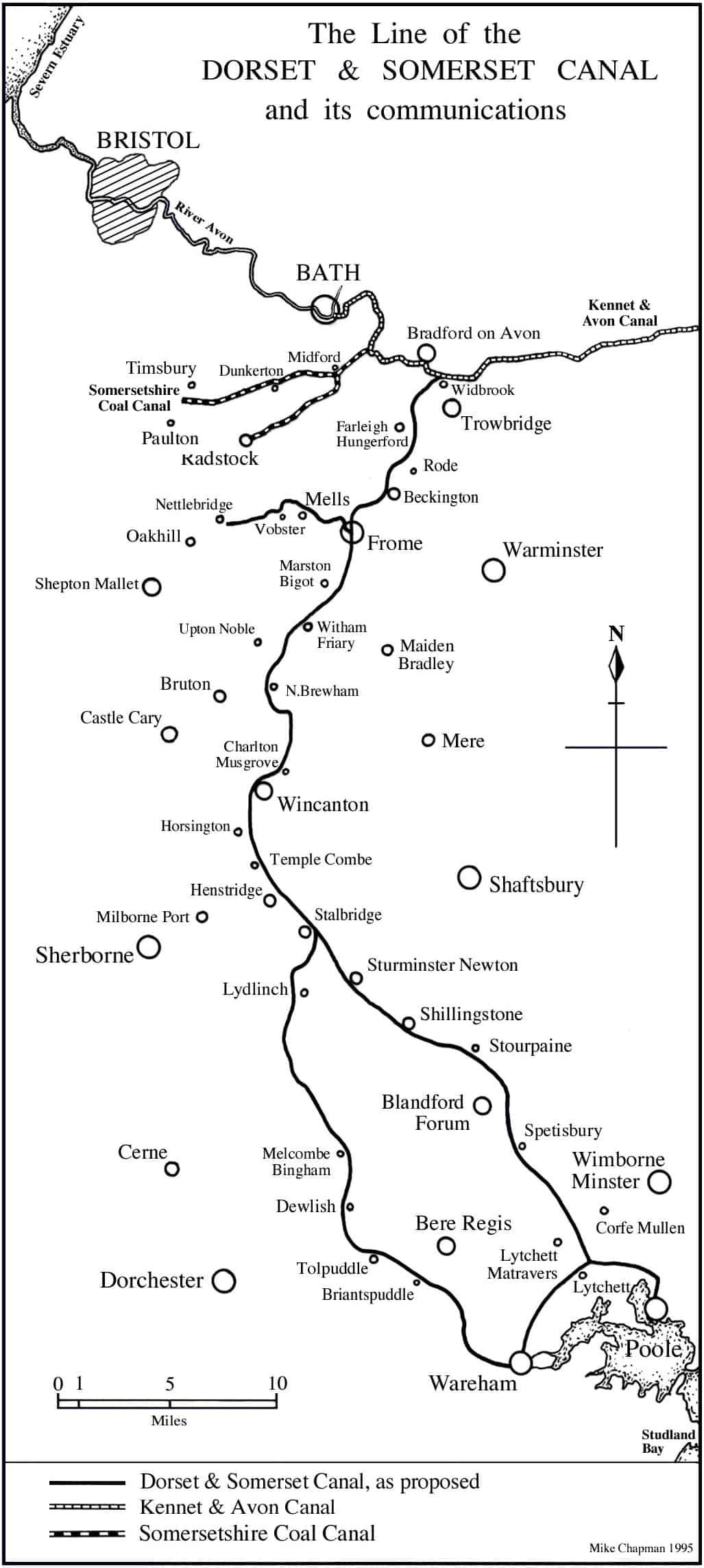
The feasibility of a ‘Dorset and Somerset Inland Navigation’ was first discussed at a meeting in Wincanton’s Bear Inn in January 1793, when canal- mania was sweeping across the entire country. In 80 years, 4,000 miles of canals were built, helping to transform both the national economy and local economies along their routes. The local plan was to provide a waterway link between Poole and Bristol – an alternative to the long and hazardous voyage around Cornwall.
Huge network planned!
Supporters predicted a regular traffic in coal from the Bristol and Somerset coalfields, and Purbeck clay destined for the Staffordshire Potteries.
Other cargoes envisaged included freestone and lime from Somerset and timber, slate and wool from Dorset. Initially there was great interest from investors with subscriptions greatly exceeding the prescribed minimum. The proposed route ran from Bath to Frome (with a branch to the Mendip collieries) and on via Wincanton, Henstridge, Stalbridge, Sturminster Newton, Lydlinch, King’s Stag, Mappowder, Ansty, Puddletown and Wareham to Poole Harbour. Wareham folk were supportive but a meeting at the Crown in Blandford insisted the canal would be more beneficial if it went from Sturminster Newton to Poole via Blandford and Wimborne.
Counting the cost
Robert Whitworth, the project’s consulting engineer until he resigned in September 1793, favoured the Blandford option. His costing for the 37 miles from Freshford to Stalbridge was £100,234 (approximately £15,461,737 in2021)
The remaining 33 miles to Poole had an estimated cost of £83,353.
The Blandford route was finally chosen in 1795 but with branches to Wareham and Hamworthy.
It seemed like the perfect compromise but there was still opposition from some landowners. Lord Rivers insisted that ‘the canal did not proceed beyond some point betwixt Sturminster and Blandford, otherwise withholding his consent’. In 1796 a drastic decision was taken to abandon the southern section, reducing the canal’s length to 48 miles and the cost to £146,018 (approx. £22,524,212 in 2021 terms). Bizarrely, it would now terminate at Gain’s Cross, Shillingstone.
Catastrophe rocks the plan
With £73,000 already raised from shareholders, the necessary Act of Parliament was quickly obtained and received royal assent.
It gave the owners the right to draw water from any source within 2,000 yards of their canal and to create a junction with the Kennet and Avon, thus connecting to the national network.
Work on the Mendip collieries branch began in the summer of 1796.
A newspaper advertisement said progress was rapid, the public would soon experience the benefits of the canal and ‘part of it near the collieries is already completed and a barge was launched there on Monday’.
The advertisement proved to be hopelessly optimistic. Of the original £70,000 pledged by prospective shareholders, only £58,000 materialised.
Over the next few years, partly due to the Napoleonic wars, the company lurched from crisis to crisis and only eight miles of canal were built. Progress was hampered and expenses increased by the rocky terrain.
Those eight miles alone required 28 bridges, three tunnels, an aqueduct, 11 grooved stop-gates, nine double stop-gates and three balance locks.
Construction ceased in 1803, when the last of the money ran out, although hopes lingered on until the mid-1820s, when attempts were made to involve the canal company in plans for a railway covering the same route. It would be another 30 years before the rail link came to fruition.
By then the canal – originally described as ‘one of the best conceived undertakings ever designed for the counties of Dorset and Somerset’ – was reduced to an overgrown relic in the Somerset countryside.
The company’s records suffered an even worse fate when a bomb fell on Wincanton during World War Two.
Among the few surviving documents is the plan for the double-arched aqueduct at Fiddleford, shown opposite. The picture also shows a ford where the stone bridge is today and two houses that still survive.
After a year of fundraising, Wessex Group Ltd, based in Shaftesbury, isthrilled to present Teddy20 with a cheque for £5,000.
From fancy dress to cake baking competitions, the teams have pulled out all the stops and had huge fun doing so. For the most recent fundraiser the teams held a Christmas tombola with an impressive array of prizes donated by staff, suppliers and customers. Prizes included a 55” flat screen tv, Virginia Hayward hampers, wine, champagne and a lot of chocolate. The raffle tickets alone raised over £2,000.
In 2021, Sam James from the Wessex Property Care team nominated Teddy20 for the company’s annual fundraising charity. Sam described his rationale “Teddy20 provide funding to families to ease financial pressures, offer a holiday respite in their ‘Ted Shack’ holiday home, and host parties, events and experiences for the children and their families. They also donate money to research into various forms of cancer.
I volunteer in various ways for this charity, and they never fail to blow me away with their amazing work. They work so hard to raise the money, let alone the work they do with the money. They are local heroes and the money we would raise would do so much good for so many families suffering the effects of children’s cancer.” Simon Morgan, Director said, “The staff are fantastic and always get stuck in to raise money; it is heartening to know that the fun we have at the events go to a very worthy cause.”
Owen Newton, Founder of Teddy20 said, “We are very thankful to Wessex for their efforts this year and the amount they have raised for Teddy20. We survive solely on donations and their support will help us continue to provide support to children and young people suffering with cancer.”
At least externally, two of Gillingham’s pubs have barely changed in the 120 years between these two pictures, says Roger Guttridge.
The c1900 picture from Barry Cuff ’s postcard collection appears in David Burnett’s latest book Lost Dorset: The Towns.
Confusion reigns over the address of the Phoenix Inn at Gillingham, which some sources give as High Street, others as The Square and which until the 1880s was in Bridge Street.
Names aside, the location has changed remarkably little in the 120 years or so between the taking of these two pictures. For one thing the two pubs in the picture not only survive but retain their names, although the Phoenix (near right) has changed from ‘Commercial Hotel’ to ‘Inn’.
The Red Lion is a few doors further along on the right. Between them are the former Free School, which was founded in 1516 and survived until 1876; Mayflowers the florists; the Topsie Rabbit Kindergarten; Stone House; and Reynolds’ pet supplies and boot repairs. The Square end of the Phoenix (near right in the bottom image) is now the Gillingham Tandoori Indian Restaurant.
On the far left of the pictures (where the two boys stand) is the entrance to Church Walk, leading to the parish church. Beyond the boys today are the art shop Scenes, a couple of takeaway shops, the Studio and Rutters the solicitors. The large three-storey building in the middle of the terrace formerly hosted Silvester Edgar’s watchmaking, printing and bookbinding business but is now residential accommodation.
As the Love Local, Trust Local Awards enters its third season, founder Barbara Cossins is thrilled so many sponsors have remained – but is looking for a few new partners to join the 2022 awards.
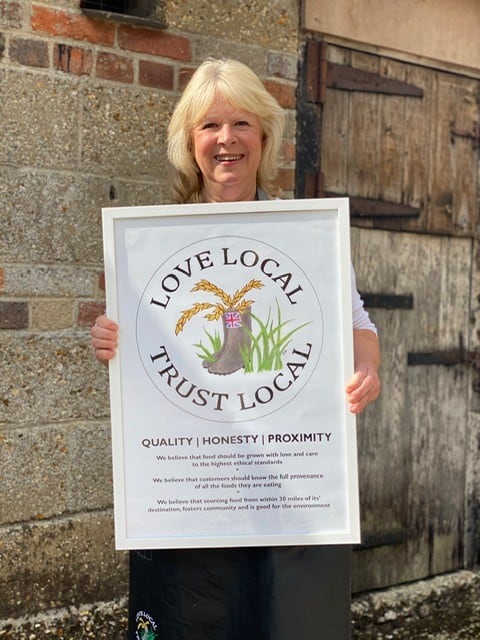
Barbara Cossins, local farmer, business woman and founder of the Love Local Trust Local label and Awards.
Now in its fourth year, Love Local Trust Local is making great progress in educating and encouraging the people of Dorset to eat & shop locally, supporting our incredible array of food producers, farmers & fishermen.
This year, they are looking for more local Dorset organisations to become part of the Love Local Trust Local sponsorship family. Remaining for their 3rd consecutive year as sponsors are NFU Mutual Wessex, Blanchard Bailey, Symonds & Sampson, The BV Magazine, Damory Vets, Kingston Maurward College, Roberts Foodservice, Chase Farming, Hemsworth Farm, Harbarn Developments, Dike & Son and Saffery Champness.
Join the family
For a small investment you can join them and benefit from so much in supporting the production of wonderful food & drink here in Dorset. Sponsorship of a category is only £750 for the year. Some of the many benefits include:
Raising the local profile of your business & gaining positive publicity & PR
Benefitting from an increased online presence and profile by association
Becoming a judge of the tastings for the finalists in your category
Developing new partner relationships with other key Love Local Trust Local sponsors
Appearing in printed, online and PR placement as the key sponsor for an entire award category
Having your own organisational website profile on the well-respected Love Local Trust Local website
Building awareness of your brand with Dorset businesses from regular activity on a range of social media platforms supporting the annual Love Local Trust Local Awards
Enjoying networking opportunities with everyone involved
Attending the Awards Night as our guest and bringing clients or team members with you to celebrate your achievements
Presenting your Love Local Trust Local award to the lucky winner at the main event
Displaying your own pop-up banner & marketing material to the awards event to promote your business on the night
Love Local Trust Local is fast becoming the food & drink movement to be part of, campaigning for British food and fair treatment for our farmers, food producers and fishermen and support from our government, local and national.
Get in touch at [email protected] or call 07831 184920 and talk to Barbara Cossins, the founder of Love Local Trust Local
A Dorset charity for women, The Water Lily Project, has launched a newinitiative to help disadvantaged women and particularly those in rural areas in our region get back into education or the world of work.
The Water Lily Project, which has worked with vulnerable women in the community for over 10 years, is putting particular emphasis on women from deprived and rural areas of the county. Project Manager Liz Carter explained:
“It’s a fact that it’s often women from poorer or rural areas whose life chances for continuing their education or becoming employed are reduced significantly. “Giving them the opportunity to learn and reboot their career chances is vital for empowering them to live independent lives and fulfil their potential. We are asking women to come and EAT with us – ‘empower, activate and train’. “We know from our years of helping women in crisis that equipping a person with the right life skills is a vital building block in their route to helping themselves improve their own circumstances.” This scheme is offering 24 places to women aged 18 or over who are currently unemployed or economically inactive. The European Union Social Fund and the Education & Skills Funding Agency (ESFA) fund it along with support by Groundwork UK, a federation of charities mobilising practical community action on poverty and the environment across the UK.
The women will benefit from mentoring and fully- funded training suited to their individual needs for five hours a week for 20 weeks to help equip them with the skills to get a job or to continue their chosen path of education.
The Water Lily Project is keen to hear from other support agencies across Dorset, especially those in rural areas, who may be working with women who meet these criteria and could benefit from the scheme.
To find out more about the how the scheme can help you or someone you know, please contact Liz Carter via email: [email protected]
This month can be used to get yourself properly prepared for springtime. The following jobs will help, says gardener Pete Harcom.
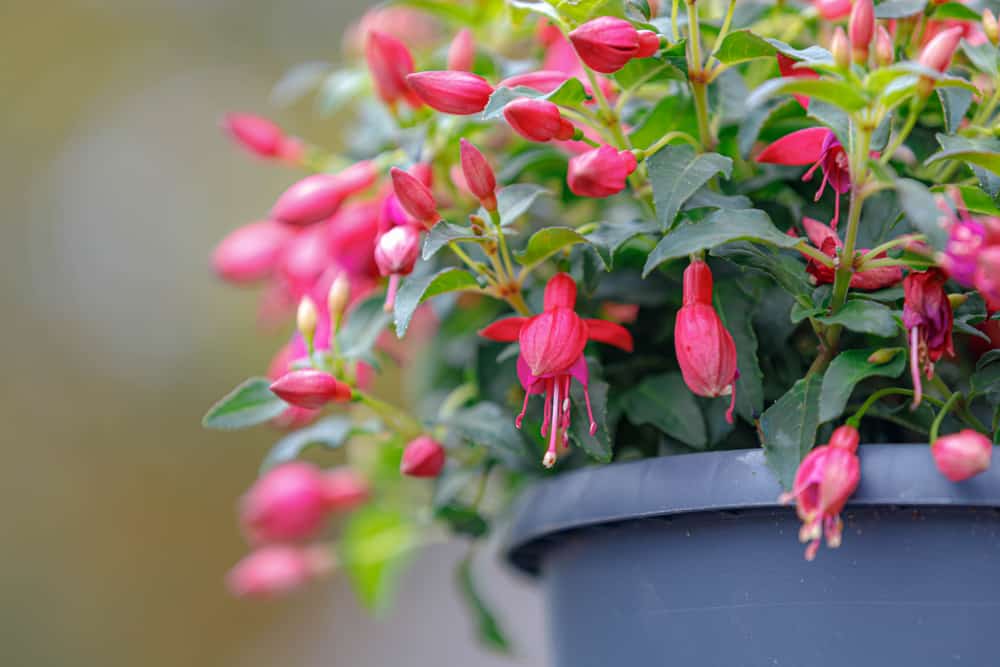
Fuchsias are a popular patio plant, but have a habit of becoming leggy when overwintered. Pete shares his pinching out method to ensure yours will be covered in summer flowers
Tips for Basic housekeeping
Clean up and consider fumigating the greenhouse – this will help keep pests under control.
How about installing a water butt now, ready for the summer? Rainwater is particularly useful for watering acid-loving, ericaceous plants.
Find out what type of soil you have. Invest in a soil testing kit to help you choose the right plants for your garden.
Wash empty pots by scrubbing them with hot water and a mild detergent. Rinse them well afterwards.
Keep feeding the birds, hangup fat balls and keep bird feeders topped up.
What you should be pruning
Prune winter-blooming shrubs such as mahonia, winter jasmine and heathers, once they’ve finished flowering – but be careful not to cut back into old wood.
Cut back wisteria side shoots to three buds from the base, to encourage abundant flowers in spring.
Prune buddleia and elder hard back – right to the base – to keep these vigorous shrubs to a reasonable size. Trust me. They’ll grow back!
Trim back ivy and deciduous hedges, Virginia creeper and any other climbers. Do this now, before birds start nesting and to keep gutters and windows clear.
Prune summer-flowering clematis towards the end of the month, before active growth begins. Cut stems back to healthy buds about 30cm from the base.
Get ready for sowing
It’s a good idea to organise this year’s seeds by sowing date. Get hold of a box with dividers, and file your seed packets by the month they need to be sown in. This will make life a lot easier in the weeks to come.
Start now for show-stopping summer fuchsias
If you have a cold greenhouse you can start potted Fuchsias back into growth. Prune overwintered fuchsias back to one or two buds on each shoot. For the next few months if you pinch out the lead bud on every shoot, you will have lots more flowers in the summer. Show- quality Fuchsias (used for showing later in the year), are pinched out like this. Removing the growing tip stimulates the side shoots into growth, so, instead of having one main stem, you double the shoots each time you pinch out. These side shoots will then take precedence. Let those side shoots grow until they have two or three pairs of leaves, then remove their growing tips. Repeat this process until you’re happy with your fuchsia form, though it’s best to stop pinching out around June at the latest. Having pinched out several times, you’ll have a nice bushy plant with lots of growth, lots of flowers and maybe even a show quality plant!