The benefits of a volunteering policy are far wider than simply ‘giving back’ and ESG work, says Ian Girling, CEO of Dorset Chamber
Hello and welcome to my April column. At last it feels Spring is with us, and it’s brilliant to have the lighter evenings and mornings! This month I’d like to talk about the value of volunteering; not just for individuals, but how this is a fantastic concept for both employers and employees to really embrace. Many businesses are now focusing on this as part of their ESG (Environmental, Social and Governance) work, and this can really be a win-win for all involved.
Why is volunteering so important? Over the last few years, the 3rd Sector has been called upon to deliver more and more as funding for public services has been reduced. The 3rd Sector plays an incredibly important role and this has never been more evident than over the last couple of years with Covid and now the terrible situation we see in Ukraine. Many charities and voluntary groups are being stretched to their limits in terms of capacity. These organisations can hugely benefit from volunteering – and enabling volunteers to offer their expertise to help.
Build it into the business There are a huge amount of volunteering opportunities of all types available. Many employers now support a specific charity or cause each year, and will also give employees an allocated number of paid days to volunteer. This enables these employers to make a positive contribution to support the community and voluntary sector, and to support the vital work the sector delivers. Importantly, this isn’t about PR – many employers go about this very quietly. For the employer, it also results in motivated employees who are able to help make a difference.
An attractive workplace Many employers also report real recruitment challenges; it is very much an employee-driven market. Employees will now often have a very clear idea of the type of business they want to work for – businesses that are a force for good, with strong values and ethics. Businesses that embrace volunteering will be attractive to many future employees. If you are interested in volunteering, you can see a range of opportunities on the Volunteer Centre Dorset website www.volunteeringdorset.org.uk.
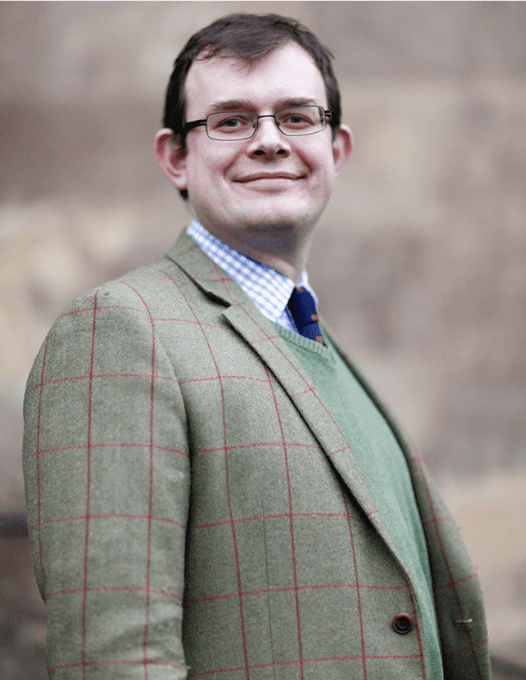
Chris Eldridge, Head of History at Wells Cathedral School, has been made a Fellow of the Royal Historical Society (RHS) in recognition of the unique work he and his team have been doing in promoting the study of medieval history in the Sixth Form at Wells. He is thrilled to have been made a Fellow, especially as it is normally university-level academics who receive the recognition.
“When I first arrived in Wells I was captivated by our 10th century origins and the medieval heritage that we live and work within. Not studying medieval history in this context looked to me like a lost opportunity. Yet medieval history tends to get neglected in British schools. A lot of teachers think it’s either incomprehensible or irrelevant to modern students. I hope the work we do at Wells studying and promoting it dispels this myth.” The RHS is trying to increase its engagement with secondary level education, and Chris will be involved in future initiatives for this sector. He has been invited to speak at the Historical Association’s forthcoming national conference in Bristol on 13th May about ‘Making Medieval History accessible to Sixth Formers.’
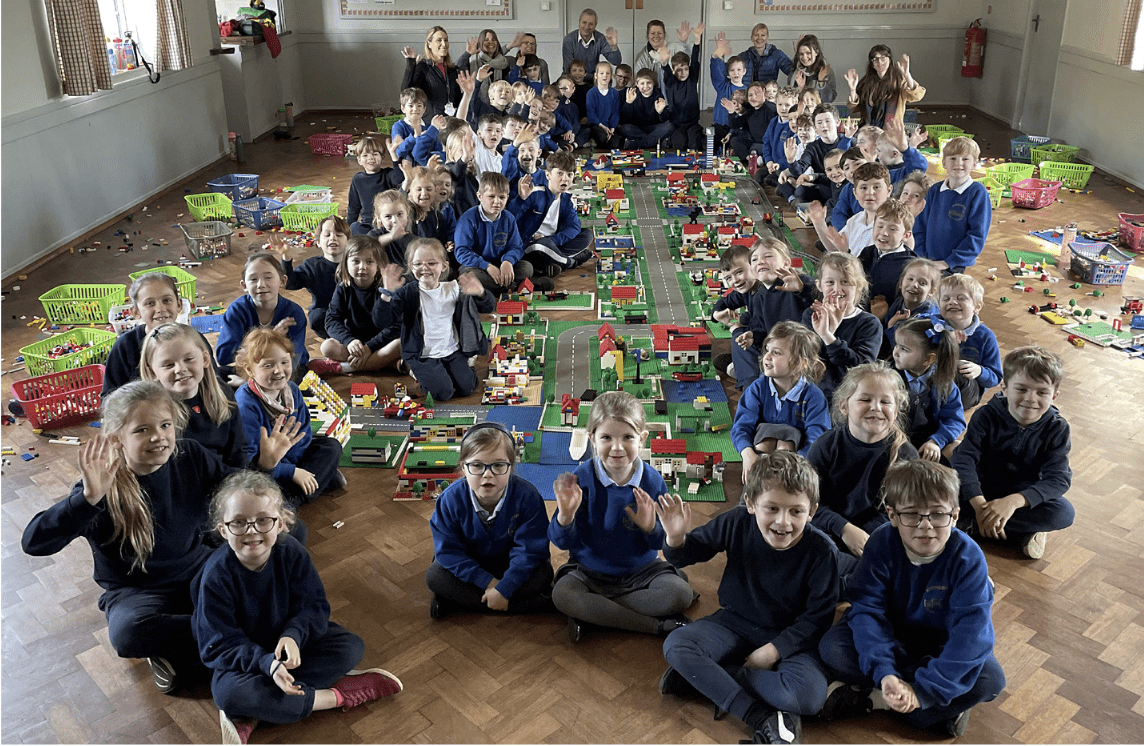
All the pupils at Witchampton First School decamped to the village hall this month to mark Science Week – by spending a day building with LEGO. With the theme of ‘growth’, the youngsters designed and created their own town which included houses, vehicles, roads, trains, airports and woods. There were 20,000 pieces of LEGO available during the day, which was organised by Bob Walker of Primary Workshop.
A unique creation Headteacher Jo Hancock said: “With the theme of ‘growth’ our children were able to grow their own town out of nothing. “They all loved building with LEGO and it taught them many lessons – including the importance of communication and collaboration. “The children designed and planned their parts of the creation, and then either on their own or with others built them. It was fun to see the whole thing coming together and watching the children become totally absorbed in it.” Liz West, CEO of Wimborne Academy Trust, said: “Science is an important subject and it’s crucial to introduce the subject as early as possible. I’m sure that through the day the children learned a great deal without realising it.
The Spring Countryside Show is taking place at Turnpike Showground between Gillingham and Shaftesbury on the 23rd and 24th April.
The show is organised by the Gillingham and Shaftesbury Show team, and the theme for this year is ‘Bring Spring to Life’. A line up of over 50 exhibits, demonstrations and attractions are set to deliver a weekend jam-packed with fun for the whole family. James Cox, event organiser said: “We’re so excited to bring this new country show to Turnpike showground. It embraces and highlights all the wonderful rural pursuits, traditions and talented craftspeople our region has to offer. There really is something for everyone.
Rural Living Countryside pursuits and rural activities will of course be on display, including a dedicated ‘Rural’ ring sponsored by Gritchie Brewing Co. See heavy horse logging, terrier racing, gun dog demonstrations and the spectacular horseback falconry display by Jonathan Marshall. The famous Dorset Axemen will be battling it out against the clock, and there’s a dedicated Farm Yard feature sponsored by Friars Moor Livestock Vets with the hilarious ‘Sheep Show’ – yes, sheep love to dance – plus farm machinery and goat milking demonstrations. Plus the pre-requisite goat milk ice cream.ice cream. The rural skills of farrier, wood carving, blacksmith, stickmaker and coppicer will also be on show.
Green-fingered visitors will enjoy the stunning show gardens and floral displays.
Entertainment To increase the celebratory atmosphere there’s a festival area with live music, food and – of course – a bar with local ales, gin and cider. This will all be open until 10pm on the Saturday evening, so visitors can dance beneath the stars and enjoy a true festival vibe.
You can join in If that’s not enough to ‘bring on the spring’, there’s a fun fair with bouncy castles, and tractor and trailer rides. Perhaps try your hand at willow weaving, in one of the various have-a-go activities scheduled.
Tickets start from £8.50 for adults and just £1 for children – but hurry as the price will increase when a quota is reached! And, if you have a country craft or tradition you can demonstrate or want to try your luck at a Show Garden or floral display – there’s still time to get involved. For tickets, more information and details on how to exhibit, visit www.springcountrysideshow.co.uk or telephone 01747 823955
Is a rural site in Dorset right for a large solar farm? Rachael Rowe revisits the proposals for an industrial-scale solar farm between Mappowder, Hazelbury Bryan and Pulham.
We’re all aware of escalating energy prices and the impact of the war in Ukraine on oil and gas supplies. More sustainable solutions need to be found quickly, but what if they are not the most appropriate ones for a rural site? If you have recently been out on a spring walk and admired the delightful scenery in the Blackmore Vale, how would you feel if you turned a corner and encountered a mile-long solar panel farm? We revisited the solar panel proposals planned for a site between Mappowder, Hazelbury Bryan and Pulham to see what progress has been made.
When does a plot become a blot? How large can a solar panel site be before it becomes a blot on the landscape? The area around the proposed site is prime farmland and lies within the setting of the most beautiful northerly part of the Dorset Area of Outstanding Natural Beauty (AONB). The views from Woolland Car Park and the Wessex Ridgeway, in particular, would be obliterated by a mile-long solar farm. At 77 hectares, it would be one of the largest solar farms in the South West. Apart from losing good agricultural land, Ian Bryan from Save Hardy’s Vale said: “They need it to be as big as possible to be economically viable. This type of development eats up farmland for very little return.” The group supports solar panels, just not on an industrial scale in a rural area.
A handy location Solar panels have to go somewhere, but why did the developers pick this particular site? At a meeting in October last year, a representative from the proposed developer British Solar Renewables explained the reasons for creating an industrial solar power station at North Dairy Farm. It turns out there are already 132,000 Kva power lines running above the fields, making it highly attractive as a site for a solar farm. Further reasons included ‘doing it for Dorset Council’ and for local supply. However, the people of Spetisbury recently learned the electricity generated from a solar farm near them is actually supplying London, raising questions about where power from Mappowder would go.
The ‘Boywood canal’ – or the road to Hazelbury Bryan as some people call it.
Flood plain And could the developers have picked a site with a far lower risk of flooding? Remember that day of torrential rain and flooding in October last year? Mappowder was cut off by flooding for hours. Photos from the proposed solar farm site reveal a weakness: its position where the River Lydden and Wonston Brook meet, and where the high landscape points converge, mean this area is always vulnerable to flooding. It’s not somewhere you would naturally choose to place solar panels, where they would probably get submerged in heavy rain or flash flooding. There are also footpaths in the area that would be significantly affected by the development. We all need to change our habits and learn to live with alternative energy sources in the months and years to come. But how effective is solar power compared to other sustainable energy sources? Compared to hydropower or offshore wind, it lags behind and is less efficient.
From bridleway N52/5 the site can be seen – indicated in red.
A planning opportunity? As pointed out in an article in the February issue of the BV, Dorset has been slow on the uptake of solar panels on housing. Is there an opportunity for new housing developments in Dorset to be fitted with solar panels as a more sustainable solution? Rupert Hardy, chairman of the North Dorset CPRE, said: “On the solar front, we are well aware of the climate emergency and have not objected to a number of solar farms in North Dorset, except for the more inappropriate ones, which are often the larger ones, that would desecrate our countryside. We are supportive of small, <5MW, community-funded solar farms that can be well screened, and more deployment of roof- mounted Solar PV.”
What is the current position? The senior landscape architect at Dorset Council has recommended the site be opposed, due to its impact on the landscape. It is now Dorset Council’s responsibility to decide whether to support or oppose the proposal, which could see a significant effect on a beautiful part of North Dorset. There are more than 200 letters opposing the proposals on the planning portal, reflecting the strength of feeling from local people. Although we all have a responsibility to look at more sustainable ways of living, there is clearly a time and place for developments on an industrial scale.
How exactly does spending time with a horse help when you’re struggling? Equestrian columnist and RDA coach Sara Greenwood reflects on the power of those gentle ears, and talks to April Kibby of Lofty Therapy Horses.
Simon was a little nervous at first and he was still a bit unsure when Bertie edged close to him and tried to give him a kiss. Then Bertie closed his eyes and waited for Simon to feel brave enough to come closer.
Where do you turn if you have a problem? Personally, I will have a cuddle with a horse and we put the world to rights. Thoughout my life I have done the same – I’ve been lucky enough to always have a horse there to listen. It’s not even necessarily about the riding; is it the feel or the smell of a horse that helps? Or is it just someone that doesn’t answer back?
It’s not just about the exercise Most of us suffer through short periods of physical or mental health issues. But for some these are lifelong and debilitating – and the Riding for the Disabled Assiociation (RDA) and Equine Therapy Centres are always there to help, whatever a person’s age. Horse Therapy has been effective for dementia patients as much as it is for physically impaired children and struggling teenagers. Many schools for pupils with special needs now routinely use RDA sessions. The physical activity provides a sense of independence and freedom, while developing co- ordination and muscle tone. Inevitably, however, the real benefits go far deeper than core strength. Children will increase in confidence, improve communication, gain real life experiences and even work towards being employed in the equestrian world, among other things.
Sara Greenwood says never underestimate the power of a quiet chat with a pony, especially for someone who is lonely or perhaps frightened to speak aloud.
Locally, the wonderful Milton Abbas RDA works with younger children, Bryanston RDA works with adults, and the Blackmore Vale RDA works with all ages. The Stella Hayward Meerhay Group work with teenagers from Beaminster School who are finding it difficult to see their way in life. “This year we have focused on work experience, starting with the basics of putting on a headcollar, a rug, saddlery. Tying up a horse or a hay net with the correct knot can take a lot of work on co-ordination. We have been working on the BHS Challenge Awards, as these have small bitesize chunks to work on, with certificates that show lifetime skills.” Horses often simply help people talk; someone who is lonely, or just frightened to speak aloud, can whisper quietly to a non- judgmental ear. Even walking a horse, whether being ridden or led, around the village will always cause lots of chat and brightens someone’s day. My own neighbour and her pony are going to the next village ‘Coffee, Cake and Chat’ meeting. It gives people a chance to pat, stroke and talk to a pony that they otherwise may not have.
‘A Lofty kiss for Jenny’ – Lofty Therapy Horses is a Somerset-based charitable organisation offering animal-assisted therapy open to all ages and abilities with one-to-one sessions and small groups.
Horse therapy April Kibby runs Lofty Therapy Horses. Lofty and his friends are miniature horses, pint-sized pals that travel around Yeovil and the surrounding areas, offering animal-assisted therapy. April says: “Working with, learning how to care for, and interacting with horses has a really positive effect on our mental health. It has been said that horses are ‘mood altering drugs, without the side effects’ and that is so true! Horses can read human emotions, they mirror our feelings. They are kind, forgiving, challenging … and they are incredibly good at teaching us about ourselves, our emotions and how we interact with others. “Horses provide psychological therapy – helping us to learn about ourselves through interacting and connecting with them, how to manage new challenges, and ultimately leading to new life skills and a more positive outlook on life.
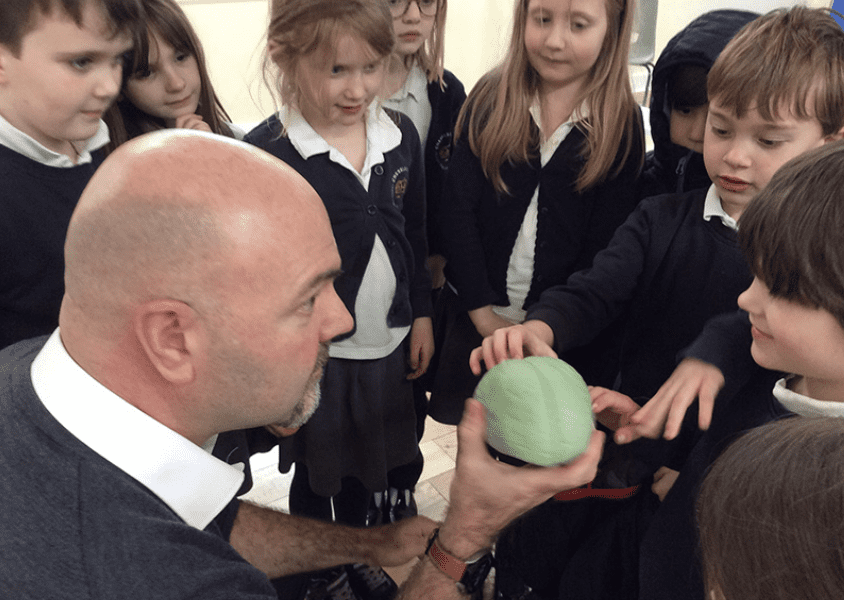
Cheselbourne’s village school motto of ‘inspiring a lifetime love of learning’ had true meaning this month, when a STEM-themed week of activities created a wide range of experiences ranging from a Science Dome to a Robotics workshop, and many visits and webinars from ‘proper’ scientists.
The passion of all of the staff members and helpers was truly showcased, and the children were engaged in so many ways. These opportunities support the children not only to develop their knowledge, but also skills that will be transferred across the curriculum into many other subjects. During one task, the children had to design a contraption that could hold an egg. The contraption was dropped from over 7 feet in height and the aim was to see if the egg would stay intact … Great fun!
There’s endless enjoyment from the bottom of a wine glass, says expert wine merchant Sadie Wilkins – but make sure you keep an open mind.
One of the things I love about wine is the fact that each glass becomes an experience. There are so many variables that are tightrope walking in any given bottle that’s it’s hard not to feel excited or like there’s an opportunity to feel something new from the bottom of each glass. So, I suppose the question I am posing is: can we ever truly suss out a single grape variety? There are so many factors at play, from climate and terroir to winemaking processes and blending; the easy (and, enthralling) answer is, simply, no. However, does this mean that we never know where we stand? To an extent, yes – but we can of course always fall back on tradition, long-standing terroir conditions and appellations to protect the typicity of a given region, right? Though, even in these contexts, we can’t account for climate change and the individual personality of a winemaker, which influences their unique style – they are human after all.
Do you take your Malbec French or Argentinian? Let’s take Malbec for example; a grape which has risen to heady heights over the last 20 years, it is often a grape that customers feel confident in claiming as a variety they ‘know and love’. Interestingly though, we can often bet that 75% of the time when they say ‘I like Malbec’ that they mean they like Argentine Malbec, as the recent popularity is thanks to the South American revival. Malbec from this region, most notably Mendoza, is incredibly different to a glass of Malbec (or ‘Cot’) from France – the country of origin. If it’s made in Argentina, you are going to have a warmer climate and grapes that ripen at a faster rate. Therefore, you can expect a very fruit-forward plummy style alongside a fuller body, which quite often has more in-your-face oak ageing than its French counterpart – which is still plummy in flavour, but has a drier, more subtle freshly-picked-from-the-hedgerow style. The same goes for many other wine grapes: a Marlborough Sauvignon Blanc for example offers a greener palate, with vibrant vine tomatoes, gooseberries and cut grass notes in comparison to a leaner, more mineral French take from the Loire.
Handy benchmarks But what I’ve done here is rely on my previous experiences to create a ‘typical grape experience’, an expectation, in my mind. But wine is much more than that. We source wines at Vineyards that are both typical and unusual examples of a grape variety – but that’s where having a benchmark standard comes in handy. It gives you a point of comparison. The actual beauty of wine is being taken on a journey from a single sip – whether that be to a place of surprise or somewhere within your comfort zone. So, is it ever worth pigeonholing a grape when there’s so much at play in each given vineyard? For us, an open mind is the best approach and is the thing that makes a career in wine so fun!
A unique heritage project is reviving historic connections between North Dorset and Newfoundland – and has already led to a couple of a remarkable discoveries, says BV columnist Roger Guttridge.
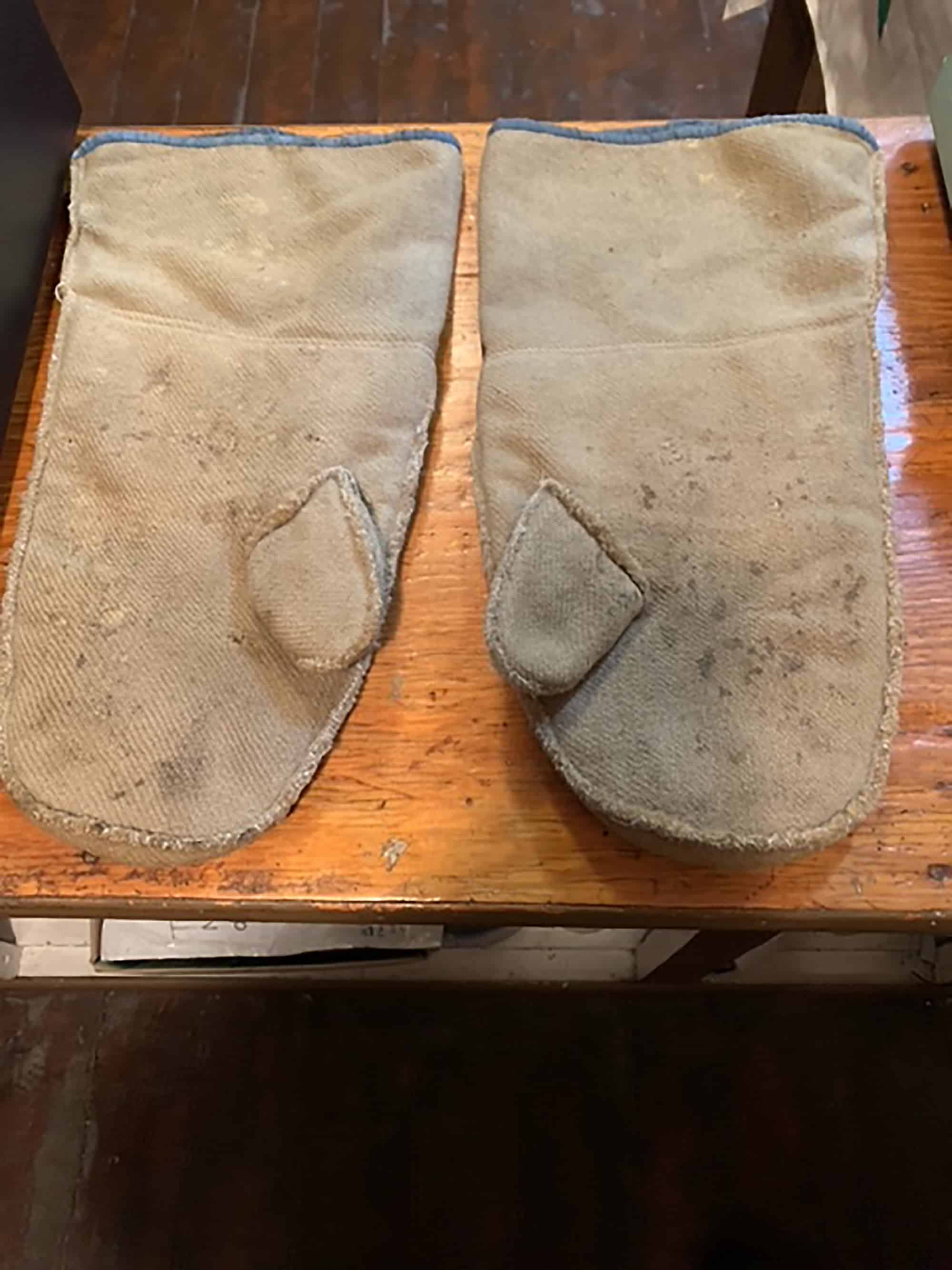
A humble pair of mittens that probably started life in Sturminster Newton has turned up in a private museum in a remote part of Newfoundland – and is causing ripples of excitement on both sides of the Atlantic. The mittens are the world’s only known surviving garments made of swanskin, which was uniquely manufactured in the Blackmore Vale from the 16th to the 19th centuries.
The discovery of these rather dull-looking mittens is causing international excitement – they are the world’s only known surviving garments made of swanskin, which was uniquely manufactured in the Blackmore Vale in the 1500- 1800s. The cloth for these may well have been made in Sturminster Newton.
Dorset’s fishing mitts They came to light as a direct result of a heritage project called the Swanskin Seafarers of Sturminster Newton, which is bringing together historians, museums, teachers and students in both Sturminster and Twillingate, Newfoundland. As word of the project spread around Newfoundland’s remote north coast, Peter Porter came forward to say he had the mittens in his museum on Change Islands. Peter has a ledger recording the sale of the mittens in 1899 but they may be decades older – and the material would have been made in the Blackmore Vale. Former teacher Jocelyn Bath told the BV from Twillingate: ‘My father remembers his dad having a pair. “They were favoured by the fishermen because they were warm but could also be removed quickly when the need arose while fishing or sealing.”
Twillingate and Sturminster Jocelyn has also uncovered some family documents dating back to 1816 that included orders for swanskin and references to Sturminster Newton. An estimated 92% of the ancestors of people in Twillingate (pop 2,121) and neighbouring Change Islands (pop 208!) and Fogo Island (pop 2,244) came from Dorset – and many of those from North Dorset.
The swanskin mittens are in a private museum in Newfoundland
As I discovered when I visited Twillingate in 1997, a huge proportion of residents have traditional Dorset surnames, and speak with strong elements of the Dorset accent and dialect. The story of North Dorset’s close connection with Newfoundland dates back to the 16th century, when hundreds of ships sailed annually from West Country ports to exploit the North Atlantic’s rich stocks of codfish.
No swans were harmed in the making of these mittens … In those days the Blackmore Vale was predominantly sheep- farming country and much of the wool was turned into a thick flannel-type cloth called swanskin. Swanskin, whose only connection with swans was its colour, was ideal for clothing fishermen working in the cold and wet North Atlantic waters, and Newfoundland became the main market for a fast-growing production line. The earliest reference to swanskin is dated 1578, when Sturminster clothier James Yonge (Young) applied for tax relief on cloth sold to ‘mariners going beyond the seas’. In 1611, a fulling mill was built alongside Sturminster’s grain mill. Here water- powered fulling stocks hammered the fabric until it was sufficiently felted to make it waterproof. By 1793, no fewer than 1,200 Sturminster people were employed in swanskin production, an industry which also extended to Shaftesbury, Stalbridge and the villages. Between 4,000 and 5,000 35-yard pieces were produced each year and carted to Poole, whose ships dominated the Newfoundland trade in the 18th and 19th centuries. A trade directory reported of Sturminster: ‘The principle manufactory carried on here is for white baize or swanskin, in which the poor, who are very numerous, are chiefly employed.’ The Sturminster dialect poet Robert Young recalled that the racks on which the cloth was fixed covered one or two fields. ‘Many a time I have watched the weavers’ swift shuttles passing between the tightened threads,’ he wrote. The fulling mill was demolished about 1800, when the swanskin trade was beginning to decline in the face of competition from the industrialising North and Midlands. By 1812, the number of people employed had dropped to 700 or 800. As this trend continued, some of the Sturminster cloth merchants filled the economic vacuum by switching to cod fishing. This in turn led to a dramatic increase in the migration of Dorset people to Twillingate and other developing fishing communities.
The only other known picture of a swanskin garment dates from 1712 and shows a swanskin-clad fisherman (far right) at a Newfoundland fishing station
High school Zoom The Swanskin Seafarers project, supported by a £14,000 grant from the Association of Independent Museums (AIM) and the National Lottery Heritage Fund, will include research led by the Sturminster Newton Heritage Trust, arts projects – including a film – led by arts company Emerald Ant and hands-on research by students on both sides of the Atlantic. As the former Old World Connection columnist for Newfoundland’s Downhomer Magazine, I was honoured to kick off the project by talking to 100 students at Sturminster High School and, by video link, to students at JM Olds Collegiate (JMOC) in Twillingate. Students from the two schools have since met each other via Zoom and more exchanges are planned. The Twillingate youngsters are especially intrigued by the discovery that most of their ancestors came from a small area of southern England and are plunging into family history. JMOC principal Stephen Earle said his school community felt privileged to be involved in a project which had already exceeded expectations. ‘Our students are already making some amazing connections between Twillingate and Sturminster Newton, particularly around their ancestry,’ he said. ‘This project is allowing us to easily expand into some of our deep learning objectives and we look forward to continuing this partnership.’
tudents at JMOC, Twillingate, learn about their community’s historic connections from Roger Guttridge (on the big screen). From the JMOC Facebook page “Mrs. Bath’s grade 9 social studies class take in a chat from UK historian Roger Guttridge as part of our history linkage project between us and Sturminster Newton High School. More exciting stuff to come in the following weeks!”
The Twillingate students are planning a school trip to Peter Porter’s museum on Change Islands, which is also home to a Newfoundland pony refuge. The hardy ponies, whose numbers have dwindled in recent decades, are descended from the New Forest, Dartmoor, Exmoor and Connemara ponies that went out on the ships as working animals. Jocelyn Bath added: ‘We’ve had so much community interest in this project on our end. The response has been fantastic.’ At Sturminster High School, one of the topics that has caught students’ imagination is the apprenticeship of young orphans to the Newfoundland trade. In 1621, Sturminster clothier William Williams left money in his will to apprentice two boys a year – from Sturminster, Shaftesbury and Blandford in rotation – ‘to the sea service’. Each apprentice received ‘two jackets, two pair of breeches, a greatcoat, three shirts, two pair of trousers, one hat, two pair of shoes, two pair of stockings, two handkerchiefs, knives, combs, caps, bed, pillows and a large blanket’. The William Williams charity, which also aided ‘clothiers, serge-makers, linen weavers and felt-makers’, continues to fund students 400 years later (see BV March issue here) Sturminster High School students are furthering their studies with visits to the mill, museum and the Dorset History Centre. ‘This project has enabled staff and students to weave the “golden thread” of local history through the existing curriculum, creating exciting opportunities for further study,’ said the school’s head of humanities, Sandra Mitchell.