Rubicon, an employee-owned company, has relaunched Rubicon Executive to enhance its recruitment of top executives across the UK. In a rapidly changing business environment, finding the right leaders is crucial. Jessica Comolly-Jones, Rubicon’s Commercial Director, emphasises that executive hiring involves more than evaluating resumes; it’s about cultural fit and understanding individual industry nuances. Rubicon uses advanced methods like psychometric testing to better assess candidates, ensuring they align with company values and are effective in their roles. The importance of correct hiring is underscored by a REC report, revealing that 95% of HR decision-makers admitted their business made significant hiring mistakes last year, costing an average of £132,000. The company also prioritises diversity and maintaining a strong talent pipeline, preparing businesses for future challenges with the necessary leadership. The relaunch of Rubicon Executive marks a strategic move to differentiate their executive recruitment services from the broader Rubicon Recruitment portfolio, offering specialised, high-quality solutions. Jessica explains, ‘Rubicon Executive’s mission isn’t just to fill vacant positions; it’s to influence business success across the UK by identifying top-performing leaders.’
Taylor Wimpey Southern Counties, has made a significant contribution of £1,000 to the Gillingham Community Cinema, following the relocation of its facilities to a new venue. The donation will ensure that the residents of Gillingham can still enjoy the latest films.
Gordon Amery (left) of Gillingham Community Cinema receiving the cheque from Katie Westbook (Taylor Wimpey – right).
Originally located at the Gillingham Methodist Church, the cinema has relocated to Vicarage Schoolroom due to the closure of the church hall. The funds donated will be instrumental in addressing various expenses associated with the relocation process.
From essential electrical work to securing professional installations for specialised equipment, the donation will enable the cinema to overcome the upcoming logistical challenges. Additionally, the contribution will cover costs such as equipment maintenance and security measures, ensuring a safe and immersive cinematic experience for all.
Gordon Amery, organiser of Gillingham Community Cinema, said: “We’re very grateful for the donation from Taylor Wimpey as it has allowed us to get the cinema equipment installed in time for our opening night. There were a certain amount of funds available from our old location but not enough to cover all of the costs involved in the move. Hopefully, there should now even be a little money left over to enable us to purchase some additional comfy chairs for the cinema.”
Rosamund Wells, Sales and Marketing Director for Taylor Wimpey Southern Counties, said: “We are thrilled to be supporting the Gillingham Community Cinema in their mission to elevate cultural experiences within our local community. Situated conveniently near our Gillingham Lakes development, we are delighted to contribute to the accessibility of diverse and engaging entertainment options for residents.”
The cinema is a firm favourite with the local community and the relocation of the Gillingham Community Cinema represents an exciting development for the local community, offering enhanced accessibility to cultural experiences and fostering a sense of community engagement. Taylor Wimpey’s contribution reflects its dedication to supporting initiatives that enrich the quality of life for residents and contribute to the overall areas in which it builds.
For further information about the Gillingham Community Cinema and to find out what’ on next visit https://www.filmatgmc.org.uk/
Independent family brewer Hall & Woodhouse’s 2024 Community Chest Awards are now open for applications. Charitable organisations across Dorset can seek support from H&W’s largest-ever fund of £60,000, marking the highest pledge in the initiative’s 22-year history. The Community Chest is available to a wide range of community initiatives and small volunteer-led charities with a total income of less than £200,000. H&W aims to provide essential funds to enhance local areas within its trading region across southern England. Grants can support youth activities, arts and culture initiatives, sports and social clubs, health and social care, the elderly and disabled, and environmental conservation. Applications for grants between £300 and £3,000 are open until Sunday, July 14. Funding can cover operational costs, essential equipment, and essential training. Mark Woodhouse, Family Director of H&W, said: ‘Each year, we are inspired by the remarkable efforts of local people who go above and beyond to help others, that work tirelessly to make a difference in our local communities.’ Since its inception in 2002, the Community Chest has donated over £800,000 to more than 950 good causes across southern England. Application forms are available at hall-woodhouse.co.uk/community-chest and can be emailed to [email protected] for consideration.
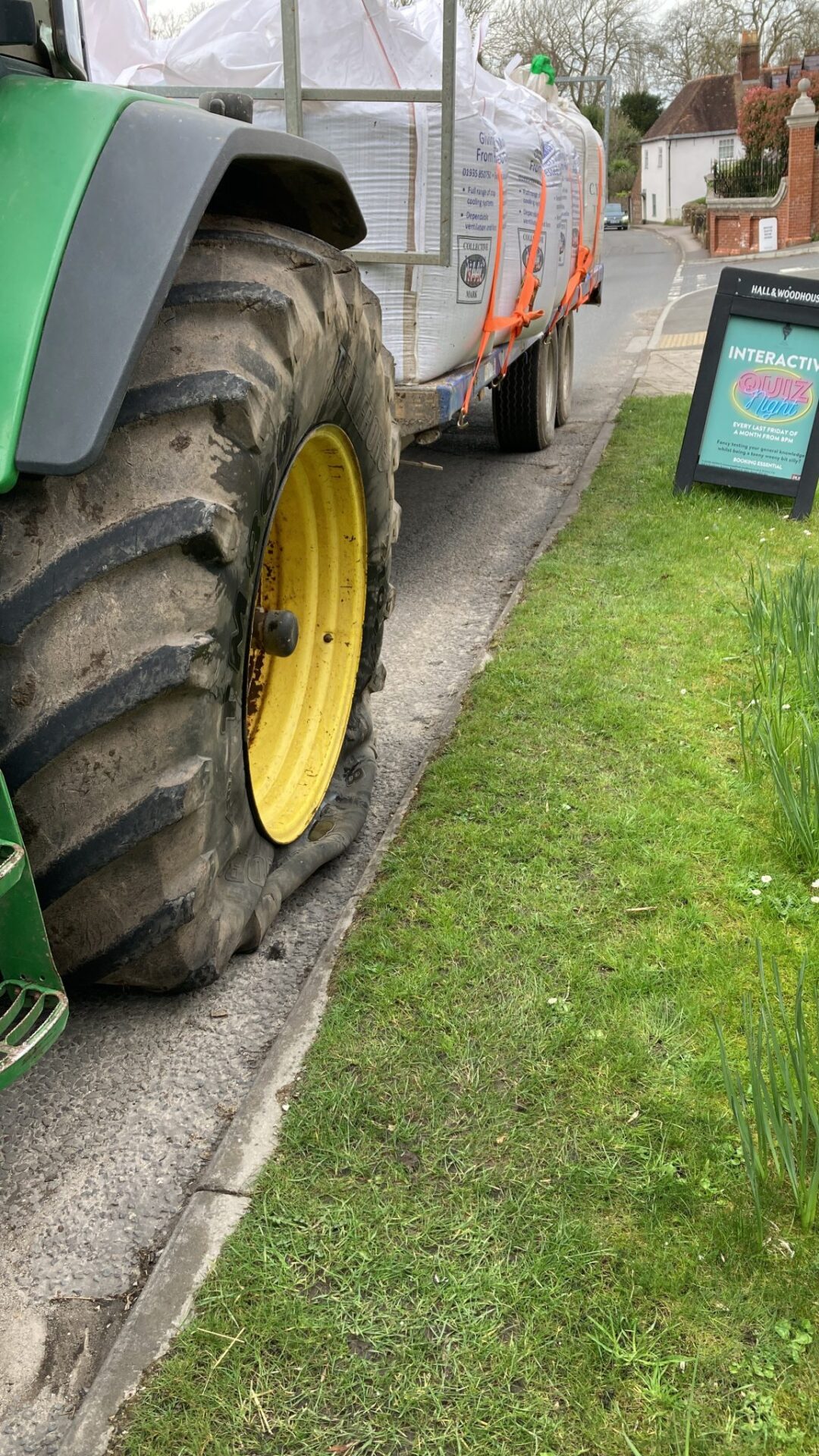
Tractor troubles during critical sowing – George Hosford gets a flat during spring planting … handily while he was outside the brewery!
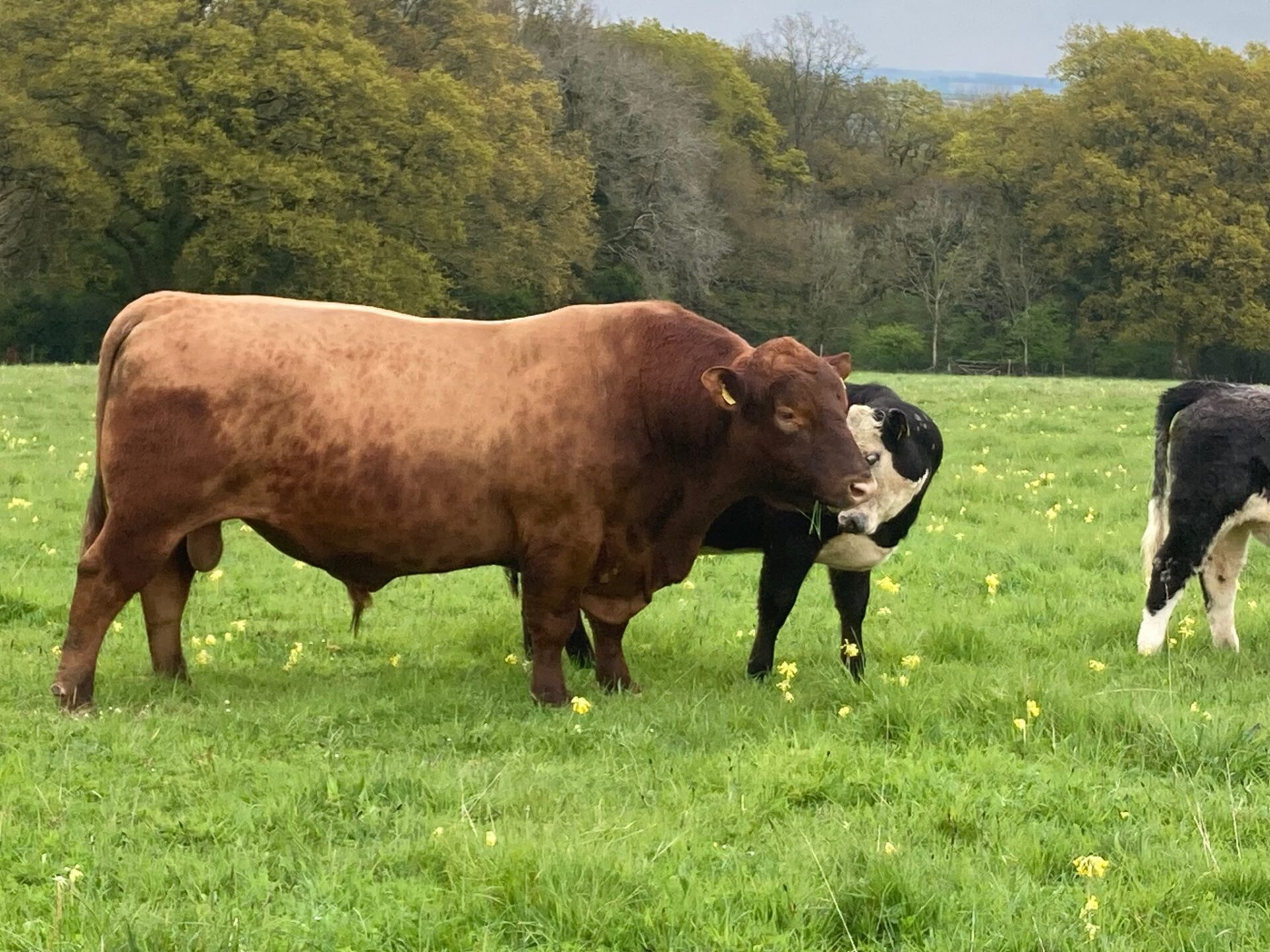
Mr Red enjoying the company of 11 heifers, replacements for the herd for next year, and the cowslips. All images: George Hosford
The scene below is not really what you need when towing a 10 ton load of seed through town – right outside the Hall & Woodhouse brewery in fact – during a short break in the weather. The load was sufficient to sow around 60ha of our 220ha spring sowing programme. Pat from Blandford Tyres was on the scene very quickly and we managed to get the tyre blown up, the trailer unhitched and the tractor into the brewery car park for a proper repair to be made (an old factory repair on the previously tubeless tyre had given out, so Pat had to put in a £150 tube). Brendan came to the rescue with another tractor and took the seed trailer on to the drill, and we got the barley sown by the skin of our teeth before it rained … again. But the soil was too wet to roll, like every other field this spring – and half the autumn-sown crops too. Before I wallow too indulgently in self-pity, I’d better put in a word for the farmers who farm land a good deal wetter than ours. Our chalk-based soils drain quite quickly compared with the heavier clays on which much of the country depends for its food. Countless thousands of hectares of winter crops were under water for many months in some parts of the country, and of course, the crops will have been destroyed, with precious little chance of the soil drying out in time to sow a viable crop in the spring, as the rain continued almost without relief until late April. A great many of those fields will need more than a year to recover their productivity. One option would be to plant a summer fallow of mixed flowering species, and hope for an opportunity to sow a crop in the autumn. Otherwise, it’s leave well alone until spring next year – but who knows how much it will rain next winter? The financial consequences of all this are eye-watering.
Flat tractor tyres in the centre of Blandford are not a fun way to spend afternoon
Going bats Last month, Claire, our cluster group leader, organised a bat walk, led by Jim Mulholland of the Vincent Wildlife Trust. He gave us a fascinating talk with slides, focussing on the greater horseshoe bat, which has a colony of around 500 very local to the farm. We learnt that many years ago our land was highly likely to have provided foraging habitat for this endangered species, and we, as well as neighbouring farms, were encouraged by the Vincent Trust to both manage our hedges to benefit the bats, and also to refrain from using Ivermectin wormers on our cattle. This family of medicines kill the flies and beetles that feed on – and live in – cowpats, and which simultaneously provide an essential food source for bats, as well as many other species. From a low of just 2,200 individuals 30 years ago, the UK greater horseshoe bat population is now said to number around 10,000 – thanks not in small part to the Vincent Trust, which has spent huge amounts of money purchasing buildings already in use as roosts, and then adapting them to suit bat requirements as closely as possible. Jim took us to the roost, gave us bat detectors and encouraged us to stand quietly, watching the sky and listening for the bat’s unmistakeable sonar-like noise. Normally undetectable by the human ear, through the detectors they sound a bit like the Clangers, with a rising pitch phrase of 5 or 6 blips. The sound of approaching bats on the detectors made us look upwards to be treated to swoops of individuals leaving or provide plenty of wildlife shelterreturning to the roost. The bats were silhouetted against the dusky sky, and the combination of sound and vision was captivating. This link takes you to a leaflet about the greater horseshoe bat, and it has some great pictures.
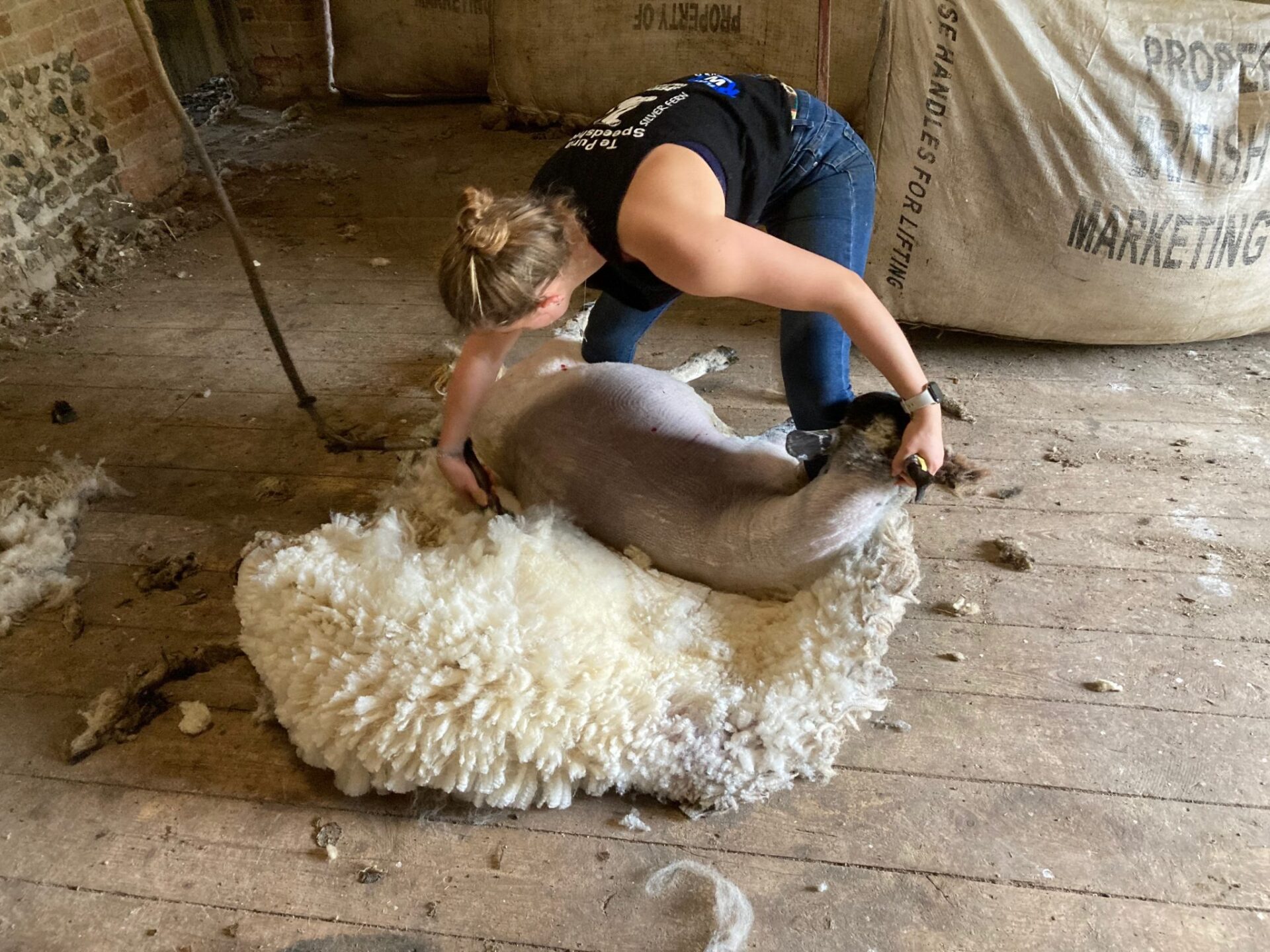
Lessons with a Kiwi shearing gang meant the shearing can be done in-house
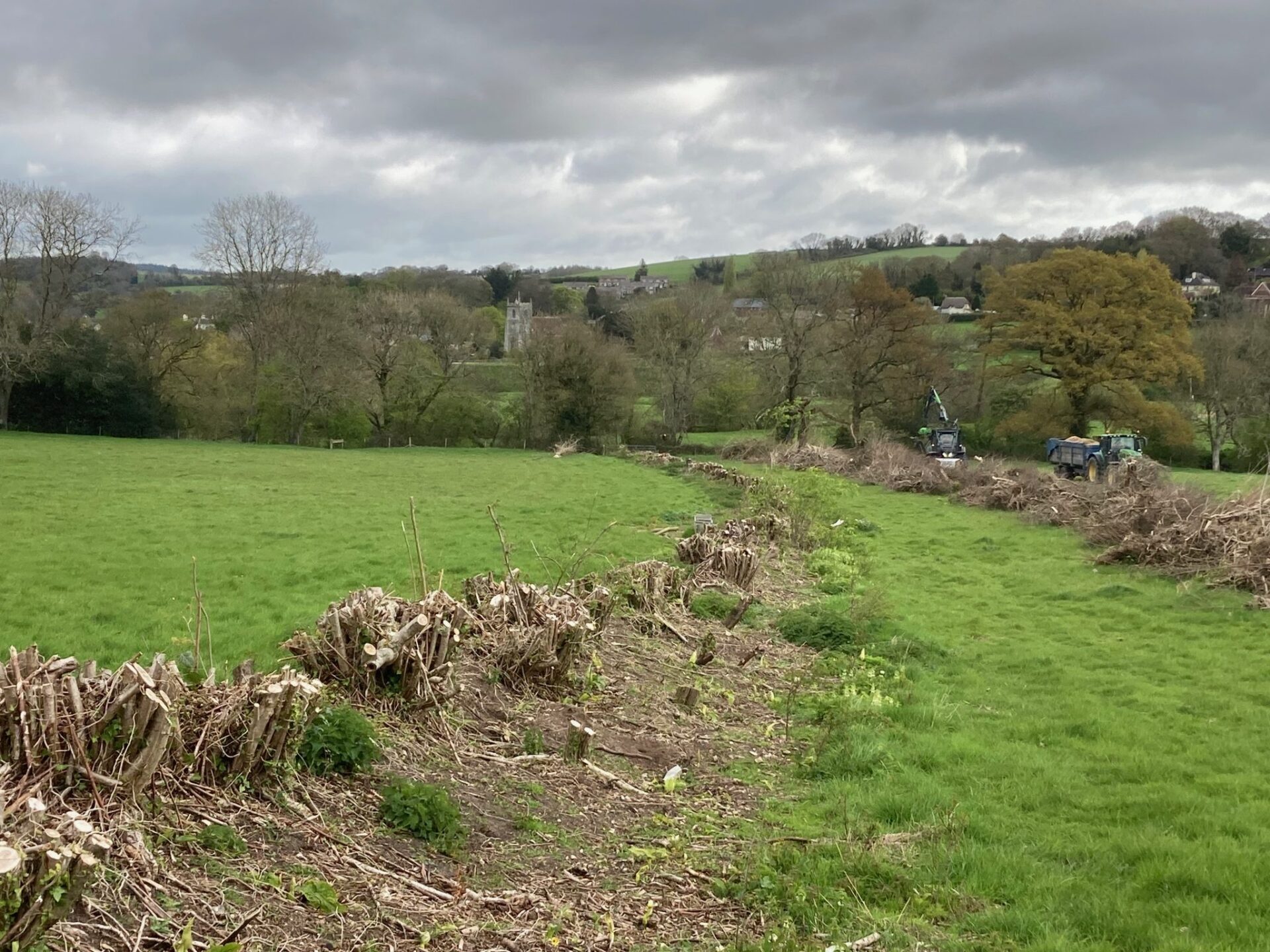
Drastic action We have done a bit more hedge coppicing this winter – admittedly it looks pretty radical when work is complete, but once we have filled in the gaps, and the stumps have sprouted new growth, we will end up with a much healthier hedge, with a thick bottom and lots of growth which will provide shelter for nests and fledglings. We hired a man and machine for the day to chip up all the brush wood – the chipper is huge and can munch it up faster than the operator can feed it with his long armed grab! We will use the resulting wood chip in the cow shed next winter to give the straw bedding a good base, and also to mulch new hedging and trees around the farm. Fencing it in then immediately moved up high on the to-do list of ongoing work, to prevent deer and our livestock eating the new growth! Lastly, you can see above it was time to get the wool off the ewes, a couple of weeks before they lambed. Newly-learned lessons with a Kiwi shearing gang meant the shearing can be done in-house once again.
Hedge coppicing looks brutal when it’s fresh – but these hedges will swiftly grow back with thick bottoms which not only keep livestock contained but also provide plenty of wildlife shelter
Holidays for racehorses, the quiet season at the stud … but Lucy Procter is juggling the complexities of artificial insemination delivery
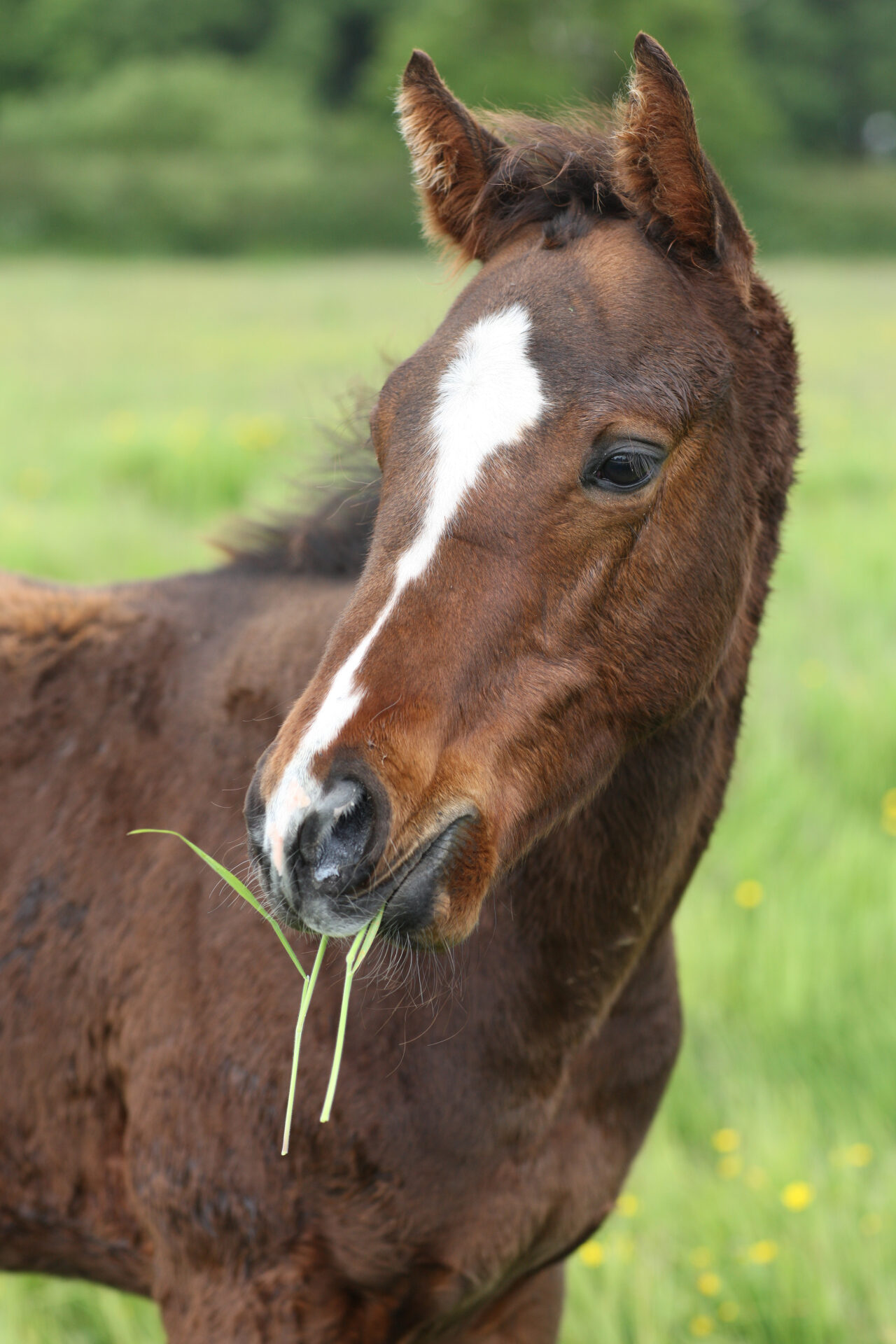
Summer holidays are here for two of our racehorses, who are enjoying a six-week break from racing before coming back into work for an autumn racing campaign. The Swede and Spinnova have had their shoes removed to avoid injury to themselves or to each other – the photographs below show that they certainly relished their first morning’s turnout together: they were high jinxing around the field like a pair of youngsters! Initially they will come in overnight, with their turnout time gradually increased until in a week or so, they will be able to stay out all the time, and properly relax. The rest of the stud farm is quiet, with most of the mares and foals living out now. There is just one mare to foal, and all except two of the Thoroughbreds are back in foal, with the last two due to be covered imminently. Our mares have plenty of grass and are topped up with ‘hard feed’ – concentrated pellets of feed, specially formulated for broodmares by our chosen feed company, Saracen Horse Feeds. Well-fed mares are relaxed mares and, blessed finally with good weather, the foals are also relaxed and able to spend a lot of time sleeping during the warmth of the day, playing during the evening when it gets cooler.
We still have a couple of the non-Thoroughbred mares to cover using artificial insemination (AI) – where semen is collected from the chosen stallion and delivered to the stud either frozen in a nitrogen tank, or chilled. The stallions our client is using this year are in studs in Belgium, however, and it is very tricky to time a request for delivery of chilled semen when it takes more than 24hrs to be couriered from their stud farm to ours. Demand for this chilled semen is high, so there is no guarantee of getting any at the right time, either.
As a back-up, we have a supply of the stallions’ frozen semen. However, the difficulty with using frozen semen is that, once defrosted, it has a short life span and must be inseminated into the mare within six hours of her ovulating in order to have a chance of her getting pregnant. This requires more frequent visits from the vet to scan the mare, often at unsocial hours.
Fun in quarantine A couple of weeks ago, Doug had a rare night away in Doncaster for the TBA National Hunt Awards. Although not collecting an award (for the first time since 2019!), he did make it into the Racing Post Sales Diary column – he was spotted at various times through the evening, drinking champagne, white wine, cider and lager. The fact that he was still standing at the end of the evening was apparently worthy of an award in itself!
A couple of days later, Doug was in the horsebox at 4am, driving back to Doncaster for the Goffs HIT Sale (Horses in Training), where he was joined by a racing enthusiast that Doug had met when racing at Cheltenham only a few weeks ago. He was keen to get into breeding, and they successfully purchased a lovely broodmare prospect, Aubis Walk, who coincidentally raced in the same colours as our superstar, Honeysuckle. Having brought the mare straight back from the sales, she needs to be isolated from the rest of the broodmare band for 14 days, but we have put her in a field with one or our youngsters for company during her quarantine period. It was great fun to have the new owner visit the stud the following weekend and enjoy a long lunch in the garden. His dreams of breeding winners grew more ambitious with each bottle opened. Thank goodness he came by train!
On my weekly radio show I try to focus primarily on new and underground artists, bringing them to a wider audience and dispelling the myth that “there’s no good music anymore”. As a result, it has been a point of some consternation to me that 2024 has been conspicuously lacking in high quality debut albums. In fact, two of my recent Album Of The Month submissions have featured artists with careers spanning well in excess of 20 years. I was therefore delighted to hear the debut L.P. from Canadian singer-songwriter Wyatt C. Louis. The album’s title, Chandler, is taken from the C. in the artists name, and reflects the deeply personal nature of this record, produced close to home in Calgary. But what immediately catches the attention is the sure-footedness of both the writing and the arrangements on display here. While on its surface this is a Canadian take on Americana-Folk, a la Dallas Green (City & Colour) and Spencer Burton (Grey Kingdom), Wyatt never shies away from adding the kinds of flourishes and unexpected musical touchpoints necessary to set their music apart from their contemporaries. The album opens in a wash of acoustic guitar accompanied by piano and wind instruments before settling into Wild, where beautiful but subtle violin and pedal steel flourishes ebb and flow as Louis implores “Take me as I am, take me”. The standout track and centrepiece of the album, In Emerald, is where the self-confidence and aplomb of this album really reaches its peak. The mastery of melody and lyrics on show as Louis sings “Rainy day, headed to a guitar shop … didn’t have the money anyway” is a perfect set-up for the tail of the song, where country vies with soul in a vocal style simultaneously fresh and comfortingly familiar in its delivery. This is a superb, accomplished debut from an artist to watch.
Matthew Ambrose presents Under The Radar on Tuesday evening at 7pm on Abbey104. Broadcasting on 104.7FM and online at abbey104.com.
Step back in time with our ‘Then and Now’ feature, where vintage postcards from the Barry Cuff Collection meet modern-day reality. Explore the past and present on the same page, and see the evolution of familiar local places. ‘Now’ images by Courtenay Hitchcock
Duntish Court, sitting just a mile from Buckland Newton village church, was a large Palladian-style country residence designed c. 1760 by Sir William Chambers for Fitzwalter Foy. Supposedly it had been on the short-list when the Royal Family were looking for an estate for the Prince of Wales in 1862, being overlooked for Sandringham instead. Following the death of the head of the family, John Holford, in a road accident in 1940 – shortly after his escape from France via Dunkirk – the estate had been underused. It was used during WWII as training headquarters for the Auxiliary Units in Dorset, and the house was demolished in 1965. The 18th century landscape and pleasure ground survives, including a lake, cascade and a grotto. The original ha-ha survives, as does a garden house, and significant late 18th and 19th century tree planting remains.
Ken Jeanes (left) presents the West Country Honey Farm Award to Lionel Horner (right)
Castle Cary beekeeper Lionel Horner has been awarded this year’s West Country Honey Farm Award, which is presented annually to a beekeeper who has made an outstanding contribution to beekeeping in Somerset. The award was announced at the annual meeting of the Somerset Beekeepers Association. Speaking (SBKA) at the presentation, Ken Jeanes, chairman of the South East Somerset branch of the British Beekeepers Association, said: ‘Lionel has inspired many newbies to start their bee-keeping journey and has always been there to help and offer advice.’ Originally from Devon, Lionel has been keeping bees for nearly 50 years and has been running beginners courses in Somerset since 2014. He was the driving force in establishing a bee keeping club at Ansford School in Castle Cary and is constantly in demand as a speaker. He appeared on television as a mentor for Sarah Beeny in Sarah Beeny’s New Life in the Country – he was seen in the television series collecting a swarm to introduce into her hive. He plays an active role in swarm collection locally, and he always uses the time spent with the person who has called him, teaching them about bees and their habitats. For many years he has had a major role in organising the SBKA stand at the Bath and West Show and is, said Mr Jeanes, ‘an excellent ambassador for the association with his incredible depth of knowledge and understanding of bees, and his quiet engaging manner.’
Apiary on the solar farm Lionel’s most recent contribution to the area’s bee-keeping community has been the formation of the divisional apiary at Hook Valley Solar Park on the outskirts of Wincanton. He led the team who worked with energy firms and contractors ‘to turn a muddy disused corner of the site into the thriving apiary today, with 12 colonies and a storage shed with enough room for people to meet inside.’ Ken Jeanes continued: ‘Thanks to Lionel’s unstinting support, hard work and encouragement, the apiary now provides the perfect opportunity for all members, at all levels of experience, to learn and experiment with different methods of beekeeping, types of hives, queen rearing, etc.’ Dr Bob Jones, a much-loved former Wincanton GP and one of the south east Somerset group’s longest standing members, says: ‘I have known Lionel since he first came to this area, and I have always found him unfailingly helpful, especially with those new to beekeeping – patient and always ready to give freely of his time whenever there is a cry for help from anyone in our beekeeping fraternity.’
Peter Morgan of Cranborne’s Book and Bucket Cheese Company has just announced the launch of a new cheese, Stowaway – you might say it was literally launched, as the new product has been created specifically for the Queen Anne cruise ship, the latest addition to the Cunard fleet.
Peter Morgan of The Book & Bucket Co
Stowaway is the first of two new cheeses, both the results of a collaboration between Peter and Cunard’s development chefs – a second bespoke cheese will join the ship later in the year. Stowaway is a sheep’s milk cheese, made using a special blend of cultures to create a unique flavour profile fit for this state-of-the-art ship. It was important to have a connection with Cunard’s long history at sea, so Peter has combined this modern blend of cultures with a traditional cheddar-making process. It is finished with the remarkable Blackthorn salt, made by the ancient tower method which is unique to Ayrshire. Finally, the cheese is aged in the Book and Bucket cheese cellars. The Dorset provenance gives the cheese a terroir that only Cranborne Chase can provide, producing a natural rind that changes through the seasons. The combination of new cultures, natural rind and traditional cheesemaking methods fits perfectly with Queen Anne, who made her inaugural voyage in May, with her naming ceremony scheduled in Liverpool in early June. Stowaway was on board for that maiden voyage, along with two others from the Book and Bucket range, Cranborne Blue and Smoked Blyton.
Peter Morgan founded the Book and Bucket Cheese Company five years ago. When he began making cheese, he sought the advice of people who had more than 120 years experience in the industry between them. Each said the starting point was to “buy some books and read as much as possible. After that it is just bucket science – keep playing until you make something you like!” And so, in January 2019, with a bucket full of recipes, many ideas and the help of friends, Peter launched The Book and Bucket Cheese Company. He has developed an extensive knowledge of each type of milk, how to perfectly age a cheese, how the right salt can enhance and change a flavour profile, an understanding of the distinctive notes of traditional Cheddar and how to create modern flavours from the cultures. Peter Morgan is justifiably proud of the Cunard collaboration. He says: ‘Everyone involved in developing this cheese has fallen in love with it.’