The Blackmore Vale logo
Home Blog Page 103

Protecting Dorset: housing targets damagingly destructive

0

Unrealistic targets double the build rate, threaten greenfields and ignore affordable homes and local infrastructure, says CPRE’s Rupert Hardy

New Houses in Poundbury Dorset

Labour swept to power this summer determined to solve Britain’s housing crisis … but is that crisis the same everywhere? We would argue that the Government is setting totally exaggerated and unrealistic housing targets for Dorset Council.
The build rate in Dorset would have to more than double, as the Government seeks to shift house building from big cities, where most of the brownfield sites are, to greenfield sites in the countryside – a misguided policy.
We also suggest that the proposed target won’t achieve key goals. It would neither bring down house prices nor address the shortfall of truly affordable housing and lack of social or low-rent housing. All the towns and larger villages in Dorset could be earmarked for new, large developments too, threatening the county’s exceptional environment, especially in North Dorset, which has a smaller proportion than other parts of the county within Areas of Outstanding Natural Beauty (AONBs, now National Landscapes) which have some degree of protection.

Key issues highlighted by North Dorset CPRE:

Unrealistic targets: We dispute the feasibility of Dorset Council’s (DC) new housing target, which, according to the Government’s formula, would require the number of new homes to increase from the current 1,310 to 3,230 annually. This target is significantly higher than the Office for National Statistics’ (ONS) projected household growth of 1,212 per year, driven mainly by net in-migration of older residents. It is also much higher than the 1,793 homes annually figure proposed in the draft Local Plan, which was much criticised in the 2021 consultation.
The new government formula calculates housing need only by looking at prices and incomes – a rather crude and simplistic approach compared with the standard method used by the Conservative government, which was in itself flawed.
Supply chain constraints: Such high targets are far beyond the available supply of building materials and skilled labour.
Demand and finance challenges: There is no evidence in Dorset that planning constraints are the main barrier to house building. There are currently 11,060 plots with permission in Dorset waiting to be built. Additionally, buyers with the necessary financial resources required are lacking.
House prices: Contrary to public perception, large housebuilding targets do not lead to a decrease in house prices: indeed they may have the opposite effect if developers look to buy more land. When prices start to fall, developers slow down rather than sell cheaply. The main factors behind house prices are the availability of finance and the level of interest rates.

Aerial view of new build housing under construction in Wimborne
  • Risk of harmful development: Dorset allocating land for 48,450 homes, plus a potential 10,000 allowance for overspill from Bournemouth, Christchurch and Poole, could force planners to approve unsustainable Green Belt and greenfield sites.
  • Environmental and climate change: Higher housing numbers may have an adverse impact on air pollution, carbon footprints, loss of natural habitats, reduction in ecological pathways and biodiversity, and, in Dorset specifically, nitrogen and phosphorus pollution in Poole Harbour.
  • Traffic congestion, local infrastructure and public transport: Everyone in North Dorset has noticed the increase in traffic in recent years, driven mostly by new car-dependent housing. This has an adverse impact on the local economy in lost hours, exacerbated by the lack of public transport. Just imagine the gridlock we will see if the government’s housing targets are implemented. Labour has no announced plans yet to solve the critical lack of local infrastructure. Blandford and Shaftesbury only have one doctors’ surgery each.
  • An alternative approach: CPRE would prefer realistic, achievable housing targets, based on local data detailing household growth and current home completions as well as affordability. Affordability should be addressed directly by investment in social rent homes. The Centre for Economics and Business Research published a report in February 2024 showing the cost-benefit of building 90,000 social rent homes nationally. It calculated that the long-term benefits far outweighed the costs by more than £50bn, thanks to reduced homelessness, increased employment and savings on healthcare, among others. Subsidising new social rent homes would pay a handsome return for society and the economy.

DC deeply critical of government policy
Dorset CPRE hopes to work alongside DC, which is very critical of government policy, to develop appropriate responses. A senior DC housing policy officer spoke at 10th September cabinet meeting, responding to the question: “Do you have any additional comments on the proposed method for assessing housing needs?”:
‘The figures that the method generates need to be realistic. The figure for Dorset (3,230) is nearly twice the average annual completion rate, and in our view is not a realistic target given the constrained nature of Dorset, its lack of major industry and employment, and relatively poor transport connections.
‘We consider moving completions towards the current standard method target (c.1,800 dpa) to be a realistic challenge.
‘National targets, both the previous 300,000 a year – which has only very rarely been met, and only in the days when half of the completions were council housing – and the proposed 370,000 a year, are not based on evidence of need and are not justified. Targets based on more accurate evidence of need, including population growth, net migration and evidence of “hidden households”, would provide a sounder basis for explaining to local communities why additional housing is necessary.’
The next few years are going to be difficult, and it will take time for realism to permeate government thinking, but in the meantime, talk to your local Dorset councillor and protest to your local MP. We may have an affordable housing crisis, which we addressed at our Affordable Housing Crisis conference in May, but it will not be solved by concreting over our beautiful countryside.
Dorset is worth protecting!

Princess Anne in Sherborne

0

Save the Children patron HRH The Princess Royal comes to Sherborne – Jenny Devitt speaks to organiser Anne Dearle about her 30th concert

HRH Princess Anne listens to Anne Dearle, Save the Children concert organiser

Friday 13th is not usually considered an auspicious date, but this September it turned out to be the best of days for Anne Dearle and her Save the Children volunteer colleagues. By special invitation, the Princess Royal visited – her third engagement in a busy day – to hear a concert of beautiful choral music performed by the Gentlemen of St John’s College, Cambridge in Sherborne’s Cheap Street Church. The occasion? To celebrate the 30th anniversary of the annual concert organised by Anne Dearle to raise funds for Save the Children.
This year’s concert raised more than £11,000 – more than any of the previous concerts, helping Save the Children to respond within hours of emergencies, whenever and wherever disaster strikes.
Dorset’s new Lord Lieutenant Michael Dooley greeted Princess Anne outside Sherborne Boys’ School and presented her to High Sheriff Anthony Woodhouse (dressed in the eye-catching traditional Court Dress worn by all High Sheriffs since the mid-1700s), then to Dorset Council’s chair, Councillor Stella Jones, Sherborne Mayor Robin Legg and his fiancée (now Mrs. Legg – they married the next day!), West Dorset MP Edward Morello and Anne Dearle. The Princess Royal then joined a packed Cheap Street Church congregation, who were treated to a concert of choral music ranging from Orlando Gibbons to traditional folk songs and barber shop melodies. Pupils from Leweston School accompanied the first piece, after an afternoon workshop with the choir of St John’s.

Anne Dearle (l) and HRH Princess Anne meet members of the Gentlemen of St John’s College choir

A final chorus
This was not just the 30th Sherborne concert for Save the Children, it was also the last Anne Dearle organised. A former Hanford School teacher, Anne remembers the chance invitation to a Save the Children concert at Port Regis School that marked the beginning of her involvement. In 1994 the singers came from world-famous King’s College, Cambridge, and Anne was told by the charity’s Shaftesbury branch that the cost meant it would be a one-off. She suggested it could be held at Hanford School, and organised by the relatively new Blandford branch of Save the Children. A year later the event moved to Bryanston School and word spread about the quality of the concert and singers. It soon became an eagerly anticipated annual event at Bryanston, even after Anne retired and moved to Sherborne in 2006.
“Her” singers now came not from King’s, but the equally-excellent Cambridge choir of St. John’s, which has built up an affectionate relationship with their Dorset host.
As so often happens in recent years, COVID changed everything. Anne says: ‘It was obvious that a new plan was necessary. Reluctantly, we rejected the idea of commandeering a coach (to ferry Sherborne’s music lovers to Bryanston) and so we had to leave the generous hospitality of Bryanston. Instead, we decided to hold the concert at Cheap Street Church in Sherborne, where we have been since 2021, with the enthusiastic support of Leweston School.
‘I had no idea, 30 years ago, that the modest £124 we raised that first evening would be the start of three decades of successful fundraising – and of immense pleasure for appreciative audiences.
‘Miracles do happen.’
The attendance of Princess Anne, former president and now patron of Save the Children, was a fitting end for the hard-working former teacher who has organised the concerts for three decades.

What next for Dinah’s Hollow?

0

YOU COULDN’T MAKE IT UP. After the Dorset Council committee meeting on 2nd September was declared null and void because official invitations were not sent to consultees, including the parish council, Cranborne Chase National Landscape and CPRE, the reconvened strategic planning committee meeting, on Monday 30th September, couldn’t start for nearly half an hour due to the fact it was not quorate.
This means that not enough of the possible 15 members of the committee (as listed on the council website) were present for a legal meeting to be held. 
The situation was eventually resolved when a substitute was agreed and a quorum was duly established. After that it was relatively predictable – nobody really said anything, and the proposal, controversial as it is, was nodded through. Nobody even asked the question – raised in the report in The BV last month (see here) – raised by local resident Sara Jacson: ‘Why, if as alleged there is potential danger for a serious fall, are we still allowed to drive through the Hollow?’
A member of Dorset Council’s communications team told The BV: ‘The quorum for strategic and technical planning committee is six members, and we had six members in attendance on the committee, five committee members and one substitute. Other members in attendance but not on the committee were councillors Shane Bartlett, Jon Andrews, Simon Christopher, Scott Florek and Jane Somper.’


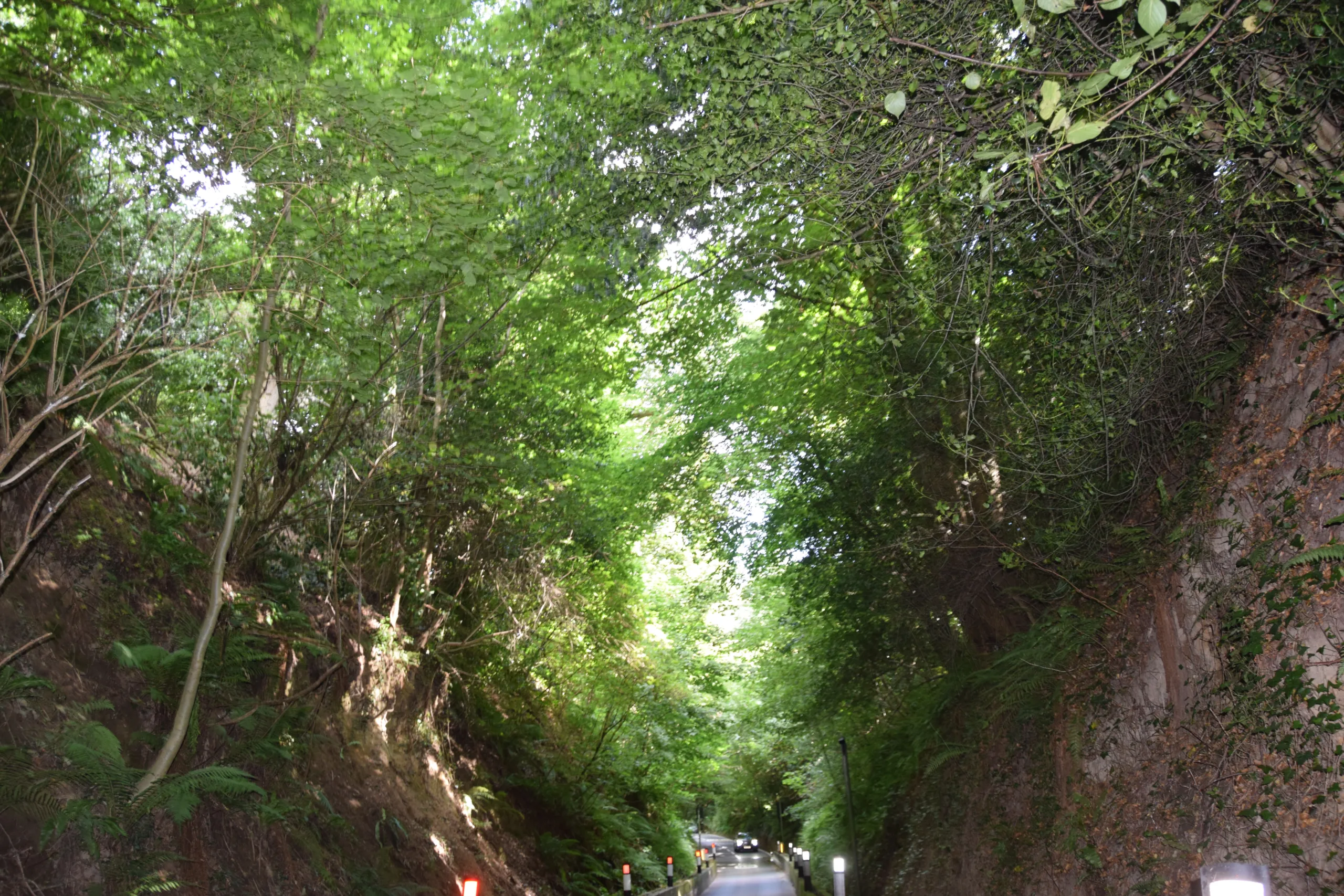
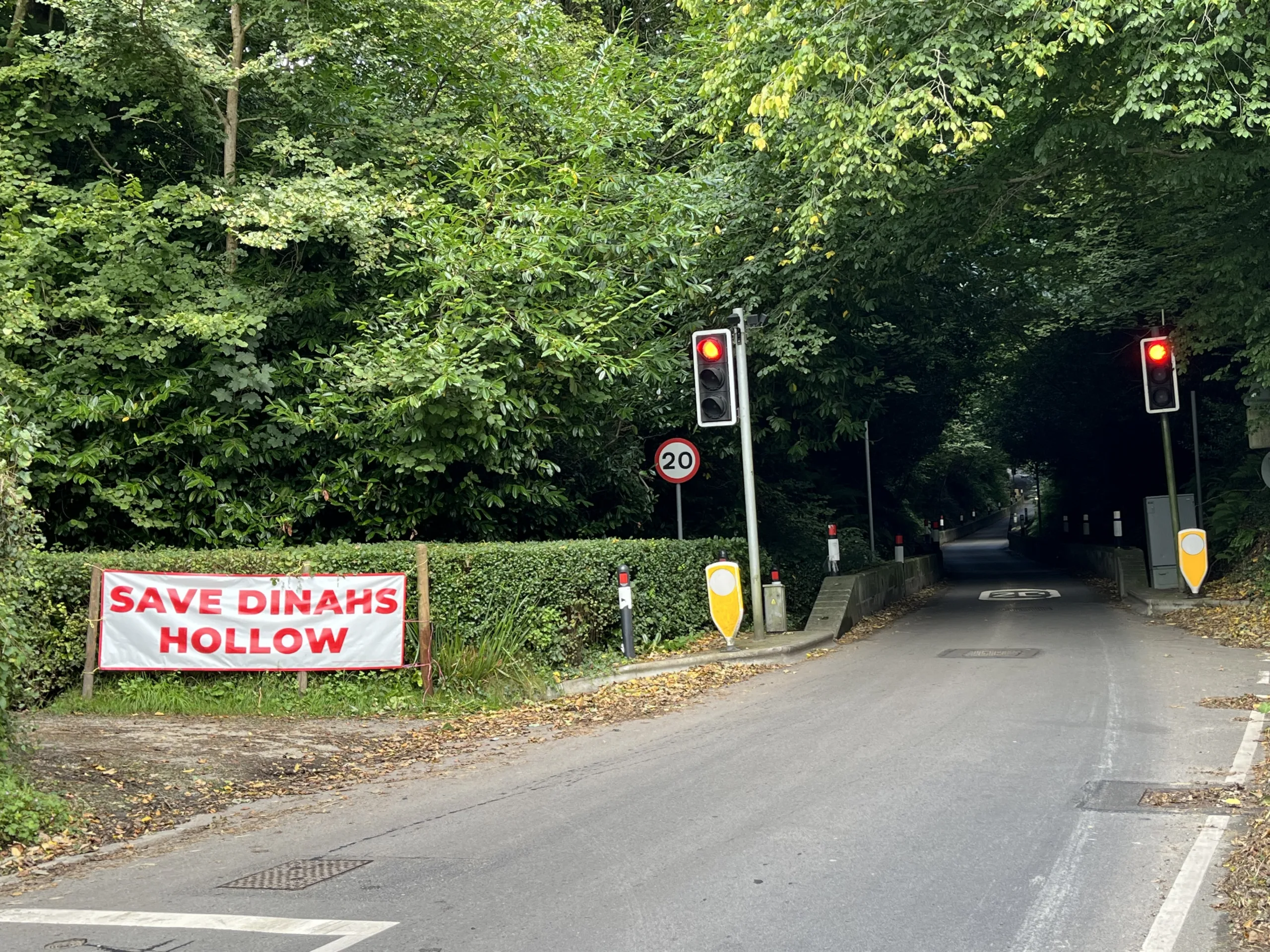
Environmental disaster or essential work to avoid a tragedy? Dorset Council’s controversial plans for the road through Melbury Abbas.

Dinah’s Hollow is back in the news. Dorset Council proposes to spend £8 million on safety work – felling trees, clearing undergrowth, compulsory purchase orders on adjoining landowners and stabilising the slopes with soil nails. 

This week the council’s strategic and technical planning committee agreed the first step: a Tree Works Application to remove trees along the hollow currently covered by a woodland Tree Preservation Order (TPO). 

Objectors believe that the holloway is environmentally and culturally important, and home to rare and endangered creatures, including dormice, bats and several red and yellow-listed bird species. 

The approval for the tree works will last for five years, much longer than usual, because of the potential delays with the CPOs. It could be three years or more before the stabilisation actually happens (perhaps even longer if there has to be a public inquiry).

The hollow, on the C13 road between Shaftesbury and Blandford, may be a remnant of the ancient forest which once covered this area of the Blackmore Vale: ‘It isn’t just any old holloway,’ says David Webber, chairman of Melbury Abbas and Cann Parish Council, whose family has lived in the area for at least 200 years. ‘And I find it ironic that Dorset Council has just declared a nature emergency.’ (see The BV Aug issue here)

Local MP Simon Hoare supports the need to improve safety for road-users on the C13 and dismisses the argument that Dinah’s Hollow has any particular significance. He says: ‘Ultimately we are not short of pretty ancient lanes and beautiful trees in North Dorset – and in this particular case they are self-seeded, non-specific and rather unremarkable examples.’

The slopes of Dinah’s Hollow

A deal to be had

Parish council chairman David Webber told the councillors at Dorchester that the geology of the hollow was very different from that at the Beaminster site of a tragic double fatality following the collapse of a tunnel in 2012. The parish council has hired Devon-based Red Rock Geological Sciences Ltd, which has been working with the landowners on a hybrid scheme involving some soil nails and retention fencing. It would cost much less, involve a much shorter period of road closure and very few trees would need to be destroyed.

The alternative A350, which runs parallel to the C13, is a primary route from Poole Harbour, where it is signposted for traffic heading to the motorway network. Between Blandford and Shaftesbury it is currently part of a voluntary one-way system for heavy vehicles – southbound on the C13 and northbound on the A350, through Iwerne Minster, Fontmell Magna and Compton Abbas, with the notorious Steepleton bends and steep Cann Hill near Shaftesbury.


 ‘Please do not talk AT them, but work WITH them. It will save a lot of time, money, trees, plants and wildlife’

Parish council chairman David Webber

Mr Webber recognises the problems for the A350 villagers and the people in Melbury Abbas. He says once you get over the county boundary into Wiltshire, the standard of the road improves, ‘but Dorset has spent nothing on it,’ he says.

He urged councillors to defer the decision: ‘Please sit down and listen and talk with the principal players.
‘Please do not talk AT them, but work WITH them. It will save a lot of time, money, trees, plants and wildlife. There is a deal to be had.’

Richard Burden, principal landscape officer at Cranborne Chase National Landscape (NL, previously known as an AONB), told the committee: ‘You have been told, correctly, that a TPO is created to sustain tree growth and amenity. How, therefore, does removing 80 trees sustain amenity? As you know, the National Planning Policy Framework guides you to give great weight to conserving and enhancing landscape and scenic beauty, and giving National Landscapes the highest level of protection. Your landscape officer is clear that there would be substantial adverse impacts arising from the tree felling. He then concludes that would not impact on the wider NL. That logic is fundamentally flawed: it would mean the NL could be eroded bit by bit. 

‘The test for decision-makers relates to the nature and scale of changes at this specific part of the National Landscape, not locations miles away!’

Mr Burden told the meeting that if the committee did not refuse – or at least defer – the application until further actions to conserve and enhance natural beauty are included, the council would be failing to comply with its duties under the CRoW (Countryside and Rights of Way) Act 2000, which was recently amended. While it did not override the Highways Act 1980, said Mr Burden, the two had to be considered together. ‘That duty is not optional; and current governmental guidance puts Cranborne Chase NL as the initial assessor of compliance.’

A sensible solution

MP Simon Hoare said he had congratulated new Dorset Council leader Nick Ireland for keeping the previous administration’s pledge to keep the Dinah’s Hollow scheme in the capital budget for what he describes as a sensible solution: ‘NOT to do anything is absolutely not an option. The next landslip could easily result in a fatality – and quite aside the human devastation that would cause, the council would be entirely culpable if it hadn’t acted on those reports.’

The problem had been discussed and researched for so long, he said, ‘If there was any chance of a silver bullet, it would have been identified by now.’

He recognised the enormous disruption to residents and commercial operators when either road is closed. ‘But if we want there to be a vibrant, viable economy in North Dorset, our existing road network – imperfect though we all know it to be – must be made fit for purpose.

‘If it were possible, there is little doubt this action would not be the first choice. 


‘It’s gone on too long. We cannot keep twiddling our thumbs, waiting for the perfect solution to magically show up’

Simon Hoare MP

But over the last ten years the council has exhausted all options. The only actual solution is an entirely new road – but the economic benefits of a parallel road running to Poole Harbour from the A303 are simply not there. The planning implications cannot be justified, the topography makes it almost impossible and the land ownership tangles as it works through the various SSSIs, National Landscapes etc are unthinkable. On top of all that, the infill development that would be required to justify the spend from the public purse will make a vast swathe of our beloved county entirely unrecognisable.’

It’s gone on too long, says Mr Hoare: ‘We cannot keep twiddling our thumbs, waiting for the perfect solution to magically show up.’ 

Speed limit and public meeting

Beacon ward councillor Jane Somper says Dinah’s Hollow has never been a party political issue for her: ‘The important point has always been about the local community voices being heard – and the safety of road users.’ She believes a public meeting is needed ‘to give everyone the opportunity to hear the details of what is planned and put their questions to senior council officers.’

While she accepts the need to stabilise the slopes, Cllr Somper says there is also a need for a full understanding of the wildlife present and the steps to mitigate harm to the wildlife and vegetation. Her other major concern is the impact of the works and the closure of Dinah’s Hollow. 

‘My focus now will be on the roads that will be most negatively impacted, and the residents I represent, while the works are carried out. It could cause huge disruption and damage to our narrow rural roads, and I have requested that funding be put aside for the repair work that will no doubt be required, along with traffic calming to avoid HGVs meeting at various pinch points along the A350. I will also be requesting a temporary 20mph along a stretch in Fontmell Magna and at other pinch points along the route.’

Looking down Dinah’s Hollow

No benefits

North Dorset CPRE told The BV the villages of Melbury Abbas and Melbury Down ‘will be scarred for many generations. This scheme will come with no benefit to the village or to traffic management within the village, nor increase safety for residents, cyclists or numerous horse riders. The proposed works to the hollow, which is rich in flora and fauna, will neither benefit the biodiversity of the area or provide any environmental gain.’ 

The countryside campaigns group says that although Dorset Council voted to budget £8m for the Dinah’s Hollow scheme, ‘the actual cost is likely to be considerably higher. No cost benefit analysis has been published, even if one has been carried out. In a time of austerity and tight financial constraints facing councils, this enormous sum could be better spent on more urgent needs such as adult social services. This scheme will also mean an ongoing maintenance cost to the tax payer.’


 ‘In a time of austerity and tight financial constraints facing councils, this enormous £8m sum could be better spent on more urgent needs’

Rupert Hardy, North Dorset CPRE

One of the affected local residents is Mrs Sara Jacson of Grove Farmhouse, who says: ‘It seems that Dorset Council is prepared to spend £8 million pounds on Dinah’s Hollow felling trees and wrecking the undergrowth by aggressive nailing of metal sheeting. The Hollow has been worn by millennia of feet both human and animal: it is not artificially man made. The trees shelter wildlife and their root structure is dense and effective in retaining soil.’ 

She criticises the impact on trees and wildlife, following the council’s decision to declare a nature emergency. There are no representatives of North Dorset on the new Dorset Council cabinet, she says, so no voice can be raised at that level ‘in protest at this apparent vandalism over which there has been no public consultation.’

Letitia Ann Ricketts (Tish)

0

27/06/195102/10/24

Letitia (Tish) Ann Ricketts of Gutch Common, Semley passed away peacefully at home on Wednesday 2nd of October 2024 aged 73 yrs. Much loved wife, mum & nan.private cremation has already taken place.

Why dig when you don’t have to?

0

The no-dig school of gardening isn’t just for the veg patch, says Pete Harcom: get healthier soil, fewer weeds and more insects, as nature does the work

Here’s a thought … How about considering ‘No Dig Gardening’ for your flower borders?
While it is very often used in the vegetable-growing world, it can also be very beneficial to ensure a healthy soil in the flower borders. Soil is a living organism and simply not digging the border over – just mulching perhaps twice a year – can really make a difference to suppressing weed growth and ensuring healthy soil.
The guru on this seems to be Somerset-based Charles Dowding – there is plenty of information on his ideas on Youtube and his website charlesdowding.co.uk.

One thing to mention though: if you have a lot of pernicious perennial weeds such as bindweed or nettles in your border, you may wish to spend some time trying to remove the weeds individually by hand. Alternatively, you can cover your border with cardboard and a thick mulch and leave it for a few months. The cardboard will smother the weeds, but then rot down and become part of the soil (no digging!). If perennial weeds are a real problem, you may have to clear the bed and leave it fallow for 12 months, continuing to remove weeds throughout that time.
Not digging can really help soil fertility and also bring back many insects. Mulch/garden compost or farmyard manure needs to be at least four inches deep and I would suggest twice a year to ensure soil improvement. Worms will do the digging over of the beds for you, and will drag the mulch, manure or garden compost down into the soil too.
If you are lucky enough to have a weed-free border, then after the mulch is put down you could immediately plant wallflowers, pansies and forget-me-knots ready for the spring.

Here are a few other jobs for the month:
Autumn is the best time for planting new trees, shrubs and hedges.
Clean out the greenhouse, and prepare it for winter sowing. If you have shade paint on your greenhouse glass, now is the time to remove it: on a dry day remove the paint carefully with a dry cloth. This will help let in more light in the shorter winter days, and help grab the sun’s heat in the cooler months.
Also remember to clean and disinfect the pots, staging and the inside of the glass with a warm solution of disinfectant to reduce pests and fungal infection.
Move tender plants (fuchsias, pelargoniums etc) into the greenhouse to overwinter later this month, ahead of first frosts.

Sponsored by Thorngrove Garden Centre

Owls in the combine

0

Farming columnist George Hosford had surprise farm guests this summer, prompting a delicate rescue before harvest could begin

Image © Alan Wicks

Before we could start harvesting this year, we had the small matter of owls in the combine spout to deal with. In May, a barn owl had been spotted entering and leaving the unloading tube of the combine parked up in the tractor shed. We were told it was likely to be a solitary male, and best left to find a new home. As is so often the case, things turned out rather differently.
Several weeks later, as the days were getting longer and the yard was quieter at dusk, we had forgotten all about it … then some odd noises were heard coming from the combine.
More advice was taken, and this time the conclusion was that perhaps there might be chicks in the auger tube.
What kind of crazy bird would lay eggs down a cold metal tube filled with a twisty metal auger? It was also a bit of a problem. No one wants to disturb young chicks, but harvest was rapidly approaching, and we needed to run up the combine to check all was working.
But we clearly couldn’t risk mangling up any chicks, so we eventually decided to slowly turn the auger manually, and see if we could persuade anyone in there to come out.

Image © Alan Wicks

Sure enough, gradually coming into view were the pale brown feathers of a young barn owl, who we managed to catch and move into the owl box recently installed in the tractor shed.
The number of turns on the pulley that drives the auger meant that the nest must have been at least a metre down the tube. Was there going to be another? We turned the auger a few more times, just in case, and hey presto, out came chick number two!
When I say ‘chick’, I really mean beautiful, fully feathered young adult barn owls – they must have been on the cusp of fledging.
Seeing as they couldn’t possibly have ever seen daylight, they coped remarkably well. How they would have found their way out of the auger tube, a metre or more from the open end, without our assistance, is a good question. And if we had not heard them, and had thrown the auger into gear a few days later, they would have been history.
Fortunately, we managed to get them both into the owl box. The next morning they had managed to jump/fly out and were perching on the wall bars of the shed. After a day or two hanging around and doing some flying practice, they disappeared from the yard, but they have been seen locally on numerous occasions. We think their parents had kept them fed throughout, and will no doubt have taken them out for hunting lessons.

The ‘Rat Pack of Opera’ bring their tour to Sturminster Newton

0

Tenors Unlimited, fondly known as the Rat Pack of Opera, will bring their new show, Great Songs Tour, to The Exchange in Sturminster Newton on Saturday, October 12th, at 7:30pm. The dynamic duo, Paul Martin and Jem Sharples, will be joined by local choir Gillingham Singers for an evening of musical entertainment that spans opera, musical theatre and pop.
The duo redefined the modern tenor by merging opera, musical theatre and classical music. The UK’s original classical-crossover “man band” have performed alongside stars such as Sting, Lionel Richie, Katherine Jenkins, Beyoncé, Hayley Westenra, Simply Red and the Royal Philharmonic Orchestra to name a few, and at prestigious venues such as the Royal Albert Hall. For 20 years, Tenors Unlimited has been entertaining audiences world-wide, bringing their own blend of wit, humour, charm and vocal arrangements to their performances. Fresh from a UK and USA tour, captivating audiences on both sides of the Atlantic, Tenors Unlimited promises an evening filled with fabulous harmonies and fun repartee.
Jem says, ‘There’s something for everyone in our new show – from Puccini’s Nessun Dorma to Freddie Mercury’s Barcelona, The Pearl Fishers’ Duet and songs from The Greatest Showman. We’ve also included some of our own compositions.’
Their entertaining blend of popular classics, crooner hits and original songs makes for a unique, memorable performance.
In 2019, Tenors Unlimited won the Broadway World Best Touring Show Award in the USA, and their single Who is He? topped UK charts in aid of The Salvation Army.
12th October, 7:30pm, adults £24. For tickets, see stur-exchange.co.uk

New Forest For Ukraine package aid – can you help?

0
Ringwood & Fordingbridge Lions Club helping to package boxes at the NFFU warehouse in 2023

On Saturday 12th October, members of Ringwood & Fordingbridge Lions Club will be travelling to the New Forest For Ukraine (NFFU) Warehouse in Lymington to help package boxes of aid destined for war torn Ukraine. As winter fast approaches, families will be in need of warm clothing, hot water bottles, footwear, clean blankets, duvets and pillows, sleeping bags, portable gas cookers, toiletries, food, medical equipment and supplies. There is a comprehensive list that can be found on the NFFU website.
If you are free on the morning of Saturday 12th October and would like to help out, or alternatively if you would like to donate items to send to Ukraine, then please contact Ringwood & Fordingbridge Lions Club via their website or by telephone on 0345 833 5819.
Ringwood & Fordingbridge Lions Club President Alastair Ward says: ‘We are humbled at the amazing work of NFFU in maintaining a steady stream of humanitarian aid to those struggling in Ukraine. Our members are proud to help them prepare boxes of the much- needed aid for transit.’
NFFU accept a wide variety of donations, which will be shipped to aid centres and hospitals in Ukraine and Poland for families in need. There are collection points assembled all over the New Forest for anyone who would like to donate items needed for aid centres and hospitals in Ukraine.
Anyone wishing to know more about either organisation or how they can help or volunteer can find out more at their respective websites:
newforestforukraine.co.uk
randflions.org.uk

Sponsored by Wessex Internet

The 46-year tractor ride

0

Tracie Beardsley catches up with C&O’s Matthew Holland – in between him selling tractors, fighting fires, making honey and selling cider!

Matthew Holland has worked at Blandford’s C&O Tractors since 1978, when it was still Stanley Pond Ltd.
All Images: Courtenay Hitchcock

When the excited 16-year-old Matthew Holland walked through the workshop doors of Stanley Pond Ltd in Blandford, it was his first step in making his childhood dream of becoming an agricultural engineer come true. Fast forward 46 years and Matthew is sales manager at the renamed C&O Tractors, the same family-run business dating back to 1753*, and now Massey Ferguson specialists. It’s one of the largest agricultural machinery suppliers in the south, with six depots, a hire fleet, parts and after-sales services.In his deep, delicious Dorset lilt, Matthew tells me: ‘My siblings went to university – I went to the university of Stanley Pond Ltd! But it’s given me 46 years of consecutive employment.’He can even remember the exact date he started: ‘July 3rd, 1978. I turned up on the moped I’d bought with money from summer bale stacking.’His hands-on apprenticeship was four intensive years. ‘I was essentially married to the senior engineer Ronnie all that time. I was a teenager: he was hard on me, but I needed it. Back then the workshop was buzzing. We had a blacksmith and a real character of a tinsmith – Burt Gale. Even my listening to Radio One didn’t drown out the backing track of Burt tapping out the tin.’

Matthew has been a part time fireman for 39 years, and was recently awarded the King’s Fire Service Medal

No more hammers
A rural childhood in Tarrant Keyneston ignited Matthew’s love for tinkering about with farm machinery. He was always either under the bonnet of a tractor or behind the wheel. ‘I loved going with my dad, a farm manager, to fix machinery,’ he says. ‘I was mesmerised by the forge and all the tools.’
Matthew looks back on the changes in his industry. ‘It’s changed beyond all recognition. We used to actually repair things – hammering, welding, brazing … that’s a style of welding with a bronze rod that’s not done anymore. For today’s agricultural engineers it’s far more complicated.
‘Machinery’s become so complex – it’s all digital, satellite, state-of-the-art technology. We need product specialists just to keep us on track … especially me, computers are not my forte!’
Given the opportunity, Matthew will still roll up his sleeves and get his hands dirty, though: ‘I delivered a machine to my old form master recently and got my overalls on to get it ready for him. And I still tinker about in my spare time. I’ve got about eight acres, and I keep some vintage Ford tractors that I love to play around with.’

Matthew Holland has recently been awarded received the King’s Fire Service Medal: ‘I was going to bring it in to show you but thought it would be a bit ostentatious.’

A King’s Medal
There’s not much of that spare time, however! A fire engine hurtles past the C&O office and Matthew wonders if it’s “one of his” – he’s been a part-time firefighter for Blandford station for the last 39 years. He modestly reveals he’s just received the Kings Coronation medal: ‘I was going to bring it in to show you but thought it would be a bit ostentatious.’
I ask him about this challenging – and brave – commitment taking up his spare time.
‘Who doesn’t want to drive a fire engine?’ he laughs. ‘I’m in the rare position that C&O will let me “turn out” to a shout. My former boss Mr Pond let me do it, and so does my present boss, Andrew Coles, for which I am very grateful.’
Many of the “shouts” take him to his C&O customers. The heatwave summer of 2022 saw the rural crew regularly battling dramatic field fires. ‘The adrenalin rush is incredible. It’s physically demanding, which I enjoy. I can also bring along my practical and engineering skills. And it’s very humbling. No matter how bad a day you’ve had, there’s someone else who’s had a much worse one! When things get demanding in the office, my leveller is my sense of humour. It helps to remind myself “no one’s died”.’
As if work and firefighting were not enough to squeeze into normal life, Matthew also keeps bees and produces quality craft cider and apple juice, aptly named Cider By Rosie. ‘I’m learning from an octogenarian cider maker. She’s the sorcerer and I’m the apprentice…again!’
There’s an agricultural saying about the secret to happiness: “tractors, fields and freedom”. Matthew certainly seems to have found all three. ‘Work is a joy,’ he says. ‘It’s a good habit. I enjoy everything I do, and it’s all been made possible by the support of my wife Charmian and my two children, Daniel and Michaela – and more recently my two fantastic granddaughters.
‘I’ve had opportunities to move on over the years. Is it loyalty or lack of ambition that I haven’t? ‘For me, it’s loyalty, a value instilled in me. The Pond family were good to me when I was a boy. As a man, the Coles family have been brilliant. I’ve had only two bosses in 46 years, and the chance to travel to Brazil, Zambia, Canada and Arizona for work. It’s a job that takes me across the stunning Blackmore Vale most days, and I go home to my own “little piece of England” at the end of my day. Not bad for a country bumpkin!’

C&O Tractors are Massey Ferguson specialists, and one of the largest agricultural machinery suppliers in the south

A-list dinner party guest?
‘Steve Fletcher, former centre forward for AFC Bournemouth when the club was going through a hard time. He was so loyal. And Eddie Howe, a top man who should have been knighted for Bournemouth FC’s fairytale transformation. Charmian, and also my first boss Timothy Pond, who I’m ever grateful to.’

Book by your bedside?
‘No books. Farmer’s Weekly Magazine. I go to bed dreaming of tractors!’

C&O Tractors, Construction and Garden Machinery candotractors.com
*C&O Tractors was founded in 2000 – Stanley Pond Ltd, now owned by C&O, was founded in 1753.