
Home Blog Page 224

The Sheep Show

0

Brilliant and unmissable, The Sheep Show hilariously highlights the importance of wool and the truth about sheep farming … while debunking certain sheep-related myths.
by Rachael Rowe
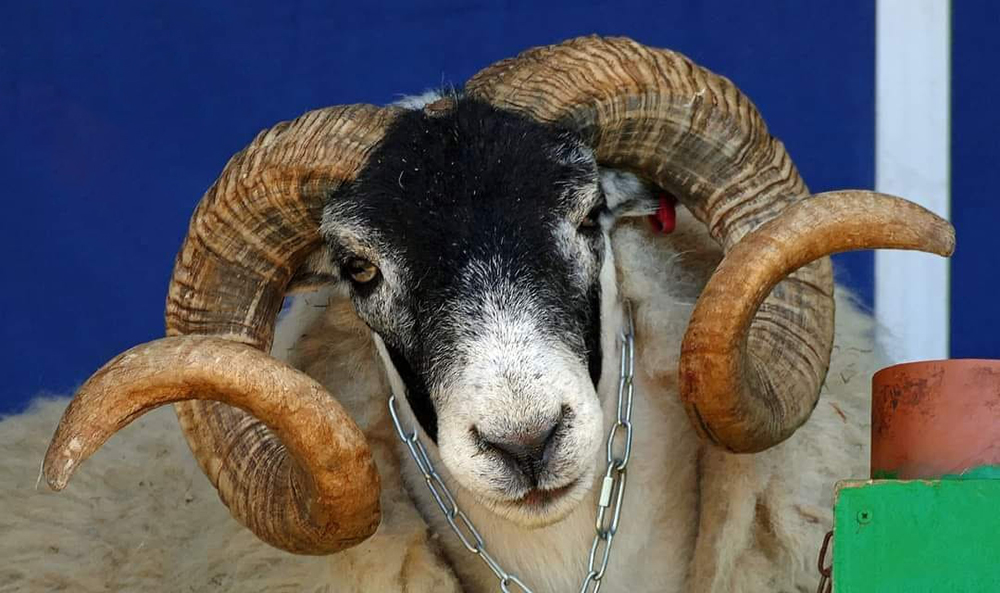
Dougal the Scottish Blackface. All images: Trevor Wayborn

Trevor Wayborn paced the stage on a cold, windy, damp morning when the early crowd had begun to have second thoughts about coming to a spring agricultural show. But there was something about The Sheep Show that brightened a dull day and put a smile on everyone’s face. The laughter, the engagement – even the education – that came from the performance was an absolute tonic. And we’ve not even mentioned the sheep. By the time he had finished, even the sun was shining!

The Sheep Show travels in style

Trevor is based in North Devon with his family (and sheep) – but every year he heads out on the agricultural show circuit with The Sheep Show.
‘I’ve always been in farming. My parents were farmers, but they had to come out of it before I was old enough join them. When I left home I joined the ambulance service and became a paramedic, but I always kept sheep alongside the day job and also did contract shearing.
In 2013 I left the ambulance service – the same year I saw Richard Savory with his Sheep Show at Devon County Show. I chatted to him and thought to myself: “I’d love to be involved with that”.

Trevor Wayborn demonstrating sheep shearing. Image: Rachael Rowe

It just all came together really. I have experience in the theatre and in sheep shearing. So I worked with him to see what I could do and started doing my own shows in 2015. Richard had been running The Sheep Show for 30 years at that point, and I was in awe of the way he worked. I took over the business in 2022 and that’s where I am now. It’s a family affair too – my wife and daughter are also involved.’
No-one watching The Sheep Show can fail to notice some stand-out performers in the team – look especially for Lenny and Belinda among the native British breeds.
‘There’s not a special thing we look for in the sheep. All the breeds we use are chosen because they tell a story – but we do try to get them early in their lives. Then they get used to food. We don’t get them too tame and we just look for that little bit of something to work on.
‘I don’t want to give away too many trade secrets! Once we’re on stage we just work around them. We don’t train them – actually they train us!
‘We see what the individual sheep starts to do when it walks around after the food and we work with that. We just watch for what they do naturally, we don’t teach them, and then we reward their behaviour with food.

Lenny the Lincoln Longwool and Dougal

For example, Dougal tries to head butt me – all I’m doing is harnessing his talent.’
The sheep start to learn there is food available, and soon learn that repetitive behaviour gets rewarded. They just know they will get fed – and they love it!’
The preparation for each show goes beyond the sheep themselves, however.
‘Of course we keep an eye on their health, but we’re not looking for pristine sheep, so it’s not about bathing and combing etc. A lot of preparation is involved in performing at a show. The lorries have to be ready. We need hay, water and feed. And then we need enough food and stuff for the humans – we can be away at shows for ten-day stretches. So everything, both the sheep and humans, needs to be ready.
Sheep have a reputation for being a bit … stupid. But Trev’s keen to dispel the myth.
‘Sheep are not stupid! They are very intelligent. Look at what the team does around the back of the show – where the hard work really takes place. I’m just part of the act. The sheep know exactly what order they come up in, and when they hear their music they get up and get ready to go on the stand. It’s really cool to see the sheep adopt this behaviour in the show because they enjoy it. They even go to sleep up there.
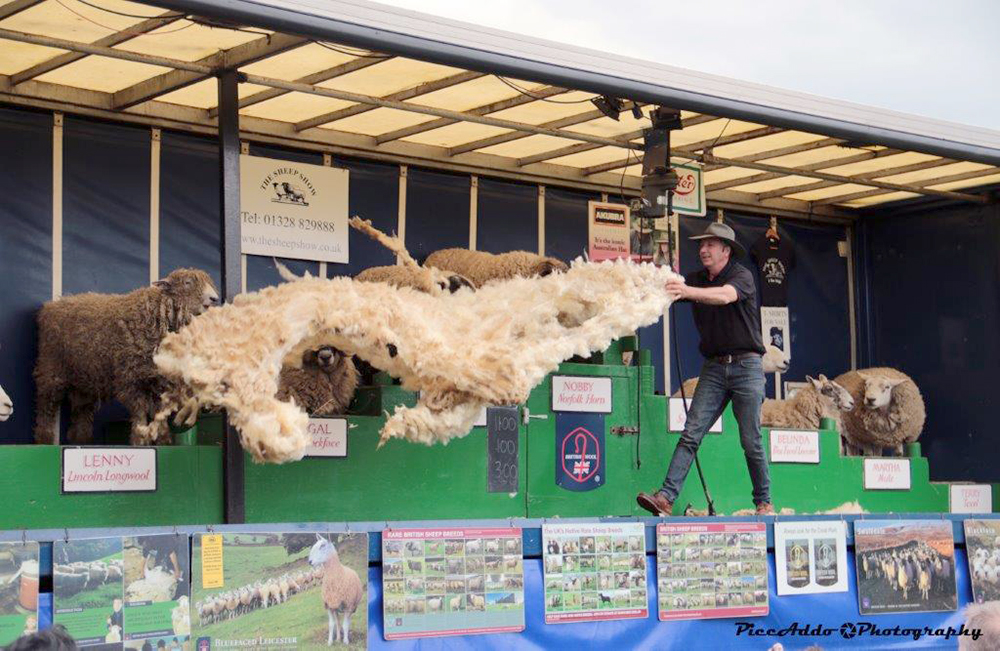
The shearing is total ‘edutainment

‘Really! I had to wake Sam up the other day at the Great Yorkshire Show. He was asleep on the stand! The sheep just won’t go on that stand if they don’t want to.
‘And every time the sheep come up they surpass my expectations – they come up every time and do what they do.
‘They have favourite music too. They love a bit of Taylor Swift! And they like Kenny Loggins’ Footloose, too. As soon as we put Taylor Swift on they all get up and start. And when Footloose comes up they know it’s dancing time. You can see them look at each other and say: “Here we go!”
Even after so many shows, Trevor admits that it doesn’t always run perfectly smoothly: ‘I forgot to put a sheep in the hatch for shearing at one show. I was standing there waiting for it to come out and nothing was in there! Last week, one of my mates hid in the hatch, and instead of my expected sheep he jumped out at me! But that’s what happens with the travelling show community, we all look after each other.’
The show is brilliant entertainment, but it has a serious message hidden within the dancing sheep.

‘I think people learn different things, depending where we are. Some people have never even seen a live sheep – I couldn’t believe it when I did an inner city show in London. But even when we go to rural shows there are still people who don’t understand why we shear sheep, or that the fleece has such little financial worth.
‘We’re happy that people take just one or two facts from the show – perhaps why we have to shear the sheep for their welfare and for legal reasons. Wool is so good for the environment – endlessly renewable and truly biodegradable. And we all want to enjoy the countryside, which sheep help us maintain. It’s part of the make up, what the countryside is all about.’

RBL raises £1,400 in one weekend!

0

The August Bank Holiday weekend saw the Sturminster Newton Royal British Legion Branch manning a stall at the Stock Gaylard Oak Fair. The Poppy Appeal organisers, Anthony and Tracy Walsh, organised a fantastic draw – with the star prize being a unique bottle of gin made for, and donated by, the Royal Marines in Poole. It came complete with a Commando dagger in the neck that the gin gets poured through! That along with 12 other prizes, a name the Teddies competition and some generous donations raised just over £1400, split between the Poppy Appeal and the Military Association.
The branch would like to extend a huge thank you to all the organisations who donated prizes and to everyone who stopped by to buy a ticket, name the teddies or just to say hello. It was very much appreciated and made all the hard work extremely worthwhile!

Sponsored by Wessex Internet

Gillian Matthews – the pioneering Paralympian who inspired others for 60 years

0

Gillian Matthews, who redefined athleticism, leaving an indelible mark on Paralympic history and on grassroots disability sports, has died, aged 87

Gillian Matthews in 2004, on the day she received her MBE for her services to charity

When Gillian Matthews fell from her favourite horse, Sunsketch, at the Larkhill Point to Point in 1965, she broke her back – and the high spinal fracture meant that she would spend the rest of her life in a wheelchair.
But although the determined young mother, from Penselwood, near Wincanton, had four children, including three-year-old twin boys, she also found innovative ways to continue as a sportswoman. Sunsketch was uninjured in the accident and went on to win the Artillery Gold Cup at Sandown two years later.
Gill spent six months in Stoke Mandeville Hospital undergoing rehabilitation. Refusing to accept her active life was over, she started training as a Paralympian.
She went on to represent Great Britain in four Paralympic games. She won two bronze medals in Heidelberg in 1972 for table tennis. In 1974, Gill won a gold medal for the pentathlon at the Commonwealth Paralympic Games in New Zealand, displaying skills in shot put, a 60-yard wheelchair dash, swimming, javelin and archery. She also won bronze and silver in table tennis. In the Paralympic Games in Toronto 1976 and Arnhem 1980, she won medals in archery and lawn bowls.
Along with her collection of Paralympic achievements, in 1988 Gillian became the Paralympic World Champion table tennis player in Brisbane.

A lasting legacy
However, Gill wanted to bring the experience of the Paralympic games closer to home so that anyone could be inspired to have a go, particularly those who would not otherwise have had the opportunity to see disabled athletes in action. She felt that actually seeing what athletes could do would be inspirational for people with a disability.
Gill met the Bath & West Show team and in 1973, the Bath & West Games for the Disabled was introduced to the annual show, where the sport remains a feature.
In 1997, the Western Daily Press interviewed Gill for the 25th anniversary of the games at the Bath & West. Gill said: ‘I was already very competitive, but I became even more so when I was in a chair. I got involved in the National Games at Stoke Mandeville and competed for 26 years.
‘The event here is unique – no other agricultural show has anything like it. Sport can be a tremendous therapy and it has so much to offer in other ways.’
For many years, Gill remained heavily involved in the planning of the Bath & West Games for the Disabled, and campaigned for facilities for people with disabilities. The Games were visited by the late Queen, the then Prince Charles and also by Princess Alexandra. Gill persuaded the Prince to try some wheelchair slaloms – he managed a few obstacles, according to Gill’s son, Gerrard – but Princess Alexandra completed the entire course!

Gillian is to the left of Prince Charles, who is trying the wheelchair basketball at the Bath & West Games for the Disabled

A lasting legacy
Despite her accident, Gill and her husband Franey maintained an avid interest in horses, especially racing. They raced at several courses including Wincanton, where their horse Alder Mairi won the Handicap Hurdle in 2014.
The couple had four children – Sarah (deceased), Belinda, Gerrard and Nicholas. Gill was grandmother to Venetia, Emily, Charlie, Jamie, Antonia, Tom and Elizabeth, and great- grandmother to Isabella.
As well as her extraordinary achievements as a Paralympian, Gillian was a Justice of the Peace and magistrate in Dorset from 1978 to 2006. In 2004, she was awarded the MBE for her services to charity.
Gill was also a trustee and patron of the Inspire Foundation which champions independence and quality of life for people with spinal cord injuries.
When life changes in an instant, none of us know how we would react. Gillian Matthews made the most of every moment and has left a sporting legacy that will inspire generations to come.

Is this Dorset’sBiggest Larder?

0

With a super-sized new Food Hall and more than 100 producers, we’re thinking: ‘Yes, yes, it is!’

We’re so excited. This year’s show has a huge new Food Hall. And when we say huge … it stretches for 60 metres!
The foodie paradise showcases the best of British food and drink producers, with a particular focus on those from Dorset. From brownies to beer, pickles to pork, cider to sourdough, English wines, local gins, cheese, olives and more, the massive marquee provides a taste-tempting experience. And of course there are tasty samples – so you can try before you buy!
Justin Langham from Langham Wine Estate near Dorchester – one of the show’s sponsors – says: ‘Dorset’s farming community is rightly proud of its produce. The new Food Hall at this year’s show is an exciting opportunity for us to celebrate the world-class food and drink we make here. We’re delighted to be a part of it.’
Show organiser James Cox says: ‘Our county is bursting with wonderful food and drink producers – we’re delighted to bring together more than 100 of them, ranging from small producers who are just starting out to well-established, international award-winning names. We love putting visitors and producers together.’

The new Food Hall sits alongside a new Food & Drink Area, sending
mouthwatering smells of delicious hot and cold treats. From Dorset burgers to local doughnuts, this new area welcomes local producers selling both food and condiments for you to enjoy on site and take home to use in your own kitchen. James Cox says: ‘The new area has a festival vibe, with colourful flags and live music. Enjoy a pitstop for a cool local cider or a Dorset ploughman’s picnic.’ The area also has outside pitches for
market traders as well as picnic marquees.

Hamshaw Thomas Catherine

0

3rd November 1930 – 23rd August 2023

Loving and beloved wife of Christopher, mother of Anne, Hugh, Charles and John, grandmother of Emile, Jack, Billy, Cecily, Joe, Jeremy, Ivan and Gus and great grandmother of Florence.

Cash vs contactless: the uncertain future of banking in Dorset

0

The declining use of cash particularly affects the elderly and rural dwellers, says MP Chris Loder, but new regulations aim to protect access to cash

Chris Loder MP

Over the last few decades, we have seen a fundamental shift in the patterns of personal banking. Cash has dominated our financial behaviour for centuries, but it has been overtaken in less than 40 years by the popularity of credit and debit cards – and, recently, contactless payments.
It puts users of cash in the Blackmore Vale and wider West Dorset in an untenable situation, and raises important questions about the future role of cash in the local and national economy.The Covid pandemic accelerated these trends. In 2021, only 15 per cent of payments were made with cash. The decreased reliance on physical cash is one of the main reasons bank branches and building societies have re-structured their business models and withdrawn from our high streets.
Here in the South West, we have felt this hardest: in the last decade, our region has experienced the largest fall in the number of bank and building societies by comparison with the rest of the UK.
Sherborne is no exception –
the town now only has a Lloyds Bank, which operates with reduced hours and doesn’t open on a Saturday. The Post Office on Cheap Street deals with cash, but only provides limited banking services. Natwest, Barclays and TSB have all come and gone, leaving users of cash and abandoned buildings in their wake.

Cash still required
Yet, for a market town, cash in integral in transactions between Sherborne’s traders and customers. It is a reliable, secure and simple form of payment, particularly so for those who are aged over 65, who live in rural areas, use cash for smaller purchases or budgeting; and those who are not used to using – or do not have access to – digital technology and the internet.
There is, therefore, still an evident need for banks and building societies to remain on our high streets. Many constituents have told me how important it is for them to be served in person when dealing with something as sensitive as their personal finances.
Automated teller machines (ATMs) can bridge the gap between digital and physical banking and fill the void left behind by bank closures. In Sherborne, there are five ATMs located across the town, but for rural-dwellers outside the town, it means a journey, perhaps up to 7km or more, just to access cash.

Have your say
Under a new framework recently announced by the Treasury, the vast majority of people and businesses should be no further than three miles (4.8km) away from withdrawing cash. This is a step in the right direction and will ensure that the most vulnerable cash users are protected. The Financial Conduct Authority has also been given new powers to ensure that banks and building societies protect access to cash.
Nonetheless, a blanket approach to the digitisation of personal banking risks excluding the most vulnerable and will disproportionately affect residents in rural areas. Many of my constituents, from Sherborne to Bridport and Dorchester, have no wish to manage their finances digitally but have effectively been forced to succumb to the changes of the banking and finance sector.
I’d be interested to know what your views are on this issue, what your preference is, and in what direction you think personal banking is going.
You can submit your views to my dedicated survey at chrisloder.co.uk/banking, or you can write to me at:
Chris Loder MP, House of Commons, London, SW1A 0AA.

World-class cars, family fun, and a Rev-Off to remember!

0

Clayesmore’s second Classic & Supercar Sunday showcased more than 450 stunning vehicles, from vintage classics to modern marvels

Show sponsors Harwoods brought along the brand new Aston Martin DB12

On Sunday 13th August, the sleepy Dorset villages around Blandford, Shaftesbury and beyond awoke to the sound of a phenomenal convoy of world class cars, all heading to exhibit at the Clayesmore Classic & Supercar Sunday event.
Over 450 of the finest, classiest, fastest and brightest cars ever made joined the exhibition; with private owners and car clubs coming from as far afield as Bristol and London (though there were of course some much more local!). One visitor commented that the supercars approaching the school on the A350 looked like a tube of smarties – every colour under the sun!
It wasn’t all brights though; the demure and classy were in town (village?) too! From 1920 Bentleys and Lagondas to a glorious array of Aston Martins from DB5s onwards, right up to the brand new DB12, thanks to event sponsor, Harwoods. This is probably the car that enthusiasts have in mind when they say ‘showstopper’!

The youngest drivers were put through their 4×4 paces

The cars weren’t just for the adults though; children were also put through their paces by the Mini Rovers team. The 100 metre square assault course set up for the youngest drivers was challenging and fun as they navigated the hills and markers to reach the finish. Thanks again to the Harwoods Group, the experience was free for everyone, and the little learners even earned a mini driving licence once they’d crossed the line!
The event billed two Rev Offs in the schedule, and they did not disappoint. Set outside the main house at Clayesmore, the backdrop was perfect for the competing cars to line up for the exciting showdown of noise and muscle! Crowds flocked to watch and the atmosphere was electric as they took turns to try and break the decibel record.
After all that excitement, the rock music from the Replicas, along with gourmet burgers, woodfired pizza (plus gelato and crepes to die for), were the perfect vibe for the rest of the afternoon! Happy faces everywhere. Can we do it all again next Sunday please?! Roll on August 2024 …

Show organiser Zander Miller recording decibels during the Rev Off

Big Pete and the Grim Reaper

0

Tracie Beardsley caught up with Michael Murty, the man at the wheel of the world’s biggest monster trucks as his team prepares to rev into the main ring.

The main man and the monster – Michael Murty on Big Pete

How did you get into the world of Monster Trucks?

I grew up in a family of motorsport fanatics – motorbike stunt riders and drag racers.
My father and my brother both did it – it’s a family thing and very much in our blood.

Tell us about the sport

It originates from America – heavily modified trucks were popular during the 1970s and were used in the sports of mud bogging and tractor pulling.
Bob Chandler was the man behind the original. He was the first to put huge tyres on a truck and build what is considered the first ever monster truck – Big Foot. He started a worldwide phenomenon along with Jasmer Everett, who created another famous monster truck, USA-1. Now, monster trucks as we know them entertain at shows around the world! The tours culminate in the incredible Monster Jam World Finals.

Where do your Monster Trucks come from?

Big Pete and Grim Reaper both started out life in the USA, but they are both completely my own creations – they’re a hybrid of USA and UK engineering that
I’ve rebuilt and rebranded.
The work is never finished – owning monster trucks is very much a labour of love! I’ve owned five in total over the years, but these two are adapted perfectly for green field entertainment in the UK.

The Grim Reaper makes light work of a family car
Big Pete in action

Where do they get their names?

I always joke and say Grim Reaper is named after one of my ex-girlfriends!
It’s actually a nod to one of the most famous monster trucks of all time and our personal favourite – Grave Digger.
The red one, Big Pete, is a unique monster truck. It’s based on the type of truck built by the famous American Peterbilt Motors Company. They started life in the 1930s and are still making trucks today.

When did you start driving Monster Trucks?

I’ve been in this business for 20 years and am proud to be one of the most experienced monster truck drivers in the UK.
I actually started driving when I was about six years old – in a 10-tonne tipper truck which I drove on a disused airfield where my dad used to practice drag racing. I did pass my test first time when I was 17!
Cars, vans, lorries – I think I’ve driven most forms of vehicle and, with travelling all over Europe, probably slept in most too!

The Grim Reaper seems to shrink the ‘normal’ sized cars beneath its wheels

What’s it really like being behind the wheel of a Monster Truck?

It’s loud. And it’s intense. An assault on your senses. And the visibility is limited.
It’s also very uncomfortable! The suspension has to be extremely hard because the truck is so heavy.
To be honest, I could do with a long, hot bath after every show and a deep tissue sports massage, but we stay in caravans for six months of the year while we’re touring – so all I’ve got is a small shower!

Embrace the rain

0

It might be a damp squib of a summer, but Thorngrove’s Secret Garden might be just the treat you need, says Kelsi-Dean Buck

The last days of what little Summer we’ve had are upon us! It’s been an unsettled one, but we’re delighted that so many of you still chose to stop by and see us in the garden centre and café here at Thorngrove in Gillingham. The cyclamen are looking delightful right now in the courtyard and doing their best to steal the show – plus we have plenty of beautiful summer plants such as dahlias, rudbeckias, and hebes – all looking for their new homes with you!
Prep is currently underway for the autumn and winter – yep, even Christmas will be here before you know it (secretly we can’t wait – it’s always a feel-good time of the year!). We’ve got some work happening behind the scenes to hopefully bring a special Christmas event to Thorngrove – stay tuned, but bear with us while we iron out the details.

What’s good this month?
Looking for garden ideas this month? September means the beginning of the autumn season, so it’s a good time to focus on plants that thrive in cooler temperatures and are suited for the transition to winter. Spring bulbs, cool-season vegetables, herbs like parsley, chives, thyme and sage and of course the winter colour stalwarts of pansies and violas. We have a humongous selection of seeds and bulbs – plus all your planting tools and essentials if you’re looking to get started for the new planting season.

Got skills? Want to run a workshop?
Something else which is happening behind the scenes is our new events calendar. We’re currently working with a range of creative local craft people who will be hosting some special workshops and events at Thorngrove in the coming months. We’re keen to really build our calendar for the next 12 months, so consider this a call to action! If you’d like to utilise some of our space, and collaborate with some cross promotions and marketing support from us – please get in touch! Whether you’re looking to host something plant-themed, arts and crafts, or perhaps educational workshops – we want to hear from you!
Connecting with a diverse and creative group of local people in Gillingham and the surrounding communities is one of our top priorities.