The warm, wet month has meant a burst of growth on the allotment says Barry Cuff – sadly, for the weeds as well as the courgettes
With more than four and a half inches of rain recorded for the month and temperatures around normal for July, growth of both crops and weeds has been phenomenal. Even the strong winds on two occasions did no damage. We were harvesting young carrots (Early Nantes) by the second week. These had made a slow start from successional sowings, with the earlier sowings catching up with the later. It’s been the same story with the two varieties of beetroot (Moulin Rouge and Crimson King). Runner beans and French beans had to be picked every third day to ensure the plants kept producing. This year our runner beans were sown with home-saved seed and we have both white and red coloured flowers, which means they had cross-pollinated the previous year. Last year’s variety was Moonlight (white) and an allotment neighbour had Polestar (red). There was no discernible difference in either yield or taste! Lettuce, spring onions and radishes have all made excellent growth and we were able to gather daily for salads. Celery and celeriac also put on good growth, ready for the autumn – both of these were mulched with our own compost.
Our sweetcorn (Swift) started flowering mid-month with good pollen production. The three varieties of courgettes – Black Beauty, Defender and Astia – produced fruits every other day, while the weather has meant our winter squashes have made more growth than I can remember in previous years! The peas finished early due to the previous month’s dry weather, whereas our mangetout and snap performed better. We grow Carrouby De Maussane and Purple Magnolia – both are excellent for stir frys and salads. During the drier periods we harvested Charlotte, Rooster, Jazzy and British Queen potatoes – all except Rooster did well. Our remaining varieties will be lifted in August so we’ll keep an eye on the plants for blight. Both our potatoes and onion patches became very weedy, especially with fat hen, gallant soldiers (a plant that can produce 15,000 seeds …) and many-seeded goosefoot – all are difficult to remove without pulling up the crop. We also have a few unusual weeds on the plot. Weasel’s snout is now a quite scarce cornfield weed. Thorn apple has large white five-lobed trumpet-shaped flowers and green oval spiky fruits. The other we have is moth mullein, a biennial plant which we let bloom as it has very attractive flowers loved by bees. All our fruit bushes have loved the rain and produced large currants, gooseberries and raspberries – most of these are swiftly made into jam and wine!
MP Chris Loder warns the swing to divisively extreme ideologies is eroding the potential for important and meaningful debate
MP Chris Loder
We don’t have a Pride event in the Blackmore Vale as such, but there are many Pride events taking place in the South West region over the summer. These events bring attention to the identity of members of society who often feel under-represented. Since I was elected in 2019, we have seen a whirlwind of identity politics through the mainstream media – that is, the politics and profile of a specific characteristic of an individual or group. It is often about gender, sexuality, race, nationality, religion or something else. What the media report and what we see and feel here in the Blackmore Vale are often very different, but nationally, I think awareness is at an all-time high. In times past, the causes and campaigns that have been associated with identity have mostly been those that have looked to achieve equity for all. Fairness, equality and justice – to ensure that everyone is treated as equal, regardless of their difference – not for preference but for parity. Increasingly though, the politics of identity have become less about achieving fairness (often because fairness has already been achieved) and more about forcing a view onto others, or to show that one group of society is better than another. What’s worse is that if a particular view is not mutually held, it now seems to warrant a relentless, personal attack in order to shut them down or to bully them into submission.
Identity and youth The increasing politicisation of gender and sexuality has deeply concerned me, especially considering its impact on young people. When I was growing up, I didn’t want to be recognised as better than everyone else, I just wanted to be equal. I didn’t want to stand out for my difference, I wanted to be an equal part of my community and society. That is why I often find it so difficult to reconcile with the extreme and unpleasant campaigning which is now becoming the norm. This extreme politicisation in campaigning is eroding civilised debate about important matters. It is also permeating our schools – mostly about the ability of children to self-identify as a different gender. For some schools, self-identity of children has become so prevalent that on a weekly basis, the school circulates a list of children who have self-identified as a different gender. It seems that every week there are national headlines about children self-identifying their gender at school – without the knowledge of their parents or guardians. I think this raises fundamental questions around safeguarding, parental responsibility, and indeed the sources which are influencing the malleable minds of young people. Teachers now fear the consequences in this situation. That is not right, and I have made my petitions to the Education Minister for prompt action.
A destructive force I once thought identity politics had a place for good, but it has now become so divisive that it is societally destructive. There is an increasing inability for rational and understanding debate. The race for one group of the population to be positioned in a better place than everyone else, which has permeated our online ecosystem, is now generating a dog-eat-dog type of society. While it may seem a distant reality to readers in a quiet corner of Dorset, campaigning in the extreme – not just in this subject area, but others too – is having a detrimental impact on our democracy. It places undue importance on one specific characteristic or cause in an effort to dominate the political agenda. I sincerely hope that we can move forward in a way that means this divisiveness calms and that we can have meaningful conversations about difficult issues. If you have any thoughts or views on this issue, I would be very pleased to hear from you: [email protected]
Stepping up the levels has been an exciting move – though there was an unexpected dunking for Toots Bartlett at Freestyle R’s 4* debut
Toots and Cor y Taran competing in July All images: Luke Perrett Photography
There has been a lot of training going on for team TB, with coaches Lisa White (for flatwork) and Robin Dumas (showjumping) helping both me and the horses step up levels. Freestyle R had his first CCI4* at Aston Le Walls at the beginning of July. He did a fabulous dressage of 29 – inside the top ten in a section of more than 100 top athletes! He was jumping very well, till his 4* debut ended with a sudden dunking in the water after misreading the fence in. Fortunately we were both fine – Freestyle cut free and I only suffered from cuts and bruises. Sadly, my fall meant I was unable to compete at Upton House – where Cor Y Taran was meant to be stepping up to his first Intermediate competition. I was able to re-route him to the next Aston Le Walls last weekend, however. The weather tried incredibly hard to spoil the day – it didn’t stop raining once! But Cor Y Taran moved into Intermediate in style. We got a top five dressage, followed by two fabulous jumping rounds, even in the bad conditions! Planned time penalties meant he missed out on a top ten placing, but I am incredibly excited by this lovely seven-year-old!
Toots and Freestyle R
Positive thinking I am incredibly lucky that when things go wrong I am able to stay positive as a jockey. I have confidence in my training program and in my horses, and know that any issues will be ironed out quickly. I feel that as long as I learn from the days that just don’t go to plan, then I won’t make that mistake again – and therefore it doesn’t seem to knock my confidence. Of course I know the risks that come when riding horses … although it’s probably no worse then getting in a car. But a lot more exciting! Finally team TB is looking forward to welcoming some new faces to the yard – one of my lovely Ragdoll x Maine Coon cats is pregnant; keep your eyes peeled, we’ll soon have kittens!
Let me know I am currently available for teaching and freelance riding – are you in need of any help? In any discipline, no matter your ability or age. Or do you simply need some help with someone riding your horses? Please don’t hesitate to contact me on [email protected]
Dearly beloved wife of Franey, mother of Sarah ( Dec’d ), Belinda, Gerrard, Nicholas. Grandmother to Venetia, Emily, Charlie, Jamie, Antonia, Tom and Elizabeth. Great- grandmother to Isabella.
Paralympian in the 70’s and 80’s. Ran the Royal Bath & West Disabled Games for 40+ years. Dorset magistrate for 28 years. MBE in 2004 for services to Disabled Sports.
Memorial service 1st September at St Michaels Church Penselwood BA9 8LS at 2.30pm. No flowers. Donations to The Inspire Foundation.
Pauline Batstone shares her monthly round up of what’s happening among the town’s collection of community enterprises and events
You never know what kind of glamour you can pull together in The Boutique
Introducing the Artists… 1855, Stur’s artisans bank continues to flourish: there are now more than 70 traders taking a space to show their craft or produce. Why not come and enjoy a food tasting on the first Saturday of the month, between 10am and 12 noon? For the time being 1855 will not be open on Sundays, and the monthly late night shopping Friday has been paused.
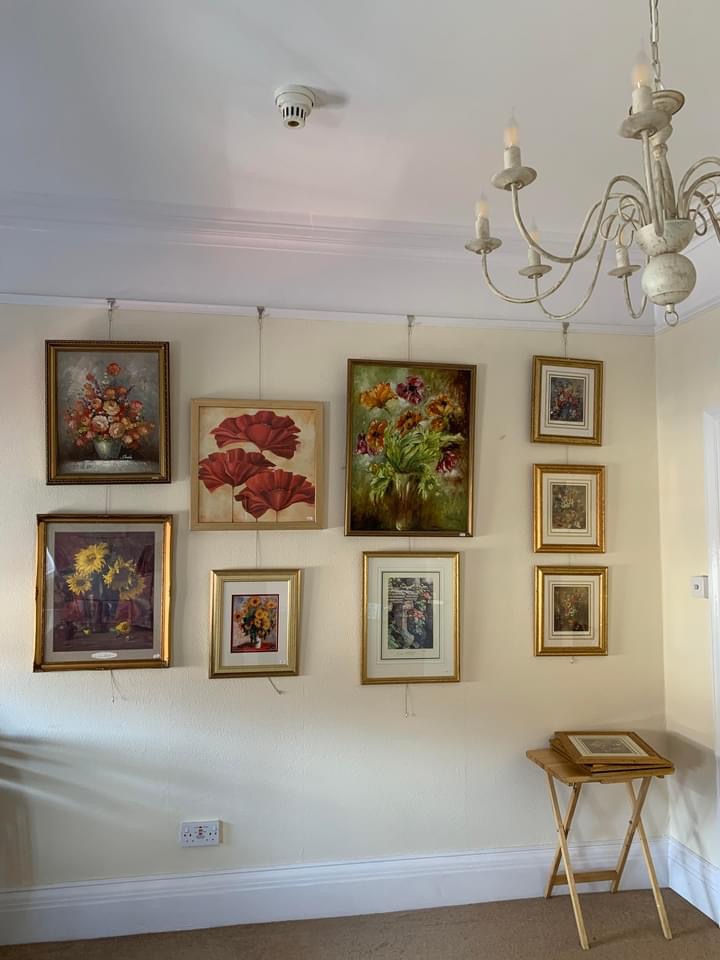
The art gallery above The Emporium
FREE school uniform Both The Emporium and The Vale Pantry are working together to provide a free school uniform hub in the former Barclays Building to help children get ready to go back to school. Do you have any items that have been grown out of and are now lurking in a drawer? All donations gratefully received. And do come and see if there is anything which fits your children. Why buy new when you can recycle? The Boutique always has free school uniforms alongside some great quality children’s clothes, most of which are just £2. It’s a great place for mums and grandmums to find a new outfit too: a constantly-changing range of lovely garments for the new season at knockdown prices!
Inside 1855 in Sturminster Newton, the town’s artisan bank with more than 70 traders
Sofa art While you’re strolling through town, don’t forget to pop in and explore the Art Gallery in The Emporium – it’s an actual Tardis above the shop, and every room is filled with art. Down the road at the old Barclays bank the Furniture Store is similarly bulging with fascinating items to transform your home, whether your sofa is actually on its last legs or you’re looking for an upcycling project. We are always ready to receive donations – and always ready to welcome new volunteers into our team.
Family festival SturAction, Sturminster Newton’s own Community Benefit Society, is one of the supporters of the Riverside Family Festival which is back this year on Saturday 19th August on the Riverside Meadows down by the bridge. The Festival aims to give families a cheap, fun day out during the summer holidays while raising funds for local charities – this year The Vale Pantry, The Yellow Bus Community Project and Children’s Cancer UK wil all be benificiaries. The group of parents running the festival would welcome some extra help on the day (and tidying up the day after!) – if you have a couple of hours to spare you would be very welcome. Please contact [email protected]
Free parking on the first Saturday There is always free parking – all day, both car parks – on the first Saturday of every month thanks to SturAction. By random chance cough it also happens to be the same day that the 200 or so car and bike enthusiasts have a friendly morning meet in the Rec.
The excitement has been building, the engines are purring in anticipation, and we can finally announce that the 2023 official Clayesmore Classic & Supercar Sunday Show magazine is here!
Just a year ago, the inaugural Clayesmore Classic & Supercar Sunday made an impressive debut, drawing a crowd of over 1,500 guests who marvelled at a stunning collection of 180 beautiful classic and supercars gleaming under the blazing sunshine at Clayesmore School. The event, expertly organised by Clayesmore’s own then-18-year-old Zander Miller, exceeded all expectations, with iconic vehicles such as a Ferrari F40 and Alfa Romeo GTAM wowing the crowd, and a range of classic cars spanning nearly 80 years of automotive history on display.
Following the tremendous success of the previous event, we’re thrilled to present this year’s official show magazine, designed to enhance your experience at what’s set to be an even bigger and better Classic & Supercar Sunday.
What’s Inside?
The show magazine is a treasure trove of information. Within its pages, you’ll find an exclusive feature on cars not to miss – all hand-picked by our team of car enthusiasts. Get ready to see, amongst others, a dazzling Ferrari F40 and an F12 N-Largo, a Ford GT, a Lamborghini Gintani SV and a Twin Turbo Huracan, the Aston Martin Vanquish Zagato Shooting brake … and also a brand new DB12 from sponsors Harwoods!
No event would be complete without a schedule of activities. We’ve made sure to include a timetable in the magazine to keep you informed of all the exciting activities we have planned for the day. You wouldn’t want to miss the ‘REV OFFs’ and the awarding of prizes such as the Best Club Stand and the People’s Choice Award.
Finally, our sponsors have been a vital part of making this event possible, and we’re pleased to include notes from them, sharing their passion for cars and their support for our event.
The Clayesmore Classic & Supercar Sunday is more than a car show – it’s a celebration of automotive artistry, a gathering of enthusiasts, and a family-friendly day full of fun. Grab your official show magazine, get involved, and be part of this spectacular event.
We look forward to seeing you there. Get ready to rev your engines!
Interested in exhibiting? Classic and supercar owners and clubs are invited to register here.
The stoat has a mesmerising effect on those who spot it and Dorset may be a perfect habitat. But they remain a mystery, says wildlife writer Jane Adams
I saw a stoat the other day. The heavens had just opened, and it appeared on the road just as I was sheltering under some trees at the side of a small wood. I couldn’t take my eyes off it. Its sinewy body and short little legs seemed to flow up the road like a furry brown wave breaking again and again over the tarmac. Then it was gone.
Vital exuberance Stoats are part of the mustelid family, a group of meat-eating mammals that include the weasel, polecat, pine marten, otter and badger. Weasels look very similar to stoats, but at roughly 20 rather than 30 centimetres long, weasels are much smaller, and their shorter tail also lacks the stoat’s distinctive black tip. It would be interesting to know how many stoats live in Dorset; with its rich mosaic of woodlands, heaths and farmland, it seems the perfect place for them to thrive. It’s also home to their favourite prey of voles, shrews and rabbits – despite the latter often being twice their size! Yet, the precise number – just like the mammal itself – remains a mystery. Culturally, the snow-white winter pelts of stoats with black-tipped tails, known as ermine, were not only favoured embellishments for royal ceremonial garments but also carried significant symbolism in ancient heraldry. Our local stoats stay brown-furred and white-bellied year round, as Dorset lacks the cold winter climate needed to trigger a colour change. Nevertheless, the UK permits gamekeepers and poultry farmers to trap and kill them under licence, and in some countries stoats are still farmed for their valuable fur. A few years ago, a friend phoned me, bubbling over with excitement about a family of stoats that had taken up residence in his garden log pile. They played, he told me, with such utter exuberance and vitality – bouncing, twisting and slithering between the logs. He swore it was the most joyful thing he had ever witnessed. So, please raise a glass to the remarkable stoat. Long may it remain a wild enigma … and stoatally different.
‘the stoat is bigger than the weasel, and can also be identified by the black tip to its tail’
Stoat facts
Stoats hunt along hedgerows, walls and ditches, avoiding wide open spaces.
Females can delay embryo implantation (called embryonic diapause) for nine to ten months in order to give birth to up to 12 young (kits) during the most favourable environmental conditions.
In August, kits born in the spring are starting to become more independent and hunt for themselves, so may be seen more often.
Male stoats are called dogs, hobs or jacks. Females are known as jills. Their collective name is a gang or pack.
As well as voles, shrews and rabbits, they will also eat amphibians, reptiles, birds, eggs, fruit and earthworms.
They use the nests of their prey as dens, and are known to line them with rodent fur during cold weather.
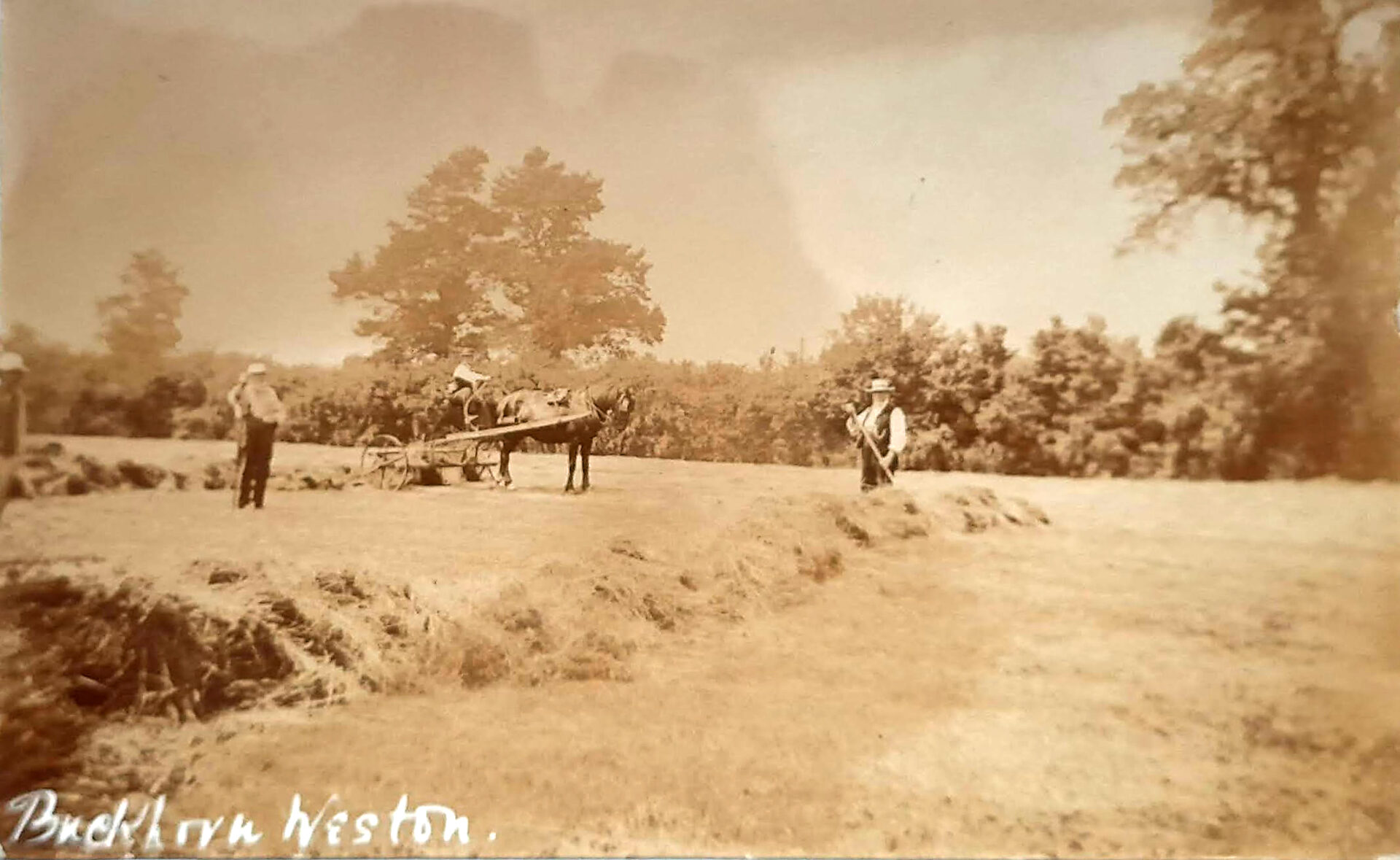
This month Barry Cuff has selected a few postcards with a suitably agricultural theme for the August harvest and the Gillingham & Shaftesbury Show.
This postcard of threshing at Chetnole was posted on the 14th October 1920 to Chiswick, LondonThis postcard of sheep being watered at Ashmore pond was sent to Chester in February 1907This scene of hay making at Buckhorn Weston was sent to Southampton in 1906This postcard of Lord Portman’s prize cattle at Bryanston was sent in 1911 to Birchington-on Sea in Kent
After 40 years in the TV industry, Simon and Karen Priestman bought a boutique vineyard – and promptly created an award-winning wine
All images: Courtenay Hitchcock BV Magazine August 2023
After four decades behind the cameras on some of the UK’s biggest TV drama and film productions – including Paddington, Dr Who, Call the Midwife, Poldark and Grand Designs – Simon Priestman and his wife Karen decided it was time for a change in lifestyle. ‘The kids left home and we were looking for a project,’ says Simon. ‘We loved growing things, so decided it had to be related to that. It was initially going to be a lavender farm, then we changed our minds and it became a vineyard. We looked at lots, including a vineyard in Italy,. Then one day, this place just happened to come up online. We said: “we’ll go down and have a look at it, but it’d be mad to get involved.” So we did … and look what happened!’ ‘We walked around the corner as you go down into the vineyard and just … wow. The view opened up and we said: “Well, this is lovely!” – and that was it,’ says Karen. ’There’s so much potential in this place for other things as well. So yes, that was it. We were hooked!’
Karen and Simon Priestman, owners of Little Waddon Vineyard – image Courtenay Hitchcock BV Magazine August 2023
Bold beginnings As professional camera crew, how much experience or knowledge did the couple have in vineyards and vines? ‘None.’ In winemaking? ‘None!’ Simon is remarkably cheerful as he acknowledges this. ‘I applied to Plumpton College in June 2018 to see if I could do their week-long vineyard course. They were fully booked and didn’t have anything available – because of course you’re meant to book these things two years in advance. We were still working full time shooting at that point, and so by the time we made it through the inevitable delays, the lawyers had done their thing and all the paperwork was complete, we literally wrapped on a film in Liverpool and drove straight down.
The vineyard is filled with beds of pollinator-friendly wild flowers – image Courtenay Hitchcock BV Magazine August 2023
‘We got here at some ghastly time in the morning, exhausted, to find the entire vineyard completely overgrown. The whole thing was just … oh my god, what have we done?’ ‘We knew the vineyard was planted in 2004 with three varieties of grape – Phoenix, Seyval Blanc and Regent,’ says Karen. ‘They’re all cold climate grape varieties, so they’ll thrive in the UK, and they’re disease-resistant, so we were confident we had a good base. But it’s not your usual three varieties – English sparkling is traditionally made from the classics, Chardonnay, Pinot Noir and Pinot Meunier. Combine that with our lack of knowledge and we could have met a bit of resistance in the industry before we even started!’ ‘We parachuted into this,’ Simon continues. ‘It’s been a very steep learning curve, but a fantastic one. We don’t actually make the wine here – that’s a stage further, we’ve not taken that on yet. Daniel Ham is our winemaker – he was Langham’s head winemaker when we met and has now left to set up on a bio-dynamic vineyard near Salisbury.’
The Terrace at the vineyard is a delighful spot for the Tour & Tasting experiences. Image: Simon Priestman
Little Waddon was certified as Organic, but due to a recent hike in the cost of the certification process, it is no longer officially classed as organic bio-dynamic. However they stay true to those principles, and continue to produce their wine in a regenerative, environmentally-friendly manner in the low intervention style. ‘We’re pesticide free,’ says Simon. ‘We don’t put any harmful chemicals on our land or on our vines. We don’t use commercial yeast for making the wine – it’s wild yeast ferments and no chemical or mechanical filtering, food colourants or added tannins and we don’t use sulphur at the start of the winemaking process or at bottling. We’re proud that it’s simply grape to glass. ‘In five years we’ve built a portfolio of seven wines. When we first spoke, Daniel asked what style of wine we would like, and Karen immediately said “definitely a sparkling wine!”. He asked if we realised that it’s a three-year process to make a Traditional Method sparkling wine (we didn’t) … So Karen said “Can’t you make us a Prosecco, or similar? That’s quite quick isn’t it? Just for the first couple of years while we wait for our English Sparkling wine?” He sort of gave us a look, and said “well, for a start Prosecco is DOC, so you can’t make it in this country. Also, you have to have pressurised tanks, which you know I don’t have!”
The Little Waddon col fondo range, including a rosa and a rosso. image Courtenay Hitchcock BV Magazine August 2023
Cold Fondo ‘But then he said, “you know, there is this method that I know about – but I’ve never made before. It’s an ancestral method that goes back to the ninth century, called Col Fondo.” ‘I thought he said cold fondo, so I excitedly told Karen: “we can make cold fondo!” and went back to Dan with a “Yes, we’ll have the cold fondo, please!” ‘There was another sigh, and Dan said patiently ‘Noo-o-o, it’s from the Italian, Con il Fondo – it translates as with the lees, or with the bottom.” You make the base wine by letting that go through fermentation and then malo-lactic fermentation, then let it cold clear over winter.
The Fizz at the vineyard Tour & Taste experience includes fresh scones with jam and cream
In February of the following year you add 10 grams of organic sugar per litre and stir it up with the lees in the tank. Then you bottle it and simply beer cap it. Around about May, as it starts to warm up, it re-ferments a second time in the bottle. It’s two and a half bar pressure, as opposed to the five bar pressure of a Traditional Sparkling wine method. It does contain the lees, hence ‘with the bottom’ but it makes an extraordinary semi-sparkling wine. ‘The 2018 vintage was put forward for a competition and we won a bronze medal!’ ‘Interestingly enough,’ adds Karen, ‘that year, we were only the second vineyard in the country to make it. But since we started, we’ve set a trend – everyone now is making Col Fondo! We went on to make a Col Fondo Rosa (rosé). Then last year we also made a Col Fondo Rosso (red) sparkling – very on trend, it looks completely crazy because the mousse is red. ‘The Blanca, the white, is still our most popular, but the Red Col Fondo is great fun. It’s a great barbecue drink, perfect for surprising your friends! ‘We also do a Still White and a Still Red. And of course we now have our Traditional Method Sparkling too! ‘We do like to experiment and try different things – hence the Red Col Fondo. ‘We’re known for our Col Fondos, but if we do say so ourselves, our Traditional Method Sparkling is a little beauty.’
The newly-refurbished Tasting Room – image Courtenay Hitchcock BV Magazine August 2023
The Tasting Room
‘We sell our wine at some local shows and events’ say’s Simon. ‘But people really love our Tour & Tasting experiences. ‘I take everyone for a stroll around the vines and tell the story, then we arrive back at the Tasting Room. We sit on the terrace if the sun is being kind enough to allow us to enjoy the spectacular view, and Karen does an amazing plate of food while we all taste the wines.’ Little Waddon Vineyard produces small batches of low intervention crafted wine. Most people buy direct from the Vineyard via the online shop. Some of their Ruby Moon red goes to the Groucho club in Soho, and some Col Fondo can be found at ‘Terroir Tapas’ and also ‘Parlourmentary Deli’ in Bournemouth. It’s a busy sort of choice for “retirement”, but Simon and Karen show no signs of slowing down any time soon. They also have The Hide, a shepherd’s hut, with a cabin and wood-fired hot-tub, in a quiet corner of the vineyard, which earns its keep as a luxury Airbnb rental. With its lush interior, stunning views to the coast and of course that wood-fired outdoor hot tub, it’s no surprise that it’s already booked up for most of the year. With the ever-present pressure of rising energy costs, they are also moving the vineyard towards 100 per cent renewable energy already powering most of their needs.
image Courtenay Hitchcock BV Magazine August 2023
See the Little Waddon Vineyard website for Tour & Taste event details, to purchase wine direct or to find more details of The Hide.