

This month’s cover photo wasn’t meant to be symbolic. After our usual heated tussle and group vote, we finally plumped for the bright, buttery yellow flowers with a rain-soaked ladybird perched on top, both of them looking slightly surprised by the amount of water involved.
Only afterwards did I realise we had rather serendipitously chosen daffodils for the cover of the fourth anniversary of the war in Ukraine. They’ve become one of the symbols of the conflict – their bright, sturdy yellowness standing for hope and resilience. Quite unintentionally, our cover now carries a small reminder of a war that still hasn’t gone away, even as the world keeps finding new ones to worry about.
It’s all a bit much, isn’t it?
Ukraine is still at war, but the news is suddenly full of Iran. The cost of… everything… continues its determined climb upwards. And every economist on the radio sounds like someone who has just opened a very alarming electricity bill.
So this week I did what any sensible person does in publication week: I scrolled TikTok every time the kettle boiled. Which, to be honest, is quite often.
I have learned several important things.
Firstly, pandas are absolute chaos merchants. There is a whole genre of videos devoted to pandas being jump-scared, falling out of trees or simply rolling downhill for reasons known only to themselves. Secondly, Ring doorbells have created an entirely new category of comedy in which unsuspecting humans step confidently out of their front doors and immediately vanish sideways down the steps.
And thirdly, there are endless videos of people being surprised by a much-missed daughter, son, cousin, friend or parent appearing unexpectedly through an airport gate or front door. I am apparently powerless against these. Within seconds I’m sniffling over strangers hugging each other in a departures lounge somewhere in Ohio.
TikTok also assures me, several times a day, that growing up in the 1980s was the greatest moment in human history, that owning a cat will improve – or ruin – your life by 300 per cent, and that a mid-life crisis is really just a perfectly sensible decision to stop wearing uncomfortable shoes. I find all of this oddly cheering.
And sometimes a rain-drenched ladybird lands on a daffodil and reminds you that even in very soggy weather, life keeps going.
Laura x
On When Water Rises
Your excellent article on groundwater flooding highlights something that many residents have been saying for years: the figures used to assess flood risk are hopelessly out of date.
Planning decisions are still being made using models and assumptions that simply no longer reflect the reality we’re living in. Rainfall patterns have changed, winters are wetter and extreme events are more frequent. Yet developments continue to be approved based on calculations that appear to belong to another climate entirely.
Until planners begin using realistic projections that properly account for current conditions – not historic averages – we will keep repeating the same mistake: building homes in places that are increasingly vulnerable to flooding.
Communities then end up paying the price when those models inevitably prove wrong.
If climate change is already altering how and where water moves through the landscape, surely our planning system needs to catch up with that fact as a matter of urgency.
Catherine Small
Gillingham
Your recent article on flooding was fascinating, but I suspect many of us living in rural Dorset are drawing a simpler conclusion. Over the years it feels as though a lot of the routine maintenance that once kept water moving has disappeared. Ditches, gullies and culverts that used to be cleared regularly are now often choked with leaves and debris. When heavy rain comes, the water has nowhere to go. The same with rivers and streams – they used to be cleared of debris and fallen trees far more frequently than they are today, and were dredged. It’s hard not to feel that the basic housekeeping that once helped manage water has been neglected.
Flooding is a complex issue and climate change is real. But before we leap to complicated solutions, perhaps we should start by making sure the drains, ditches and waterways we already have are actually able to do the job they were designed for?
Name and address supplied
I’ve noticed numerous comments on your Facebook page suggesting that dredging our rivers would solve Dorset’s flooding problems. It’s an understandable reaction – many of us remember a time when rivers and ditches seemed to be cleared more regularly.
However, dredging is rarely the solution people imagine it to be.
In most cases it simply moves the problem further downstream. By deepening and straightening channels, water flows faster and arrives in larger volumes elsewhere, increasing flood risk for those further along the river.
Modern flood management tends to focus on slowing water down rather than speeding it up – allowing floodplains to hold water, restoring natural river meanders and managing land higher up the catchment so rainfall is absorbed rather than rushing straight into rivers.
Dredging has a place in very specific situations, but it is not the simple fix many people believe it to be.
Flooding is becoming more complex as rainfall patterns change, and unfortunately there are no easy answers.
Harry P, Shaftesbury
THANK YOU!
To the two kindest gentlemen who rescued my daughter when she hit a pothole near Three Legged Cross two weeks ago. The first stopped and changed her tyre for her, and when she discovered her spare was flat after he left, a second gentleman not only pumped it up, but gave her the pump to ensure she got home safely.
Fay-in-the-Micra’s mum, Bournemouth
On the sheep cruelty conviction
Your report on the North Dorset farmer banned from keeping sheep was deeply upsetting to read, and rightly so. No animal should suffer neglect, and the court’s decision makes clear how serious the situation was.
However, people do not often set out deliberately to mistreat their animals. Farming is not just an occupation but a way of life, and when things go badly wrong there can sometimes be underlying problems that the wider public never sees.
Farming charities have repeatedly highlighted the mental health struggles within the industry. RABI’s 2021 Big Farming Survey found that 36% of farmers are probably or possibly depressed, many reporting isolation, financial pressure and an inability to ask for help.
None of that excuses cruelty, of course. But it does suggest that when animal welfare collapses on a farm, it may sometimes reflect a farmer who has also reached a point of collapse.
If that is the case, the question becomes not only how we enforce welfare standards – which must be done – but also whether the right support systems are in place before situations reach this stage.
Compassion for animals and compassion for people are not mutually exclusive.
Hannah G, Sherborne
As a farmer, the cruelty case you reported was sickening. Anyone who keeps livestock knows that their welfare is the first responsibility of the job. Most farmers care deeply about their animals and are rightly horrified by this case.
At the same time, I think it’s important the public understands that this is not normal farming. Cases like this are rare and the vast majority of us livestock keepers work long hours, in all weathers, to ensure our animals are well cared for.
When something does go this badly wrong there is usually more going on behind the scenes. That doesn’t excuse the suffering of animals, but it may explain how standards can collapse. Animal welfare comes first. But supporting struggling farmers before things reach this point is just as important.
Name and address supplied
On the Blacksmith’s wife who died in her chair
My husband is William James Hunt’s great grandson. We still own The Old Forge where his grandfather Charles and Great Grandfather William had a wheelwright and blacksmiths. The carving of the screen in the back of Piddletrenthide Church was done by William James Hunt, and we have the diagrammes he used to carve it.
Hils Hunt, via Facebook
This lady was my husband’s great great aunt – I believe her name was Emily.
Lyn Hunt, via Facebook
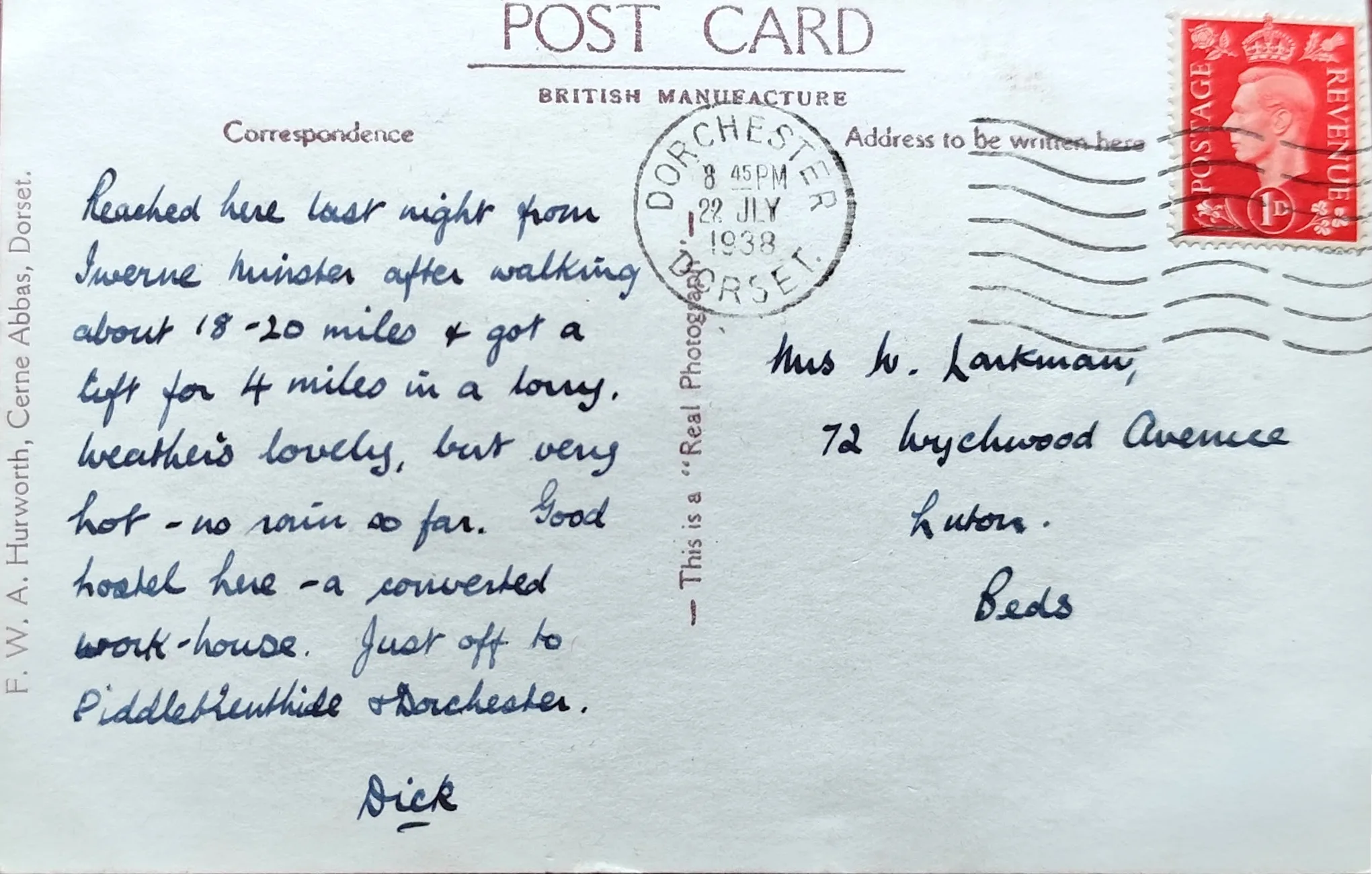
On a 1938 postcard from Cerne Abbas
Dick [the sender of the card] is Richard W Larkman (b. 1917), writing to his mother Mabel E Larkman, who of course would be addressed as ‘Mrs W Larkman’ since her husband’s name was William. It was easy to find the household in the 1939 register online. From press announcements, Dick (Richard W. Larkman) was a Captain in the Royal Army Ordnance Corps – he married in Kings Lynn in 1945. Quite a relief, since the RAOC would’ve been part of the British Expeditionary Force in France and Belgium in May 1940, and their retreat to Dunkirk. Well done Dick.
Pam Booth, via Facebook
Want to reply? Read something you feel needs commenting on? Our postbag is open! Please send emails to [email protected].
When writing, please include your full name and address; we will not print this, but do require it.