

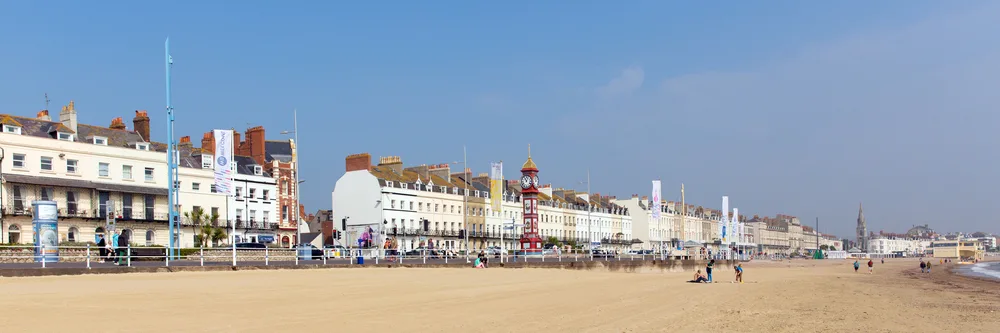
There’s a particular sound on Weymouth seafront once the summer crowds have gone home. Coins inch forward on a sliding shelf, hang over the edge for what feels like an age, and then three or four drop into the tray with a rattle. Even out of season, with the sand wet and half the kiosks shut, there’s usually an arcade on the Esplanade with its lights still flashing.
Almost anyone who grew up in Dorset has a memory tied up with them. Maybe it’s a grandparent handing over a pound in 2p pieces and telling you to make it last, or the agony of watching a fat stack of coins hang over the edge and refuse to fall. Hardly anyone walked away with more than they came in with. Nobody seemed to mind.
Not that the game has stayed on the seafront. A lot of it has moved online, where casinos offer roulette, blackjack and poker on a phone screen, usually played from the sofa rather than the prom. The game that has changed least is the one the arcades knew best. Online slots still use the same cherries and bells anyone who spent their summers on the Esplanade would spot straight off. Nobody pulls a lever any more, of course. It’s all done with a thumb on a screen, but the thing itself is more or less unchanged.
Penny in the Slot Beginnings
Long before anything electronic, the seaside was full of mechanical curiosities. Edwardian holidaymakers could pay a penny to peer into a what-the-butler-saw viewer, have their fortune read by a mechanical fortune teller or test their grip on a strength machine.
Weymouth had its share, and for a night out the obvious choice for years was the Pavilion down by the harbour, which had opened a few days before Christmas 1908. Fire put an end to it in April 1954. The blaze spread so fast that most of the building was gone inside an hour.
The Penny Falls Craze
The machine that really shaped the British arcade came out of Ramsgate in Kent. Brothers Alfred and Jim Crompton made amusement machines there, and in 1964 their firm launched Penny Falls, often credited as the first coin pusher. Its moving shelf was split into twelve sections, so twelve people could stand round it at once, all elbowing for the best spot.
Jim Crompton apparently thought it might be a hit for two or three years. He was rather wrong. Pushers ended up everywhere from Kent to Japan, and they’re still the backbone of the British seaside arcade. Decimalisation in February 1971 finished off the big old pennies, so the game carried on with 2p coins and picked up the name tuppenny falls along the way.

From Bandstand to Arcade
Few buildings sum all this up better than Weymouth’s Pier Bandstand. It opened in May 1939, having cost the town £35,000 to build. Over the years it put on everything from concerts and dances to wrestling and roller skating, and it was where the Miss Weymouth bathing beauty contests were held. The original drawings from 1937 ended up in the care of the Dorset History Centre.
By the late sixties it wasn’t pulling the crowds it once had, so in 1967 it was turned over to an amusement arcade with rides. Then in May 1986 came the day the seaward end was blown up. Underwater charges did the job while thousands of people lined the front to watch. Only the entrance building was left standing, and there’s still an arcade in it now.
The One-Armed Bandit Comes Inland
Pushers stayed by the sea. The fruit machine didn’t. People called it the one-armed bandit because of the long lever on its side, and once the gambling laws were relaxed in the 1960s it started appearing well away from the coast.
In a lot of Dorset locals it lived in the corner, somewhere between the dartboard and the door to the skittle alley. Later the reels went electronic, and from there it was a short hop to the screen.
Today’s Rules and Playing Sensibly
Playing online now comes with far tighter limits than the old pub machine ever had. Since spring 2025, a single spin of an online slot game has been capped at £5, or £2 for anyone aged 18 to 24.
In a funny way, the old seafront lessons still apply. Children given a fixed handful of coppers learned to walk away when it ran out, and that’s not bad advice for grown-ups either.
Unlike a turn on the tuppenny falls, online play is strictly for adults over 18.
Still Part of the Dorset Coast
Modern arcades mix the classic pushers with ticket games and prize grabbers. Like the steam engines and heavy horses at the Gillingham and Shaftesbury Show, the tuppenny falls has become one of those fixtures Dorset families keep coming back to year after year.
So next time you’re on Weymouth seafront with a pocketful of change, find a tuppenny falls and have a go for old times’ sake. Watch the stack wobble on the edge, and remember that people were standing in that same spot doing exactly the same thing decades ago.