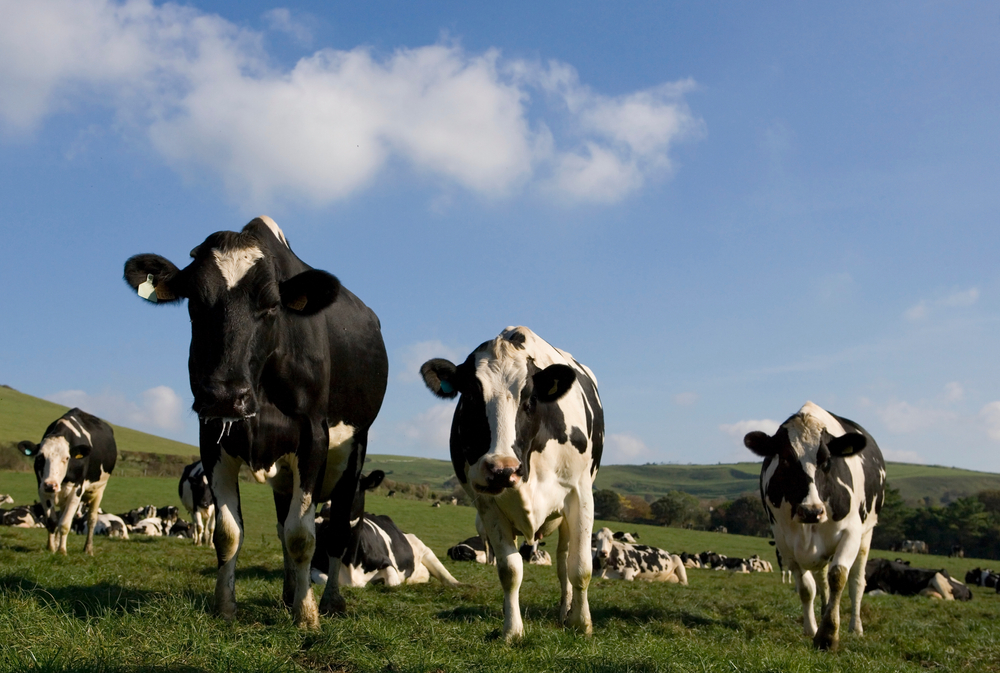
Sturminster Newton’s Car & Bike Enthusiasts Event is completely FREE for visitors and exhibitors alike, and there’s always a fantastic selection of cars and bikes from across the region, ranging from century-old vintage Ford Model A to modern day supercars, alongside giant Chevy pickups, 60s minis, 70s VW Beetles, 80s Cortinas, Harley-Davidsons, WWII army bikes … and everything in between!
Got a vehicle you love? Want to bring it along and show it off?
The meet is a friendly, welcoming and inclusive event – there are no charges, no requirements on vehicle age, type or classification and no need to register either!
The next event is from 9am to 12pm on the Sturminster Newton Recreation Ground – plenty of space, a smooth surface and toilets available too.
And if you don’t have a car or bike to share, come along and admire everyone else’s – make it a day out for the family! Stur has plenty of places to eat, lovely shops to browse, the beautiful working mill is always worth a visit and the Trailway is great for stretching the legs!
Steve Bell cooks it how he likes to eat – and the regulars keep coming back. Rachael Rowe reports in this month’s look behind the serving counter
All images: Rachael Rowe
There’s a sign on the wall in the Yellow Bicycle Cafe telling customers that there is no WiFi. Instead, people are encouraged to talk to each other. It sums up the positive vibe of one of Blandford Forum’s most popular eateries. Owner Steve Bell tells The BV his story.
What brought you here? We’ve been here for nine years now. Nine years on 1st March! My first catering business was in South Wales in 2007, after 15 years in the fitness industry. I wanted to turn my passion into a business and there was nothing left for me in the fitness world – it wasn’t possible to get promoted any further. I started out with a converted VW camper and I did festivals for three summers. Then I set up a cafe in South Wales, and then I came here to Blandford Forum. My criteria was that it had to be within 30 minutes of home and it had to be somewhere with a regular customer base. In coastal areas, you get a lot of seasonal variation but here there are a lot of regulars, which is easier when managing a business. We see our regulars week in week out. The cafe is open plan and that’s deliberate – it means we can chat to the customers. If someone is on their own, we can talk to them as we’re preparing the food. And with an open plan design there’s no hiding place. You can see what the customers are thinking when they eat the food. I’d hate to be a chef stuck out the back in a kitchen. We’re just too small for someone to sit working on a laptop for two hours, so the deliberate ‘no WiFi’ policy changes the atmosphere. People interact more.
Yellow Bicycle Cafe owner Steve Bell
Why a yellow bicycle? There’s actually no real story to it! I’m a cyclist and I wanted the cafe to have two words so it’s easy to remember.
How many are in the team? I have four people plus myself. Rhe makes all the cakes and has her own business, Rhe Bakes. (I was early, but there were already customers enquiring about cake in the cafe)
Garlic and rosemary bruschetta topped with pan fried Dorset pheasant breast, Wild Dorset Game sausage patties and mushrooms
What flies out of the cafe? It will always be our campfire beans. Our home made baked beans are cooked in a pan with local sausage, and an egg poached on top. It’s covered with local cheddar and served with home made crusty bread. I’d be lynched if that ever came off the menu!
Tell us about your suppliers? One look at the specials menu will tell any customer the food is local. Very local. We get meat from Rawston Farm, game from Dorset Game Larder – that’s on the menu today. And we have locally roasted coffee, ours comes from Poole, Full Circle Coffee. We also have New Forest asparagus, and cheese from Book and Bucket, Ford Farm and Open Air Dairy near Bridport
What are you most proud of? The fact that we’re still here! The cafe changed a lot in the pandemic. Something I have learned with the Yellow Bicycle Cafe is that you should always be moving forward and should always be better than last year. Also the fact that we have so many regular customers after nine years – it says a lot that they still keep coming here. I’m also proud that I’ve won some awards. In 2020 I won the South West Tourism Award for Cafe of the Year. And in 2018, I was National Breakfast Chef of the Year – I’m now on their judging panel. That got us in the Sunday Telegraph. I have had no formal training as a chef. I didn’t even call myself a chef until I won that award – and then I felt I deserved it.
And your biggest challenge? Everything relating to COVID. The permanent changes to hospitality that have come out of it. The main thing has actually been post-pandemic, because the government support stopped, and trying to rebuild the business. I hated the Eat Out to Help Out campaign. We don’t take bookings, so it was hard to say to regulars who never book that they had to.
So what’s next? I just want to keep moving forward, creating new dishes and using lots of local seasonal produce. When I started out with a cafe, one of the best pieces of advice I had was from a friend in the catering business: “You’re not a trained chef so cook what you are passionate about and cook it how you like to eat it.”
Find Yellow Bicycle Cafe on Facebook here and follow them on Instagram here (WARNING: both are guaranteed to make you hungry)
Yellow Bicycle Cafe is open Tuesday to Saturday, 10am to 4pm (opens 9.30am on Saturdays) on Salisbury Street, Blandford
Roger Guttridge tells the story of Bradford Abbas’s Rose and Crown pub and its ‘famous five’ customers from the 1930s
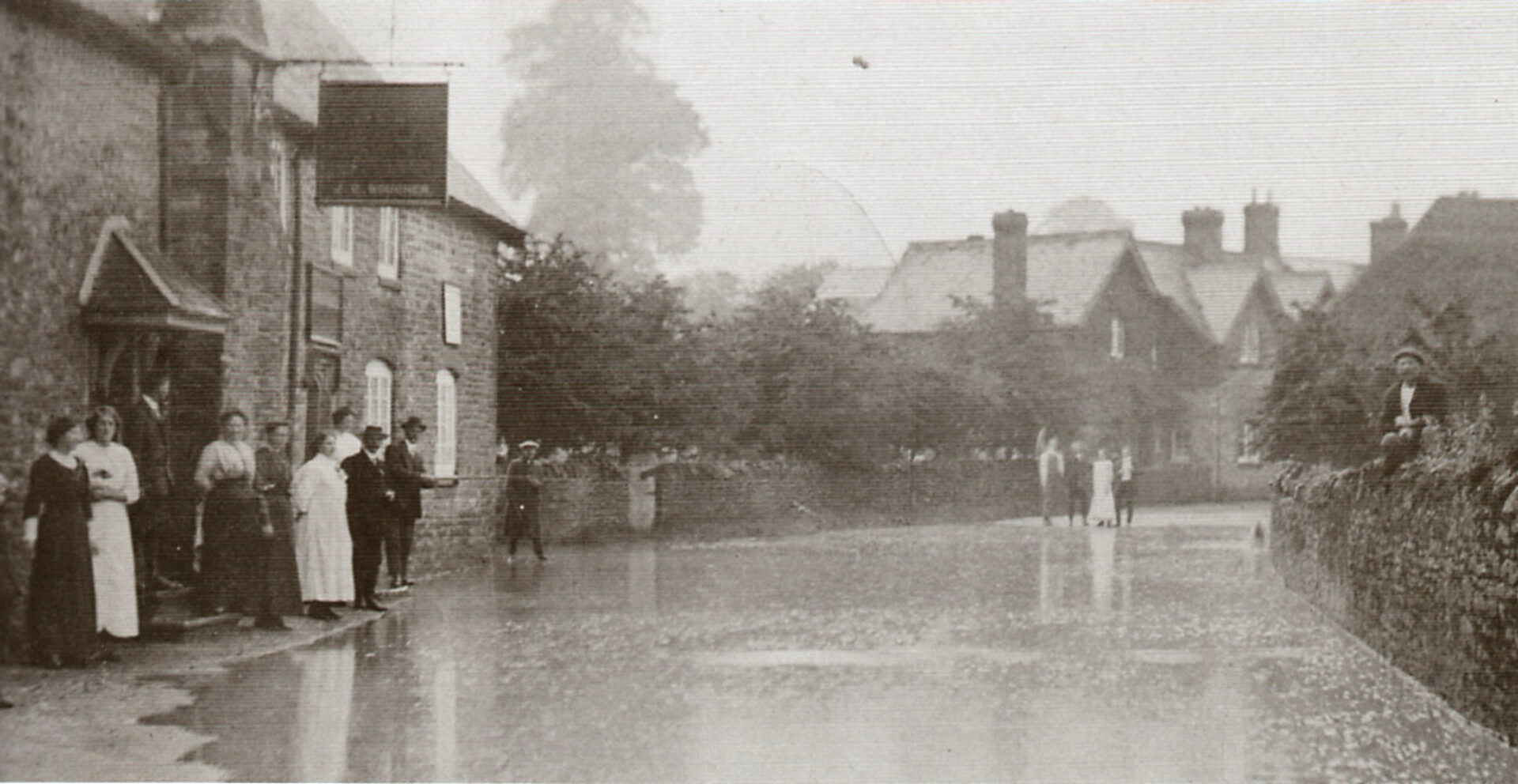
The Rose and Crown and flooded Church Road at Bradford Abbas, c1900. Old pictures from Lost Dorset: The Villages and Countryside, by David Burnett, based on Barry Cuff’s collection of Dorset postcards.
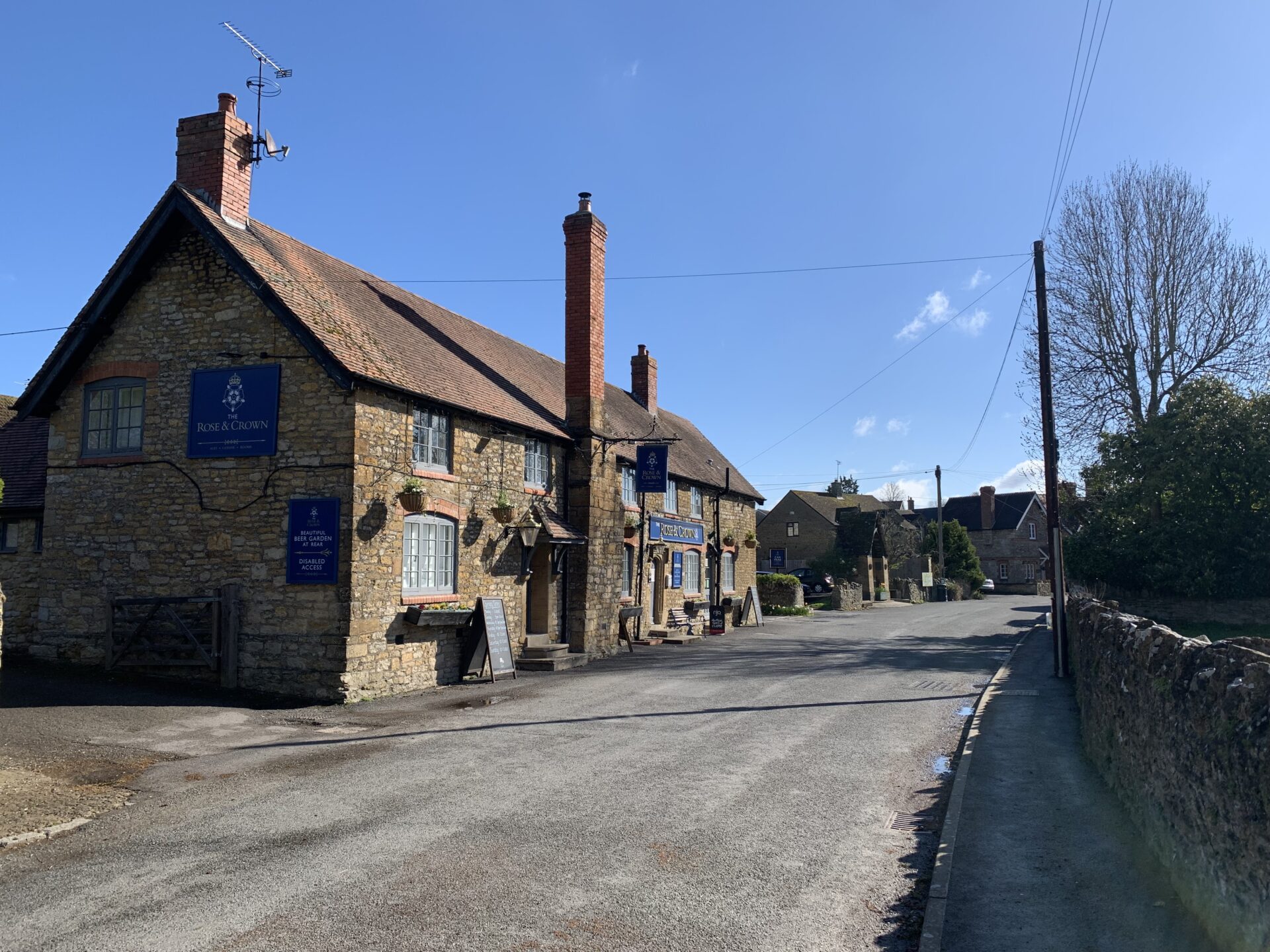
It looks like an overgrown puddle to me but this flooding event in Church Road, Bradford Abbas, was sufficient to bring out a photographer and 16 locals eager to be in his picture. The building on the left is the Rose and Crown, which remains a flourishing pub to this day. By the time the puddle picture was taken in about 1900, the Rose and Crown had already seen off at least three other hostelries which had formerly served the village and its then 400 residents. The building was originally an old farmhouse with its own brewhouse and presumably the pub grew out of that. Beyond the pub in the modern picture below is Bradford Abbas’s unusual war memorial, built in 1917 by Mr Bartlett of Yeovil and based on a design by architect C E Benson. Building costs amounted to £120 19s 6d and the structure included a steep, tiled gable roof, which at first glance has a passing resemblance to a bus shelter. Unusually, the panels list not only 12 village men who lost their lives in the two world wars but also the 79 villagers who served and came home.
The Rose and Crown today with the war memorial in the background. Image: Roger Guttridge
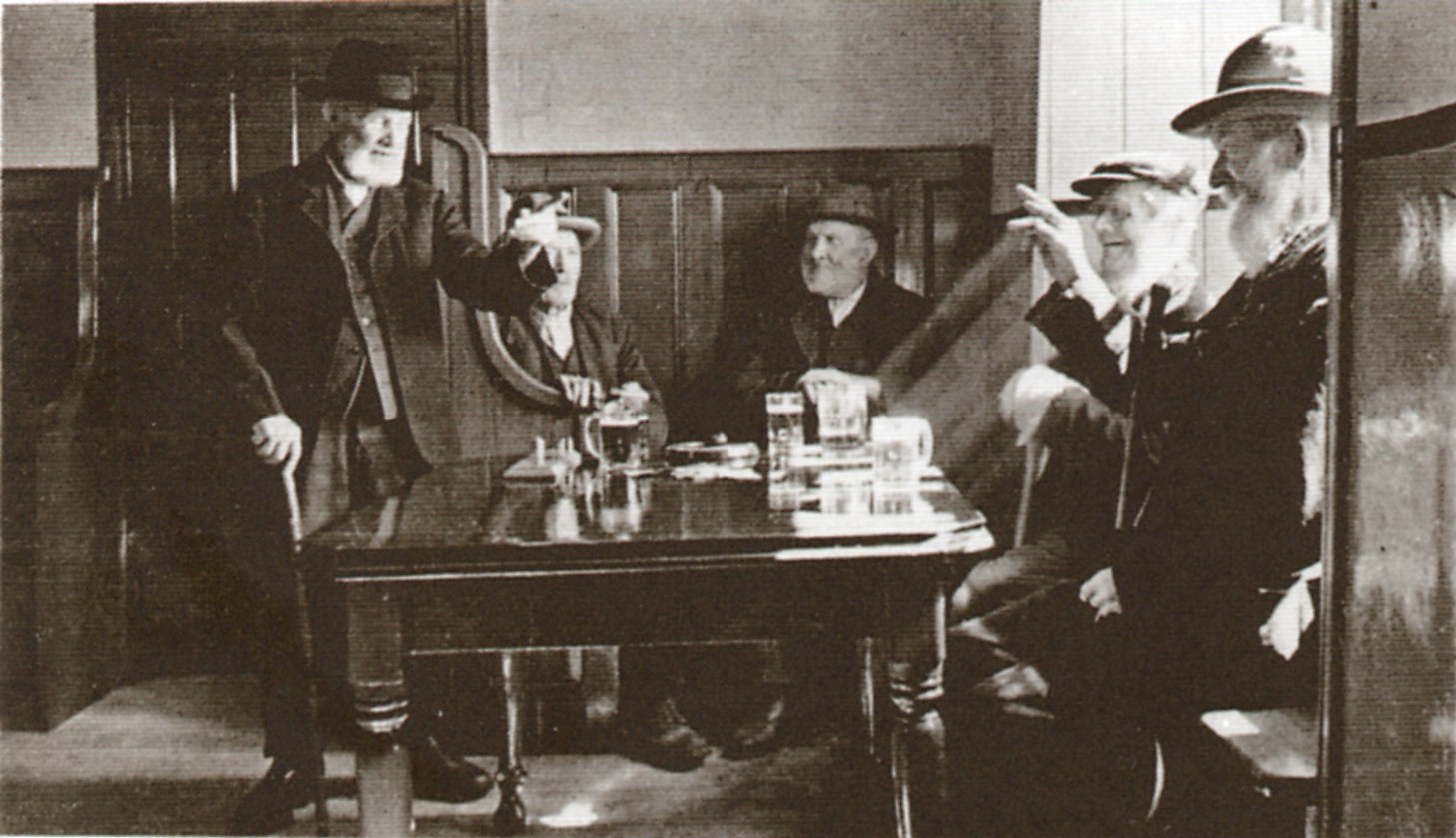
The famous five The five men in the third picture (below) were not among them. They would already have been in their 60s or 70s when the First World War broke out. Their moment of glory came in 1936, when British Movietone News filmed them sinking their pints in the Rose and Crown (video below, top), and playing skittles (video below, bottom).
Bradford Abbas’s ‘Lads of the Village’ in 1936
When the film was shown at a Yeovil cinema, Bradford Abbas’s famous five were treated like celebrities and asked to pose for photographs. Dorchester brewers Eldridge Pope issued the above commemorative postcard, describing the quintet as the ‘Lads of the Village’ and giving their combined age as 444. They were (left to right) George Chainey, aged 89, Sidney Parsons, 83, Thomas Coombs, 91, Samuel Ring, 92, and James Higgins, 89. Samuel, who lived to the age of 96, used to carry the banner of the Sick Benefit Club on club days. He didn’t derive much benefit from it himself, by all accounts, having never missed a day’s work in 76 years! I have my own minor memory of the Rose and Crown. In the early 1970s, when I was a young reporter on the Western Gazette, it was the venue for Yeovil branch meetings of the National Union of Journalists. I have a vague memory of meeting there one day when we went on strike!
SturAction sprang a surprise on John Romans on 31st March at the 1855 late night shopping – he found himself the guest of honour, receiving an award from the retiring High Sheriff Sibyl King for his contribution to the town. John officially transferred ownership of the former Lloyds Bank (since renamed the John Romans Building) to SturAction in order to house The Emporium and provide working space for local entrepreneurs. John also leases the former NatWest bank – now 1855 – and the old Barclays Bank (currently used as a pre-loved furniture outlet) to SturAction.
The Garden Room is open! 1855 continues to flourish, with more space becoming available for traders following the opening of the second area, the Garden Room. The volunteer who created this exciting room is now working on renovating the former bank vault – it will be interesting to see who opts to trade in there! 1855 has a late night opening on the last Friday of each month until 8pm, and is now also open on Sundays from 11am to 3pm. Do come in and explore – there is always something new to see. The Emporium, which houses Dapper Chaps, and the Furniture Store continue to welcome both regulars and new customers with their ever-changing range of pre-loved goods. It’s only too easy to pop in for an items you need and leave with one you just cannot live without … Meanwhile pop in to The Boutique if you’re looking for a spring wedding outfit – or any other special event. There are always beautiful clothes and accessories at knock down prices; you can even find a beautiful wedding or bridesmaids dress! It has been decided our wonderful volunteers deserve their bank holidays too, so The Emporium, The Boutique and the Furniture Store will be closed for all of the May bank holidays. 1855 will be closed on Coronation Day, but will otherwise be open for bank holiday mooching.
John Romans being presented with his award from the retiring High Sheriff Sibyl King
Dates for your diary Firstly, a thank you to David Shepherd for creating the ‘What’s Happening in Stur’ pamphlet to keep us informed each month, but just as a reminder:
Town Litter Pick Stur will be a lot tidier after Coronation Bank Holiday Monday!
Anyone with the time can join The Big Help Out litter pick – starting from 11am at the Council Offices.
3rd to 5th June Things get exciting! The first weekend in June sees:
The Exchange Beer and Ale Festival • The Garden Fair
Craft and Food Fair at The Exchange and Station Road (weather permitting)
The Car and Bike Enthusiasts Meet is back in The Rec (at the end of Ricketts Lane)
Free parking in town on Saturday 3rd June!
Pop in to The Boutique if you’re looking for a spring wedding outfit – or any other special event.Need a pie dish? A tagine? Perhaps a 30s-style vase? Cake stand? The Emporium has you covered.
3rd to 10th June Sturminster Newton Literary Festival The first week in June is the centre of the third annual SturLitFest, with a range of events around the town including fascinating talks by authors, guided literary walks, writers workshops, a book fair, and a chance to learn more about the town’s remarkable stained glass windows. See the website for full event and booking details, or pick up a brochure locally – tickets are bookable online or on the door for most events, subject to availability.
Sundays Good luck to the combined charities who are running a car boot sale in the Rec each Sunday through the summer.
Should we be rethinking wildlife protection, asks Andrew Livingston, as we attempt to balance biodiversity in the UK’s struggling ecosystems
A common buzzard was once a rare sight but is now frequently seen soaring over Dorset
n last months edition of the BV Magazine I reported on the news of Paul Allen’s arrest and sentencing for rural and wildlife offences, in connection with raptors on the Shaftesbury Estate. (Dorset one of worst counties for raptor persecution, says RSPB, after poisoned birds are found – Apr 23). The article sparked a great debate online (see the post and all comments here) –but I was surprised to see no mention of human interference in the food chain.
The killing of raptors is against the law, therefore Paul Allen’s actions were illegal. But at some point the law is going to have to be revisited. Even 30 years ago, the sight of a buzzard was a rare occurrence; today the breed dominates the skies over rural Dorset. Nationally red kites and eagles are rarer, but red kite numbers have risen substantially in recent years. They all hunt and eat the same foods – foods that include our beloved hedgehog, whose other main predator is the badger (yet another protected species in the UK).Every intervention – or non intervention – has a direct effect on the sensitive ecosystems in our rural areas. The worst thing we ever did was to get involved! Unfortunately, proponents for banning the persecution of animals don’t appear to understand the law of unintended consequences. In 1975 Sam Peltzman from the University of Chicago conducted a study into car safety in the US. In the states that passed the seat belt legislation there was an increase in the rates of traffic accidents. Because people felt safer, they drove just a little more recklessly. The unintended consequence of a safety law was more dangerous driving.
Build the habitats If we focus on protecting certain animals in our countryside, we can unintentionally reduce the biodiversity. Top predator numbers will naturally get stronger and they can begin to decimate the lower rungs of the food chain, creating an imbalance which has a ripple effect throughout the carefully balance ecosystem To encourage biodiversity we need to focus on building the habitats for animals to thrive. Rather than species protection, we should aim to grow biodiversity from the bottom of the food chain. This then supports the entire food chain up to the top predators. Unfortunately the bottom of the food chain is rarely populated by the beautiful ones.
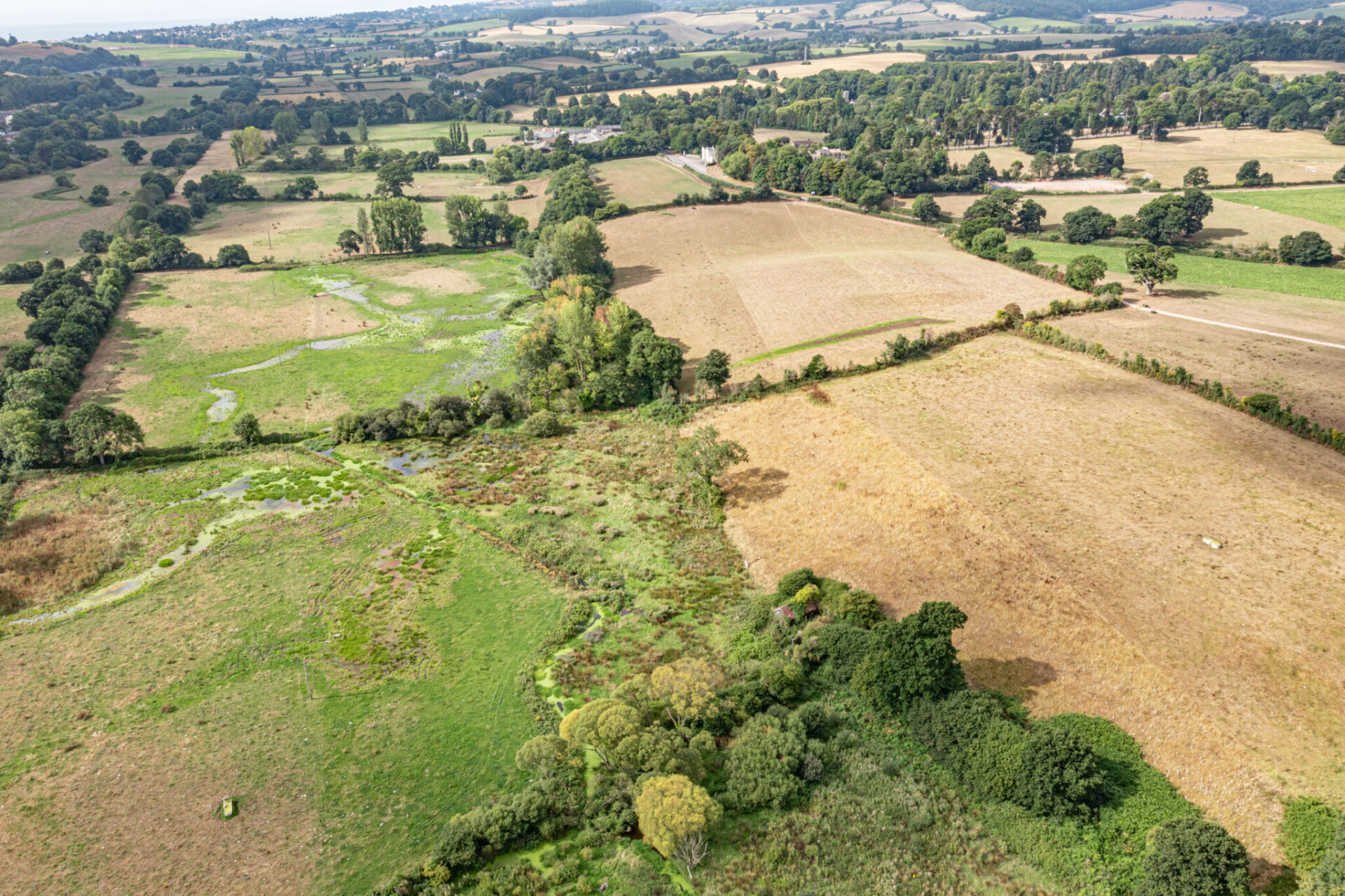
The work of the beavers on Clinton Devon Estates was visible during the 2022 drought
The beaver issue Reintroducing animals that haven’t existed in an ecosystem for decades or centuries can also carry the risks of unintended consequences. Since 2008 there has been a programme to reintroduce beavers to various parts of the UK. Now there are thought to be hundreds of Eurasian beavers living wild in England, mostly here in the south west. It is hoped that their natural activities of digging, chewing through trees and building large pools of water will improve struggling ecosystems, restore vanishing wetland habitats, and support increased biodiversity. The image, right, was taken last summer at the height of the drought on the Clinton Devon Estates. Beavers had created several dams, and it was fantastic for local wildlife. The new wetland also brings flood prevention benefits and increased carbon capture. However, a 2021 Natural England report suggested that reintroduced beavers may introduce new or previously eradicated parasites, or they may establish new transmission routes for the infection of humans, domesticated livestock and existing wildlife. I admit I don’t have all the answers … in fact I don’t think I have any answers. What I do know, however, is that the more we try to help, the worse it all seems to get.
Each month local historian Barry Cuff shares a selection of rarely-before seen images from his unique archive (more on his collection here). This month Barry has picked Shaftesbury photographer Albert Tyler.
Still easily recognisable, this postcard of Bell Street in Shaftesbury was posted to Verwood in November 1908Ashmore – in August 1911 this postcard was sent to SwanseaThis postcard of the United Temperance Fete at Cann was sent in September 1910. Taken in what was Cannfield Park, now Cannfield Farm, beside the B3081.This image of Enmore Green was posted in October 1907 to Corton Denham
‘Albert Edward Tyler, photographer published postcards of Shaftesbury and surrounding villages. He moved to Shaftesbury in 1901. His studio was in Salisbury Street. He died in 1919 at the age of 45.’
The expansion of ‘lightning fast’ broadband brings other benefits as the levelling-up agenda rolls out across rural Dorset and the New Forest
Wessex Internet, based in Iwerne Minster, has recently secured a government-funded Project Gigabit contract valued at nearly £14 million to provide around 10,500 homes and businesses in the New Forest with high-speed, full fibre broadband. It is a significant milestone for the company, demonstrating its ongoing success in bringing state-of-the-art connectivity to rural areas across the south west. The UK government’s £5 billion Project Gigabit is working to provide gigabit-capable broadband to hard-to-reach communities across the country, supporting economic growth and bridging the digital divide between urban and rural areas. This is the second Project Gigabit contract awarded to Wessex Internet, which previously secured the UK’s first major Project Gigabit contract in August 2022, connecting over 7,000 properties in North Dorset. As an independent broadband provider with a founding commitment to connecting Dorset’s rural areas, Wessex Internet’s involvement in Project Gigabit demonstrates the company’s expertise in delivering reliable, high-speed connectivity to even the most remote even the most remote communities in Dorset, Hampshire, Wiltshire and South Somerset.
Gigabit vs full fibre Generally, Dorset’s rural domestic internet connection is via BT’s ‘full fibre’ network, which is fibre to the cabinet (FTTC). The ‘final mile’ – from the cabinet to the house – is delivered over BT’s standard copper phone lines. Typically, this achieves 50-70 Mb/s depending on the length of the copper. Wessex Internet’s gigabit-capable networks are installed direct to each property, and allow download speeds of up to 900Mb/s. Gigabit broadband is more than 30 times faster than copper-based superfast broadband, which most rural households and businesses currently rely on. While superfast is fast enough for most people’s needs today, gigabit-capable connections will provide the speeds and reliability needed for decades into the future.
Levelling up Fast internet doesn’t simply mean an easier online shopping experience (though that’s true). Fast broadband speeds are known to be a key factor in the Levelling Up agenda, with businesses in rural areas hamstrung by limited bandwidth. Wessex Internet’s strong local presence, along with its passion for connecting the countryside, enables the company to build and maintain relationships with residents and communities, ensuring a more tailored approach to delivering rural broadband services. It’s not just ‘lightning fast’ broadband, as Boris Johnson called it. It has far-reaching benefits for local business and the community, providing employment opportunities and improved skills for local people.
It’s an exciting time for AKC as we welcome Richard Hooson and Adam Langford to the team, each of them bringing new skills to our agricultural consultancy. Adam has started with AKC as our first agri-environmental consultant. His background and skillset enable us to provide our clients additional value, offering environmental assessments and ecological surveys. Adam will be providing specialist follow-up work under the Future Farming Resilience Fund and he will help to support all our clients in their transition to using new land-based schemes. Originally from Kent, Adam has worked for Natural England following his postgraduate study in Wildlife Conservation. He has also worked on fruit farms in the Southeast, and on habitat connectivity on Salisbury Plain. Delivering for commercial farms is the core focus of Adam’s skillset, having worked as a Catchment Sensitive Farming Adviser in the Bristol Avon region, where he helped farmers improve their air and water quality, as well as their contribution to natural flood management and nature recovery. His main focus was on guiding farmers with slurry and manure management, utilising current land management schemes to improve legislation compliance. Adam’s motto is ‘efficiency to drive environmental gain’. He says: ‘With ever-growing pressure on land use and public scrutiny on the farming sector, the need for robust advice and support for farmers is essential. Through a blend of upcoming schemes and support I hope farmers can navigate their way to more efficient, profitable, higher-welfare farming systems while also contributing to improved soil health, nature recovery and climate resilience. These twin objectives can be achieved alongside each other.’
Future Farming Resilience Fund We have also recently welcomed Richard Hooson, who will be working on the Future Farming Resilience Fund. This is a great opportunity for farmers to receive tailored support and guidance on Agricultural Transition, through DEFRA’s funding. Over the summer, Richard and AKC will be busy attending shows & regional events to build awareness of this free service. Richard previously worked for Genus, supporting farmers with milking diagnostics, and he has been a farm business consultant for Promar for several years. His experience within the banking sector as a financial adviser equips him well when appraising and assessing farming businesses and advising on areas for improvement. Richard also has an independent business focusing on LED light control in livestock housing and buildings. Having worked within the dairy industry for many years, Richard believes that dairy farmers with the right mindset and attitude can remain productive whilst delivering under Environmental Land Management Schemes. Having also worked for milking equipment suppliers, Richard is well-positioned to offer advice for anyone investing in a parlour or robotic milking system. In the coming months, we look forward to working with our clients through the agricultural transition and adding new services to those we provide our farming clients. We feel very confident Adam and Richard will be a great addition to the team. Get in touch to see how we can help you 01380 724687 akcagric.co.uk
Roger Guttridge tells the story of Dorset’s first newspaper and the ‘Sherborne Men’ who ‘rode Sherborne’ to distribute it
The first issue of the Sherborne Mercury with Mercury and a galloping post-boy on either side of the masthead
I wouldn’t want to worry any ladies of advanced years, but – following a 20-year abstinence – no sooner did John Delap resume his old drinking habits, than his wife fell pregnant … at the age of 68. Or so the story goes … That story was perhaps the most eye-catching tale in the inaugural issue of Dorset’s first newspaper, which appeared on 22nd February 1737. ‘Her pregnancy, ’tis thought, was chiefly owing to the plentiful quantity of whisky her husband lately drank,’ reported the Sherborne Mercury. ‘They have had no child these 20 years past; for in the year 1715 the husband took an oath not to drink any of the liquor for 20 years, but the term being expired, he returned again to the use of it, and did not drink of it above a month when his wife was discovered to be with child.’ In a footnote, perhaps with their tongues in their cheeks, the paper’s owners promised that the recipe for this ‘fecundifying liquor’ would be ‘speedily published in the Mercury’. The Delaps lived in Omagh, Ireland, and the tale was the nearest thing to a local news story in that four-page first edition of the Sherborne Mercury or Weekly Advertiser, to give it its full title.
A typical 18th century printer’s shop
Most of the editorial content in the early years was political news from the capitals of Europe, copied verbatim from the London papers. A notable exception was a story on the famous raid by smugglers on Poole Customs House in 1747. The reporter was barely able to disguise his astonishment as he described how, at 2am, a ‘numerous company of persons unknown, armed with blunderbusses, pistols, swords etc, came into the town, broke open His Majesty’s Custom House there, and forcibly carried off a large quantity of tea, which had been lately brought in by the Swift privateer, who took a smuggling vessel. ‘They told the watchman that they came for their own, and would have it, but would do no other damage. And accordingly did not.’ The Sherborne Mercury was founded by London printers William Bettinson and George Price, although Price’s involvement was short-lived. London papers had been around for 100 years but the provinces had to wait until the 18th century for their own titles. The Salisbury Journal was launched in 1729. The Mercury had no illustrations apart from decorative artwork around the masthead and depictions of Mercury and a galloping post-boy on the earpieces. The paper was printed in Long Street, Sherborne, and sold for 2d (1p), a quarter of which went in tax. Short advertisements were invited at 2s 6d (12.5p), with bigger ones ‘in proportion’.
First combined edition of Robert Goadby’s Western Flying Post or Sherborne and Yeovil Mercury featuring the forthcoming public fireworks at Hyde Park. Note that the clouds don’t line up
A regular Sherborne The Mercury offered ‘good encouragement’ to ‘any industrious, honest men of the villages near Sherborne that are willing to carry out this paper’. The job was not without its hazards, however. In June 1737, the Mercury shared fears that distributor James Arnold was ‘either dead or come to some misfortune’ after disappearing, along with his papers, on the walk from Sherborne to Taunton. A reward was offered for information. Two years later hawker Richard Carrington died on his way to Warminster and his customers were asked to ‘send their respective debts to the Widow Carrington at Sherborne’. The paper’s distributors were known as ‘Sherborne Men’ and their occupation as ‘riding Sherborne’. They made up for the lack of local news in the Mercury’s columns by word of mouth, giving rise to a West Country saying that described a gossip or newsmonger as ‘a regular Sherborne’. In 1742 and 43, the Mercury included a 206-page history of Somerset in weekly instalments, though whether the paper had permission to lift it from the Somerset pages of Thomas Cox’s Magna Britannica (1720-31) is unclear. Plagiarism was commonplace in those days. In 1744 Bettinson found himself facing serious competition when the enterprising 24-year-old Robert Goadby launched the Western Flying Post or Yeovil Mercury. The Post was distributed deep into Cornwall, with Goadby appointing correspondents in every notable town between his Yeovil base and Falmouth. For a while the rivalry was acrimonious.
The Western Gazette’s first office, which stood opposite the better-known Edwardian building in Sherborne Road, built in 1905. Picture from The Book of Yeovil, by Leslie Brooke
he Western Gazette After Bettinson died in 1746, his widow Hannah continued to publish, but eventually sold the business to Goadby, who moved his whole operation to Sherborne and merged the papers to become the Western Flying Post or Sherborne and Yeovil Mercury. The first combined edition appeared on 30th January 1749, and declared it was now ‘the most numerous and extensive newspaper in Great Britain’. It included a rare front-page illustration featuring the forthcoming Hyde Park fireworks that would mark the recent Peace of Aix-la-Chappelle. It was a challenge too far for the Sherborne printers, who placed the outer sections of the woodcut the wrong way round so that the clouds failed to line up (image above). The paper continued to be known as the Mercury and it dominated local news and advertisements for more than a century. Samuel Drew (1765-1833), the son of a ‘Sherborne Man’ in Cornwall, said it was ‘the only newspaper known to the common people’. ‘There were branch riders in different directions, who held a regular communication with each other and with the establishment in Sherborne,’ he said. ‘My father’s stage was from St Austell to Plymouth. He always set off early on Monday morning and returned on Wednesday.’ The Mercury saw off many rivals; an exception being Cruttwell’s Sherborne Journal, launched in 1764 by printer William Cruttwell to challenge the Mercury’s Whig affiliations. Cruttwell survived a bankruptcy threat in 1776 and his paper stayed in his family until 1828, remaining independent until absorbed by the Chard Union Gazette in 1841. The Mercury, meanwhile, was itself finally bought in 1851 by the Yeovil Times, founded four years earlier by John Noake Highmore. This in turn was absorbed in 1867 by the most formidable rival of all, the Western Gazette, launched by Charles Clinker in 1863. By the time I joined the Western Gazette as a trainee reporter in 1970, it was Britain’s biggest provincial weekly paper with a circulation of 77,500. Sister paper Pulman’s Weekly News added another 14,000. The owners of today’s paid-for papers can only dream of such circulation figures.