The Blackmore Vale logo
Home Blog Page 428

Dog bite personal injury claims

0

‘They’ve never done anything like that before’…….. or have they?

Man’s best friend has proven good company for the owner and it is widely reported that increasing numbers of people in the UK have purchased a dog during the pandemic. Sadly, however, what has also increased is the incidence of poor behaviour in our once content animals, and, dog bite injuries.

This seemingly out of character behaviour in pet dogs has been noted to rise during the pandemic; with owners’ day to day patterns changed beyond recognition.

shutterstock

Recent advice published by The Dogs Trust website reveals the difficulty dogs have when a change in routine, such as lockdown, or lockdown relaxation, takes place. Problems with the dog’s behaviour then arise because their earlier experiences and memories do not match the new, changing routine. So, changes such as the owner suddenly being around or not being around, are enough to cause stress in the animal – and that’s when the behaviour can change to aggression and bites – a response to stress and fear.

Such new and poor behaviour then becomes an established personality pattern within the animal. The owner is often aware of the poor behaviour but at a loss as to why their once docile dog is now behaving like a guard dog. This lack of understanding means that measures to reduce the risk of the effects of aggression – namely a dog bite – are not taken, such as using a muzzle or keeping the animal on a lead.

Legal Position – Certain breeds of dogs for example Pit Bull terriers,
as listed under the Dangerous Dogs Act 1991, will render their owners liable for the injuries caused by a dog bite. No previous poor behaviour in the animal needs to be proven, the owner is simply strictly liable
for the injuries caused. (The owner is also likely to be criminally prosecuted). This is because it is accepted
that the dog is an animal that is likely to bite. Breeds of dogs causing injuries, but not listed under the Act, will only result in liability if the injured person can show that the dog was likely to bite. This ‘likelihood’ test can be a
stumbling block for some dog bite claims. This is because proving a previous pattern of poor behaviour in a dog, an animal which is often unknown to the victim, can be difficult.

Obtaining and producing evidence to show that a pattern of aggressive behaviour was present is so important. Such evidence can originate from vet records, neighbours, other incidents and local knowledge. If such a pattern exists, the victim will be in a stronger position to show the dog was likely to bite – and a successful claim may well follow.

Our Service raising a claim – At Battens, we are experienced in bringing dog bite personal injury claims. We understand the need for evidence and how best to obtain it. We can identify when an owner will be legally responsible and know how to analyse the potential to raise a successful claim.

We have seen an increase in incidents of late; particularly involving people out running for exercise in parks, footpaths and other public spaces where dogs can be off-lead.

More than anything, through our experience, we understand the trauma of the experience, the nature of the injuries, the post-traumatic effect and difficulty it can create for the victim to gain confidence again in the presence of dogs. As has been noted in numerous press reports, dog bite injuries, particularly affecting children, can lead to extensive scarring and life changing injuries.


For more information and advice contact Michelle Green on 0800 652 8411 or email [email protected]

The Prickle of Hedgehogs in Hazelbury Bryan | August 2021

0

Recently in Hazelbury Bryan we had a sad incident where three adult and two baby hedgehogs were accidentally killed by a subcontractor cutting a grass verge with a tractor. 

Building works were about to commence and with the expected amount of traffic associated with house building, the verges were considered a hazard.

As a Hedgehog Rescue I was appalled at the senseless and tragic loss of life of these beautiful little creatures, and indeed it appears that the whole of the village were up in arms. I keep remembering all the hedgehogs that were released in Hazelbury Bryan from our rescue so I could keep a closer eye on them – but of course, that is just a romantic notion, and they ran away as fast from me as they would from any other person, possibly faster!

So how do we live our modern lives along with creatures like hedgehogs? It has been wonderful to see the grass verges left to grow long, with grasses and wild flowers but inevitably there comes a time when they will need to be cut. The risk then is greater to the wildlife who have settled and made it their home.  Would it have been better to keep the verges short all the time, cutting every few weeks so hedgehogs and other creatures think twice about making a home there?

Farmers cutting fields for hay, gardeners with wild areas and even those choosing to have wild meadows are all to face this dilemma sooner rather than later. If we just consider the wildlife and cut the grass longer before cutting it to its required length it may help and give the wildlife a chance to escape.

On a happier note our fund raising event on 26th June was a fantastic success and we raised a whopping £1500 to enable our little rescue to continue. I would like to take this opportunity to thank all those who helped on the day. You are fantastic. Thank you if you came along and enjoyed the atmosphere. 

Jeanette is currently fundraising for a much-needed new microscope: she needs to cover the £600 cost of a replacement. To help, please donate via Paypal here.

“Without your help we would not be able to continue our valuable care of these beautiful, grumpy, smelly and endearing little creatures.”

More Silverware for Local Girl Honeysuckle

0

Honeysuckle, the history-making champion mare bred here in the Blackmore Vale, broke new records at the Thoroughbread Breeder’s Association (TBA) annual Awards evening on 4th August when she won a pair of trophies. 


Honeysuckle, who ended the season the highest rated hurdler on either side of the Irish Sea, retained her ‘Leading Hurdler Mare’ title (Mickley Stud Trophy), whilst also making history as the first mare ever to be crowned ‘Leading Hurdler’ (Highflyer Bloodstock Trophy)

A thrilled Doug Procter of the Glanvilles Stud picked up the award.

Seven-year-old Honeysuckle is from Glanvilles Wootton, just outside Sherborne, bred by Dr Geoffrey Guy and Guy’s co-owners and managers of The Glanvilles Stud, Doug and Lucy Procter. She ended the 2020-21 season unbeaten.

Doug and Lucy Procter attended the award ceremony and Doug – representing Dr Geoffrey Guy – accepted  the Highflyer Bloodstock Trophy. In a warm acceptance speech for the Mickley Stud Trophy, Doug explained that the award was recognition for the whole stud team.

“For people working on the studs, in the middle of winter when there’s very little daylight… you know, it’s bloody hard work. 

But everyone who works at our stud can walk into a pub and say ‘we bred Honeysuckle’. It means a lot.”

When I spoke to Doug the next day, he explained that the recognition from the industry of what they have achieved as a stud meant a great deal; not just to his own family, but to the extended family of the whole Glanvilles Stud.


“We’re absolutely delighted!” he said, admitting that the party continued long in to the night.

The annual TBA National Hunt (NH) Breeders Awards are the highlight of the annual awards calendar for the TBA.

The dinner, held in Doncaster, celebrates British-bred success on the racecourse from the previous National Hunt Season.
Horses are long-listed according to their form through the season, and that long list is reduced to a three horse shortlist for each category.

The shortlist is then voted on in a secret ballot by the NH Committee. The committee have three votes – a five, a three and a one – and are asked to select the horse whose results during the season have, in their opinion, most enhanced the prestige of British NH Breeding.

The aggregate score for each horse is calculated, and the winner is the one with the highest score. 

By: Laura Hitchcock

Brian Philip Harvey ‘Harve’

0

27th October 1931 – 3rd July 2021

Brian was born at the Nags Head Inn, Mappowder as the middle son of Edward and Laura Harvey.He had two brothers – Roy and Michael.  In 1960 he married Margaret (Newcombe), who was sadly taken from him by a long standing illness in 1992.

Brian Philip Harvey ‘Harve’

The family lived at Humber Hill Farm, Mappowder, and Brian farmed alongside his mother, Auntie Margaret and Reg, mostly as a dairy farm – though for a while there were also pigs and chickens. 

Haymaking was hard work, with farming neighbours & family pitching in to help get the hay in.  Brian’s decision to stack some bales on the roof of a car on one occasion may not have been one of his better ones!

On his retirement in 1998 Brian moved to Hazelbury Bryan. Retirement gave him more opportunity to enjoy life, and to do the things he loved. But he wasn’t quite ready to give up outdoor life completely – alongside his good friend Ronnie Taylor he took on some gardening and traditional hedge laying. 

Leisure time was spent doing a variety of things – he was a regular at Wincanton Racecourse, enjoyed taking steam train trips around the UK, he was interested in flying and military aircraft and he attended air shows whenever he could. 

He also had part ownership in a greyhound ‘Quivers Angel’ with his friend Richard Ford, which led to many outings to Poole to see a race. 

Brian always enjoyed music and comedy, particularly The Goons (The Ying Tong Song was played at his funeral). Trips to The Exchange provided an opportunity to see more live music and comedy; Jethro was a favourite. Before ill heath stopped him driving Brian could often be found in The Exchange Cafe on a Tuesday morning, having a chat and catching up with friends. 

Brian played skittles for many years for The Crusaders in the Blackmore Vale League, and occasionally for the Hunt League; the social side of the game seemed to play a greater part than the actual score! 

Some may also remember him as ‘The Mayor of Mappowder’ – complete with mayoral chain made from a milk churn lid and cubicle chain… His one and only official engagement was to present a cup to the winners of a charity football match at The Antelope, Hazelbury Bryan.

Brian leaves a daughter, Helen, and son in law Tim, as well as many friends, with treasured memories. 

The funeral has taken place but donations in Brian’s memory can be made for The Exchange or The Injured Jockeys Fund through Peter Jackson Funeral Services.

Why is Hardy so popular?

0

A lot of locals revere the writer Thomas Hardy. 

I hate to be a party pooper but he’s just that little bit miserable and misogynistic for me. And his take on human nature is dubious, even by the standards of a 19th century male novelist with a drooping moustache and an unhappy marriage.  

I got a collection of his short stories from a Stur charity shop The Emporium (for books, CDs and DVDs the price is £1 for four, they’re £1.99 each in some Sherborne charities.)

As a catalogue of misery Hardy’s tales are hard to beat.

The first tale is called ‘The Withered Hand,’ so you can see the laugh out loud jollity contained.

And take the full-length novel, Tess of the d’urbervilles.

The story? Tess has, you’ve guessed it, a bad time, being seduced by an upper class bounder, cad and ocean-going rotter, Alec, with whom she bears a daughter which, naturally, she names Sorrow (later lamented in a 1960s song written by The Merseybeats, not David Bowie as I used to think).  Sorrow dies (why am I not surprised). Tess falls in love with her wimp of a beau, Angel Clare, who knows nothing about her previous life and child. Marriage is discussed (alarm bells, a danger of happiness. Don’t worry, Thom’s got it all planned.)

So, Tess writes a confessional letter, asking the wimp for forgiveness, hoping he won’t mind her ‘shame’ and slips it under his bedroom door. The author being Hardy, the note goes under the rug. Angel doesn’t see it, which suggests lax housekeeping in the Angel household.  What does that housemaid do all day?

Thinking he read the letter and is pardoned (obviously she doesn’t ever say, ‘did you get my ….erm note, Ange?) they get married. Angel tells Tess of an affair he had (good one, Angel, wait ‘till you’re married). Tess forgives him, and mentions her indiscretion. Being a man (who’s had an affair) Angel is horrified and despite previous reassurances of undying devotion, hands her some money (all heart) and sails for Brazil as a sort of ‘sod you’ gesture – why he couldn’t move to Wiltshire or Devon, Yeovil, even, is a mystery.  Actually, maybe Yeovil isn’t on.

Result, a further life of misery for poor Tess (she’s gone back to the rapist Alec, would she really do that, Thom?) which is not helpfully ended by her swinging at the gibbet for murdering him, after a search party finds her asleep at Stonehenge (laughably, really, it’s the first place they’d look.)  

Thanks, Thom. Another riveting, uplifting read.

Let’s look at another of Hardy’s ‘celebrated’ novels, The Mayor of Casterbridge. This story, you won’t be surprised to learn, hinges again on letters going awry, in this case by disgraced ex-mayor Michael Henchard returning incriminating old love letters to his ex-flame, Lucetta, now the shiny new wife of the new mayor, Donald Farfrae (he’s Scottish, you’ll note.)

How does Henchard convey these explosive letters to Lucetta in a way that ensures her sordid past will never be known, so that she and McDonnie (he’s still Scottish) enjoy marital bliss and a public aura of spotless virtue?

Logic again suggests Henchard perhaps, just perhaps, should personally put the incriminating parcel directly into the hands of Lucetta.

But no. That’s too sensible. It’s not Thom’s way.  There’s a danger of a happy ending.

Henchard, although now unemployed and idle, is ‘too busy’ to do this (obviously he’s playing Grand Theft Oxen-Drawn Haycart V), so he hands them over to a known wretch, Jopp, who Henchard himself continually belittled, then fired, and therefore might, just might, have a grudge against Henchard.

Result, Jopp takes the parcel down the pub, probably Ye Olde Wetherspoons, hands them around and, despite literacy at the time being negligible for such people, everyone has a good read (pointing out grammatical errors, problems with syntax, laughable tautological blunders) and the disgraced Henchard ends-up dying in a hovel (it is stressed that it’s not a palace) on Egdon Heath (this is pre-solar farm Egdon Heath).

So, for me, while interesting for its historical sociological points, Hardy don’t cut the mustard as literature. I don’t care if it’s artisanal mustard lovingly hand-made and sold at a function in Mappowder village hall, but he don’t cut it.  And he could have cheered up a bit.

Further academic notes on great novels that’ll help students sail through GCSEs are available on application from Tales from the Vale University Audiobooks (Copyright.)

Burglars’ greatest friend – FaceBook

I do wonder at the sanity of my brother and sister. 

They’ve just posted pix of their families on FaceBook, telling the world that they’re enjoying a week’s camping and, to prove it, they’ve included photos showing them having ‘a really good time,’ as if anyone’s interested.

Which is great…for burglars. Our light-fingered brethren will now know they can leisurely ransack their homes – it doesn’t take a fiendishly clever Bond villain (stroking a white cat inside a hollow volcano) to find out their addresses. My siblings may as well put up a neon sign outside their homes saying, ‘Empty House – burgle at your leisure.’

Although, knowing the general state of Lucy’s house the burglars would probably force the door, take one look around and believe it’s already been turned over, then move on to Tim’s which, if anything, is worse.

Why you should join the village hall committee

We’ve had some great events at our village hall that the whole community thoroughly enjoyed. The village quiz – £10 a ticket – which includes a super large portion of fish & chips – is always a sell-out.

It’s surprising the talent that’s available in every village and hamlet in Dorset. One couple, with a background in hospitality, who recently moved into the village, offered to provide, at cost, a range of excellent curries for an evening (included in the £10 ticket). We didn’t have enough plates for the 65 or so people we’re allowed for each event so we used paper plates.

We hadn’t thought it through: the bottom of the curry-laden plates began to disintegrate, so everybody suddenly had to eat faster to stop an avalanche of chicken korma engulfing our laps, which caused vast amusement. The attending children, after a lifetime of entreaties by parents of ‘don’t bolt your food’, were delighted to be urged to ‘bolt your food.’

For MacMillan Cancer Support, the committee, with non-committee volunteers, provided a delicious cream tea/cake event which was massively attended. And this was a proper cream tea – committee members went to Craig’s Diary outside Weymouth to pick up two huge trays of proper clotted cream.

This was a revelation to me. I’d never really got this cream tea malarkey, wondered what the fuss was all about.

It dawned on me, after wolfing a home-made scone (pronounced ‘sconn’ not ‘scoane,’ as in ‘Sloane’) topped with locally-made jam and clotted cream, that I’d been missing out for years. Now, wherever I see ‘cream tea,’ I’m in there.

Our jumble sales, too, are fun (never thought I’d write a sentence like that). I always staff the bric-a-brac stall and among the ‘goods’ ranging from ‘interesting’ to ‘total crap’ (someone generously donated a used loofah? ‘We’ll start at 200 guineas, do I have any bids? 250 to the man in the bicycle clips’) were some real gems, including 1950s metal Dinky cars, trucks, trains and military vehicles. On a recent Antiques Road Show, a small collection of similar toys went for a few hundred quid. At our sale, I was selling them for a quid each – wish I’d watched the programme beforehand – I’d be able to buy a used loofah.

And we have fun with the punters: a young lady, with heavy irony, asked me the provenance of a dubious ‘Chinese’ vase.

‘It’s genuine 15th Century Ming Dynasty,’ I replied, adding, ‘and it comes with a certificate of authenticity.’

‘Can I see the certificate,’ she smiled.

Grabbing pen and paper, I wrote ‘this vase is almost definitely, probably genuine-ish Ming-ish style dysentery and could, possibly, easily be worth the £1 we’re charging. Sort of.’

‘Well, as it’s got a ‘genuine-ish’ certificate, it’s a bargain-ish,’ she said, ‘I’ll take it.’  

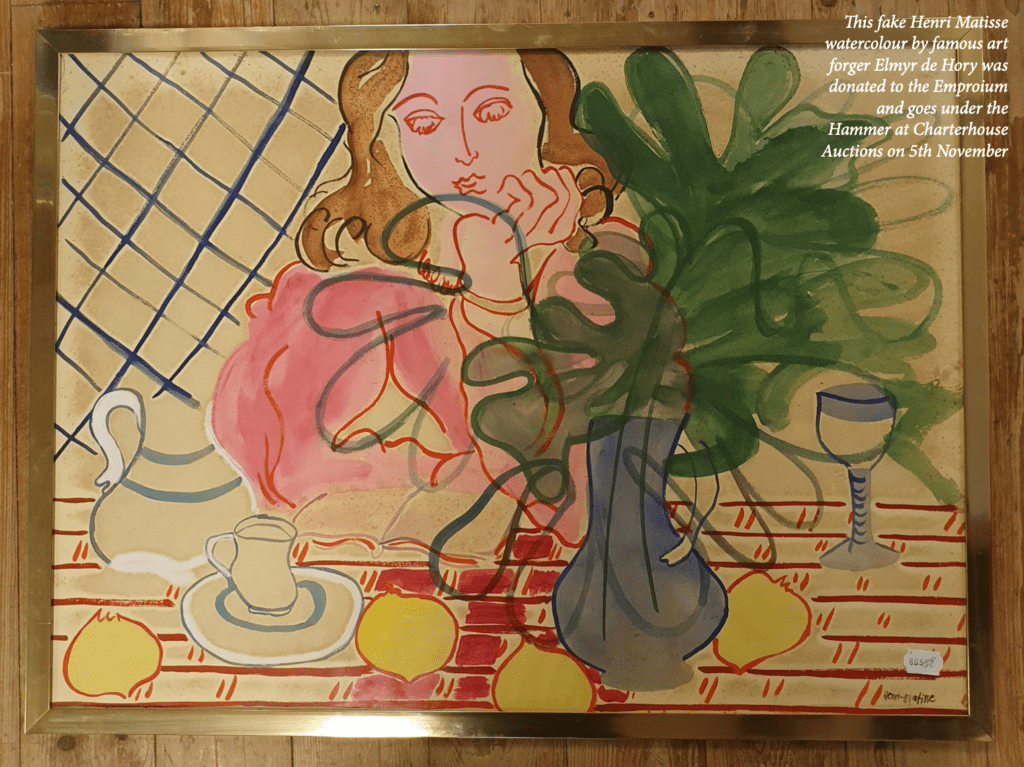
‘Do you think I’ve got a future as an art forger,’ I asked, wrapping the priceless ceramic in newspaper and tossing it over the table to her.

‘No,’ she said.

At the same session we had some old artefact which attracted no interest until a chap, slowly and carefully examining it, asked the price.

‘Fifty pence,’ I said.

He smiled, ‘that’s a bit steep.’

‘You misunderstand,’ I said, ‘I’ll give you 50p to take it away, I’m sick of looking at it.’ 

He laughed and gave me £1.

Now, I’ve flogged our unwanted stuff at enough boot sales to know that, whatever nominal price you put on an item, every time you ask what a potential buyer is prepared to pay for it, they usually offer more than what you had in mind.  And the same happened at my stall.

So, it’s great fun.

Malteaser Cake made by Tony – Image Andy Palmer

There’s an invariable pattern about events. Everything that can go wrong tends to go wrong beforehand. We anticipate the chip van phoning two weeks before saying, ‘sorry, double booking’ (which they’ll have known for months.)  A week before, we’re surprised if the electrics don’t go on the blink. Part of the ceiling collapsing the night before brings a hearty cheer for its inevitability. We’d be disappointed if a ravening yaw appeared where the floor was, due to medieval mining causing subsidence.  We look forward to the plumbing failure in the ladies’ loos, and a compensatory colossal leak in the men’s will bring a round of applause.

But magically, it always, always, comes together on the day. It’s all hands to the pump and we’re British: we rally.  Non-committee members, plumbers, joiners, roofers, friends of friends, nuclear scientists, internationally renowned heart surgeons suddenly appear offering their services. Jeff Bezos turned up once to offer some change for the cash float.  Helping with the drying-up was Queen Maxima of The Netherlands.

And the most wonderful thing is the transformation of the village hall from a soulless interior to a bustling environment decorated with bunting and beautifully arranged flowers, usually from Peggy and Natalie on the committee. We’ll be inundated with smiling volunteers working and laughing in the kitchen serving up home-made cakes, clearing tables. In fact, such is the supply of cakes from the village, there’s always a few whole ones left over, so these are raffled by our village hall stalwart, Lizzie, a professional story teller and all round good egg.  

And the cakes! All the cakes are fantastic, but one show-stopper was made by Tony, a bluff Geordie whose creation was a Malteser Cascade Cake, with an upturned packet propped six inches above the cake by a pile of Maltesers flowing over the cake. It’s a work of art. He’s a northern man – I’d presumed he didn’t know where the kitchen was in his house!

But all village hall committees need new people with new ideas and it’s interesting to be involved, especially if you’re a newcomer. Details of committee members are usually on every village notice board and they’ll welcome you with open arms.

Huge solar farm planned for the vale

The authorities are considering allowing 190 acres of beautiful and fertile north Dorset farm land between Mappowder and Hazlebury Bryan to be turned into a solar farm.

How they equate this with helping local businesses reliant on environmental tourism will have to be explained, especially as all renewable energy for homes is expected to be provided by off-shore wind turbines.

I’m not against solar farms but surely less productive and valuable land, which won’t impact on people and businesses, is available.  One instance is the eerie stretch of unpopulated heath near East Knighton, north of the A352 in east Dorset.  This bleak landscape is known in Hardy’s novels as Egdon Heath.

By: Andy Palmer

THE IMPORTANCE OF HEDGEROWS

0

In 2000 our future CPRE President, Bill Bryson, wrote: “For well over a thousand years hedgerows have been a defining attribute of rural England, the stitching that holds the fabric of the countryside together. From a distance they give the landscape form and distinction. Up close they give it life, filling fields and byways with birdsong and darting insects and the furtive rustles of rodents…Hedgerows don’t merely enhance the countryside. They make it.” Nowhere is this more true than in the pastoral landscape of North Dorset, with the added realization of the key role hedgerows can play in halting biodiversity decline and tackling climate change, by capturing carbon from the air and storing it in plants.

Thomas Hardy’s “Vale of the Little Dairies” in the Blackmore Vale is characterised by its irregular patchwork of small fields divided by ancient hedgerows. Some hedges are Bronze Age, maybe even Neolithic, in origin. As the first farmers began clearing small areas for cultivation, they left strips of trees as boundaries.

The post-war decades were incredibly damaging with farmers encouraged to grub up hedgerows to intensify food production, although the destruction was much less marked in pastoral North Dorset than in arable East Anglia. In 1980 we called for an end to these grants and for the same protection to be given to hedgerows as were given to trees. Yet in this decade the UK was still losing 4,000 miles of hedgerows a year. In 1990 the government’s first-ever Environment White Paper accepted our case for statutory hedgerow protection, although it was not until 1997 that hedgerow regulations were finally introduced. In recent years the situation has stabilized, but many hedgerows are in poor condition. We welcomed the government’s Committee on Climate Change report in 2019 calling for a 40% extension of the UK’s hedgerows, but sadly the government has done little to implement this. This May the government announced an action plan to restore and enhance trees and peatland, but inexplicably left hedgerows out.

Dorset CPRE is involved in a new project, called Hedgerow Heroes, to plant or restore over 15 kilometres of hedge across the country, including the planting of over 50,000 trees. On the Hinton Admiral Estate straddling the Dorset/ Hampshire border, it involves the planting of 1.7 km of new hedgerow and improving a further 1.3 km of existing hedgerow to create a better habitat for wildlife, and improve the amenity value of the area. We are looking for similar projects in North Dorset too, but also volunteers who would like to help on the Hinton Admiral project (please email [email protected]). Most people are now focused on planting trees to offset climate change, but do consider a hedge too. Remember it is not just the birds, insects and small mammals that will be grateful, but your children too.

Rupert Hardy, Chairman North Dorset CPRE

Blandford Parish Church receives over £600,000

0

The members of the Blandford Parish Church Big Church Project are thrilled to announce that they have been awarded a grant of £664,400 by the National Lottery Heritage Fund.

The decades of patching the roof will finally be over, as the funding is now in place for a complete refurbishment.

Alongside the repair work there will be an exciting project to research, record and explore, with the help of volunteers, the lives of those who have been connected with the church; from Hannah, ‘a Black Woman Servant of Mrs Holder’, who was baptised in the church in 1770, to George Vince, a Blandfordian who died by falling over an ice cliff while on one of Scott’s Antarctic Expeditions; to investigate the relationship between the church and various communities including the Travellers. 

Sara Loch, Chairman of the Big Church Project, the group overseeing the project, said: “No more buckets scattered around the building! And we can make the space, both inside the church and outside in the churchyard, a vibrant community resource.”

All the tiles from the roof will be removed, so that the wooden battens underneath can be sorted. It is hoped that a majority of the tiles will be re-used, but some will have to be replaced, creating a chance to have their name/suitable message recorded in perpetuity on the underside of the new tiles. So look out for an opportunity to ‘Tag-A-Tile’.

By: Laura Hitchcock

Secret Wine Gem in the Blackmore Vale

0

Wine growing in the Blackmore Vale is a tasteful and expanding business!

Recently, whilst leading a tour group in the Shaftesbury area, we came across a welcoming hidden gem – the Melbury Vale Vineyard and Winery.  The Vineyard is located just off the A350, on Foots Hill, about 1.5 miles south of Shaftesbury at Cann Bridge.

Image: Paul Birbeck

The small, family owned, rural business, is situated on 28 acres of south-facing, rolling hillside in the beautiful Stirkel Valley, renowned for its milling history. The Winery specializes in making artisan wines, liqueurs, brandy, aromatised wines and cider.

My group were enthusiastically greeted by the owner, Clare Pestell who, together with her brother, bought Melbury Vale Farm in December 2003. By 2006 they had planted the vineyard and built the winery (now also a craft distillery) in 2013.

Having followed the appropriate Covid entry procedures, we were lead into a pleasantly airy dining and tasting area, with socially distanced tables. The locally produced ploughman’s lunch using bread from The Vale Bakery, local salad, meat and selection of Dorset cheese products was delicious – the home-made rhubarb chutney being particularly tasty. Of course, a selection of wine, and non-alcoholic drinks were available to accompany the meal.

Before the group became too engrossed in sampling different wines, Clare took us into the vineyard, a visit into the winery so we could see where and how the grapes grow, how they are produced and sample the finished product all in one place.

Image: Paul Birbeck

The setting for the vineyard is surprising as normal wine-growing wisdom would suggest well drained, ideally chalky soil, are best. Given the vineyards relatively high altitude combined with heavy clay and greensand soil, plus climate conditions such as late spring frosts, early autumn frosts, mildew due to humidity in the summer; and pests – deer, badgers, pheasants, starlings and wasps, the venture was definitely experimental but obviously worth the risk!

The site has the advantage of being a sunny, south facing hillside that drains down to a river with reasonably Ph neutral soil, all of which help with vine growing. It is also well placed to the A350 which gives the winery good access to get to the other Dorset vineyards that we now work with; and is easy for visitors to find us!

Like many small enterprises, the pandemic adversely effected business. Relying on tourism and wholesale business to restaurants, hotels and pubs during a period when all have been closed has reduced trade the Vineyard has been forced to sell online and rely on sales from passing trade.

Image: Paul Birbeck

As to the future, Clare said “English wines growing reputation for high quality and excellence mean that both the wholesale and retail market is growing. We also provide glamping accommodation and soon to have self contained holiday lodges. We believe from the great feedback that we receive that the tourism and staycation market will flourish. It is a beautiful place to visit and guests really enjoy the whole experience.”

One can only agree. The vineyard is well hidden, but well worth a visit this summer. My group left happy and came away with boxes of delicious local wine. Find out more at https://mvwinery.co.uk..

By: Paul Birbeck Sherborne Walks & Blue Badge Tour Guide

August issue of the digital Blackmore Vale magazine is out now!

0

August’s digital Blackmore Vale magazine is out – read it free here https://bit.ly/BVAug21FS – take your time, it’s an absolute corker!

This month in the digital Blackmore Vale magazine

  • last week armed police chased suspected hare coursers near Blandford, arresting four suspects – we have the details, plus why illegal hare coursing is still an issue (p.4).
  • we’ve beautiful imagery of the crop circle on Okeford Hill – and have looked at the impact to the farmer (p.6)
  • We have Kate Adie (KATE ADIE!) answering our Random 19 questions this month (p.60). Journalist, war correspondent, broadcaster and author… she’s been a personal inspiration for decades. Imagine my disappointment at her attitude to dunking chocolate digestives.
  • Local girl Honeysuckle makes history: the record-breaking racehorse has this week became the first mare to be crowned Leading Hurdler by the TBA (p.42).
  • Britain’s Best Bangers – officially found in the tiny village of Ludwell (p.8 )
  • We attended Dorset Chamber’s trailblazing event ‘Talking Menopause’ – the online business event was so groundbreaking it made the BBC news.
  • The ‘alpaca-shaped evil nemesis’ of Andrew is already causing comment (p.52)
  • Oh, and Thomas Hardy fans will probably wish to skip Andy Palmer’s column this month… (p.26).
  • I seem to say it every month – but this month’s Reader’s Photography submission pile was our biggest and best yet. Do take your time to appreciate those pages (p84-87). This month’s stunning cover photo of the hiding roe deer is by Marilyn Peddle, and the astonishing night sky image as always by RPN Photography.

    https://bit.ly/BVAug21FS (remember we’re *never printed*, the only place to read us is right here online)

It’s our anniversary edition – we’d just like to say a huge thank you to everyone who has read, liked, commented and shared over the last twelve months. 🙌
Do pass us on – you can share the whole magazine, but most people hit the share button just for a particular article.As always, feel free to come have a chat. Coffee’s at 11 (we’re lying, obviously. Every hour is coffee hour), and we like posh biscuits.Laura & Courtenay