This month, Toots Bartlett’s head groom Eve reflects on joining an eventing team and has been enjoying the quiet season to get ahead on much needed yard work.
I’m Eve and I started working for TB Eventing in May this year and am lucky enough to be Toot’s head groom, having always worked within the Equestrian industry covering different disciplines. I am quickly learning the different responsibilities of being a head groom within Eventing and am thoroughly enjoying the multi facets of skills necessary in both horse and rider to compete competitively across the triathlon of dressage, show-jumping and cross-country. It makes for a varied and fascinating skill set and as I enjoy organisation so much I have really enjoyed stepping up to the challenge.
There is no denying we are now into the winter months. One of the perks of the eventing season being in the warmer months is the lack of plaiting over winter! As much as this is one of my favourite things to do, and is still necessary for dressage competitions during the winter, the chilly weather undoubtedly makes it more difficult on your fingers. Currently Toot’s horses are on a holiday at her family home where grazing (much to the horses delight) has been well rested and plentiful. However, the holidays are coming to end and December sees them all coming back into work. A gradual planned strength and conditioning programme is introduced for each horse to bring it back to full fitness over a period of approximately 12 weeks. With the majority of the horses on holiday it has given us time to concentrate on one of my favourite horses, Charlie, who sadly is being prepared and produced to sell in the Spring. He has been going to dressage and show-jumping competitions, winning almost every time out at Elementary level and with a incredible technique over a fence. I wish I could I would buy him myself as he will make someone the perfect horse, he is so utterly beautiful. The very useful down time in November has given us a perfect opportunity to get the horses stables at Fox-Pitt Eventing emptied, power-washed, disinfected, painted and much needed maintenance work done so they are fresh for the season ahead of us.
Erin, our new member of staff, is getting on really well and fits in excellently with the team dynamic. We are also extremely fortunate to have help from Donna Hills, who was Paul Nicols travelling Head Groom for 25 years. I personally am benefiting hugely from all her experience of travelling horses as I am doing my HGV training next week, so her help has been invaluable. With extra help on the ground it gives us more time for more horses. We have consequently been on the search for a couple of 4 legged projects to join the team. However, after several failed vettings and some frustrations we hope to be introducing you to two new faces next month. The season concluded with all of us at TB super excited to watch Kazuma Tomoto compete at the final 5* in Pau, France. Kazuma is stabled next to Toots and it gives our team huge inspiration to aim high for the competitive months next year.
Hidden away in a fold of Cranborne Chase outside Shaftesbury, Gritchie Brewery is crafting a fine reputation. Laura Hitchcock reports
Inside the Gritchie Brewery All images: Courtenay Hitchcock
Ask North Dorset residents about Gritchie Brewery and you get one of two answers. The first is usually: “Oh, LOVE their beer!” The second is: “oh, that’s Guy Ritchie’s, isn’t it?” – and to be honest, it’s often said with a mildly belittling tone. Because yes, this IS film director, producer and screenwriter Guy Ritchie’s company. But it’s very clear that this is no vanity project. Beyond the local area, where people know that Guy Ritchie lives on the estate just north of Shaftesbury, the Gritchie branding is never advertised with Guy Ritchie’s name. The beer is expected to stand on its own merits (though perhaps with a little A-List movie advertising help – watch the opening scenes of The Gentlemen closely, and you’ll see Matthew McConaughey enjoying a pint of Gritchie’s English Lore before he leaves the pub and passes a Gritchie delivery van) – and the business is entirely self-supporting. ‘It’s a bit frustrating in some ways’ says Gritchie Brewery’s Nick Brown, who spent nine years as a police officer in Dorset before emigrating to Australia with his wife to serve in the Australian police. They returned to the UK as COVID restrictions lifted, and, looking for a change in career, Nick applied to Gritchie Brewery. Now he’s overseeing sales and running the brewery’s busy schedule of attendance at events – their horsebox bar is a familiar sight at shows and fairs across the south. ‘Everyone thinks it’s a massive boon to have this famous name behind the brand,’ Nick continues, ‘but actually it’s almost like we have to work twice has hard to have the beer taken seriously by some people. So many celebrities just put their name on someone else’s product and await the financial return. But Guy’s a very exacting boss. He is in the office most days that he’s here in Dorset – he’s really hands-on with the business’.
Outside, Gritchie Brewery own all their own kegs to allow recycling
Field to firkin Working from Gritchie’s Ashcombe estate, tucked away in the chalk hills behind Shaftesbury, the Gritchie Brewing Company staff have a daily view that many would envy. Standing in the yard, surrounded by the usual rural sounds of birds, running water and a distant tractor, there is no hint that a busy brewery is inside the buildings surrounding the peaceful courtyard.
The view into the brewery from the oldest part of the farm complex
‘We do everything here except canning and bottling,’ says Nick. ‘We did try bottling ourselves, but the machinery takes up so much space. Economically it was better to outsource it. But the Maris Otter Barley is grown on the Ashcombe estate, we draw water from a bore hole on the estate, we brew the beer here, and everything is packaged in these buildings by the team. We even do all our own deliveries where possible, serving all the local outlets ourselves, right along the south coast, plus weekly runs to London for Guy’s Lore of The Land Pub in Fitzrovia. We literally follow the product from field to bar. ‘We have a huge drive to be as environmentally conscious as possible. Even the kegs are ours, so they can be constantly recycled and reused.’
Head brewer Alix Blease explained the basic brewing process, starting with the sacks of barley arriving back at the farm as malt. It is poured into the mash tun with hot water to create a mash. After 45 minutes, the sweet liquid wort is washed into a kettle, or copper, where it is boiled for an hour, and the hops are added at various stages depending on which beer is being made. ‘Local hops would be cheapest, obviously, but British hops tend to be dark and musky flavoured. Great for traditional British bitter ales, but a modern IPA needs a bright, zesty flavour, so we have to go further afield.’ The now-redundant grain isn’t wasted. It’s collected by a local farmer to use for animal feed. Gritchie brew 4,100 litre batches – limited by the size of their tanks. Every part of the equipment and process is carefully selected and controlled. ‘We’re all about consistency.’ says Alix. ‘We believe in Do it once, do it right. An independent craft brewery lives and dies by the reputation of its product. Because we’re making relatively small batches, we can be really responsive and brew to demand, which also means very little wastage.’ Nick agrees: ‘It’s no good us selling the beer into a pub, and having the landlord tell us the customers don’t like it this week because it’s not as good as last time. They trust us to always provide the same product. If their customers like it, the landlords will buy it. If we’re reliable in our product, we get loyalty from our customers in return. It’s good for everyone.’
Flexi-brewing It’s been a tough year for beer. There has been a 40 to 50 per cent increase in raw material costs since last summer. Heineken recently announced that they are increasing their prices by 15 per cent in January. But Alix is feeling positive. ‘Because we do so much ourselves, a lot of our costs are negated, using our own water from a borehole, for example, and selling more cask beer which doesn’t require CO2. We don’t plan to raise prices at all if we can possibly help it.’
The Break Room – the ceiling is made from old cheese store shelving
Nick feels they also have some business advantages over their bigger competitors. ‘We don’t have their scale, obviously, but we’re a small team of seven; three in production, two on deliveries, Sally in the office and me. And no matter what our official job is, really we all do everything – we were all labelling this morning, getting product packaged up. But that means we have a very close relationship with our customers and can react quickly to their needs.
Gritchie Brewery’s head brewer Alix Blease
We’ve been able to offer local pubs smaller casks, for instance – many of them are reducing their opening hours due to their own staffing and cost issues, so they don’t want a large keg opened which they only have three days to sell through. We can also respond swiftly – we can generally get stock out to them within 24 hours, often same day if they’re not far. And we’re always on the end of the phone for advice and a chat.’ The whole team is aware of the need to balance the cask ales and traditional tastes of their rural heart, while also serving the city palates of their London fans. Alix is constantly looking at new flavours and ways to develop – but for now keep your eyes peeled for the new Galaxy New England IPA. We finished our tour in the Break Room (opposite top) with a swift half of the new beer, and it’s light, slightly citrusy, explosively smooth and astonishingly delicious.
There are worse places to work …
You can buy Gritchie Beer at the following local outlets: Dikes supermarket: Ansty PYO Farm: Shaftesbury Wines: Udder Farm Shop: Shaftesbury Abbey: Morrisons Shaftesbury: or online at gritchiebrew.com/shop Or ask your local freehouse landlord if he’ll stock it.
YARD STAFF REQUIRED by the Glanvilles Stud (Glanvilles Wootton). Part time – can fit around school hours. Join us to be part of the unfolding racing story of our young racehorses: helping shape their futures from birth and following their progress on the track. No riding required.
Glanvilles Stud has a part-time vacancy for a Stud Hand – three days a week plus alternate Saturdays and Sundays – to join the existing, dedicated team, initially to the end of April. Either a genuine 8am-5pm working day or could fit around school drop-off and pick-up times. It could be two people working two days a week and one Sunday a month or some other variation – open to discussion for the right people.
The job involves working with well-mannered (mostly… 😁) broodmares, foals and youngstock; leading in and out, mucking out, feeding, assisting with veterinary and farrier work, prepping for sales and assisting with stud maintenance. Work is varied and interesting.
We are a mares-only stud with high standards, breeding top quality racehorses. Our existing team enjoy following the careers of the foals and youngstock they have helped raise.
Ideally you have previous experience with horses, and you do need to be physically fit, but the main criteria is you are willing to fit in with, and become part of, our enthusiastic, happy team.
We are easy to get to, in Glanvilles Wootton, five miles south of Sherborne – we’re even on the Dorchester/Sherborne X11 bus route if that helps.
Please email [email protected] or call Doug Procter on 07974 314262 to discuss.
At Thorngrove this year, the team have been building you memories – you just need to come along and make them, says Kelsi-Dean Buck
We made it! It’s here. Every year it feels like it arrives sooner, but December is upon us and the Christmas spirit is in full swing! As we said last month, we’re having our biggest Christmas ever with more events than any previous festive season at Thorngrove! A grotto, a fairytale forest, and wreath making classes too! Oh… and did you see our official Christmas advert? You can watch it on social media now!
Grottos and memories It can be difficult trying to “sell” in times of economic uncertainty – we’re all only too aware of the difficulties many people are facing this year. Which is why at Thorngrove we’re doing our best to offer not just the usual Christmas essentials, but make ourselves a place that you can also come to create memories that will last forever. We have already had our first Santa’s Grotto days and we had amazing feedback from those who attended. Our grotto was put together entirely by our staff, and our Employ My Ability students and service users got involved building the snowman! It was real team effort to get the grotto up and running and we hope you all enjoy it; it’s on every weekend until Christmas. You can turn up without booking but we do encourage booking beforehand as the last two weekends are already looking especially busy and close to selling out! Find all the details on our website.
Theatre at Thorngrove Dorset based company Angel Exit Theatre (angelexit.co.uk) are transforming an indoor area of Thorngrove Garden Centre into a beautiful wintery forest. Visitors will learn the secrets of this snowy land as they venture through pine trees on a sensory journey filled with fairy tale magic. They will meet the effervescent Mary Godmother played by Lynne Forbes and hear news of their favourite fairy tale characters in her stories, songs, and gossip. This event is FREE and no booking is required – dates on our website. The café is hosting a Christmas Menu on select days in December too, with Ben and his team offering some delightful options. The Taste of Christmas will be in the Secret Garden Café and more delicious than ever before.
We look forward to seeing you all this December, and wish you a very Merry Christmas and a happy new year!
We seek to appoint a creative and dynamic Communications & Content Assistant to work as part of the Communications, Marketing & Events team, promoting Milton Abbey’s unique educational offer and celebrating our students’ achievements.
The successful candidate will need to demonstrate excellent communication skills, both formally in written tasks and multimedia content creation, and interpersonally in how they work with other people. They will be familiar with different marketing channels – including social media, websites, and printed publications – and know how to create content that is tailored for different audiences and channels.
This will be an exciting role, working closely with our teaching staff and building the support of students, to tell the story of the school and bring to life our ‘Learn Differently’ approach.
This is a permanent position and applications from those wishing to work full-time or part-time (at a minimum of 26 hours to a maximum of 40 hours per week) are welcomed. A salary of £11.66 per hour (equivalent to £24,252 annual full-time salary) is offered, plus additional benefits including meals during duty times and the use of the school’s facilities.
Consideration can be given to the post holder becoming a residential member of staff if they have a suitable skillset and desire for this.
Applications must be made on the school application form. To download a full job description and an application form please go to https://www.miltonabbey.co.uk For help, please contact [email protected] or HR on 01258 880484
The closing date for applications is 5pm on Wednesday 4 January 2023, although applications will be reviewed on a rolling basis and interviews of suitable candidates may take place before the closing date. Early applications are advised.
Milton Abbey School is committed to safeguarding and promoting the welfare of children. The appointment will be the subject of an enhanced disclosure from the Disclosure and Barring Service. Additionally, please be aware that Milton Abbey School will conduct online searches of shortlisted candidates. This check will be part of a safeguarding check, and the search will purely be based on whether an individual is suitable to work with children. To avoid unconscious bias and any risk of discrimination a person who will not be on the appointment panel will conduct the search and will only share information if findings are relevant and of concern.
Please note that our school is a no smoking site.
www.miltonabbey.co.uk Registered Charity No 306318
JOB DESCRIPTION TITLE: Communication & Content Assistant DEPARTMENT: Admissions & Marketing JOB PURPOSE: To undertake duties in support of the work of the department, in marketing the school across all channels. RESPONSIBLE TO: Head of Communications, Marketing & Events (Head of CME) DUTIES & RESPONSIBILITIES • Support the production of high-quality marketing content in-line with specific, targeted campaigns and to support day-to-day marketing activity • Create accurate and engaging content – including photographs and videos – to share the narrative of the school • Design printed material using the Adobe Creative Suite • Produce and update content for the school’s website • Support with emails or other messages sent to parents. • Grow and maintain the school’s digital asset library (images, video, publications and templates) • Maintain awareness of marketing events and opportunities relevant to school life • Undertake marketing tasks and provide advice to colleagues as directed by Head of CME • Support Head of CME with whole-school and marketing-led events (to include creating marketing materials for these events) • Carry out any other duties commensurate with the role at the reasonable request of the Head PERSON SPECIFICATION Experience, Skills and Aptitudes • Essential o Excellent written English and communication skills o Strong organisational skills and capacity to take initiative o Ability to multitask o Computer literate with experience of using Microsoft software (Outlook, Word and Excel) and the Adobe Creative Suite o A collaborative and constructive approach o Strong interpersonal skills • Desirable o Previous experience in communications, marketing or events o Educated to degree level or equivalent experience in Communications, Marketing, Multimedia Production, or a related field
We seek to appoint an organised and flexible Events Assistant to work as part of the Communications, Marketing & Events team, to help with the planning and delivery of events in term-time and during holidays, for both the school and our commercial clients. The successful candidate will need to demonstrate excellent planning and organisational skills, with the ability to multitask and use their initiative. They will help the school delivery an exciting and diverse range of events, from whole-school celebrations such as our Summer Ball and Carol Service, to residential lets and weddings for our customers in the holidays. We’re looking for someone who has excellent interpersonal and communication skills, whether working with colleagues in Admissions, Catering and Housekeeping who deliver events, or speaking to potential customers who are looking to book their event with us. This is a permanent position offered part-time at an average of 26 hours per week. A salary of £11.66 per hour (equivalent to £24,252 as a full-time salary) is offered, plus additional benefits including meals during duty times and the use of the school’s facilities. Workload differs throughout the year, for example with a busy summer holiday period of commercial events. The post holder will work flexibly to meet demands and to help ensure a team member is available during events, including on some weekends and evenings. Time off in lieu can be taken at quieter times of the year and overtime will be paid when necessary Applications must be made on the school application form. To download a full job description and an application form please go to www.miltonabbey.co.uk. For help, please contact [email protected] or HR on 01258 880484
The closing date for applications is 5pm on Wednesday 4 January 2023, although applications will be reviewed on a rolling basis and interviews of suitable candidates may take place before the closing date. Early applications are advised.
Milton Abbey School is committed to safeguarding and promoting the welfare of children. The appointment will be the subject of an enhanced disclosure from the Disclosure and Barring Service. Additionally, please be aware that Milton Abbey School will conduct online searches of shortlisted candidates.
This check will be part of a safeguarding check, and the search will purely be based on whether an individual is suitable to work with children. To avoid unconscious bias and any risk of discrimination a person who will not be on the appointment panel will conduct the search and will only share information if findings are relevant and of concern.
Please note that our school is a no smoking site.
JOB DESCRIPTION TITLE: Events Assistant DEPARTMENT: Admissions & Marketing JOB PURPOSE: To assist with all aspects of event planning and delivery – for both term-time and holiday events for the school and commercial clients. RESPONSIBLE TO: Head of Communications, Marketing & Events (Head of CME) DUTIES & RESPONSIBILITIES • Support the Head of CME in planning and delivering events for the school and its commercial clients • Handle correspondence and event bookings • Help to plan and delivery a busy programme of term-time events • Manage events planning calendars and other related tools • Produce documents to support the delivery of events • Represent the team in planning meetings • Work flexibly inside and outside of term-time, including on some evenings and weekends, to ensure availability of the team while events are taking place, particularly during the busy summer letting period • Support Head of CME with the marketing of events • Carry out any other duties commensurate with the role at the reasonable request of the Head PERSON SPECIFICATION Experience, Skills and Aptitudes • Essential o Excellent written English and communication skills o Strong organisational skills and capacity to take initiative o Ability to multitask o Computer literate with experience of using Microsoft software (Outlook, Word and Excel) and the Adobe Creative Suite o A collaborative and constructive approach o Strong interpersonal skills • Desirable o Previous experience in communications, marketing or events o Educated to degree level or equivalent experience in Events Management or a related field o Knowledge of basic finance principles, including sales, contracts, invoicing and budgeting o Ability to set up presentations and displays
Global brand Neal’s Yard Remedies has its home in Gillingham – with many ingredients grown here in Dorset. Rachael Rowe reports
As thoughts naturally turn to gifts and Christmas shopping, we checked to see what’s happening at one of North Dorset’s largest family-owned local businesses – which happens to also be one of its best-known secrets. Neal’s Yard Remedies started life in Covent Garden in 1981, founded by natural health advocate, Romy Fraser. The Kindersley family, passionate organic advocates, bought Neal’s Yard Remedies in 2006, after the company’s move from London in 2005 to the new purpose-built eco-factory at Peacemarsh in Gillingham
Move to green Unlike many large beauty brands, Neal’s Yard Remedies make their products in small batches to ensure they are as fresh and effective as possible. The Gillingham production team fills, labels and packages before checking every bottle, jar and tube by hand to ensure quality and consistency. Strangely, however, many locals outside of the Gillingham area are still unaware that the award-winning eco-factory has a shop on site – there’s no longer a need to go to Covent Garden! The Peacemarsh factory has acres of organic gardens, fields and meadows – it’s right here that head gardener Fraser and his team grow the organic calendula, St. John’s wort, verbena and lemon balm used in many of their most popular products. And if sustainability is top of your shopping list this year, Neal’s Yard Remedies has this year attained its ninth consecutive Ethical Company Award from The Good Shopping Guide, continuing to achieve a perfect 100/100 score in the Ethical Company Index. This year’s Christmas campaign marks a shift from Neal’s Yard Remedies’ iconic deep blue packaging to a new forest green, created to symbolise the brand’s long-standing commitment to environmental initiatives. Neal’s Yard Remedies has also reduced its packaging (already entirely recyclable) by 15 per cent this year. However, if you are a Neal’s Yard fan, you’ll be delighted to know that the iconic blue glass bottles used to store the products are remaining. Blue helps protect the products from damaging ultraviolet light, and they can all be recycled.
The Neal’s Yard Remedies factory shop in Gillingham
Insider tips All of the Neal’s Yard cosmetics are organic, and no animals are used in testing. The company also has Soil Association accreditation. Several products are suitable for vegans. So what have the team got for those festive shopping lists? Neal’s Yard Remedies staff have some insider suggestions: ‘The Wild Rose Beauty Balm is one of our bestsellers. The rose oil comes from a FairWild-certified farm in Serbia and the balm can be used in seven different ways. Apply it as a cleanser, toner, cuticle softener, moisturiser, and more.’ (Ideal if you are looking to econo, mise on too many cosmetics). ‘The nourishing organic duos are another idea for a gift (or self-indulgent treat). For example, the Dreamy Nights Sleep Duo is perfect for anyone with insomnia and is made from lavender sourced from the French Alps. Likewise, the Bee Lovely Bath and Body duo is a delightful bath or shower gel and hand cream made from organic Mexican honey and oranges from Italy and Mexico.’
The Neal’s Yard Remedies packaging has changed to green – but the iconic blue bottles are staying
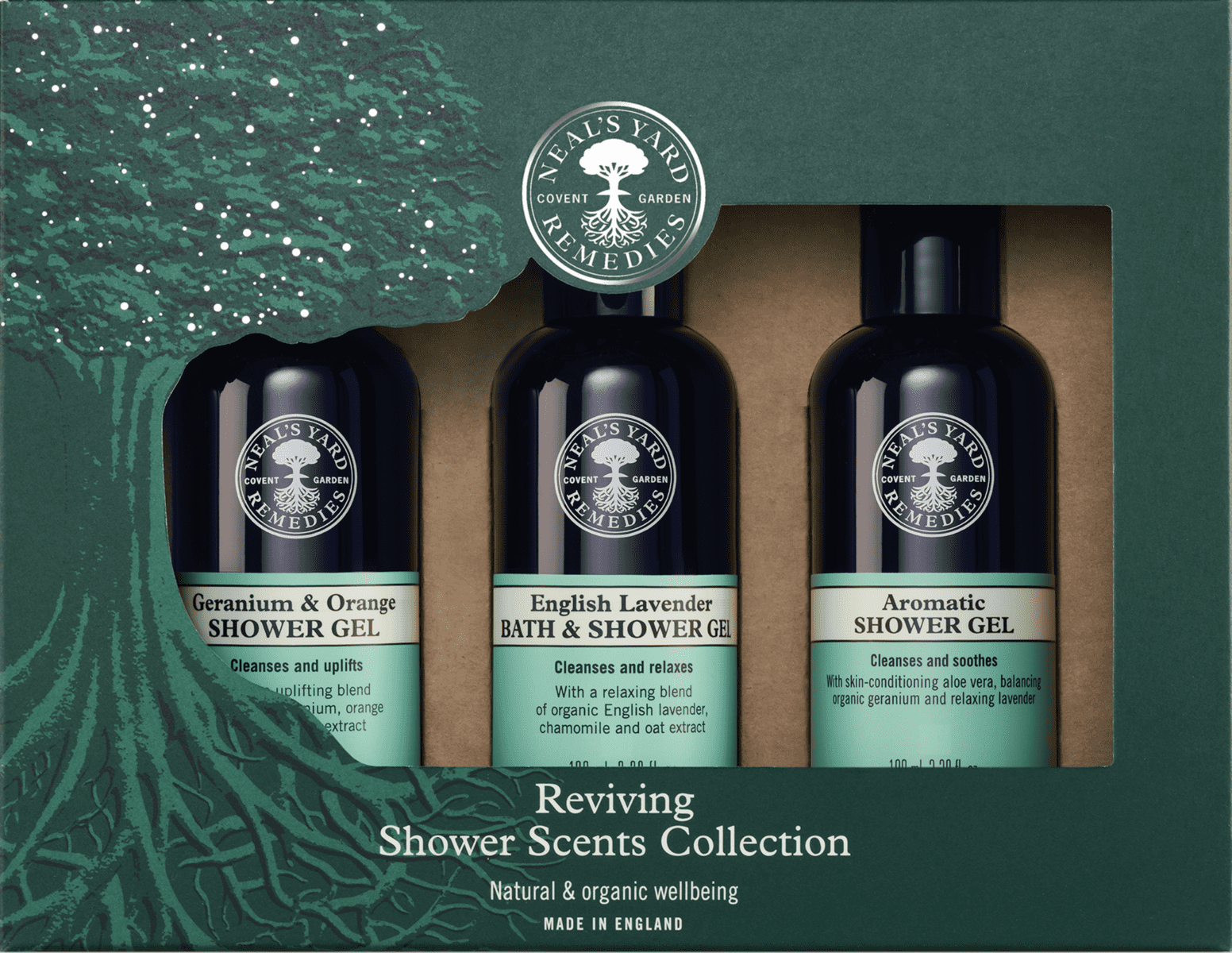
Wise anti-ageing men Neal’s Yard Remedies have a few suitably festive-scented gifts to get you in that Christmassy mood. Their frankincense collection is made with the world’s first certified organic Boswellia sacra (frankincense) from the Dhofar region of Oman. Interestingly, the historic harvesting of frankincense was responsible for the development of some of the world’s most ancient trade routes. The sacred trees that produce Frankincense and Myrrh are almost impossible to grow outside of the Arabian Peninsula, which meant they were constantly in short supply and high demand. The Frankincense Intense Age-Defying Collection has been clinically proven to reduce signs of wrinkles and ageing skin and is very popular. As well as its anti-ageing properties, frankincense is known for its calming effects; ideal for reducing all that Christmas stress. I’m wondering whether the three kings knew about its anti-ageing properties when they gave their gifts on the first Christmas … There is a gift box available, but the individual products could work well as a stocking filler. Another popular seasonal scent is mandarin, and the innovative people at Neal’s Yard have combined it with frankincense for a really Christmassy smell. You can scrub up well with the Mandarin and Frankincense shower cream, or go for the body lotion. So, what about that dilemma we all have each Christmas with the “difficult to buy for” person or “the one who has everything.” Amy has the ideal solution: ‘Our reviving shower scents packs. They smell wonderful, contain essential oils, and everyone uses shower gel, so they are a practical gift.’ Looking forward to 2023, the team at Neal’s Yard Remedies are already working on new lotions and potions, so there will be lots of new treats to buy. We’re really fortunate to have a truly global, yet innovative and ethical ‘local’ business right here in the Blackmore Vale.
A local school has performed the same nativity since 1960 – even using the same costumes! Every school’s nativity play is a special highlight of the year. But for Hanford School near Blandford, the nativity play is a timeless school tradition.
It was written in 1960, especially for Hanford‘s founder, Mrs Canning, by Donald Kittermaster. He had been headteacher of The King’s School, Worcester before joining Hanford as an English teacher. Mr Kittermaster wrote the nativity specifically with Hanford’s hall in mind, and he based his play on the Gospels of Luke and Matthew. The original costumes, some of which were given by Lady Rockley from the Amhurst Collection, are still used every year and give the play not only its colour but add a sense of authenticity and history. Mrs Canning, who encouraged girls to develop an interest in History of Art, wanted to recreate tableaus from Renaissance paintings, particularly works by Botticelli, Guido Reni and Murillo.
Old Girls were welcomed back to see the nativity play, many of whom had happy memories of playing their own part in the nativity when they were at Hanford. Rory Johnston, Head of Hanford School, said, ‘Congratulations to all the girls involved in this year’s nativity play; once again the magic of the Christmas story came alive in the Hanford Hall. As ever the music, singing, costumes and script all came together so beautifully to create a very special experience for all involved. Hanford’s nativity play has not changed for over 60 years and is a much-loved part of the school calendar.’
The play is considered as much an act of worship as it is theatre; always performed by girls in Years 7 and 8 it incorporates beautiful choral music. Interestingly, the first girl to take the role of Mary was Emma Kirkby, who would go on to become Dame Emma, one of the greatest sopranos. The Hanford nativity has been performed every Christmas since 1960 and its appeal is timeless.
As winter sets in, Dorset Wildlife Trust’s Reserves Ecologist Steve Masters urges us all to go down to the woods today
Woodland (veteran trees) at Arne (RSPB) nature reserve, early morning light, Dorset, UK. August 2011.
As winter’s cloak settles on the British countryside and wisps of mist float among the treetops, a walk among some of our oldest organisms is a must. Entering the woodland winter realm evokes a calming sense of contentedness. As you descend deeper into the recesses of canopy and understorey, you retreat from the elements outside, whether environmental or anthropogenic. Immerse yourself and let your imagination run wild with the history of these most ancient of habitats – the large herbivores of Britain’s past sheltering among the trees and grazing in woodland clearings; our distant relatives coppicing and working the woods for fuel and building materials; and for many of us of a certain age, Enid Blyton’s faraway tree, sheltering its magical folk. These old, mainly broad-leaved woodland habitats in Dorset are home to an incredibly diverse range of wildlife. The towering canopy of trees, often oak ash or beech, supports thousands of species. In winter, bird song is scarce, but the crisp air is occasionally pierced by the high-pitched peeping of troops of long-tailed tits, flitting from tree to tree in search of food. Although deer in some areas currently pose a threat to the natural regeneration of woodlands, winter is a good time to see and hear them, especially as they rut, as the vegetation dies back. As you walk, take time to contemplate the ‘wood wide web’ beneath your feet, a combination of fungi, bacteria and roots, all interconnected. This network allows the altruistic sharing of food and communications between trees and other plants. In winter though, you may need to delve a little deeper for your wildlife fix and notice the more introverted of woodland species.
Isothecium myosuroides, commonly known as slender mouse-tail moss
Fungi An important cog in the woodland ecosystem, fungi are key to recycling organic matter and helping to lock up carbon. Each time you place your foot on the woodland soil you are standing on miles of underground fungal mycorrhizae – what we see above ground is just the fruiting body of the fungi. One spectacular iconic species to keep an eye out for at the moment is the fly agaric, with its bright red cap and bright white stalk. Its colour is nature’s warning of its toxic nature.
Ferns These ancient plants, relics of times when dinosaurs still roamed the earth, are often overlooked. Their reproduction is reliant on moisture, so they often inhabit the shadier parts of woodland. Sometimes they will be perched high above your head, growing epiphytically on moss-covered tree branches. One of the most common species to look out for on your winter walk is soft shield fern, a typical shuttlecock form growing on the woodland floor. They can be large plants, but their surprisingly delicate fronds are divided several times to give a soft, feathery appearance.
Mosses and liverworts One of the oldest lineages of plants on our planet, this diminutive floral is abundant across our woodlands, often forming cushioned mats across trees, rock and woodland floor. Their amazing structures are often difficult to see with the naked eye but are really brought to life with a magnifying glass. One species which you’re likely to come across is mouse-tailed moss, growing around the base of trees. It gives a lovely, cushioned spot to sit for that coffee break!
Fly agaric – if eaten it can cause hallucinations and psychotic reactions
Find your nearest forest We are lucky in Dorset to have a wide variety of woodlands. Dorset Wildlife Trust looks after a number of them: Powerstock Common and Bracketts Coppice in West Dorset; Kilwood and Stonehill Down in the Purbecks; Girdlers Coppice and Ashley Wood in North Dorset. So, take some time, find a spot where the signal is strong, connect yourself into the Wood Wide Web and down your load. Find out more about Dorset Wildlife Trust’s woodland nature reserves: dorsetwildlifetrust.org.uk/nature-reserves