My background, prior to entering politics, is in small-scale commercial rooftop solar. Not the 50MW utility-scale type project being proposed for near Bradford Abbas. However many of the same fundamentals apply. If we are to avoid the worst ravages of the impending climate crisis, we need to rapidly decarbonise energy generation. That inevitably means more renewable energy – in all its forms. For the UK to meet its solar targets we will need to convert approximately 0.3 per cent of the UK’s total land to solar. That’s roughly half the amount of land currently being used as golf courses. However, we must ensure that the drive to generate clean energy does not come at the cost of food production. At the Wyke Solar Farm the land is predominately grades 3B and 4, theoretically less productive land. But the 430-acre site also contains parcels of the highest Grade 1 land. Taking any productive land away from food production is bad for UK food security. The reality is that making a living from food production is increasingly difficult. Farmers who agree to lease their land to renewable energy developers nearly always do so because the income represents a better future than traditional farming. An alarming state of affairs. We must address how our farmers are paid for the food they produce in order to secure both their future and that of the next generation. If we make farming viable, I’m certain we will stop seeing land given over to solar. The Wyke Solar farm is in its “pre-app” stage. That means no application has been made yet, but that developers, RWE, have begun a consultation process with local residents ahead of making the formal planning submission. People can email RWE or attend the in-person consultation in Bradford Abbas Village Hall at 4pm on 16th September. I will also be meeting personally with the developers to express my concerns. The Council will have their opportunity to scrutinise the plans once an application has been made. Edward Morello MP West Dorset
Steve Masters, Dorset Wildlife Trust’s ecologist, shines a light on the often-forgotten miniature realm of the important bryophyte
Moss has been used by humans throughout history for a variety of purposes, thanks to its absorption and antiseptic properties Image: Steve Masters
Have you ever perched on an old log in the wood, only to find yourself enveloped within a sumptuous rug of moss? Or, paddling in a river, wondered at the creeping green sheets adorning the exposed rocks? Around 1,000 species of bryophytes are found in the UK – representing 58 per cent of the total European species. As such, they contribute significantly to our biodiversity: they are in fact the second most diverse of the world’s plant groups (angiosperms – flowering plants – are the most diverse group). Bryophytes include mosses, liverworts and hornworts. They are the ancient organisms likely to have first arisen from green algae around 450 million years ago in the Ordovician period, a time of expansion for multi-cellular organisms. To identify and understand bryophytes, we need to get up close and personal with them, in some cases microscopically. The leaf structures of mosses and liverworts are often only one cell thick, with a whole host of structures which aid them in photosynthesis and water conservation. Some liverworts take the form of sheets of green fingers creeping across rocks, or miniature necklaces hung about trees.
Sphagnum moss. Image: Vaughn Matthews
Mossy romance The life-cycle of bryophytes sets them apart from other plants. It is two-staged: the leafy part (gametophyte) produces male and female structures which then combine to make a sporophyte. The sporophyte produces spores in a distinctive capsule, which are then dispersed and develop into a new leafy part. Another amazing ability is that of reproducing asexually, which many species do either by simply shedding part of their leaf structure or via specific structures which are shed. Both these and the capsules are beautiful structures, rivalling those of any flowering plant. Bryophytes play a key role in ecosystems across the UK, in many different habitats from grasslands to wetlands to woodlands. In each of these habitats, they often create favourable micro-habitats for other species – for example, conserving water for young seedlings in arid environments, thereby helping vegetation to establish. They help shelter invertebrates, the recyclers of our ecosystems, and create the perfect terrestrial habitats for amphibians. Mosses also provide the ideal cosy nest material for birds and small mammals to hunker down. They are integral components of some of our most precious habitats, such as peat bogs, in our fight to combat climate change. Among the main components of peat bogs are sphagnum mosses, and they perform three essential functions. Firstly, along with other plants, they form the storage vessel in which the carbon is locked. Secondly, they help to hold water within the bog, and thirdly, due to their chemical interactions with the nutrients around them, they create an acidic environment which reduces the decomposition of the plant material, ensuring the locked-in carbon is not released. Without the sphagnum moss component of these communities, the function of peat bogs to store the 500 billion tonnes of carbon they do worldwide would be severely impacted.
Moss hunting Dorset Wildlife Trust nature reserves offer the opportunity to discover an amazing array of bryophytes: whether during an autumnal woodland walk, a bright winter wander across a grassland or a damp dabble in a heathland mire. Why not try finding big shaggy-moss at Bracketts Coppice, cow-horn bog-moss at Winfrith Heath or swan’s-neck thyme-moss at Kingcombe Meadows, and wonder at the mysterious world of bryophytes. If you’re lucky, maybe you’ll find the moss cushion at the bottom of The Faraway Tree’s slippery slip!
Did you know?
Sphagnum mosses have been used by humans for centuries. Native Americans used them to line their children’s cots and carriers, where it acted as a natural nappy due to its absorption abilities – twice that of cotton wool. The moss also played a key role in medicine, particularly during the First World War. Its chemistry creates a mild acidity with antiseptic properties which, combined with its abilities to absorb, made it useful as a wound dressing.
Step back in time with our ‘Then and Now’ feature, where vintage postcards from the Barry Cuff Collection meet modern-day reality. Explore the past and present on the same page, and see the evolution of familiar local places. ‘Now’ images by Courtenay Hitchcock
The sign over the White Horse door, above, declares the landlord as Sidney Guy. A large family from Marnhull, Sidney Guy is listed as a carpenter and joiner, aged 44, in the 1901 census (he’s 15 in the 1871 census, the oldest of seven children all living at 11 Salisbury Street). He died in 1928, before this photograph was taken. Sidney named one of his sons William Sydney, born in 1881 – we don’t know the exact date of the postcard, but it’s probably early 20th century, making Sydney junior in his 50s or 60s: too old to be the man pictured. William Sydney doesn’t appear in the 1921 census. Above, the B3092 dwellings are also remarkably recognisable, despite the loss of a chimney stack and the vanishing of the two gabled semi-detached cottages behind the first swoopingly-thatched cottage.
The White Horse Inn has barely changed , though the large barn between it and No.40 Stearts Lane, behind, has long since vanishedThe biggest change here is not in the buildings but in the B3092 itself
“We are what we eat” and “our diet defines us”. If I take that metaphor and apply it to our political consumption for the last decade and a half, it feels as though we have been surviving on an unhealthy lifestyle. First, we had a crash diet in 2010. By 2015 there were some signs that we were recovering some fitness. But instead of knuckling down here, we decided to go for an extreme change of lifestyle (I do, of course, mean Brexit) and soon we descended into the inevitable accompanying national nervous breakdown. At this point, with our health undermined, we got Covid and suffered even more. Instead of getting a chance to recover we were conned into some fad diets by charlatans who took us to the brink. In May we decided to head for rehab, emerging a few weeks later on 5th July with a new direction under new leaders … but without a new recipe. The lack of a plan was concerning, but we knew we couldn’t keep living as we had been. We had a feeling it would be hard … but now it seems that as well as a healthier diet, we must also pay more for the gym and, instead of those previous short-lived New Year resolutions, this time we must keep going to the gym most days … indefinitely. As a nation of highly-processed chicken nugget eaters, we need some positivity if we’re actually going to convert to oily fish, nuts and beans for the foreseeable future. In the last couple of weeks, it feels that instead of the promise of steadily improving health and wellness, our new Labour life coaches are offering thin gruel, cold showers and regular weigh-ins. Where is the encouragement? Where is the hope? The truth is that the new Labour dieticians want us to be absolutely clear who exactly is to blame for our current terrible health and lousy diet – and they won’t stop ramming this message home until they are convinced we can repeat it in our sleep. Then, sometime next year – probably around the next comprehensive spending review in the Spring – the plan will be revealed for how we will get to long-term health and renewed national vim and vigour. I am all for that but, in the meantime, please can we understand the recipe better, and what is in the meal plan? We need to feel that the better days aren’t so far ahead that we lose heart and make us think about drifting back to the charlatans and their pot noodles. Could the Labour life coaches also listen to us rather than keep telling us how to live? I am prepared to start the journey with salt in my porridge, but a realistic promise of there being a little honey in due course will make the experience far more palatable. Gary Jackson North Dorset LibDems
Laughter is definitely the best medicine, and with humorous news often in short supply these days, the Daily Mail lightened the mood for us on 30th August when it ignored the serious issues elsewhere in the world and instead splashed across its front page OUTRAGE AS STARMER REMOVES MAGGIE’S PORTRAIT. Hilarious. Much more of that and Private Eye will find it has serious competition when it comes to front page jokes. Using humour rather more productively, a number of popular comedians have put their talents towards helping scientists get across the message about the increasingly urgent need for us to wake up and take action about climate change and the environment. Have a look on climatesciencebreakthrough.com. Warning – contains strong language! I imagine most people were pleased to see the law used to crack down quickly on the recent violent anti-immigrant demonstrations that were sparked partly by lies spread on anti-social media. Police officers were injured, shops looted and attempts made to set fire to places where asylum seekers were temporarily housed. In welcome contrast, peaceful demonstrators outnumbered the rioters and demonstrated the better side of human nature. The courts responded swiftly to the violent protests. One individual, who posted online encouragement for rioters to set fire to hotels housing asylum seekers, was sentenced to three years imprisonment. That does rather contrast with an earlier case of an environmental campaigner who took part in an online meeting to plan a peaceful protest aimed at temporarily stopping road traffic. He was sentenced to four years imprisonment. It’s hard to see the balance or the fairness there. Finally, the Olympics entertained and inspired us all, but it did have some greenwashing contradictions. While British cyclists won a clutch of medals, British Cycling (BC) accepted a sponsorship deal with Shell, claiming that it would ‘accelerate’ BC’s journey to net zero. Meanwhile, Shell is accelerating its own journey – by planning to invest £46bn in fossil fuels in the next six years. The International Olympic Committee also agreed a sponsorship deal with Toyota, a car manufacturer notably slow to develop electric vehicles. Among the Olympians who publicly condemned the deal was Dorset’s own star sailor Laura Baldwin. Well done Laura. Ken Huggins North Dorset Green Party
James Cossins reflects on navigating a challenging harvest, balancing the crop quality against the costs of drying grain during the erratic summer weather
The 2024 Rawston Farm harvest team in action
As I write this (1st September) our cereal harvest is finally complete. We started in mid-July, and it has been a rather stop-start harvest operation due to the on-and-off showery weather since. Only on one or two occasions have we had heavy rain, but light showers do slow up the harvest. We try not to have to dry the grains too much, due to the cost of the drying process and the use of fossil fuels. So we have to balance out the cost of potentially leaving the crop to deteriorate and lose quality in the field or to get the combine out and dry the crop. Generally, with a reasonable combine capacity on the farm, we tend to wait a little and harvest the crop dry. In some cases, if bad weather is forecast, we will cut the crop and take a small amount of moisture out. Experience has taught me that if you wait for all your crops to be dry enough, the weather will catch up with you and lead to the loss of yield and quality. Luckily we do have drying facilities to take moisture out of the grains. The harvest results have been a pleasant surprise after the wet autumn and winter and the wet spring meaning a late sowing of our spring crops. The spring barley, even though it was sown a month late, gave us an above average yield for the farm and it has also made the grade for malting – therefore gaining a premium over feed barley. The wheat yields have also generally been good, with the later-sown crops performing better than the earlier ones. This may be partly due to less fungal disease pressure in the later crops.
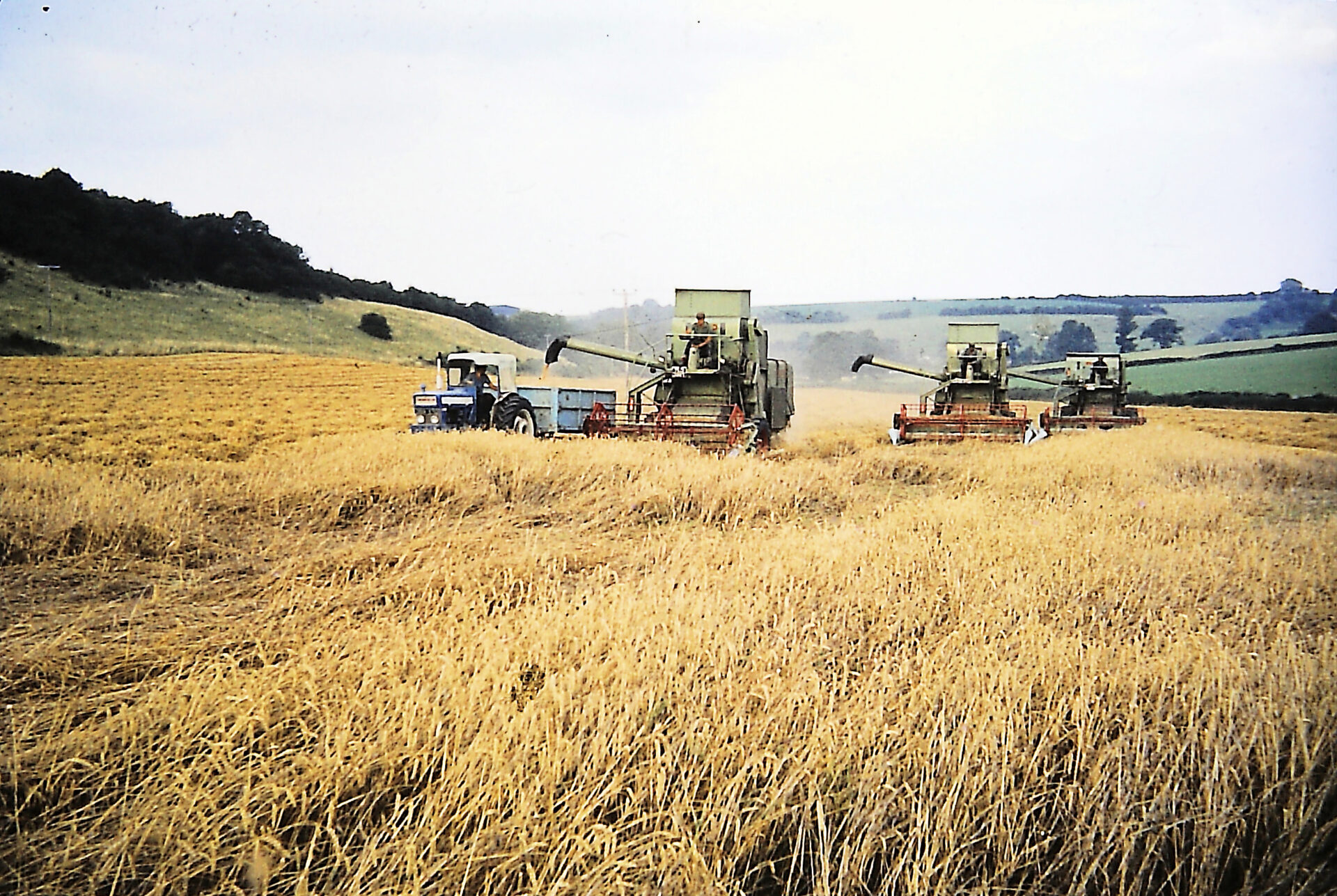
Rawston Farm harvesting, 1970s style
Tuberculosis at Rawston At the beginning of July we had the dreaded TB test. After nearly four days injecting and reading results we ended up with just the one reactor cow – the same result as the last test two months ago. The animal was close to calving, so with the agreement of AHPA we decided to let the cow calve, and then send her to off the abattoir. The final test results came back negative … SO frustrating as it means we needlessly lost the cow, and we are still unable to sell animals on the open market. There has been a lot of publicity recently, following the BBC documentary featuring a certain rock star claiming that wildlife are not a cause of the spread of TB, and that we should look into the current testing regime. I agree that we do need a more accurate testing programme put in place so that we are not needlessly culling cattle. For a long time we have been told a cattle vaccine is ‘only a few years away’ but we still don’t know when it will happen. There are trials being carried out vaccinating the wildlife to see if there will be a reduction in the prevalence of the disease in the wildlife. Recent results indicate that the current strategies for controlling badger populations have resulted in a 56 per cent decrease in the number of cattle affected by tuberculosis. This suggests to me that the measures implemented – encompassing wildlife management, regular cattle testing, and enhanced farm biosecurity – are effectively reducing the spread of the disease. Let’s hope our next test at the end of the month ends up clear. As we move into the autumn our thoughts are already focusing on planting next year’s crops: our oilseeds, forage and cover crops are already sown. Here’s hoping for a rather more average weather pattern than the last 12 months.
We have an exciting opportunity for an Assistant Chef to join our team of talented and experienced staff. Clayesmore prides itself in providing a comprehensive, in-house fresh food service to its pupils and staff.
The ideal candidate will be experienced and confident in high volume catering and be flexible, and able to work as part of a team.
This is a great opportunity to work in catering with primarily daytime shifts. Benefits include a non-contributory pension scheme, Death in Service benefits, a free meal each day and free membership of the Clayesmore Sports Facilities.
Please feel free to ring the HR department on 01747 813213 if you would like to discuss this role.
Clayesmore is committed to the safeguarding and promotion of children’s and young people’s welfare and expects all staff and volunteers to share in this commitment.
This month Jess talks to head groom Stacey Blunn to find out just how she keeps Team Rimmer on track – and on time
Jess Rimmer (left), Stacey Blunn and Jo Rimmer take a well-earned break at ‘Cafe Fontmell’ All images: Courtenay Hitchcock
This month has seen Team Rimmer competing at Bicton, Hartpury and Wellington. Jimmy has stepped up to Novice in great style and Max has produced some competitive results, finishing third at Wellington. Elsa jumped a superb double clear at Wellington in the OI (Open Intermediate), and Mattie and Henry learned lots in the exciting Hartpury atmosphere. But rather than getting stuck into basic event reports, I thought we could look at life as an event groom – and who better to speak to than our very own 5* groom and long-standing head girl, Stacey Blunn? She joined Fontmell Parva in 2006, and is now part of the family here, playing a pivotal role not only in the daily care and exercise of the horses, but also in grooming at competitions up to the highest 5* level with me, mum Jo and Boy Joe (Eventer Joe Roome, who shares the yard with Team Rimmer). There is nobody more reliable, trustworthy or conscientious and, although she won’t admit it, she is an absolute font of knowledge, respected and admired by so many. Stacey’s job as head groom involves her working closely with Jo and Joe to manage the daily running of the yard. She organises vets and farriers, orders the feed, hay and straw deliveries as well as managing the care of the horses – clipping, trimming, plaiting, medical care … she basically does it all. We’re fairly sure she’s a secret superhuman and she pretty much runs the ship around here. The role of a groom is primarily focused on the daily care and well-being of the horses, but their work is far from limited to this. While Stacey, as head groom, oversees the overall yard management, the grooms are the very backbone of the team, the support crew that ensures every detail is attended to and that the yard runs smoothly. Grooms are SO important to us – sadly it’s a job often viewed as bottom of the pecking order, when it really shouldn’t be!
Just a gratuitous we-love-Henry shot for your pleasure …
A horse schedule So, join us as we have a cup of coffee and a chat in our famous Café Fontmell (OK, it’s the side of the yard with the plastic patio chairs). To set the scene: it’s Sunday lunchtime, and we’ve just put the kettle on before starting the afternoon yard shift. As we take a break, Stacey lets me in on her origin story – where did the love of horses begin? ‘I started riding up north with my grandparents during the holidays,’ she says. ‘I rode a horrible pony who bucked for the duration of the ride – my mum kept promising I could dismount the next time he bucked, but then she never let me! I slowly fell in love with horses through my local riding school and produced my first pony, Snoopy, from a four-year-old. I visited Fontmell Parva when I was 17, through a friend who was doing work experience – I loved it, phoned Jo for a job, and the rest is history!’ (We pause here for a brief interruption from Hannah, who is offering us doughnuts, which we naturally accept most happily.)
Stacey with Jo and Newt after their double clear in the 5* at Luhmülen in 2019
While every day is different, Stacey is keen to point out the need for organisation in such a busy yard. ‘We always try to keep to the same routine,’ she says. ‘It’s really important for the horses. Obviously there are occasional longer days and earlier starts which add some nice variety, but the horses thrive on a steady, consistent routine and we work hard to stick to the same system. They have breakfast at 6.30am, and are then exercised throughout the morning. They’re always put to bed late afternoon, in time to receive their supper at 5pm.’ Being a groom is every horsey child’s dream job – and though it’s a lot of hard work, Stacey acknowledges that even after almost two decades it has its special moments that make it all worth while. ‘For me, the best part is simply playing a part in the journey of both the riders and the horses,’ she says. ‘It doesn’t matter if that’s to compete at the higher levels or just to achieve a personal goal. That’s not to say it’s not without its challenges, though. It’s commonly known that horsey people aren’t the easiest! I’ve had to learn to deal with all types of clients – actually only half my job is about managing the horses! ‘The weather is another major challenge. British winters are tough, and the rain can feel pretty relentless. It’s not something we can control, though, so it’s just a case of sucking it up – and finding some really good waterproofs!’ Despite the long winter slogs, there have been plenty of career highlights too. ‘For me personally, finishing second (twice!) in the Riding Club Open Championships and producing my horse, Reney, up to Intermediate was a real achievement. From a grooming perspective, Pau 5* in 2018 (Jo and Newt’s first 5) was pretty special, along with their double clear result in the 5 at Luhmülen in 2019. Joe and Auriella flew round the 3*L at Blair that same year – Auriella has been a tricky mare who is very special to me, and it was incredibly rewarding to see her perform so well.’
Stacey Blunn visited the Fontmell Parva yard as a teenager 18 years ago – she immediately asked Jo for a job, and has been part of the team ever since
Not-so-secret life hacks At this point I asked Stacey for her top groom hack, but she was a little affronted: ‘I would have said Fairy Liquid, but you stole my secret tip for last month’s column!’ Joe Roome, who has been listening in over his own doughnut, chips in here: ‘Stacey’s time management is unbelievable. She is always early, which is a huge life hack in itself. There is always so much going on in our days – punctuality is vital to make sure everything runs smoothly, which always happens when Stacey’s in charge!’ As her career has grown, Stacey tells me her role models have changed too. ‘When I was riding, it was Pippa (Funnell), William (Fox-Pitt), Ian Stark and Toddy (Australian eventer Mark Todd). But as soon as I focussed on grooming, Jackie Potts became a huge inspiration.’
Henry thoroughly enjoying his prep team, while making sure he’s showing his good side for the photos
Jackie is widely renowned to be the authority on the profession of Eventing grooming, and is the long-time groom of William Fox-Pitt at his yard near Sturminster Newton. Inevitably in a life built around horses, there are countless times when it’s all gone horribly wrong. ‘There are so many stories!’ says Stacey. ‘I vividly remember being dragged through the flood by a young horse – we deliberately took him down there as it’s hugely beneficial for them to see water from a young age. He put his back up (as if he was going to buck me off!), so I dismounted … and he ran off through the flood. Now anyone who knows me knows I won’t let go of a horse – I was practically water skiing!’
Quarter marks are purely to look smart and impress the dressage judges! Every groom has their own favourite method and pattern – Stacey likes to use Quarter Mark spray and a circular metal curry comb for best results
Stacey has some solid advice for anyone thinking of following her footsteps. ‘Be prepared to work hard. The days are long, and 80 per cent of it is just hard graft. But for me it’s totally worth it for that 20 per cent of good!’ Speaking of hard work, the doughnuts are done and we’d better start the afternoon yard before the horses start demanding their dinners …
Local wildlife photographer Ian Nelson sent this wonderful set of barn owl images to us, despite knowing they couldn’t be entered into the reader’s photography pages this month. We have just one rule for the monthly photography pages – the images included must have been taken in the preceding month (the images featured in this September issue will all have been taken in August). However, Ian took these images earlier in the summer and then deliberately withheld sharing them for a couple of months. ‘I didn’t submit them because the barn is possibly identifiable,’ he says. ‘Sadly not everyone understands how to observe wildlife responsibly, and I didn’t want the owls to be disturbed by an influx of visitors. Four chicks were being raised, and I didn’t want to risk them being stressed to the point that they abandoned the young.’ All four chicks have now fledged, and although they break the rules for the reader’s photography section, we couldn’t resist sharing such stunning images of one of the nation’s most beloved birds for everyone to enjoy.
Images by Ian Nelson
Images by Ian Nelson
Images by Ian Nelson
Images by Ian Nelson
Did you know …
The barn owl is not only the world’s most widely distributed species of owl, but is also one of the most widespread of all birds – it is found on every continent except Antarctica
Though they reside throughout the tropics, they avoid areas with cold winters. Scotland has the most northern breeding barn owls in the Northern Hemisphere
In eastern England barn owls are far more likely to nest in trees than in barns.
Barn owls don’t hoot! The male has a long, harsh scream that lasts about two seconds
The chicks make their first flights when they are around 50 days old, but they won’t be independent of their parents for another month
British barn owls have distinctive white breasts, but in central and eastern Europe they are a shade of dark yellow-orange
Barn Owls do not build a nest: they lay their eggs directly onto the previous years’ nest debris, a compacted layer of old owl pellets!