

As Armistice Day approaches, we pause to remember the sacrifices of those who fought for their country. Yet we know that some veterans, like Dorset’s Henry Maidment, slipped quietly through the cracks of history. Henry’s bravery was recognised only when poverty forced his name back into the public eye.
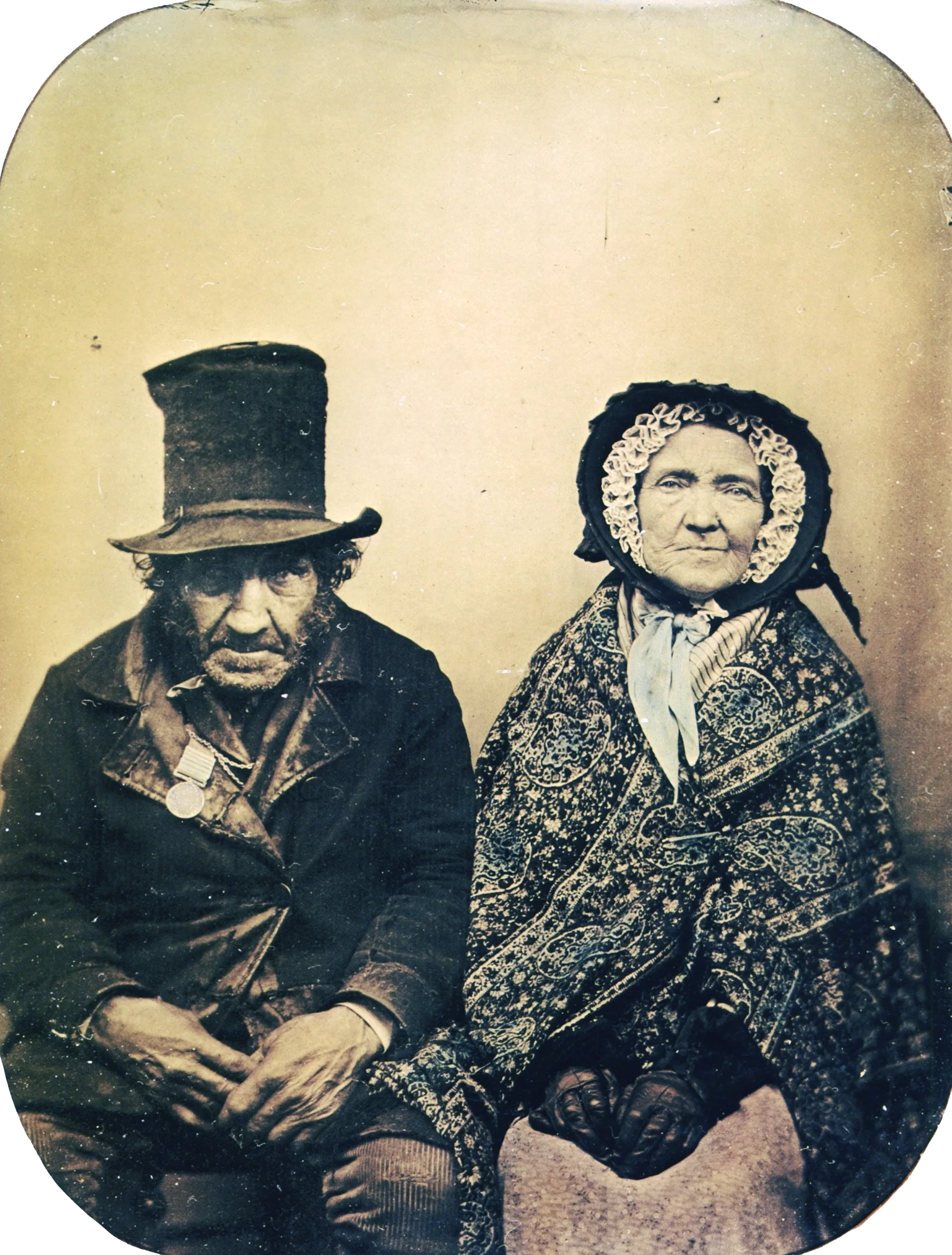
The photograph above, sometimes seen in colour-tinted form, is widely circulated online labelled as ‘Henry Maidment, a Napoleonic War veteran, with his wife Rosanna Belben’. It appears on genealogy sites such as Find a Grave, though there is no definitive proof of the couple’s identity. When the military charity SSAFA shared the same image, they described it simply as an ‘unknown soldier’. Some have noted that Henry’s medals appear to be worn on the wrong side – perhaps simply a sign the image was flipped, but it could be that the decorations were not his at all. Whatever its origins, it remains a powerful, haunting symbol of an old soldier’s twilight years.
Born in 1783 in the village of Pimperne, near Blandford, Henry Maidment fought in the Peninsular War against Napoleon’s forces, taking part in the brutal battles of Talavera, Salamanca, Vittoria and Toulouse. His medal – the Military General Service Medal with multiple clasps – testified to years of service in Europe’s bloodiest campaigns. Yet by 1866, aged 83, we know the decorated veteran was destitute, surviving on a parish handout of two shillings and sixpence a week and a single loaf of bread.
Public appeal
His situation prompted a very public appeal. In March 1866, George Mansel, a local lieutenant, wrote to The Times describing Maidment as “a fine old soldier now suffering hard times” and inviting donations from readers:
May I endeavour to enlist the sympathy of your numerous readers on behalf of one of the few surviving veterans of that army which gained immortal renown under our great Duke in Spain from 1809 to 1814? The subject of this appeal, Henry Maidment, is now living at Pimperne, near Blandford.
He is in his 84th year, and his sole support is 2s. 6d. a week and one loaf of bread, allowed him by the parish. He served in the 53rd Regiment, and fought in the following battles, for which he received a medal and seven clasps:- Talavera, Salamanca, Vittoria, Pyrenees, Nivelle, and Toulouse.
Having enlisted for ten years, he was discharged without a pension. He is a fine specimen of an old soldier, and has always borne an excellent character. If any one who reads this appeal would like to soothe the remaining years of this veteran with a few necessary comforts, the Rey. William Bury, rector of Pimperne, near Blandford, and myself will be glad to be their almoners.—I remain, yours truly, GEORGE P. MANSEL, Langton-lodge, Blandford.
‘More shame’ for Mansel
But the response to the appeal was mixed. The Times’ letter was also shared in the local Western Gazette, and the editor, in recapping the whole of the correspondence, noted that ‘the following snarling epistle’ appeared a few days later:
Sir,- read in the Times of the 28th a letter signed by a gentleman of property and position, as I am told, in Pimperne – Colonel Mansel – inviting the sympathy and assistance of the public towards maintaining a very old Peninsular veteran, whom he describes as bearing an excellent character, and having no other maintenance than 2s. 6d. a week from the parish of Pimperne.
If this be so, more shame, I think, for the Colonel, Lord Portman, and other rich proprietors in the parish and neighbourhood, who surely might afford, among them, to keep this poor old soldier in comfort without invoking the powerful aid of your columns to assist them.
We have heard much of late of the condition of Dorsetshire labourers, who are starved on wages of 8s. and 9s. a week, so perhaps one ought not to be so greatly surprised at this appeal. I am neither a landed proprietor nor a military man; but, thank God, I live in a part of the kingdom where we pay our labourers from 15s. to 18s, a week, and do not require the sympathy of the benevolent public to help us to keep such deserving objects of charity living among us as this worthy old veteran.–Yours, &c., a MAGISTRATE.-’
Henry Maidment died two years later, his death registered by a neighbour who had cared for him in his final days. He was buried in St Peter’s churchyard, Pimperne. His story – uncertain in image but clear in meaning – serves as a reminder that remembrance is not just for the fallen, but also for those who lived through the hardships of war.
As we mark Armistice Day, Henry’s story continues to resonate: a soldier whose battle extended beyond the battlefield.