The Blackmore Vale logo
Home Blog Page 213

On cloud wine!

0

Sherborne is home to the best wine retailer in the UK – so say the biggest names in the industry. Hannah Wilkins, owner of Vineyards, tells all

The Vineyards team inside their new premises at the Old Yarn Mills in Sherborne

We’re writing this only hours after getting back from London, with our heads still spinning. 2023 is turning out to be an exceptional year – definitely vintage worthy!
After winning the Drinks Retailing’s ‘Best Wine shop in UK’ in February, we didn’t think things could get any better for Vineyards. Then the IWC contacted us to say we were a finalist for Single Site Wine Retailer of the Year – and (spoiler alert) we only went and won!

Quite a night
On 4th July we headed to the Hurlingham Club in London for the most prestigious wine event in the calendar. Launched in 1991, the The International Wine Challenge (IWC) Merchant Awards recognise and reward the outstanding achievements of the UK wine trade. As in February, we were over the moon to simply be shortlisted and thrilled to have an invite. Truth be told, we were feeling rather out of our depth.
We were rubbing shoulders on the night with huge commercial names being recognised across this year’s categories, including Naked Wines, Waitrose, and Majestic. The room was filled with world-class specialists, Masters of Wine and wino heavyweights – we also stood beside Oz Clarke at one point, which was surreal, having watched him on screen swirling a glass and making wine accessible to the masses for years.
We were completely certain that being recognised at such a high level was not on the cards for our little rural wine shop – it couldn’t happen twice in a year.
But what do we know?

Hannah Wilkins (left) set up Vineyards of Sherborne 18 years ago

It’s more than us
When Hannah opened Vineyards in 2005, she wanted to celebrate great wine that was made by fantastic producers and small growers, and be accessible for all budgets – and she has kept her promise. We love what we do. We source with a meticulous approach, we champion independence, we clink glasses with friends, we sell for fair prices for the entire supply chain (in an ever-more-difficult climate) … above all, we are happy when we turn up to work. That’s our daily trophy.
So to be recognised by such esteemed judges on an international stage? Overwhelming.
After hearing our name called, Sadie was whisked off for a quick interview – and that’s when it started to feel real. We were asked ‘What does it mean to win an IWC?’ and Sadie had to find a way to verbalise the truth – which is simply ‘the world’.
We’re rural, we’re neurodiverse, we’re female-led, and until recently we shied away from nominations like this.
But in all honesty this feels like it is a win not just for us, but also for great indie wine, for the small growers and fantastic producers we support, for our incredible suppliers, our loyal ‘winos’ – and never forgetting our little market town community.

Sadie Wilkins being interviewed after Vineyard’s were declared as IWC’s Single Site Wine Retailer of the Year

Why Vineyards?
So what is so special about Vineyards? We’ve been thinking about this a lot, and with the help of the judges, we feel confident in sharing what they see in us. All we have ever set out to do is be authentic, to make folk feel welcome in what can be an intimidating (wine) world. We only sell wine we source – and love – personally, and we only work with people who share our core values.
Our trusted team of wine experts are proud of our extensive (and, yes, eclectic) portfolio and strongly we believe in good old fashioned customer service.
But more than that, we see ourselves as a community hub, where locals regularly enjoy tasting evenings, foodie pop-up nights, festivals, charity events and workshops.
Come and say hello – pop a cork with us and see for yourself.

Vineyards can be found at The Old Yarn Mills, Sherborne DT9 3RQ.
vineyardsofsherborne.co.uk
Tue to Thu 12 to 5pm
Fri 11am to 9pm
and Sat 11am to 6pm

25 special offers for 25 years!
2023 is quite the celebratory year for Vineyards. Our Sherborne wine shop turned 18, I (Hannah) celebrate 25 years in the wine trade, and now we have picked up not one but two awards naming us ‘the best wine sellers in the UK’.
To share the love, the whole team at Vineyards have put together 25 special offers for you, our customers, to enjoy – and all the wines are available to try on the drink-in menu throughout July too.

The disappearing bullfinch

7

He’s a short, beefed-up robin, a ‘skinhead in a Hawaiian shirt’, and he has a voice ‘like a squeaky wheelbarrow’, says wildlife writer Jane Adams

With his bright pink chest, jet black head, grey back and stocky build, male bullfinches have the look of a skinhead dressed in a Hawaiian shirt.
But surprisingly – and I secretly believe each male has an invisibility cloak – they simply disappear into the muted greens of our summer countryside.
Admittedly, the Eurasian bullfinch is not a common bird, so is never easy to find. But with a resident population of over half a million, they are not rare either (yet).
They are found across the world, from the UK in the west, through northern and central Europe to Russia and Japan on the Pacific coast. They’re seen as a symbol of good luck by the Japanese.

In need of help
Back in the UK, it’s the bullfinches that could do with some luck. Their numbers have declined by more than 40 per cent since 1967 – and could drop even further if intensive farming techniques don’t change. They require thick, healthy native hedgerows and woodlands for nesting, along with a supply of seed and flower buds in spring to survive.
Bullfinches only visit ten per cent of gardens, but if you’re one of the lucky few, you can help their conservation by providing sunflower hearts, a particular year-round favourite food. If you’re simply trying to tempt them to your garden, make sure it has plenty of dense cover and native fruit trees.
In fact, if you do this, even without bullfinches other wildlife will benefit from the habitat you’ve created.

How to see them in the wild? First, listen out for their call. Often described as mournful in bird books, it sounds more like a wheelbarrow with an intermittent squeak to me.
Then look for a stocky bird, about the size of a beefed-up robin but with shorter legs.
As a bonus, bullfinches mate for life and they do everything together, so if you see one, look out for its mate (you never know, if one is lucky, maybe seeing two is doubly so!).

Bullfinch facts

  • Female bullfinches are like males but have a muted beige pink, rather than a bright chest. Fledglings are like the females but without the black head.
  • Both males and females show a tell-tale white rump in flight.
  • Finches are seed eaters, but will also eat flower buds in spring and will feed insects to their young.
  • On average, they live for two to three years but the oldest recorded ringed bullfinch was nine years, two months, nine days (set in 1975).
  • They lay four to five eggs, and can have one or two broods (occasionally three) a year, between late April and mid-July.
  • On 7th January, in Japan, the ceremony of “Uso-Kae” sees people exchange small wooden bullfinches as a way of exchanging their past lies for future good luck. ‘Uso’ means both bullfinch and a lie in Japanese.

Girl Friday

0

Sophie Giles swapped working on an industrial estate for life as an island girl – Tracie Beardsley met Brownsea Island’s youngest ranger

All images:
Courtenay Hitchcock

On her lunch breaks, Sophie Giles used to seek out the only green space on the bleak industrial estate where she worked on a cosmetics production line.
Now she spends well-earned lunch hours dipping in the sea or sitting beneath picturesque pines, enjoying incredible views of her workplace – Brownsea Island in Poole Harbour. Her commute is the refreshing boat ride across the world’s second largest natural harbour to the idyllic island.
When I meet her, Sophie was still processing the news that she’d just been appointed a National Trust Ranger. One of only three on the island, she’s the youngest and only female in the team.

Sophie has had to learn to drive tractors and crew boats

No longer struggling
In a whirlwind year as an apprentice, the 22-year-old has learned to drive tractors, crew a boat, use chainsaws and brushcutters and all manner of other ‘boy’s toys’. As well as learning on the job, her online lessons in ecology, biodiversity, conservation and the island’s history are obviously paying off. Sophie pauses to point out baby oystercatchers, she marvels at the stunning passiflora just coming into bloom and talks confidently about the habitats around her. No wonder her impressed tutor nominated her for Apprentice of the Year.
Sophie says: ‘At school, college and university, I fell short and struggled. My grades were low, and though I really wanted to succeed, I found even simple tasks very difficult.’
Although a talented artist, Sophie quit her BA in graphic art in the second year and volunteered on Brownsea for six months. ‘My parents were worried I was dropping out and losing direction, but I felt an urge to be outdoors, to do something that spoke truer to myself. Getting my hands into the soil and doing physical work felt right.’

Sophie Giles

Bracken pulling, ragwort monitoring, thinning out trees – her ranger role involves huge amounts of practical and very physical conservation work. ‘It’s hard work, but I come home exhilarated. In my previous job, I’d drive home and sit in my car for ten minutes with my head resting on the steering wheel just needing to decompress. No energy or enthusiasm. Working with nature I’m super-inspired. It’s really switched on my creative side. I’ve started drawing again.’
Favourite task so far? ‘Surveying butterflies. On a sunny day you walk around the different habitats and log all you see. We share the data with the Butterfly Conservation Trust. It’s a true indicator of the island’s biodiversity.

Sophie’s working day is a far cry from her previous job on a cosmetics production line


Moth traps are super-fun too. You set them at night and in the morning it’s like finding treasure! Lots of wonderful species, vital food for the churring nightjars we have nesting here.’
Keen to share her new-found knowledge, Sophie helps support a government-funded scheme in partnership with Dorset Wildlife Trust, hosting free school visits. She has used her artistic skills to design a series of educational activities, along with an engaging booklet that inspires kids to work within nature.
‘Our aim is to empower children. These school visits are such a success, with kids from all backgrounds and educational levels getting stuck in and curious. It’s a dynamic and exciting project.’

Christmas thermals
As we talk, the weather is glorious, with the temperature in the high 20s. I wonder if working on the island in the depths of winter is such fun?
Sophie recalls: ‘I’ve worked one winter here. The staff boat broke down so we had to cross on the logistics barge – essentially a metal bath tub. Normally, my Christmas list is full of fru-fru nonsense, but last year insulated socks and fur-lined boots were added to it rapidly!
‘It’s a very chilly start in the winter months, but once you start thinning out trees, you soon warm up. I’m also a great believer in power porridge breakfasts – making sure it’s full of peanuts, almonds, spirulina and chai seeds.
‘Being in an environment I’m truly passionate about, around like-minded people, I’m thriving and finally excelling with my studies. I’m very grateful to have found “my thing” after feeling I couldn’t succeed at anything.’

Pulling bracken is just one of the day to day tasks under Sophie’s responsibility

Quick fire questions:

A-list dinner party guests?
I’m a Springwatch fan, especially as it was filmed in Dorset recently, so Chris Packham with Sir David Attenborough. Native American musician Mariee Sioux – her music is so grounding and in tune with nature. It’d be fun inviting Mary Bonham-Christie, the ‘Demon of Brownsea’, the reclusive owner who believed in leaving nature alone.
Book by your bedside?
The Ship of Magic by Robin Hobb (I love fantasy fiction) and also Feral: Rewilding the Land, Sea and Human Life by George Monbiot – it’s a captivating, beautiful book.

Stop and eat the flowers!

0

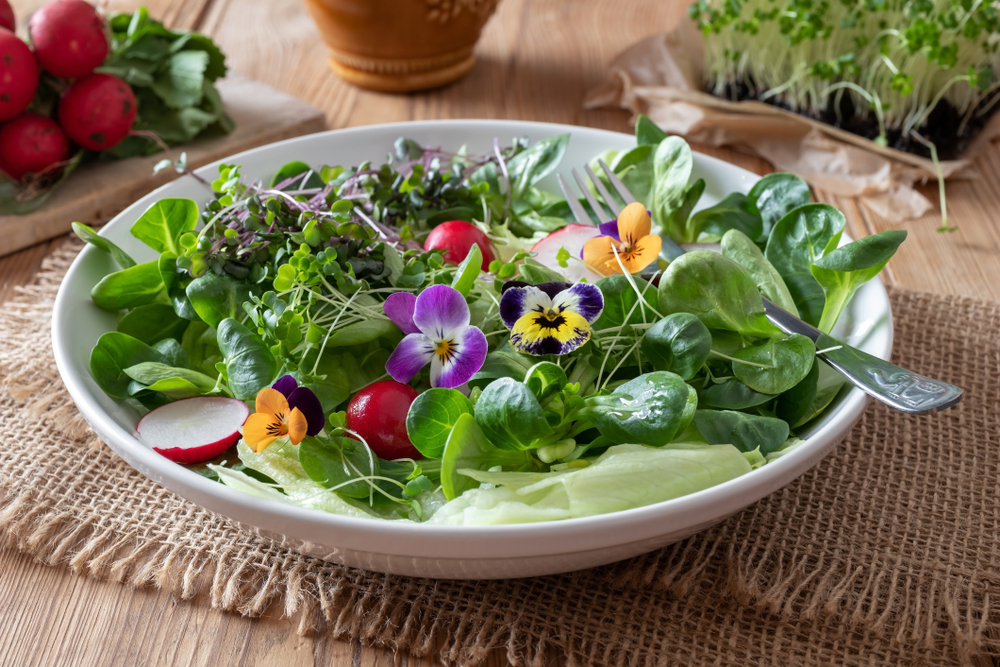
They look glorious in a vase, but flower farmer Charlotte Tombs is also learning how our garden flowers provide for the table too

Flowers that you can eat! Perfect in my book – and if you grow your flowers from seed, you know exactly what’s on them. For me that means I know there’s no pesticides and no nasties … but perhaps the odd greenfly …
Do note, there are many edible flowers and, as with all foraged food, you do need to be 100 per cent certain what it is that you have picked!
Most people know about the common garden nasturtiums – they are deliciously peppery in flavour. The flowers look wonderful on a plate, and you can add the leaves to a salad or make them into a pesto. The seed pods stored in vinegar can be a replacement for capers.
Calendula petals are also slightly peppery and can elevate a green salad into a work of art (calendula is also used for its herbal properties, made into soothing balms and lotions).
Cornflowers have a peppery-clove aroma with a mild sweet spice flavour – add them to a salad, and they are also delicious dried and used as a tea.
Violas are probably one of my favourites to add to a green salad – with their little faces they just look so pretty!

For years chefs have used lavender to flavour sugar; my mother used to make lavender shortbread and there was always a jar of sugar with lavender heads in the larder. From personal experience I can confirm it is not very nice on your cornflakes in the morning!
Geranium flowers can also be used and the flavours tend to correspond to the scented leaves. Lemon geraniums are wonderful: try sprinkling them over cakes, they make an unassuming lemon drizzle cake oh-so-glamorous.
Chive flowers, coriander flowers, basil flowers … they can all be eaten. In fact, there are so many that once you start Googling, the list feels endless. I’ve just seen that dahlia tubers are edible, as are the flower petals. I’ll let you know how I get on with a tuber!

Charlotte offers workshops throughout the year – please see northcombe.co.uk for further details.

Unveiling the Ancient Wonders: Home of Hillforts & Henges 2023

0

Home of Hillforts & Henges returns in 2023, celebrating Dorchester’s Neolithic, Bronze, and Iron Age heritage from July 28th to July 30th. The festival invites visitors to explore the ancient landscapes that have shaped the town for over 6,000 years.
Dorchester proudly holds the title of ‘the Home of Hillforts & Henges’ due to its significant historical sites. Before the town’s establishment, the region served as the centre of a major Neolithic ceremonial landscape.
Within Dorchester, four impressive henges and two formidable hillforts stand as testaments to its rich heritage.
One of the remarkable sites is the Dorchester Neolithic Monument, one of Britain’s largest. Located in the Tudor Arcade, its vast palisaded enclosure features signs of huge wooden posts and a curving ditch.
Maumbury Rings, constructed over 4,500 years ago, served as a giant henge with a single entrance and possible standing stone. The Romans later re-purposed it as an amphitheatre by enhancing the banks and filling the inner ditch.
Flagstones, located just outside Dorchester, is a late Neolithic circular ring with chalk walls and unevenly spaced pits. It boasts a large sarsen stone, referred to as The Druid Stone by Thomas Hardy, which still stands in a garden.
Mount Pleasant, an oval Neolithic ‘superhenge,’ captivates visitors with its concentric rings of postholes and cross-shaped aisles.
Poundbury Hill encompasses evidence of Neolithic and Bronze Age settlements, an Iron Age hillfort, and even a section of Roman aqueduct remains.
Maiden Castle, the largest Iron Age hillfort in Europe, stands proudly in the landscape just two miles south of Dorchester.
The South Dorset Ridgeway, nestled between Dorchester and Weymouth, hides more than 500 archaeological monuments and barrows, making it Europe’s finest funerary landscape.

Home of Hillforts & Henges 2023
Part of the National CBA Festival of Archaeology, this year’s event offers an immersive experience for visitors. Guided walks, talks, and activities will take place across the town, culminating in the grand HengeFest at Maumbury Rings on July 30th. This free family day out within the ancient monument features trade stands, local food, live music, and engaging nature crafts, ensuring a fabulous day out for the whole family.
The festival is made possible by headline sponsors Kingston Maurward, Dorset Hideaways, and Dorchester Town Council, as well as other supportive partners and sponsors.
Don’t miss the opportunity to unravel the secrets of Dorchester’s ancient past at Home of Hillforts & Henges 2023. From July 28th to July 30th, immerse yourself in a journey through time and explore the wonders that shaped this remarkable town.

discoverdorchester.co.uk

New ways with old wood

0

Retired schoolteacher Mark Dunham has a new career as a wood artist – Edwina Baines learns more about his work

The Fibonacci clock
© Mark Dunham

Woodworking is one of the oldest arts known to mankind: archaeologists have discovered tools which are more than a million years old and contain traces of acacia wood.
In a small workshop near his house in Mere, Mark Dunham continues this ancient tradition – but to describe him only as a woodworker would be doing him a disservice. His designs go beyond the wood itself – every piece uses a combination of skills, including glass, copper and metalwork as he instinctively draws on a connection between his designs and our natural world.
When he left school, Mark took up work as an apprentice wood machinist before progressing to teacher training at Brunel University. For many years he was a teacher of craft, design and technology (CDT) in Poole, later moving north to Port Regis School. He was always eager to tell his pupils that imagination and design are the most important starting points – even before understanding the techniques of working in wood, metal or glass.
At the end of a long career in teaching, Mark now has the time to pursue his personal passion for woodworking – in particular, creating his uniquely organic long-case clocks and lamps.
Each piece starts from either a single piece of wood or a sketched design – which may evolve or change as the work develops.

The Ripples in Time clock

Shaped by nature
Mark uses wood that he sources locally or that is randomly brought by friends.
Several of the clocks and smaller items Mark has on display were made from an old burred oak. Burrs are the bumps, swellings or bulges that grow on or from the trunk of a tree, caused by the stunted growth of tiny branches which die back. They build up in a bumpy form with a cauliflower-like texture, and the interior burr wood forms swirling patterns that are particularly lovely and much sought after by woodworkers.
A small wax melt-holder is made of the same burred oak, intertwined with copper. It combines Mark’s logo of twin hearts into the copper work. The stylised hearts logo appears again at the base of a small bowl made of holly and old Mahogany spiralling out of the central design.
The hands of an unusual spiral clock are based on the Fibonacci sequence – a shape which appears throughout nature. Mark explains how it ‘fits the flow of the walnut frame and patinated copper markers without spoiling the form of the sculpture, effectively becoming a kinetic sculpture by slowly moving to show the time. It’s a pleasing demonstration of form and function. The clock is read by taking a point from the centre through the spiral tips towards the markers.’

Mark Dunham
Image: Edwina Baines

Pre-war influences
Ripples in Time is another stunning clock (see previous page) made of London plane, otherwise known as lacewood. Mark could not guess at the number of hours he had worked on this beautiful piece. The case has been cut in a way to emphasise the quarter-sawn plank, which exposes the medullary rays of the wood in each ripple – cellular structures visible to the naked eye, more noticeable in certain types of wood.
When timber is quarter-sawn, the wood is cut into boards with the growth rings roughly perpendicular to the face of the board, and the medullary rays often produce beautiful patterns. London plane has a very conspicuous flecking, which gives the wood its nickname, lacewood.
Mark is interested in the pre-Second World War period of design, including the Bauhaus and Art Deco movements. He is influenced by, among others, Victor Horta, a Belgian architect and designer and one of the founders of the Art Nouveau movement, who used curving stylised vegetal forms in his innovative use of iron, steel and glass. Mark loves the organic forms and natural flow of Art Nouveau, and reflects similar lines in his own designs.
For each new design, Mark has to learn different processes. For example, he bought some second-hand shoe lasts on eBay to use for shaping copper sheets.

A small wax melt holder made of burred oak, intertwined with copper

A modern twist
Standing guard in a corner is a unique six-segment digital display as the face of another longcase clock, this one in yew. It’s a digital clock, but instead of the traditional seven-segment display we usually see, these numbers changed each minute into stylized Art Nouveau characters. Mark explains that there was ‘an electronic device which signals each of the LED arrays through the frame, which is then diffused through the glass to provide the shape of the numbers.’ The number design gives a traditional clock a distinctively contemporary twist – a hallmark of all Mark Dunham designs.
Due to the amount of time he takes over each design, Mark can only cope with a trickle of commissions.
Some of the pieces in this article can be seen at a show at Shaftesbury Arts Centre gallery in July and at Stock Gaylard Oak Fair in August.

The long case Art Nouveau digital clock face designed by Mark Dunham

mrdunham.uk
Elements at the Shaftesbury Arts Centre is a combined show with potter Joanne Rutter and artist Ani Overton, 12th to 18th July
Stock Gaylard Oak Fair is on 26th & 27th August

The everyday, ordinary reptile

0

With the right environment, the aptly-named common lizard really is a common sight in the county, says Dorset Wildlife Trust’s Alex Hennessy

Dorset is lucky to have a range of lizard-friendly habitats

Living up to its name, the common lizard is the UK’s most widespread reptile and, interestingly, it is the only reptile native to Ireland. Found across many habitats, including heathland, moorland, woodland and grassland, it can often be seen basking in sunny spots. Here in Dorset, we are fortunate to have a range of these habitats, including our Dorset Wildlife Trust nature reserves. Upton Heath in Poole, Tadnoll and Winfrith Heath in East Knighton and Sopley Common in Christchurch are just a few of the places where conditions for lizards are just right – in fact, these sites are so good they are also home to the much rarer sand lizards.
Also known as the ‘viviparous lizard’, the common lizard is unusual among reptiles as it incubates its eggs inside its body and ‘gives birth’ to live young, rather than laying the eggs. Adults emerge from hibernation in spring, mate in April and May, and produce three to eleven young in July.

Spotting a lizard
Summer is the peak season for potential sightings of common lizards, as they can’t generate their own heat and instead bask in sheltered spots of sunshine or rest on a warm surface.
But how can you tell if you’ve spotted a common lizard? They are variable in colour, but are usually brownish-grey, often with rows of darker spots or stripes down the back and sides. Males have bright yellow or orange undersides with spots, while females have paler, plain bellies.
If you spot one, please don’t disturb it in order to identify it – as with all wildlife, it is best admired from a distance to avoid disturbance and stress.
And yes, the ‘tail-tales’ are true: if threatened by a predator, the common lizard will shed its still-moving tail in order to distract its attacker and make a quick getaway. It can regrow its tail, although it is usually shorter than the original.
To find out more about lizards and nature reserves where wildlife is thriving this summer, visit dorsetwildlifetrust.org.uk.

Beware the Jabberwock! The jaws that bite, the claws that catch!

0

The village of Pokeytin is under threat. Crops and cows disappear in the night, Mrs Dodos’ washing has been pinched from the line and Mr Walrus can’t find a single oyster! Who is to blame? Why the Jabberwocky of course! But is this monster really as bad as those old locals make out?
Calf 2 Cow present a hilarious new adaptation of Lewis Carroll’s famous poem The Jabberwocky. Expect multi-rolling, floor stamping rock ‘n’ roll and a giant dragon puppet, breathing actual fire (we hope)! Grab your Jubjub bird and your best mad hat, and prepare yourself for the belly-laughing quest of a lifetime. This is the Jabberwocky as NEVER seen before.
The Jabberwocky is on Tue 22nd August at Springhead Gardens, Fontmell Magna.
Gardens open from 5.30pm for picnics and the performance starts at 7pm (Adults £14, child £6, family £36 ).

Tickets from artsreach.co.uk
or call 01747 811853
Recommended for ages 6+. Note it is an outdoor performance – bring your own chair/blanket to sit on. Assistance dogs only.

Nourishing your bones

0

Bone disease is usually a silent risk – with a little effort it is possible to prevent, postpone or manage the effects, says expert Karen Geary

I’m quite focused on bone health – both osteopenia and osteoporosis are prevalent in my family. Osteopenia is characterised by lower-than-normal bone mineral density (BMD), but the bone loss is not as severe as in osteoporosis. It is often a precursor to osteoporosis. Individuals with osteopenia have weaker bones that are more susceptible to fractures than those with normal bone density, but less susceptible than those with osteoporosis.
However, not everyone with osteopenia will progress to osteoporosis – the journey is gradual and can take many years.
Osteoporosis is a more advanced and serious condition, characterised by significantly low bone density and deteriorated bone quality. Bones become fragile and prone to fractures, even with minor stress or trauma. Osteoporosis is often referred to as a ‘silent disease’ because it progresses without noticeable symptoms until a fracture occurs. Common sites of fractures associated with osteoporosis include the spine, hip and wrist. Women, particularly after menopause, are more prone to developing osteoporosis, but it can also affect men and younger individuals due to certain medical conditions or lifestyle factors.
Maintaining strong and healthy bones is crucial for overall well-being and quality of life. As we age, the risk of developing either osteopenia or osteoporosis increases. However, by adopting a balanced and nutritious diet, combined with a few lifestyle modifications, you can manage and potentially delay deterioration in bone health. It’s good to know the best foods to promote bone health. Here are some valuable tips to help you maintain strong and resilient bones.

What makes a good bone diet?

  • Protein
    Protein is essential for bone formation and repair. Ensure that your diet includes lean sources of protein such as fish, poultry, lean meat, eggs, legumes and tofu. However, it’s important to strike a balance – excessive protein intake can lead to increased calcium excretion and place undue pressure on the kidneys. Aim for 0.8g to 1g of protein per kilogram of body weight, more if you are athletic or an older adult.
  • Calcium-rich foods
    Calcium is an essential mineral that forms the building blocks of our bones. Incorporating calcium-rich foods into your daily diet is vital for bone health. Dairy products such as milk, yogurt and cheese are excellent sources of calcium. If you are lactose-intolerant or prefer non-dairy alternatives, consider fortified plant-based milks, calcium-set tofu and leafy green vegetables like kale, broccoli, spinach and bok choy. Oats, tahini, sesame seeds, chia seeds, poppy seeds and almond butter also contain good amounts of calcium. It’s important to note that studies suggest calcium supplements make NO difference, but ensuring an abundance of cofactors such as vitamins D and K2 and magnesium DO!
  • Vitamin D
    Vitamin D plays a crucial role in calcium absorption, making it a key nutrient for bone health. Exposure to sunlight is the most natural way to obtain vitamin D, but it can also be found in fatty fish (salmon, mackerel), egg yolks and it’s in fortified foods like cereal. However, many individuals may require vitamin D supplements, particularly if they have limited sun exposure or are unable to meet their dietary needs. It’s recommended to regularly test your vitamin D levels, aiming for an ideal level of 75nmol/L.
  • Magnesium, Phosphorus and Boron
    Magnesium and phosphorus are two minerals that work alongside calcium to maintain bone strength. Nuts, seeds, whole grains, legumes and dark chocolate are excellent sources of magnesium. Phosphorus-rich foods include seafood, lean meats, poultry, dairy products and nuts. Boron helps regulate calcium and magnesium levels and sources include apples, pears, nuts, bone broth, beans and lentils.
  • Vitamin K
    Vitamin K is necessary for the production of proteins that regulate bone metabolism and mineralisation. Leafy green vegetables like spinach, kale and collard greens are rich in vitamin K. Other sources include broccoli, Brussels sprouts and fermented foods like sauerkraut and kimchi.

Lifestyle tips to prevent osteoporosis

  • Regular exercise
    Engage in weight-bearing exercise like walking, jogging, dancing and resistance training, to promote bone strength and density.
    Incorporate balance and flexibility exercises to reduce the risk of falls.
  • Avoid smoking
    Smoking can negatively impact bone health. Also be mindful of caffeine, alcohol and fizzy drinks – high consumption of all of these may increase calcium excretion from your bones, removing important minerals and accelerating the loss of bone density over time, increasing the risk of fractures.
  • Maintain a healthy weight
    Being underweight or overweight can adversely affect bone health. Strive to maintain a healthy weight through a balanced diet and regular physical activity.

Post-menopause
The loss of oestrogen during menopause increases the risk of osteoporosis. Weight-bearing exercises, phytoestrogenic foods (flaxseeds, cruciferous vegetables, sesame, nuts), and good nutrition as described above are all important after the menopause. In summary, a nutritious and varied diet may help improve bone density and delay deterioration.
Supporting your gut microbiome – an emerging focus in bone health research – may also help to regulate bone health.