Dorset is to hold the country’s 32nd ECB Premier League – after years of meticulous planning and consultations with the ECB. The initiative aims to elevate standards in the Wessex Iontenret Dorset Cricket league both on the pitch and off it. To qualify for top division play, clubs must meet specific criteria focused on ground facilities and long-term sustainability. The league retains an ‘all-through’ structure, meaning teams gain promotion based on performance. The shift acknowledges a longstanding trend: ambitious young talents within the county have often sought opportunities in clubs from other leagues. Many local clubs have also opted to compete ‘out of county,’ notably in the Hampshire and Southern Leagues—the latter already enjoying ECB Premier League status. The ultimate aim is to foster a Dorset League robust enough to keep the majority of the county team’s players playing locally. Ben Skipworth, Cricket Dorset Ltd managing director, said ‘This is a massively exciting development in the grassroots game and should provide a highly competitive environment for our best club players to thrive. It is a testament to the efforts of the committee, especially Alan Graham, to finally realise this level of league being in place in the county.’
An astonishing tale of undercover archivists, FBI involvement and the triumphant return to Britain of the stolen Turing documents
Alan Turing’s 1936 passport photo
“He does not seem to have any aptitude for languages.” Alan Turing’s German teacher clearly had no idea that his struggling pupil would have such a significant impact on the world when he wrote his school report in 1931. His English teacher’s report wasn’t much better, criticising his handwriting and becoming frustrated at his lack of enthusiasm for discussions on the New Testament. Alan may not have grasped German grammar and vocabulary, but his genius in the language of computing and codes quite literally transformed the world – and continues to do so with artificial intelligence. Alan Turing is one of Sherborne School’s most famous alumni, attending the school from 1926 to 1931. However, until now, few people were aware that many of Turing’s personal documents – including school reports, his OBE and his PhD certificate –disappeared to the United States in a bizarre incident during the 1980s. On Tuesday 22nd August this year, a repatriation ceremony was held at Sherborne School when Special Agent Greg Werstch formally handed over the material which had been taken from the school’s Turing Archive. The fascinating collection of documents can be seen on the school’s website and provides a rich insight into the young Turing. But how did they get to America in the first place, and what was the role of the FBI?
‘He’s a very grubby person at times. I hope Ireland will de-ink him.’ – 1926 Summer term report, age 14
The Colorado connection In 1965, the Turing family donated a number of Alan’s personal items to Sherborne School where they were kept in the archives. Thousands of miles away in Colorado in the 1970s, Julia Schwinghamer became fascinated by Stanley Kubrick’s film 2001 Space Odyyssey – and in particular with HAL 9000. When she looked into the development of computers, she discovered Turing, and subsequently developed an obsession with him. This led to her taking a trip in 1984 to Sherborne School, by which time she had legally changed her surname to Turing. She managed to convince staff at the school that she was a close relation and she was allowed to “borrow” some items and she also took others without anyone knowing. At this time, the work of Alan Turing was not widely recognised – not least because his top secret work on the Enigma Machine and codebreakers at Bletchley Park during World War Two was only declassified by the government 11 years ago in 2012. On 10th September 2009, 55 years after Turing’s death, British Prime Minister Gordon Brown released a public apology on behalf of the UK Government for the way the mathematician, codebreaker and computer scientist had been punished in the 1950s, because of his homosexuality. When the film about Turing’s life, The Imitation Game, was released in 2014, Julia began to realise the significance of anything connected to Alan Turing. Then, in 2018, the University of Boulder, Colorado, planned an exhibition of famous people in science. Julia offered them her Turing items for display – but the archivists were suspicious.
‘I can forgive his writing, though it is the worst I have seen. I try to view tolerantly his … inexactitude and slipshod, dirty work … but I cannot forgive the stupidity of his attitude towards discussion on the New Testament’ Michaelmas report 1927 – he was top of set for maths, but bottom for English (he had been caught doing algebra during divinity lessons!).
Diligent archival community The archival global community is responsible for preserving documents – they work closely together with constant communication networks across international boundaries. When the Boulder University team was offered a collection by someone claiming to be Turing’s relative, they contacted Sherborne School – where archive staff confirmed the items had gone missing from their archive in the 1980s. Julia Turing was arrested by the FBI. When Alan Turing’s mother donated his reports and papers to Sherborne School, she had included a detailed inventory which was used to identify and confirm the missing documents. The possessions were seized in Colorado by the US Dept of Homeland Security Investigations. Department of Justice Assistant United States Attorney Laura Hurd and her team were instrumental in the return of the archives, with the assistance of Metropolitan Police Inspector Alan Seldon and an investigator at the US Embassy in London working for the Homeland Security Investigations agency Dipesh Dattani, who also attended the recent ceremony in Sherborne.
Alan Turing’s school report for Lent term 1931
Headmaster Dr Dominic Luckett said: ‘Few people have had a greater positive impact upon the world than Alan Turing. ‘Although denied due recognition before his life came to a tragic and premature end in 1954, the extraordinary nature of his achievements is now finally being understood and celebrated.‘His crucial work as a cryptanalyst at Bletchley Park and his enormous contribution to the development of computing and artificial intelligence were not merely of vital practical significance at the time but continue to underpin many of today’s most important intellectual and technological advances. As a school, we are intensely proud of our association with Alan Turing and want to do all we can to preserve and promote his legacy. ‘As part of that, we take very seriously our responsibility to look after those items in our archives which relate to his time at Sherborne School and his subsequent life and work. ‘I am most grateful to all those, both in the US and those closer to home, who have worked so hard to ensure the safe return of these precious artefacts.’In a fitting conclusion, it is thanks to Alan Turing and his work on computers that it is now possible for anyone to view digital versions of archival documents online – including the Alan Turing page on the School Archives website here.
We’re looking for General Assistants for the prestigious Milton Abbey School in Milton Abbas, near Blandford.
“We are looking for our next superstar to join our team!”
Independent educational caterer Milton Abbey School, Blandford Forum £10.42 per hour Full-time / Part-time / Weekday / Weekend / Morning / Afternoon and Evening roles available. 0 – 40 hours a week Opportunity for overtime School open 52 weeks per year
Here are just some of the amazing benefits we offer:
WORK/LIFE BALANCE
Morning, day or evening shifts, weekdays, weekends, term time or all year round. We are especially looking for weekend staff.
NO EXPERIENCE REQUIRED
Duties include serving pupils, cleaning dining rooms, topping up foods and cleaning dishes.
We’ll show you the ropes!
PERKS
You’ll have free parking, free meals on duty, development training and company benefits such as discounts at the major supermarkets (Waitrose, Asda, Tesco, etc), high street retailers, and a company pension.
Free onsite parking
This is a great opportunity to join a great team!
If it sounds like you or someone you know, then please call Barry on 07565 802 110 or email [email protected]
All appointments will be subject to relevant safeguarding checks
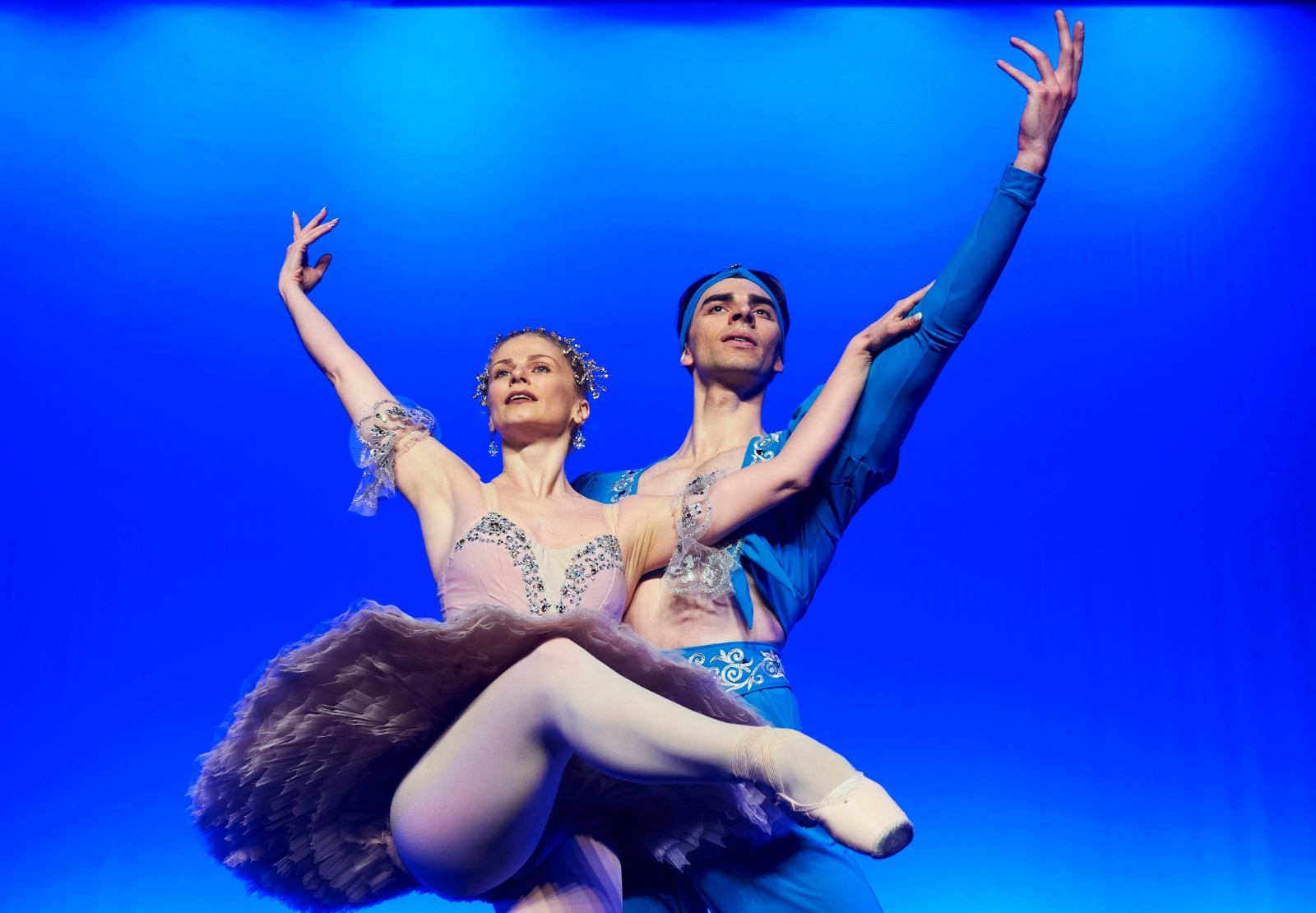
Stranded in the west after the Russian invasion, Kyiv City Ballet is on a never-ending tour and will stop off in Shaftesbury in October
In February 2022, when Russian tanks invaded Ukraine, Kyiv City Ballet was in Paris – and the company has been in effective exile ever since, performing across Europe and making a first visit to the US. In early October, the director, artistic director and some of the dancers are coming to North Dorset. The week-long visit will be a rare treat for lovers of classical ballet and dance in general. They will be hosted by Shaftesbury Refugee Group, whose members are drawing up a programme which aims to delight dance lovers, provide inspiring workshops for local young dancers, engage the interest of the many people sympathetic to the plight of the Ukrainian people and stimulate some illuminating discussions.
Bread and salt It will be an opportunity for the more than 250 refugees (mainly Ukrainian) now in the Shaftesbury and North Dorset area to reconnect with the language and the rich culture of their homeland, as well as giving a chance to many local people to learn more about the background of the people to whom they have opened their hearts and their communities. The hosts and their partners will meet the Ukrainian dance company at an opening reception at Compton McRae, the deli-cafe at Semley. This event will have the Ukrainian traditional theme of “bread and salt” – offering a loaf of bread and salt as a sign of respect to the person you are meeting.
A rich, local life During the week there will be school workshops, events attended by the Mayors of Shaftesbury and Gillingham, and a film and talk at Shaftesbury Arts Centre. There will be two discussion evenings, at Shaftesbury and Gillingham, with the ballet company director Ivan Kozlov and the artistic director, his wife Ekaterina (Katya), with a particular focus on ideas of identity and the role of culture in a time of war. The week will culminate in an exciting celebration of Ukrainian culture at The Exchange at Sturminster Newton on Sunday 8th October. The evening will not only include ballet performances and traditional Ukrainian dances by members of Kyiv City Ballet, but also songs by locally-based Ukrainian singers and Shaftesbury’s Palida Choir, founded by composer and musician Karen Wimhurst – as well as some surprises! ‘We want to use the visit of Kyiv City Ballet to draw attention to the positive influence of refugees on our community, to show how their endeavour, cultural transfer and economic contribution makes for a richer local life,’ says Carolyn Godfrey, who chairs Shaftesbury Refugee Group. ‘It is also an opportunity to thank the local community for their support, especially the hosts involved in the Homes for Ukraine Scheme.’ There will also be some respite for the dancers, who have been living as displaced persons for nearly 18 months. ‘Maintaining a company without a base is sometimes intolerable,’ says Carolyn. For their week in North Dorset, they will be staying as guests of the Grosvenor Arms, and the SRG has arranged for two recreation days when the Ukrainian visitors will see some of the landmarks and attractions of this beautiful area.
The infinity tour Kyiv City Ballet was founded by its director Ivan Kozlov in 2012 and now numbers about 40 dancers, some of whom are still in Ukraine. Ivan was a leading dancer with both the world-famous Mariinsky Theatre in St Petersburg and the ballet troupe of the National Opera of Ukraine. The Kyiv company, whose two-week European visit in 2022 has turned into what Ivan calls ‘the infinity tour,’ has been delighting audiences at the Edinburgh Festival Fringe and will be giving a number of performances in London in September. The slogan of this brave ballet company is ‘Spreading the message of peace and love worldwide through ballet. You can stay updated with the planned events for the week via the Shaftesbury Refugee Group website here.
• Shaftesbury Refugee Group is grateful for the generous support of The Grosvenor Arms and its owners, Stay Original Co. The project is also supported by grants from Dorset Community Foundation (Dorset Welcome Grant), Dorset Council (Community and Culture Fund Round 5), Toby’s of Shaftesbury Fund, North Dorset Partnership, Community and Inclusion fund and TLW Dance Foundation.•
• As well as Shaftesbury and Gillingham Town Councils, the project has a number of partners including local schools, TLW Dance, Compton McRae, Palida Choir and Shaftesbury Arts Centre.
Peter Harding Wealth Management (PHWM), an appointed representative of St. James’s Place Wealth Management, has donated £2,500 to Lewis-Manning Hospice Care. Peter Harding and Clair Smith, representatives of PHWM, visited the hospice for a guided tour and were updated by CEO Clare Gallie on the hospice’s expansion over recent years. Peter Harding expressed admiration for the hospice’s dedication to local communities, stating, ‘It’s been great to hear about the impressive growth of the hospice’s services to the local communities that it serves, supporting patients and their families with life-limiting illnesses. We are committed to continuing our support to Lewis Manning – it’s important to us as a business and brilliant to know that it is making a positive difference to them. We’re proud to facilitate these funds via the St. James’s Place Wealth Management Charitable Foundation.’ In response, Clare Gallie conveyed her immense gratitude: ‘We are deeply thankful to Peter Harding Wealth Management for their continued support, which is helping us bring our services closer to patients’ homes.’
The G&S honours North Dorset’s vibrant sectors in a showcase of tradition, innovation, and community says MP Simon Hoare
Simon Hoare MP
The Gillingham & Shaftesbury Show is an always an annual showcase of all that is good and impressive from across North Dorset. It is, of course, primarily an agricultural show – allowing our fantastic local farmers to come together and to show off their livestock to visitors (and each other!). Farming and the wider food sector is so important to our North Dorset economy, of course, but also, much of our landscape depends upon farmers and landowners. I want to salute them for going out in all winds and weathers to feed us and maintain our environment. When food security and supply chains are at the forefront of so many debates, if we ever needed to be reminded of the importance of maximising sustainable UK food production, the time is undoubtedly now. But the G&S is, of course, not just an agricultural show. It provides a platform for many local businesses, allowing them to exhibit their entrepreneurial flair and innovation. Their importance locally is not just in job creation – they play a vital role in the mosaic of “North Dorset PLC”. The show is also a fantastic opportunity for so many of our local charities and voluntary sector organisations to explain what they do, raise much-needed funds and hopefully secure some new volunteers or helpers along the way. The immense skill of the local craft and cottage industries at the show provide us an important link to our collective roots.
Volunteer Trimmy at the G&S showground
Old and new I believe that these groups illustrate the strengths and the character of our beautiful part of Dorset; the vibrant and future-focused farming sector, the real community of people looking out for others through our voluntary sector, the fact we are an ancient area where craft and tradition are still valued … but also that we are a forward-looking county, sustaining our economy and creating livelihoods for our people. I want to wish everyone a fantastic show – whether exhibitor, farmer, business, or simply ready for a fun day out. The G&S is a wonderful event – I wouldn’t miss it for the world. Have a wonderful two days!
Anna Hamilton’s quiet social media plea turned into an overnight sensation, shifting her from financial despair to overwhelming success
Anna Hamilton
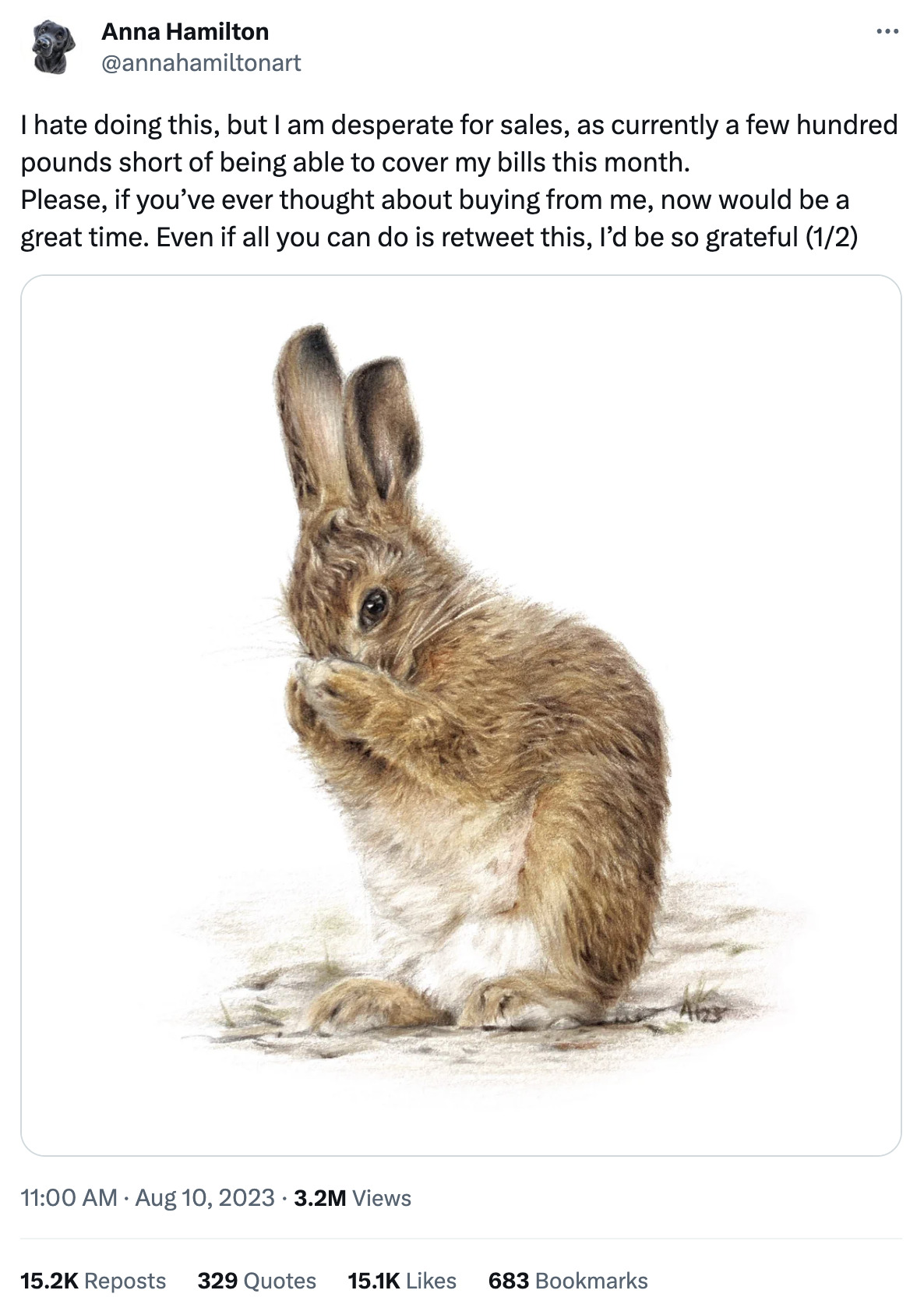
“I hate doing this, but I am desperate for sales, as currently a few hundred pounds short of being able to cover my bills this month. Please, if you’ve ever thought about buying from me, now would be a great time. Even if all you can do is retweet this, I’d be so grateful. I haven’t slept properly for days, I feel ill with stress and honestly don’t know what to do other than ask for help. Anything you can do would be so very much appreciated.” Many people have been hit hard by the sheer cost of living over the last year. For Dorset artist Anna Hamilton, scraping by from month to month, Thursday 10th August was rock bottom. She knew that this month, ‘scraping by’ simply wasn’t going to happen. She was out of options, and desperation lead her to make that single Tweet. Anna could never have predicted what would happen next. ‘I hoped it might prompt three, perhaps four sales,’ she says. ‘Honestly, I thought it was a vain hope, but I was desperate and might just sell something to get me through the month.’ Anna woke the next day to find her polite, hopeful little tweet had gone viral. She had more than 3,000 orders, her online shop had sold out, the website buckling under the strain. Every inbox was overflowing with messages. ‘I was stunned. Overwhelmed. I have no idea why it happened.’ Backed up by art which is both beautiful and accessible, it seems all Anna really needed was to be seen, and that single sad, lonely, late night message had a magical effect on the often-cynical Twittersphere. The comments and re-tweets flooded in. Compliments on her art abounded, and many also shared it on – a simple, generous act which cost them nothing. In so doing, a bigger audience than Anna could ever have dreamed of saw her work. At time of writing, the tweet has been seen by 3.2million people. It’s been reposted more than 15,000 times, and bookmarked by almost 700 people – presumably those waiting for Anna’s shop to restock.
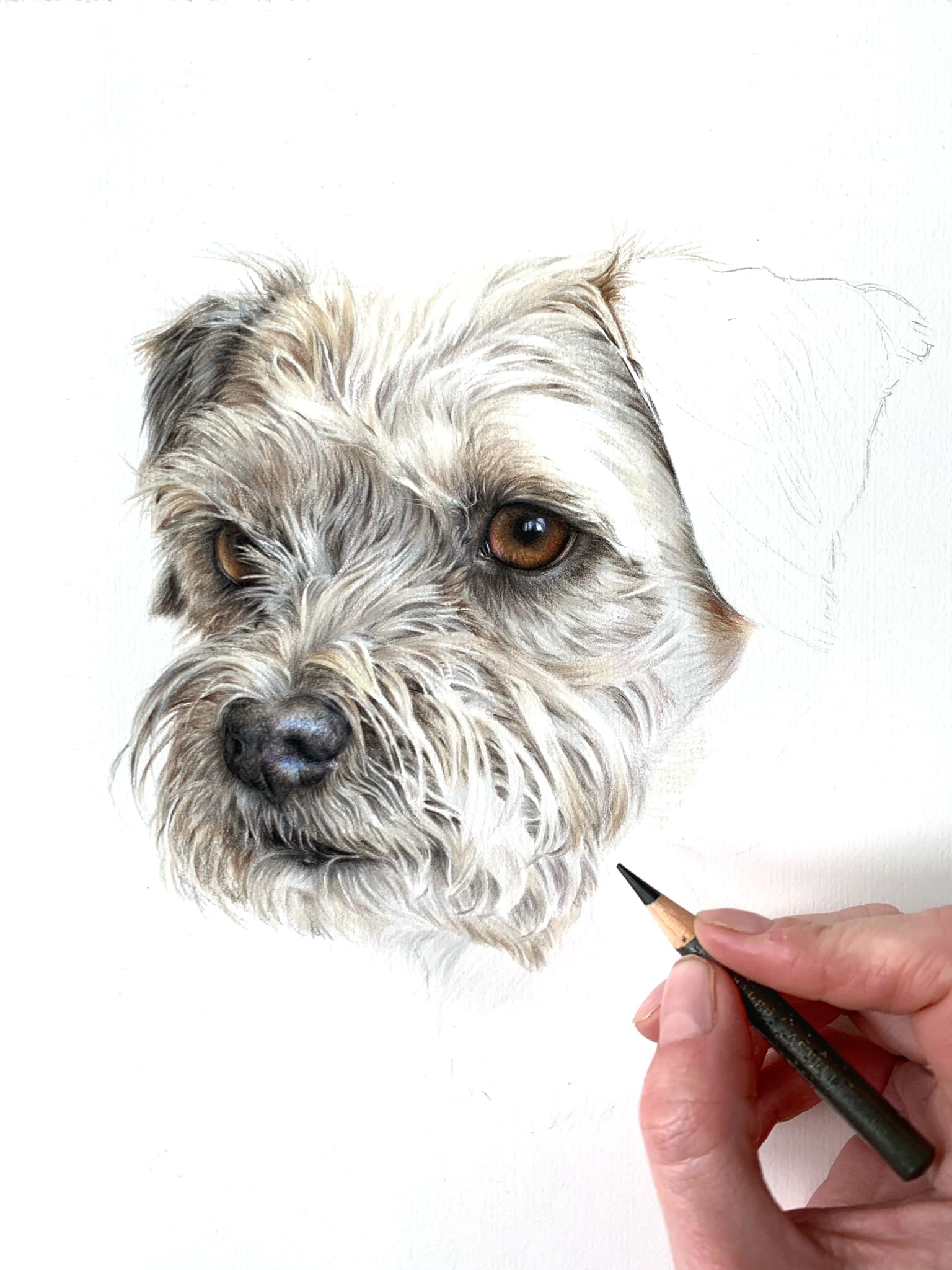
Tilly in progress – commissioned portrait
An accidental career Anna is entirely self-taught, and her career as a professional artist was almost accidental. ‘I’ve been drawing ever since I could hold a pencil. But I never really considered making it my job – the only artists who earn money are the dead ones, right? So I spent 12 years as a data analyst – about as far as you can get from creativity! ‘But I never stopped drawing as a hobby. A friend asked if I could draw their dog. Then another requested me to ‘do their cat’. Eventually, about eight years ago, someone pointed out I should really stop doing them as favours and actually charge for my pet portraits! ‘In 2018 I was able to give up the day job, and become a full-time professional artist through both my pet portraits and wildlife art.’ Anna only works in pencil, ‘… mainly because I don’t like having to clean anything after I’ve been working! Sadly, art is a luxury item, and it’s an obvious thing to cut back on when times get tough. I had to take on two part time jobs to make ends meet. It’s been so incredibly stressful, and I was at a very low point. It’s tough to ask for help.’ Unexpectedly making 3,000 sales in 24 hours brings its own level of stress, however. ‘I’m now kept awake at night having a bit of a panic attack about all the emails I’m getting about orders that haven’t arrived. My tiny flat looks like a warehouse! ‘It seemed like such a good idea to individually sign and hand write the title on my limited edition prints – it was a really nice touch when I was doing a couple a month.
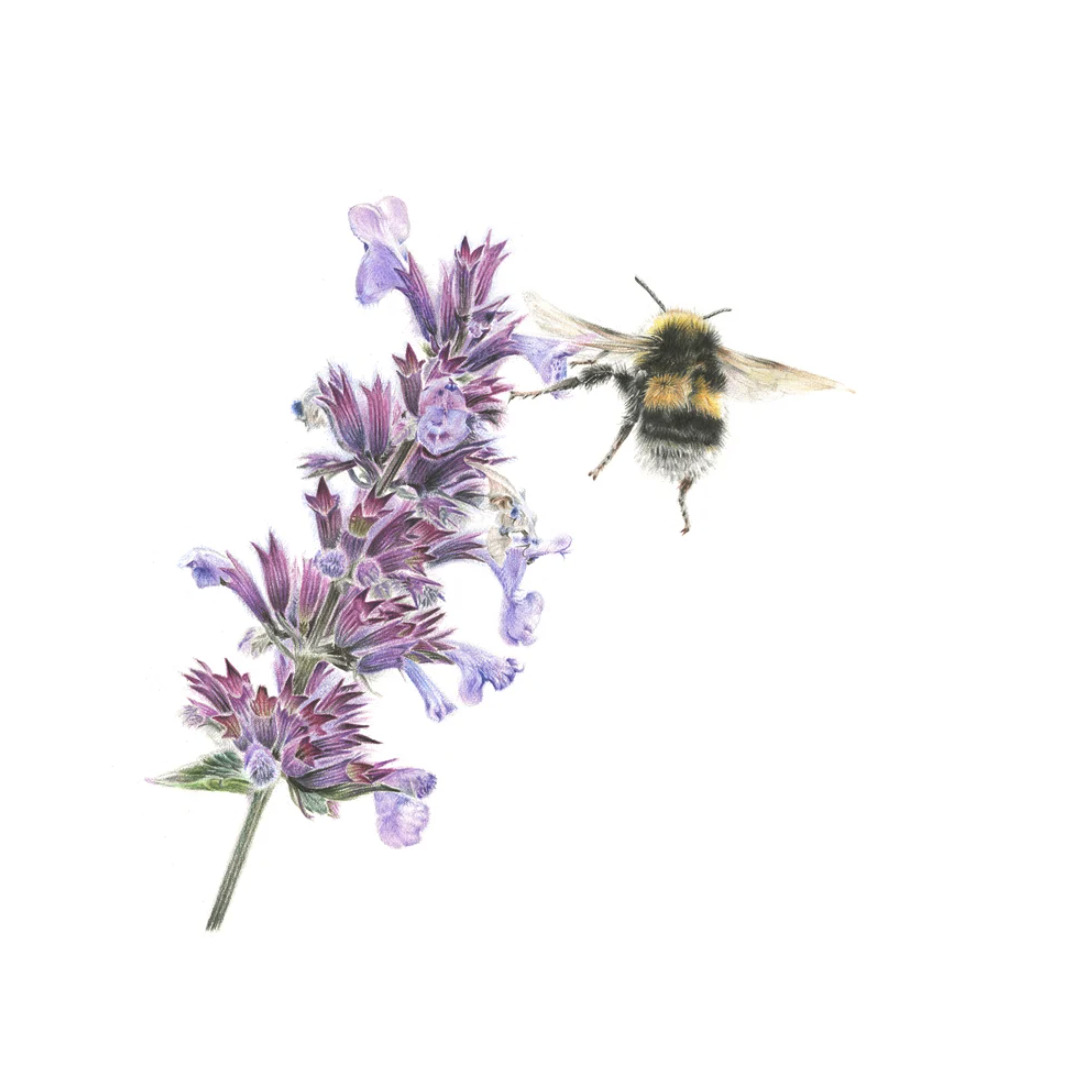
Bumble – limited edition mounted print
‘But now I have to get 300 done – once I’ve mounted them by hand – and also put together 7,000 greeting cards. I had to order complete new stock, but that arriving was a double-edged sword. I had to holepunch 1,800 bookmarks and add the tassels myself (though I did buy some posher tassels to celebrate!). ‘Even if I were to send out 100 orders a day (which in itself is impossible), it would take me a full month to get through every order that has come in. The size of the task in front of me is very scary, and now I’ve had a few people complain because they haven’t received orders yet. It’s upsetting, I’m trying but simply can’t keep up – I’m surviving on very little sleep at the moment! ‘But most people have been really understanding and are just happy for me. And of course, I’m so grateful for the orders. It’s just been a wild, exhausting and unbelievable few weeks. This has been the hardest but best thing that’s ever happened to me and I feel incredibly lucky. I’m sure at some point I’ll look back and laugh!’
The warm, wet summer hasn’t been a pleasure for most of us, but the veg approve – Barry Cuff has never had such a good harvest
A very damp July was followed by a damp August – perfect conditions for potato and tomato blight. Coupled with high humidity and warm nights, it was inevitable that there would be an outbreak of the disease. First signs on the potato leaves were spotted at the end of July, but the spread from plant to plant was unusually slow. However, by 15th August it had spread to all the potatoes on the site. This disease can be difficult to spot and can be confused with magnesium deficiency, which was common this season and probably due to the high summer rainfall. Once blight is seen it is best to remove the haulms* to prevent the disease from reaching the tubers. We always plant our potatoes early in the season so as to avoid the worst of the blight, and we remove the haulms ten days before lifting. Our maincrop varieties were all dug and stored by the 20th, and the earlies and second earlies were dug in July.
Crop round up The wet summer has ensured there was good growth of vegetables and fruit – in more than 30 years on the plot I cannot remember such good yields from most of our crops!
Beetroot: these have simply been harvested as needed for salads and pickling.
Brassicas: All are doing well and protected from pigeons by a net! There has been less Cabbage White caterpillar damage than some years – these are just removed by hand when seen.
Carrot: We are lifting good roots of Early Nantes. We made a last sowing on 18th.
Bees enjoying a large Echinops on the allotment flower border
Celeriac: The plants growing well. We mulched with compost on 20th.
Celery: Loving the rain! Dug one plant on 20th.
Chinese Leaves: Sown on the 13th (Mustards, Mizuna) after potatoes were lifted.
Chinese radishes: Four varieties were sown on 13th – will need to keep an eye out for flea beetle.
Courgette: Plentiful harvest!
French Beans: Finally slowed down by 25th.
Gherkins: Plentiful picking every third day.
Leeks: Growing well.
Lettuce: Excellent hearted plants of Little Gem from successional sowings.
Mange tout: Still picking twice a week.
Onion: Excellent bulbs of both Golden Bear and Bonus. Harvesting over a period to allow to dry.
Parsnips: Amazing tops, so we should have good roots for late autumn and winter.
Peas: Our single disappointing crop, the peas finished producing in early July.
Raspberries: Very plump fruit picked every third day. Bees and hoverflies have been doing a wonderful job pollinating the flowers.
Runner beans: Production has now slowed down.
Spring onion: The last lot sown is doing well and simply being pulled as required.
Sweetcorn: We had our first cobs on 23rd – and they were delicious!
Squashes (winter): The patch is actually a jungle, but I have managed to spot two Crown Prince and one Butternut!
Sweet Peppers: All varieties are doing well in the greenhouse. First fruits were picked mid month.
Tomatoes: Large pickings from the greenhouse! *the stalks or stems
How the Dorset charity Future roots is cultivating a new generation of resilient youths out of those abandoned by an inflexible system
Future Roots students are expected to participate in all aspects of farming
Registered social worker Julie Plumley grew up on a farm – 15 years ago she saw the potential of the farming environment for helping young people who were not coping in a main stream school environment. Future Roots has now seen over 1,200 youngsters, aged from as young as 8 up to 18, through its gates since it began in 2008.
It’s not you Julie is quick to point out that the young attendees aren’t the problem—it’s society’s lack of both understanding and flexibility toward their unique needs. ‘Young people come to Future Roots not because they are “naughty” or “bad,” but because they need a secure learning space where they can truly flourish,’ she says. One of the charity’s notable collaborations is Branching Out, a project in association with Child and Adolescent Mental Health Services (CAMHS) that supports those who fall outside the criteria for Core CAMHS – referrals are strictly through CAMHS. Julie believes that farming is a gateway which offers an alternative learning opportunity and prepares young people for future life.
Future work Some of the youngsters who have attended Future Roots have themselves become farmers and thanks to the lottery funded Youth Ambassador programme young people who have attended Future Roots will be able to have their say about what things impacted most on their life in a positive and negative way. This will include what has worked, what they would have liked to happen and what they think might have worked for them, resulting in a book of life stories and a video. These materials will be used as training tools when approaching teachers, social workers, and youth workers. The lottery has also funded Rural Remedies at Future Roots, which supports very young people from nine to 13 years who don’t have statutory intervention but are referred via families, teachers or other people who know them and feel they are struggling. As a result of Covid, the team at Future Roots is finding that there are many young people struggling and too anxious to even go out the door. The Rural Remedies work is around improving confidence, resilience and helping these young people to catch up. The charity recently received two year funding for its Futures programme from the John Lewis partnership and the Police Crime Commissioners Fixing the Future Fund which is centred on supporting Future Roots young people into adulthood, assisting them into suitable work or training settings. ‘Over 17 years of work at Future Roots, we have demonstarted that farming can be one of the greatest learning opportunities and untapped health and social care services.’ says Julie. ‘It enables young people to become resilient, purposeful, confident, caring members of society, providing stability and direction.’
Julie believes in the innate benefits of simply learning to look after livestock
Director needed Future Roots is currently on the hunt for a Deputy Director to increase the capacity of its management team and to help run a number of new projects that have developed over the past couple of years. If you’te inetrested, more info and full job description here.