This month, more than 300 makers and artists will be taking part in the first full the Somerset Art Weeks Open Studios event for five years
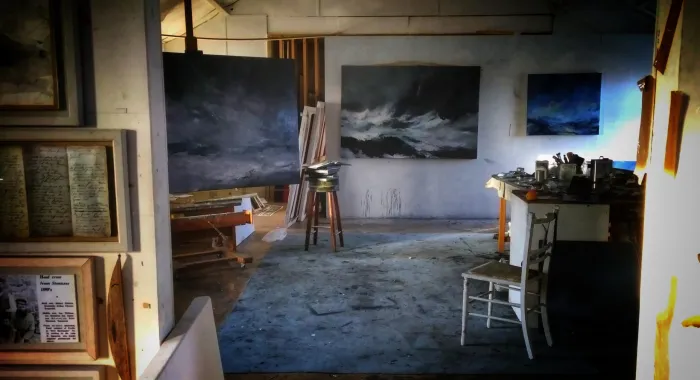
Jannette Kerr – known for depiction of wild seas – is opening her studio in Coleford
HIS year’s Somerset Art Weeks, from 16th September to 1st October, will be the first full Open Studios event since 2018, with more than 300 makers and artists across the county, from Wincanton to Watchet, wil be inviting the public into their work-places. Organised by Somerset Art Works, since its inception in 1994, the the open studios fortnight has become an important event in Somerset’s cultural calendar. Traditionally biennial, alternating with group and gallery shows, it is an invitation to meet some of the area’s most exciting and original creative people in their own place – studio, workshop, home or shed. Painters, photographers, printmakers, sculptors, potters, woodworkers and textile artists will all be opening their space to show their work. It’s not only an opportunity to meet interesting, creative people but also to explore the county and discover places you didn’t know! It’s the perfect chance for the casual and curious visitor to see what goes on behind normally-closed studio doors. Artists value the engagement that the event provides; a chance comment or connection can sometimes provide invaluable encouragement. In Batcombe, a collection of artists are working together: Jo Addison creates linocuts, etchings and watercolours of natural subjects. Camilla Frederick is a portrait artist who works in oils. Alison Harrison is a sculptor works in bronze and mixed media. Debbie Hart specialises in tesxtile art with patchwork and quilting. Jade Ogden makes handwoven scarves and soft furnishings using dyed and undyed local and Shetland wool. Jan Pitt creates her work in pastels and oils. Peter Sheldon’s is showing a collection of quirky illustration and newsprint collages. Castle Cary hosts an exciting cluster of creatives at Pithers Yard, including photographer Dave Watts, painter Franny Watts, prop maker Charlotte Austin as well as Tom Baskeyfield and Lotte Scott, who create works informed by interests in ecology, spirituality, matter and place. Near Frome, ceramicists Christine-Ann Richards and Lutz Krainhoefner have a joint studio venue, with work, inspired by their travels to China and Japan, featuring burnished, smoke-fired pottery and glazed stoneware. The Somerset Open Studios 2023 Guide is online here and Somerset Art Weeks (SAW) venue signs will guide you to the sometimes hidden venues. SAW is also working with Visit Somerset to give an increased profile for the event and its artists on the Visit Somerset website. For more details and to plan your visit, please visit somersetartworks.org.uk or visitsomerset.co.uk
Inspired by post-Impressionists, Carolyne captures intimate, light-filled interiors in her Shaftesbury studio
Carolyne Moran in her garden
During lockdown, we were plunged into a world where both work and social life were played out in a virtual world – and we suddenly had the opportunity to sneak a look into the personal spaces of our friends, of colleagues and celebrities. This intimate snapshot into the lives of others is not entirely new – artists have always taken inspiration from their immediate surroundings, often revealing much about their everyday lives. The things we have in our homes say a lot about both us and the lives we lead. Interiors become a portrait of the owner; the human essence that is left behind when the room empties. Carolyne Moran is an artist drawn to interiors: ‘But it has to be the right interior. It’s to do with light against dark, or certain reflections. Older properties inspire me … and I get very attached to chairs and odd pieces of furniture,’ she says. In her studio, at the foot of Shaftesbury’s Tout Hill, alongside her paintings is an eclectic mix of antique chairs and objets d’art.
All images: Edwina Baines
Antiques and art Carolyne studied Fine Art at Bournemouth and Exeter colleges of art. After six years of training, she worked for some years with the influential Bath artist Saied Dai. She completed her PGCE at Cardiff College before embarking on a career as head of the art department in several Dorset schools. She has had regular exhibitions at the Mall and Bankside Galleries in London, where she has won two awards. Her work has been featured in numerous art publications including The Artist magazine, and she is listed in Who’s Who in Art. Some years ago she ran an antique shop in Blandford where her love of beautiful furniture led to a constant hunt for new finds – many of which are included in her paintings.
Carolyne’s studio is filled with an eclectic array of objets d’art
The Red Aga – a work in progress
Putting in the work Carolyne is inspired by the Post-Impressionists Pierre Bonnard and Edouard Vuillard, founder members with other young artists of the avant-garde brotherhood Les Nabis (The Prophets). This Parisian group played a large part in the transition from Impressionism to Abstract art. After Les Nabis disbanded, Bonnard and Vuillard were involved in the Intimism movement, which is known for the depiction of everyday scenes, particularly within domestic interiors. ‘The first Bonnard exhibition I went to, I cried the whole way around,’ Carolyne says. ‘I found his paintings so moving.’ The influence of Bonnard is evident in many of Carolyne’s paintings – his interiors with their characteristic intimate and cosy atmosphere and his use of colour to capture the play of light and shadow. Vuillard was also known for his small-scale interior works, combining flat patterns with delicate colours. Carolyne’s favourite place to paint is sitting by the window with views of her garden: ‘I try to have discipline in my art. Painting is hard work. You have to set aside the time,’ she says.Once at work on a painting, she will often stay at the easel until late at night – and then lie awake thinking about the next stage. Painting mainly in gouache and oils, she will spend a day working out the composition in pencil or charcoal before applying a tint to the paper. Work may continue on several pieces at once and it could take up to a month to finish a complete painting.
Looking Through to the Little Stone Conservatory
‘Shapes, patterns and colours are important to me. I don’t do big landscapes. Often my flowers and garden paintings are like rooms. I’m often looking through the window … It’s your personality that you put on a piece of paper or a canvas,’ she says.Holidays in France offer further time for painting. Each of Carolyne’s works tells a story. In Looking Through to the Little Stone Conservatory, someone may have just walked out of the room into the sunlight, leaving the door open behind them. Another shows a soft glow from table lamps – perhaps showing a favourite spot for the owner to sit and read. Carolyne’s own garden – full of flowers, especially foxgloves – is also a source of inspiration. Everyday objects with a particular shape, pattern or colour can also capture her imagination. Her striped kimono hanging on the back of her bedroom door has been the source of several paintings and the red Aga – central in a current work in progress – has been featured several times. The kimono and the Aga both symbolise comfort and a familiar warmth.
Studio Interior With The Green Chair
Open studio Carolyne opens her studio for the second Blackmore Vale Art Trail which runs from 9th to 17th September. Participants all live within a ten-mile radius of Shaftesbury. Artists across a wide range of disciplines, from painting to jewellery, are opening their studios. Brochures are free and available in shops, pubs, cafes and libraries.
Get set to cheer your favourite team as the Pony Club Mounted Games gallops into the Dorset County Showground for the first time
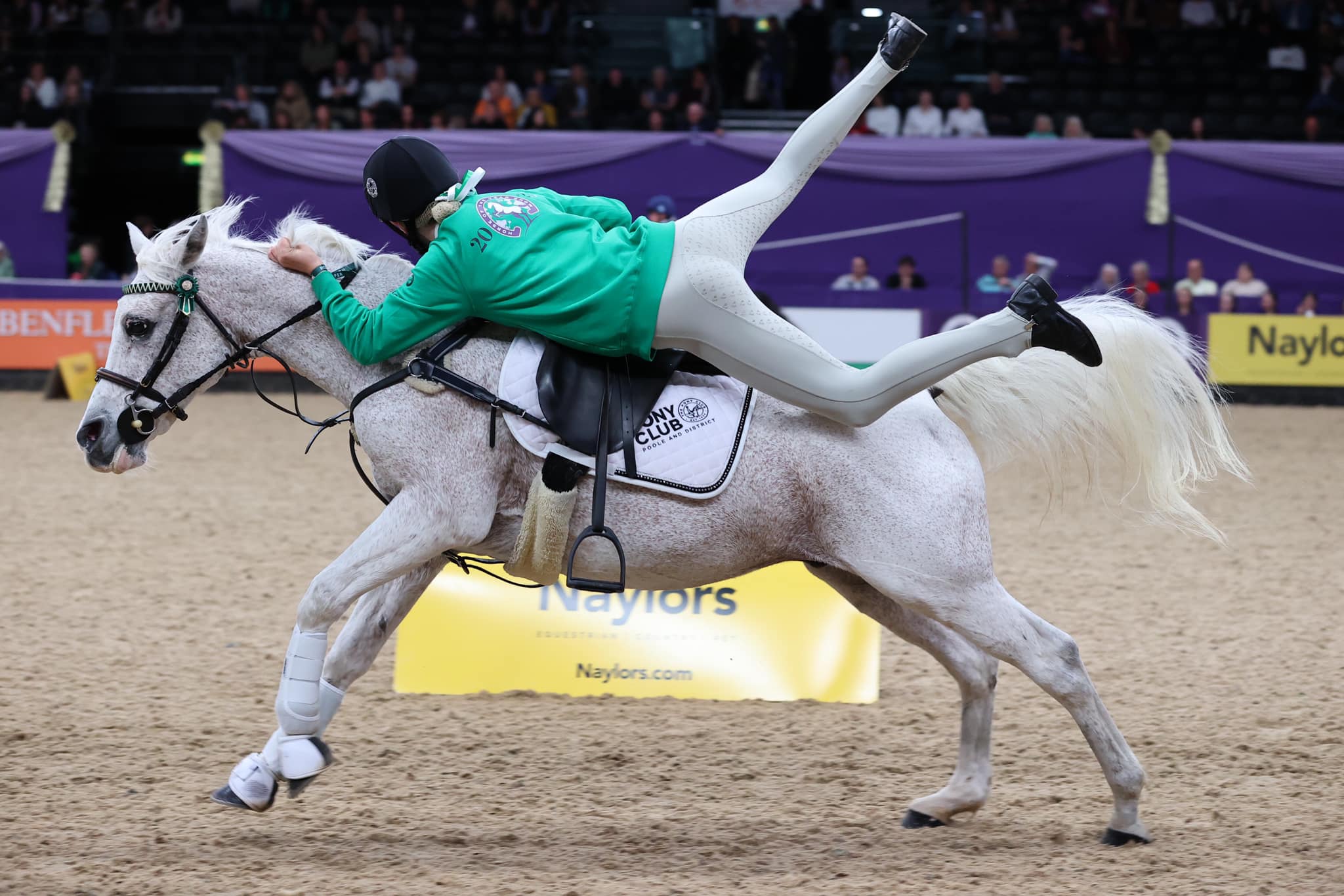
Poole & District Pony Club’s Holly riding Dude at NEC Birmingham in the Horse of the Year Show 2022
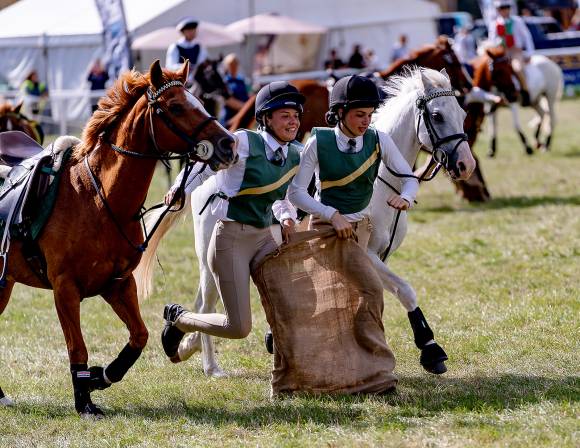
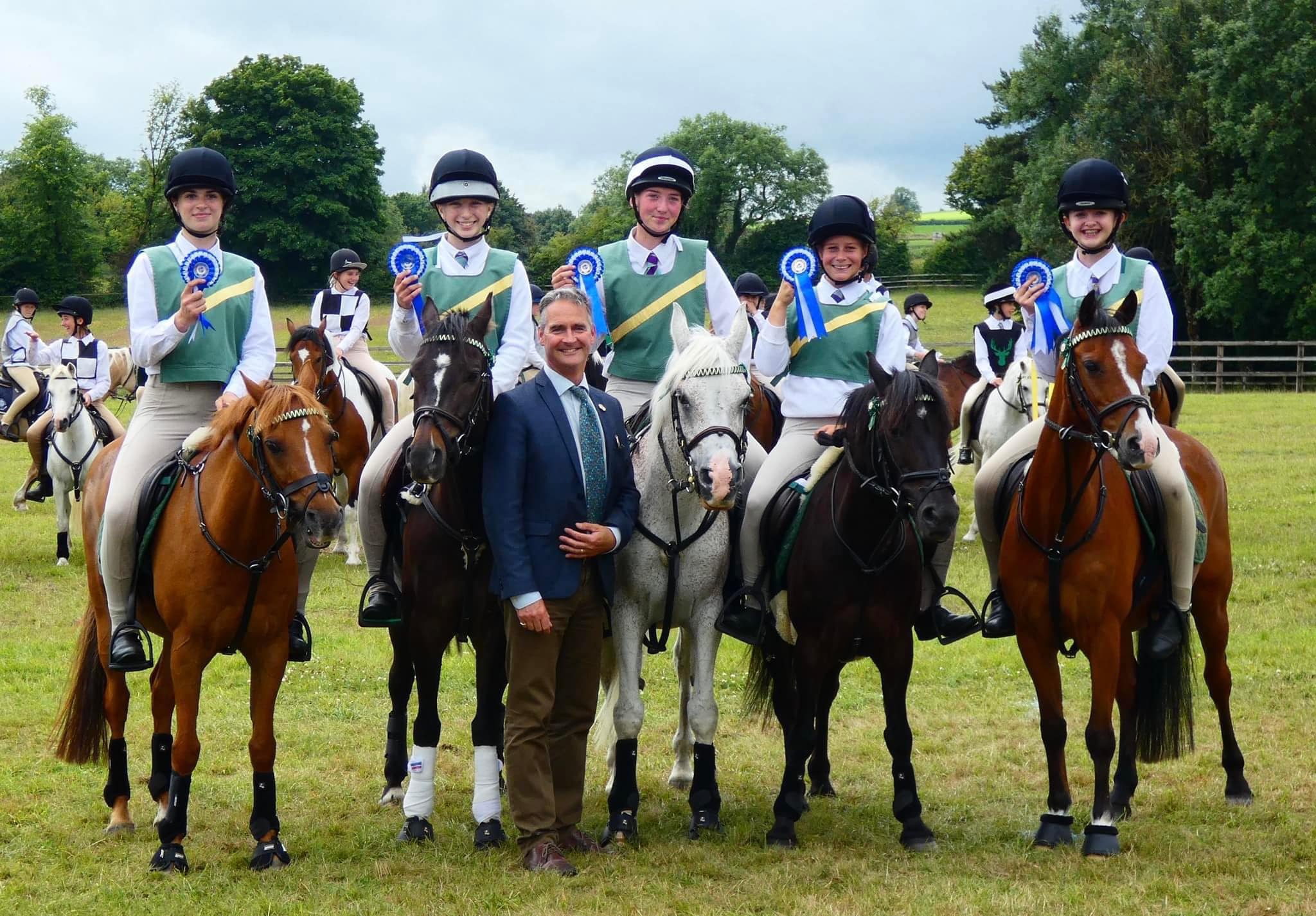
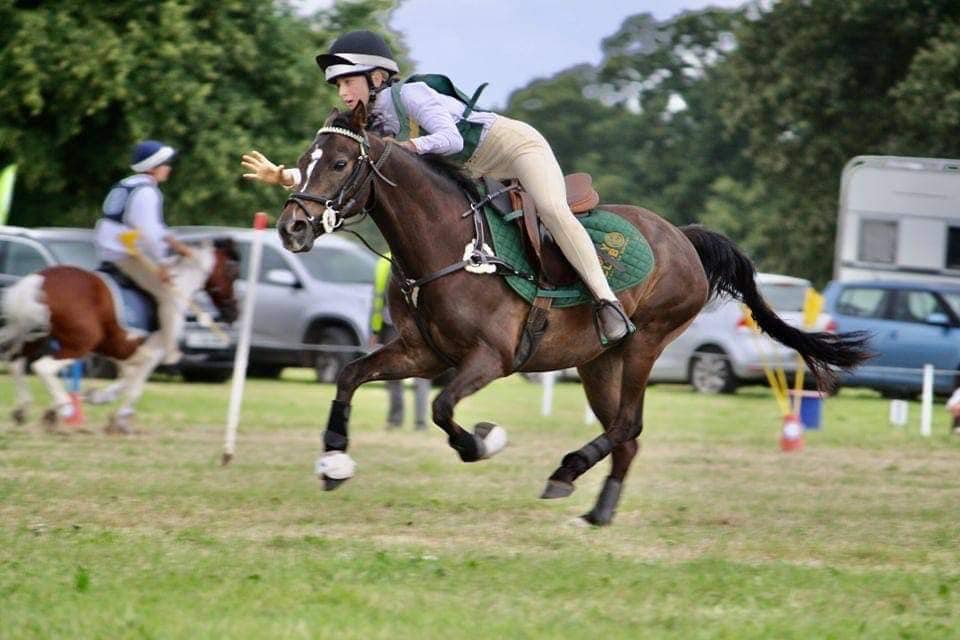
Think school sports day … but on turbo-charged ponies! The thrilling Pony Club Mounted Games are another new attraction at this year’s Dorset County Show, and it all happens in the brand new Hill Top Ring. Featuring fearless young riders ranging in age from eight to 15, teams of four or five riders and their speedy ponies compete in a series of exciting relay races that involve a mix of turns, handover skills, vaulting and galloping.
Riders must navigate their way through a variety of obstacle races, which can include bending poles, stepping stones and a stacking race. All classes rely on the skill, control and agility of the rider to complete without penalties – and of course finish quicker than the other teams. The ponies must be calm, fast and able to turn on a sixpence – which makes great entertainment for spectators! Each team sports a different colour bib so you can cheer on your favourite.
Top tip – the last rider in each team wears a white headband, so be sure to look out for them crossing the finishing line! Ian Mariner, Pony Club Mounted Games chairman, explains: ‘These games are an adaptation of the traditional gymkhana, which tends to have solo competitors. Mounted Games focus on teamwork. It’s all about the three C’s – concentration, competitiveness and commitment. Plus, of course, a love of ponies. ‘And the ponies love it too. It’s just like teaching a dog, they come to understand the games and what is being asked of them. They get as excited as the riders!’ ‘The more mature ponies are definitely the best,’ says Nicola Way, the Mounted Games Area Coordinator and trainer at the Poole & District Pony Club. ‘They have years of experience to cope well with the sights and sounds of big events.’ ‘These exhilarating games are not just about having fun,’ says Ian. ‘They are also teaching these young horse riders valuable skills – improving accuracy, agility, concentration, speed, hand to eye co-ordination, team work and sportsmanship.’
Many of the Mounted Games riders go on to compete for their country, working their way up through local, regional, national and even international championships. Part of the Pony Club agenda is to also teach young riders about animal welfare and care of their ponies. Many competitions now include an element of stable management as part of the judging process. The four tiers of Mounted Games competitions culminate in the six top teams competing at The Horse of the Year Show for the coveted Prince Phillip Cup. Ian Mariner says: ‘Many of these young riders you see today competing could end up as stars in the equestrian world. You could be cheering on a future Olympian!’
Did you know?
The Pony Club, founded in 1929, is represented in 27 countries with a worldwide membership exceeding 110,000, making it the largest association of young riders in the world. Mounted Games is one of nine disciplines Pony Club members can learn, along with show jumping, dressage, endurance, eventing, polo, polocrosse, pony racing and tetrathlon.
From folk to installation art: Helen Ottaway talks about about her multi-dimensional journey in music as she chooses the discs she can’t live without
Helen Ottaway
Frome-based composer Helen Ottaway is a sound installation artist and founder-director of Artmusic, which creates collaborative, participatory, and site-specific art. Among her many musical interests she loves folk music, and has been described as a folk minimalist. She has two audio installations at this month’s Inside Out Dorset Festival. The first, Lachrymae, was created through Artmusic in 1999. In the original installation, the movement of people around the space triggered the sounds. Helen collaborated with visual artist Rowena Pierce, who made the wonderful teardrop hangings (lachrymae is Latin for tears). Visitors could walk through the wood, see the amber drops of the sculptures in the trees, and hear the music. The second installation, Saeflod, is a walking requiem. ‘It started in 2017,’ says Helen. ‘My mother had died, and I went on an artist residency in Sri Lanka. I had always thought that her death would be when I would feel like writing a requiem – and I did. I started sketching in Sri Lanka, by the sea. I’ve carried on, supported by Artmusic and Inside Out Dorset Festival, and it’s come to fruition this year. Again, this is an installation that includes music and some visual elements – you discover it in the woods. There’ll be interactive elements and a choir, which performs at particular times.
A life in music And so to Helen’s eight music choices, in no particular order, along with how and why they have stuck in her life:
Love’s Old Sweet Song Kathy Durkin This is a song that my mother used to sing to me and my sister at bath time and bedtime. I’ve got really clear memories as a little girl sitting on her lap, wrapped in a towel, hearing her sing this song. Both of my parents were very musical – my father sang in the Oxford Bach Choir. My mother had been a really good pianist at school and often played in assembly. She never took it much further, but she was always playing. And we had inherited a lovely Blüthner grand piano from one of my father’s aunts, ‘musical aunt Lucy’. So I grew up surrounded by music. My father was a vicar, and my parents met on stage – they were both in the amateur dramatics society, and they played opposite each other, that was the beginning of their relationship! There was always music, and my mother was always singing and humming.
Monteverdi: Vespers of 1610 Duo Seraphim, The King’s Consort Choir under Robert King. I took a little while to really love classical music, although it was it was in my blood and I played a lot. I don’t remember many concerts until this one. I had an inspirational school music teacher who brought music to life in a brilliant way – he took the class to Coventry Cathedral for a performance of Monteverdi Vespers. It was around the time when John Eliot Gardiner had started the Monteverdi Singers and it may actually have been them. It was just beautiful. And the one piece that I really love is where the voices of the baritone and countertenor dance with each other. It just stayed with me, this beautiful environment, the beautiful music – and then I found this particular version of it. The baritone is James Gilchrist, and later on in my career I was lucky enough to have James perform my music. I wrote a choral piece called the Echoing Green, it was the opening concert of Salisbury Festival, in the cathedral, in 2003 – and James Gilchrist was the soloist.
Bring Him Back Home Hugh Masekela I went to college in London, and it was a politically tortured time really. There was Margaret Thatcher coming to power, the National Front were marching through South London, there was the New Cross fire, the Brixton riots … And through all of this, people were trying to get Nelson Mandela freed from prison. Hugh Masekala had correspond-ed with him when Mandela was in prison. He wrote this song about freeing Mandela and London in the late 70s. Throughout the 80s London was a really interesting place to be – I saw lots of first performances of major works, and lots of touring bands. And I managed to see Hugh Masekela play on a couple of occasions. He and his band made a really exciting sound. And it had this backstory as well, it was revolutionary, a political protest.
Excerpt from Inlets John Cage John Cage was an amazing person, not only a great philosophical thinker, a conceptual artist and a musician, but he was also just a lovely man. I was really fortunate to meet him twice – once when I just left college. He and his collaborating partner, choreographer Merce Cunningham, came to Goldsmiths, where I had just finished. We musicians had a week with John Cage, and the dancers had a week with Cunningham. They performed for us and we performed for them. His ideas are just very liberating. The way he thinks … it gives you permission to allow chance to take a part in your work – it’s been something that I’ve incorporated ever since. So in the case of the original Lachrymae installation in the woods in Inside Out Dorset, people walked around and triggered the sounds by their movement. It meant that the arrangement of sound couldn’t ever be predicted. It was different every time. And this is really critical to the way John Cage used to work. This piece I’ve chosen, Inlets, is also a really beautiful thing to watch. He plays a conch shell, and he fills it with water. And in front of the microphone, he manipulates the conch shell, moves it around and it makes lovely musical gurgling sounds – but the performer can’t control it. It’s really chance, what happens, because you can’t see the inside of the conch shell, you can’t see where the walls and curves are. And so it’s totally unexpected.
The Third Dream Jeremy Peyton Jones Regular Music was a band formed by me, Jeremy Peyton Jones and Andrew Poppy in 1980. We’d just finished Goldsmith – the three of us had been on the music course together. They were both composing, and I was mostly playing other people’s music at that time – often one of theirs! Regular Music was an example of the kind of avant-garde, contemporary art rock band that was around at that time. We toured and played in London for more than ten years. Jeremy became quite involved in experimental theatre and was regularly asked to write for cutting-edge companies’ shows. The Third Dream, the piece that that I’ve chosen, was from a theatre piece called Lulu Unchained, which was an Institute of Contemporary Arts (ICA) commission, written by the American writer Kathy Acker and directed by Pete Brooks. It was on for three or four weeks – something totally unheard of now. We were the stage band, I was the pianist for that production and we played this work every night. It was great! The other thing that happened was as a result of working in theatre at the ICA, I met my partner Steve, who was at the time the finance controller at the Institute of Contemporary Arts. The ICA was really, really important to all of us.
English Idyll No.1 George Butterworth This was a really hard choice! I’m sometimes described as a folk minimalist, and I’ve often talked about the influence of people like Michael Nyman and Gavin Bryars. Also the American minimalists like Philip Glass and Steve Reich. But folk music is somehow in my blood. I think there is such a thing as an English composer. I think we’ve all got a bit of that English pastoral in us. Vaughan Williams used a particular mode – I think it was mixolydian – and, as a result, his music is pretty unmistakable. It was really hard to choose one English composer influenced by folk music – it could have been Vaughan Williams, it could have been Cecil Sharp or Percy Grainger, whose music I absolutely love. But in the end I chose Butter-worth, because we don’t get enough of Butterworth! He went off to the First World War and was killed in battle, and that was the end of Butterworth’s music. It’s debatable whether he was going to carry on writing when he came back from the war. But before he went, he collected folk songs, in Sussex mainly. I have a long connection with Sussex – we always went to Sussex in the summer because as a vicar, my father didn’t own the vicarage. So my parents had a house in Sussex and we would go there once or twice a year. I found that these folk songs that Butterworth collected really spoke to me. This piece, the first of the English Idylls, has three folk songs in it. They’re Dabbling in the Dew, Just as the Tide Was Flowing, and Henry Martin. Those last two, Butterworth collected himself, and you can hear them – the folk songs are very evident in the piece of music. It’s just a beautiful thing that our folk tradition comes bubbling up through the work of newer composers and it’s been preserved in that way. I don’t collect folk songs – I don’t know if there’s anybody still singing the old folk songs actually in the vernacular. But people sometimes say that the tunes I write are like folk songs.
Blow The Wind/Pie Jesu Jocelyn Pook Kathleen Ferrier was my mother’s favourite singer – again it comes back to my mother. This piece, ‘Blow the Wind / Pie Jesu’ by Jocelyn Pook uses words from the requiem. Joc took a sample from Kathleen Ferrier singing Blow the Wind Southerly and mixed it with the voice of Melanie Pappenheim, who we both (Jocelyn and I) have worked with over many years. So in this piece you have the blend of the original Kathleen Ferrier song and Jocelyn’s new material sung by Melanie.
Take Me To The River The Commitments I don’t know if it’s come through or not, but I’m obsessed with water! Everything I write has got something to do with water – the very first piano and viola piece I wrote was called I Hear Water. And it keeps coming back. The walking requiem, Saeflod, is all about flooding. It’s a requiem not just for our personal losses, like mine of my mother, but also the environmental loss that we’re currently suffering, with climate change and species loss and loss of environment. And of course the fact that the seas are rising. When I started doing a local radio show, I decided to play only music that was related to water in some way – it could have been the title, the kind of material, it could even be the picture on the album cover. For my theme tune, I chose Al Green’s Take Me to the River. I started by using just his version, but then I found lots of other people had covered it. There’s a great one by Annie Lennox, there’s a wonderful cover by Talking Heads. And this one appears in the film, The Commitments – it’s a really lovely, exuberant version. But the reason I knew the song in the first place was back when I was living in London. Before I really put all my energy into writing music I worked as a picture researcher for Grove Dictionary of Music – a lot of the people working there were musicians as well as editors, copywriters or researchers. One day, we had a Grove Dictionary company party on one of those party river boats. And Antony, my friend, said “why don’t we be the band? We can play Take Me to the River!” So I was the bass part on my keyboard, and he played all the other parts on his keyboard. And there was a lovely singer, who worked in the post room. And that was my introduction to the song – and I’ve always loved it. By the way, if I had more choices, you’d have a lot more pop – it was really hard to choose!
A book? I have one book that I always say is my favourite – and it’s back to water again! It’s Waterlog by Roger Deakin, and it’s about what people now call wild swimming which in the old days, we just called swimming! He did a tour of the UK, and found wonderful places to swim, high up tarns in Yorkshire, lovely waterfalls in Wales, his own moat (because he used to live in a moated house in Suffolk). He was a journalist, and he came to see an installation piece I did with Jocelyn Pook and Melanie Pappenheim. We did this piece that was all about the sunken bells off the coast of Suffolk at Dunwich – there are apparently 55 churches underwater in the North Sea. And in certain circumstances, you can hear the bells ringing. It inspired a trilogy of works that we created. Roger Deakin was really interested in it and he wrote about our work; if he had lived longer, we hoped that we would make a film with him about the sunken bells. So this is what I have of him, this wonderful book Waterlog, signed by him. And on my Dorset island, I guess I would be looking for places to swim other than the sea (obviously, I’d swim in the sea). A luxury item I would like a grand piano – a Blüthner if possible. But a Blüthner with a treated soundboard so that it wouldn’t crack in the heat. I have just come back from a festival in Spain, where my latest piano piece was premiered. The festival is all outside, and the piano is sitting under the oak trees. Two years ago, when they had the first festival, the piano warped – but it has recovered! It’s the same piano that’s there this year. So I have faith that a piano can survive on a Dorset island!
Inside Out Dorset returns 15th to 24th September 2023. Experience thought-provoking installations at Moors Valley Country Park & Forest (including both of Helen’s pieces, Lachrymae and Saeflod). Gather at the rewilding spot in Bere Regis for food, stories and performances. Capture the imaginations of little ones at family-friendly circus shows in Poole and Wimborne. And see Weymouth come to life at night with giant singing dolls and expert drummers. See more at inside-out-dorset/
A whole new ring, with new attractions in it! See ponies put through their paces in the thrilling Mounted Pony Club Games and the Shetland Pony Racing – think traditional sports day on pocket rocket ponies!
Field to fork
Tradition comes alive as the colourful vintage tractor parade trundles a timeline of heritage through the main ring while the Steam Engine Section offers all the sights and smells of the past. Your little ones will love a free ride on pedal tractors in the Fabulous Food & Farming Area – this hands-on area traces the journey of food from field to fork with fun and interactive elements.
rural life
Rural pursuits are at the heart of the show – we have been showing Dorset agriculture, countryside and rural life for more than a century. During your visit you can enjoy close-up milking demos, watch sheep shearing displays, see gun dogs in action, enjoy the falconry and laugh at the ferret racing in the Countryside Ring.
This month Andrew Livingston is taking a nostalgic stroll through the Dorset County Showground
Andrew (left) with his big brother at a local Show
As a young child, the news that ‘Dorset County Show is this weekend!’ was always met with sadness. Never a reflection on the show, I hasten to add – it simply signalled the final weekend of the school summer holidays. Every year, in the days leading up to the show, I would be dragged by my mother to Dorchester or Yeovil to buy new school uniform. “I don’t need to go back to school!” I would protest (thankfully my mother knew better than me). Some of my earliest memories are of exploring the county showground, walking around in the shadow of my Dad – he was a feed rep for Mole Valley Farmers, and would alwaysbe working on the day. Well – he would refer to it as work, but what he called ‘networking’ just looked like listening to farmers moan to me. Why were they so miserable? They worked outdoors and they didn’t have the threat of going to school next week! How naïve I was. If I’d known then what I know now about the struggles of modern farming I would have suggested they start writing a column in The BV magazine to air their grievances. I certainly find it therapeutic these days!
Andrew’s Dad Guy was a feed rep who had a stand at the local shows – back when an agri stand was a caravan with awning
Times change For so many at the show, this is their one big day out of the year. Some are up every day at the crack of dawn milking, while others have been contracting evry hour they can through the summer in a mad rush to earn every penny possible. And for hours on end, my Dad would be at the Mole Valley stand, handing out cups of tea and chatting with these farmers. (I’ll be honest, standing next to him – and eating all the biscuits, obviously – the conversations went straight over my head. Not because of the content – I simply couldn’t understand a word they said in their deep Dorset dialect.) Eventually, I got older and was finally trusted to roam the site on my own. I would meet with friends and only return to my dad to reach into his pockets and steal another handful of change to spend on sweets or carnival games. When my dad’s pockets eventually emptied, the game became who could collect the most and best freebies from the stands. Simply listen to a vendor’s spiel for two minutes and scamper off with your thousandth pen of the day. What was my greatest freebie of all time you ask? I’m too polite to say. But I will say that I got it from the NHS stand and, since about the age of 13, it’s had pride of place in every wallet I’ve ever owned, but has never been touched. It’s all changed now. My days of going to the show and picking my Dad’s pocket are long gone – instead my own pockets get swiftly empties by my two small children. Thinking about it … maybe I should have used my favourite Dorset County Show freebie at some point. It would have saved me a fortune on school uniforms in the future!
Meet Dorset’s soap star Kirsty Hearne – creator of a thriving cottage industry selling goats’ milk and the soaps she makes from it
Most of us nip to the local shop when we run out of milk. Not Kirsty Hearne – she pops down the garden and milks one of her 13 goats. The result is ‘foamy and makes just the best coffee,’ she says. ‘Raw goat’s milk is great for your gut and full of good bacteria.’ She has seen a huge increase in sales from her garden gate to both locals and holidaymakers. ‘Last winter I had to limit people to five litres each, I just couldn’t keep up with demand. Especially with so many people making their own kefir.’ Her Maycottage milk – and her range of beautiful handmade soaps – began life accidently 14 years ago. ‘I bought a goat and her daughter just for the milk for my family. I was up the pub, chatting to a friend about how we might make some extra money, as you do. I’d heard that you could make soap with goats’ milk and said I was going to have a go.
Honeybee having a happy moment All images: Kirsty Hearne
‘So I started making some and going to craft fairs. I quickly discovered that I was quite creative about dressing the soaps and the stall. I use baskets, flowers and plants to create the cottage-like backdrop of where the soaps come from – it’s a pretty idyllic lifestyle look.” Kirsty then invested in an online shop. ‘I now post soaps all over the UK – particularly to Scotland. I’ve no idea why the Scots love it so much!’ Her soaps are also sold in shops in Wimborne and Bournemouth. Now from a single goat, she has a herd and business is booming. ‘I’d been a riding instructor for 30 years and thought this would give me something to do when it’s raining or through the winter. It was just supposed to be a sideline! But it swiftly took over and I actually gave up teaching.’ Her real life cottage home epitomises a genuine cottage industry. She milks all her ‘girls’ by hand, and mornings are always early. Sometimes as early as 4am if Kirsty’s at a rural show or market that day. Her goats are all registered British Guernseys and Toggenburgs. They enjoy idyllic free ranging with the chickens, and at night they sleep in stables at the bottom of the garden. They’re given no antibiotics, chemical wormers or vaccinations. ‘I only use homeopathic methods,’ says Kirsty, who’s also trained in Reiki for animals. It seems to be working – she hasn’t needed a vet for three years.
‘My girls have very different characters. There’s a fierce hierarchy and Honeybee, 13 years old and still going strong, is the matriarch. Chilli, my latest addition, is very pesky. She follows me everywhere and is so nosy.’ But don’t goats have a reputation for being a tad petulant? Kirsty says: ‘You can’t make goats do anything they don’t want to. Patience is essential. You need softness, to ask them nicely. If you pull or drag them, they simply dig in their heels and win!’
Every Maycottage soap contains 25 per cent goats’ milk along with a gorgeous variety of natural scents, all concocted by Kirsty. Her neroli orange blossom is proving a favourite this year. She believes goats’ milk soap is so popular because it’s extremely kind to skin conditions. ‘Eczema, psoriasis, sensitive skin – my soap is incredibly gentle and moisturising. It’s the same pH as your skin and it also contains 30 per cent olive oil which is anti-inflammatory.
Repeat customers tell me that it makes such a difference to their skin issues. It’s not a cure, obviously, but it helps keep the skin in better condition. And my soap doesn’t have all the chemicals that commercial soaps contain.’ Kirsty makes all the soaps at her kitchen table, packaging them in pretty fabric tied with rustic twine. Using the traditional cold-pressed method, soaps are poured into loaf moulds and rested for 48 hours before being carefully cut up and then left in the spare room to cure for four weeks. ‘It used to be my son’s bedroom, so I was glad when he moved out!’ says Kirsty. ‘It can get lonely working from your kitchen table. My other half, Keith, works all day so I can get to 6pm and have only spoken to goats or my dogs all day!’
Quick fire questions: A-list dinner party guest? American horse trainer Mark Rashid – Aikido for horsemanship is a big part of his work. It’s about softness, and works with goats as well as horses! He’s one of the most amazing people I’ve ever met.
Book by your bedside? Curlew Moon by Mary Colwel. It’s about the plight of these beautiful birds and their struggle for survival.
Rachel Jeffries uses vibrant, planet-friendly fabrics from Rajasthan to make ethical and comfortable clothes for her local customers
Rachel Jefferies modelling her Harper dress
Natural dyes and fair working conditions are all-important in Rachel Jeffries’ clothing. She brings the brilliant colours of an Indian bazaar to Dorset – a journey that begins deep in rural Rajasthan. She has travelled into the heart of India, both figuratively and physically, to learn how the clothes she sells are produced. She has stalls at the monthly Sherborne and Shaftesbury markets, and is stocked in a shop in Frome. In the winter months she returns to Jaipur, where she designs her fabrics and clothing range. And the rest of that paragraph goes. where she designs her fabrics and clothing range. Her stall is easy to spot – the riot of vibrant colour brings the bright shades of an Indian bazaar to Dorset. For ten years, Rachel had an Indian textiles emporium called House of Eunice on London’s South Bank. ‘During those years I went on an amazing journey. I wanted to travel to the source of my textiles rather than using middle men. I wanted to see where the money was going,’ she says. ’There are some incredibly talented artisans but often they only get a pittance for their work. Whenever I travelled to India I took an extra excursion, into the interior. I wanted to bring back the story. ‘I saw what was happening on the ground, and the more I saw the more I was motivated to work within a fair trade ethos. These are the real core values of my business. ‘I effectively gave myself an apprenticeship in how to make clothes. I’m totally self-taught. At first I bought some clothes off the peg from Indian wholesalers, but the fit just wasn’t right. The fabric was beautiful but the fit just wasn’t there. For example, Western women have broader shoulders. And as we age, there are body parts that we’re sensitive about. I quickly realised that I needed to design clothes to cater to my western customers. Through necessity, I learned to make patterns.’
Jaipur Joy’s Bengali housecoats, featuring the Kantha stitching that imitates monsoon rainfall
Kinder processes When the lease on Rachel’s London shop ran out, she decided to relocate to Frome, just before Covid hit. After lockdown, her business continued to evolve with a rebrand to Jaipur Joy and she sold direct from market stalls. Her direct contact with India has helped her in developing her business and given her a second chance, she says. Her focus is on the environment and the impact of the clothing industry. She sees countless examples of poor working conditions in India and is determined to work fairly and directly with the artisans. ‘I discovered ugly dyeing processes, such as an acid-based bath where workers were operating barefoot and had no protection. It has a terrible impact on both the people and the environment. I felt that there had to be a better way – I didn’t want my fabrics to depend on these processes. Then I found a wonderful community of printers who work in a more humane way, using natural dyes. They bake the designs on the fabric using rollers in an oven. Fabric gets through the rollers in five minutes and it fixes the dyes. ‘I also work with artisans who are using plant enzyme technology, which is far kinder to the environment. Significant amounts of water are used in the process and a lot of dyes end up in rivers. I’m working with artisans who use a natural process – they’re using the calla lily in the water, because it produces natural enzymes which effectively ‘eat’ the waste material, making the water almost drinkable so it can then be reused. It is much cleaner. That’s really important in a desert state like Rajasthan.’
Rachel’s colourful stall on Abbey Walk at the monthly Shaftesbury Market
Madamji Jaipur is famous for its colourful sandstone buildings, earning it the name of The Pink City. It inspired Rachel to design an initial capsule collection of clothing,and, to her amazement, she sold out of the six designs and four colours. Rachel loves Jaipur: ‘There’s so much beautiful architecture, and the history of the Mughals, the Maharajahs, the palaces, the art … and, of course, the people. They are so warm and joyful.’ When Rachel started working with artisans she encountered several people greeted as masterji – a term of respect for a male teacher. ‘You really have to work with a masterji. There is a masterji for printing, for dyeing and for pattern cutting. They are the experts and they command significant respect. You need your masterji to get things done. In fact, when I was there they called me madamji!’ The patterns and processes of some of Rachel’s textiles are embedded in Indian culture. For example, some designs use Kantha stitching – ‘essentially a running stitch and used to quilt fabrics together. We’re only just getting started with recycling in this country, but other nations have been doing things a lot longer. Typically, old saris or curtains were sewn together to make a bedspread or bed cushion, to make a further use of the fabric. It’s originally from West Bengal, a region known for its monsoon rains – when they sew Kantha stitching they try to imitate the monsoon rainfall in the embroidery. It’s very dense, vertical embroidery.’
Rachel has Kantha-stitched jackets and throws in stock, as well as a range of pintuck shirts, tunics and comfortable loosest dresses, and bags dyed with natural indigo and pomegranate. At the end of September, Rachel will head back to Jaipur, but her fabrics and clothing will still be on sale in Sherborne, Shaftesbury and Frome, as well as being available to buy direct on her website.
Brilliant and unmissable, The Sheep Show hilariously highlights the importance of wool and the truth about sheep farming … while debunking certain sheep-related myths. by Rachael Rowe
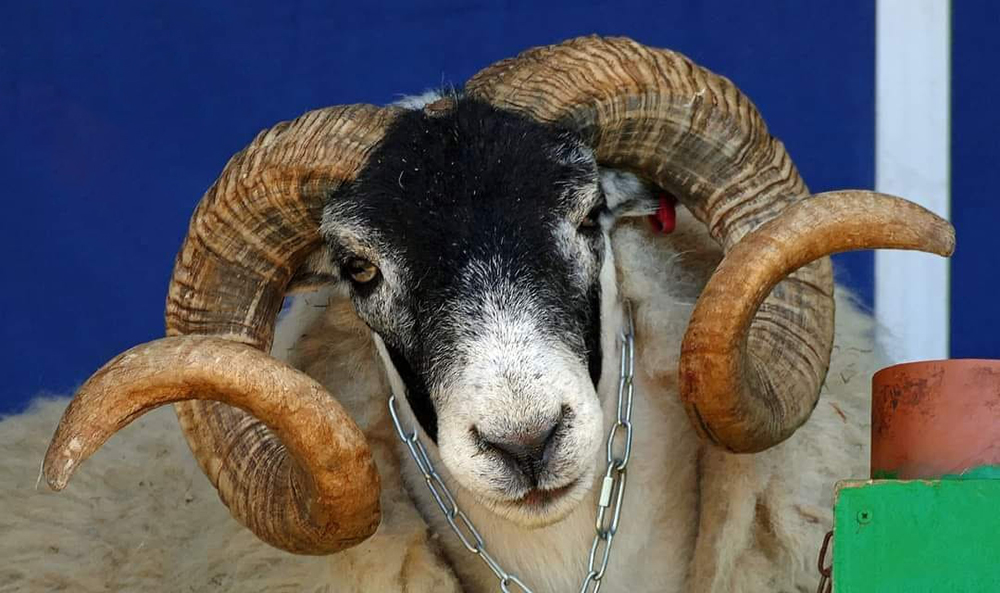
Dougal the Scottish Blackface. All images: Trevor Wayborn
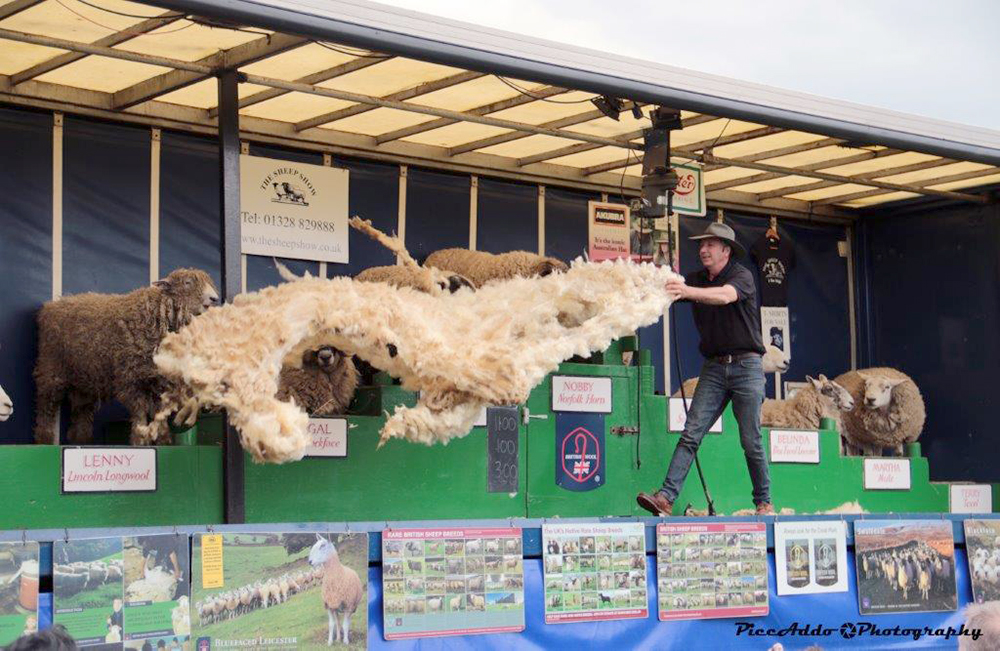
Trevor Wayborn paced the stage on a cold, windy, damp morning when the early crowd had begun to have second thoughts about coming to a spring agricultural show. But there was something about The Sheep Show that brightened a dull day and put a smile on everyone’s face. The laughter, the engagement – even the education – that came from the performance was an absolute tonic. And we’ve not even mentioned the sheep. By the time he had finished, even the sun was shining!
The Sheep Show travels in style
Trevor is based in North Devon with his family (and sheep) – but every year he heads out on the agricultural show circuit with The Sheep Show. ‘I’ve always been in farming. My parents were farmers, but they had to come out of it before I was old enough join them. When I left home I joined the ambulance service and became a paramedic, but I always kept sheep alongside the day job and also did contract shearing. In 2013 I left the ambulance service – the same year I saw Richard Savory with his Sheep Show at Devon County Show. I chatted to him and thought to myself: “I’d love to be involved with that”.
It just all came together really. I have experience in the theatre and in sheep shearing. So I worked with him to see what I could do and started doing my own shows in 2015. Richard had been running The Sheep Show for 30 years at that point, and I was in awe of the way he worked. I took over the business in 2022 and that’s where I am now. It’s a family affair too – my wife and daughter are also involved.’ No-one watching The Sheep Show can fail to notice some stand-out performers in the team – look especially for Lenny and Belinda among the native British breeds. ‘There’s not a special thing we look for in the sheep. All the breeds we use are chosen because they tell a story – but we do try to get them early in their lives. Then they get used to food. We don’t get them too tame and we just look for that little bit of something to work on. ‘I don’t want to give away too many trade secrets! Once we’re on stage we just work around them. We don’t train them – actually they train us! ‘We see what the individual sheep starts to do when it walks around after the food and we work with that. We just watch for what they do naturally, we don’t teach them, and then we reward their behaviour with food.
Lenny the Lincoln Longwool and Dougal
For example, Dougal tries to head butt me – all I’m doing is harnessing his talent.’ The sheep start to learn there is food available, and soon learn that repetitive behaviour gets rewarded. They just know they will get fed – and they love it!’ The preparation for each show goes beyond the sheep themselves, however. ‘Of course we keep an eye on their health, but we’re not looking for pristine sheep, so it’s not about bathing and combing etc. A lot of preparation is involved in performing at a show. The lorries have to be ready. We need hay, water and feed. And then we need enough food and stuff for the humans – we can be away at shows for ten-day stretches. So everything, both the sheep and humans, needs to be ready. Sheep have a reputation for being a bit … stupid. But Trev’s keen to dispel the myth. ‘Sheep are not stupid! They are very intelligent. Look at what the team does around the back of the show – where the hard work really takes place. I’m just part of the act. The sheep know exactly what order they come up in, and when they hear their music they get up and get ready to go on the stand. It’s really cool to see the sheep adopt this behaviour in the show because they enjoy it. They even go to sleep up there.
The shearing is total ‘edutainment
‘Really! I had to wake Sam up the other day at the Great Yorkshire Show. He was asleep on the stand! The sheep just won’t go on that stand if they don’t want to. ‘And every time the sheep come up they surpass my expectations – they come up every time and do what they do. ‘They have favourite music too. They love a bit of Taylor Swift! And they like Kenny Loggins’ Footloose, too. As soon as we put Taylor Swift on they all get up and start. And when Footloose comes up they know it’s dancing time. You can see them look at each other and say: “Here we go!” Even after so many shows, Trevor admits that it doesn’t always run perfectly smoothly: ‘I forgot to put a sheep in the hatch for shearing at one show. I was standing there waiting for it to come out and nothing was in there! Last week, one of my mates hid in the hatch, and instead of my expected sheep he jumped out at me! But that’s what happens with the travelling show community, we all look after each other.’ The show is brilliant entertainment, but it has a serious message hidden within the dancing sheep.
‘I think people learn different things, depending where we are. Some people have never even seen a live sheep – I couldn’t believe it when I did an inner city show in London. But even when we go to rural shows there are still people who don’t understand why we shear sheep, or that the fleece has such little financial worth. ‘We’re happy that people take just one or two facts from the show – perhaps why we have to shear the sheep for their welfare and for legal reasons. Wool is so good for the environment – endlessly renewable and truly biodegradable. And we all want to enjoy the countryside, which sheep help us maintain. It’s part of the make up, what the countryside is all about.’